While the broader crypto market was ripping higher on Wednesday, bitcoin BTC$67,152.96 briefly plunged 30% to below $48,000 on decentralized perpetuals exchange Lighter in a violent move that lasted seconds.
The flash crash stood in sharp contrast to price action elsewhere. During the same session, bitcoin surged from below $64,000 to above $69,000, marking one of its strongest intraday rallies in weeks.
The extreme move appeared to have been isolated to Lighter, where thin liquidity amplified what would otherwise have been a routine trade. In shallow order books, even modest sell pressure can trigger exaggerated price swings, producing so-called flash crashes that don’t reflect the broader market.
That’s likely what happened on Lighter. A single sell order of roughly 1,000 bitcoin — worth about $67 million at the time — wiped out available bids and briefly sent prices spiraling, according to a Discord post by pseudonymous Web3 developer 0xTimberJ.
“Because Lighter is a newer DEX with less liquidity than centralized exchanges, the sell order wiped out all available bids and pushed the price down to ~$47k before recovering instantly,” 0xTimberJ wrote.
Lighter is an up-and-coming decentralized perpetuals exchange seeking to challenge category leader Hyperliquid. Perpetual futures, or “perps,” have become crypto’s dominant derivatives product, allowing traders to use leverage and take long or short positions around the clock without contract expirations.
The platform briefly captured significant market share last November, processing over $292 billion in monthly volume — roughly a quarter of the $1.15 trillion traded across exchanges, according to data by The Block.
But activity has cooled sharply since its token airdrop late last year. Traders who ramped up activity to farm rewards have since rotated out, and monthly volume fell to $70 billion in February out of a $500 billion total market, trailing rivals such as Hyperliquid, Aster and EdgeX.
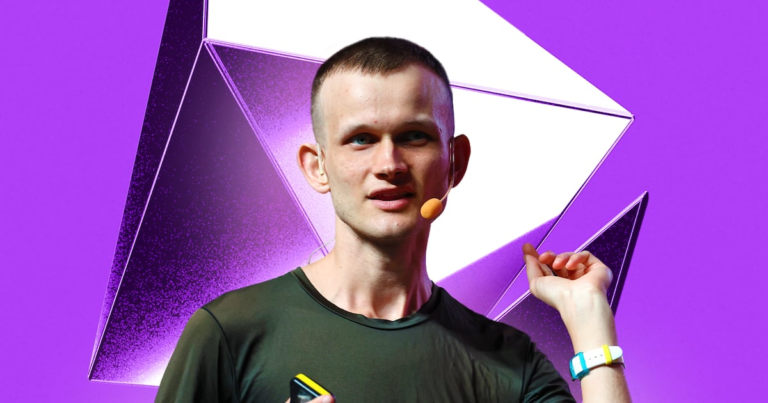
Vitalik Buterin proposed what he called a quantum roadmap on Thursday.
He wants to update the cryptography that secures the blockchain.
At least one change could make its way into an Ethereum upgrade this year.
Ethereum co-founder Vitalik Buterin proposed what he called a “quantum roadmap” on Thursday that could protect the blockchain from encryption-cracking computers.
That roadmap features several changes to parts of the blockchain that are vulnerable to quantum computers. It does not include a proposed timeline for those changes, though at least one proposed change is currently being considered for inclusion in an Ethereum upgrade expected to arrive in the latter half of 2026.
Quantum computers are still theoretical, but researchers’ rapid progress building them has frightened some blockchain engineers and even pro-crypto Wall Street executives.
It has roiled the Bitcoin community, which is divided over the urgency of the issue. Ethereum developers, however, have signalled they want to take a more proactive approach to the looming threat.
Buterin is among the most concerned. He warned in November that quantum computers could break Ethereum’s underlying security model before the next US presidential election in 2028.
His solutions to the quantum threat, all explained in highly technical jargon, include certain hash-based signatures, recursive STARKs, native account abstraction, and protocol-layer recursive signature and proof aggregation.
Put simply, they would update the cryptography that currently secures the blockchain. And at least one of those changes could arrive by the end of the year.
Hegota
Ethereum developers are currently debating which improvements should be included in a forthcoming upgrade dubbed Hegota.
Several weeks ago, Ethereum Foundation developer Felix Lange suggested that Hegota include frame transactions — a new type of transaction that would offer a more robust version of account abstraction.
“It’s also for us the most important one, because of the readiness for the post-quantum world,” Lange said.
“We feel like we have to get started with the off-ramp from ECDSA, and in order to do that, we need a comprehensive system that can deal with whatever signature algorithms we want to use.”
ECDSA is the acronym for the quantum-vulnerable cryptography that undergirds Ethereum currently.
Buterin previously suggested he supported including frame transactions in Hegota. On Thursday, he appeared to renew his push for the feature.
Adding frame transactions would give Ethereum users “first-class accounts that can use any signature algorithm,” including those that cannot be broken by quantum computers, Buterin wrote.
Other proposals in Buterin’s quantum roadmap require advances in computer science.
“It’s manageable, but there’s a lot of engineering work to do,” he wrote.
Quantum focus
Last month, the Ethereum Foundation said it had established a post-quantum team following “years of quiet R&D.”
The Swiss nonprofit would also host new, bi-weekly calls in which Ethereum developers would discuss quantum security and offer a new $1 million prize to anyone who can help harden quantum-resistant cryptography.
Foundation employees are also working on a website that will detail a post-quantum strategy for Ethereum that “targets a full transition in coming years with zero loss of funds and zero downtime,” according to researcher Justin Drake.
But support from Buterin and the Ethereum Foundation doesn’t necessarily mean Ethereum developers will go along, a point that Drake emphasised earlier this week when he released a “strawman roadmap” for the blockchain.
The “strawmap” it was named due to “the limits of drafting a roadmap in a highly decentralised ecosystem.”
“An ‘official’ roadmap reflecting all Ethereum stakeholders is effectively impossible,” Drake wrote, calling it “one reasonably coherent path among millions of possible outcomes.”
It details potential Ethereum upgrades through the end of the decade and features five focus areas, including quantum resistance.
Aleks Gilbert is DL News’ New York-based DeFi correspondent. You can contact him at aleks@dlnews.com.
The perp DEX is incubated by Aptos Labs and plans to leverage the blockchain’s high speed to deliver a highly responsive trading experience.
Decibel, a perpetual derivatives decentralized exchange (DEX) incubated by Aptos Labs, launched its mainnet today alongside its official points program.
The DEX is starting with perpetual markets, before expanding to spot and real-world assets (RWAs), similar to the progression taken by market leaders Hyperliquid and Lighter.
According to a press release shared with The Defiant, Decibel’s testnet generated “over 1 million user trades per day” across more than 130,000 daily active users (DAU).
So far, the DEX has processed $6.4 million in volume since its mainnet launch and hosts $57 million in total value locked (TVL), according to DeFiLlama.
The DEX is based on a central limit order book (CLOB) model, and hosts its risk engine onchain, ensuring functions such as auto-deleveraging are directly verifiable via the block explorer.
While Aptos Labs incubated Decibel and the DEX is built on the Aptos Layer 1, the DEX also uses X-chain accounts to enable deposits from Ethereum and Solana.
The perpetual market remains red hot, with more than $730 billion traded across all DEXs in February, roughly the same amount traded throughout all of 2023. Activity has cooled off since volumes peaked at $1.37 trillion in October, but the sector remains one of the most popular in DeFi.
Perpetual Volume & Open Interest – DeFiLlama
Brylee Whatley, the Head of the Decibel Foundation, told The Defiant, “On the acquisition side, Decibel has invested heavily in aligning incentives with real usage. Season 1 of our Amps points program is live and is designed to reward genuine trading activity. But incentives only get users through the door.”
“What keeps traders is trust in the system they are trading on. Everything on Decibel is transparent – the infrastructure, risk approach and liquidation logic. We built an exchange where serious traders feel confident deploying real capital,” they added.
While a majority of DEXs offer tokenized equity and commodity offerings, only HyperUnit’s TradeXYZ, Lighter’s tokenized Korean stocks, and Ostium have found sustained liquidity and success.
Whatley also touched on the future vision for Decibel as it enters the highly competitive tokenized RWA trading space, citing Aptos’ existing success in the world of RWAs and the chain’s global go-to-market reach.
“Imagine using tokenized RWA holdings – treasuries, equities, commodities – as collateral to trade perpetuals, or using your crypto portfolio to margin equity positions. That kind of cross-asset capital efficiency is impossible at a traditional brokerage and isn’t available on other DEXs,” Whatley concluded.
On Thursday, Congress took a small but significant step toward ensuring America remains the best place in the world to build. Bipartisan legislation – the Promoting Innovation in Blockchain Development Act of 2026 – would protect software developers from being swept up under criminal code Section 1960, a statute designed for money laundering, not innovation. For builders working in good faith on open-source software, that legal gray zone has cast a chill on American competitiveness.
It is one bill. But the principle it embodies reaches further than any single piece of legislation – and it arrives at a pivotal moment.
As the United States approaches its 250th anniversary this July, it is tempting to look backward to commemorate milestones and celebrate triumphs. But America’s most consequential moments have rarely come from preservation alone. They have come from renewal: building new systems that allowed the country to adapt to a changing world.
Every American century has been defined not just by ideals, but by infrastructure. Canals and railroads powered industrial expansion. Telecommunications connected a continental economy. The internet reshaped commerce, culture and capital markets. Each era rewarded those willing to build.
Today, the next layer of infrastructure is taking shape in code.
Software developers are the architects of modern economic systems. They shape how money moves, how markets function and how people coordinate on a global scale. Unlike the builders of past eras, many are globally distributed and highly mobile – choosing where to work and innovate based on clarity, opportunity and regulatory environment. Open-source development allows anyone, anywhere, to contribute foundational code. That work has produced billions of lines of software that are collectively maintained and power modern commerce and coordination.
At the same time, the nature of financial infrastructure itself is evolving. Where previous generations built physical rails, today’s builders are creating digital rails – protocols that move value, establish trust and operate at internet speed. These layers increasingly underpin payments, financial services, identity and ownership.
One illustration of this transformation is the growth of the developer ecosystem building on Solana. According to the most recent Electric Capital Developer Report, Solana was the leading ecosystem for new developers in 2024, growing 84% year over year. The Solana ecosystem shows how fast, low-cost, open infrastructure attracts and retains talent willing to invest in solving real problems – from payments and decentralized finance to identity and decentralized applications at scale.
This is not about hype or token prices. It’s about where infrastructure gets deployed, and whether the builders of tomorrow, who write the code that defines digital markets, feel a country welcomes innovation or obstructs it.
Globally, governments are recognizing this reality. Several jurisdictions have moved forward with clear frameworks for digital assets and blockchain-based systems, providing developers and entrepreneurs with predictability. This sends a signal: building is welcome here.
In the United States, there are encouraging signs of progress beyond Thursday’s bill. Under the leadership of SEC Chairman Paul Atkins, the Commission is shifting from a posture defined primarily by enforcement toward one focused on engagement, clarity and constructive rulemaking.
Developers and market participants do not expect the absence of regulation – they expect rules that are understandable, durable and aligned with how modern technology actually functions. Recent efforts to engage industry, solicit public input and distinguish bad actors from good-faith builders are an important step toward restoring confidence that the United States intends to lead, not lag, in the development of digital financial infrastructure.
We have seen this dynamic before. The early days of railroads, aviation and the internet were marked by experimentation and ambiguity. Regulation followed innovation, not the other way around. That sequence was not a flaw; it was a feature of leadership. It allowed the United States to set global standards rather than inherit them.
As we look toward America’s next 250 years, the same principle applies. Protecting the freedom to build – especially in open, general-purpose technologies – is a core American value. Writing code, absent intent to harm, is a form of expression and exploration. A nation founded on free speech and enterprise should be cautious about criminalizing innovation simply because it is new.
This moment is also an opportunity to renew American leadership in capital markets. Blockchain-based systems enable faster settlement, broader participation and more resilient market infrastructure – an evolution some have termed “internet capital markets.” These ideas are not about overnight disruption, but about upgrading the rails beneath existing institutions so they remain globally competitive.
The question before us is not whether these technologies will shape the global economy. They already are. The question is whether the United States will lead its development – or watch as talent, standards, and capital consolidate elsewhere.
America’s founders did not assume their experiment would succeed forever. They designed it so future generations could improve it. As we celebrate our nation’s 250th year, we face a similar responsibility: not to preserve the past unchanged, but to ensure that future builders still see America as the best place in the world to build.
The next American century will be written in code. The choice we make now determines where that code gets written.
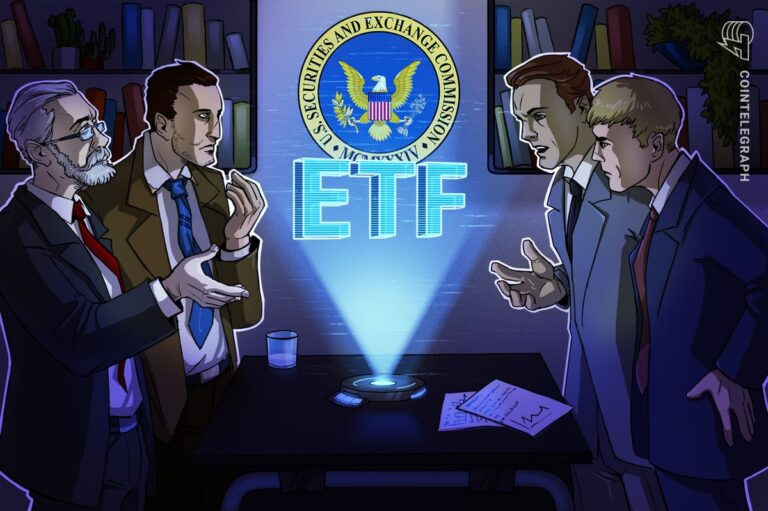
Nasdaq has filed a proposed rule change to list the VanEck JitoSOL ETF, a fund designed to hold the Solana-based liquid staking token JitoSOL.
Liquid staking allows users to stake tokens to help secure a proof-of-stake network while receiving a transferable token in return that represents the staked assets and accrued rewards.
Jito Foundation president Brian Smith told Cointelegraph that if the fund is approved, staking rewards would not be distributed separately but instead reflected in the fund’s net asset value.
Because JitoSOL automatically compounds rewards, each token held by the trust would represent the underlying deposited SOL along with any staking yield accrued on the Solana network.
The exchange submitted the proposal under Nasdaq Rule 5711(d), which governs commodity-based trust shares, seeking approval to list and trade shares of a trust that would hold JitoSOL directly.
Created by the Jito Network, JitoSOL (JTO) is a liquid staking token backed by SOL deposited into a staking pool on the Solana network. It lets holders earn staking rewards through a transferable token without directly running validators or managing onchain staking.
The filing cites the SEC’s prior spot Bitcoin (BTC) and spot Ether (ETH) ETP approval orders, arguing the proposal satisfies fraud, manipulation and surveillance standards and can be approved through “other means” despite the absence of a regulated futures market for JitoSOL.
According to the proposal, the trust would value its shares using the MarketVector JitoSol VWAP Close Index, which is calculated from pricing data contributed by multiple trading platforms, and the trust would permit both cash and in-kind creations and redemptions.
The filing also claims JitoSOL is economically comparable to SOL (SOL), citing correlation data, and says an appropriately structured liquid staking token can be treated as analogous to the underlying asset for purposes of the generic listing standards approved by the SEC in September.
Under the SEC’s review process, the agency has 45 days from Federal Register publication to approve or disapprove the proposal, which can be extended to 90 days.
Related: Ethereum Foundation starts staking ETH as client diversity concerns persist
Staking exposure exists, but not liquid staking ETFs
While the VanEck JitoSOL ETF has reached the SEC’s exchange review stage, no liquid staking token ETF of this type is currently trading in the United States. There are, however, existing funds that provide regulated exposure to staking economics.
One of the earliest US ETFs to offer direct staking exposure was the REX-Osprey Solana + Staking ETF (SSK), which began trading on July 2, and combines spot Solana price exposure with onchain staking rewards distributed to shareholders.
In September, the company launched the REX-Osprey ETH + Staking ETF (ESK), offering spot Ether exposure alongside monthly payouts tied to staking yield.
About a month later, Grayscale expanded staking across its exchange-traded lineup, adding staking exposure to the Grayscale Ethereum Mini Trust ETF and Grayscale Ethereum Trust ETF (ETHE). The company also enabled staking for the Grayscale Solana Trust (GSOL), which is seeking regulatory approval to uplist as an ETP.
While the SEC’s Division of Corporation Finance said in May that certain protocol staking activities generally do not involve the offer or sale of securities under federal law, and in August issued similar staff guidance on liquid staking and staking receipt tokens, the statements are not formal rulemaking and do not automatically approve specific products.
In Europe, 21Shares launched a Jito-staked Solana exchange-traded product in January, providing listed exposure to SOL with staking integrated into the structure.
Jito’s total value locked (TVL) stands at around $1.1 billion, after peaking above $3.0 billion in 2025 before retracing into early 2026, according to DefiLlama data.
Cointelegraph is committed to independent, transparent journalism. This news article is produced in accordance with Cointelegraph’s Editorial Policy and aims to provide accurate and timely information. Readers are encouraged to verify information independently. Read our Editorial Policy https://cointelegraph.com/editorial-policy
Trusted Editorial content, reviewed by leading industry experts and seasoned editors. Ad Disclosure
Following a brief and sudden market-wide uptick, the Ethereum price is drawing closer to the pivotal $2,100 mark again, recording a 12% rise in the past day. Despite the bounce on Wednesday, the broader market of ETH is still quite bearish, but bullish sentiment appears to be gaining momentum in the Spot ETFs sector.
The recent price movement of Ethereum has been quite harsh, with steep declines and ongoing volatility significantly impacting market sentiment. However, beyond the persistent waning price action, a different narrative is unfolding in the Ethereum Spot Exchange-Traded Funds (ETFs).
Despite the sell-off, causing ETH’s price to drop from $4,900 to under $2,000, spot ETF flows show renewed interest and, in certain situations, ongoing capital allocation. This discrepancy between robust ETF demand and poor price performance raises the possibility that institutional and long-term investors are seeing the decline as an opportunity rather than a warning.
After a period of significant outflows in the middle of 2025, Leon Waidmann, market expert and head of research at Lisk, highlighted that ETH has seen selling pressure steadily decrease across its exchange funds. The enormous surges of influx that occurred in late 2024 and early 2025 have vanished, but peak panic selling is also turning out to be an issue.
ETH Spot ETFs inflows are gradually returning | Source: Chart from Leon Waidmann on X
Compared to the previous turbulent periods, the recent flow bars are much smaller in both directions, and the sellers are running out of steam. According to the expert, this trend is relevant because the institutional exodus appears to be exhausting itself despite one of the sharpest ETH drawdowns in recent memory.
Currently, the weak hands that desired to exit the market have already done so, and this does not mean that the price bottom for ETH is in yet. There is still a slight outflow bias in recent weeks, and a clear accumulation signal has not yet unfolded.
However, the intensity of selling is clearly fading, representing the first thing that needs to happen before any trend reversal emerges. Thus, Waidmann has warned that when selling stops before sentiment recovers, investors should pay attention. Interestingly, this is where the next move begins to develop.
Short Positions On ETH Are Vanishing From The Market
Given the latest bullish response, the Ethereum market is currently undergoing a crucial shift. Market expert and investor CW reported that ETH short positions are now being destroyed completely, suggesting a growing positive market environment.
The expert highlighted that there are bearish bets left on the ETH market, with investors gradually leaning toward the long side. Despite this major shift in investors’ sentiment, the rate of increase of high-leverage long positions is very slow.
Data shared by CW suggests that Investors with high levels of leverage seem to have used up much of their remaining capital. However, the expert has classified this trend as a very positive situation that could be pivotal for the ETH’s price.
ETH trading at $2,054 on the 1D chart | Source: ETHUSDT on Tradingview.com
Featured image from Adobe Stock, chart from Tradingview.com
Editorial Process for bitcoinist is centered on delivering thoroughly researched, accurate, and unbiased content. We uphold strict sourcing standards, and each page undergoes diligent review by our team of top technology experts and seasoned editors. This process ensures the integrity, relevance, and value of our content for our readers.
Common phrases heard among Bitcoiners include “don’t trust, verify” or “not your keys, not your coins”, sometimes even claiming that it’s “backed by math”. But what do these proverbs ultimately boil down to, and how exactly is this involved math put into practice? Most readers are surely aware that a fundamental ingredient in the design of Bitcoin is public-key cryptography and more specifically digital signatures, which are essential to prove ownership without needing a central entity. Probably less well-known is what piece of software is under the hood to make that elliptic curve math work and what efforts are involved to ensure that this happens in the most secure and performant way, with continuous improvements. Let’s dive into the exciting history and evolution of “libsecp256k1”, a library that started out as a small hobby project and over the years evolved into an essential part of consensus rules protecting a multi-trillion dollar asset.
The Genesis
For reasons we don’t know for sure, Satoshi picked an elliptic curve named “secp256k1” for creating and verifying digital signatures in Bitcoin. The initial version of the Bitcoin client was shipped using the widespread OpenSSL library for signing and verifying transactions. Relying on a third-party library sounds like a reasonable approach from a software engineering perspective (even more so if it is something as domain-specific and complex as elliptic-curve
cryptography), but this choice turned out to be problematic later due to inconsistencies in the signature parsing code. In the worst case, this could even lead to unintended chain splits. One lesson from that time period was that OpenSSL is not a suitable library for a consensus-critical system like Bitcoin. The issue was later fixed by BIP66, which ensured a strict encoding of ECDSA signatures. After that, the OpenSSL dependency was replaced with libsecp256k1 in Bitcoin Core v0.12, released in early 2016.1
But taking a step back, the initial motivation behind starting the libsecp256k1 project was mostly curiosity about a potential speed-up. Sometime in the year 2012, Bitcoin Core developer Pieter Wuille a.k.a. “sipa” stumbled upon a bitcointalk thread by Hal Finney (known for being the recipient of the very first Bitcoin transaction in 2009 from Satoshi).
Under the subject “Speeding up signature verification”, the post discussed an optimization that would make use of a so-called “endomorphism” (more specifically using the so-called GLV-method, Gallant-Lambert-Vanstone), something that only certain elliptic curves allow, secp256k1 conveniently being one of them. Hal Finney himself implemented it using OpenSSL primitives, it was later even submitted as a PR to Bitcoin Core.2 Even though it showed a solid
~20% speedup, it was never merged in the end due to concerns about increasing code complexity and missing assurance that the involved cryptography is sound.
Pieter Wuille went ahead and decided to start a new library from scratch, with the initial commit of the “secp256k1” repository dating back to March 5th 2013. After only one week the library was able to verify the full blockchain (block height ~225000 at that time), within another week the signing functionality was implemented. It took some more time and testing until the library was ready to be used in Bitcoin Core as a replacement for OpenSSL, first for signing in the
wallet (release v0.10, 2015), and finally for ECDSA signature verification in consensus (release v0.12, 2016). The efforts were absolutely worth it: according to the PR description in Core, using libsecp256k1 for signature verification was “anywhere between 2.5 and 5.5 times faster”. Ironically, this didn’t yet include the earlier mentioned endomorphism optimization, since it wasn’t turned on by default due to worries about patent violation. It was only activated in the year 2020, after the patent expired (enabled in release v0.20), leading to another solid speed-up of around 16%.
Over time, the project attracted several other contributors. This naturally involved people that were closely working with Pieter from the start at Blockstream, namely then-CTO Gregory Maxwell and researcher Andrew Poelstra. In 2015, Jonas Nick and a few years later Tim Ruffing joined, both employed by Blockstream as researchers and now holding the role of maintainers of libsecp256k1 for several years. As they are responsible for both specifying new cryptographic
protocols (including detailed security proofs) and putting them into practice by implementing and reviewing them, it is very appropriate to call them “full-stack cryptographers”, as Tim Ruffing likes to describe himself.
Occasionally even cryptographers from outside the Bitcoin space have contributed to
libsecp256k1. One notable example of that is Peter Dettman, known for being one of the maintainers of the C#/Java cryptography library BouncyCastle, who up to this day shows up every now and then with various performance improvement suggestions. One of his major contributions was implementing modular inversion using the “safegcd” algorithm in 2021 to safely improve , following a paper by Daniel J. Bernstein and Bo-Yin Yang.
Why Reinvent The Wheel?
The goal of libsecp256k1 is to provide the highest quality library for cryptographic operations on the secp256k1 curve, with the primary intent of being useful in the broader Bitcoin ecosystem–Bitcoin Core is simply the main client using it. The API of libsecp256k1 is designed to be robust and hard to misuse, in order to prevent users from performing insecure operations (e.g. by rolling their own cryptographic schemes) that could lead to a loss of funds in the worst case. By focussing only on one elliptic curve and by limiting its functionality to operations
relevant to Bitcoin (that is, primarily signing and verifying transactions), the code can be both faster and simpler to review, leading to a lower maintenance burden and higher overall quality in comparison to other implementations. libsecp256k1 is written in C and doesn’t have any dependency on other libraries, so it only uses internal code written specifically for the project. As such it is designed to also run on constrained devices like micro-controllers, which are commonly used in hardware wallets.
Measure Twice, Cut Once
From very early on, libsecp256k1 had a strong focus on quality assurance that was continuously improved and honed over the years. Now it has a testing code coverage of close to 100%, and new modules only have a chance of getting merged if that bar is still met. In addition to that, there is also a special form of assurance called “exhaustive testing”. The basic idea is to exercise the functionality of the library for the whole space of possible values on the curve. As this would be infeasible on the actual secp256k1 curve, consisting of ~2^256 points, a special, much smaller but very similar curve is used which has an order that is merely in the double or triple digit range, so it can easily be executed within a reasonable amount of time. Another important part of testing is assurance of constant-time behaviour, which is particularly relevant for signing, as we will see below.
Schnorr: A Whole New World
Shifting our focus from QA to new features, one of the major milestones within the last decade in libsecp256k1, and in the Bitcoin protocol in general, was the introduction of Schnorr signatures. Being an essential part of the Schnorr/Taproot soft-fork activated in late 2021, they offer many advantages over ECDSA signatures, including being provably secure under standard assumptions, more compact, and enabling a whole lot of other constructions on top like key and signature aggregation for more efficient multisignature schemes. Both the specification in BIP340 and implementation was created by the current three maintainers of libsecp256k1, Pieter Wuille, Jonas Nick and Tim Ruffing.
libsecp256k1 Is Good For Your Node And The Network
It goes without saying that verifying digital signatures is one of the (if not the) most important and security-critical code paths of the Bitcoin consensus engine. No matter what complex script-paths and extra spending conditions might be included in some locking script, at the end there is likely at least one signature check involved in the transaction to ensure that it was actually created by the owner of the coins being spent. For such an essential operation, we want the code to be as robust, well-tested and performant as possible. Fast signature verification is also critical for both fast transaction and block propagation, and also to speed-up the Initial Block Download (IBD) for new participants in the network. We have already mentioned earlier the ~5x speedup when libsecp256k1 replaced OpenSSL for the first time about ten years ago. Over time, further performance improvements were implemented, and a recent investigation shows that libsecp256k1 is now about ~8x faster than OpenSSL for ECDSA signature verification using the most current version of each.3
Signing Can Be Dangerous, So Do It Right
So far we have focused on the verification functionality of libsecp256k1, being the most crucial for performance of node runners and miners. The other side of the coin (no pun intended!) is signing, i.e. the process of creating a digital signature for a transaction in order to spend funds. What makes this process delicate is the fact that secret key material is involved. If this material is in any way leaked, it could in the worst case lead to a catastrophic loss of funds, so special care has to be taken at the implementation level. libsecp256k1 tries to combat against so-called “side-channel attacks” by avoiding data-dependent branches, i.e. instances where different pieces of code are executed depending on what data is fed into it. This is a non-trivial task and takes some extra effort with regards to modern compilers, which are sometimes “too smart” in the sense that they try to optimize code while compiling it to software with resource saving branches where we explicitly don’t want that to happen. This is not just a theoretical concern, but has happened more than once, requiring patches to be shipped (e.g. releases 0.3.1 and 0.3.2). The important constant-time property is also tested using a tool called “valgrind” that was originally built for debugging memory issues. By using it to find any branching in code operating on secret data, we can detect if a potential side-channel risk exists.
Another way secret material could be leaked is by leaving it in memory unintentionally. Overwriting a memory region to make sure it is erased sounds trivial, but this has to be done in a way that prevents the compiler from getting in our way due to code optimization during compiling. Great care is taken to ensure that doesn’t occur.
Some Happy Accidents
More than once during the development of the library interesting things came up by surprise. In 2014, Pieter Wuille and Gregory Maxwell were already working on an extensive test suite for the library. One of the strategies to achieve a higher degree of assurance was verifying the behaviour of internal functions in the library against other implementations with special random inputs. This revealed a case where OpenSSL gave a wrong result when squaring a number, a serious security relevant bug filed as CVE-2014-3570 (“Bignum squaring may produce incorrect results.”).
In another instance a few years later, Pieter Wuille proposed a new method for computing a bound (or limit) on the number of iterations needed for the previously mentioned “safegcd” algorithm for computing modular inverses. This allowed shrinking that bound, leading to a faster computation. But it didn’t stop there. Mostly by accident, Gregory Maxwell discovered a different variant of Bernstein and Yang’s algorithm with even lower bounds, leading to another significant speedup both for signing and verification.
It’s noteworthy to mention that correctness (so, safety) of the “safegcd” implementation has been formally verified using a special theorem proving software called “Rocq” (formerly named “Coq”) and the “Verifiable C” program logic.4 This impressive work was done by Russell O’Connor and Andrew Poelstra, who state that the entirety of libsecp256k1 could be verified in the same way.
Cryptography Is Still Evolving
We have now shown that libsecp256k1 is primarily used for creating and verifying digital signatures in Bitcoin transactions, taking great care to do so in the safest and most efficient way possible, but it doesn’t stop there. Whenever other proposals are put forward that involve cryptographic operations on the secp256k1 curve (ideally formalized in a BIP) and are seen as overall beneficial for the Bitcoin ecosystem, the chances are good that the necessary code is considered in-scope for the library. In such a case, given enough developer time for implementation and review, it has good odds at winding up in a release of libsecp256k1. This has notably happened before with the ElligatorSwift module, a piece that was essential for enabling encryption for nodes’ P2P communication [see BIP324; discussed in-depth on here], and most recently for MuSig2, a key aggregation scheme based on Schnorr signatures that allows creating n-on-n multi-signatures in a space-efficient and privacy-preserving way. There is also an ongoing effort to add a new module for Silent Payments, a proposal for a privacy-preserving static reusable address that doesn’t need interaction before payment between sender and receiver. And there is yet so much more to come: Batch Validation for Schnorr Signatures, DLEQ proofs, FROST, etc. Let’s see what the next 10 years of development in libsecp256k1 will bring!
Readers interested in libsecp256k1 are encouraged to take a look at and play around with secp256k1lab, a Python implementation of the secp256k1 curve that is intended for prototyping and experimentation.5
Get your copy of The Core Issue today!
Don’t miss your chance to own The Core Issue — featuring articles written by many Core Developers explaining the projects they work on themselves!
This piece is the Letter from the Editor featured in the latest Print edition of Bitcoin Magazine, The Core Issue. We’re sharing it here as an early look at the ideas explored throughout the full issue.
Telegram’s built-in crypto wallet has introduced a feature that allows users to earn returns on major cryptocurrencies inside the messaging app.
The update introduces vaults in TON Wallet, a self-custodial wallet integrated within Wallet in Telegram, enabling users to hold, send and earn on Bitcoin (BTC), Ether (ETH) and Tether’s USDt (USDT) without leaving the chat interface, according to a Thursday announcement shared with Cointelegraph.
“At Wallet in Telegram, our mission is to transform digital assets from complex concepts into practical tools for everyday life,” said Andrew Rogozov, CEO of The Open Platform and Wallet in Telegram.
The system runs on decentralized finance (DeFi) infrastructure provided by lending network Morpho, the TON ecosystem’s execution layer TAC (TON Applications Chain) and strategy provider Re7. The tools operate in the background, while users interact with a simple interface similar to a typical app wallet, per the announcement.
Related: Telegram CEO faces Russia probe over allegations of terrorism facilitation
Telegram aims to simplify DeFi earning
Wallet in Telegram said the goal is to make earning on crypto easier for everyday users by removing the technical steps normally associated with DeFi services, which often require multiple wallets, network bridges and external applications.
The vault strategies generate variable returns and allow users to keep control of their funds through self-custody, the announcement said. USDT vaults offer dollar-denominated earning strategies with different risk levels, while BTC and ETH vaults extend the same functionality to two of the largest cryptocurrencies, according to the announcement.
“The goal is to make onchain yield accessible in the simplest possible way — directly inside a self-custodial wallet embedded in a mainstream consumer app. We’re lowering the barrier to DeFi strategies by packaging advanced yield strategies in a product that is native to Telegram,” a spokesperson for Wallet in Telegram told Cointelegraph.
Wallet in Telegram also plans to support direct deposits of native Bitcoin and Ether, which will automatically appear in wrapped form within the TON ecosystem to enable transfers and earning features.
Wallet in Telegram claims to have more than 150 million registered users.
Related: Kraken-backed xStocks launches on TON Wallet in ‘nearly all markets’
TON launches crypto payments toolkit for merchants
Earlier this month, the TON Foundation introduced TON Pay, a payments software development kit that lets merchants and Telegram Mini App developers accept cryptocurrency directly within Telegram.
Telegram significantly increased its operating revenue in 2025, reporting $870 million in the first half of the year, a 65% increase from $525 million a year earlier. Roughly $300 million of the revenue came from exclusivity agreements tied to its associated cryptocurrency Toncoin (TON).
Magazine: 6 weirdest devices people have used to mine Bitcoin and crypto
Cointelegraph is committed to independent, transparent journalism. This news article is produced in accordance with Cointelegraph’s Editorial Policy and aims to provide accurate and timely information. Readers are encouraged to verify information independently. Read our Editorial Policy https://cointelegraph.com/editorial-policy
Block Inc. will cut more than 4,000 jobs, reducing its workforce by nearly half as CEO Jack Dorsey calls it one of the hardest decisions in the company’s history. Block Slashes More Than 4,000 Roles in Companywide Restructuring Block founder Jack Dorsey announced on Thursday, 12 minutes after markets closed, that it will reduce its […]
Pepeto announced today that its presale has surpassed $7.33 million while Bitcoin trades at $68,500 after bouncing 6% from $63,000 this week. Every major bitcoin price prediction model still targets six figures. Standard Chartered holds $150,000. Bernstein maintains $150,000 with a path to $200,000. Citigroup projects $143,000 to $189,000. The crash was not the end. It was the shakeout before the next leg up. And the smart money already knows it.
Pepeto Presale Surges While Bitcoin Price Prediction Analysts Confirm the Crash Was Manufactured by Whales
Bitcoin dropped 46% from its all time high of $126,080 to a February low near $60,000. Over $2 billion in leveraged positions were liquidated. The Fear and Greed Index hit 10. Retail sold everything. But here’s what the crypto news didn’t tell you.
This is what most investors never see. The bitcoin price prediction hasn’t changed at the institutional level. Standard Chartered didn’t lower their target. The only thing that changed was the entry price. And the smartest wallets aren’t just buying Bitcoin. They’re buying new crypto presales.
Pepeto Is the New Crypto Project That Scammers Are Already Trying to Clone and That Tells You Everything
Scammers don’t clone dead projects. They clone the ones about to explode. Fake Pepeto tokens are appearing on decentralized exchanges faster than the team can flag them. It happened before SHIB listed. Fake tokens everywhere. Before PEPE went parabolic. Dozens of copycat contracts. Every time, fakes arrived before the real price explosion.
The real Pepeto is in presale only at the Pepeto official website. Not on any exchange or DEX. Token price is $0.000000186. PepetoSwap offers zero tax trading. Pepeto Bridge connects blockchains. Pepeto Exchange approaches launch. A Pepe original cofounder backs it. SolidProof and Coinsult verified every contract. Zero percent tax. Binance listing approaching.
Pepeto Staking on $200,000 Outperforms Every Bitcoin Price Prediction Return by a Wide Margin
Consider what new crypto investors with serious capital should understand. Put $200,000 into Pepeto staking at 211% APY. That generates $422,000 in one year. $35,166 every month. $1,156 every day.
Now compare. If the bullish bitcoin price prediction plays out and Bitcoin hits $150,000, that’s 119% on $200,000, roughly $238,000. Pepeto staking alone pays $422,000. Before the listing multiple. A $50 million cap turns every dollar into $100. A 10x is conservative. 20x realistic. 100x very possible when SHIB hit $40 billion with zero products.
Pepeto Presale Won’t Stay Open While New Crypto Demand Accelerates and Whales Position for the Listing
As CNBC reported, bitcoin price prediction forecasts for 2026 range from $75,000 to $225,000. That volatility is where wealth gets created. But not by waiting. By positioning before the move.
Presale is 70% filled. $7.33 million raised. Staking pays $1,156 a day on $200,000. Listing hasn’t happened. Binance hasn’t been priced in. Products are built. Audits done. Price still $0.000000186. That gap between what exists and what the market sees is where generational returns live.
Every bitcoin price prediction says recovery is coming. Every new crypto cycle starts the same. Whales accumulate while retail panics. Then presale holders collect multiples Bitcoin investors dream about. The fakes prove demand. The data proves the setup. Visit the Pepeto official website now.
About Pepeto
Pepeto is a new crypto meme coin building real trading tools. With PepetoSwap, a cross chain bridge, and a dedicated exchange, Pepeto combines culture with infrastructure. The presale is live at the Pepeto official website.
FAQs
What is the bitcoin price prediction for 2026?
Major institutions forecast Bitcoin between $75,000 and $225,000 for 2026. Standard Chartered targets $150,000. Citigroup projects $143,000 to $189,000. Most analysts expect recovery after the February correction.
Why is Pepeto considered the best new crypto to buy right now?
Pepeto offers 211% staking APY, three products approaching launch, dual audits from SolidProof and Coinsult, and a Pepe cofounder. The $0.000000186 presale price gives early investors maximum upside before listing.
Are there fake Pepeto tokens on decentralized exchanges?
Yes. Multiple fake contracts have appeared. Pepeto is in presale only. The only way to buy real tokens is through the Pepeto official website.
How much does Pepeto staking pay on a $200,000 investment?
At 211% APY, $200,000 earns $422,000 per year, $35,166 per month, and $1,156 per day in staking rewards.