
Home Blog Page 914

LAX Introduces Merchant Trust Signaling Architecture for Cross-Border Web4 Transactions

0

The framework embeds intelligent trust-layer coordination into decentralized payment flows, advancing AI-orchestrated infrastructure for cross-border digital commerce.

Seattle, WA – February 27, 2026 – LAX has introduced a Merchant Trust Signaling Architecture designed to strengthen verification, coordination, and transactional confidence across cross-border Web4 environments. The framework establishes a structured trust layer that integrates intelligent signaling mechanisms directly into decentralized payment infrastructure. By embedding contextual validation logic into transaction pathways, LAX advances the evolution of digital commerce from asset transfer toward intelligence-driven coordination.

The architecture is built to support cross-border Web3 transactions while preparing infrastructure for Web4’s intelligent systems layer. Merchant trust signaling operates through programmable indicators that enhance transparency and reliability across distributed networks. Rather than relying solely on static verification models, the system enables adaptive trust evaluation aligned with transactional context, behavioral inputs, and cross-platform interoperability requirements.

As digital ecosystems expand across jurisdictions and decentralized marketplaces mature, trust infrastructure becomes foundational. Web4 architecture emphasizes context-aware automation, persistent digital identity frameworks, and interoperable coordination layers. LAX’s trust signaling model contributes to this shift by enabling decentralized systems to assess and communicate merchant reliability within AI-coordinated environments. This supports more resilient payment ecosystems where trust is not assumed but intelligently structured.

“Cross-border commerce requires more than connectivity; it requires coordinated intelligence,” said J. King Kasr, Chief Scientist at KaJ Labs. “By embedding programmable trust signaling into payment infrastructure, we are strengthening the structural integrity of decentralized transaction systems.”

Through the Merchant Trust Signaling Architecture, LAX positions itself within the broader transition toward Web4 infrastructure, where decentralized commerce is supported by adaptive trust frameworks, automated validation logic, and interoperable intelligence layers that extend beyond traditional Web3 transaction models.

About LAX

LAX develops intelligent financial infrastructure designed to support adaptive treasury systems, cross-border coordination, and AI-aligned digital payment environments.


Social Media

X

IG

LAX develops intelligent financial infrastructure designed to support adaptive treasury systems, cross-border coordination, and AI-aligned digital payment environments.LAX develops intelligent financial infrastructure designed to support adaptive treasury systems, cross-border coordination, and AI-aligned digital payment environments.LAX develops intelligent financial infrastructure designed to support adaptive treasury systems, cross-border coordination, and AI-aligned digital payment environments.LAX develops intelligent financial infrastructure designed to support adaptive treasury systems, cross-border coordination, and AI-aligned digital payment environments.LAX develops intelligent financial infrastructure designed to support adaptive treasury systems, cross-border coordination, and AI-aligned digital payment environments.LAX develops intelligent financial infrastructure designed to support adaptive treasury systems, cross-border coordination, and AI-aligned digital payment environments.LAX develops intelligent financial infrastructure designed to support adaptive treasury systems, cross-border coordination, and AI-aligned digital payment environments.LAX develops intelligent financial infrastructure designed to support adaptive treasury systems, cross-border coordination, and AI-aligned digital payment environments.LAX develops intelligent financial infrastructure designed to support adaptive treasury systems, cross-border coordination, and AI-aligned digital payment environments.LAX develops intelligent financial infrastructure designed to support adaptive treasury systems, cross-border coordination, and AI-aligned digital payment environments.LAX develops intelligent financial infrastructure designed to support adaptive treasury systems, cross-border coordination, and AI-aligned digital payment environments.LAX develops intelligent financial infrastructure designed to support adaptive treasury systems, cross-border coordination, and AI-aligned digital payment environments.





Germany’s AllUnity issues regulated stablecoin tied to safe haven Swiss franc

0

AllUnity, a joint venture between DWS, Galaxy, and Flow Traders, has expanded its stablecoin lineup with a new token pegged to the Swiss franc, which has emerged as a haven darling for major banks and analysts.

The BaFin-regulated e-money institute has unveiled CHFAU, which is backed 1:1 by Swiss franc reserves, in response to institutional demand for regulated digital CHF for payments, settlements, and treasury operations.

It debuts on the Ethereum blockchain as an ERC-20 token, with plans to expand to other networks later this year.

“In response to strong demand for a compliant digital Swiss Franc, we progressed from concept to launch in a matter of months, demonstrating the strength and scalability of AllUnity’s multicurrency platform,” Alexander Höptner, CEO of AllUnity, said in a press release shared with CoinDesk.

“This milestone is just the start of a broader transformation in how global liquidity moves,” said.

The debut is a sign of growing investor demand for stablecoins pegged to fiat currencies beyond the U.S. dollar. Last year, AllUnity debuted the EUR-stablecoin, while several other firms have issued tokens pegged to other fiat currencies such as JPY.

The debut signals surging demand for stablecoins pegged to fiat currencies beyond the dollar. Last year, AllUnity launched its EUR-pegged token, joining others that have issued JPY-tied alternatives. The stablecoin market has exploded since 2020, hitting $310 billion in combined value, with dollar-pegged tokens in pole position.

Safe haven CHF

Prospects for CHF-linked assets look bright as the currency is gaining notoriety as a better haven currency than the widely popular Japanese yen.

A safe haven currency is a stable, liquid currency that investors seek to hold during periods of economic uncertainty, political turmoil, or market volatility to protect their capital.

“If you’re a fiscal basket case, markets weaken your currency and push up government bond yields. Japan and Switzerland are polar opposites: Japan is a basket case, Switzerland is a massive safe haven,” Economist Robin Brooks said on X, echoing what Bannockburn Global Forex’s Chief Market Strategist Marc Chandler told CoinDesk last year.

Investment banking giant Morgan Stanley has compared the Swiss franc to gold, calling for a 17% appreciation against the U.S. dollar.

“CHF is an overlooked, under appreciated asset safe haven asset that looks set to appreciate more substantially and speedily than investors think and markets anticipate,” the bank said this week.

Goldman and Bank of America revealed a bias for franc over yen as haven currency in September last year.

U.S. spot BTC ETFs see $1.1 billion in 3-day inflows, set for biggest week since mid-January

0

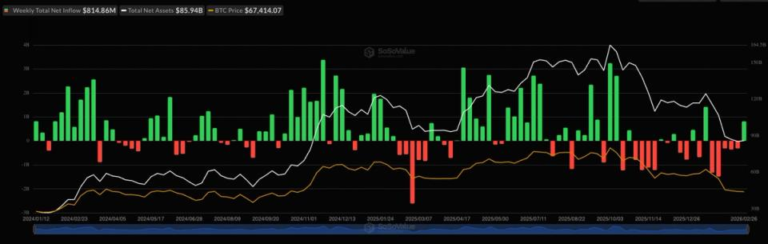
U.S. bitcoin exchange-traded funds (ETFs) are on track to snap a streak of five consecutive weeks of net outflows with their strongest performance since mid-January.

The funds recorded net inflows of $1.1 billion in three straight days, according to data from SoSoValue, leaving them roughly $815 million ahead after Monday’s net outflow is taken into account, the most since adding $1.4 billion in the week ended Jan. 16.

BlackRock’s iShares Bitcoin Trust (IBIT) accounted for more than half of the three-day flow, drawing in roughly $652 million. On Wednesday, Grayscale’s GBTC, which carries the highest fee among the funds, posted its largest single-day inflow since converting from a trust structure to an ETF.

The renewed inflows suggest U.S. demand is returning, an conclusion reinforced by the Coinbase Premium Index turning positive after 40 days in negative territory. The index tracks the price difference between bitcoin on Coinbase (COIN), which is accessible to firms in the world’s largest economy, and the broader global market. It is widely used as a gauge of U.S. institutional flows and sentiment.

Data from Checkonchain shows total bitcoin holdings across U.S. spot ETFs climbed to 1.29 million BTC, putting assets under management (AUM) less than 10% below their October peak.

This comes despite the spot price of bitcoin remaining 45% below its October record. The largest cryptocurrency has continued to consolidate around the mid $60,000 range this week.

Meanwhile, open interest on the Chicago Mercantile Exchange (CME) has continued to decline, falling to 107,780 BTC, according to Glassnode data. Because CME allows institutions to simultaneously take a long position in spot bitcoin and a short position in futures — a strategy known as a basis trade — the drop in futures can be seen as indicating the ETF inflows are outright long positions.

Resilience Cyber Claims Data Reveals The New Economics of Professionalized Cybercrime

0

Cyber insurance claims data from leading cyber risk company Resilience reveals a dramatic evolution in the economics of cybercrime. An analysis of claims across Resilience’s client portfolio in 2025 showcases a remarkable shift in how threat actors execute prolonged attacks on organizations, while painting an increasingly common picture of the material consequences of cyber incidents, both in their immediate aftermath and in the shockwaves that follow.

Based on claims data and research from Resilience’s Risk Operations Center (ROC), Resilience’s 2025 Cyber Risk Report details a particularly complex challenge for organizations—and provides a unique look into how they can best mitigate material loss. In 2025:

  • Extortion demands to suppress stolen data comprised less than half (49%) of all extortion claims in the first half of the year, then grew to nearly two-thirds (65%) in the second half. Across the entire year, data theft-only attacks accounted for more than half (57%) of all attacks, as hackers look to bypass organizations’ increasingly strong backup practices. 
  • Infostealers harvested more than 2 billion credentials and were frequently observed in victim organizations’ environments before ransomware attacks occurred, meaning that infostealer activity should be treated as a critical early warning signal requiring immediate action to prevent credential harvesting and prevent follow-on attacks.
  • Threat groups like Interlock continued to find victim organizations’ cyber insurance policies among stolen data to better calibrate their ransom demands—maximizing payouts while staying below coverage limits.
  • Vendor risk was the second-highest loss category across Resilience’s portfolio, representing nearly one-fifth (18%) of total losses. Threat actors are successfully leveraging password reset attacks and are increasingly infiltrating open-source code repositories that serve as the foundation for enterprise applications; this opens the door to an industry-wide cascade of short- and long-term disruption following the compromise of a critical vendor.

Taken together, the data points to a concerning new reality for organizations. Cyberattacks are more calculated, strategic, and well-planned; resulting losses can extend well beyond the moment they happen and accumulate over months and even years.

“Cyber risk is constantly changing. As cybercriminals shift their tactics, a new reality is setting in: the real risk is about more than a security incident’s immediate disruption, it’s about the long-tail aftershocks that follow,” said Vishaal “V8” Hariprasad, Co-Founder and CEO of Resilience. “Claims data gives us the best and most granular insight into the real-world costs of those shockwaves. Understanding the materiality of the full lifecycle of a cyber incident is the only way to meaningfully arm ourselves against advanced new tactics and grow more resilient to inevitable threats.”

Resilience’s report recommends that organizations work to meaningfully mitigate material losses by prioritizing investments in data loss prevention systems and zero-trust architecture, credential monitoring, vendor incident contingency plans, tabletop exercises, and comprehensive insurance coverage that reflects 2025’s severity levels rather than mere historical averages.

“Looking at the increasing professionalization of the threat landscape, it can be tempting to assume that there’s no recourse. But our latest findings give us incredibly useful insight into the incentives behind the incidents—and how we can best fight back,” said Judson Dressler, Head of Resilience’s Risk Operations Center (ROC). “For instance, to mitigate infostealer activity, our ROC team proactively hunts for stolen credentials on the dark web or new exploits or vulnerabilities that affect their environment and alerts our clients to these critical findings. That’s one example of what it looks like in practice to adjust to the reality that we’re facing an ‘everything, everywhere, all at once’ model of cyber risk.”

Resilience’s 2025 Cyber Risk Report leverages data from the company’s ROC and claims in their insurance portfolio to analyze trends in cybercrime and industry responses throughout the year. To read the full report, see here.

Allunity Launches EU-Compliant Swiss Franc Stablecoin

0

Allunity has introduced CHFAU, a fully reserved Swiss Franc stablecoin designed for institutional payments and cross-border settlement under the European Union’s MiCAR framework. Frankfurt-based Allunity, a joint venture between DWS, Flow Traders, and Galaxy, announced the launch of CHFAU on February 26, 2026. Regulated by BaFin as an E-Money Institute, the firm developed this 1:1 […]

World Liberty Financial ties voting power to staking as USD1 supply tops $4.7 Billion

0

World Liberty Financial is moving to lock up governance power, requiring token holders to stake their WLFI for six months before they can vote on the protocol’s future.

A new proposal would require holders of unlocked WLFI tokens to stake for at least 180 days to vote, while creating “Node” and “Super Node” tiers that grant large stakers access to subsidized 1:1 conversions into its USD1 stablecoin and direct partnership discussions with the team.

Under the framework, holders who stake at least 10 million WLFI, roughly $1 Million at current prices, would qualify as “Nodes,” gaining access to over-the-counter stablecoin conversion channels facilitated by licensed market makers. World Liberty Financial said it would subsidize those market makers to maintain parity, effectively passing arbitrage opportunities that previously generated 10 to 15 basis points per cycle to qualifying stakers.

Participants who stake 50 million WLFI, about $5 Million, would qualify as “Super Nodes,” receiving guaranteed access to the team for partnership discussions and potential eligibility for additional economic incentives, subject to commercial agreements.

Stakers would earn an estimated 2% annual reward in WLFI, funded by the project’s treasury and contingent on participating in governance votes. The proposal comes as USD1’s circulating supply has grown to roughly $4.7 Billion, making it one of the largest stablecoins in the market.

A date for voting has not yet been determined.

Souhoola Gains Approval for New Prepaid Card in Partnership with Banque Misr, Visa, and Modupay

0

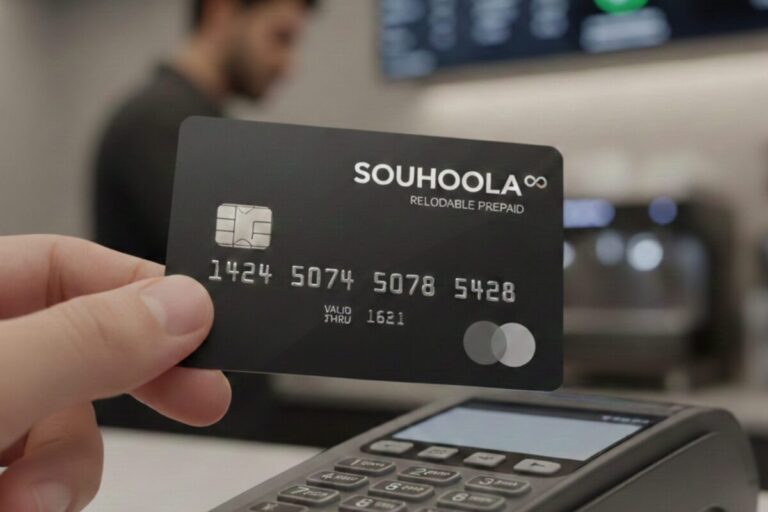
Souhoola, the Egyptian consumer finance company, has received initial regulatory approval to launch a new reloadable prepaid card.

The launch is the result of a strategic partnership involving Banque Misr, Visa, and Modupay, which is acting as the specialised technical payment partner. The card is designed to serve Souhoola’s existing customer base as well as individuals in urban areas across Egypt, offering a blend of everyday payment functionality and consumer finance options.

Combining payments with 60-month installments
Ahmed Alshanawany, managing director of Souhoola

The prepaid card aims to provide an “integrated financial experience.” It allows users to instantly activate the card, add funds, withdraw cash, and track their balances and transactions in real-time via an app.

Crucially, the product integrates Souhoola’s core consumer finance offering, allowing cardholders to pay for purchases in installments over a period of up to 60 months.

Ahmed Alshanawany, managing director of Souhoola, commented on the strategic importance of the launch: “We are pleased to announce receiving the initial approval to launch Souhoola’s prepaid card, which represents an important strategic milestone in our digital transformation journey. This step is not merely an administrative procedure, but an extension of our vision to empower individuals and enhance financial inclusion in Egypt… This card clearly embodies that concept through innovative features that grant customers full security and total control over their spending, while maintaining the unique flexibility of accessing Souhoola’s exclusive installment services.”

A collaborative technical infrastructure

The card’s security is powered by Visa technologies, while Modupay provides the technical and operational support required to ensure service continuity.

Modupay, a Cairo-headquartered payment-technology enabler (formerly known as MDP), combines card issuing, payment processing, and digital payment solutions.

Eng. Ahmed Nafea, CEO of Modupay, added: “At Modupay, we are always proud to support and empower fintech companies seeking to expand their payment solutions in line with today’s evolving customer needs. Our partnership with Souhoola in launching this card reflects our commitment to delivering a reliable, flexible, and scalable payment infrastructure that contributes to strengthening financial inclusion and accelerating digital transformation in the Egyptian market.”

Founded in 2019, Souhoola was established to provide technology-driven financial solutions to address the increasing financial challenges faced by citizens.

Mohamed Gamal, chief business officer at Souhoola, stated: “This initial approval marks an important step toward expanding Souhoola’s digital presence and strengthening its reach across the country. Our cooperation with Banque Misr, Visa, and Modupay reflects our ongoing commitment to offering trusted and secure solutions that meet customer aspirations and reinforce Souhoola’s competitive position.”

Bitcoin slides Friday after Nvidia’s earning pullback

0

Bitcoin and the broader crypto market headed into Friday on the back foot, with most major tokens posting losses over the last 24 hours as traders continued to de-risk alongside equities following Nvidia’s earnings-driven pullback.

Bitcoin was trading around $67,766 at the time of writing, down 1.5% on the day but still clinging to a 0.6% gain on the week. Ethereum mirrored the move, off 1.5% in 24 hours to trade just above $2,047. Both remain stuck in a narrow range that has defined price action since the Feb. 5 crash, with Wednesday’s push toward $70,000 marking the upper boundary and this week’s lows testing the middle.

The selling pressure, however, looks more like a leverage flush than a structural breakdown. Hourly returns across the board were green Friday morning, meaning the bulk of the drawdown happened overnight and buyers have quietly stepped back in at these levels.

“What you’re seeing right now is Bitcoin trading with the broader risk market,” said Daniel Reis-Faria, CEO of ZeroStack. “Nasdaq fell after Nvidia earnings, and crypto followed. Bitcoin pushed closer to $70,000 pretty quickly, and when momentum in equities stalls, that fast money comes off just as quickly in Bitcoin.”

Reis-Faria sees the move as positioning cleanup rather than a trend reversal. “A lot of leverage came back into the system on that push higher, and when stocks start selling, crypto is usually the first place people de-risk. Volatility is elevated because liquidity is tight across the board.”

Zoom out to the weekly chart and the picture looks considerably healthier. Cardano led major assets with a 7% gain over seven days. Solana added 5.5%, Ethereum 4.8%, and BNB 4.3%, all outpacing Bitcoin’s comparatively modest weekly return and suggesting altcoin appetite remains intact beneath the surface noise.

XRP was the notable exception, down 3.7% in 24 hours and the only top asset in the red on a 7-day basis at -0.1%. The underperformance stands out given that most altcoins absorbed the same macro headwinds without giving back weekly gains.

The broader macro backdrop adds context. Asian equities are on track for their best February since 1998, led by South Korean tech names up roughly 20% this month as investors rotated into AI infrastructure plays.

That rally has drawn capital away from U.S. markets, with the MSCI Asia Pacific Index set to outperform the S&P 500 for a third consecutive month.

For crypto, the throughline is the same one it has been for weeks. “We’re still in the same range we’ve been in,” Reis-Faria said. “Until we see consistent new demand, these moves are going to keep happening. Bitcoin trades like a macro asset. When equities pull back, Bitcoin pulls back.”

Indiana Crypto Rights Bill Heads for Governor’s Signature

0

Indiana lawmakers sent a bill to Governor Mike Braun that would expand legal protections for cryptocurrency users and require certain state retirement and savings plans to offer a self-directed brokerage option with at least one crypto investment choice.

House Bill 1042 (HB1042) for the “regulation and investment of cryptocurrency” cleared the legislature on Wednesday, with 59 lawmakers voting in favor and 33 against, according to data from Legiscan.

The bill seeks to protect Bitcoin (BTC) and cryptocurrency investor rights, ban discriminatory crypto taxes and open the door for digital asset holdings in state retirement plans.

The bill is headed to Braun for his signature. If signed, most provisions will take effect July 1, while the retirement-plan self-directed brokerage requirement would take effect later.

Indiana House Bill 1042, history. Source: Legiscan

A handful of US states have already signed crypto investor protection bills, including Oklahoma in November 2024 and Kentucky in March 2025.

Pennsylvania’s House Bill 2481 (HB2481) for crypto investor protection rights passed in October 2024 with strong bipartisan support, but has yet to be signed into law.

Indiana’s cryptocurrency rights bill stands out from the others as the only piece of legislation seeking to offer self-directed brokerage accounts to facilitate crypto retirement plans.

Related: Stablecoin stagnation, tariffs a headwind for Bitcoin prices, analysts say

Retirement plans add crypto option

The bill would allow Indiana citizens to hold Bitcoin and digital assets as part of their retirement plans for the first time. 

If signed, the bill would require certain state retirement and savings plans to offer self-directed brokerage accounts with at least one cryptocurrency investment option by July 1, 2027.

This would extend to the legislators’ defined contribution plan, the Hoosier START plan, specified public employees’ retirement funds and specified teachers’ retirement fund plans, among others.

Indiana House Bill 1042. Source: Legiscan

Moreover, the bill includes other key provisions that protect the rights of crypto investors from future regulatory crackdowns.

Related: Texas Bitcoin reserve hearing ‘symbolic move’ for crypto — Analyst

State rules limited on crypto

Indiana’s bill would restrict state and local public agencies from adopting or enforcing rules that would prohibit lawful crypto payments, self-custody or mining, subject to the bill’s carve-outs.

Under the legislation, public agencies, excluding the Department of Financial Institutions, will be prohibited from adopting regulations that prohibit an individual’s ability to accept digital asset payment for legal goods and services, take custody of their crypto holdings or impose taxes and fees on crypto payments and self-custodied holdings.

The bill also prohibits the enforcement of regulations that would prohibit crypto mining operations for businesses or individuals.

Magazine: Bitcoin’s ‘biggest bull catalyst’ would be Saylor’s liquidation — Santiment founder