Getnet, the leading Latin American and Iberian fintech payment provider owned by Santander, has launched Get Code. The platform serves as an official developer community built to inspire, connect, and empower technology professionals worldwide.
Fostering digital co-creation
Daniel Flores, head of product at Getnet
The initiative aims to provide developers with a collaborative network to share knowledge and build innovative solutions for the future of digital payments. Through the platform, tech talent will have access to networking events, content sharing, hackathons, and opportunities to connect their ideas to real market needs.
Daniel Flores, head of product at Getnet, explained the vision behind the launch, “Innovative products lie at the heart of Getnet. Get Code represents our commitment to keep fostering innovation and supporting the developer ecosystem. By creating a space where talent, creativity, and technology meet, we aim to accelerate new solutions that transform the payments industry. For developers, it’s an opportunity to access valuable resources, expand their network, and gain visibility for their ideas on a global stage.”
Inaugural event to focus on AI
The community will officially kick off its program of activities on 26 February with a meet-up in Brazil. Themed “The Future of Payments Using AI,” the inaugural event will feature participation from open-source software company Red Hat and electronic payment solutions provider Verifone.
During the event, Caetano Altieri, CEO of Verifone, will share strategic insights on how artificial intelligence is currently transforming payment methods. Getnet plans to announce additional initiatives and programs for the community gradually throughout the year.
For Getnet, which processed over €222billion across 9 billion transactions in 2025 and serves 1.3 million clients, the launch is a strategic step to strengthen its presence in the global tech ecosystem.
Denis De Lutiis, head of marketing LATAM at Getnet, added “Get Code reinforces Getnet’s positioning as a global fintech connected to the future of technology. It is an initiative that brings together innovation, collaboration, and a long-term vision to drive digital transformation in the financial sector.”
The former CEO of defunct exchange MtGox, operating under his GitHub handle MagicalTux, submitted a pull request to Bitcoin Core over the weekend proposing a hard fork (a fundamental change in code that splits the blockchain) that would let 79,956 BTC be redirected from the address they’ve been sitting in since 2011.
At current prices, that’s roughly $5 billion in bitcoin that hasn’t moved in 15 years.
The proposal was narrow, with just under 60 lines of code. A single consensus rule change that would substitute one public key hash for another when validating transactions from the theft address, allowing the MtGox trustee to spend the coins and route them into Japan’s existing court-supervised rehabilitation process.
Read more: Mt Gox: The History of a Failed Bitcoin Exchange
The activation height was set to infinity, meaning nothing would happen unless the community explicitly agreed to turn it on.
It lasted about 17 hours.
The forum was auto-closed even before a discussion took place, with bitcoiners suggesting that Karpelès submitted a pull request directly when he should’ve first discussed the changes on the Bitcoin development list. Some of them said that Karpelès should first propose this as an official Bitcoin Improvement Proposal (BIP).
To be fair, bitcoin core github isn’t the appropriate forum for that kind of community discussion. bitcointalk, X, bitcoin mailing list(s), delving, etc are all a more appropriate forum.
The people it was supposed to help rejected it, too. Several MtGox creditors said publicly on X that they didn’t want Bitcoin’s rules rewritten on their behalf. The network’s guarantee that private keys equal ownership matters more to them than getting their coins back.
I’m a creditor. Absolutely not. Would break a key pillar of Bitcoin.
Karpelès had anticipated the objections and listed them himself in the proposal.
The theft is unambiguous, and the coins haven’t moved in 15 years. A legal framework to distribute them already exists. The scope targets one address. Every argument for exceptionalism was there.
Once Bitcoin redirects coins for any reason, the question stops being whether it can and starts being when it will do it again.
Bitfinex victims, DeFi hack victims, and anyone who lost coins to a documented theft could cite this as precedent and seek the same remedy for their incidents. The line between one justified exception and a general mechanism is exactly the kind of subjective boundary Bitcoin was built to avoid.
This is not to say a change in code didn’t happen before.
Previous emergency interventions, such as the 2010 value overflow bug or the 2013 chain split, involved technical failures that threatened the network itself. This was different. The network was working exactly as designed. The proposal was asking it to work differently for one group of people, however sympathetic their case.
The pull request is now closed. $5 billion in bitcoin remains frozen at the same address it’s been at since 2011. And the creditors who might have benefited chose the principal over the payout.
Ultimately, Bitcoin’s fundamental principle of “code is the law” prevailed.
A group of 11 US senators has asked federal authorities to investigate whether crypto exchange Binance is complying with US sanctions and Anti-Money Laundering (AML) requirements, citing recent reports.
In a letter on Friday to Treasury Secretary Scott Bessent and Attorney General Pamela Bondi, the lawmakers urged a “prompt, comprehensive review” of the exchange’s compliance controls and its adherence to settlement agreements reached in 2023.
The senators pointed to allegations that approximately $1.7 billion in digital assets flowed through Binance to Iranian entities linked to terrorism, including groups connected to the Houthis and the Islamic Revolutionary Guard Corps. Investigators also reportedly identified more than 1,500 accounts accessed by users in Iran and potential activity connected to Russian sanctions evasion.
According to the letter, some Binance compliance staff who uncovered suspicious transactions were later dismissed, and law enforcement agencies said the exchange had become less cooperative in providing customer information.
Related: Binance stablecoin reserves have sunk 19% since November
Senators warn Binance products could enable sanctions evasion
Senators Chris Van Hollen and Ruben Gallego, joined by Angela D. Alsobrooks, Andy Kim, Raphael Warnock, Tina Smith, Catherine Cortez Masto, Mark R. Warner, Elizabeth Warren, Jack Reed and Lisa Blunt Rochester, signed the letter.
They also raised concerns about newer products, including payment cards launched in parts of the former Soviet Union and partnerships tied to stablecoin initiatives, which they warned could facilitate sanctions evasion.
The senators asked the agencies to report by March 13 on any steps taken to examine the exchange’s conduct.
Senators ask for probe into Binance. Source: Senate
On Tuesday, Senator Richard Blumenthal, ranking member of the Senate Permanent Subcommittee on Investigations, also launched a congressional inquiry into Binance. He sent a letter to Binance CEO Richard Teng requesting documents and internal records related to the exchange’s sanctions controls.
Related: Binance confirms employee targeted as three arrested in France break-in
Binance denies Iran-linked transaction claims
In a statement to Cointelegraph this week, Binance rejected allegations that its platform facilitated illicit transactions, saying it identified and reported suspicious activity to authorities and does not allow Iranian users. A company spokesperson said recent media coverage misrepresented the exchange’s operations.
Last week, the exchange also disputed a report claiming it processed more than $1 billion in Iran-linked transfers and denied dismissing investigators over the issue.
Teng has also criticized a Wall Street Journal report alleging $1.7 billion in Iran-related activity, calling it defamatory and seeking a retraction.
Magazine: How crypto laws changed in 2025 — and how they’ll change in 2026
Cointelegraph is committed to independent, transparent journalism. This news article is produced in accordance with Cointelegraph’s Editorial Policy and aims to provide accurate and timely information. Readers are encouraged to verify information independently. Read our Editorial Policy https://cointelegraph.com/editorial-policy
Bitcoin (BTC) rewards investors the most who hold it for at least three years, according to data shared by André Dragosch, head of research at Bitwise Europe.
Key takeaways:
Holding BTC for at least three years has historically slashed losses to just 0.70%.
Bitcoin price predictions for 2026–2027 cluster around $100,000–$150,000 in bullish scenarios.
Long-term Bitcoin holders rarely lose
A Bitwise analysis reviewed Bitcoin’s price history between July 17, 2010, and Feb. 11, 2026, concluding that the probability of being in the red drops to just 0.70% when BTC is held for at least three years.
Bitcoin investors’ probability of loss per holding period. Source: Bitwise
In other words, nearly all rolling three-year entry points in Bitcoin’s history ended up profitable. Beyond three years, the risk of loss fell even further: 0.2% over five years and 0% over ten years.
Traders holding Bitcoin for less than three years faced a much higher risk of loss.
Intraday buyers, for instance, had a 47.1% chance of being underwater. That probability stayed elevated at 44.7% over one week, 43.2% over one month, and 24.3% over a one-year holding period.
Stronger hands are 90% in profit already
The realized price metric also shows declines in holders’ losses over multi-year windows.
As of Saturday, Bitcoin was down by roughly 50% from its October 2025 high, trading for around $65,000.
That was way above its three-to-five-year realized price of $34,780, meaning investors who bought and held through that window were still sitting on an approximately 90% profit.
BTC realized price by age. Source: Glassnode
Meanwhile, some traders argue the ongoing Bitcoin price correction could extend toward $30,000.
A move to that level would wipe out much of the cohort’s cushion, pushing the three–five year band closer to breakeven. That would further test whether these holders start adding to sell pressure or sit tight.
Conversely, most traders who bought Bitcoin in the past two years were underwater.
BTC realized price by age. Source: Glassnode
The cost basis of the 6m–12m cohort, entities that have been holding BTC for up to a year, was around $101,250, leaving them with roughly a 35% in unrealized loss as of Saturday.
However, the 1y–2y cohort’s cost basis was lower, around $78,150, translating into about a 15% unrealized loss.
The gap reinforced the same pattern seen in the holding-period data: the longer the holding window, the smaller the drawdown tends to be during corrections.
How high can BTC price go?
Longer-term forecasts still cluster around a handful of upside targets for 2026–2027.
For instance, global brokerage firm Bernstein maintained its $150,000 BTC price call for 2026, pointing to relatively modest net outflows of about 7% from spot Bitcoin ETFs, even as BTC’s price fell by 50%.
“The current Bitcoin price action is a mere crisis of confidence,” Bernstein analysts led by Gautam Chhugani said.
Standard Chartered, meanwhile, warned of a potential “final capitulation” phase that could drag BTC toward $50,000 amid weak ETF flows and a tougher macro backdrop, before recovering toward $100,000 by the end of 2026.
Looking into 2027, Timothy Peterson’s historical “average return” framework points to $122,000 by early 2027, with high odds that BTC trades above that figure.
Trailing positive BTC price months with put option payoff data. Source: Timothy Peterson/X
This article does not contain investment advice or recommendations. Every investment and trading move involves risk, and readers should conduct their own research when making a decision. While we strive to provide accurate and timely information, Cointelegraph does not guarantee the accuracy, completeness, or reliability of any information in this article. This article may contain forward-looking statements that are subject to risks and uncertainties. Cointelegraph will not be liable for any loss or damage arising from your reliance on this information.
Trump Media and Technology Group (DJT) is considering spinning off its social media platform, Truth Social.
Shares of the new entity would be provided to DJT holders prior to the firm’s planned merger with TAE Technologies.
Details about the impact to the firm’s Bitcoin holdings or crypto initiatives remain unclear.
Trump Media and Technology Group (DJT) is considering spinning off Truth Social—its free speech-focused social media platform championed by President Donald Trump—into its own public entity, the firm announced on Friday.
The move would see Truth Social and other Trump Media businesses become SpinCo, which would then merge with Texas Ventures III. However, some assets and businesses would remain with the Trump Media, though the firm did not indicate which.
Shares of the new entity would be provided to DJT shareholders prior to the firm’s announced merger with TAE Technologies, a power fusion firm that is still in a pending merger with the Trump Media.
“The contemplated transaction is intended to create shareholder value through the creation of pure play companies, each with distinct strategies,” the firm’s announcement reads.
The news did not immediately register any positive impacts for DJT shareholders though. Shares in the firm are down around 2.10% today as broader markets decline. It has now fallen around 40% in the last six months, recently changing hands around $10.73.
While the comment above might suggest that Trump Media’s crypto initiatives would remain alongside Truth Social, details about its crypto-related plans were not immediately clear. A representative for the firm did not immediately respond to Decrypt’s request for comment.
Last year the firm sought to “protect itself from discrimination from financial institutions” by adding $2 billion in Bitcoin and Bitcoin-related securities to its balance sheet.
It also filed for a Bitcoin ETF last June and later a crypto blue chip ETF, which includes other tokens like Ethereum, Solana (SOL) and Ripple-linked XRP.
The firm signaled its intent to bolster its crypto ETF offerings earlier this year, filing for a joint Truth Social-branded Bitcoin and Ethereum ETF, as well as one centered on the Crypto.com-linked token, CRO.
It is also working with Crypto.com on a digital token that would be airdropped to Trump Media shareholders as it seeks to adopt crypto rails across its business. The deadline for broker participants to provide information on shareholders passed earlier this month, though the token has not yet been distributed.
Daily Debrief Newsletter
Start every day with the top news stories right now, plus original features, a podcast, videos and more.
The cryptocurrency market served as a real-time volatility barometer over the weekend as joint U.S. and Israeli strikes on Iran triggered a sharp sell-off while traditional markets were closed. The Bitcoin Benchmarking The cryptocurrency market once again fell victim to its own always-on architecture. As the only major asset class trading 24/7, digital assets bore […]
Pepeto: Three Products That Create a Compounding Demand Flywheel
One of the notable features supporting Pepeto’s momentum is the compounding demand flywheel created by three interlocking products. While Ethereum remains the most widely used smart contract platform, the $45 billion meme coin economy built on top of it has zero dedicated trading infrastructure. Pepeto addresses this gap with products that create exponential rather than linear demand growth.
Three products have been announced by the team and are close to being ready. PepetoSwap will handle cross chain meme trading with zero transaction tax. Pepeto Bridge approaches deployment, routing tokens across Ethereum, Solana, BSC, and every blockchain where billions sit trapped. Pepeto Exchange enters final development as the first curated listing hub for verified meme coins.
Here is why the flywheel changes everything. Every swap on PepetoSwap requires Pepeto tokens. Every bridge transfer requires tokens. Every exchange trade routes through the ecosystem. A trader who bridges tokens from Solana to Ethereum then swaps them then discovers a new project on Pepeto Exchange creates three demand events from a single session. The three products do not add demand. They multiply it in a compounding loop that strengthens with every new user entering the system according to Forbes. Dual audits from SolidProof and Coinsult found zero critical vulnerabilities. Staking at 211% APY rewards holders while the products approach deployment.
Growing Visibility While Whales Manufacture the Perfect Panic
The whale playbook is transparent to anyone paying attention. Ethereum dropped to $2,011 on the PPI shock. Solana slid to $85 down over 31% in a single month. Dogecoin fell to $0.10. XRP dropped to $1.40. Cardano sits at $0.29. PEPE trades at $0.0000042. SHIB holds at $0.0000059. BONK sits at $0.0000107 and FLOKI trades at $0.000029.
Those 96,000 liquidated traders sold at the bottom. The whales bought it. This is the same pattern that preceded every major meme coin rally in history. The whales create maximum fear, trigger panic selling, scoop positions at discounted prices, then ride the recovery. Right now those same wallets are accumulating Pepeto at six zeros because the compounding demand flywheel creates returns that established tokens cannot match.
Pepeto Presale Progress and the Whale Math
At $0.000000186, a $1,000 investment becomes $269,000 at $0.00005. A $5,000 position crosses $1,345,000. Those targets sit below what DOGE achieved at $88 billion and SHIB hit at $40 billion. Both had zero products. Pepeto has three products creating compounding demand.
Morgan Stanley is still building Bitcoin trading infrastructure for $9 trillion in assets. Indiana still approved public retirement Bitcoin ETF investments. None of the bullish fundamentals changed. Only the price changed. And that is exactly what the whales wanted to trigger liquidations and accumulate.
Outlook: Whales Accumulate While Retail Sells the Bottom
The combination of three products, dual security audits, the Pepe cofounder’s proven track record, and $0.000000186 entry places Pepeto among a select group of projects positioned for explosive growth when the recovery arrives. The compounding demand flywheel means every new user creates multiple demand events across PepetoSwap, Pepeto Bridge, and Pepeto Exchange. That compounding effect is what separates infrastructure plays from simple token launches that fade when the hype cools.
The whales are preparing for the bull run. They crashed the market. They liquidated 96,000 traders. They scooped up cheap positions. And now they are accumulating Pepeto at six zeros while everyone else sells at the worst possible time. The question is whether you will join the whale wallets before the compounding flywheel activates or sit on the sidelines watching the recovery happen without you. $1,000 becomes $269,000. $5,000 becomes $1,345,000. The presale at six zeros will not survive the next leg up.
Click To Visit Pepeto Website To Enter The Presale
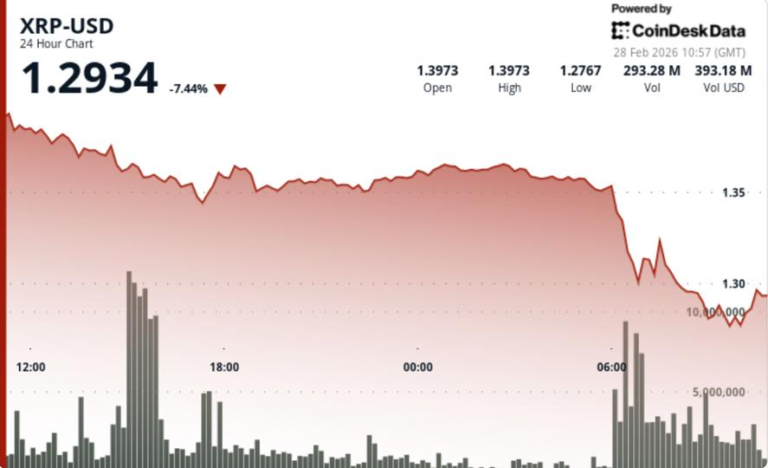
XRP reversed sharply after failing to sustain its rebound, with a high-volume breakdown through $1.36 accelerating downside momentum.
News Background
XRP fell alongside renewed weakness across the broader crypto market, but the decisive move was technical rather than headline-driven.
The token had staged a brief relief rally earlier in the week, only to stall below key resistance and roll over as sellers defended higher levels.
The breakdown extends XRP’s corrective pattern since its July 2025 peak, reinforcing a sequence of lower highs and failed recovery attempts.
Price Action Summary
XRP dropped 9.1% from $1.42 to $1.30
Selling intensified once $1.36 support failed
Volume surged more than 170% above average during the main capitulation phase
A brief rebound toward $1.33 was quickly rejected
Technical Analysis
The critical event was the clean break below $1.36, which had served as near-term structural support.
Once lost, downside momentum accelerated, driving price toward $1.30 on outsized volume — a sign of forced selling rather than gradual distribution.
A short-covering bounce pushed XRP to $1.325, but the rally stalled immediately, forming a clear lower high and confirming the broader downtrend remains intact. Former support at $1.36–$1.37 now acts as resistance, while $1.32–$1.33 caps near-term recovery attempts.
On higher timeframes, XRP remains below key retracement levels, with $1.47 representing the next meaningful structural hurdle should buyers regain control.
What traders say is next?
Traders are focused on whether $1.30 can hold as a near-term floor.
If $1.30 stabilizes, XRP may consolidate before attempting another push toward $1.32–$1.36. A reclaim of $1.36 would be the first sign that the breakdown was overextended.
If $1.30 fails decisively, downside risk shifts toward the $1.20–$1.22 region, where longer-term demand is expected to emerge.
For now, momentum favors sellers, and any bounce is viewed as corrective until resistance levels are reclaimed.
Paradigm is seeking to raise as much as $1.5 billion for a new fund that would expand its scope into frontier technologies, including artificial intelligence and robotics, according to The Wall Street Journal.
The San Francisco-based venture capital firm has built its reputation backing digital asset protocols and web3 infrastructure since its founding by former Sequoia partner Matt Huang and Coinbase co-founder Fred Ehrsam.
Paradigm, overseeing $12.6 billion in assets as of late 2024, launched a $2.5 billion vehicle in 2021 that backed projects including Uniswap and StarkWare, and followed with an $850 million early-stage fund in 2024.
The planned fund comes as investment in AI and robotics continues to accelerate in 2026, reflecting the growing industrialization of autonomous systems.
The trend has encouraged firms to pursue opportunities in physical AI, where machine learning models are increasingly being deployed directly into hardware-driven and enterprise automation workflows.
Paradigm invested $50 million in Nous Research and recently partnered with OpenAI to develop EVMbench, a tool for evaluating AI performance on blockchain-related tasks.
Other crypto-native investors have similarly moved to diversify into adjacent technology fields, seeking to capitalize on the potential convergence between decentralized networks and machine learning systems.
Ethereum continues to host the largest concentration of stablecoins and decentralized finance (DeFi) capital, even as successive waves of faster networks emerge.
Newer blockchains have promised higher throughput and lower costs, raising questions about whether institutional capital could eventually migrate away from Ethereum.
Kevin Lepsoe, founder of ETHGas and a former Morgan Stanley derivatives executive in Asia, said he expects Ethereum’s lead to endure, as institutions tend to prioritize capital depth over flashy performance.
“[Transactions per second] is the metric that gets engineers excited, but is that what drives capital to the blockchain?” Lepsoe asked in an interview with Cointelegraph.
“The capital is on Ethereum; the stablecoins are there. TradFi is looking at where the liquidity is,” he said.
Institutional capital brings scale and stability to a blockchain’s ecosystem. Large asset managers and tokenized fund issuers move capital in volumes that deepen liquidity and anchor stablecoin supply. Their presence can establish a network’s position beyond hype-driven retail activity that surges in bull markets and fades in downturns.
Ethereum isn’t the fastest chain, but its DeFi liquidity is the deepest. Source: DefiLlama
Liquidity keeps Ethereum ahead of faster rivals
If institutions prefer to operate where most of the money already sits, then simply making a faster blockchain will not pull capital away from Ethereum.
Over the past several cycles, performance has become a weapon to attract users. Solana has emerged as Ethereum’s high-speed alternative, dubbed an “Ethereum killer,” though that label is debated. It onboarded retail traders through the non-fungible token (NFT) boom and the memecoin frenzy, but the heightened activities weren’t sustained in the long run.
Related: Can Solana shed its memecoin image in 2026?
Solana now has its own generation of “Solana killers” that advertise higher theoretical transactions per second (TPS). But Ethereum’s liquidity grants tighter spreads, lower slippage for large trades and the capacity to absorb institutional-sized transactions without heavily distorting prices.
“I think of Ethereum as like downtown,” Lepsoe said.
“You could build a marketplace uptown somewhere in the suburbs and you could get far off market prices there, maybe it’s more convenient or maybe you like the vibe. But if you want the deepest liquidity, you go downtown, and that’s Ethereum.”
Though past crypto booms featured high-stakes retail speculation, the next phase is shaping up to include more institutional capital. As it stands, institutional players have expressed interest in practical use cases such as stablecoins and real-world assets (RWAs).
Even the world’s largest asset manager is leaning into RWA products. BlackRock’s USD Liquidity Fund (BUIDL) is its tokenized Treasury fund that started on Ethereum and branched out to several blockchains. Ethereum holds over a 30% BUIDL market capitalization.
Ethereum has been widening its lead as the distribution layer for RWAs, excluding stablecoins. Source: RWA.xyz
Ethereum is the largest network for stablecoins as well, which BlackRock’s global head of market development, Samara Cohen, said are “becoming the bridge between traditional finance and digital liquidity.”
Ethereum leads the industry in stablecoin market cap, with $160.4 billion, according to DefiLlama.
Ethereum’s L2 liquidity is returning to L1
Though Lepsoe said liquidity depth shapes institutional preference, a network’s efficiency cannot be completely disregarded.
Ethereum has been adjusting its own technical profile. Transaction fees that once routinely spiked to virtually unusable prices have fallen significantly, as layer-2 rollups eased pressure on the main chain. These solutions brought in new problems of their own. Rollups fragmented liquidity across multiple environments.
Related: 2026 is the year Ethereum starts scaling exponentially with ZK tech
Lepsoe described the liquidity fragmentation as a blessing in disguise for Ethereum. He argued that if L2s didn’t take away liquidity from the main chain, capital would have flown out to competitors.
“I think it actually saved the liquidity from going to other L1s, where they eventually probably couldn’t have brought it back,” he said.
Recently, Ethereum has shifted its focus back to scaling the main chain. Co-founder Vitalik Buterin said that many layer 2s have failed to decentralize, while the main chain is now sufficiently scaling.
“Both of these facts, for their own separate reasons, mean that the original vision of L2s and their role in Ethereum no longer makes sense, and we need a new path,” Buterin said in a recent X post.
Institutions want their own chains, and Ethereum L2s let them have that without leaving Ethereum’s ecosystem, an Arbitrum developer said. Source: Steven Goldfeder
With transaction fees tamed, Ethereum is expected to execute the Glamsterdam fork in 2026, raising the block gas limit to 200 million from 60 million and putting its layer 1 on the road to 10,000 TPS over time.
For Ethereum, the timing coincides with institutions evaluating blockchain infrastructure for the next generation of financial services.
Alongside protocol upgrades, infrastructure providers are experimenting with ways to improve execution efficiency. Projects like Lepsoe’s ETHGas aim to optimize Ethereum’s block construction process through offchain execution and coordination, while Psy Protocol uses zero-knowledge technology to bundle multiple transactions into one.
Marcin Kaźmierczak, co-founder of blockchain oracle RedStone — which supplies data feeds for tokenized assets and institutional blockchain applications — said that Ethereum has the edge, as institutions prefer blockchains that have been battle-tested and around “for a very long time.” However, while institutions are “aggressively” expanding into Ethereum, they’re also shopping around.
“They look at Solana, which is getting good traction. Canton is extremely important for them because it gives them privacy, which they value very, very much,” Kaźmierczak told Cointelegraph.
Lepsoe said he sees “zero threat” from Solana or Canton, arguing that Ethereum still has the deepest liquidity pool, which is the primary draw for large allocators.
For institutional capital, performance improvements may expand Ethereum’s capacity, but liquidity remains its defining advantage. In blockchain markets, speed can attract users during booms, but capital tends to stay where the deepest markets already exist.
Magazine: 6 massive challenges Bitcoin faces on the road to quantum security
Cointelegraph Features and Cointelegraph Magazine publish long-form journalism, analysis and narrative reporting produced by Cointelegraph’s in-house editorial team and selected external contributors with subject-matter expertise. All articles are edited and reviewed by Cointelegraph editors in line with our editorial standards. Contributions from external writers are commissioned for their experience, research or perspective and do not reflect the views of Cointelegraph as a company unless explicitly stated. Content published in Features and Magazine does not constitute financial, legal or investment advice. Readers should conduct their own research and consult qualified professionals where appropriate. Cointelegraph maintains full editorial independence. The selection, commissioning and publication of Features and Magazine content are not influenced by advertisers, partners or commercial relationships.