Home Blog Page 890

Oil and gold pull backed from peaks while equity futures remain under pressure

0

U.S. equities fell in pre-market trading after the U.S. and Israel entered into conflict with Iran over the weekend.

The Invesco QQQ exchange-traded fund (ETF), which tracks the Nasdaq 100 index, declined 1.5%, though early losses have started to moderate, suggesting that initial concerns may have been somewhat overstated.

A Saudi Arabia oil refinery was hit by Iran’s response, pushing WTI crude oil as high as $75 per barrel. It was recently trading below $72, though remains 8% higher over the past 24 hours.

Gold rallied more than 2% in the past day to $5,400 per ounce, putting it within reach of its all-time high near $5,600 as investors sought traditional haven assets. It also drew back following an initial surge.

Bitcoin has held up, trading above $66,000 and gaining about 1% over the past 24 hours. This marks a modest divergence from its recent correlation with software stocks, as the iShares Expanded Tech-Software Sector ETF (IGV) is down around 1%.

Among crypto-related equities, Strategy (MSTR), the largest publicly traded corporate holder of bitcoin, is little changed. Crypto-exchange Bullish (BLSH), CoinDesk’s parent company, is down 4%, while AI-focused miners Cipher Digital (CIFR) and IREN (IREN) are both lower by about 3%. Crypto exchange Coinbase (COIN) is down 2%.

The conflict pushed the U.S. dollar index (DXY) higher to 98.2. At the same time, both the S&P 500 volatility index (VIX), and the U.S. bond market volatility index (MOVE), are up by more than 10%, reflecting elevated market uncertainty.

NFT Marketplace Magic Eden Streamlines Operations to Focus on Solana and Dicey Gambling

0

Magic Eden is narrowing its focus to the Solana blockchain and its Dicey gambling platform while sunsetting various Bitcoin and Ethereum services. CEO Jack Lu announced on X that Magic Eden will streamline its marketplace to focus exclusively on Packs and Solana while doubling down on Dicey, its crypto casino and sportsbetting project. The company […]

The Tomorrow Company Launches With a Bold Mandate to Build the Infrastructure Layer of the AI-Native Financial Era.

0

Vancouver, BC, Mar 2, 2026 – (ACN Newswire) – The Tomorrow Company (“TMRW”) today announced the completion of its strategic merger with Carbon Distributed Technologies AG (“CUT”) and Plato Technologies Inc., forming an integrated Web3 infrastructure platform positioned at the convergence of artificial intelligence, tokenized real-world assets, and programmable climate markets.

The Company is launching with a clear conviction: the next decade of value creation in digital finance will belong to those who build and own infrastructure — not interfaces. Systems that are programmable. Intelligence that is embedded. Assets that are verifiable. Rails that institutions can scale on.

Global markets are entering a structural transformation. Artificial intelligence is rapidly becoming embedded into capital allocation, enterprise operations, and regulatory oversight. Digital assets are evolving from trading vehicles into programmable utility frameworks capable of moving value instantly and transparently. Climate accountability is moving from narrative commitments to measurable, auditable instrumentation.

The Tomorrow Company is designed to operate at the intersection of these structural shifts — and to grow with them. The merger unites two powerful and complementary platforms.

CUT Carbon Distributed Technologies AG contributes a tokenized carbon utility framework structured around verifiability, traceability, and retirement mechanics. Built within Liechtenstein’s Blockchain Act framework and deployed on Ethereum Mainnet, CUT’s model emphasizes measurable CO₂ reduction linkage and immutable audit trails across issuance, transfer, and retirement. As regulators, institutions, and global enterprises demand higher standards of disclosure and impact validation, programmable carbon infrastructure becomes foundational to next-generation capital markets.

Paul Thomson, Co-Founder of CUT Carbon Distributed Technologies AG, commented:

“Tokenized commodities are moving from intention to instrumentation. For tokenized carbon credits, what matters now is verifiability—traceable assets, defensible controls, and retirement mechanics that stand up to real scrutiny. By integrating into The Tomorrow Company’s broader infrastructure platform, we believe we can accelerate adoption and bring institutional-grade carbon instrumentation to global markets.”

Complementing this climate utility layer is Plato Technologies Inc., which brings an AI-driven intelligence engine purpose-built to convert fragmented global data into deployable, decision-ready workflows. Plato’s vertically focused intelligence products are designed for repeat enterprise usage and global distribution, with an operating discipline centered on scalable infrastructure and cost efficiency.

Bryan Feinberg, CEO and Founder of Plato Technologies Inc., stated:

“AI is only transformative when it moves from insight to execution. This merger connects measurable data verticals with a distribution-driven intelligence engine designed to operate at scale. The opportunity ahead is not incremental — it is to embed AI directly into the infrastructure layer of emerging digital markets.”

The Tomorrow Company is structured as a diversified Web3 infrastructure holding platform with multiple reinforcing value engines. The strategy extends beyond a single asset class or vertical. Leadership intends to expand tokenized asset frameworks beyond carbon into additional real-world asset categories where verifiability and programmability unlock new liquidity. The Company plans to accelerate the deployment of vertical AI intelligence products across sectors where data fragmentation creates inefficiencies. It also intends to pursue selective acquisitions and integrations aligned with durable utility, regulatory alignment, and institutional capital flows.

Management believes that over the coming years, the convergence of AI and tokenization will redefine how capital is raised, allocated, verified, and measured. Markets will increasingly reward platforms that can demonstrate programmable accountability, embedded intelligence, and infrastructure resilience. TMRW’s long-term objective is to build a compounding portfolio of infrastructure assets that operate beneath market cycles — generating value through adoption, integration, and scale rather than volatility.

The Company’s growth roadmap includes expanding institutional partnerships, deepening blockchain-native infrastructure capabilities, and deploying AI systems that integrate directly into financial and enterprise workflows. As tokenized real-world assets and AI-native markets expand globally, The Tomorrow Company aims to position itself as a foundational infrastructure layer — enabling new asset classes, accelerating measurable climate action, and embedding intelligence into digital capital flows.

This launch represents the beginning of an expansion strategy, not its culmination. The leadership of The Tomorrow Company believes that the coming cycle will see a dramatic re-rating of infrastructure-layer platforms that combine regulatory alignment, programmable assets, and deployable AI systems. TMRW is entering the market with the ambition to help define that category.

About The Tomorrow Company

The Tomorrow Company is a Web3 infrastructure and digital asset holding company focused on building foundational rails for the AI-native financial era. Through strategic acquisitions, tokenized utility frameworks, and vertically deployable intelligence products, TMRW seeks to architect scalable systems designed for institutional-grade adoption and long-term compounding growth.

About CUT Carbon Distributed Technologies AG

CUT Carbon Distributed Technologies AG operates CUT.eco, a tokenized carbon utility platform focused on verification, traceability, and transparent retirement mechanics under Liechtenstein’s blockchain regulatory framework.

About Plato Technologies Inc.

Plato Technologies Inc. develops AI-powered, vertically focused intelligence products designed to transform aggregated global data into deployable workflows and scalable Web3 AI capabilities.

Forward-Looking Statements

This press release contains forward-looking statements relating to anticipated strategic benefits, expansion initiatives, market opportunities, and future performance. These statements are based on current expectations and involve risks and uncertainties that may cause actual results to differ materially. The Company undertakes no obligation to update such statements except as required by law.


War With Iran May Spark Federal Reserve Intervention, Arthur Hayes Says

0

Trusted Editorial content, reviewed by leading industry experts and seasoned editors. Ad Disclosure

Iran and the Middle East are on fire again. US and Israeli forces launched a series of airstrikes on Iran over the weekend, killing Supreme Leader Ali Khamenei — a development that sent shockwaves through global markets and sparked fresh debate about what comes next for the US economy. And amid all the chaos, one prominent voice in the crypto world is already drawing a straight line from the bombing runs to Bitcoin prices.

Arthur Hayes Makes His Case

Arthur Hayes, co-founder of crypto exchange BitMEX, published a blog post this week arguing that US military action in the Middle East has a historical pattern — and that pattern tends to be good for crypto.

His reasoning goes back decades. According to Hayes, every sitting US president since 1985 has sent forces into the Middle East. Each time, the Federal Reserve followed by cutting interest rates or pumping more money into the financial system to help cover the costs.

A quote by Arthur Hayes on his blog post.

The Gulf War in 1990. The aftermath of the September 11 attacks in 2001. The troop surge in Afghanistan in 2009. Each episode, Hayes argues, came with a looser money supply.

His conclusion: if US President Donald Trump keeps spending heavily on what Hayes calls “Iranian nation-building,” the Fed may eventually feel pressure to ease up on its current tight monetary stance. That, in turn, could send money flowing into riskier assets — including Bitcoin and other cryptocurrencies.

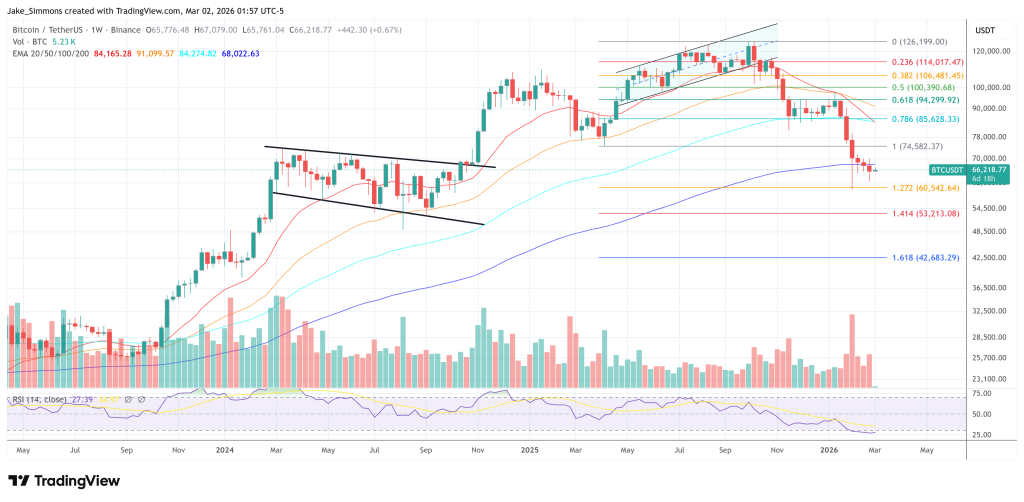
BTCUSD now trading at $65,919. Chart: TradingView

Iran-US War: Markets Stay Calm For Now

So far, the markets aren’t panicking. Stock futures dipped only slightly when trading opened Monday. Oil prices spiked at first, then pulled back, erasing nearly half the early gains. The S&P 500 shed less than 1%. Financial newsletter The Kobeissi Letter was blunt about it — this was no doomsday open.

Crypto social media told a different story in tone, if not in substance. Reports say mentions of “World War 3” spiked across platforms over the weekend, according to data from analytics firm Santiment.

But those numbers were still well below the levels recorded last June, when a prior round of Israeli strikes on Iranian nuclear and military sites led to nearly two weeks of direct conflict between the two countries.

A Pattern Worth Watching

Hayes himself is urging caution for now. He admits there’s no way to know how long Trump will stay committed to a costly military campaign in Iran, or how much market pain the administration can stomach before pulling back.

His advice to crypto investors is to wait — specifically for a concrete Fed rate cut or money-printing signal before making big moves.

“The time to back up the truck and buy Bitcoin,” he wrote, is right after the Fed acts, not before.

Featured image from Getty Images, chart from TradingView

Editorial Process for bitcoinist is centered on delivering thoroughly researched, accurate, and unbiased content. We uphold strict sourcing standards, and each page undergoes diligent review by our team of top technology experts and seasoned editors. This process ensures the integrity, relevance, and value of our content for our readers.

Riot, Core earnings, U.S. jobs report: Crypto Week Ahead

0

Earnings reports are still rolling in. This week Riot Platforms, the fourth-largest bitcoin miner by market cap, is due to report, as is Core Scientific, the No. 6.

Like many of their peers, the two are using their experience running large data centers and negotiating power-supply deals to expand into AI. Core, whose proposed $9 billion purchase by CoreWeave (CRWV) failed in October, barely mentions digital asset mining on its homepage. It will be interesting to see how much of its business still comes from that source.

Also due this week is the U.S. jobs report for February. The world’s largest economy is forecast to have added 60,000 nonfarm positions last month, according to the consensus estimate on Trading Economics.

Traders will also be monitoring the war in the Middle East, which has seen the U.S. and Israel strike Iran in what President Donald Trump called “major combat operations” targeting the country’s missile, naval and nuclear infrastructure.

Iran has retaliated with attacks on various countries in the region that host U.S. military bases. The conflict has been escalating with Iran-backed militias joining in. Trump has said it’s expected to last “four to five weeks,” so an earlier-than-expected truce could bring risk appetite back.

What to Watch

(All times ET)

  • Crypto
    • March 2: SuperRare to release Delirium, a new collection by artist Xer0x
    • March 2: Mantra’s OM token to change to MANTRA with a 1:4 coin split as the Mantra chain upgrades from v6 to v7.
    • March 3: SolCex mobile app to debut on Google Play and Apple’s App Store.
    • March 4: Qubic begins testing parallel dogecoin mining and AI training
  • Macro
    • March 2, 10:00 a.m.: U.S. ISM manufacturing PMI for February est. 52.3 (Prev. 52.6)
    • March 3, 5:00 a.m.: Eurozone inflation rate YoY flash for February (Prev. 1.7%); Core YoY (Prev. 2.2%)
    • March 3, 7:30 p.m.: Australia GDP growth rate QoQ for Q4 (Prev. 0.4%)
    • March 3, 8:30 p.m.: China NBS manufacturing PMI for February (Prev. 49.3)
    • March 4, 8:15 a.m.: U.S. ADP employment change for February (Prev. 22K)
    • March 4, 10:00 a.m.: U.S. ISM services PMI for February (Prev. 53.8)
    • March 4, 2:00 p.m.: U.S. Fed Beige Book
    • March 5, 8:30 a.m.: U.S. initial jobless claims for week ending Feb. 28 (Prev. 212K)
    • March 5, 8:30 a.m.: U.S. nonfarm productivity QoQ prel for Q4 (Prev. 4.9%)
    • March 5, 4:30 p.m.: U.S. Fed balance sheet update for period ending March 4
    • March 6, 8:30 a.m.: U.S. nonfarm payrolls for February Est. 60K (Prev. 130K)
    • March 6, 8:30 a.m.: U.S. unemployment rate for February (Prev. 4.3%)
    • March 6, 8:30 a.m.: U.S. average hourly earnings MoM for February (Prev. 0.4%)
    • March 6, 8:30 a.m.: U.S. retail sales control group MoM for January (Prev. 0.0%)
    • March 8, 8:30 p.m.: China inflation rate YoY for February (Prev. 0.2%)
  • Earnings (Estimates based on FactSet data)
    • March 2: Riot Platforms (RIOT), post-market, -$0.32
    • March 2: Core Scientific (CORZ), post-market, -$0.18
    • March 6: Metalpha (MATH), pre-market
    • March 9: Sharplink (SBET), pre-market, $0.31
    • March 11: Exodus Movement (EXOD), pre-market, $0.14

Token Events

  • Governance votes & calls
    • PoolTogether DAO is voting to manually resubmit and execute the remaining actions for the PTBR-35 governance shutdown after a previous execution error. Voting ends March 2.
    • Angle DAO is voting on an orderly wind-down of the EURA and USDA stablecoins, providing users a one-year 1:1 redemption period followed by a final settlement airdrop. Voting ends March 2.
    • GMX DAO is voting to transition to a defined leadership model by hiring a CEO with performance-tied compensation and forming an interim leadership committee to guide the restructuring. Voting ends March 2.
    • ShapeShift DAO is voting to appoint PTT as the Tokenomics Workstream Leader for a six-month term, compensated entirely in FOX tokens to eliminate stablecoin costs. Voting ends March 3.
    • Decentraland DAO is voting to explore the automatic execution of approved proposals and soft term limits for signer keys while maintaining emergency oversight. Voting ends March 3.
    • Uniswap DAO is voting across two linked proposals to expand v2 and v3 protocol fees to eight layer-2 networks and enable a new tier-based fee system across all v3 pools. Voting ends March 4 and 5.
    • ENS DAO is voting to replace three DNSSEC oracle algorithms to patch a critical RSA signature forgery vulnerability and significantly reduce gas costs. Voting ends March 4.
    • Gnosis DAO is voting to provide a grant to fund the continued support, infrastructure and maintenance of the Revoke.cash security platform. Voting ends March 5.
  • Unlocks
    • March 5: Ethena (ENA) to unlock 2.24% of its circulating supply worth $18.35 million.
    • March 6: Hyperliquid (HYPE) to unlock 2.72% of its circulating supply worth around $288.77 million.
  • Token Launches
    • March 8 or earlier: Chiliz (CHZ) to deploy revenue from the protocol to buyback and burn CHZ tokens.
    • March 8 or earlier: WhiteBit Token (WBT) to be listed on Kraken.

Conferences

Hong Kong links up with Shanghai trade authorities to put cargo data on blockchain

0

Hong Kong is doubling down on its role as China’s financial bridge, signing a new agreement with Shanghai authorities to build cross-border blockchain rails for cargo trade and trade finance.

The memorandum of understanding between the Hong Kong Monetary Authority, the Shanghai Data Bureau, and the National Technology Innovation Center for Blockchain, announced Monday afternoon in Hong Kong, formalizes plans to develop a shared digital platform linking trade data, electronic bills of lading, and financing systems.

The MoU signals growing adoption of bitcoin in real-world plumbing, targeting $1.5 trillion in annual cargo finance where paper work and jams still cost a lot in delays in fraud.

By plugging mainland cargo data into Hong Kong’s international-facing infrastructure, officials aim to reduce friction in cross-border trade while reinforcing the city’s status as the primary conduit between China and global capital markets.

Under the agreement, the parties will study the creation of a cross-border platform under the HKMA’s Project Ensemble framework. The initiative will explore the use of electronic bills of lading and blockchain-based documentation to streamline trade finance, while connecting with Hong Kong’s Commercial Data Interchange and CargoX to facilitate secure data sharing.

For Hong Kong, the move extends its digital asset strategy beyond tokenized green bonds and into the real economy. Instead of focusing solely on sovereign issuance or crypto markets, regulators are targeting the operational bottlenecks in cargo finance, where paper documents, fragmented data, and manual verification continue to slow credit decisions.

If successful, the platform could embed Hong Kong deeper into mainland supply chains while offering international investors and banks a compliant gateway to Chinese trade data. In doing so, the city is attempting to turn blockchain from a pilot project into core cross-border financial infrastructure.

South Africa Tax Collector Deploys New Tech to Track Crypto and Offshore Assets

0

South African crypto-asset service providers must now transmit detailed transaction data directly to the revenue collector, allowing for precise automated reconciliation and targeted audits. The End of the ‘Offshore Shield’ The South African Revenue Service (SARS) has, since March 1, used its most sophisticated tools to date to track crypto-assets and offshore financial interests. The […]

Aave Proposal Clears First Hurdle After Split Vote

0

Aave’s “Aave Will Win” framework has passed its Temp Check vote, clearing the first formal stage of the protocol’s governance process. 

On Sunday, the off-chain Snapshot vote closed with 52.58% voting in favor, 42% against and 5.42% abstaining. The result advances the measure to the Aave Request for Final Comment (ARFC) stage, where terms may be revised before any binding on-chain vote.

The framework asks tokenholders to approve up to $42.5 million in stablecoins and 75,000 Aave (AAVE) tokens for Aave Labs. In return, the organization would route 100% of revenue from Aave-branded products to the Aave DAO treasury under a DAO-funded operating model. 

The narrow margin highlights a divided governance base as the protocol considers structural changes to its funding, revenue alignment and long-term development. 

Aave DAO’s Temp Check voting results. Source: Snapshot

The ARFC stage will determine whether concerns raised during the debate will translate into revisions before a formal Aave Improvement Proposal is submitted on-chain. 

Split vote reflects ongoing governance tensions

Aave founder Stani Kulechov said in a post on X that the Temp Check brings the protocol closer to a “fully token-centric model,” adding that structural improvements will be incorporated at the ARFC stage based on community feedback.

Source: Stani Kulechov

Critics previously questioned the size of the funding package and the inclusion of 75,000 AAVE tokens, which carry voting power.

Others called for clearer definitions and stronger disclosure standards around governance holdings. 

Related: Grvt integrates Aave so traders can earn yield on perp collateral

On Feb. 25, competing reports from Aave Chan Initiative (ACI) founder Marc Zeller and Aave Labs offered contrasting interpretations of past funding and value creation ahead of the vote. 

The ACI published a transparency report reviewing Aave Labs’ historical funding, while Aave Labs outlined its role in building the protocol since 2017. 

What happens next in Aave governance process?

Under Aave’s governance framework, proposals typically move from Temp Check to ARFC before advancing to an on-chain Aave Improvement Proposal (AIP) vote. Only AIPs executed on-chain are binding. 

If the proposal advances beyond ARFC, tokenholders will vote on whether to formalize the DAO-funded model and ratify Aave V4 as the long-term technical foundation.

The outcome could reshape how the Aave ecosystem structures development, revenue and brand stewardship.