

When Beijing-based historian Jiang Xueqin warned in May 2024 that a second Trump term would lead the United States into war with Iran — and that America would ultimately lose — many dismissed it as academic theater, but two of his three headline predictions have since materialized. Strategic ‘Trap’ Theory Raises Questions About U.S. Military […]
Turkey’s ruling party unveils 10% crypto income tax proposal
Turkey’s ruling AK Party has introduced a sweeping economic bill in parliament that would formalize crypto taxation while revising a range of tax and spending rules.
The draft, now before the Turkish Grand National Assembly, would amend the Income Tax Law and Expenditure Taxes Law to create a new framework for cryptocurrencies, the country’s state news agency Anadolu Ajansı reports.
Crypto platforms regulated under the country’s Capital Markets Law would withhold a 10% tax on gains each quarter, regardless of whether the investor is an individual or company, resident or non-resident.
Service providers would also pay a 0.03% transaction tax on the sale amount or market value of crypto assets they broker.
Crypto brokers and other intermediaries would be on the hook for tax checks based on the records they keep. If a user provides wrong or incomplete information, tax authorities would pursue that person for any shortfall, the news outlet writes.
The bill also makes clear that key terms such as “crypto asset,” “wallet,” and “platform” carry the same meaning as in Turkey’s Capital Markets Law, tying the tax regime to existing financial rules.
The country’s president would also have the power to lower the 10% withholding tax to 0% or raise it to 20%, depending on the type of token, how long it was held, who issued it, or the type of wallet used.
The bill exempts crypto deliveries subject to the transaction tax from value-added tax (VAT) and excludes foundation university hospitals from corporate tax exemptions starting in 2027.
The crypto provisions would take effect two months after publication if approved.
Fundbank makes major investment in CASP applicant and blockchain fintech, Trrue

Dublin, Ireland, Monday 2nd March 2026 – The FundBank Group (“FundBank”) has announced today that it has made a significant investment in Trrue Chain (“Trrue”), as it continues its expansion of products and services to meet the demand for banking for digital assets.
Trrue, a Layer-1 blockchain, provides tailored, cutting-edge infrastructure for businesses and individuals. The addition of this key service demonstrates FundBank’s commitment to support digital assets as they gain prominence in institutional portfolios. FundBank is dedicated to meeting the rising demand for secure fiat banking and custody services, from diverse stakeholders in the digital asset space.
Derek Delaney, senior executive at FundBank, and founder of ComOp, the lead institutional investors in Trrue, commented, “ComOp has been a long-time admirer of the innovative approach to governance through blockchain developed by Trrue and this coupled with a VASP and, subject to approval, CASP license, makes it a very unique asset.
Ireland has seen a number of the institutional VASPs choose to convert to CASPs in other jurisdictions and this has left a gap in the market that will become apparent as CASPs mainstream the institutional holding of crypto and digital assets in funds. When one looks at the product offering of FundBank in Ireland allied to these crypto capabilities, Ireland is now able to provide the Fiat + Custody solution that is a competitive advantage for Ireland as a leading funds domicile. We view this as being as transformative as AIFMD was for the creation of institutional management companies. Again, we believe we can be the earliest adopters of institutional Fiat + Custody and, in time, will round this out to Fiat + Custody + Trading.”
Owen O Driscoll, CEO of Trrue commented, “Since founding Trrue in 2021, our focus has been on rebuilding the core architecture of finance. The systems the global economy relies on simply weren’t designed for the speed and demands of today.
This investment is an important milestone and a meaningful affirmation of our strategy. Our conviction has always been that this technology will fundamentally reshape the infrastructure of financial markets.
With this partnership, we are accelerating the build-out of infrastructure that enables institutional capital to move instantly and securely. Becoming part of the FundBank Group accelerates our evolution as an institutional platform and strengthens our ability to scale with the governance and rigor the market demands.”
About Trrue Chain
- Trrue builds secure, compliant digital asset solutions designed for a sustainable and impact-driven future. Trrue Chain, our Layer-1 blockchain, provides tailored, cutting-edge infrastructure for businesses and individuals.
- Trrue Chain ensures seamless adherence to various global regulations and offers compliant tokenisation for businesses in highly regulated industries.
- Our infrastructure and investment solutions effectively bridge the gap between responsible investors and socially-driven projects, fostering financial returns alongside positive societal change.
Qivalis in talks with crypto exchanges ahead of euro stablecoin launch
Qivalis, the group of European Union banks developing a MiCA-compliant euro stablecoin, is in advanced discussions with crypto exchanges, market makers and liquidity providers as it prepares to roll out in the second half of this year, Spanish business daily Cinco Días reported on Monday.
The group, which includes ING, UniCredit, BNP Paribas, CaixaBank and BBVA, wants to ensure the token is available on regulated trading platforms from day one to ensure liquidity, according to Qivalis CEO Jan Sell.
The initiative is designed to provide a European alternative to the U.S.-dominated stablecoin market, contributing to the EU’s strategic autonomy in payments, the banks said. A euro-pegged token would allow businesses and consumers in the bloc to make blockchain-based payments and settlements using euros, without relying on traditional financial rails or foreign third-party providers.
The Netherlands-based venture is considering European and international venues as it seeks to position the stablecoin as a regulated alternative to U.S. dollar-denominated tokens and a tool for real-time cross-border corporate payments.
Spanish crypto exchange Bit2Me confirmed it has held talks with one of the group’s banks, though most platforms declined to comment.
Qivalis did not immediately respond to a CoinDesk request for confirmation.
According to Cinco Dias, Qivalis also disclosed details about the token’s reserve structure. The stablecoin will be backed 1:1, with at least 40% of reserves held in bank deposits and the remainder allocated to high-quality, short-term euro-area sovereign bonds diversified across EU countries. The reserves will be held with multiple highly rated credit institutions, and the design includes 24/7 redemption for token holders.
The consortium is seeking authorization from the Dutch central bank under the EU’s Markets in Crypto-Assets (MiCA) framework.
Bitcoin miner turned Ethereum treasury firm stakes over $6B in ETH as BMNR shares slide and ether dips.
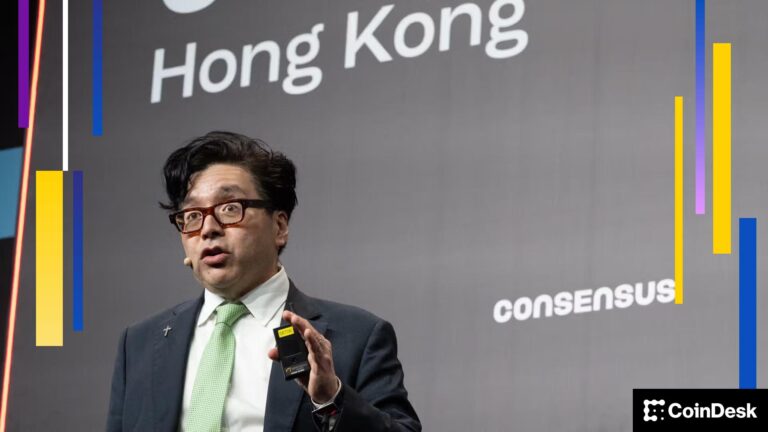
Bitmine Immersion Technologies (BMNR) on Monday reported purchasing nearly 51,000 more ETH tokens last week, increasing its holdings to 4.474 million.
“In the midst of this ‘mini crypto winter,’ our focus continues to be on methodically executing our treasury strategy and steadily acquiring ETH and in turn, optimizing the yield on our ETH holdings,” said Chairman Tom Lee.
The company said it now has 3,040,483 ETH staked, worth about $6 billion at current prices. Lee said annualized staking revenue stands at $172 million. At full scale, staking rewards could reach $253 million annually based on a 2.86% yield over the last seven days, Lee continued.
The company holds 4,473,587 ether (ETH), valued at $1,976 per token, along with 195 bitcoin and $868 million in cash, as well as a $200 million stake in Beast Industries and a $14 million investment in Eightco Holdings. Bitmine said its ether position represents 3.71% of Ethereum’s 120.7 million token supply.
Lee added that the firm is developing its Made in America Validator Network, or MAVAN, a staking platform slated for launch in early 2026. Bitmine said it is working with three staking providers as it builds the network.
BTC takes aim at $69,000 as stocks shrug of Iran strikes

Crypto prices are rebounding from their worst weekend levels in early U.S. trading on Monday alongside a sizable bounce in U.S. equity indices.
Roughly one hour into the session, the Nasdaq is down just 0.1% after futures at one point overnight had indicated a plunge of more than 2%. The S&P 500 and DJIA are also posting just very modest losses.
Gold remains higher by 2% and crude oil by 7%. The U.S. dollar index is having one of its strongest sessions in weeks, gaining 1%.
Bitcoin has moved up to $68,600, ahead 2.3% over the past 24 hours. Ether (ETH) is higher by 1.4%, with solana (SOL) and XRP (XRP) up similar amounts.
Crypto-related stocks are posting even larger gains, led by Circle’s (CRCL) 12% advance. Strategy (MSTR) is higher by 6% and Galaxy Digital (GLXY) by 4.7%.
On the macro side, the ISM manufacturing PMI came in at 52.4, marking another month of sector expansion and the first consecutive run of expansions since the fourth quarter of 2022. This follows Friday’s Chicago Business Barometer, which rose to 57.7 in February 2026 from 54 previously, well above expectations of 52.8. The reading signals only the second expansion since November 2023 and reflects the strongest pace of US activity growth since May 2022.
Against the backdrop of conflict in the Middle East, reaccelerating manufacturing activity, hotter-than-expected PPI data last week, and higher oil prices driven by geopolitical tensions, a March rate cut now appears effectively off the table ahead of the Federal Reserve’s March 18 meeting.
Northern Ireland Accelerates as Global Fintech and RegTech Hub

In an exclusive interview with Mark Walker, Editorial Director of The Fintech Times, Peta Conn, director for GB and Europe at Invest Northern Ireland, detailed how the region has evolved into a global leader for governance, risk, and compliance (GRC) and emerging technologies.

According to Conn, Northern Ireland’s success stems from a unique collaborative environment where industry, academia, and government bodies work in tandem to meet market demands.
A foundation of STEM talent
A primary driver of this rapid expansion is the region’s talent pipeline. Students in Northern Ireland consistently outperform those in other UK regions in academic achievement.
To illustrate the scale of this talent pool, Conn highlighted several key statistics:
- Almost half of the students at Northern Ireland’s higher education institutes are currently enrolled in broad STEM-related subjects.
- Approximately 5,500 students graduate annually in finance and technology-related disciplines.
- One in five people in the region now work in financial and professional services.
This workforce is further bolstered by the Department for the Economy and Invest Northern Ireland, which provide significant support for company-level and collaborative training programmes.
Specialised expertise in RegTech and GRC
Northern Ireland has carved out a distinct niche in RegTech. This is reinforced by the development of the North West City Region’s regulatory technology supercluster. Marking a global first, this initiative unites public bodies and researchers to tackle global challenges in sustainability, environmental, social, and governance (ESG) criteria, and artificial intelligence (AI).
“There is no aspect of governance, risk, and compliance that doesn’t exist within Northern Ireland,” Conn stated. She highlighted that local firms are delivering advanced, end-to-end solutions ranging from AI-driven client lifecycle management to immersive incident response training.
The local ecosystem features a strong blend of global giants and homegrown innovators. International players such as Citi, PWC, and Allstate operate closely alongside local leaders like FinTrU, FS.com, and Neueda Technologies.
Strategic advantage and competitive costs
Beyond its talent pool, Northern Ireland offers a highly strategic geographical advantage. It remains the only part of the UK to share a land border with the European Union.
This unique position allows businesses to operate within the UK’s robust regulatory framework while maintaining close proximity to Irish and European financial markets.
Furthermore, cost-efficiency is a significant draw for inward investment. Conn pointed out that operating costs in the region can be up to 40 per cent lower than in other Western European locations. This compelling value proposition has helped Northern Ireland lead the UK in growth for financial and related professional services, recording an annual average real growth rate of 3.2 per cent.
Future growth and AI innovation
Looking ahead, the region is doubling down on artificial intelligence. This effort is being spearheaded by the Artificial Intelligence Collaboration Centre (AICC). Led by Ulster University in partnership with Queen’s University Belfast, the AICC focuses on increasing the adoption of AI technologies across the business landscape, driving technical expertise in areas like fraud detection and cloud computing.
“We are continually looking at what the global financial industry needs in order to move forward,” Conn added, emphasising that the sector remains a top economic priority for the government.
To ensure the region maintains its trajectory as a high-growth fintech hub, Invest Northern Ireland has launched a new three-year strategy designed to further drive innovation and productivity.
You can watch the full video interview with Peta Conn on The Fintech Times YouTube channel
Strategy Adds 3,015 Bitcoin as Holdings Top 720,737 BTC
Michael Saylor’s Strategy, the world’s largest public holder of Bitcoin, completed its 101st Bitcoin purchase, pushing its total holdings above 720,000 BTC.
The company acquired 3,015 Bitcoin (BTC) for $204.1 million last week, according to a US Securities and Exchange Commission filing on Monday.
The average buy price of its latest purchase was $67,700 per BTC, marking another purchase well below the company’s average acquisition price of $75,985.
The purchase brings its holdings to 720,737 BTC, acquired for a total cost of about $54.8 billion, the company disclosed.
Another buy below Strategy’s cost basis
The latest buy is one of a small number of Strategy purchases made below the company’s average cost basis, according to data compiled by SaylorTracker, a website that tracks Strategy’s bitcoin acquisitions.
The first such purchase occurred on Feb. 9, when the company bought 1,142 BTC as market prices dipped below $76,051 during the week. Strategy reported the average acquisition price of that batch at $78,815, above the market price at the time.

Strategy encountered a similar situation around 2022-2023, when BTC price dipped below its cost basis of around $30,600. The company completed a total of seven purchases of 28,560 BTC during that below-cost period.
MSTR shares rise modestly while Bitcoin trades near $65,800
Strategy (MSTR) shares saw some upward momentum last week, rising from around $125 on Monday to nearly $130 by Friday, according to TradingView.
Bitcoin, however, remained largely flat over the same period. The crypto asset started the week near $65,000, briefly surged above $69,000 on Wednesday, and dipped below $64,000 before stabilizing. At the time of publication, Bitcoin was trading at $65,834, according to TradingView.
Related: Strategy yield wrapper lands in Europe as 21Shares lists STRC ETP
The news came after Strategy chairman Saylor announced on Sunday that the company is raising the dividend on its STRC preferred stock, also known as “Stretch,” to 11.50% for March 2026, from the previous 11.25%.
The capital raised through the stock can be used for corporate purposes, including potential Bitcoin acquisitions.
Magazine: 6 massive challenges Bitcoin faces on the road to quantum security
Cointelegraph is committed to independent, transparent journalism. This news article is produced in accordance with Cointelegraph’s Editorial Policy and aims to provide accurate and timely information. Readers are encouraged to verify information independently. Read our Editorial Policy https://cointelegraph.com/editorial-policy
Iranian crypto outflows jump 700% minutes after airstrikes, Elliptic says

Crypto outflows from Iran’s largest exchange jumped 700% within minutes of the first U.S.-Israeli airstrikes on Tehran, blockchain analytics firm Elliptic said in a Monday blog post.
Elliptic said transaction volumes leaving Nobitex spiked almost immediately after the strikes, suggesting a rush to move funds offshore. Initial blockchain tracing indicates the crypto was sent to overseas exchanges that have historically received significant inflows from Iran.
The activity “potentially represents capital flight from Iran that bypasses the traditional banking system,” according to Dr. Tom Robinson, Elliptic’s co-founder and chief scientist.
Over the weekend, coordinated U.S. and Israeli airstrikes struck multiple targets in Iran, killing Supreme Leader Ayatollah Ali Khamenei and escalating a wider Middle East conflict. The attacks stoked market volatility as investors priced in potential disruptions to oil supplies through the strategic Strait of Hormuz, sending global crude prices sharply higher and triggering broad sell-offs in equities and safe-haven buying across assets.
Nobitex allows users to convert Iranian rials into crypto and withdraw funds to external wallets, offering a route around traditional banking channels.
The exchange processed $7.2 billion in crypto transactions in 2025 and claims more than 11 million users, making it central to Iran’s digital asset ecosystem, Robinson said.
Elliptic has previously linked the exchange to IRGC-aligned financial activity and reported in January that Iran’s central bank appeared to use Nobitex in efforts to support the weakening rial.
Iran’s crypto ecosystem
Previous reports have detailed Iran’s growing use of cryptocurrencies as a hedge against a weakening rial and as a potential workaround to international sanctions, with U.S. authorities probing whether digital-asset platforms have enabled state-linked actors to move funds and access hard currency outside the traditional banking system. Blockchain research cited in those reports estimates that Iran-linked crypto activity has reached into the billions of dollars annually, spanning retail users as well as, according to officials, sanctioned entities.
Robinson also flagged additional surges in Iranian crypto outflows earlier this year. The largest came on Jan. 9, following widespread anti-regime demonstrations and a subsequent government-imposed internet blackout.
Two additional surges followed U.S. sanctions announcements targeting Iranian actors, the report said, suggesting crypto may be used to mitigate the impact of sanctions.
Bitcoin and major altcoins dropped sharply in the immediate aftermath of the strikes, with BTC briefly falling below $64,000 before recovering to the mid-$60,000s, underscoring crypto’s sensitivity to geopolitical tensions. Ether (ETH) and other tokens also declined, though several remained above pre-strike levels, pointing to a relatively swift rebound after the initial sell-off.
The world’s largest cryptocurrency was over 2% lower at publication time, trading around $65,500. Ether, the second-largest crypto by market cap, was 3.8% lower at around $1,930.
Read more: Iran crisis puts the regime’s $7.8 billion crypto shadow economy in spotlight
NEAR Protocol (NEAR) jumps 12.4% over weekend
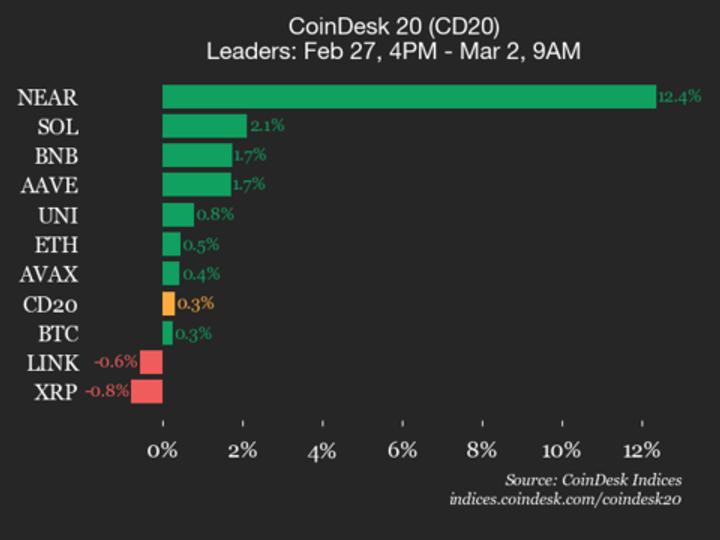
CoinDesk Indices presents its daily market update, highlighting the performance of leaders and laggards in the CoinDesk 20 Index.
The CoinDesk 20 is currently trading at 1907.12, up 0.3% (+5.99) since 4 p.m. ET on Friday.
Eight of the 20 assets are trading higher.
Leaders: NEAR (+12.4%) and SOL (+2.1%).
Laggards: DOT (-7.3%) and BCH (-4.5%).
The CoinDesk 20 is a broad-based index traded on multiple platforms in several regions globally.