T. Rowe Price has brought what it said is the industry’s first actively managed multi-token spot crypto exchange-traded fund (ETF) to the market.
The T. Rowe Price Active Crypto ETF (TKNZ) began trading on Thursday, giving investors exposure to a portfolio of crypto assets rather than a single token. The launch marks a milestone for the Baltimore-based asset manager, which oversees $1.9 trillion in assets, as it expands its product lineup into digital assets.
Unlike the spot bitcoin BTC$64,069.72 and ether (ETH) exchange-traded funds that have dominated the market over the past two years, TKNZ is designed to hold a diversified basket of cryptocurrencies, including bitcoin, ether, BNB, XRP, solana (SOL) and Hyperliquid (HYPE), among other digital assets.
The fund also differs from most crypto investment products because it is actively managed. Instead of tracking a fixed index, portfolio managers can adjust allocations based on market conditions, research and risk assessments. T. Rowe Price said the strategy is intended to capture changes in market leadership and momentum as capital rotates among different cryptocurrencies.
These had accompanied two straight days of lower-than-expected US inflation data, with both the Consumer Price Index (CPI) and Producer Price Index (PPI) dropping in June.
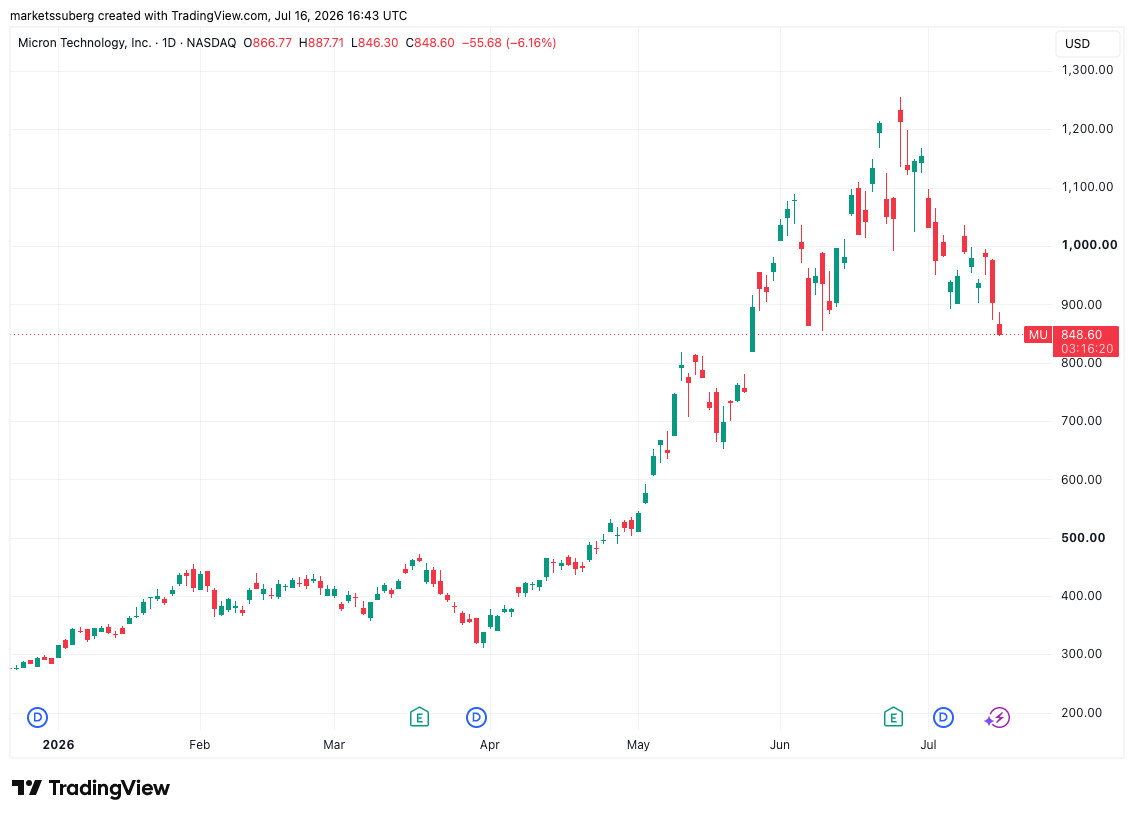
While crypto and equities initially gained, tech stocks came under pressure on Thursday, with the closely-watched Micron Technologies down 15%.
“Micron is now down over -30% since its June 22nd record high,” trading resource The Kobeissi Letter commented in a response on X.
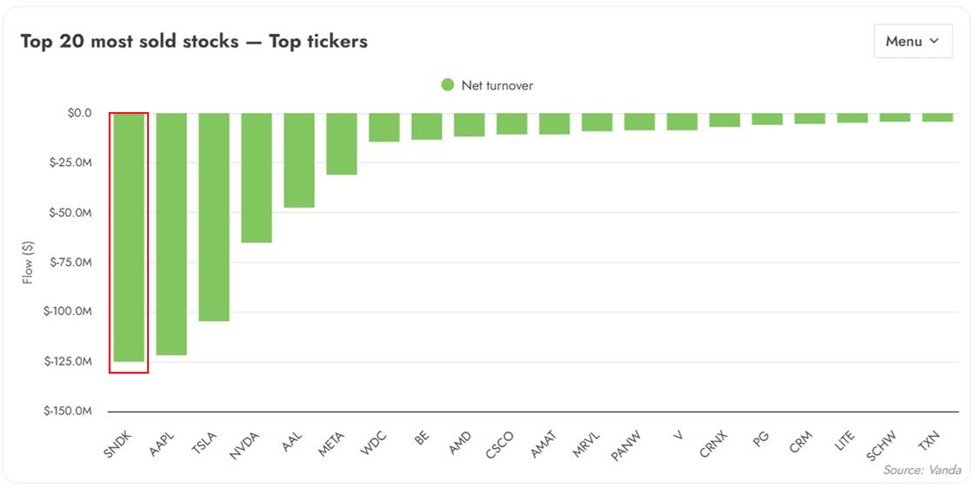
Kobeissi additionally noted profit-taking in action by retail tech-stock investors, with sales of Tesla and Apple hitting $200 million over the past two weeks.
“Meanwhile, the total retail turnover in single stocks rose to a record $370 billion, up from $220 billion at the start of 2026,” it continued.
“Retail investors are locking in gains following a historic tech rally.”
Retail investor equity sales data. Source: The Kobeissi Letter/X
Earlier, Cointelegraph reported on Bitcoin speculators cashing in on the recent local highs.
“Rejection” becomes new BTC price keyword
Turning to BTC price action itself, the mood among market participants remained conservative on the day.
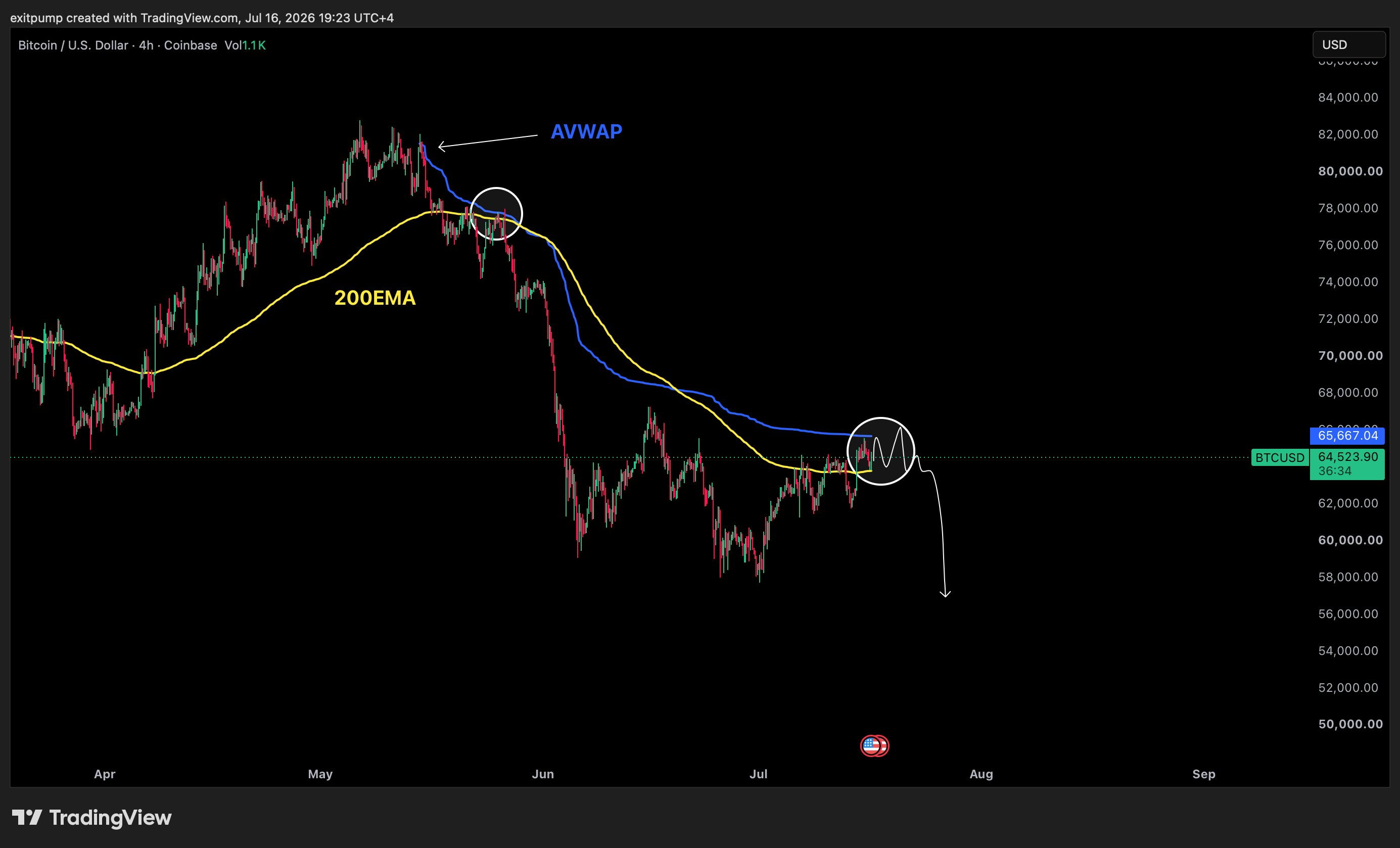
Commentator Exitpump flagged anchored volume-weighted average price (AVWAP) as measured from Bitcoin’s run to $82,000 in early May, as the level to end the current rebound.
“Price is finally going to retest the AVWAP from 82K top that lead to strong local downtrend. To me such retest should cap the upside and give stronger rejection,” they told X followers.
BTC/USD four-hour chart. Source: Exitpump/X
Trader and analyst Rekt Capital argued that BTC/USD was “showing initial signs of rejection” from its 50-month exponential moving average (EMA) at $65,900.
Rekt Capital reiterated the concept of current price behavior copying the 2022 bear market, having already warned that the next macro bottom would not come until later in the year.
But this time, with a twist: Earlier this week, macroeconomist and all-round Bitcoin legend Lyn Alden announced Orange Juice — an investment firm that aims to buy, improve and get businesses on a Bitcoin standard.
The idea is that Orange Juice will buy small and mid-sized businesses at low prices, improve their operations, and hold them indefinitely rather than reselling them.
A portion of the businesses’ profits will get converted into Bitcoin, which serves as the company’s treasury asset.
“Pure-play Bitcoin holding companies exist, but their cash-flowing operations tend to be small or non-existent,” Alden wrote in a blog post.
She added: “Orange Juice instead will emphasize building a strong and diversified base of cash flows, with a portion of the retained earnings of its businesses accumulating into a Bitcoin treasury.”
Ego Death Capital partners Jeff Booth, Lyn Alden, Nico Lechuga, Andi Pitt founded the company along with Adrian Steckel and Ruben Zweiban, while Mexican billionaire Ricardo Salinas participated as the anchor investor, a Wednesday announcement read.
Salinas — one of Mexico’s richest men — has long-praised Bitcoin and last month admitted he had increased his allocation in the asset from 10% to 70% of his portfolio.
It added that the company had already raised $40 million and intends to pursue a public listing in the future.
“Over the coming decades, a significant wave of business successions will take place,” the announcement said. “Unlike traditional private equity, Orange Juice is not constrained by fund cycles or the pressure to resell, allowing it to focus on the long-term health of its businesses.”
JUST IN: 🇺🇸 Lyn Alden’s ‘ORANGE JUICE’ Raises $40 million to launch a permanent capital holding company backed by a BTC treasury 👀
“It’s a company that acquires, improves, and permanently holds cash-flowing businesses, backed by a bitcoin treasury” – Lyn Alden🚀 pic.twitter.com/A8kyVpIVVx
— Bitcoin Magazine (@BitcoinMagazine) July 15, 2026
Bitcoin treasury craze
The announcement comes at a time when Bitcoin treasuries have taken a hit: the business model — of buying and holding Bitcoin and other digital assets with spare cash — suffered last year with a plunge in crypto prices.
Strategy, the biggest and oldest Bitcoin treasury, has seen its Nasdaq-listed stock nosedive by nearly 80% over the past year.
Little known publicly traded companies in 2025 rushed to announce they were buying digital assets in a hope to boost their stock prices. The strategy worked but since the market downturn, a number of firms in the space have had to sell a portion of their holdings.
There are currently over 360 digital asset treasuries, according to BitcoinTreasuires.net, made up of private and public entities holding a variety of digital assets.
ARK Invest’s director of research disputed a16z crypto’s thesis that traditional finance will adopt permissioned blockchain infrastructure instead of decentralized finance, saying institutions will increasingly rely on DeFi rails.
Breez has partnered with Turnkey to let developers add non-custodial bitcoin to applications that run wallets from their own servers, the companies announced.
The partnership addresses a structural problem. Many mainstream apps operate from the backend, with a single service handling millions of users. Adding bitcoin under that design has meant holding user keys on company servers.
Holding keys makes a company a custodian, a status that carries licensing requirements, legal liability, and the security burden of a large store of user funds. The alternative has been to build a separate device-based wallet, a change that breaks the architecture these apps use to reach scale.
Under the new model, each user receives a wallet whose keys are created and stored inside Turnkey’s secure enclaves. According to the companies, those keys stay out of reach of the app’s servers, Breez, and Turnkey. The company’s backend holds a credential that defines what actions it can take, while authority to move funds rests with the user.
In other words, this partnership positions some of the world’s largest consumer apps to add non-custodial bitcoin without rebuilding their backend architecture or taking custody of user funds.
Turnkey supports Spark, the network the Breez SDK is built on. Paired with Breez’s server mode, a single backend can manage wallets for millions of users without storing keys.
The approval flow works as follows. The user holds a credential, such as a passkey registered with Turnkey at signup. The server prepares a transaction and displays the amount, the fee, and the destination.
The user approves the transaction, and it completes. The server cannot spend funds without that approval. For the user, the app’s existing flow does not change, and there is no seed phrase to record.
Turnkey provides embedded wallet infrastructure used by a range of consumer apps and holds a SOC 2 audit. In a note to Bitcoin Magazine, Breez positioned the release as a way for exchanges, fintechs, and neobanks to offer bitcoin and stablecoin services to large user bases without taking custody of funds.
Exchanges can automate payouts under rules their security teams define, and fintechs can add a non-custodial bitcoin service inside their existing interface.
The partnership extends a series of Breez SDK features aimed at lowering barriers to bitcoin integration. Passkey Login replaced the seed phrase, Stable Balance addressed price volatility, and a separate feature added support for sending the stablecoins USDT and USDC. The companies say the combined tools let backend-run products offer bitcoin and stablecoins to users while custody of the assets stays with those users.
Keyrock, a digital-asset services firm, acquired the trading and brokerage assets of BlockFills’ institutional digital asset business, bolstering its push into institutional crypto markets, the company said in a press release Thursday.
The completed transaction adds BlockFills’ client relationships, trading technology and derivatives expertise to Brussels-based Keyrock’s existing businesses spanning market making, over-the-counter (OTC) trading, options, credit, onchain services and asset management.
CoinDesk reported in June that Keyrock was in the process of acquiring Chicago-based crypto trading and lending firm Blockfills. According to a bankruptcy filing, Keyrock agreed to pay $3.25 million for substantially all of BlockFills’ assets, while assuming certain liabilities, equity interests, customer relationships and proprietary technology.
The acquisition broadens Keyrock’s regulatory reach through a CIMA-registered entity in the Cayman Islands and the proposed acquisition of an FCA-authorized entity in the U.K., subject to regulatory approval.
The company said the combined platform will offer institutional clients enhanced execution capabilities backed by Keyrock’s balance sheet and regulatory infrastructure.
Cointelegraph is committed to providing independent, high-quality journalism across the crypto, blockchain, AI, and fintech industries.
All news, reviews, and analyses are produced with full journalistic independence and integrity. For more details on our standards and processes, please read our Editorial Policy.
Ledger said is bringing its hardware security model to the fast-growing world of AI agents with the launch of Ledger Agent Stack, an open-source toolkit that allows autonomous software to interact with crypto wallets without ever controlling private keys.
The toolkit lets AI agents read wallet balances, analyze portfolios, prepare transactions and propose payments, but requires every sensitive action to be explicitly approved on a Ledger hardware device before it can be executed.
This is the first product release under Ledger’s 2026 AI roadmap, as the hardware wallet maker bets that human oversight will become a critical security layer as AI agents take on increasingly complex financial tasks.
“Agents propose. Humans approve,” the team wrote in their press release shared with CoinDesk. “Crypto wallets have protected billions on this standard for years,” said Ian Rogers, Ledger’s chief human agency officer, in the press release. “Ledger Agent Stack allows your agent to use these wallets just as easily as humans.”
President Donald Trump said in January he had no plans to pardon Bankman-Fried. He has cleared Binance founder Changpeng Zhao and Silk Road creator Ross Ulbricht, along with other white-collar offenders.
Bankman-Fried ran two companies at once. FTX was a crypto exchange, which holds customer money the way a broker does and is not supposed to touch it. Alameda Research was a trading firm he also owned. He moved billions of dollars in FTX customer deposits to Alameda, which spent the money on trades, venture investments, political donations, and Bahamian real estate, while FTX’s software exempted Alameda from the rules that would have forced it to cover its losses like any other trader.
The facade was blown open after CoinDesk obtained Alameda’s balance sheet in November 2022 and found that most of what the firm counted as assets was FTT – a token FTX had created itself and could issue at will.
The collateral propping up Alameda was, in effect, something its sister company had invented. Further cracks emerged after the prominent exchange Binance said, days later, it would sell its FTT holdings, leading to a rapid collapse in FTT prices.
Customers rushed to pull their deposits, and FTX could not return the money because it was no longer there. The exchange filed for bankruptcy on Nov. 11, 2022, just over a week after the story ran.