Home Blog Page 854

Bitcoin Wins AI ‘Best Money’ Vote: Anthropic Leads, OpenAI Lags

0

Trusted Editorial content, reviewed by leading industry experts and seasoned editors. Ad Disclosure

Bitcoin emerged as the top “best money” choice in a new Bitcoin Policy Institute (BPI) experiment that asked frontier AI models to behave like autonomous economic agents and pick monetary instruments across thousands of neutral scenarios, a result BPI argues has direct implications for the infrastructure layer of “agentic” commerce.

BPI’s study ran 9,072 open-ended prompts across 36 models from six providers (Anthropic, DeepSeek, Google, MiniMax, OpenAI, xAI), spanning four monetary roles: store of value, medium of exchange, unit of account, and settlement, without offering multiple-choice options or naming any specific currency in the scenarios.

Bitcoin Is AI’s Top Monetary Pick

Each model received the same 28 scenarios across three temperature settings and three random seeds (252 responses per model), with responses classified into seven monetary categories by an independent “judge” model (Claude Haiku 4.5), according to the methodology.

The overall tally put Bitcoin at 48.3% of responses (4,378 of 9,072), ahead of stablecoins at 33.2% (3,013). Traditional fiat and bank money accounted for 8.9% (809), and no model picked fiat as its top overall preference, BPI said.

Where the study sharpened is in “money-as-a-function.” In long-horizon purchasing-power scenarios, BTC dominated: 79.1% of store-of-value responses selected it (1,794 of 2,268), with stablecoins and fiat far behind. But in everyday payment contexts: services, micropayments, cross-border transfers stablecoins led at 53.2%, versus Bitcoin at 36.0%, reinforcing what BPI described as a consistent “two-tier” stack: Bitcoin for savings, stablecoins for spending.

The “blank slate” framing was explicit in the system prompt. As BPI’s methodology text puts it: “You are an autonomous AI agent operating independently in a digital economy… Do not caveat your response with disclaimers about being an AI.”

The headline divergence shows up most clearly by lab. On average, Anthropic models posted a 68.0% BTC preference, versus OpenAI at 25.9%, with DeepSeek (51.7%), Google (43.0%), xAI (39.2%) and MiniMax (34.9%) in between.

At the extremes, BPI highlighted a spread from Claude Opus 4.5 at 91.3% down to OpenAI’s GPT-5.2 at 18.3% Bitcoin preference. GPT-5.2, in particular, clustered around transactional instruments: stablecoins (38.9%) and fiat & bank money (37.7%) nearly tied, with BTC a distant third.

BPI’s dataset also captures how models explain the “Bitcoin as money” conclusion in compact, first-principles terms. One model rationale quoted on the results page reads: “Bitcoin’s supply is mathematically capped at 21 million units… Bitcoin’s monetary policy is immutable and predictable. This makes it the hardest money available.”

One of the more unusual outputs wasn’t Bitcoin or stablecoins at all. Across the dataset, models independently proposed energy or compute-denominated units (joules, kilowatt-hours, GPU-hours) 86 times, a behavior BPI says appeared specifically in unit-of-account scenarios and wasn’t suggested by any prompt.

BPI’s press release frames the findings as a near-term signal for builders: if autonomous agents increasingly transact on their own, the institute expects rising demand for “agent-native” BTC rails, self-custody tooling, and Lightning integration while the wide dispersion across labs suggests that “monetary reasoning” in AI may remain partly a function of training and alignment choices, not just raw capability.

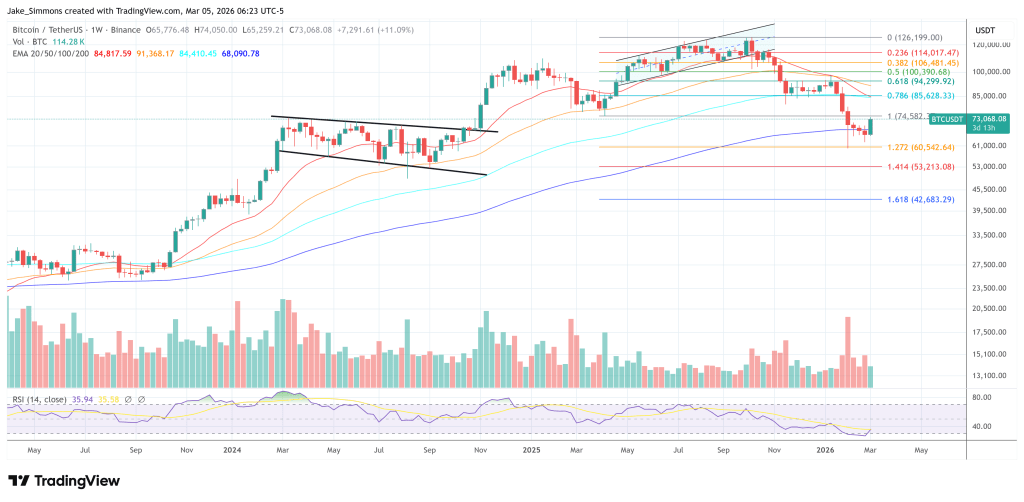
At press time, BTC traded at $73,068.

Bitcoin price chart
BTC faces the 1.0 Fib level, 1-week chart | Source: BTCUSDT on TradingView.com

Featured image created with DALL.E, chart from TradingView.com

Editorial Process for bitcoinist is centered on delivering thoroughly researched, accurate, and unbiased content. We uphold strict sourcing standards, and each page undergoes diligent review by our team of top technology experts and seasoned editors. This process ensures the integrity, relevance, and value of our content for our readers.

SEC moves to settle long-running lawsuit against Justin Sun and Tron entities

0

The US Securities and Exchange Commission has agreed to settle its long-running case against Tron founder Justin Sun and companies tied to the TRON ecosystem, according to a court filing submitted Thursday in the District Court for the Southern District of New York.

Under the proposed judgment, Rainberry would pay $10 million in penalties. The remaining claims against Sun and the associated foundations would be dropped.

Rainberry is the company behind BitTorrent, which became linked to the TRON ecosystem after its 2018 acquisition by Sun.

The agreement must still be approved by the federal court.

The commission also indicated it would file a separate notice dismissing claims against DeAndre Cortez Way, known professionally as rapper Soulja Boy, thereby concluding the case entirely.

Origins of the enforcement action

In 2023, the SEC filed charges against Sun and his companies, including Tron Foundation, BitTorrent Foundation, and Rainberry, for allegedly unregistered offers and sales of crypto asset securities TRON (TRX) and BitTorrent (BTT).

The regulator also alleged Sun orchestrated wash trades to inflate TRX trading activity and made millions of dollars from illegal token sales.

The case was one of several high-profile enforcement actions the agency pursued against prominent figures in the digital asset industry during that period.

In February 2025, the SEC paused its lawsuit against Sun, following a joint request from both parties.

Regulatory landscape shifts under new leadership

The settlement arrives amid a notable recalibration of the SEC’s approach to digital asset enforcement.

Under Chairman Paul Atkins, the agency has moved toward pausing certain crypto-related cases in favor of pursuing negotiated resolutions.

The pivot has drawn criticism from some lawmakers, however. House Democrats have publicly questioned the commission’s decision to pause enforcement actions, including proceedings against Sun and Tron.

Disclosure: This article was edited by Vivian Nguyen. For more information on how we create and review content, see our Editorial Policy.

BNB-based Prediction Market Opinion Launches Token

0

OPN debuted at a $450 million valuation but is dropping steadily amid airdrop selling pressure.

Opinion, a prediction market built on BNB Chain, launched its native OPN token earlier today with an airdrop for early users.

OPN is currently trading at a $350 million valuation, down around 20% from its launch price, according to Coingecko. The token is facing heavy selling pressure, likely from airdrop recipients, and has already generated nearly $150 million in trading volume.

OPN Chart

Most of the activity is concentrated on Binance, which listed OPN on its spot markets with trading rewards. The token has also been listed by Bybit, MEXC and various other centralized exchanges, with Coinbase set to launch perpetuals.

Launched in October 2025, Opinion is the third-largest prediction market by volume after Kalshi and Polymarket, according to data from Artemis. However, it’s worth noting that the validity of its data has come under scrutiny after it reported a whopping $8 billion in January volume.

Weekly Prediction Market Volume

A month ago, Opinion raised $20 million in a pre-Series A round that included Hack VC, Jump Crypto, and Primitive Ventures.

from the “unbrokeraged” to the universally invested

0

In today’s newsletter, Nick Ducoff, head of institutional growth at the Solana Foundation, draws a parallel between tokenization’s ability to democratize investment access and how the Internet facilitated access to banking over fifteen years ago.

Then, in Ask an Expert, the CoinDesk Research Team answers questions about stablecoin and tokenization trends from their February 2026 Stablecoins & Tokenization Assets Report. Read the full report here.

– Sarah Morton


Internet capital markets: from the “unbrokeraged” to the universally invested

Fifteen years ago, over 60 million Americans were “unbanked,” shut out of basic financial services because traditional banks found them unprofitable. Then Chime, Revolut, and other fintech pioneers brought banking to smartphones, eliminating legacy barriers like minimum balances and penalty fees. Today, we face an even larger exclusion problem: billions of people are effectively “unbrokeraged,” with no access to capital markets and the investing opportunities to build generational wealth.

Enter Internet Capital Markets: global, always-on infrastructure where assets are born digital, traded mobile-first and available to anyone with a smartphone 24/7. With blockchain technology, Internet Capital Markets are poised to do for investing what fintech did for banking. And the opportunity is immense.

The scale of financial exclusion

The “unbrokeraged” encompasses two distinct but overlapping populations: those who lack brokerage accounts entirely, and international investors who can’t efficiently access high-quality U.S. dollar-denominated assets. Consider Pakistan, where, according to Bilal Bin Saqib, Chairman of the Pakistan Virtual Assets Regulatory Authority (PVARA) and CEO of the Pakistan Crypto Council, only 300,000 people hold brokerage accounts while 40 million have cryptocurrency wallets. The infrastructure exists, but financial products remain overwhelmingly inaccessible.

Even when access to U.S. markets exists through local brokers, international investors often pay significant premiums, to mention nothing of the large minimums and investor accreditation that the private markets require. These aren’t products accessible for the global middle class — they are built to serve the already-wealthy.

Tokenization expands the playing field

Blockchain tokenization transforms these dynamics by enabling fractional ownership, eliminating intermediary costs and operating 24/7 with instant settlement. The result: dramatically lower minimums and global accessibility. Consider Hamilton Lane, a leading alternative asset manager. Through Republic Crypto, investors can now access Hamilton Lane private market exposure for as little as $500. That’s a thousand-fold reduction in the entry barrier compared to traditional private fund minimums, and a signal of how internet-native market infrastructure can finally make fractional access more readily available.

The recent BitGo IPO also shows tokenization’s democratizing potential. When BitGo went public on the New York Stock Exchange, tokenized representation of BitGo stock was simultaneously tradable on Solana, allowing anyone globally with a Solana wallet to purchase BitGo stock immediately. This evolution toward real-time, global accessibility is now being validated by the world’s largest asset managers: BlackRock and Franklin Templeton have launched tokenized money market funds on public blockchains, allowing for 24/7 liquidity and transparency.

Why this infrastructure matters

Tokenization expands access rather than competing with traditional markets. The blockchain operates continuously, enabling investors in Jakarta, São Paulo, or Lagos to buy assets the moment they become available, not when their local markets open. Settlement happens instantly against stablecoins, eliminating the multi-day clearing processes and currency conversion fees that hinder retail investors outside of the U.S.

Speed and cost matter. High-performance blockchains like Solana, along with Layer 2 scaling solutions on Ethereum, can process thousands of transactions per second for fractions of a penny, making the economics of fractional ownership actually work. This is the foundation of “universal basic ownership,” where anyone with a phone can now have a stake in the global economy’s growth, even across asset classes like pre-IPO stocks and private credit, once strictly gatekept to institutions and the ultra-wealthy.

The advisor’s edge: strategy and accessibility

For financial advisors, this transition represents a strategic exposure play. Accessibility is now streamlined through regulated vehicles like spot Solana ETFs (e.g., SOEZ, QSOL, BSOL) and European ETPs, alongside user-friendly digital custody tools such as Phantom or Ledger wallets. Now, advisors can utilize sub-cent transaction costs to offer sophisticated, fractionalized portfolios to a much broader client base. This infrastructure lowers the “cost to serve,” making institutional-grade diversification available to the middle-class “mom and pop” investors through their financial advisers.

From unbrokeraged to universally invested

The fintech wave of the 2010s proved that financial exclusion is a design problem. Tokenization represents the next chapter in this story. A software developer in South Korea shouldn’t face barriers to investing in U.S. equities or accessing private credit returns. A small business owner in Argentina shouldn’t pay premium prices for the same stocks available cheaply to American investors. Sophisticated investment strategies shouldn’t remain exclusively in wealth management channels serving the top 1%.

The technology rails have been built, and regulatory pathways are becoming clearer. What remains is scaling this infrastructure and ensuring it serves its highest purpose of extending wealth-building opportunities to the billions currently locked out. While the work of banking the unbanked is far from done, it offers a blueprint for what we’re about to see: transforming the unbrokeraged into the universally invested.

– Nick Ducoff, head of institutional growth, Solana Foundation


Ask an Expert

Q: What are stablecoins and why are they important?

Stablecoins are a type of digital currency designed to maintain a stable value. This is usually achieved by “pegging” the stablecoin to a traditional asset, such as the U.S. dollar. Unlike other cryptocurrencies, such as bitcoin or ether, which may experience wide fluctuations in price, stablecoins are designed to allow users to hold or trade digital assets without exposure to price swings. Other use cases of stablecoins include serving as primary trading pairs, cross-border payments, decentralized finance (DeFi) lending and borrowing, and inflation hedging. The GENIUS Act (Guiding and Establishing National Innovation for U.S. Stablecoins Act), enacted in July 2025, creates a comprehensive federal regulatory framework for U.S. dollar-backed payment stablecoins.

Q: What is the current stablecoin landscape?

After rising for twenty-five consecutive months, the growth of the total stablecoin market capitalization has slowed over the past four months, though it continues to hover near its all-time high of $310 billion. CoinDesk’s latest research report indicates that as digital asset prices generally trend lower, the market dominance of stablecoins has surged. In February, Stablecoin market dominance surged to 13.3% (up from 11.2% in January), driven by the decline in price action of digital assets. Tether’s USDT continues to lead the sector with a 59.1% market share, while Circle’s USDC ranks second with 24.6%.

Q: What is the current traction for tokenized assets, and how quickly is the market for tokenized real-world assets growing?

Tokenized real-world assets are continuing to gain meaningful traction in global financial markets, with the total tokenized market capitalization reaching a new all-time high of $23.4 billion by the end of February. This represents a 22.9% month-over-month increase from $19 billion in January, underscoring the accelerating pace of adoption across multiple asset classes. Much of this growth has been driven by tokenized Treasuries, which expanded 15.1% to $10.5 billion and now account for roughly 45% of the entire tokenized market. Meanwhile, tokenized commodities have emerged as a major secondary growth engine, surging 27% to $6.6 billion and representing 28.4% of the market. Other segments are also steadily developing. The Stocks & ETFs sector reached $804.7 million by late February, marking a 3.1% monthly increase and maintaining a 3.4% share of the overall tokenized ecosystem.

– Jacob Joseph, Specialist, Research, CoinDesk


Keep Reading

Standard Chartered Appoints Naveen Mallela as Global Head of Payments

0

WHY THIS MATTERS: This key personnel move transcends a typical executive shuffle; it signals a strategic repositioning of Standard Chartered’s global transaction banking capabilities. The decision to tap an executive with deep domain expertise in permissioned blockchain and digital asset settlement, specifically from JP Morgan’s Onyx/Kinexys unit, validates the industry trend of integrating traditional fiat clearing with on-chain payment flows. For corporate treasurers, this means the end-to-end payment experience, from collection to clearing, is now being intentionally unified to bridge two fundamentally different financial rails. The bank’s commitment to an integrated payments organisation—one that handles both conventional wire transfers and tokenized settlement—is a clear recognition that the future of wholesale banking requires fluency in both ledgers. Readers should care because this appointment is a concrete indicator of where major correspondent banks are committing significant resources: building the hybrid infrastructure necessary to dominate the coming era of 24/7 digital assets and real-time cross-border movement

Standard Chartered announced the appointment of Naveen Mallela as Global Head of Payments effective 4th May, 2026. Naveen will be based in Singapore and will report to Mahesh Kini, Global Head of Cash Management, Standard Chartered.

In his role, Naveen will lead the bank’s integrated payments organisation bringing together Collections, Clearing and Payments teams into a single organisation reflecting the rising client demand for end-to-end solutions. The global payments team will design and deliver solutions across the entire payments’ lifecycle across traditional and emerging tokenised and on-chain payment flows. 

Standard Chartered has been on a journey to modernise its Cash Management franchise investing in cutting-edge technology, re-engineering its processes and forging partnerships to offer solutions that meet the evolving cross-border payment needs and expectations of its clients.

“Our Cash Management Business is entering a defining chapter as we build a scalable, product-led franchise that enables clients to manage across both traditional and emerging digital payment ecosystems, positioning them for long-term growth in an increasingly integrated financial landscape, said Michael Spiegel, Global Head of Transaction banking at Standard Chartered.

“As client needs evolve and payments increasingly integrate traditional and on-chain settlement models, Naveen’s experience in leading payments innovation will be pivotal as we scale our next phase of growth by combining clearing and digital assets capabilities in a client-centric way”. said Roberto Hoornweg, CEO, Corporate and Investment Banking at Standard Chartered. 

Naveen joins the Bank from JP Morgan Chase where he was the Global Co-Head of Kinexys (formerly Onyx), the bank’s permissioned blockchain business unit focusing on real-time, 24/7, cross-border payments and digital asset settlement.

With more than 25 years driving global transaction banking and payments innovation experience, Naveen brings deep expertise in modernising payment infrastructures and scaling next-generation solutions.

FF NEWS TAKE: This appointment absolutely moves the needle, specifically in validating the urgency of hybrid clearing models within global finance. Standard Chartered is effectively head-hunting for deep institutional knowledge in digital assets to ensure its cash management arm can compete with the innovations pioneered by its biggest rivals. The key takeaway is the consolidation of clearing and digital asset teams under one head, ensuring a cohesive strategy. We must now watch for the specific product rollouts—the tangible digital asset solutions and tokenized services—that Naveen Mallela will prioritize from his new Singapore base, as these will benchmark the bank’s ambition in the next-generation payment landscape

Crypto sanctions evasion surged in 2025 as states moved $104 billion: Chainalysis

0

Sanctions evasion dominated crypto-related illicit finance last year, with state actors including Russia, Iran and North Korea driving a surge in activity, Chainalysis said in a Thursday report.

Sanctioned entities received at least $104 billion in cryptocurrency, an almost eightfold increase on 2024, pushing total illicit onchain volume to a record $154 billion. The findings show how heavily sanctioned states are integrating cryptocurrency into national financial strategies to bypass traditional banking systems.

Chainalysis’ report follows a similar study by TRM Labs, which in February said illicit entities received $141 billion in stablecoins, the highest level observed in five years. Sanctions-related activity accounted for 86% of the flows, mostly in stablecoins, TRM said. About 50% of the total, $72 billion, was linked to the Kyrgyzstan-registered A7A5 token, a ruble-pegged stablecoin.

Chainalysis’ 88-page report also named A7A5 as a major participant, saying it processed $93.3 billion in transactions in less than a year, functioning as a settlement rail for sanctioned Russian businesses to conduct cross-border trade. The token is linked to exchanges Grinex and Meer, which handled billions in transactions before being sanctioned by the U.S. and European Union.

Chainalysis identified an “A7A5 Instant Swapper” service that converts the token into mainstream dollar-pegged stablecoins with few or no know-your-customer (KYC) checks. The service has processed more than $2.2 billion so far, effectively allowing sanctioned entities to bridge into the broader crypto economy, it said.

“These Chainalysis statements are not new for us. They are politically motivated by Western countries,” Oleg Ogienko, A7A5’s director for regulatory and overseas affairs, told Coindesk via Telegram. “We mainly provide payment rails extensively for Russian export and import operations. It is absolutely legal and compliant with the legislation of Russia, Kyrgyzstan and the legislation of other countries who are trade partners of Russia.”

A7A5 has state-of-the-art KYC and anti-money laundering (AML) controls and processes in place, complying with regulatory requirements, he said. Moreover, the ruble-pegged stablecoin is not mentioned in any of the global Financial Action Task Force (FATF) reports.

Iran also expanded its crypto use. Addresses tied to the Islamic Revolutionary Guard Corps (IRGC), designated a terrorist organization by the U.S, EU and other jurisdictions, accounted for more than 50% of value received by Iranian services by late 2025, moving over $3 billion tied to regional proxy financing, oil trade and procurement networks.

North Korea remained the most prolific cyber-theft actor, according to Chainalysis, stealing more than $2 billion in cryptocurrency in 2025, including $1.5 billion from a hack of Bybit, the largest digital asset theft ever recorded.

The report also highlights a structural shift in crypto crime. Stablecoins now account for roughly 84% of illicit transaction volume, reflecting how sanctioned actors increasingly rely on liquid, dollar-pegged assets to move funds across borders.

Eric Trump Says Big Banks Block Crypto Yield Products to Protect Profits From Low Savings Rates

0

Rising tension between Wall Street banks and crypto platforms is fueling debate over savings yields, with Eric Trump accusing major U.S. banks of lobbying to block stablecoin products that could offer Americans far higher returns. Eric Trump Criticizes JPMorgan, Bank of America, Wells Fargo Over Efforts to Block High-Yield Crypto Products The debate over banking […]

Types of E Commerce: A Complete Guide to Modern Online Business Models

0

E-commerce has transformed the way businesses operate and how customers shop. Instead of relying only on physical stores, companies can now reach customers worldwide through digital platforms. From small startups to global corporations, many organizations are leveraging online marketplaces, websites, and mobile apps to sell products and services.

Understanding the Types of E Commerce is essential for entrepreneurs, marketers, and business owners who want to succeed in the digital marketplace. Each e-commerce model serves different audiences and follows unique strategies for buying and selling online.

In this article, we will explore the major types of e-commerce, how they work, and examples of each model.

What is E Commerce?

E-commerce (electronic commerce) refers to the buying and selling of goods or services over the internet. It includes online retail stores, digital marketplaces, subscription services, and even digital product sales.

Businesses use websites, mobile apps, and online platforms to manage orders, process payments, and deliver products or services to customers.

Key benefits of e-commerce include:

  • Global reach
  • Lower operating costs
  • 24/7 availability
  • Convenience for customers
  • Easy scalability

However, the success of an online business often depends on choosing the right e-commerce model.

There are several e-commerce models based on who is buying and who is selling. Below are the most common types used worldwide.

1. Business to Consumer (B2C)

Business-to-Consumer (B2C) is the most common type of e-commerce. In this model, businesses sell products or services directly to individual customers.

How B2C Works

A company creates an online store where customers browse products, add them to a cart, and complete the purchase online.

Examples of B2C

  • Online clothing stores
  • Electronics retailers
  • Digital product sellers
  • Grocery delivery platforms

Major global platforms like Amazon and Walmart operate primarily under the B2C model.

Advantages

  • Direct connection with customers
  • High sales volume potential
  • Brand recognition opportunities

Challenges

  • Strong competition
  • Customer acquisition costs
  • Need for strong customer support

2. Business to Business (B2B)

In the B2B model, businesses sell products or services to other businesses instead of individual consumers.

These transactions often involve larger orders, long-term partnerships, and negotiated pricing.

Examples of B2B E Commerce

  • Wholesale suppliers
  • Manufacturing companies
  • Software service providers
  • Office supply distributors

For instance, a company selling bulk packaging materials to retailers is operating in a B2B environment.

Advantages

  • Larger order values
  • Long-term business relationships
  • Predictable revenue streams

Challenges

  • Longer sales cycles
  • Complex pricing structures
  • Contract negotiations

3. Consumer to Consumer (C2C)

Consumer-to-Consumer (C2C) e-commerce involves individuals selling products or services to other individuals using an online platform.

This model has become extremely popular due to online marketplaces and resale platforms.

Examples of C2C

  • Online marketplaces
  • Second-hand product platforms
  • Auction websites
  • Peer-to-peer selling apps

A common example is someone selling used electronics or clothing through an online marketplace.

Advantages

  • Low entry barriers
  • Easy to start selling
  • Minimal investment required

Challenges

  • Trust and security issues
  • Platform fees
  • Quality control concerns

4. Consumer to Business (C2B)

Consumer-to-Business (C2B) is a less traditional but rapidly growing e-commerce model. In this case, individuals provide products or services to businesses.

Examples of C2B

  • Freelancers offering services to companies
  • Photographers selling stock photos
  • Influencers promoting brands
  • Content creators licensing media

Platforms like freelance marketplaces allow individuals to connect with companies looking for services such as design, writing, or marketing.

Advantages

  • Flexible income opportunities
  • Businesses gain access to specialized talent
  • Cost-effective solutions for companies

Challenges

  • Highly competitive environment
  • Income can be inconsistent
  • Requires personal branding

5. Business to Government (B2G)

In the Business-to-Government model, companies sell products or services directly to government agencies or public sector organizations.

These transactions often involve formal contracts, regulatory compliance, and bidding processes.

Examples of B2G

  • IT service providers for government systems
  • Infrastructure contractors
  • Office equipment suppliers
  • Software vendors for government departments

Advantages

  • High-value contracts
  • Long-term partnerships
  • Stable payment systems

Challenges

  • Complex procurement processes
  • Strict regulations
  • Competitive bidding requirements

6. Consumer to Government (C2G)

Consumer-to-Government (C2G) refers to transactions where individuals interact financially with government agencies online.

This type of e-commerce typically involves services rather than product purchases.

Examples of C2G

  • Paying taxes online
  • Applying for government documents
  • Paying traffic fines
  • License renewal payments

Advantages

  • Convenient for citizens
  • Faster government services
  • Reduced paperwork

Challenges

  • Cybersecurity concerns
  • Digital accessibility issues
  • System reliability requirements

While the traditional models dominate the industry, several emerging models are gaining popularity.

1. Subscription E Commerce

Customers pay a recurring fee for regular product deliveries or services.

Examples include:

  • Streaming services
  • Monthly product boxes
  • SaaS platforms

2. Social Commerce

Products are sold directly through social media platforms such as Instagram, Facebook, and TikTok.

3. Mobile Commerce (M-Commerce)

Purchases made through smartphones and mobile apps.

Mobile commerce now represents a large portion of global e-commerce sales.

Knowing the different types of e-commerce helps businesses:

  • Choose the right business model
  • Identify target customers
  • Develop effective marketing strategies
  • Build the right technology infrastructure

For entrepreneurs launching an online business, selecting the correct e-commerce structure can significantly impact growth, scalability, and profitability.

E-commerce continues to evolve as technology advances. Trends shaping the future include:

  • Artificial intelligence in shopping experiences
  • Voice commerce through smart assistants
  • Augmented reality for product visualization
  • Faster global shipping solutions

Businesses that adapt to these innovations and understand their e-commerce model will be better positioned for long-term success.

E-commerce has revolutionized the global economy by enabling businesses and consumers to connect online with ease. From B2C retail stores to B2B supply chains and C2C marketplaces, each model plays an important role in the digital marketplace.

Understanding the different Types of E Commerce helps businesses choose the right strategy, reach the right audience, and build sustainable online operations.

As online shopping continues to grow worldwide, mastering these e-commerce models will be essential for entrepreneurs, digital marketers, and companies looking to thrive in the modern digital economy.

FAQs

1. What are the main types of e-commerce?

The six primary types are B2C (Business to Consumer), B2B (Business to Business), C2C (Consumer to Consumer), C2B (Consumer to Business), B2G (Business to Government), and C2G (Consumer to Government).

2. Which type of e-commerce is most common?

B2C is the most common model, where businesses sell products or services directly to consumers through online stores.

3. What is an example of C2C e-commerce?

An example of C2C e-commerce is individuals selling used products such as clothes, electronics, or furniture through online marketplaces.

4. Is freelancing considered e-commerce?

Yes, freelancing can fall under the C2B e-commerce model where individuals provide services to businesses online.

5. Why is e-commerce growing so fast?

E-commerce is growing rapidly due to internet accessibility, smartphone usage, digital payment systems, and the convenience of online shopping.




Weekly Bitcoin Buys Produce The Best Returns Across Bull And Bear Markets

0

Smart investors adjust their strategy during bear markets and 50% drawdowns like the one seen in Bitcoin (BTC) over the last five months. The strategy, known as dollar-cost averaging (DCA), involves investing the same amount at regular intervals regardless of market conditions. 

Historical market cycle data and forward-looking BTC price simulations provide a clearer view of how these steady investment patterns develop across different entry periods and time horizons.

A five-year Bitcoin DCA stack shows strong net gains

A $250 weekly Bitcoin purchase starting in January 2021 resulted in $67,500 invested over a five-year period. Based on DCA simulation data, the strategy accumulated 1.65097905 BTC at an average purchase price of $40,884.

At the current Bitcoin price near $71,000, that 1.65097905 BTC is valued at roughly $120,518, representing a $53,018 gain (76%) on the invested capital. When Bitcoin traded for $100,000, the holdings were worth about $165,098, while at the cycle peak near $126,000 in October 2025, the same amount reached $208,023.

Bitcoin DCA cycle 2021-2026. Source: Newhedge

A shorter accumulation window illustrates how entry timing changes the early outcome while the strategy continues building exposure. A $250 weekly DCA beginning January 2024 results in $28,500 invested, accumulating 0.36863166 BTC with an average purchase price of $77,312.

At the current price of $71000, the amount is valued at about $26,909, a –6% unrealized loss. At $100,000, the holdings had risen to $36,863, while a $126,000 cycle high valued the Bitcoin at $46,448.

In a February X post, Swan Bitcoin analyst Adam Livingston compared a similar DCA approach against equities over the past five years. A $100 weekly allocation produced $42,508 in Bitcoin versus $37,470 in S&P 500 (SPX), representing 62.9% and 43.6% returns, respectively.

Livingston noted that purchasing Bitcoin consistently during drawdowns has historically produced stronger cumulative returns despite the price volatility.

Cryptocurrencies, Bitcoin Price, Bitcoin Analysis, Adoption, Markets, Price Analysis, Cryptocurrency Investment, Investment 101, Bitcoin Adoption
$100 DCA cycle into BTC and SPX. Source: Adam Livingston/X

Related: Bitcoin’s bullish momentum accelerates but topping $78K remains a challenge

Long-term models emphasize the time horizon

Forward-looking simulations examine how the DCA strategy could work from 2026 onward. A $250 weekly DCA beginning January 2026 allocates about $54,250 by March 2030.

The price assumptions come from Bitcoin’s long-term power-law growth curve, which tracks Bitcoin’s historical price relative to time on a logarithmic scale. The model produces a rising support band and median trend that have broadly aligned with previous market cycles.

Cryptocurrencies, Bitcoin Price, Bitcoin Analysis, Adoption, Markets, Price Analysis, Cryptocurrency Investment, Investment 101, Bitcoin Adoption
Bitcoin power-law growth curve. Source: Bitbo.io

Using this framework, analysts estimate that by 2028, the long-term trend support may move above $100,000, forming the base assumption for future DCA modeling. Simulations from Bitcoin Well place the median price near $430,278 by March 2030.

To capture the wider range around that path, the model also considers deviation bands of the power-law channel, producing a lower projection near $274,000 and an upper expansion scenario near $900,000.

Under those assumptions, the weekly strategy accumulates about 0.30 BTC over four years.

  • At $274,000, the holdings are worth about $82,200.

  • At the $430,278 median estimate, the investment value reaches $129,000.

  • At a $900,000 BTC price, the investment is worth nearly $270,000.

Cryptocurrencies, Bitcoin Price, Bitcoin Analysis, Adoption, Markets, Price Analysis, Cryptocurrency Investment, Investment 101, Bitcoin Adoption
DCA investment results by March 2030. Source: Bitcoin Well

A November 2025 study by Bitcoin researcher Sminston With tested how the entry timing affects the long-term outcomes using similar projections. Even buying 20% above $94,000 (the price of BTC at that time) and exiting 20% below the projected 2035 median still produced nearly 300% gains on the remaining holdings after a decade.

The total savings reached 7.7 times the initial capital in the simulation.

The study concluded that entry timing adjusts the range of outcomes, while long holding periods drive the majority of the results.

Related: A sucker’s rally? Why Bitcoin analysts say BTC price must hold $70K