Home Blog Page 848

Integrity Viking Funds Modernizes Investment Accounting Infrastructure with FIS Investment Accounting Manager

0

Global financial technology leader FIS® today announced that Integrity Viking Funds has selected FIS Investment Accounting Manager to modernize its investment accounting infrastructure. The partnership demonstrates FIS’ ability to deliver enterprise-grade technology to handle increasingly complex investment strategies without prohibitive costs or operational complexity to assets managers of all sizes.

As investment strategies grow more sophisticated and incorporate alternative assets, complex derivatives, and diverse fixed income instruments, the systems that track and value these holdings must deliver corresponding sophistication without corresponding complexity or cost barriers. 

To address these ever-changing demands, Integrity Viking Funds has selected FIS Investment Accounting Manager to modernize its investment accounting software. The SaaS-based solution, which supports an exhaustive range of investment types, asset classes and accounting methodologies, empowers asset managers and fund administrators to quickly and cost-effectively integrate their core platform with other solutions as needed to support any new investment strategy. The solution is highly automated, provides access to timely, accurate data with reporting capabilities, and cuts through complexity with fully integrated tools to help improve operational efficiency while keeping investors’ money actively at work.

Shelly Nahrstedt, Treasurer at Integrity Viking Funds said: “For years, we believed that firms of our size had to settle for less robust platforms that couldn’t fully support the complexity of our fixed income strategies. FIS has changed that equation entirely. Their decades of industry expertise have led to them providing us with a solution which allows us to capture and automate every security type and amortization method our portfolio demands. We’re no longer spending valuable time on manual corrections and workarounds, so we can finally focus on what matters most: delivering superior outcomes for our investors.”

“Asset managers are navigating increasingly complex investment strategies while facing heightened expectations for precision, transparency, and speed,” said Matt Stauffer, Head of Back Office Solutions at FIS. ” When firms can compete on strategy rather than being constrained by their systems, this is ultimately better for investors depending on accurate portfolio management.”

The implementation reflects FIS’ commitment to unlocking financial technology for organizations across the money lifecycle, enabling asset managers to access the sophisticated capabilities necessary to manage today’s complex investment portfolios of money at work.


Kazakhstan’s Central Bank To Channel $350 Million Of Reserves Into Crypto And Bitcoin  Investments

0

The National Bank of Kazakhstan plans to allocate up to $350 million from the country’s gold and foreign exchange reserves toward investments tied to digital assets, marking one of the most significant steps by a central bank to gain exposure to the crypto sector.

Governor Timur Suleimenov said the initiative will focus on companies and financial instruments connected to cryptocurrency markets rather than direct purchases of assets like Bitcoin. The investments are expected to include shares of technology firms involved in digital asset infrastructure as well as index funds whose performance tracks crypto-related markets.

The allocation represents a small portion of Kazakhstan’s overall reserves. 

As of February, the country held roughly $69.4 billion in gold and foreign exchange reserves, according to data from the central bank.

Deputy chair Aliya Moldabekova said the investment program is scheduled to begin in April and May as the bank finalizes a list of eligible companies and financial instruments.

“We are not talking about any large investment in cryptocurrencies,” Moldabekova said, noting that officials are concentrating on firms involved in digital asset infrastructure and related technologies.

Kazakhstan already plays a prominent role in the global crypto ecosystem. Following China’s sweeping ban on crypto mining in 2021, many mining operations relocated to the Central Asian country due to its energy resources and permissive regulatory environment. 

As a result, Kazakhstan emerged as one of the world’s leading centers for industrial-scale bitcoin mining.

Bitcoin-fiat facing services

Financial institutions in Kazakhstan are also experimenting with consumer-facing crypto services. Suleimenov said two banks have already launched crypto-fiat payment cards that allow users to transact between traditional currencies and digital assets. Two additional banks are preparing to introduce similar products.

These initiatives are currently operating in a regulatory sandbox while authorities finalize broader legislation governing digital financial assets.

The central bank is also pushing to create a licensing framework for cryptocurrency exchanges operating in the country. Under the proposal, exchanges would be required to comply with anti-money laundering rules, tax regulations and other financial oversight measures.

Officials say the broader regulatory push aims to integrate digital asset services into Kazakhstan’s financial system while maintaining oversight of the sector.

Suleimenov has framed the effort as part of a broader transformation of financial markets driven by technology. According to the governor, innovations such as tokenized assets, digital bonds and crypto-linked payment rails are creating entirely new categories of financial instruments.

“In essence, a completely new sector of the financial market is emerging,” he said.

The central bank believes digital financial assets could expand access to funding for businesses and investors. For example, real estate developers could tokenize property holdings and sell fractional ownership through digital tokens, offering an alternative to traditional bank financing.

Hands-on Review by Bitcoin.com – Digging Into WhiteBIT Coin’s (WBT) World

0

Hands-on Review by Bitcoin.com. WhiteBIT Coin (WBT) sits at the core of one of Europe’s largest cryptocurrency exchanges – but it has grown beyond the typical exchange token model. Launched in August 2022 at approximately $1.90, WBT later traded above $60 during its 2025 expansion phase, marking a significant period of price appreciation as the […]

Bitcoin Firm Strike Lands NYDFS Bitlicense, Expands Bitcoin App to New York Users

0

Strike has secured a New York Bitlicense and a Money Transmitter License from the New York State Department of Financial Services, allowing the bitcoin payments platform to offer its services to residents and businesses across the state. The company, founded by Jack Mallers and operated under Chicago-based Zap Solutions Inc., announced the approval on March […]

Paysafe Unveils Strategic Partnership with Spreedly to Boost Global Open Payments

0

Paysafe, a global payments platform, has entered into a new strategic partnership with open payments orchestration provider Spreedly.

Under the terms of the new agreement, Spreedly’s global payments orchestration platform has officially integrated Paysafe as an acquirer. This integration will allow Spreedly to process credit card and debit card payments for online merchants targeting Europe, North America, and other global markets.

Expanding the Open Payment Platform

Spreedly’s Open Payment Platform boasts established connectivity to more than 140 different payment gateways and over 40 unique payment methods. By incorporating the Paysafe Gateway, the platform will now be able to seamlessly process online card payments for merchants and their customers, with all transactions completed in seconds.

Through the partnership, Spreedly aims to leverage Paysafe’s 30 years of online payment experience. Paysafe brings deep expertise in supporting forex and financial trading brokers, as well as serving other high-volume industries including iGaming, eCommerce, financial services, travel, and hospitality.

A phased rollout
Rob Gatto, chief revenue officer at Paysafe

According to the announcement, the partnership is already live. Paysafe is currently processing card payments for multiple online trading brokers and financial services companies directly via Spreedly’s Open Payment Platform. Additional merchants are close to being onboarded under the deal, with several more expected to launch before the end of 2026.

While the first phase of the partnership focuses primarily on Paysafe’s role as an acquirer for card payments, the roadmap includes broader capabilities. Merchants will also gain the ability to integrate Paysafe’s suite of alternative payment methods. These include:

Michael Rokos, partner strategy director at Spreedly
  • Skrill and Neteller: Paysafe’s flagship digital wallets.
  • PaysafeCard: A pre-paid payment method tailored for consumers who prefer transacting online with cash

Rob Gatto, chief revenue officer at Paysafe, expressed his enthusiasm for the collaboration: “We’re excited to partner with Spreedly, which is a major player in the payment orchestration space, with well over a decade’s experience. With the Paysafe Gateway a trusted solution for card payments among forex and financial trading brokers and a wide range of other industries, we look forward to strengthening Spreedly’s Open Payment Platform and streamlining payments for its merchant users and their customers.”

Michael Rokos, partner strategy director at Spreedly, highlighted the value of providing merchants with greater optionality: “At Spreedly, we believe open payments drive better outcomes for merchants. Bringing Paysafe onto our Open Payments Platform expands optionality for our customers and reinforces our mission to provide a flexible, future-ready infrastructure for global commerce.”

Vancouver Mayor’s Bitcoin Reserve Dream Hits Legal Wall

0

Trusted Editorial content, reviewed by leading industry experts and seasoned editors. Ad Disclosure

Vancouver city staff have recommended that councillors drop Mayor Ken Sim’s Bitcoin motion, which ordered work on accepting payments in BTC and exploring a Bitcoin reserve for part of the city’s funds.

Bitcoin: “Not An Allowable Investment Asset”

In a report released on March 2 reviewing outstanding council directions, the Vancouver staff has deemed Bitcoin as a “not an allowable investment asset for the City”, suggesting that the Mayor Sim’s motion to turn Vancouver into a “Bitcoin friendly city” should be concluded. The report also asks council to de-prioritize some of the 78 motions passed since 2019 part of a broader clean‑up of outstanding directions.

The rationale for this, as stated by the report, is a “reprioritization of staff and resources” and the need for “coordinating and aligning work with related initiative(s)”: the goal is to reduce the city’s spending by optimizing internal capacity.

City staff back these conclusions with the Vancouver Charter, the provincial law that sets out how municipal funds can be invested.

Inside The Vancouver Charter

The B.C. Ministry of Municipal Affairs has clarified that the Community Charter and the Vancouver Charter “don’t recognize cryptocurrency as payment for municipal services or other transactions,” so cities shouldn’t treat BTC like normal money on their balance sheets.

The ministry has also stated that local governments “are not permitted to hold financial reserves in cryptocurrency” because crypto is not on the listed of permitted investment vehicles laid out in the provincial legislation.

Under section 183 of the Community Charter, which the province applies to local governments’ funds, eligible investments are cited as things like Municipal Finance Authority securities, pooled funds, federal or provincial bonds, guaranteed bank products and similar high‑grade instruments. There is simply no legal category that would cover Bitcoin or other volatile digital assets, which doesn’t mean that it’s prohibited: it simply doesn’t exist in the law.

The Bitcoin Dream: A Bitcoin Friendly City

Mayor Sim’s Bitcoin motion pushed through in December 2024. Sim, who’s an investor in a cryptocurrency exchange, said he believed investing in Bitcoin was “the financially responsible” thing to do amidst inflation and market volatility. He went so far as to pledge a personal 10,000‑dollar Bitcoin donation to seed a municipal reserve, publicly lauding BTC as one of the most important financial innovations of the era.

It would be irresponsible for the City of Vancouver to not look at the merits of adding bitcoin to the city’s strategic assets to preserve the city’s financial stability.

What’s Next?

The staff was supposed to report back to council in the first quarter of 2025, but until the cited report, no other was made public.

The Vancouver city staff recommendation will land at council on March 10. Mayor Sim will be forced to decide whether to burn political capital defending his BTC agenda or watch his Bitcoin dreams be shelved and dismissed by his own administration.

Bitcoin, BTC, BTCUSD

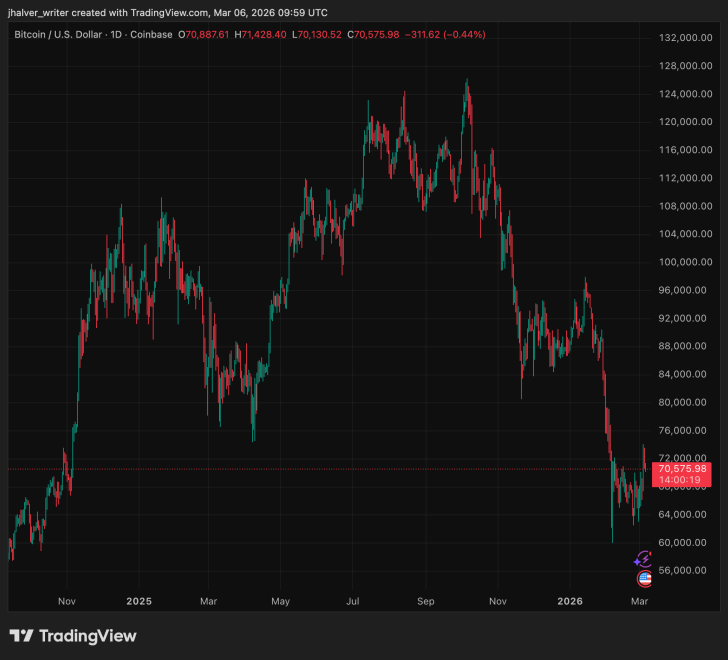
BTC's price trends to the downside on the daily chart. Source: BTCUSD on Tradingview

Cover image from ChatGPT, BTCUSD chart from Tradingview

Editorial Process for bitcoinist is centered on delivering thoroughly researched, accurate, and unbiased content. We uphold strict sourcing standards, and each page undergoes diligent review by our team of top technology experts and seasoned editors. This process ensures the integrity, relevance, and value of our content for our readers.

Farage aide ‘Posh George’ loses $655,000 betting on Iran invasion on Polymarket – DL News

0

  • Nigel Farage’s political aide lost $655,000 betting on the Iran strikes last weekend.
  • War markets have renewed scrutiny of prediction markets.
  • “Posh George” Cottrell won $4.4 million betting on Trump’s election win in 2024.

George Cottrell may have beaten the odds betting on Trump in 2024, but his luck appears to have run out.

The 32-year-old political aide to Nigel Farage, the leader of the UK right-wing Reform Party, appears to have lost approximately $655,000 incorrectly betting on when the US would strike Iran.

The aide, nicknamed “Posh George” due to his aristocratic background, traded under the username GCottrell93 and placed a series of bets in this market — and did manage to win $107,000 by betting that the US would not strike on February 27.

Crypto investigator ZachXBT has previously linked the account to Cottrell.

However, his biggest loss, worth $550,000, was betting “no” on whether the US would attack on February 28, according to Polymarket data and first reported by The Telegraph. He lost another $165,000 across three other wagers, inaccurately betting on other dates, too.

Prediction markets such as Polymarket let users wager money on the outcomes of political, sporting, or financial events.

In this case, Polymarket launched a market that enabled users to speculate on when the US military would attack Iran.

Users could bet on “yes” or “no” for a variety of dates.

After it was clear that the US bombed Iran on February 28, the market closed and paid out those who accurately bet on the day’s violent strikes.

All eyes on prediction markets

The multi-million-dollar war markets on Kalshi and Polymarket, the two largest prediction markets, have drawn fresh scrutiny from lawmakers.

Polymarkets wager on the ouster of Iranian leaders saw more than $529 million in volume.

Six specific users, however, stood out.

Just hours before the strike, analytics firm Bubblemaps showed six brand-new accounts emerge and rake in $1.2 million accurately betting on the strikes on February 28.

“It’s insane this is legal,” Democrat Senator Chris Murphy said on Sunday. “People around Trump are profiting off war and death. I’m introducing legislation ASAP to ban this.”

A White House spokesperson denied that anyone close to US President Donald Trump was behind the trades, according to NPR.

GCottrell93

Betting on Polymarket hasn’t been a complete loss for Cottrell.

Indeed, the author of the book “How to Launder Money” has bagged $3.4 million in profits — after accounting for losses — across 23 predictions.

His biggest win came from betting on the presidential election winner in 2024, where he bagged $4.4 million wagering on Trump.

After inaccurately betting on the Iran strikes, his next biggest loss was betting that the sitting UK Prime Minister, Keir Starmer, would be ousted on February 28, 2026.

He lost nearly $125,000 on the wager.

The Reform Party didn’t immediately return a request for comment.

Liam Kelly is DL News’ Berlin-based DeFi correspondent. Have a tip? Get in touch at liam@dlnews.com.

Crypto exchange Binance tells U.S. Senate probe no accounts sent crypto directly to Iran

0

Binance, via its lawyers, told a U.S. Senate investigation it found no evidence that accounts on its platform transacted directly with Iranian entities, refuting allegations that $1.7 billion in crypto flowed through the exchange to Iran-linked groups.

In a March 6 letter responding to inquiries from Sen. Richard Blumenthal’s (D-Conn.) Permanent Subcommittee on Investigations, the largest crypto exchange said an internal review found only indirect exposure to wallets that may have had links to Iran, and that accounts tied to the activity were removed.

Binance also attacked the media coverage that prompted the probe, calling reporting by outlets including the New York Times, Wall Street Journal and Fortune “demonstrably false” and “defamatory in several material respects.”

The response comes after Blumenthal opened an inquiry into whether the exchange allowed funds to move to Iran-linked organizations, including Yemen’s Houthi militants. The investigation followed media reports that internal Binance investigators had identified transactions tied to Iranian entities.

Binance said its review began after law enforcement contacted the company last April seeking information about transactions between Binance wallets and several external addresses that authorities said could be connected to terrorist financing.

According to the letter, the exchange provided user records and transaction information to investigators and continued examining the activity internally.

The exchange’s lawyers said Binance identified two entities, Hexa Whale and Blessed Trust, whose accounts had interacted with the flagged wallets. Binance said it removed Hexa Whale from its platform in the following August and offboarded Blessed Trust in January after completing its investigations.

Binance also disputed reports that compliance investigators were dismissed after raising concerns, saying most departures were voluntary and that one employee was terminated for violating company policy on disclosing internal user information.

“When there is credible risk information, Binance investigates, mitigates, offboards accounts, and reports to appropriate authorities,” the letter said. “Binance has a rigorous compliance program that is consistently growing stronger.”

Short-term bitcoin holders send $1.8 billion in BTC to exchanges after $74,000 rally

0

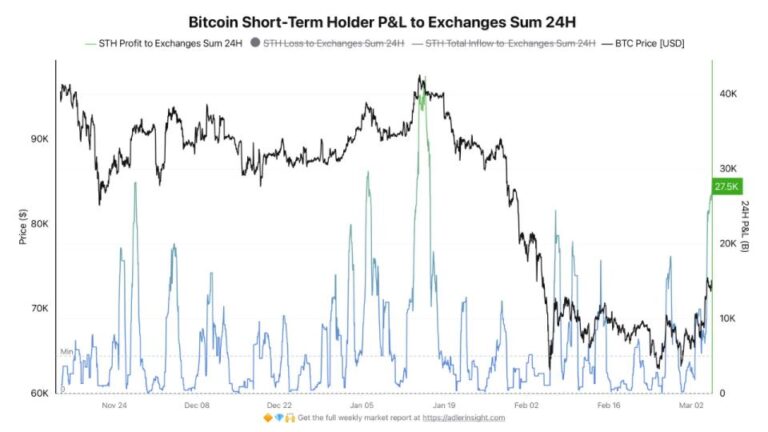
Bitcoin’s move to a one-month high of $74,000 this week triggered a wave of profit-taking from short-term traders, according to data from CryptoQuant.

The largest cryptocurrency is trading around $69,000 after losing momentum from Wednesday’s break above $70,000.

CryptoQuant analyst Darkfost explains that short-term holders transferred more than 27,000 BTC ($1.8 billion) to exchanges in profit over the past 24 hours — one of the largest spikes in recent months.

The only short-term investors currently in profit are those who accumulated bitcoin between one week and one month ago, with a realized price of roughly $68,000, suggesting some recent buyers are choosing to lock in gains rather than extend their positions.

Short-term holders are typically the most reactive group in the market, and their selling reflects lingering caution in light of the ongoing war in Iran.

CoinDesk analysis on Wednesday identified a potential bull trap as price action mirrored that in January when price broke out to $98,000 before taking a leg lower.

And that leg lower occurred on Friday, accelerated by comments from U.S. president Donald Trump who demanded that Iran unconditionally surrenders – a move that also sent the price of oil soaring.

Bitcoin bull trap (TradingView)

Despite the profit-taking, broader factors are helping support bitcoin’s rally according to Adrian Fritz, chief investment strategist at 21Shares.

Fritz said traders are increasingly betting that the Clarity Act, a U.S. digital asset market structure bill, could pass by year-end. Prediction markets currently price the probability at around 70%, though Fritz noted these markets are relatively illiquid.

He also pointed to rising geopolitical tensions and strong institutional demand as key drivers.

Some investors are increasingly viewing bitcoin as a “gold beta” trade, rotating into the asset after gold’s recent rally. Meanwhile, spot bitcoin ETFs have shown resilience, with holdings down only about 5% during the recent pullback and over $700 million in net inflows this week.

While political developments may have helped spark the move, Fritz said the rally is being sustained by geopolitical hedging and growing institutional conviction in the asset.

TransferMate Deploys Vivox AI Agents Globally to Automate KYB Compliance

0

TransferMate, a provider of embedded B2B payments infrastructure, has completed a full global rollout of trusted, explainable AI agents from Vivox AI to serve as its new Know Your Business (KYB) automation platform.

The deployment is designed to support TransferMate’s rapid expansion across the Asia Pacific region and other key global markets. As rising onboarding and due diligence volumes threatened to create operational bottlenecks, the payments firm required a scalable compliance operating model capable of absorbing growth without compromising strict regulatory standards.

TransferMate currently operates the largest regulated fintech payments infrastructure in the world, holding 100 licences and serving customers across APAC, the Americas, and Europe.

Enterprise-grade AI orchestration

To accelerate its KYB and customer due diligence workflows, the firm turned to London-based Vivox AI.

Vivox AI’s platform enables compliance teams to execute comprehensive reviews by leveraging an ensemble of specialised models, more than 24 integrated verification and screening APIs, and over 35 AI models.

Key capabilities of the newly deployed system include:

  • Analysing up to 100 complex corporate documents and registries per case.
  • Identifying ultimate beneficial owners (UBOs), shareholders, and directors.
  • Performing sanctions, politically exposed person (PEP), and adverse media screening.
  • Generating complete customer due diligence (CDD) or enhanced due diligence (EDD) reports.
  • Processing multiple document formats—including large files and low-quality images—across more than 100 countries.
Rapid deployment and human-in-the-loop learning

The live operational deployment was completed in a record-breaking eight weeks.

A core component of the implementation is a self-learning AI agent that operates strictly within Vivox AI’s governance framework. As part of the implementation, Vivox AI configured control modules aligned with TransferMate’s internal policies to evaluate the agents against defined risk, quality, explainability, and human oversight criteria.

During the first two weeks of live production use, the system continuously incorporated feedback from TransferMate’s senior analysts. Because of this controlled, human-in-the-loop learning, the quality approval rate of AI-generated outcomes increased from approximately 60 per cent to around 80 per cent, demonstrating measurable performance improvement.

Industry perspectives
Alex Clements, global head of AML at TransferMate

Alex Clements, global head of AML at TransferMate, highlighted the necessity of the upgrade: “We operate in a fast-moving regulatory landscape, and maintaining compliance excellence is fundamental to how we scale. As we expand into new regions, we must increase onboarding capacity without compromising the rigour of our due diligence processes. Vivox AI has enabled us to compress timelines significantly while enhancing the depth, consistency and auditability of every review. Crucially, it augments our compliance team while keeping humans firmly in the loop.”

Tim Khamzin, Founder and CEO of Vivox AI

Clements also noted that the level of detail within Vivox’s AI governance framework provides confidence that the firm can demonstrate robust controls during audits and regulatory inspections relating to AI use.

Tim Khamzin, Founder and CEO of Vivox AI, added: “TransferMate’s implementation demonstrates how responsible, transparent AI can deliver measurable impact at scale. The deployment aligns with evolving regulatory expectations, from the EU AI Act to recent FCA and Singaporean frameworks, while maintaining strong governance and auditability across jurisdictions.”

The deployment reflects a broader shift across regulated financial services towards trusted and auditable AI technologies. TransferMate’s programme will soon be complemented by independent AI assurance to further validate its safety, governance, and regulatory alignment, reinforcing the firm’s commitment to responsible innovation.