Pakistan’s parliament passed the Virtual Assets Act, 2026 on Wednesday, cementing the Pakistan Virtual Assets Regulatory Authority (PVARA), a government agency, as the country’s digital asset regulator.
The framework gives PVARA, established in July 2025, the authority to enforce licensing requirements and oversight over digital asset service providers, according to an announcement from the regulator.
PVARA is also tasked with setting and enforcing anti-money laundering provisions and international sanctions compliance under the new legislation. PVARA Chairman Bilal Bin Saqib said:
“With no objection certificates (NOCs) already issued and banking rails being developed in coordination with the State Bank of Pakistan, we are now moving toward a comprehensive licensing framework aligned with global AML and financial integrity standards.”
The bill passed in both the Senate and Pakistan’s National Assembly, but must still be signed by Pakistan President Asif Ali Zardari to become law.
The government of Pakistan moved to regulate cryptocurrencies as legal tender in November 2024, reversing long-standing pushback from regulators, who said crypto would never be legalized or integrated into the financial system.
Related: SEC proposes ‘token taxonomy’ for interpreting crypto under securities laws
Pakistan may emerge as a crypto hub in five years
Since that time, Pakistan has announced a Bitcoin strategic reserve and dedicated 2,000 megawatts of electricity for mining and AI data centers.
Digital assets are the foundation of a “new financial rail for the global south,” and Pakistan views blockchain technology as critical infrastructure, Bin Saqib said at the Bitcoin MENA conference in December 2025.
Pakistan ranks near the top of Chainalysis’ 2025 Global Crypto Adoption Index. Source: Chainalysis
In January, Pakistan signed a memorandum of understanding with SC Financial Technologies, an affiliate of World Liberty Financial, the decentralized finance platform founded by US President Donald Trump’s sons.
The collaboration will explore the use of the USD1 stablecoin for digital payments, including cross-border transactions and remittances.
Binance co-founder Changpeng Zhao said Pakistan could emerge as a global hub for digital assets by 2030 if the country continues its rapid pace of development and regulatory progress.
Magazine: Pakistan will deploy Bitcoin reserve in DeFi for yield, says Bilal Bin Saqib
Cointelegraph is committed to independent, transparent journalism. This news article is produced in accordance with Cointelegraph’s Editorial Policy and aims to provide accurate and timely information. Readers are encouraged to verify information independently. Read our Editorial Policy https://cointelegraph.com/editorial-policy
Trusted Editorial content, reviewed by leading industry experts and seasoned editors. Ad Disclosure
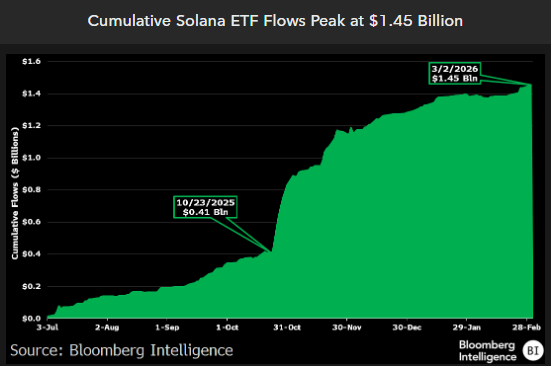
Spot Solana ETFs have pulled in roughly $1.45 billion since launching in July even as SOL fell 57% over the same stretch, a combination Bloomberg ETF analyst Eric Balchunas called “about as unlucky timing as you’ll ever see in ETFs.” For crypto markets, the takeaway is not just the headline flow number, but what it may say about the depth and quality of institutional demand.
Spot Solana ETFs Beat Bitcoin ETFs
Balchunas argued that the resilience of those inflows matters as much as their size. “Solana is down 57% since the spot ETFs launched in July … yet they managed to not only accumulate $1.5b in flows but not really give any of it up,” he wrote on X. He added that “50% of the assets are from 13F filers = serious inv base. Both really good signs for future IMO.”
The chart he shared shows cumulative Solana ETF flows climbing from about $410 million on Oct. 23, 2025, to $1.45 billion by March 2, 2026. The steepest acceleration came in late October through November, when cumulative inflows jumped sharply toward the $1 billion mark before continuing to grind higher into early March. Even with some flattening near the end of the period, the broader pattern is one of persistent net intake rather than hot-money churn.
Cumulative Solana ETF flows | Source: X @EricBalchunas
Balchunas’ more provocative point was the relative comparison with Bitcoin. “The other thing about these flows, if we adjust for the size of solana vs bitcoin mkt cap, it’s the equiv of $54b in net new flows, which is about DOUBLE where bitcoin was at the same point,” he wrote. “And bitcoin was up a ton at that time vs down 57%. Anyhow, pretty impressive numbers given size and condition of the underlying mkt.”
That comparison goes to the heart of the thesis. Absolute flows still heavily favor Bitcoin, whose US spot ETF complex sits near $94.6 billion in assets, according to the table Balchunas posted separately. BlackRock’s IBIT alone accounts for roughly $57.1 billion, while Fidelity’s FBTC and Grayscale’s GBTC hold about $13.9 billion and $11.5 billion, respectively. On Wednesday, the group took in another $461.77 million, with IBIT contributing $306.58 million.
Bitcoin ETF data | Source: X @EricBalchunas
But Balchunas used that same Bitcoin flow snapshot to make a broader point about the risks of drawing sweeping conclusions from short windows of market action. After noting that Bitcoin had risen 12% since the Iran strike while gold fell, he posed a deliberately overstated question: “So does that mean gold has failed as a safe haven and may be devoid of any purpose and vice-versa for btc?” He then answered it himself in the next post.
“I don’t actually think this btw, just trying to point out the problem with making these types of damning judgements of an asset based on a short term window of price action,” Balchunas wrote. “Gold has my respect as asset as does bitcoin. Bitcoin’s surge may have little to do w geopolitics but rather the Jane St bogeyman going away and vibe change. And ppl selling gold may just be taking profits, some may be looking for next run in btc, wth knows.”
The same logic applies to Solana. A 57% drawdown would usually be the sort of backdrop expected to choke off ETF demand, not sustain it. Instead, the Solana products appear to have attracted sticky capital and, at least in Balchunas’ framing, done so at a pace that compares favorably with Bitcoin once market-cap context is applied.
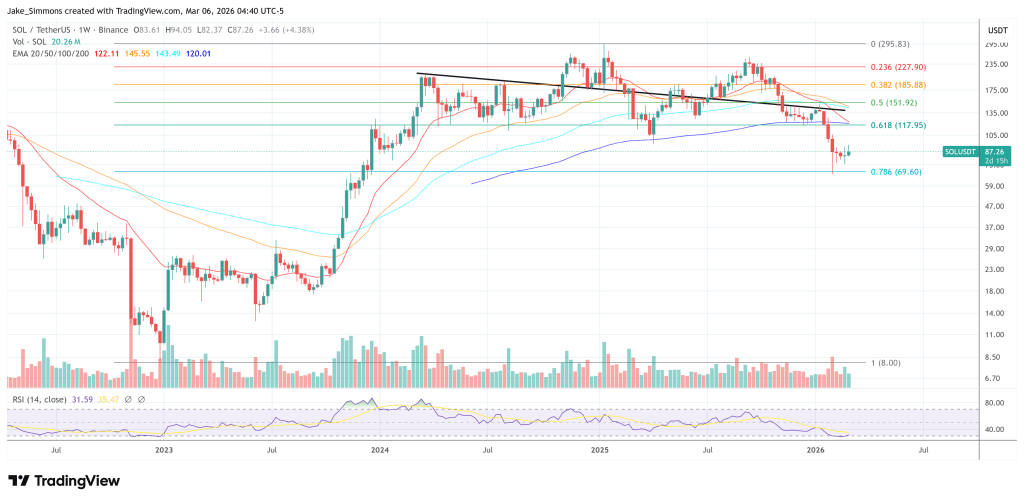
At press time, Solana traded at $87.26.
SOL must reclaim the 200-week EMA, 1-week chart | Source: SOLUSDT on TradingView.com
Featured image created with DALL.E, chart from TradingView.com
Editorial Process for bitcoinist is centered on delivering thoroughly researched, accurate, and unbiased content. We uphold strict sourcing standards, and each page undergoes diligent review by our team of top technology experts and seasoned editors. This process ensures the integrity, relevance, and value of our content for our readers.
This content is provided by a sponsor. In the rapidly evolving landscape of digital finance, demand for secure, private cryptocurrency exchange services is growing. CCE.Cash values financial sovereignty and digital privacy and presents a strong alternative to centralized exchanges that constantly require more personal data. This fully automated, non-custodial cryptocurrency exchange platform, launched in 2024 […]
For more than a decade, the global conversation on the digital economy has focused on access. Getting people online was the priority. Expanding connectivity was the metric of progress.
That chapter is now closing.
As the digital economy enters a new phase, the defining question is no longer whether people are online; it is whether they can meaningfully participate, create value, and shape the technologies transforming work, society, and opportunity.
This shift matters. Because connectivity alone does not guarantee prosperity.
Inclusion, long recognised as essential, is now becoming urgent. Governments, companies, and institutions, including many DCO Member States, Observers, and partners, are scaling up strategies and investments in digital skills, equitable opportunity, and broader agency. The underlying realisation is simple but consequential: access without capability limits impact.
The shift from access to agency
Nearly four in five people are online, yet approximately 2.2 billion remain offline, mostly in low- and middle-income regions. Even among those who are connected, persistent gaps in skills, confidence, and opportunity continue to shape who benefits from digital transformation. Gender disparities remain stark, particularly in advanced fields such as artificial intelligence and digital services.
The constraint has shifted from access to agency.
The key question is not simply who is connected, but who has the tools, confidence, and opportunity to learn, innovate, start businesses, access services, and exercise influence. Without agency, connectivity risks becoming a passive condition rather than a catalyst for shared prosperity.
Where digital capability is broad, the effects are powerful. Technology becomes embedded across education, healthcare, small business, public services, and entrepreneurship, rather than concentrated in a narrow set of sectors or geographies. Economies that invest in skills, digital public services, and institutional capacity tend to convert connectivity into productivity more effectively.
This is already evident in parts of South and East Asia and the Pacific, where progress in digital government services and skills training now matches or outpaces that of many higher-income economies. These experiences underline an important lesson: outcomes are shaped as much by strategic choices as by income level.
An economic imperative
Yet gaps remain.
Women continue to be underrepresented in advanced digital fields and leadership roles. Only around 3.1 per cent of female graduates specialise in information and communication technology, compared with approximately 9.6 per cent of men. In areas such as artificial intelligence, leadership, investment, and research capacity are heavily concentrated in a small number of firms, countries, and demographic groups.
This imbalance is not only a social issue; it is an economic one.
When large segments of the population are excluded from digital skills, leadership pathways, and entrepreneurial opportunity, economies operate below their potential. Innovation reflects a narrower range of needs and perspectives. Productivity growth slows. Resilience weakens.
By contrast, inclusive digital ecosystems tend to be more dynamic and robust. When women and underrepresented groups participate fully in digital education, enterprise, and governance, technology is applied to a wider range of challenges, from education access and healthcare delivery to small-business productivity and climate resilience.
Capability-building in action
Encouragingly, many governments are now acting on this understanding, including within the DCO community.
In Nigeria, federal programmes aim to train and certify one million people in digital skills, with a longer-term ambition of near-universal digital literacy by 2030. In Saudi Arabia, digital inclusion is a central pillar of Vision 2030, reflected in major investments in digital government, skills, connectivity, and regulatory cooperation. Similar initiatives are advancing across Africa, the Middle East, Asia, and Latin America.
There is also a growing recognition that digital inclusion and sustainability are closely linked. Digital tools enable more efficient energy systems, smarter resource management, and better environmental data use, reinforcing that inclusion supports long-term resilience as well as growth.
These developments point to a broader conclusion: the digital economy is not a zero-sum race for technological dominance; it is a collective project of capability-building.
Bridging the divide
Rebecca Cousins, chief of outreach and global communications at the Digital Cooperation Organization
Countries most likely to succeed over the long term are those that invest not only in infrastructure and platforms, but in people, institutions, trust, and participation. They build education systems that foster digital confidence, support entrepreneurs in adopting technology, and develop digital public services that are accessible, efficient, and trusted.
As policymakers, business leaders, civil society partners, and innovators gathered in Kuwait at the DCO’s International Digital Cooperation Forum under the banner ‘Inclusive prosperity in the age of the AI’ in February this year, the task was clear: Shared principles must translate into practical action that drives meaningful impact.
Growth rates and investment flows remain important, but they are no longer sufficient indicators of progress. Participation, institutional maturity, human capability, and trust matter just as much.
The choices made today in education, skills policies, regulatory frameworks, and investment decisions will shape the digital economy for decades. They will determine whether technology deepens divides or bridges them.
When inclusion is treated not as a social add-on, but as a core economic strategy, digital transformation becomes a force for shared prosperity rather than a source of new inequality.
About the author
Rebecca Cousins is chief of outreach & global communications at the Digital Cooperation Organization, where she leads global engagement and communications efforts to advance inclusive and sustainable digital economy growth across Member States.
Strike, a Bitcoin financial services firm founded by Jack Mallers, has received both a BitLicense and a money transmitter license from the New York State Department of Financial Services, allowing the company to operate in one of the most tightly regulated digital asset markets in the United States.
The approval allows Strike to offer its Bitcoin brokerage, payments, and custody services to individuals and businesses across New York.
The state’s regulatory framework requires firms to meet standards for capital reserves, cybersecurity, and operational transparency.
New York’s BitLicense regime has long served as a gatekeeper for digital asset companies seeking access to the state’s financial markets. Several crypto firms have opted not to pursue the license because of the compliance requirements and ongoing regulatory oversight.
Mallers described the license as a major step in the company’s effort to build a Bitcoin-focused financial platform.
“Receiving our BitLicense is a defining milestone for Strike,” Mallers said in a statement. “Strike is building the leading Bitcoin financial institution. With our BitLicense, we can now bring that mission to New York, the global center of finance.”
Strike’s bitcoin services
With the approval, New York users will gain access to Strike’s suite of Bitcoin services. The platform allows customers to buy and sell bitcoin through linked bank accounts, debit cards, or wire transfers.
Users can also directly deposit their paychecks and convert a portion, or all, of their wages into bitcoin.
The platform includes automated trading tools such as recurring purchases and price-triggered orders. Recurring buys allow customers to schedule bitcoin purchases on a set interval, while target orders execute trades when bitcoin reaches a specific price.
Strike also allows users to pay bills from a bitcoin balance, including utility payments, credit card balances, and mortgage bills. The feature reflects the company’s effort to position bitcoin as a tool for daily financial activity rather than only as an investment asset.
According to the company, customer bitcoin and cash balances are held one-to-one and are not lent or used for company operations. Strike said users can withdraw bitcoin to personal wallets at no cost, with the firm covering on-chain transaction fees.
The license also places Strike under the supervision of the New York State Department of Financial Services, which requires periodic audits, cybersecurity reviews, and capital reserve compliance.
Strike’s expansion into New York comes as the company outlines broader growth plans for its platform. In late 2025, Mallers said the firm intends to add bitcoin-backed lending, which would allow customers to borrow fiat currency while holding their bitcoin.
Recent events at the US Federal Reserve signal acceptance of digital assets at the highest levels of the country’s monetary system.
Kraken recently became the first crypto exchange to receive a master account at the Federal Reserve.
The Fed could also see a new crypto-friendly chair. US President Donald Trump on Wednesday submitted a pro-Bitcoin candidate for the Senate’s consideration.
These developments represent a significant shift in how the Fed could treat the crypto industry. But there are also detractors.
Why are Fed master accounts so important to the crypto industry?
On Wednesday, Kraken announced that its Wyoming-chartered bank, Kraken Financial, had been awarded a Fed master account. This made it “the first digital asset bank in US history to gain direct access to the Federal Reserve’s payment infrastructure.”
Kraken co-CEO Arjun Sethi said, “With a Federal Reserve master account, we can operate not as a peripheral participant in the US banking system, but as a directly connected financial institution.”
The master account represents access to the most coveted form of money for financial institutions: dollars held directly within the Federal Reserve system.
Related: US Bitcoin reserve still has no plan to stack sats
These dollars are widely perceived as risk-free. Aaron Brogan of Brogan Law, a firm specializing in digital assets, said they “are the intrinsic architecture of the United States monetary system, which can always just make more of them.”
Since United States dollars remain the preeminent global currency, the best form of USD is the best there is. Other instruments like cash, dollars in FDIC-insured bank accounts and T-Bills are pretty good, but Fed dollars are the best.”
For an exchange like Kraken, “it improves reliability and efficiency for moving fiat deposits in and out of digital-asset markets,” according to Sethi.
But not every financial institution is granted access, and certainly not the upstart disruptors of the cryptocurrency industry, at least not until now.
What are Federal Reserve master accounts?
The Federal Reserve System is split into 12 different banks. While these banks come together for important policy decisions, each has a certain degree of autonomy.
In an effort to bring the Fed system a bit closer together, Congress passed the Monetary Control Act of 1980. The law gave all depository institutions access to Federal Reserve accounts. This was the beginning of the master account.
Julie Andersen Hill, the dean of the University of Wyoming’s College of Law, wrote that Congress “intended that all depository institutions would be able to use the Federal Reserve’s payment systems. The legislative history of the Monetary Control Act is littered with references to ‘open access’ to ‘all depository institutions.’”
However, as the banking industry changed, the Fed began to express preferences over who got access and how much. Per Brogan, three tiers developed:
Tier 1: Federally chartered banks with deposit insurance
Tier 2: Federally chartered banks without deposit insurance
Tier 3: State-chartered banks
“Perhaps unsurprisingly, the Federal Reserve Board thinks banks in Tier 1 should get master account access, while Tier 3 banks are subject to heightened scrutiny, and Tier 2 somewhere in the middle,” he wrote.
The crypto industry has long had a problem with finding banks willing to serve them. Those that would were often state-chartered banks, which already had trouble accessing the federal system.
Related: Banks can’t seem to service crypto, even as it goes mainstream
The Fed doesn’t want to be too exclusive with master accounts. According to Thomas Kingsley, director of financial services policy at the American Action Forum, “During periods of stress, access to central bank settlement accounts can materially affect a firm’s ability to meet redemption demands. In that sense, master account access can reduce run risk relative to structures reliant on commercial bank deposits.”
However, the Fed also doesn’t want to give out access to just any institution. Per Kingsley, “If a large nonbank with a master account were to experience operational failure or disorderly unwinding, the disruption would occur closer to core financial infrastructure.”
Enter the skinny account. In October 2025, Fed Governor Christopher J. Waller proposed a new type of account that would provide access to Fed payment rails, but also control for certain risks, while carrying restrictions. These are:
This is what Kraken got. It may be limited, comparably, but it is still a major victory for the institutionalization of crypto. Pro-crypto Senator Cynthia Lummis called it a “watershed milestone in the history of digital assets.”
Bank groups push back on account
Not everyone’s happy about it. Independent Community Bankers of America (ICBA) CEO Rebeca Romero Rainey wrote, “Granting nonbank entities and crypto institutions access to master accounts poses risks to the banking system.”
She said that there are “significant risks to expanding direct Fed account access to institutions that operate outside the traditional banking regulatory framework.”
The Banking Policy Institute’s co-head of regulatory affairs, Paige Pidano Paridon, said the BPI was “deeply concerned” that the Fed approved the “‘limited purpose’ master account—which appears to be a ‘skinny’ account—before the Federal Reserve Board has finalized its policy framework for those accounts.”
She said that the decision ignored public comment the Fed sought on skinny accounts and was made “with no transparency into the process for approval or the risk mitigants that have been imposed to address the very significant risks it raises.”
A pro-crypto banker could soon lead the Fed
In addition to the US central bank giving accounts to crypto exchanges, the bank itself could soon be led by a pro-crypto economist. On Wednesday, Trump sent the nomination of Kevin Warsh, a Shepard Family Distinguished Visiting Fellow in Economics at the Hoover Institution of Stanford University, to the Senate.
Kevin Warsh, a former Fed governor nominated by President Trump to chair the central bank. Source: Hoover Institution
The White House is seeking to make Warsh chair for four years and a governor on the Fed board for 14 years.
Warsh, who served as a Fed governor under former US Presidents George W. Bush and Barack Obama from 2006 to 2011, has made some pro-crypto remarks in the recent past.
“Bitcoin does not make me nervous,” he said in a May 2025 interview. He said that billionaire investor Marc Andreessen, “showed me the white paper […] I wish I had understood as clearly as he did how transformative Bitcoin and this new technology would be. Bitcoin doesn’t trouble me. I think of it as an important asset that can help inform policymakers when they’re doing things right and wrong.”
Warsh’s nomination may not be smooth sailing. Democratic lawmakers and central banking policy experts alike have expressed concerns about the Trump administration’s continued efforts to exert control over the Fed.
Trump has wanted interest rate cuts for months, but the Fed, currently chaired by Jerome Powell, has not complied with his wishes.
In January, Trump’s Department of Justice served the Federal Reserve with grand jury subpoenas and threatened Powell with a criminal indictment over alleged misuse of funds to build an office building. Powell claimed that the real argument was over the Fed’s unwillingness to follow orders from the White House.
The US central bank is increasingly accepting cryptocurrency, a trend that is likely to continue with new, more favorable policies and pro-crypto leadership.
Magazine: What’s a ‘Network State’ and are there real-life examples? Big Questions
Cointelegraph Features publishes long-form journalism, analysis, and narrative reporting produced by Cointelegraph’s in-house editorial team with subject-matter expertise. All articles are edited and reviewed by Cointelegraph editors in line with our editorial standards. Research or perspective in this article does not reflect the views of Cointelegraph as a company unless explicitly stated. Content published in Features does not constitute financial, legal, or investment advice. Readers should conduct their own research and consult qualified professionals where appropriate. Cointelegraph maintains full editorial independence. The selection, commissioning, and publication of Features and Magazine content are not influenced by advertisers, partners, or commercial relationships. This content is produced in accordance with Cointelegraph’s Editorial Policy.
Utexo, a startup building Bitcoin-native stablecoin settlement infrastructure, announced a $7.5 million seed round co-led by Tether, Big Brain Holdings, and Portal Ventures.
The round also included participation from Franklin Templeton, Maven11 Capital, Fulgur Ventures, Alchemy VC, Ethereal Ventures, Auros Ventures, Arcanum Capital, Paper Ventures, Axia8, FlowTraders, Plan B, Gate Ventures, Sats Ventures, and strategic angels including operators from Ledger, Hyperion, BTC Turk, Echo, Legion, and SOLV.
The company was founded to address a longstanding gap in the cryptocurrency ecosystem: enabling USDT to settle natively on Bitcoin with robust, production-ready payment rails. Tether’s
CEO, Paolo Ardoino, said that Bitcoin has been central to the stablecoin issuer’s long-term vision for USDT. “Market cycles come and go, but the need for open and resilient settlement infrastructure remains constant,” Ardoino said.
He added that Utexo provides a layer that makes Bitcoin-native USDT settlement viable at scale, strengthening Bitcoin’s role as a global settlement rail for real-world dollar transactions.
Historically, the Lightning Network and RGB protocols have offered technical capabilities for Bitcoin-based payments, but their complexity limited adoption in production environments. Utexo abstracts these complexities behind a single API layer, allowing payment operators to route USDT settlement over Bitcoin-native rails without modifying custody, compliance workflows, or user experiences.
Chris Hutchinson, co-founder of Utexo, explained the system’s value proposition: “We built Utexo so that USDT could move on Bitcoin the way money is supposed to move: instantly, privately, with no surprises on costs. Our partners integrate our API once and can route USDT on the most resilient open network ever built, with full control over cost structure.”
Viktor Ihnatiuk, co-founder, added that the infrastructure allows wallets to offer free USDT transactions while boosting adoption of Bitcoin-native stablecoins.
The infrastructure supports atomic settlement, privacy-preserving execution, and predictable fees for every transaction, independent of network congestion.
Settlement occurs in USDT and is anchored to Bitcoin’s security model, completing in under one second. Utexo encrypts all on-chain transactions, preventing disclosure of counterparties and wallet addresses, distinguishing it from public transaction graphs on other networks.
Tether and Bitcoin
By providing a reliable, predictable settlement layer, the company enables Bitcoin to serve as a viable rail for dollar-denominated payments, advancing Tether’s vision of native USDT on Bitcoin.
In February, Tether open-sourced MiningOS (MOS), a modular operating system for managing and automating bitcoin mining operations, unveiled at the 2026 Plan ₿ Forum in San Salvador.
The system provides unified control over hardware, energy, and site infrastructure using a peer-to-peer architecture, reducing reliance on proprietary or centralized software.
Targeted at exchanges, wallets, payment service providers, high-frequency trading firms, and platforms handling large volumes of USDT, Utexo focuses on routing existing stablecoin flows over Bitcoin rather than launching speculative L2 solutions.
Cryptocurrency exchange Binance has officially responded to a February inquiry launched by a group of 11 US senators, largely denying facilitating transactions to Iranian entities and the narrative around employees’ terminations.
In a Friday letter to US Senators Richard Blumenthal and Ron Johnson of the Permanent Subcommittee on Investigations, Binance said that an inquiry launched in February into the exchange’s activities was based on reports that were “demonstrably false, unsupported by credible evidence, and defamatory in several material respects.”
The exchange referred to reporting from the Wall Street Journal, New York Times and Fortune, which said that Binance fired employees that reported the company had facilitated more than $1 billion in crypto transactions to entities connected to Iran, called Hexa Whale and Blessed Trust. According to Binance, the company launched an investigation in response to law enforcement inquiries, resulting in the removal of the entities from the platform.
“[T]o our knowledge, no Binance account transacted directly with an Iran-based entity,” said that exchange.
Source: Binance
In response to the reports’ claims about the dismissal of employees who brought the investigation to the attention of executives, Binance said that some of them resigned, while another was terminated for disclosing internal user information:
“Binance takes seriously the privacy of its users and has no tolerance for employees violating that trust by sharing internal information externally. Binance also closely follows its labor and employment policies. This employment action was no different.”
The letter from the 11 senators to Treasury Secretary Scott Bessent and Attorney General Pamela Bondi asked for a response by March 13 as to whether the government officials intended to investigate Binance. As of Friday, neither Bessent nor Bondi had publicly commented on the matter.
Related: SEC ends case against Justin Sun with $10M settlement
In 2023, Binance reached a settlement with US authorities, agreeing to pay $4.3 billion to resolve violations of sanctions and Anti-Money-Laundering laws. Then-CEO Changpeng “CZ” Zhao stepped down as part of the deal and pleaded guilty to one felony charge, which later resulted in a four-month prison term.
Trump-Binance ties under scrutiny after presidential pardon
Zhao pleaded guilty and served prison time, under an agreement that he not be permitted to assume another leadership role at Binance. However, in October, US President Donald Trump issued a pardon for CZ, which legally opened the door to his return to the exchange. Zhao has publicly ruled out going back as CEO.
Before Trump announced the pardon, the administration’s ties to Binance were already under scrutiny from many lawmakers after a UAE-based company, MGX, used the USD1 stablecoin issued by World Liberty Financial to settle a $2 billion investment in the exchange. Many lawmakers have labeled the deal as corruption given that World Liberty Financial is backed by the president and his sons.
Magazine: The debate over Bitcoin’s four-year cycle is over: Benjamin Cowen
Cointelegraph is committed to independent, transparent journalism. This news article is produced in accordance with Cointelegraph’s Editorial Policy and aims to provide accurate and timely information. Readers are encouraged to verify information independently. Read our Editorial Policy https://cointelegraph.com/editorial-policy
PancakeSwap, the leading decentralized exchange on BNB Smart Chain, rolled out the StableSwap feature on March 1.
PancakeSwap, the leading decentralized exchange (DEX) on BNB Smart Chain, is facing allegations of unauthorized code use.
Earlier today, Ethereum-based DEX Curve Finance accused the platform of copying its StableSwap code without permission, constituting a violation of the code’s license. PancakeSwap rolled out the StableSwap feature on March 1.
“Looks like you copied our code without asking. It is violation of its license. Not only it is illegal: historically it showed to be unwise for those who did it this way in other regards,” Curve wrote on X.
Curve also offered to discuss licensing and potential collaboration to enable PancakeSwap to use the code legally.
“We’re reaching out to your team directly to discuss this,” responded PancakeSwap.
Curve’s StableSwap algorithm is designed to enhance stablecoin exchanges by reducing slippage and fees, making it a valuable asset in decentralized finance (DeFi).
PancakeSwap’s CAKE token is down nearly 4% in the past 24 hours, but remains up 4% over the past week.
CAKE Chart
PancakeSwap currently holds a total value locked (TVL) of approximately $2 billion, according to DeFiLlama, making it the second-largest DEX after Uniswap.
This article was generated with the assistance of AI workflows.
After three days of strong inflows, crypto ETFs cooled off on Thursday, with bitcoin funds posting a $228 million outflow. Ether, XRP, and solana ETFs also ended the day in the red, signaling a broad market pause. Crypto ETFs Turn Red: Bitcoin Loses $228 Million, Ether Drops $91 Million Momentum in the crypto ETF market […]