After months of bearish pressure and fading market enthusiasm, Solana (SOL) appears to be finding its footing again. A new report by Messari, a crypto market intelligence platform, shows the network’s payment volume has surged dramatically by 755%, indicating that users are finally flooding back into the blockchain. Amid this surge, Solana has also seen a significant spike in its exchange-traded fund (ETF) despite its low price, indicating that users and institutional investors are returning to the market.
Solana 755% TPV Surge Point To User Comeback
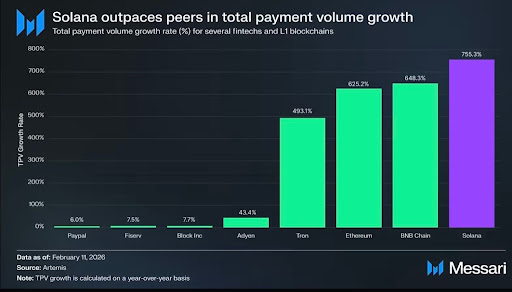
In its new report, titled ‘State of Solana Payments,’ Messari reveals that the cryptocurrency is aggressively positioning itself as the backbone of global payment infrastructure. As of February 11, 2026, the report shows that Solana’s Total Payment Volume (TPV) recorded a 755.3% year-over-year growth rate, nearly tripling the median of 268.24% across traditional fintech giants and peer layer-1 blockchains.
The figures place Solana ahead of every competitor measured, including Ethereum at 625.2%, BNB Chain at 648.3%, and legacy processors like PayPal and Fiserv, which posted modest growth rates of 6% and 7.5%, respectively. Notably, the scale of Solana’s TPV growth points to a clear return of users to the ecosystem. Volume at this level does not occur without real on-chain activity, and the data shows that both developers and end users may be actively engaging with SOL’s payment infrastructure again.
In its report, Messari argues that most of SOL’s edge comes from the structural failures of traditional financial infrastructure. The current global system still relies heavily on legacy rails built for the internet. Because of this, payments are often expensive and slow. Transactions can take several days to complete as funds must pass through banks in different countries, placing a heavy burden on cross-border payments.
Messari notes that Solana addresses these issues by unifying “messaging and settlement into a single atomic operation.” Due to its high throughput and parallel architecture, the blockchain network is said to settle transactions in milliseconds, avoiding intermediaries from correspondent banks and the typical delays seen in legacy systems. Historically, SOL has also reportedly maintained a median block time of 392 milliseconds and a median transaction fee of $0.0004.
Institutional Investors Quietly Pile Into Solana ETFs
While SOL’s 755% TVL spike indicates that users are finally getting back into the network, institutional investors appear to be making similar moves, as new reports reveal a surge in Solana Spot ETFs.
According to LookOnChain data, Solana ETFs recorded 447,694 SOL in seven-day inflows, equivalent to approximately $40 million. The ETF surge comes as institutional demand surges despite broader bearish pressures on the SOL price.
Among the four Solana funds currently available for trading, Bitwise’s (BSOL) has attracted the largest net inflow by a wide margin. Daily flows into BSOL recently reached 205,287 SOL, bringing its seven-day total to 409,402 SOL. Fidelity (FSOL) ranked second in weekly inflows, recording 15,627 SOL over the past seven days, despite its daily inflow reaching just 4 SOL. By comparison, Grayscale’s (GSOL) daily inflow reached 361 SOL, and its seven-day total was 12,530 SOL.
Featured image from Pxfuel, chart from Tradingview.com

Editorial Process for bitcoinist is centered on delivering thoroughly researched, accurate, and unbiased content. We uphold strict sourcing standards, and each page undergoes diligent review by our team of top technology experts and seasoned editors. This process ensures the integrity, relevance, and value of our content for our readers.