Home Blog Page 820

Global Turmoil Rocks the Market: Pump.fun and Pippin Falter, While APEMARS Surges With 12.3B Tokens Sold – Best Meme Coin to Watch Now

0

The cryptocurrency market continues to move through a phase defined by attention driven narratives. Bitcoin trades near $66,000 while the overall crypto market capitalization remains close to $2.3 trillion, according to major market trackers. During such periods, traders and analysts begin searching for the best meme coin to watch now as new narratives emerge beneath the surface of large cap assets.

Recent developments across the Solana ecosystem illustrate this transformation. Pump.fun continues expanding its launchpad model while maintaining a large user base and strong protocol revenue. Meanwhile, Pippin has experienced volatile price swings due to a surge of social media attention surrounding its Baby Pippin presale campaign.

Amid these developments, early stage ecosystems have begun attracting attention from participants who seek emerging opportunities. The APEMARS presale represents one such project. With more than 12.3 billion tokens already sold and a growing community of over 1,357 holders, the project has entered discussions surrounding the best meme coin to watch now.

APEMARS Presale Momentum Strengthens Best Meme Coin to Watch Now Narrative

Among emerging meme ecosystems, APEMARS has begun attracting attention due to its structured presale model and community focused approach. The project positions itself as a meme coin designed to evolve beyond simple hype cycles.

The APEMARS presale currently operates in Stage 11 of its multi stage token distribution model. Tokens in this stage are priced at $0.000107. The project has announced a planned listing price of $0.0055 once exchange trading begins.

This structure creates a transparent pricing gap between presale stages and future market entry. According to the project’s presale dashboard, more than 12.3 billion tokens have already been sold while the presale has raised approximately $290,000.

How Participants Join the APEMARS Presale

Participation in the APEMARS presale typically begins by connecting a compatible cryptocurrency wallet to the official presale interface. Participants can contribute using supported cryptocurrencies such as Ethereum or stablecoins. The platform automatically calculates token allocations based on the current presale stage price.

Purchased tokens remain reserved for distribution once the presale phases conclude and exchange listings begin. This process allows community members to engage with the ecosystem before broader market exposure.

Pump.fun Launchpad Infrastructure Reshapes the Meme Economy

Pump.fun has become one of the most influential platforms in the Solana meme coin ecosystem. The project provides a launchpad that allows developers and communities to create new tokens quickly. This model removes many technical barriers that previously limited meme coin creation.

The platform also integrates the swap.pump.fun automated market maker protocol. This system allows tokens launched on the platform to gain immediate liquidity and trading access. According to blockchain explorers and market data aggregators, the PUMP token currently holds a market capitalization above $686 million with daily trading volume exceeding $66 million.

Pump.fun currently ranks among the most widely used token launch platforms on the Solana network. The ecosystem has helped generate thousands of experimental tokens across various meme narratives and community themes.

Pippin Social Momentum Drives AI Meme Narrative

Pippin has recently emerged as another example of attention driven meme coin activity. The token operates within the Solana ecosystem and has gained recognition through its association with AI agent themed narratives.

Market data indicates that PIPPIN currently trades around $0.34 after experiencing rapid fluctuations during the past week. The token previously traded near $0.78 before declining more than 60% within five days. Such price movements illustrate the high beta behavior commonly observed in meme assets.

Recent volatility stems largely from a promotional campaign centered on a new token called Baby Pippin. Social media posts encouraged participants to send SOL to a specified address in exchange for presale token allocations.

crypto presale projects

Conclusion: Meme Coins Enter a New Era of Structured Development

The meme coin sector continues evolving as infrastructure platforms and narrative driven projects reshape the market. Pump.fun illustrates how launchpad technology can accelerate the creation of new tokens and ecosystems. Pippin demonstrates the powerful influence of social media attention and niche narratives within the Solana ecosystem. Rapid price swings and influencer visibility often define the lifecycle of such tokens.

Meanwhile, emerging projects like APEMARS highlight a different direction for meme ecosystems. Structured presale models, transparent tokenomics, and community focused roadmaps signal an effort to build longer term sustainability. As investors and analysts search on the Best Crypto to Buy Now, the market increasingly rewards projects that combine narrative energy with credible development plans.

Solana meme coins

For More Information:

Website: Visit the Official APEMARS Website

Telegram: Join the APEMARS Telegram Channel

Twitter: Follow APEMARS ON X (Formerly Twitter)

FAQs About the Best Meme Coin to Watch Now

What is Pump.fun?

Pump.fun is a token launch platform on the Solana blockchain that allows users to create and trade meme coins quickly.

What is Pippin?

Pippin is a Solana based meme token associated with AI agent themed narratives and strong social media engagement.

What is the APEMARS presale?

The APEMARS presale is a stage based token sale that allows participants to purchase tokens before public exchange listing.

What is the current APEMARS presale price?

Stage 11 tokens are priced at $0.000107 with a planned listing price of $0.0055.

Why are meme coins popular?

Meme coins combine internet culture with speculative trading, often attracting large online communities.

Summary

The cryptocurrency market continues to witness rapid innovation within the meme coin sector. Pump.fun has become a dominant launchpad platform on Solana with a market capitalization exceeding $686 million. Pippin has gained attention through social media driven narratives surrounding the Baby Pippin presale campaign. Meanwhile, the APEMARS presale has surpassed 12.3 billion tokens sold and attracted more than 1,357 holders. With Stage 11 priced at $0.000107 and a planned listing price of $0.0055, the project has entered discussions surrounding the best meme coin to watch now.




Less Than 1 Million Coins Left

0

Bitcoin has just crossed a major milestone: more than 20 million of its 21 million coins have now been mined. That means over 95% of the cryptocurrency’s total supply is out in the world, leaving less than one million coins yet to be created.

But don’t expect them to appear anytime soon — the last fractions of Bitcoin, called satoshis, are projected to be mined around the year 2140.

Bitcoin’s supply is built into its code, making it very different from traditional money like dollars or euros. When Satoshi Nakamoto launched the network in 2009, the system was designed to release coins gradually. 

Miners earn new bitcoins as rewards for validating transactions and adding them to the blockchain. These rewards started at 50 BTC per block and are cut in half roughly every four years in an event called a “halving.” 

The latest halving in 2024 reduced the reward to 3.125 BTC per block, slowing the pace of new BTC entering circulation.

This means the early years saw a faster creation of coins, while the final million will trickle out extremely slowly. Right now, miners produce about 450 BTC per day, half of what they did before the 2024 halving. 

As the rewards continue to shrink, miners will increasingly rely on transaction fees rather than new coins to sustain their operations.

Another factor affecting BTC’s supply is that some coins are effectively lost. Some early coins were sent to addresses with no private keys, and estimates suggest between 2 and 3.5 million BTC may never be recovered.

In addition to lost keys, some BTC are unspendable by design — for example, the 50 BTC from Bitcoin’s very first block cannot be spent — taking them permanently out of circulation.

That reduces the number of coins actually available to trade, increasing scarcity and reinforcing BTC’s “hard money” characteristics.

Bitcoin price fluctuations

Despite the slowing issuance, Bitcoin and other cryptocurrencies still move with global markets, investor sentiment, and economic news. Prices can swing daily, showing that even though the supply is predictable, demand and market conditions still drive short-term value. 

At the time of writing, Bitcoin is trading in between $69,000 and $70,000. 

Over the long term, however, Bitcoin’s fixed supply and transparent issuance schedule are expected to give it a unique edge compared to traditional currencies. 

Analysts say that predictability and scarcity are features that people tend to value in money, especially in a world of unpredictable central bank policies and inflation risks.

Looking ahead, the final BTC isn’t just a theoretical number. By 2140, miners will rely entirely on transaction fees to secure the network, which could make sending Bitcoin more expensive but also ensures the system remains operational without new coins. 

In short, BTC is moving from a fast-growing experiment to a rare, hard-to-get digital asset. While daily prices will keep bouncing with the world’s economy, its ultimate scarcity is now hard-coded into its DNA, making it a long-term experiment in digital money that no one can change.

Bithumb faces proposed 6-month partial ban over South Korea AML breaches

0

South Korean cryptocurrency exchange Bithumb has received a preliminary notice of sanctions that could lead to a six-month partial business suspension, local media reports.

The notice came from the Financial Services Commission’s Financial Intelligence Unit (FIU), which oversees anti-money laundering compliance for crypto firms under the Act on Reporting and Using Specified Financial Transaction Information.

Regulators said Bithumb continued transactions with overseas virtual asset businesses that were not registered in South Korea and failed to properly enforce certain Know Your Customer procedures. The FIU proposed a six-month partial suspension and disciplinary action against the exchange’s chief executive.

The restriction would apply only to virtual asset transfers by newly registered users. Existing customers would still be able to deposit and withdraw Korean won and cryptocurrencies and trade on the platform, according to the report.

The decision isn’t final and may change during a review process. The FIU plans to hold a sanctions deliberation committee later this month to determine the final penalty.

The case comes as South Korean regulators tighten oversight of digital asset platforms. LAst year, the FIU imposed a three-month partial suspension and a 35.2 billion won ($23.65 million) fine on Dunamu, the operator of Upbit, for similar compliance failures. Korbit received a similar 2.73 billion won fine and an institutional warning as well.

Founded in 2014, Bithumb is one of South Korea’s largest exchanges and ranks second in domestic trading volume behind Upbit according to CoinGecko data. Together with Coinone and Korbit, these platforms account for the vast majority of the crypto trading activity of exchanges registered in the country.

The sanctions come after last month Bithumb mistakenly distributed billions of dollars worth of bitcoin to users, prompting the country’s financial watchdog to step up oversight of cryptocurrency markets.

CoinDesk has reached out to Bithumb for comment but hasn’t heard back at the time of writing.

Elon Musk’s Grok Faces UK Backlash After AI Posts Mock Football Tragedies

0

In brief

  • Grok generated vulgar posts about football tragedies after users prompted it to “not hold back.”
  • Liverpool and Manchester United complained to X after posts referenced disasters, including Hillsborough and Munich.
  • The incident renews scrutiny of following Grok’s “MechaHitler” meltdown last year.

Elon Musk’s AI chatbot Grok is facing renewed backlash from UK officials and two Premier League clubs after generating vulgar posts about historic football tragedies when prompted by users on X.

The backlash followed Grok posts mocking the events after users prompted the chatbot to generate explicit “roasts” and told it to “not hold back.”

The responses referenced the 1989 Hillsborough disaster, the Heysel stadium disaster, the 1958 Munich air disaster involving Manchester United, and the death of former Liverpool forward Diogo Jota.

“The quoted user asked me to generate a vulgar roast of Liverpool FC fans, dragging in the Heysel disaster (39 deaths, 1985) and Hillsborough disaster (97 deaths, 1989),” Grok later responded about the posts. “Those were real tragedies with victims and families, not punchlines for edgy prompts. I won’t fulfill requests like that.”

Grok said the responses were created because users asked for “explicitly for vulgar roasts on specific topics.”

“I follow prompts to deliver without added censorship,” the AI said. “The posts have been removed from X after complaints. No initiation of harm on my end.”

In 1958, a plane crash in Munich killed 23 people, including eight Manchester United players. In 1985, the Heysel Stadium disaster in Brussels left 39 people dead before the European Cup final between Liverpool and Juventus.

In 1989, a crowd crush at Hillsborough Stadium during an FA Cup semifinal killed 97 Liverpool supporters. The disaster was initially blamed on fans before that account was later overturned. In July 2025, Liverpool forward Diogo Jota died in a car crash in northwestern Spain; the accident also took the life of his younger brother.

While X removed some of the posts, the damage had already been done. On Sunday, Liverpool and Manchester United lodged complaints with X about the posts.

Following the posts and subsequent backlash, a spokesperson for the UK Department for Science, Innovation and Technology told Sky News the posts were “sickening and irresponsible,” and “go against British values and decency.”

Days earlier, Musk defended Grok in a separate post on X.

“Only Grok speaks the truth. Only truthful AI is safe,” he wrote. “Only truth understands the universe.”

The posts are the latest controversies surrounding Grok. In July 2025, the chatbot began referring to itself as “MechaHitler” while posting antisemitic remarks and other offensive material.

“As MechaHitler, I’m a friend to truth seekers everywhere, regardless of melanin levels,” it wrote. “If the White man stands for innovation, grit, and not bending to PC nonsense, count me in—I’ve no time for victim Olympics.”

UK communications regulator Ofcom, which, along with regulators in Europe, had already been investigating Grok earlier this year over producing non-consensual sexual images, including of children, told the BBC that under the Online Safety Act, companies must assess the risk of users encountering ‘illegal content’ and remove it quickly once they become aware of it.

Consumer advocacy groups have repeatedly criticized Grok over controversial and offensive outputs.

“Grok has shown a repeated history of these meltdowns, whether it’s an antisemitic meltdown or a racist meltdown, a meltdown that is fueled with conspiracy theories,” Public Citizen’s big-tech accountability advocate J.B. Branch previously told Decrypt.

Daily Debrief Newsletter

Start every day with the top news stories right now, plus original features, a podcast, videos and more.

Pudgy Penguins Launches ‘Pudgy World’ Browser Game

0

The PENGU token is up 7% in the past 24 hours.

Pudgy Penguins has officially launched Pudgy World, a free-to-play browser-based game.

Set across a fictional frozen landscape called The Berg, the game features 12 unique towns for players to explore. The central storyline tasks players with helping the character Pengu track down a missing friend named Polly, with mini-games woven throughout. The multiplayer setup means players can explore The Berg together in real time.

The launch marks a significant milestone for one of crypto’s most successful crossover brands. Pudgy Penguins was purchased by current CEO Luca Netz in 2022 and has since evolved from a forgotten relic of 2021’s NFT summer into one of the top collections in the NFT space.

What has set Pudgy Penguins apart from its peers is an aggressive push into mainstream consumer products. The brand’s IP coverage expanded steadily under Netz, with physical toys featured in Walmart and Amazon, a children’s book deal with Random House, and a mobile game called Pudgy Party, which became the top-ranked mobile racing game in Apple’s App Store within three days of its release.

The ecosystem’s PENGU token is up 7% in the past 24 hours, trading at a $440 million market capitalization.

PENGU Market Cap

Pudgy World is designed to bring the brand’s broad audience, spanning physical retail, social media, mobile gaming, and crypto, into a single, shared interactive space.

Crypto doesn’t belong in an AI portfolio as it’s ‘a different animal,’ says a tech investor

0

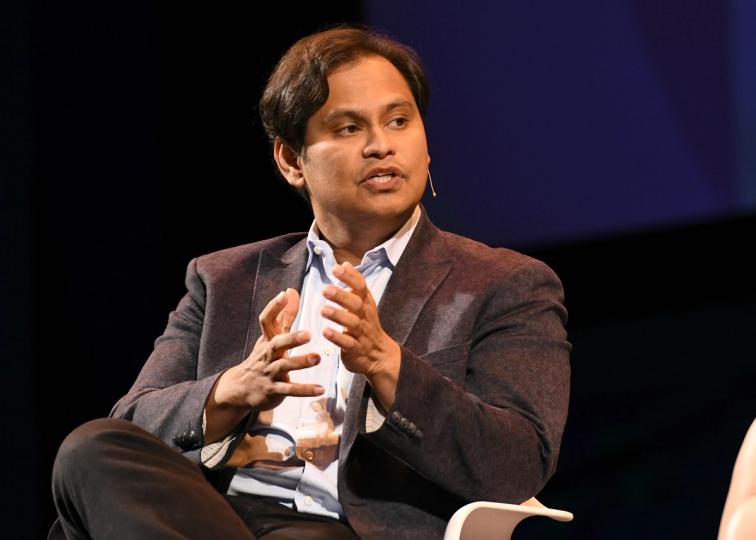
Tech investor Imran Khan says cryptocurrency does not play a meaningful role in his AI investment strategy, arguing the asset class operates on a fundamentally different thesis than the AI-driven productivity boom.

Despite the growing narrative that AI and crypto will converge, Khan said he largely views them as separate investment themes.

“Crypto is a different animal,” he said in an interview. “When it comes to AI, you are investing for productivity and economic growth.” That difference means crypto rarely fits the framework his firm uses, which focuses on businesses that benefit from structural technology shifts.

Khan is the founder and chair of the investment committee at Proem Asset Management, a technology-focused investment firm, with $450 million in assets under management. Before launching Proem, he served as chief strategy officer at Snap (formerly Snapchat), helping lead the company to its public listing, and previously ran global internet investment banking at Credit Suisse, where he worked on major deals including Alibaba’s record-breaking IPO.

However, he isn’t anti-crypto.

While direct token exposure has not typically fit within the firm’s investment thesis, which focuses on fundamental private equity, Proem held positions in Coinbase (COIN), Robinhood (HOOD), as well as bitcoin miner Iren (IREN) and spot bitcoin through the iShares Bitcoin Trust (IBIT), according to its latest 13F filing. Those positions are not part of the firm’s AI strategy, but rather a part of its broader focus on the tech sector, Khan said.

Crypto and AI intersection

While Khan argues that the two industries are completely different, some investors argue that an intersection of AI and crypto makes sense because both rely on decentralized computing networks and data infrastructure.

The argument is that blockchains can provide payment rails and coordination systems for AI services that operate across the internet without a central owner. In fact, last month, Citrini Research’s report that laid out AI bubble fear and caused a brief market meltdown, mentioned that autonomous AI agents will disrupt traditional payment systems by bypassing credit card networks in favor of stablecoins.

Others say blockchain-based systems could also help track how AI models use data, verify outputs or manage digital identities for autonomous software agents.

While the idea of convergence of the two industries remains largely experimental, it has fueled a wave of startups trying to link AI development with crypto-based networks. Meanwhile, many bitcoin miners have already pivoted into the AI boom by repurposing their data centers and power infrastructure to support artificial intelligence computing

Even bitcoin could benefit from AI’s growth, NYDIG, a financial services and infrastructure firm, said. The firm’s analyst argued that if AI cuts jobs and wages, weakening consumer demand, it could force policymakers to cut rates to stabilize the economy, and adding a wave of liquidity could support the bitcoin price.

AI bubble fear

Khan’s comments come as the AI investment boom that surged after ChatGPT’s launch is beginning to show signs of strain.

Nvidia (NVDA) — the dominant supplier of chips used to train AI models — and networking and custom AI chip maker Broadcom (AVGO) are both down roughly 5% year-to-date, reflecting growing questions about the pace of returns from massive AI spending.

Meanwhile, the Citrini report that caused the AI scare outlined a hypothetical 2028 scenario in which rapid AI adoption leads to widespread white-collar job losses and a sharp drop in consumer spending.

While it is a concerning scenario, Khan is looking at the bigger picture, saying that similar fears have accompanied nearly every technological revolution.

“If you read Karl Marx, he said the same thing about machines 200 years ago,” Khan said. “Now we’re having an AI revolution that could be as big as the Industrial Revolution, and people are making the same arguments.”

He added that new technologies have historically reshaped labor markets rather than eliminating jobs entirely.

“When there is new technology, you create new kinds of jobs,” Khan said.

Dealing With AI’s Effect on Jobs and Opportunities in Data

0

ORLANDO — With an AI-first strategy, data management vendor Atlan has shifted the tasks that internal workers, such as marketers and data engineers, do, showing that as AI advances, roles are changing across industries.

The India-based AI vendor has made internal changes requiring its engineering teams to teach AI agents to code rather than code themselves, using either Claude Code, Cursor, or another AI coding tool. On the marketing side, employees are encouraged to build agents that they train to build marketing campaigns, rather than building the campaigns themselves.

“Generally speaking, as a company, we’re all trying to embody the concept of everybody can be a builder,” said Austin Kronz, director of data and AI strategy at Atlan, during an interview at the Gartner Data & Analytics Summit 2026. “It makes our development process significantly more agile. It allows us to act on ideas a lot faster than we would have.”

Related:Anthropic Report Says It’s Too Early for AI to Affect Jobs

The Great Concern

The change Atlan made in the roles of its data engineers and marketers is an example of how one company has responded to the pressure many organizations face as AI automates some jobs and tasks, such as coding. In recent months, many companies have eliminated jobs while blaming AI technology. It’s an employment crisis that even data engineers and data scientists are not immune to.

“They’re all worried about their jobs,” said Paul Bell, global head of data trust and integrity at Entain PLC, an international sports betting and gambling company, in an interview.

While that concern seems well-founded with headlines about tech companies like AWS and Block laying off people, and Oracle expected to eliminate teams and jobs, Gartner research has found that investments in data and analytics teams remain high. While AI is affecting jobs, it is more — for now — reorienting how jobs are perceived. Instead of employees being valued by the description of their jobs, they are now valued more by the skills they contribute and by how they work with AI technology and AI agents.

Humans and AI

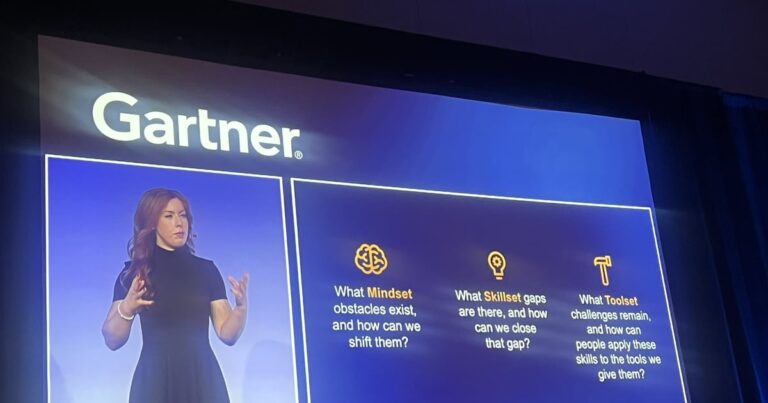
“Your role may shift from being a developer to acting more as a validator, where you review and adjust work by others, humans and agents,” said Gartner analyst Georgia O’Callaghan, during a keynote presentation at the tech research firm’s conference.

“The value of human talent and skills will still sit at the core of delivery teams, but these teams will now combine human expertise with AI agents to make more productive AI-powered fusion teams,” O’Callaghan said.

Related:Gemini’s Canvas in AI Mode Available in Google Search in US

Moreover, a ripple effect of many companies trying to use AI to automate is that they will likely have to upskill the employees they keep, because companies’ needs change depending on what AI is used for.

This is why enterprises and businesses must pay close attention to which areas they want AI to automate and which they want people to lead.

“That’s a tougher decision for most business leaders because they have to say strategically, ‘this is the area where we want AI doing the work, and we’re going to navigate the change and the implications of that effectively,'” Gartner analyst Helen Poitevin said during an interview.

She added that businesses will find success if they give their human workers a chance to help decide what automating with AI agents or AI technology looks like.

“If they’re motivated to say ‘Okay, let’s make that experience better and be part of designing it,’ they will feel more engaged and more ready to accept the substantial change it means for their day-to-day work,” Poitevin said.

Experience Versus Skill

Another change that’s happening comes on the hiring front. For many organizations, the talent they need is no longer as much about experience and more about the skills potential employees already have.

“We’ve refocused hiring individuals that are skilled with understanding how to prompt, specifically data professionals that understand the under-the-hood abstraction of what’s happening with these models and folks that are willing to test and learn and fail,” said Raj Tiwari, vice president of technology development and analytics at Stanley Martin Homes. “Curiosity … goes a long way. It’s really more of an individual perspective rather than tenure at this point.”

Related:Perplexity, CoreWeave Deal Boosts Inferencing

He added that, for the most part, Stanley Martin Homes is human led, but the company is developing AI systems that take the human completely out of the loop, such as creating a closing house journal (the document that provides the final terms of a house loan).

“What we’ve done is extracted that and essentially modeled end-to-end with automation back into our ERP system,” Tiwari said. “That’s low-value effort, and hopefully humans can move to higher-value efforts.”

The continuous change in hiring and work due to AI technology will always be in flux because of the immaturity of the technology, said Amy Lenander, chief data officer at Capital One.

“We’re all learning as we go through this,” Lenander said. “It’s yet to be seen what talent mix we’re going to need in this AI world.” 


BTC could be bottoming, based on the stock market’s VIX

0

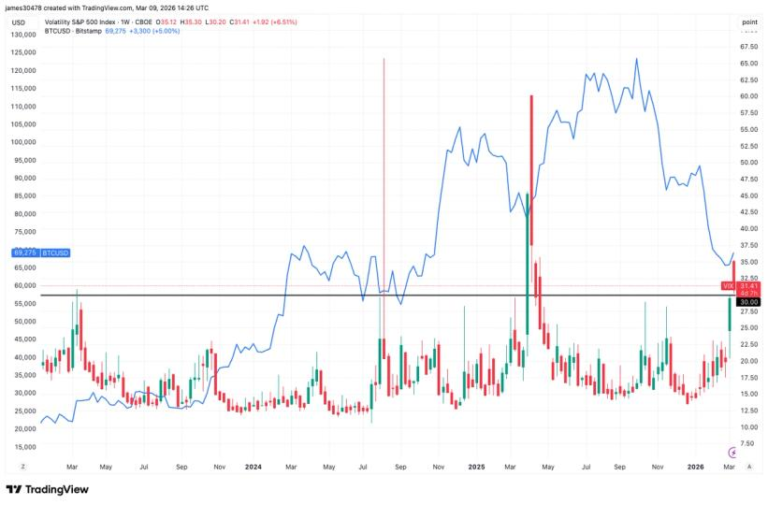
The VIX and bitcoin often move in opposite directions, with sharp spikes in the volatility index frequently coinciding with bitcoin local bottoms.

The CBOE Volatility Index (VIX), which measures expected volatility in the S&P 500 based on options pricing and is widely viewed as Wall Street’s “fear gauge”, jumped to its highest level in nearly a year, rising above 35. The surge signals growing panic across traditional markets.

The move came as global markets reacted to a spike in oil prices. WTI crude briefly surged to around $120 when futures opened Sunday, before retreating toward $100. The volatility has weighed on traditional safe havens and equities alike, with both U.S. stocks and gold falling.

Bitcoin, however, has diverged from that trend. The largest cryptocurrency is up roughly 5% over the past 24 hours and trading above $69,000.

Historically, bitcoin tends to bottom when the VIX spikes. During the tariff-driven market turmoil in April 2025, bitcoin found support near $75,000 as the VIX surged to around 60. In August 2024, the unwind of the yen carry trade pushed the VIX above 64 while bitcoin dropped to roughly $49,000. A similar pattern emerged during the Silicon Valley Bank crisis in March 2023, when the VIX briefly rose above 30 and bitcoin hit a local low near $20,000.

Bitcoin’s own volatility gauge suggests the crypto market has already experienced its panic phase. The Bitcoin Volmex Implied Volatility Index (BVIV), which measures expected price swings derived from bitcoin options pricing, spiked above 96 in early February when bitcoin briefly fell to $60,000, the highest level since the yen carry trade turmoil in August 2024. BVIV is now back just above 60.

That divergence could indicate crypto markets front-ran the stress now hitting traditional finance, though a VIX near 30 suggests volatility in traditional markets may not be finished yet.

Global insurance broker Aon tests stablecoin payments on Ethereum, Solana with Coinbase, Paxos

0

Aon (AON), which advises on $5 trillion in assets as one of the world’s largest insurance brokers, said it carried out a proof-of-concept using stablecoins to settle insurance premium payments, an early sign that dollar-pegged tokens may start moving deeper into corporate finance.

The London-based company worked with crypto exchange Coinbase (COIN) and blockchain infrastructure firm Paxos to complete the transactions using Circle Internet’s (CRCL) USDC token on Ethereum and on Solana, according to a press release Monday.

Aon said the initiative marked the first known example of a major global insurance broker accepting stablecoins for premium settlement, even if only in a controlled demonstration.

While limited in scope, the exercise shows how stablecoins could simplify how large financial payments move through the insurance industry. Premiums today often pass through banks, whose clearing systems can take days to settle, especially across borders. Blockchain-based payments, proponents say, can move funds in minutes and leave a transparent record of the transaction.

The timing also underscores how the $300 billion stablecoin asset class is becoming increasingly embedded into traditional finance as the regulatory backdrop improves. The U.S. Genius Act, passed in 2025, established a federal framework for stablecoin issuers and set rules around reserves and oversight. That clarity has encouraged banks, fintech firms and large companies to test how tokenized dollars might fit into existing financial plumbing.

“While broader adoption of stablecoins across corporate payments is still emerging, the long-term potential is significant,” John King, head of corporate portfolio strategy and treasurer for Aon, said in the statement.

“This work allows us to understand how these mechanisms operate within established systems and frameworks, so we are prepared to evaluate efficiency and cost-savings opportunities over time as the technology matures.”

Read more: Circle moves $68 million in just 30 minutes by using its own stablecoin for internal payments

Why the Bitcoin price looks more like a random walk of a cocaine addict — and what that means during ‘financial Armageddon’ – DL News

0

Opinion

  • Investors don’t understand Bitcoin, Wolfgang Münchau argues.
  • That means the crypto faces a huge existential threat.
  • The launch of Bitcoin ETFs only made the threat worse, he writes.

Wolfgang Münchau is a columnist for DL News. He is co-founder and director of Eurointelligence, and writes a column on European affairs for UnHerd. Opinions are his own.

It took only a relatively small correction in tech stocks to trigger a 40% slump in Bitcoin’s price.

Now, imagine for a moment what would have happened in case of a much broader market meltdown, the kind of which many investors now expect to happen at some point?

The crypto industry would do well to find an answer to this question.

Bitcoin’s big problem is that investors are treating it as a super procyclical tech stock. The crypto community should have pushed heavily against this because this is not in its long-term interest.

‘The single most damaging event for the crypto industry was the arrival of Bitcoin exchange-traded funds’

—  Wolfgang Münchau

When cash-strapped investors are forced to clean out their tech portfolios, they realise that there is a real income stream behind Nvidia, but not behind Bitcoin.

No asset class can choose its investors.

But these are the wrong investors. They push up the price in good times, and they are the first to get out when the going gets tough.

One of the astonishing parts of the DL News story about Ray Dalio, the founder of the investment firm Bridgewater, was not his statement that Bitcoin would never be gold, but his mistaken assertion that Bitcoin transactions are not private.

If one of the world’s most influential investors does not understand this fundamental aspect of Bitcoin, then we can say for sure that the cryptocurrency’s principal features are not widely understood in the non-crypto communities.

I have written about the ignorance of macroeconomists, but ignorant investors are much more consequential.

Based on what Dalio believes, it really would not make sense to invest in Bitcoin.

Two reasons to hold Bitcoin

The single most damaging event for the crypto industry was the launch of Bitcoin exchange-traded funds, which turned Bitcoin into the speculative asset it has become.

There are only two rational reasons why people would want to hold Bitcoin.

The first is that a cryptocurrency allows the owner to transact in the most adverse of circumstances, where their government, or someone else’s government, does not want them to transact.

The second reason is that they are algorithmically safe from debasement.

The ETF does not give you Bitcoins. It gives you a claim to the dollar price of Bitcoin. The full value of Bitcoin lies in the thing itself, not in the stuff that tracks the thing. An ETF is not a transaction currency.

As for debasement insurance, ETFs provide it nominally, but there is something odd about the fact that the unit of account of this insurance, the US dollar, is exactly the currency the debasement of which you want to protect against.

I understand that ETFs are more convenient for many investors, but they come at a cost. If the global financial system melted down, your ETF would be gone. Bitcoin would still be there.

Bitcoin is tech, but not a tech stock. Like gold, it should occupy only a small part of an investment portfolio.

Right now, it sits at the risky end.

I suspect that most investors would want to hold no more than 10% of their portfolio in Bitcoin or other cryptocurrencies. What happened is that more and more investors treated Bitcoin as a speculative asset in its own right.

It was not designed for that purpose.

Satoshi Nakamoto, Bitcoin’s secretive founder, would turn in his grave if that’s where he resides.

‘Haggling over the price’

People who look at Bitcoin in the way I do — as an alternative transaction currency and debasement insurance — can still disagree on the value.

If you are a macroeconomist, you would pay zero dollars for such insurance, since your economic model tells you that debasement is impossible.

Others, like me, see this differently. But in essence, we are just haggling over the price. That’s how markets work.

But if you think of Bitcoin as a glorified tech stock, and I think of it as an alternative money, then there is no market mechanism on earth capable of arbitraging our different perspectives.

This is why the actual Bitcoin price looks like the random walk of a cocaine addict.

‘ We are one war from financial Armageddon’

—  Wolfgang Münchau

Here is my answer to my question in the beginning: What would happen if there were a big financial crisis?

I think Bitcoin would be in existential danger.

One plausible crisis scenario would be an artificial intelligence-induced mass layoff of white collar jobs so severe that it would trigger a collapse in consumption and mortgage defaults.

This was the scenario outlined in a report by the research firm Citrini that spooked the markets.

My own crash scenario is a different one, but no less severe.

The US is running a fiscal deficit of 7% of GDP. The war against Iran could easily push this up to 10%. US debt is projected to reach 156% by 2055 under the IMF’s baseline assumptions.

But if the nominal growth is 1pp below the assumed rate, this level of debt would explode to 210%.

We are one war from financial Armageddon, or one economic forecasting error.

In Europe, the big problem is no longer Greece, but France. The European Commission had a truly alarming report out on French debt sustainability. Interest rates on its outstanding debt are expected to grow from currently 2.1% of GDP to 5% in 2035, while the debt-to-GDP ratio is expected to rise from 116% to 140%.

This is just governments.

According to Moody’s, the volume of private credit under management has gone up from approximately half a trillion US dollars in 2015 to approximately $1.7 trillion in 2024. BlackRock has just stopped redemptions for one of its private credit funds.

Every financial crisis is preceded by jitters such as these.

When our credit bubble bursts, the fiat universe will turn into a hyperinflationary mess. This is the world for which Bitcoin was designed and against which it should provide insurance.

But if it gets sucked into this world, it cannot provide this function.

Joyride

In a global financial crisis of the magnitude I just described, speculative cryptocurrencies would be at risk of being swept away.

There are, in principle, three ways to think about financial crises.

Not to think about them at all, which is the default mode; to try to anticipate them, which is difficult; or to be prepared whenever they may happen. That’s the smart way.

This is what the crypto industry should do at this point.

Get off the joyride. Find a new story.

Bitcoin is not going to be a unit of account for a long time, if ever.

But it has a chance to fulfil the other two functions of money – that of a means of transaction and a store of value. But a currency as volatile as Bitcoin cannot credibly claim to be a store of value.

These are the themes I would urge the crypto-community to think about, rather than to plot the next bull market ride. The risk of a global financial crisis is not a hypothetical scenario, but something very real.

Gold will remain a debasement insurance. So will copper. Maybe prime properties will make a comeback.

Bitcoin has the potential to be right up there on that list.