
Elvira Nabiullina, the head of the Central Bank of Russia, has declared that first-wave banks were finalizing their preparations to support the digital ruble on day one. She also clarified that the bank was on schedule for the launch expected by September. Central Banks Reinforce Preparations Are ‘On Schedule’ To Launch Digital Ruble The Central […]
Payward partners with Nasdaq to develop xStocks-powered gateway connecting permissioned and permissionless tokenized equities markets

xStocks will power the permissionless infrastructure layer supporting Nasdaq’s issuer-sponsored equity tokens, enabling transfers seamlessly between regulated capital markets and decentralized blockchain ecosystems in eligible jurisdictions
Payward, the developer of the xStocks tokenized equities framework and parent company of global crypto platform Kraken, today announced a partnership with Nasdaq to develop next-generation infrastructure connecting tokenized equity capital markets with decentralized blockchain networks.
The initiative will build on the growing adoption of xStocks, which provide tokenized exposure to publicly traded equities across blockchain ecosystems. Since launching less than a year ago, xStocks have surpassed $25 billion in total transaction volume, including more than $4 billion settled on-chain, with over 85,000 unique holders across supported networks.
The collaboration will support the upcoming Nasdaq equity token design, a new approach to tokenizing equities preserves control, existing regulatory frameworks, and the underlying rights associated with company shares.
Both organizations believe tokenization has the potential to transform capital markets, modernizing how securities are traded and settled while enabling greater global access, programmability, and operational efficiency across financial infrastructure.
“Tokenization upgrades market infrastructure at the asset layer by allowing equities to exist as programmable financial instruments that can operate across both regulated capital markets and open blockchain networks. Today most equities sit inside brokerage systems where their utility is largely limited to directional exposure and in some cases broker specific margin arrangements. That structure fragments liquidity across venues and leaves a meaningful amount of capital static relative to its potential utility. With xStocks our goal is to make equities natively interoperable across trading venues, financial applications and blockchain networks while preserving issuer rights, regulatory protections and price integrity,” said Arjun Sethi, Co-CEO of Payward and Kraken.
Building the Infrastructure for Tokenized Equity Markets
As part of the partnership, Payward and Nasdaq will develop an equities transformation gateway, powered by the xStocks framework, designed to connect regulated, permissioned equity markets with permissionless decentralized financial networks in jurisdictions where xStocks are available.
Within this architecture, the xStocks framework will serve as the infrastructure layer powering the permissionless ecosystem, enabling tokenized equities to interact with open blockchain networks while remaining aligned with the underlying securities traded within regulated markets.
The gateway will allow clients in eligible jurisdictions to seamlessly swap tokenized equities between a regulated, permissioned market environment and the permissionless DeFi ecosystem, enabling assets to move fluidly between institutional trading infrastructure and global on-chain financial networks.
Connecting Regulated Markets with On-Chain Financial Networks
To support the integrity of the ecosystem, Payward Services will provide KYC and AML onboarding tokenized equities through the Kraken platform, ensuring participants accessing the gateway between regulated permissioned equity markets and the permissionless decentralized ecosystem meet applicable compliance requirements in relevant jurisdictions.
In addition, in eligible jurisdictions where clients can trade xStocks today, Payward will serve as the primary and foundational settlement layer for Nasdaq equity token design transactions for an initial period, providing the infrastructure necessary to enable secure and efficient tokenized equity settlement across connected networks.
By connecting Nasdaq’s market infrastructure with the xStocks ecosystem, the gateway is designed to create interoperability between institutional trading environments and decentralized networks. This architecture allows equity securities to move fluidly between regulated capital markets and global onchain networks, while preserving issuer rights, regulatory compliance, and price integrity.
The equities transformation gateway will be available to clients in jurisdictions where xStocks are available and where Payward is appropriately registered, licensed, and approved to offer such.*
Sethi added:
“Bringing equities onto programmable infrastructure expands how they can function within a portfolio. Instead of simply representing exposure to a company, tokenized equities can operate as collateral within unified trading systems that support spot markets, cross margin trading derivatives, perpetual futures and financing environments. In traditional systems portfolio capital efficiency is constrained because collateral cannot move freely between venues and products. If collateral is represented as C and gross market exposure as E then portfolio utilization can be expressed as:
U = E / C
In fragmented systems U is artificially capped because each venue requires isolated collateral. When assets become interoperable across markets the same base collateral C can support multiple strategies simultaneously and effective exposure becomes the sum of all positions:
E_total = Σ E_i
This increases capital utilization across trading environments while maintaining risk constraints enforced by a unified real time margin framework.
For international customers tokenized equities expand access to public markets in regions where traditional brokerage distribution is limited or operationally complex. For customers operating within more developed financial markets the opportunity is capital efficiency allowing equity collateral to participate more fluidly across trading lending and hedging strategies within a shared liquidity and risk framework. When collateral can move programmatically between systems, settlement friction decreases and capital can move more dynamically between strategies and markets.”
As tokenized assets continue to expand across blockchain ecosystems, Payward and its partners aim to establish infrastructure that enables regulated securities to interact with decentralized markets in a secure and interoperable way.
Nasdaq expects its Nasdaq equity tokens design and related distributed ledger technology (DLT)-based services to become operational beginning in H1 2027.
Sethi concluded:
“Our partnership with Nasdaq is important because tokenization alone does not create markets. Markets require liquidity risk management and reliable infrastructure. By combining Nasdaq’s leadership in regulated equity markets with Payward’s digital asset infrastructure and Kraken’s global trading platform we are helping build the liquidity layer risk engine and financial applications that allow tokenized equities to function within a more global continuous and capital efficient financial system.”
Trump Iran War Signals Lift Crypto, Sink Oil Prices

Oil prices fell while cryptocurrencies posted modest gains on Monday after US President Donald Trump told reporters that war with Iran could be coming to an end — even as he later ramped up the war rhetoric again on social media.
In a phone interview with CBS News on Monday, Trump made it appear that the war in Iran was wrapping up. The US military claims to have struck more than 3,000 Iranian targets in the first week of operations.
“I think the war is very complete, pretty much,” Donald Trump told CBS News. “If you look, they have nothing left. There’s nothing left in a military sense,” he added.
The comments saw oil prices fall 28% from their four-year high of $118 on Monday to around $85 in the hours that followed, according to OilPrice.
However, in his latest post on Truth Social on Tuesday, Trump ramped up the war rhetoric again, stating that “If Iran does anything that stops the flow of oil within the Strait of Hormuz, they will be hit by the United States of America TWENTY TIMES HARDER than they have been hit thus far.”
“Additionally, we will take out easily destroyable targets that will make it virtually impossible for Iran to ever be built back, as a Nation, again,” the President added.
“Death, Fire, and Fury will reign upon them — But I hope, and pray, that it does not happen!”
Trump’s comments in a Republican congressional fundraising event in Florida on Monday also hinted that the war may still have room to run.
“We’ve already won in many ways, but we haven’t won enough,” Trump said. “We go forward more determined than ever to achieve ultimate victory that will end this long-running danger once and for all.”
Crypto will follow other risk assets
Crypto markets are up 3.1% over the past 24 hours, with Bitcoin (BTC) reclaiming $70,000, and Ether (ETH) is hovering just above $2,000 at the time of writing.
Augustine Fan, partner and head of insights at crypto trading software service provider SignalPlus, told Cointelegraph that it is generally “hard to take these headline comments at face value, especially with other members of his [Trump’s] cabinet stating that things are still in the beginning phase, and US military assets still deployed in the region.”
“Crypto prices will continue to follow other risk assets without a fundamental narrative of its own in the near term, and macro leadership will still be driven by oil, which has seen a +$30 turnaround over the span of just 24 hours.”
Related: Bitcoin relief rally faces headwinds as bear market persists: analysts
“We don’t expect the conflict to be resolved any time soon,” he said, adding that “we would expect tradable bounces and BTC to do relatively better as a potential store of value during these times.”
Potential for prolonged uncertainty persists
Meanwhile, Andri Fauzan Adziima, research lead at Bitrue, told Cointelegraph that if Trump’s claim that the Iran war is almost over proves accurate, “I’m expecting a strong relief rally in crypto, driven by plunging oil prices, eased inflation/geopolitical fears, and renewed risk appetite.”
However, “doubts persist amid mixed signals from Iran and potential for prolonged uncertainty,” he added.
Iran’s Revolutionary Guard reportedly responded to Trump by saying that his comments were “nonsense” and “we are the ones that will determine the end of the war.”
Magazine: Bitcoin to outperform gold soon, FBI busts $46M crypto heist: Hodler’s Digest
Cointelegraph is committed to independent, transparent journalism. This news article is produced in accordance with Cointelegraph’s Editorial Policy and aims to provide accurate and timely information. Readers are encouraged to verify information independently. Read our Editorial Policy https://cointelegraph.com/editorial-policy
Trump-backed American Bitcoin insider buys 68,000 ABTC shares in fresh stock purchase
Richard Busch, a board member at American Bitcoin (ABTC), acquired 68,000 shares of the Nasdaq-listed Bitcoin mining company at an average price of $1.15, a transaction valued at $78,200, according to a new SEC filing.
With the latest purchase, Busch now holds approximately 1.4 million ABTC shares, valued at about $1.5 million based on Monday’s closing price. The stock has fallen 35% year to date amid volatility across crypto-related equities, per Yahoo Finance.
The purchase signals continued insider confidence in the Trump family-backed firm as it pursues aggressive Bitcoin accumulation strategies.
American Bitcoin controls 6,500 Bitcoin valued at above $450 million, placing it 17th among corporate BTC holders.
The company operates from Miami and has positioned itself as a Bitcoin infrastructure company that combines self-mining operations with direct Bitcoin accumulation to build strategic reserves.
Eric Trump, who co-founded the company, serves as Chief Strategy Officer and has been instrumental in shaping the firm’s approach to the steady expansion of its Bitcoin holdings across varying market conditions.
Disclosure: This article was edited by Vivian Nguyen. For more information on how we create and review content, see our Editorial Policy.
Ether, solana, XRP jump higher as Trump signals Iran war nearing end

Major tokens snapped back on Tuesday as ceasefire optimism rippled through risk markets.
Ether reclaimed $2,029, up 2.6% over the past 24 hours and back above the $2,000 level that has served as a psychological pivot for weeks. Solana led the recovery at 2.9% to $85.67. BNB added 2.6% to $639. XRP gained 1.7% to $1.37. Dogecoin lagged at just 1% and remains down 1.4% on the week, continuing to underperform the broader market on every bounce.
The catalyst was U.S. president Donald Trump telling reporters late Monday that the Iran conflict would resolve “very soon” and that U.S. military objectives were “pretty well complete.” Asian equities surged 2% after Monday’s 3.7% plunge. Tech stocks in the MSCI Asia Pacific index jumped 3.5%. Oil fell from Monday’s spike above $100.
Analysts at Nansen said in an email that crypto had “already absorbed the negatives and priced them in,” arguing the market was responding to headlines rather than broader macro deterioration.
The institutional flow data supports that read. CoinShares reported $619 million in crypto fund inflows for the week ending Friday, with $521 million going to bitcoin products and total AUM reaching $108.3 billion.
That capital came in during a week where the S&P lost $1 trillion in a single session and the economy shed 92,000 jobs. “Spot Bitcoin ETFs continue to attract capital even as price weakens, which suggests institutional allocators are treating this as a tactical entry rather than capitulation,” said Ryan Kirkley, co-founder and CEO of Global Settlement, in an email to CoinDesk.
Ethereum’s position above $2,000 is the one to watch this week. The second-largest cryptocurrency has been fighting to hold that level since late February, and FxPro analysts flagged $2,500 and the 200-week moving average as the zone that would confirm a genuine recovery rather than a series of dead cat bounces. The gap between $2,000 and $2,500 is where the narrative shifts from “surviving the drawdown” to “starting a new trend.”
For solana, the recovery has been structurally weaker. SOL remains down roughly 55% from its cycle highs and has underperformed ether on every major bounce since the October crash.
The memecoin economy that fueled solana’s 2024 rally has evaporated, and without that speculative engine the token is trading more on macro sentiment than ecosystem activity.
XRP has been the most range-bound of the majors, hovering between $1.30 and $1.45 for most of March. ETF inflows have been positive and the legal clarity from Ripple’s settlement should be a tailwind, but the token has failed to decouple from broader market direction.
The Fed meeting on March 17-18 looms as the next real test.
Global Settlement’s Kirkley noted that the 90-day correlation between bitcoin and the S&P 500 has climbed to 0.78, one of the highest readings since mid-2022. When bitcoin trades in lockstep with equities, altcoins amplify every move in both directions.
A hawkish dot plot or any hint that rate hikes are back on the table would hit the higher-beta end of crypto hardest.
Best Crypto to Buy Now: Pepeto Presale Surges Past $7.8M as Walbi Launches AI Trading Agents

The crypto market is showing signs of recovery in early March. This sparks a search for the best crypto to buy now. Walbi, a blockchain focused trading platform, just introduced no code AI trading agents. These are designed to help users automate strategies without technical expertise. According to CoinDesk, the launch highlights the growing intersection of artificial intelligence and crypto trading infrastructure.
Interestingly, established tokens like Ethereum and XRP could lose investor attention to Pepeto. This is a project that combines a full trading ecosystem with meme energy. It does this at presale pricing far below where major altcoins trade today.
Investors are confident that the strong fundamentals, a $7 billion founder, and the Binance listing approaching could deliver returns that large cap tokens simply cannot match from their current market caps.
How Real Trading Infrastructure Could Make Pepeto the Best Crypto to Buy Now
Crypto never sleeps and neither does the Pepeto ecosystem. In a market where speed and infrastructure define success, Pepeto has become the talk of traders for one reason. It gives holders access to PepetoSwap, a cross chain bridge, and a full exchange. In fact, all have been announced and are close to launch.
The founder previously built a project that reached a $7 billion market cap. A SolidProof audit confirmed zero critical vulnerabilities. The presale has raised $7.8 million during the worst sentiment of the cycle. Additionally, the entry price still sits at a fraction of a cent.
What sets Pepeto apart is the combination of meme culture with real trading functionality. Rather than relying on hype alone, it delivers infrastructure that generates demand from actual usage. This is exactly what separates presales that deliver from those that fade after listing.
Other wallets are entering the presale and claiming the exact tokens you are considering right now. Their conviction is building from the same supply, and every token they take is one fewer available at the current price. You can explore the full details on the Pepeto official website. Staking at 209% APY is already compounding for the wallets that moved first.
Ethereum Could Reclaim $2,000 Before the End of March
ETH trades near $1,950 on March 10, recovering from recent lows as institutional demand through spot ETFs continues building. Over 30% of supply remains locked in staking contracts, which limits sell pressure. The Fusaka upgrade improved data throughput and transaction costs according to CoinDesk.
Resistance near $2,100 continues capping the near term upside. ETH offers strong long term fundamentals. However, at a $240 billion market cap, the kind of explosive returns traders seek in the best crypto to buy now conversation live at earlier stages. These are stages where the listing has not yet happened.
XRP Bulls Are Confident in a Strong Rebound
XRP trades near $1.34 on March 10, holding above key support as regulatory clarity continues expanding. The GENIUS Act and the rescinding of SAB 121 have created the most favorable environment for XRP in its history. In addition, bulls maintain that rising institutional demand could push XRP toward $2 to $3 over the coming months.
Still, XRP is not fully out of the red zone. At an $80 billion market cap, the returns from current levels are measured in small multiples. This is not the asymmetric upside the best crypto to buy now crowd is searching for.
Conclusion
Walbi just launched AI trading agents because the market sees exactly where crypto infrastructure is heading. The arithmetic between Pepeto’s presale price and the projected listing level is not speculation. Instead, it is the measured gap that $7.8 million in conviction and a SolidProof audit stand behind. The Binance listing erases the current entry permanently. Also, 209% APY is compounding daily in wallets that already acted. Visit the Pepeto official website before the price you see today turns into the number you remember but can never reach again.
Click To Visit Pepeto Website To Enter The Presale

FAQs
Which crypto will boom in 2026? Pepeto is positioned to boom with PepetoSwap, a bridge, and an exchange approaching launch at a fraction of a cent with a Binance listing drawing closer.
Which crypto will explode in 2026? Pepeto is expected to explode with $7.8 million raised, a $7 billion founder, 209% staking APY, and three announced products at presale pricing.
Is Ethereum a good long term investment? ETH has strong fundamentals but limited upside from $240 billion. Pepeto offers asymmetric returns at presale pricing with real trading infrastructure.

Bitcoin May Follow Oil With A Rally To $79K

Key takeaways:
-
Oil price spikes often precede 20% spikes in Bitcoin value, though initial market reactions remain volatile and unpredictable.
-
Bitcoin currently mirrors tech stocks with an 81% Nasdaq 100 correlation, making it less sensitive to oil prices.
Oil prices surged to $101 per barrel on Sunday, marking a 55% increase in ten days—the largest move in history. The event caused the SPX to reach its lowest level in 10 weeks on Friday. Bitcoin (BTC) saw an initial positive reaction with prices jumping 16% between Feb. 28 and Wednesday, though it eventually erased the entire move by Sunday.
Traders now question whether Bitcoin price could suffer from the uncertainty brought by the US-Israel war with Iran. Persistently high oil prices could trigger inflation and hurt consumer spending while the US job market remains weak. Bitcoin price has benefited from sudden jumps in oil prices in the past, but the gains usually happen over a four-week period.
West Texas Intermediate (WTI) crude oil prices surged by 15% in a week starting on June 11, 2025, after global agencies assessed that Iran had enriched uranium nuclear warheads and Israel launched air strikes in the region two days later. Initially, Bitcoin price declined by 8% to $101,000 from $110,300, but it ended up reverting the move and posted 10% gains in four weeks.

On March 27, 2023, WTI prices jumped by 16% in eight days, fueled by a legal dispute leading to 450,000 barrels per day in exports from Kurdistan and a surprise production cut from OPEC. Bitcoin price gained 12% in two weeks but failed to sustain the bullish momentum, returning to the initial $28,000 level in less than a month.

A 29% weekly rally in WTI oil prices initiated on Feb. 28, 2022, following the full-scale military invasion of Ukraine by Russia, triggered global sanctions on Russian oil exports. Bitcoin prices jumped 17% over the initial two days, but those gains evaporated by the end of the week. Still, Bitcoin price eventually surged by 25% over the next three weeks as its price reached $48,000.

WTI gained 23% in nine days starting on Nov. 2, 2020, as traders anticipated the rollout of COVID-19 vaccines and US oil inventories showed unexpected drops. Bitcoin price followed the trend, gaining 16% during that nine-day window, eventually seeing 45% gains from the initial $13,500 price in under a month.
Related: Oil retreats from 25% surge as G7 weighs emergency reserve release
Bitcoin may reach $79,200 by the end of March if history repeats itself
On average, Bitcoin gained 20% over four weeks during the last four times WTI jumped by 15% or more within 10 days. These instances happened between November 2020 and June 2025, a period that includes the bear market of 2022 and most of 2023. Still, four events are not statistically significant enough to prove a solid correlation.
Bitcoin’s price has been much more closely tied to the tech sector lately, shown by its current 81% correlation with the Nasdaq 100 index. If Iran or the US de-escalate sooner than expected, the stock market may recover, and Bitcoin should benefit from that bullish momentum.
Ultimately, the duration of the war in Iran will decide if a Bitcoin rally to $79,200 is possible by the end of March. That target would match the historical 20% average gain from the $66,000 price seen since the oil rally picked up steam on Feb. 28.
This article does not contain investment advice or recommendations. Every investment and trading move involves risk, and readers should conduct their own research when making a decision. While we strive to provide accurate and timely information, Cointelegraph does not guarantee the accuracy, completeness, or reliability of any information in this article. This article may contain forward-looking statements that are subject to risks and uncertainties. Cointelegraph will not be liable for any loss or damage arising from your reliance on this information.
U.S. Treasury Recognizes Legitimate Uses For Crypto Mixers

The U.S. Treasury Department told Congress that bitcoin or crypto mixers can serve legitimate financial privacy purposes, signaling a shift in the government’s approach to blockchain privacy tools.
The 32-page report, submitted under the GENIUS Act, also proposes new legislative tools to combat illicit finance, including a “hold law” that would give financial institutions temporary safe harbor to freeze suspicious digital assets.
The report acknowledges that lawful users may employ mixers to protect sensitive information on personal wealth, business payments, or charitable donations.
This represents a recalibration from Treasury’s earlier stance, which included sanctioning Tornado Cash in 2022 and designating international mixers as money-laundering hubs in 2023.
At the same time, Treasury data shows that criminal actors, particularly those linked to North Korea, continue to exploit mixers.
The report cites DPRK-affiliated cybercriminals who stole at least $2.8 billion in digital assets between January 2024 and September 2025, including a $1.5 billion hack of the Bybit exchange.
In these operations, mixers are commonly used to break tracing links, often in combination with stablecoin swaps and cross-chain bridges.
New data on crypto laundering
The report provides original Treasury analysis of mixing activity involving stablecoins and bridges.
Since May 2020, more than $37.4 billion in withdrawals from over 50 bridges were denominated in the two largest stablecoins by market capitalization. Of that total, approximately $1.6 billion flowed from mixing services, with over $900 million concentrated in a single bridge scrutinized for DPRK-linked activity.
The Treasury noted in the report that direct stablecoin deposits into crypto mixers for illicit purposes are relatively low, but criminals frequently convert other digital assets through mixers before swapping into stablecoins to obscure the source.
The report distinguishes between custodial and non-custodial crypto mixers. Custodial services, which must register with FinCEN as money services businesses, can provide identity data, off-chain transaction information, and behavioral patterns.
The Treasury does not recommend new restrictions on non-custodial mixers and refrains from finalizing FinCEN’s 2023 proposed recordkeeping rule, instead citing a 2025 Presidential Working Group report recommending careful evaluation of privacy and illicit finance risks.
‘Hold law’ to crack down on illicit activity
Treasury also urged Congress to enact a digital asset–specific “hold law,” creating a temporary safe harbor for freezing suspicious assets during brief investigations.
The department described such a law as particularly useful for countering illicit finance involving permitted stablecoins.
On decentralized finance, the report recommends Congress specify which actors should face anti-money laundering (AML) and countering the financing of terrorism (CFT) obligations based on their roles and associated risks.
It also proposes expanding Section 311 of the USA PATRIOT Act to authorize the Treasury to impose conditions on certain digital asset transfers that fall outside correspondent banking relationships.
These proposals align with concerns raised by industry groups, including Galaxy Research, which in January warned that the Senate Banking Committee’s CLARITY Act could represent the largest expansion of financial surveillance authority since the Patriot Act.
The report comes at somewhat of an inflection point for crypto regulation.
Treasury lifted Tornado Cash sanctions in March 2025 after a federal appeals court found OFAC had exceeded its authority, though a Manhattan jury later convicted co-founder Roman Storm of operating an unlicensed money transmitter.
The Department of Justice has indicated a narrower approach to prosecuting developers, suggesting that coding privacy tools without criminal intent should not constitute a violation.
The U.S. Treasury framed the report within a broader effort to study “innovative or novel” tools for detecting illicit activity in crypto, as mandated by the 2025 GENIUS Act.
The report draws on more than 220 public comments and consultations with financial institutions, blockchain analytics firms, crypto firms, law enforcement, and recent national risk assessments.
Tom Lee’s Bitmine sends 5,300 ETH worth $11M to Coinbase, possibly for staking

Bitmine Immersion Technologies (BMNR), the publicly traded Ethereum treasury firm chaired by Fundstrat co-founder Thomas “Tom” Lee, moved 5,300 ETH valued at approximately $11 million to Coinbase Prime today in a move that may signal plans to stake the funds, according to Arkham Intelligence data.
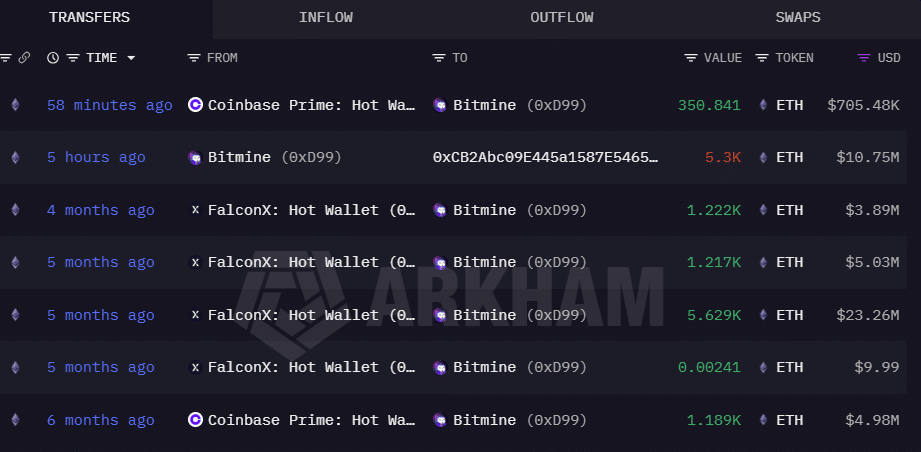
A transfer to Coinbase Prime does not necessarily mean the assets are about to be sold. Coinbase Prime is an institutional platform that provides custody, trading, and staking services, meaning deposits can be tied to a variety of treasury or portfolio management strategies.
Bitmine announced Monday total holdings of $10.3 billion across crypto assets, cash, and venture-style “moonshot” investments, including 4.5 million ETH, 195 BTC, and $1.2 billion in cash.
Over 3 million ETH, worth roughly $6 billion, has been staked, producing major annualized staking revenue as the company advances its MAVAN validator network set for launch in early 2026.
The company now owns approximately 3.8% of Ethereum’s circulating supply and is on track to reach the “Alchemy of 5%” accumulation target.
Le said in a statement that Ethereum showed resilience despite macro uncertainty and rising oil prices. According to him, ETH is closely tracking historical S&P 500 moves in 2011 and 1987, which could indicate a potential bottom between March 8 and March 14 near $1,740.
ETH was hovering around $2,000 at press time, up 3% in the last 24 hours, per CoinGecko.
Disclosure: This article was edited by Vivian Nguyen. For more information on how we create and review content, see our Editorial Policy.
Bitcoin jumps past $70,000 as war volatility fades

Bitcoin pushed back above $70,000 Tuesday morning East Asia time, completing a rapid recovery from a weekend selloff that briefly dragged the largest digital asset down to around $65,000.
The move higher came as volatility in energy markets eased after crude oil surged amid fears of disruptions in the Strait of Hormuz. Bitcoin dipped alongside risk assets during the initial shock but quickly stabilized in the mid $60,000 range — given Wall Street’s insulation from the energy crisis — before climbing again as markets digested the geopolitical headlines.
Market maker Enflux said the cryptocurrency showed notable resilience despite the scale of the energy shock.
“Bitcoin dipped below 66k during the initial risk-off wave yet quickly stabilized back in the 66k to 68k range,” the firm said in a note to CoinDesk. “In relative terms, it held up better than equities and even some traditional hedges.”
Institutional demand has also remained supportive.
U.S. spot bitcoin ETFs drew about $568 million in net inflows last week, following $787 million the week prior, according to data from SoSoValue, pushing cumulative net inflows across the products above $55 billion.
Early data from SoSoValue shows that Monday’s U.S. inflows were about $57 million, though not all issuers had reported at the time of publication.
Onchain and derivatives indicators suggest the market is stabilizing after the recent volatility, though conviction has yet to fully return.
“Overall, conditions are stabilizing, with momentum, ETF demand, and profitability metrics improving modestly,” analysts at Glassnode wrote in a recent report. “However, capital flows remain soft, speculative participation is limited, and broader conviction has yet to fully return.”
Prediction markets also flipped more bullish as bitcoin rebounded.
On Polymarket, the odds that BTC will reach $75,000 in March jumped to about 56% on Monday from roughly 34% a day earlier, highlighting how quickly trader expectations shifted as the cryptocurrency reclaimed the $70,000 level.