Home Blog Page 804

Bitcoin price can hit $1m if store-of-value market continues breakneck growth: Bitwise – DL News

0

  • “Reasonably conservative assumptions” suggest Bitcoin could hit $1 million in 10 years, according to one crypto executive.
  • Those assumptions include a quickly growing market for safe-haven assets along with Bitcoin capturing a larger share of that market.
  • But Bitcoin might never reach such heights if governments pull back from quantitative easing and reliance on relatively low interest rates.

The price of Bitcoin can hit $1 million in 10 years if the “store-of-value market” continues its breakneck rate of growth, according to Bitwise Chief Investment Officer Matt Hougan.

Like the $100,000 figure, which Bitcoin first hit in December 2024, the idea of Bitcoin trading at $1 million per coin has loomed large in the minds of proponents. That is, in part, because it would imply the market capitalisation of Bitcoin has eclipsed that of gold, the original safe-haven asset.

“This is why $1 million per Bitcoin sounds unreasonable to many, and why I dismissed it for years,” Hougan wrote in a Tuesday memo. “That is a very high bar.”

But that misses a key point about what Hougan calls store-of-value assets: their market has been growing rapidly over the past 20-plus years. And if it continues its current rate of growth, Bitcoin will only have to capture one-sixth of that market in order to surpass $1 million per coin.

Hougan only places two assets in the store-of-value category: gold and Bitcoin. The former is worth about $36 trillion. The latter is worth about $1.4 trillion, or 4% of the store-of-value market.

But gold was worth just $2.5 trillion in 2004, when the first gold ETFs launched in the US. That means it has grown at a compound annual growth rate of 13% since.

“The mistake people make when evaluating bitcoin’s potential is ignoring this growth,” Hougan wrote. “If this growth rate continues, the global “store of value” market will be ~$121 trillion in 10 years.”

If that were to happen, Bitcoin would need to capture just 17% of the store-of-value market.

Those two elements — a quickly growing market for safe-haven assets along with Bitcoin growing from one-twenty-fifth of that market to about one-sixth — are “a set of reasonably conservative assumptions,” Hougan wrote.

That likely understates the challenge: the price of Bitcoin would have to grow 14-fold, or about 1,300% in order to top $1 million.

And there are developments that could put a damper on the store-of-value market, according to Hougan.

If governments pull back from quantitative easing and reliance on relatively low interest rates to juice the economy, fear of currency debasement will recede. That could hurt the price of gold and Bitcoin, which benefit from such fear.

“But I think there’s equal risk that these projections are too conservative — that the store-of-value market will grow faster in the future, as concerns about government debt reach crisis levels, and that Bitcoin will end up taking much more than 17% of the store-of-value market in ten years,” Hougan wrote.

Aleks Gilbert is DL News’ New York-based DeFi correspondent. You can reach him at aleks@dlnews.com.

A Complete Guide to International Wire Transfer

0

Sending money across borders has become a routine financial activity for individuals and businesses. Whether you are paying overseas suppliers, supporting family abroad, or managing global business transactions, secure cross-border payment methods are essential. One of the most reliable ways to move funds between countries is through an International Wire Transfer, a banking method that allows direct electronic transfer of money from one financial institution to another.

How Cross-Border Bank Transfers Work

Cross-border bank transfers operate through a network of financial institutions connected through systems such as SWIFT or other payment networks. When a sender initiates the transfer, their bank communicates with the receiving bank using secure messaging protocols. The sender provides details such as the recipient’s name, bank account number, routing information, and the receiving bank’s SWIFT or BIC code.

Once the transaction is approved, the sending bank deducts the amount from the sender’s account and forwards the payment instructions. Depending on the banks involved, the funds may pass through intermediary institutions before reaching the final destination. This process ensures that the transfer is secure and traceable.

Key Benefits of Global Bank Transfers

Using bank-to-bank transfers for overseas payments offers several advantages. First, they are highly secure. Banks follow strict regulatory standards and use encrypted networks to protect transactions. This level of security makes them suitable for large payments, business transactions, and time-sensitive transfers.

Another advantage is speed. Many international payments are completed within one to five business days, depending on the destination country and the banks involved. Some financial institutions also offer expedited options that can deliver funds even faster.

Global bank transfers also provide transparency. Senders typically receive a reference or tracking number that allows them to monitor the status of the transaction until the recipient receives the funds.

Common Fees and Charges

Although cross-border bank transfers are convenient, they often involve fees. Banks may charge a sending fee, a receiving fee, and sometimes intermediary bank charges. In addition, currency conversion costs may apply if the payment is sent in a different currency than the recipient’s account.

Exchange rates offered by banks can also affect the final amount received. For this reason, it is important to compare rates and fees before initiating a transfer. Some banks provide fee calculators or estimated cost breakdowns to help customers understand the total cost of the transaction.

Information Required to Send Money Abroad

Before initiating a transfer, you need accurate details about the recipient and their bank. Typical requirements include the recipient’s full name, bank account number or IBAN, bank name, branch address, and SWIFT or BIC code. Providing incorrect information can delay the payment or result in additional fees.

For business transactions, additional documentation may sometimes be required, especially when large sums are involved. Financial institutions must comply with international regulations related to anti-money laundering and financial transparency.

Tips for Secure Overseas Transfers

When sending money internationally, always verify the recipient’s details before confirming the transaction. Double-checking account numbers and bank codes can prevent costly mistakes. It is also wise to initiate transfers only through trusted banks or authorized financial institutions.

Keeping transaction records is another important step. Save receipts, confirmation emails, and tracking numbers for reference. These documents can be helpful if you need to trace a payment or resolve disputes.

Final Thoughts

Cross-border banking services play a vital role in today’s global economy. They enable individuals and businesses to move money efficiently between countries while maintaining high security standards. Understanding the process, associated costs, and required details can help ensure a smooth and successful transfer experience.

As international commerce and global connectivity continue to grow, reliable banking solutions will remain essential for sending funds safely across borders.


Binance Sues Wall Street Journal Over February Article

0

Crypto-exchange Binance has filed a defamation lawsuit against The Wall Street Journal over a February article that alleged the exchange dismantled an internal investigation into cryptocurrency transactions tied to Iranian networks.

In a complaint announced Wednesday, Binance said the Feb. 23 report falsely claimed the company halted a compliance probe after investigators flagged more than $1 billion in crypto flows linked to entities connected to Iran-backed militant groups.

According to the newspaper’s reporting, internal investigators at Binance traced transactions through intermediaries, including a Hong Kong trading firm that allegedly moved hundreds of millions of dollars in stablecoins associated with Iranian networks. 

The article further claimed that investigators who raised concerns about the activity were later suspended or dismissed.

Binance has denied those allegations, saying the investigation was never stopped and that the exchange continued to pursue the matter internally.

“Binance categorically did not dismantle any compliance investigation,” a company spokesperson said Wednesday, adding that the publication “continues to report the same falsities.”

The lawsuit marks the latest escalation in a dispute between the exchange and the newspaper over reporting tied to sanctions-related crypto flows. Binance said the reporting caused reputational damage and misrepresented its compliance practices.

Dugan Bliss, global head of litigation at Binance, said the lawsuit was filed to address what the company described as misinformation about its operations.

“We view this lawsuit as a necessary step to defend ourselves against misinformation, and address the significant reputational harm and business consequences that have resulted,” Bliss said in a statement.

Binance said its internal investigation identified what it described as a “sophisticated, multi-jurisdictional pattern of financial activity” spanning Asia and the Middle East. The exchange said it offboarded accounts connected to the activity and reported its findings to law enforcement.

The company also pointed to its compliance program, saying it has invested hundreds of millions of dollars in monitoring and investigative systems and employs more than 1,500 staff in compliance, risk, and investigative roles.

DOJ probes Binance 

On top of this, just this morning the Journal reported that the U.S. Department of Justice is examining whether Iranian actors used the exchange to evade sanctions. 

According to the report, officials have contacted individuals with knowledge of transactions involving more than $1 billion in alleged flows linked to Iran-backed groups.

The Journal said investigators are seeking interviews and gathering evidence but it remains unclear whether the inquiry is focused on Binance itself or customers who used the platform.

Binance said it is not aware of any such investigation.

“We are not aware of any investigations,” the company said in response to the report, adding that it continues to cooperate with regulators and law enforcement where appropriate.

Bitcoin Could Hit $1M if it Tracks Gold

0

Bitcoin needs to make up just one-sixth of the global “store of value” market, currently dominated by gold, to reach $1 million per coin, argues Bitwise chief investment officer Matt Hougan.

In a blog post on Tuesday, Hougan said that most dismiss the lofty forecast for Bitcoin, as it would require Bitcoin to muscle into 50% of gold’s current market value.

However, Hougan said the “mistake” most people are making is ignoring the growth of gold and the broader “store of value” market.

Gold’s market cap has grown at around 13% annually since 2004, from $2.5 trillion to around $38 trillion, driven by “rising concerns about government debt, geopolitical uncertainty, easy monetary policy, and other factors.”

“If this growth rate continues, the global ‘store of value’ market will be [around] $121 trillion in 10 years. At that level, Bitcoin only needs to take 17% of the market to be worth $1 million a coin.”

Gold market cap from 2004 to the present. Source: Bitwise Asset Management

Related: Bitcoin undervalued relative to gold signals potential rally: Analyst

Hougan cited the growth of institutional investment, such as exchange-traded funds, sovereign wealth funds, and increasing portfolio allocations as potential catalysts.

“There are still miles to go, but with these undercurrents, capturing one-sixth of the store-of-value market in 10 years doesn’t seem extreme,” he said, adding:

“As I see it, the base case — that the store-of-value market will continue to grow as it has, and Bitcoin will continue to gain market share as it has — leads you to much, much higher prices than we have today.”

Bitcoin and gold divergence deepens

Hougan’s million-dollar Bitcoin (BTC) thesis depends on the asset continuing to converge with gold; however, the last several months have shown that Bitcoin hasn’t been moving in lockstep with gold.

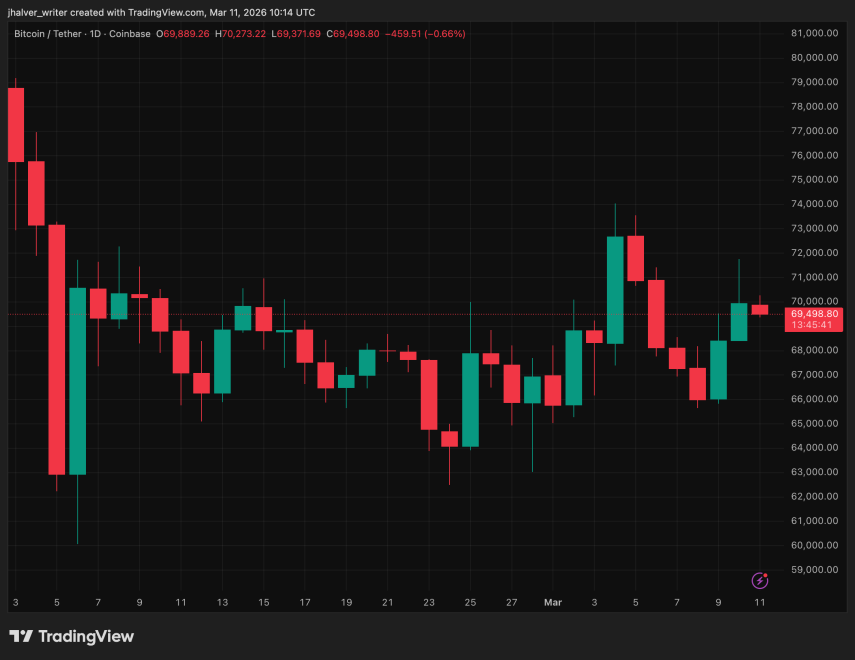
The price of gold hit an all-time high of $5,327 per ounce in late January, and it is just 2.2% away from that today, whereas Bitcoin is currently trading down 44% from its October peak.

Billionaire investor Ray Dalio cautioned against Bitcoin as a long-term store-of-value and safe-haven asset in early March, stating that gold was much better.

He argued that central banks are not buying BTC, which he said behaves more like a tech stock.

Greg Cipolaro, global head of research at NYDIG, said on March 6 that it appears Bitcoin is “not currently being priced as a macro hedge, a sovereign risk hedge, or a real-rate or inflation trade.”

“That dynamic helps explain the ongoing frustration around Bitcoin’s failure to ‘act like gold’ despite the digital gold label.”

Bitcoin and gold markets have been diverging since the October crypto market crash. Source: Google Finance

Magazine: China’s ‘50x’ blockchain boost, Alibaba-linked AI mines Bitcoin: Asia Express