Pi Network’s PI token led the market higher on Friday, according to CoinGecko data, rising 30% during Asia’s morning hours, after crypto exchange Kraken said it would list the asset.
Pi Network is a mobile-first cryptocurrency project that replaces traditional proof-of-work mining with a phone-based trust graph, where users tap a mobile app daily to “mine” tokens and form identity-verified security circles that feed into a consensus system derived from the Stellar protocol.
The project launched its externally connected mainnet in February 2025 after operating for years in a closed ecosystem, saying it had about 19 million KYC-verified users and roughly 10 million accounts migrated to the chain.
Pi Network is currently listed on OKX, Gate, and Bitget, as well as some smaller exchanges.
In February 2025, Bybit CEO Ben Zhou publicly refused to list Pi Network’s token and called the project a scam, citing a 2023 warning from Chinese police alleging that Pi Network targeted elderly users, collected personal information, and caused some victims to lose pension savings.
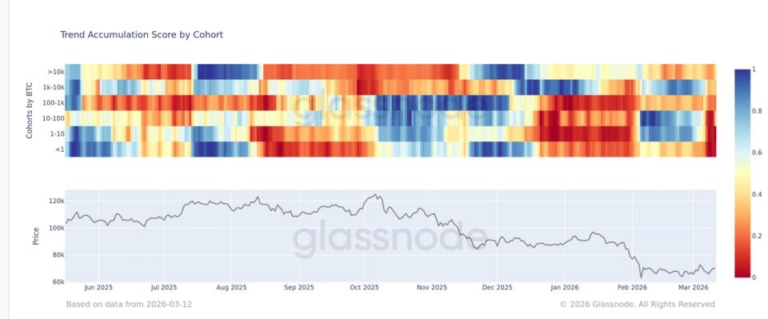
On-chain data from Glassnode shows that bitcoin holders across nearly all wallet cohorts have shifted back to aggressive selling amid persistent geopolitical tensions in the Middle East.
The distribution is being led primarily by retail investors, who appear to be the main source of selling pressure.
Glassnode’s Accumulation Trend Score, which measures whether different wallet groups are buying or selling, has dropped to around 0.04, signalling deep net distribution across the network.
The metric evaluates both the size of entities and the amount of bitcoin they have accumulated over the past 15 days.
The breakdown shows that smaller holders are leading the distribution. Wallets holding 1 to 10 BTC, typically associated with retail investors, are in heavy selling mode.
Entities holding 10 to 100 BTC are also distributing at a significant pace. Even larger participants are not immune to the trend. Wallets holding 1,000 BTC or more are also net sellers, though the intensity of their selling is less severe than that seen among smaller cohorts.
Despite the broad-based distribution, bitcoin continues to demonstrate relative resilience compared with traditional macro assets.
The U.S. dollar index has risen above 99.5, the U.S. 10-year Treasury yield has climbed to a one-month high above 4.2%, and brent crude oil is trading around $100. Typically, stronger yields, a firmer dollar and higher oil prices create significant headwinds for risk assets. Bitcoin’s ability to hold near $70,000 suggests underlying demand remains intact even as on-chain data shows investors bailing in the short term.
What he’s saying: Nahas told Sam Ewen on CoinDesk’s Gen C that Avalanche is a business tool, not a crypto product. He said companies want tailored blockchain infrastructure that fits compliance, geography and operational needs.
Nahas compared Avalanche’s model to WordPress, arguing businesses should be able to “spin up” a blockchain the way they spin up websites.
He said Avalanche’s strategy has shifted from broad crypto narratives toward “built for business” and embedded finance.
The goal, according to Nahas, is to help companies either make new revenue through digitization or cut costs through more efficient digital rails.
Why it matters: The discussion shows how one major crypto network is trying to distance itself from speculative token mania and pitch itself as enterprise infrastructure.
Nahas said much of crypto has been “technology for technology’s sake,” with too few products solving concrete customer problems.
He argued that businesses do not want to force their operations onto a shared general-purpose chain if they need privacy, specific fee structures or regulatory controls.
That stance reflects a broader industry push to hide the underlying blockchain and sell outcomes instead: faster payments, tokenized assets and new customer experiences.
Closer look: Nahas said Avalanche’s former “subnets” model, now rebranded as Avalanche L1s, is designed to let businesses run sovereign blockchains with their own validators and rules.
He said Avalanche has more than 70 live L1s and is targeting roughly 200 by the end of the year.
He pointed to use cases including tokenized equities, FIFA digital products, deed records in Bergen County, New Jersey, and tokenized asset programs in Japan.
Nahas said Avalanche’s combined L1 activity is processing about 40 million daily transactions, though those transactions are spread across many chains rather than concentrated on one flagship network.
Reading between the lines: Nahas was blunt that crypto’s critics are not entirely wrong. He said too much of the industry has relied on speculation, weak business models and short-term headlines.
He said “the token was the product” for many projects, which in his view is not a durable business model.
Nahas argued the sector still has not produced enough true “killer apps” that only blockchain can enable, though he suggested stablecoins may be emerging as one of them.
He also said enterprise partners are already in crypto, but often do not like what they see when projects focus more on announcements than execution.
What comes next: Nahas said clearer rules could unlock more institutional activity, even if crypto’s more libertarian wing resists regulation.
He said many companies want to build with blockchain now but will not move until they know where the legal line is.
On AI, he said blockchain-based payment rails could become important for agentic systems and micropayments, pointing to Avalanche partner Kite AI as an example.
His broader argument: the winning crypto platforms will be the ones that act less like ideology and more like dependable business infrastructure.
Solana’s next major protocol overhaul is edging closer to reality, and developers say it could dramatically reduce transaction confirmation times while simplifying the network’s core mechanics. Solana’s Alpenglow Upgrade Targets Near-Instant Finality and Simpler Consensus Solana developers are preparing a sweeping consensus upgrade called Alpenglow, a protocol redesign expected to cut transaction finality from seconds […]
The new product combines digital asset exposure with income potential
BlackRock today introduced the iShares Staked Ethereum Trust ETF (Nasdaq:ETHB), an exchange-traded product (“ETP”) that provides investors with exposure to spot ether while potentially generating income by staking a portion of its ether holdings. ETHB expands BlackRock’s digital asset offering, which includes the iShares Bitcoin Trust ETF (IBIT), and the iShares Ethereum Trust ETF (ETHA), both the largest ETPs of their kind with over $55 billion and $6.5 billion in assets under management respectively.1
The iShares Trusts are not investment companies registered under the Investment Company Act of 1940, and therefore are not subject to the same regulatory requirements as mutual funds or ETFs registered under the Investment Company Act of 1940.
“Investors are increasingly allocating to digital assets as part of their strategic portfolio construction, and ETHB provides access to income and exposure to the asset in a convenient, transparent way,” said Jessica Tan, Head of Americas for Global Product Solutions at BlackRock. “We continue to innovate to meet client demand and expand access, while providing the transparency and risk management clients expect from BlackRock.”
Ether, as the native token of the Ethereum network, represents exposure to the expanding economic activity taking place on Ethereum, and the staking of the Trust’s Ether holdings offers an additional source of potential return.2 iShares now offers investors a choice between ether exposure (ETHA) and a staked option (ETHB) designed to provide income.
“As the world’s second-largest digital asset, Ethereum plays a central role in the long-term growth of blockchain adoption and the expansion of decentralized applications, including tokenization and stablecoin use cases,” said Robert Mitchnick, Global Head of Digital Assets at BlackRock.3 “By bringing together spot ether exposure and staking rewards in an ETP, ETHB provides investors with an important new avenue to participate in the ecosystem’s evolution.”
ETHB carries a 0.25% sponsor fee with a one-year waiver reducing the fee to 0.12% on the first $2.5 billion assets under management.4
BlackRock is a leading asset manager in the digital asset ecosystem, overseeing roughly $130 billion in assets across cryptoasset ETPs, tokenized liquidity funds, and stablecoin reserve management. iShares captured approximately 95% of industry flows into digital asset ETPs in 2025.5
Lido, the largest liquid staking protocol on Ethereum, is expanding beyond ether (ETH) with the launch of a new product designed for stablecoin holders.
The project on Thursday introduced a revamped version of its yield product, Lido Earn, which now revolves around two vaults: EarnETH for ether-based assets and EarnUSD for stablecoins. The goal is to make it easier for users to earn returns on crypto without having to choose or manage strategies themselves.
In simple terms, a vault is a pooled investment tool where users deposit crypto and the platform automatically puts those funds to work across different strategies designed to generate yield.
The new EarnUSD vault marks Lido’s first product built specifically for dollar-pegged tokens. It accepts stablecoins USDC and USDT and automatically allocates deposits across a range of decentralized finance (DeFi) opportunities on Ethereum, such as lending markets and other yield-generating strategies. Users receive a token representing their share of the vault, with returns accumulating over time.
The EarnETH vault works similarly but for ether-related assets, including ETH, WETH and Lido’s stETH. Deposits are spread across several DeFi protocols, including Aave, Uniswap and Morpho, with the system shifting funds toward strategies that are performing better.
The stablecoin vault comes as dollar-pegged tokens have become a major part of activity in Ethereum’s DeFi ecosystem. Roughly half of DeFi activity on the network now involves stablecoins, according to a press release shared with CoinDesk.
“Stablecoins are a fundamental part of DeFi, and until now we weren’t serving those users,” said Marin Tvrdić of the Lido Ecosystem Foundation, in the press release.
Read more: Lido Launches GG Vault for One-Click Access to DeFi Yields
The White House is demanding that ABC News retract a report about a possible Iranian drone attack on California.
Officials say the FBI bulletin referenced in the story relied on a single unverified tip and did not represent a credible threat.
The dispute comes as Iran launches hundreds of drones across the Middle East in response to U.S. and Israeli strikes.
The White House is demanding that ABC News retract a report warning that Iran sought to launch drone attacks on California, saying the story relied on a single unverified tip and overstated the threat.
The dispute centers on a leaked FBI bulletin circulated in February that described a scenario in which Iran could retaliate for U.S. strikes by launching unmanned aerial vehicles from a vessel off the West Coast toward unspecified targets.
On Thursday, White House Press Secretary Karoline Leavitt took to social media to demand that ABC News remove the story.
“They wrote this based on one email that was sent to local law enforcement in California about a single, unverified tip,” Leavitt wrote on X. “The email even states the tip was based on unverified intelligence. Yet ABC News left out this critical fact in their story! WHY?” she said.
“TO BE CLEAR: No such threat from Iran to our homeland exists, and it never did,” Leavitt added.
After the news of the warning surfaced, officials in California rushed to ease fears, emphasizing that there is no imminent danger.
“While we are not aware of any imminent threats at this time, we remain prepared for any emergency in our state,” California Governor Gavin Newsom wrote on X. The assurance was shared by government and law enforcement officials across the state.
In light of current global events, the Department remains at an elevated level of readiness and is maintaining increased vigilance as we continue to protect our residents of Los Angeles County. We are working closely with our federal and local law enforcement partners to share… pic.twitter.com/9M7ggNKYfT
The controversy comes as drones play a growing role in the ongoing conflict between Iran, the U.S., and Israel. Following joint U.S. and Israeli strikes on Iran in February, Iran retaliated by launching large waves of drones and missiles against targets across the Middle East.
Air defenses have intercepted many of the projectiles, but several attacks have caused damage to ports, ships, energy facilities, and other infrastructure. Iranian drone strikes have also targeted oil infrastructure and shipping routes in the Gulf, disrupting energy markets and contributing to rising oil prices.
Military officials say the attacks illustrate how relatively inexpensive drones have become one of the defining weapons of modern warfare.
Drones reshape the battlefield
Unlike American-made MQ-9 Reaper drones, which fly long distances, carry out missions, and return to base, the drones most often associated with Iran’s attacks are primarily the Shahed-131 and Shahed-136. Both are one-way attack drones designed to fly to a target and explode on impact. Russia has used the same designs in Ukraine under the names Geran-1 and Geran-2.
Because the aircraft can be produced far more cheaply than many of the missile systems used to shoot them down, they allow countries or militias to overwhelm air defenses through sheer volume.
The growing military drone market is expected to be worth $66 billion by 2035, according to research firm Global Market Insights.
Crypto funding appears in drone investigations
Crypto has also played a part in the growing drone supply chain. In 2022, Ukraine reported spending over $54 million in crypto on drones and other military expenses. That same year, Chainalysis reported that pro-Russian groups donated over $2 million in cryptocurrency.
In September, U.S. prosecutors sought to seize more than $500,000 in USDT from an Iranian national accused of supplying navigation technology used in military drones deployed by Iran. Days later, Israeli officials called for the seizure of $1.5 million in Tether allegedly tied to Iran.
Authorities said the funds were held in a private cryptocurrency wallet and were allegedly linked to a company that supplied navigation equipment for Shahed drones, which have been deployed in conflicts around the world.
ABC News has since updated its article to reflect new reporting on the alert. Still, the episode illustrates how rapidly emerging technologies like drones can trigger public fears as they become a growing part of modern warfare.
Daily Debrief Newsletter
Start every day with the top news stories right now, plus original features, a podcast, videos and more.
Brevis recently launched an end-to-end media authenticity system that allows images and videos to cryptographically prove their origins while protecting user data. The Shift From Detection to Proof On March 9, 2026, the zero-knowledge-proof computing company Brevis launched an end-to-end media authenticity system designed to tackle the online trust crisis. Known as Brevis Vera, the […]
RateGain Travel Technologies Limited (NSE: RATEGAIN), a global leader of AI-powered SaaS solutions for the travel and hospitality industry, and Juspay, a leading global payments technology company, today announced a strategic partnership to power RG Pay, RateGain’s embedded financial technology platform for the travel and hospitality ecosystem.
This partnership marks a significant step in Juspay and RateGain’s mission to drive higher checkout conversions, unlock localized and flexible payment options, and create seamless, scalable booking experiences for travelers around the world, aligned with the recent launch of RG Pay.
As travel businesses scale globally, payments remain a critical operational priority, from supporting diverse local payment methods to managing cross-border transactions efficiently. RG Pay extends these capabilities by integrating Juspay’s cutting-edge payment orchestration stack into the RateGain travel commerce ecosystem. The platform goes beyond checkout to enable a unified transaction lifecycle model, combining payment processing, intelligent routing, orchestration, and affordability solutions within RateGain’s existing distribution and connectivity infrastructure. Through this partnership, travel and hospitality brands gain access to RG Pay, powered by Juspay’s high-performance payment stack. Built for scale and reliability, the platform leverages Juspay’s proven capabilities, which process over 300 million daily transactions and handles more than $1 trillion in annual payment value with 99.999% uptime. Together, with a strong global presence across major travel markets, this partnership will enable seamless, high-performance payment experiences for travel and hospitality brands worldwide.
“We are excited to partner with RateGain to demonstrate how high-performance payment technology can co-create a new benchmark for the travel industry,” saidIshan Sharma, Head of Sales and Business Development at Juspay. “RG Pay bridges the gap between institutional scale and the agility of modern technology, ensuring that hotels can offer the same seamless, secure checkout experience that the world’s largest digital enterprises rely on.”
“RG Pay marks our evolution from optimizing bookings to enabling the full transaction lifecycle across our hospitality commerce platform,” said Parijat Tiwari, Executive Vice President & General Manager, Distribution, RateGain. “By integrating Juspay’s globally scalable orchestration infrastructure and AI-powered routing intelligence into our ecosystem as a launch Partner, we are strengthening the foundation of payments in travel, aligning discovery, distribution, conversion, and transaction performance within a unified architecture for travel brands worldwide.”
Together, RateGain and Juspay aim to strengthen the foundation of global travel payments, enabling travel and hospitality brands to operate with greater agility, resilience, and confidence across markets.
In today’s newsletter, Ganna Vitko, president of the Toronto Chapter of Women in Crypto, takes us through accounting rules that are in place for crypto and digital assets and some of the challenges of dealing with these new assets.
Then, in Ask an Expert, Aaron Brogan of Brogan Law answers questions about token issuance and its tax implications.
– Sarah Morton
The accounting and auditing challenges for crypto funds: a glimpse into the EU and US markets
The crypto market poses significant challenges for auditors and accountants in all jurisdictions. These are some of them.
What to Know:
Since digital assets do not fit neatly into existing Generally Accepted Accounting Principles (GAAP) and International Financial Reporting Standards (IFRS) frameworks, there’s a lot of uncertainty around their classification, valuation, and disclosure in both the EU and the U.S.
While the EU is slowly moving toward better standardization through new regulations, the U.S. continues to rely on interpretive approaches.
All of this leaves auditors, accountants, and fund managers to navigate higher inconsistency and risk.
The finance industry has undergone an extraordinary metamorphosis in the past decade. With digital assets becoming full-fledged parts of the financial ecosystem, every market player has had to adapt to new circumstances.
No one has had it more difficult than auditors and accountants. Specifically, conventional audit and accounting practices — based on the traditional financial instruments and reliable infrastructure — are not enough to contend with the ever-changing world of digital wallets and distributed ledgers.
Below, we’ll discuss some of the most prevalent challenges that auditors and accountants are facing, both in the U.S. and in the EU.
The core of the issues
At the heart of crypto accounting and auditing issues lies a fundamental mismatch: digital assets simply do not fit into long-established frameworks. For instance, under the U.S. GAAP and the IFRS, assets are grouped into clearly defined categories such as cash, securities, derivatives, or intangibles.
However, cryptocurrencies defy such straightforward classifications. Are they financial instruments? Intangible assets? Or should they be seen as inventory? Despite recent attempts, not many jurisdictions have managed to fully define them.
This lack of clarity has several negative effects, as it shapes how crypto holdings are validated, when impairments are recognized, and how gains and losses are actually recorded in financial statements.
Regulatory pressure and enforcement trends
We have to note that this accounting and custody ambiguity is unfolding in an environment where regulatory scrutiny is at an all-time high. While not all SEC enforcement actions relate directly to crypto or audit failures, recent data on accounting and auditing enforcement offer a useful window into the compliance conditions that digital asset funds now operate in.
The data in the table above reveal a notable shift in enforcement dynamics. For one, it is clear that the number of respondents in accounting and auditing cases declined in fiscal year 2024. However, the average settlement amounts increased significantly, especially for individual respondents. This pattern points to a shift away from broad-based enforcement and a move toward fewer cases with higher financial stakes. That, in turn, increases the personal and professional risk for everyone involved.
On the other hand, Europe is moving along a markedly different path. As Markets in Crypto-Assets (MiCA) enters phased implementation and supervisory coordination strengthens across all member states, the emphasis is slowly shifting to formalized compliance frameworks and standardized reporting obligations.
Thus, there is a contrast in regulatory mechanics between these jurisdictions. In the U.S., enforcement intensity ebbs and flows with policy direction and case selection. On the other hand, EU codification is advancing through structured legislative harmonization. Both of these dynamics shape the governance environment in distinct but consequential ways for crypto fund managers and their auditors alike.
Looking ahead: best practices and innovation
Amid regulatory and technical uncertainty in the EU and the U.S., market participants are doing their best to proactively adopt best practices. They include:
Regular third-party attestation of reserves
Independent valuation providers using multi-exchange pricing
Enhanced internal controls over crypto operations
Investment in audit technologies that leverage blockchain analytics.
Auditors and accountants themselves are expanding their skills and partnering with specialists, which is a big step in the right direction.
Conclusion
At the moment, accounting and auditing for crypto funds are at a crossroads. Issues such as fragmented regulation, volatile markets, and novel custody arrangements all strain legacy financial frameworks. In the EU, new regulations signal a move toward better harmonization, while the U.S. largely continues to rely on creativity and interpretive approaches.
For auditors and accountants alike, navigating these waters demands more technical knowledge and active engagement with all emerging guidance. In the end, matters will get better once more improved frameworks pop up. Only they can enhance transparency, reduce risk, and support sustainable growth in the crypto fund ecosystem.
– Ganna Vitko, president, Toronto Chapter of Women in Crypto
Ask an Expert
Q. My client is considering launching a meme coin. What should they take into account?
The SEC has provided guidance that it does not consider certain “meme coins” to be securities. If a client wishes to sell these tokens, they should be aware that the tax treatment of meme coin sales is not equivalent to an exempt securities offering. IRC § 1032 says that proceeds from stock are not taxable income, but this is a statutory creation with no crypto analogue. If your client sells meme coins, they may owe ordinary income tax.
Q. How might this change in the future?
There has been a push among crypto legal practitioners, such as Miles Jennings, to re-shore cryptocurrency projects. However, many projects prefer to make offerings offshore in part to attempt to avoid the tax burden of issuing in the United States. Tax is a live policy issue among crypto lobbyists in Washington, D.C., and a solution to the issuance conundrum could be the subject of future legislation.