Home Blog Page 785

Ford’s New AI Tool Offers In-Depth Insight Into Its CVs

0

Ford has revealed a new AI fleet management system for its commercial vehicle business.

The U.S. automaker introduced Ford Pro AI at the Work Truck Week show in Indianapolis this week. It is available now to the company’s U.S.-based Pro telematics subscribers.

The tech delivers the capability to analyze more than a billion data points daily from connected CVs — covering elements such as fuel consumption, engine health, route optimization, and even whether occupants are wearing seatbelts — and turn them into insights that fleet managers can act on.

With Ford thought to have more than 840,000 paid subscribers globally, the company hopes the AI tool can ramp up profits for the Pro CV division, which last year reported revenue of more than $66 billion, assisted by a 30% rise in software subscriptions.

Ford says Pro AI offers customers added value by boosting the efficiency of their fleets and reducing downtime on the road.

Related:AI Legal Platform now Valued at $5.5 Billion

“This isn’t AI for AI’s sake. You can’t simulate Ford’s 120-plus years of commercial vehicle experience and customer understanding,” Kevin Dunbar, Ford senior vice president, said in a release. “We build on that deep expertise and blend it with a robust data fabric enhanced with proprietary data and leverage large language models [LLMs] in a way that respects the realities of a modern fleet.”

The company’s own research suggests fleet managers spend more than 23 hours a week handling routine tasks, such as scheduling services and tracking costs, and that AI can help reduce this workload by about 40 %each week.

Ford provided examples of how the tech, built on Google Cloud and using a number of LLMs, uses Ford’s data to deliver results.

It cited, for example, an imaginary fleet manager for a plumbing company querying how many of its 25 vehicles require a service in a given month. After inputting this question into Pro AI, Ford says it “quickly responds with a list of vehicles in [the] fleet that need service based on their vehicle health data”.

The comprehensive answers go deeper than would be provided by a chatbot, according to Ford, offering a detailed analysis of the vehicles’ diagnostics — providing the information required for a fleet manager to decide which vehicles need servicing first — and can also navigate to Ford’s Pro Telematics Software, enabling customers to book maintenance.

The tool is available at no additional cost to Pro Telematics customers at launch in the U.S., with Europe and Canada among other markets Ford is assessing for future rollout.

Related:Contextual Data is Important for Enterprises’ AI Projects


Bitcoin’s early crash to $60,000 now looks like a warning for stocks

0

Many see bitcoin as a safe-haven and store-of-value asset, like gold. But some currency traders treat it as a lead indicator for broader market mood, and they’ve been proven right again: Before finding stability near $70,000 recently, bitcoin plunged sharply, presaging the ongoing global stock market swoon.

Bitcoin’s price peaked above $126,000 in early October and started falling, eventually hitting lows near $60,000 early last month. The sell-off featured rapid outflows from U.S.-listed spot ETFs. CoinDesk flagged this in January, questioning whether these flows – absent any clear crypto trigger – signaled an incoming macro economic blowup and stock market sell-off.

Fast forward to today: Global market sentiment has worsened, with the Iran war and oil price spike weighing heavily on Asian and European indices. The S&P 500 and Nasdaq have also come under pressure while the dollar index gains. Meanwhile, bitcoin has been rock steady around $70,000.

Here’s where it gets even more interesting: Key stock indices like the S&P 500 mirrored Bitcoin’s pre-crash back-and-forth trading in a broad range.

Daily charts for BTC, SPX futures, XLF and Nifty. (TradingView)

Bitcoin held above $100,000 for months in this volatile, expanding channel before plunging into bear territory. An identical setup has unfolded in the SPDR Financial Select Sector ETF (XLF), India’s Nifty (among the hardest hit), and S&P 500 futures.

Repeat of 2021-22

This isn’t the first time bitcoin has led price action in traditional risk assets. Over the years, the cryptocurrency has often foreshadowed equity trends, most clearly in late 2021-2022.

BTC versus S&P 500 e-mini futures. (TradingView)

BTC peaked near $60,000 in November 2021 and quickly tanked to under $50,000 in a month. The bear market deepened in 2022. The Nasdaq and S&P 500 topped out two months later in January 2022, then followed suit with their own prolonged declines as the Federal Reserve raised borrowing costs rapidly.

Todd Stankiewicz, president and chief investment officer of SYKON Capital, in a blog post on the Chartered Market Technicial (CMT) Association website, noted bitcoin’s tendency to peak before the S&P 500 in three key instances: late 2017, weeks before the COVID crash, and late 2021.

“Bitcoin either rolled over or failed to make new highs while the S&P 500 pushed ahead. In each case, the equity rally eventually stalled and reversed,” Stankiewicz said.

All things considered, the takeaway is clear: Stock traders should start watching bitcoin trends closely from here.

Bitcoin tax controversy pulls in Brian Armstrong, Jack Dorsey – DL News

0

  • A Bitcoin investor alleged that Coinbase lobbyists are working against a proposed tax break for Bitcoin.
  • Coinbase executives denied they wanted to limit tax exemptions to stablecoins.
  • Jack Dorsey, CEO of Block, publicly asked Brian Armstrong for clarification.

While crypto investors fixated on the plummeting price of Bitcoin, something changed on Capitol Hill over the past three months: a Bitcoin tax break that seemed headed for passage is suddenly being limited to stablecoins.

One Bitcoin advocate thinks he knows why: Coinbase.

Yesterday, Ten31 managing partner and Bitcoin advocate Marty Bent fired the first shot, alleging that lobbyists from the US’s largest exchange were telling lawmakers that “no one is using Bitcoin as money” and pushing for tax exemptions that apply solely to stablecoins like USDC.

Bent claims to have spoken to three sources close to the matter.

USDC’s issuer, Circle, has had a strategic relationship with Coinbase since 2018, with the exchange earning revenue from USDC reserves.

Multiple Coinbase executives quickly denied Bent’s allegations, calling them “categorically false.” They said the company has advocated for tax exemptions covering “all digital assets,” including Bitcoin, since 2017.

“This is a total lie, Marty Bent,” wrote Faryar Shirzad, Coinbase’s chief policy officer. “We have never and will never lobby against Bitcoin. Ever.”

Then Block CEO Jack Dorsey got involved, publicly questioning Coinbase CEO Brian Armstrong.

“Hope this is true for de minimis as well. Brian Armstrong?” asked Dorsey.

In just one word, Armstrong joined his colleagues in denying the allegations.

De minimis exemption

At the core of the clash is something called a “de minimis exemption.”

It’s basically a tax break for small crypto purchases. Without a de minimis exemption, it would be impractical to use crypto for payments.

Right now, the US treats crypto as property, meaning that every sale triggers capital gains taxes. Buying a coffee with Bitcoin? You have to report to the Internal Revenue Service because that’s a taxable event.

But whatever Coinbase’s role, there has been a change on Capitol Hill, according to Conner Brown, of the Bitcoin Policy Institute.

“Over the past three months, there’s been a strong shift on the Hill to limiting the de minimis exemption to stablecoins only,” Brown wrote, although he did not name Coinbase directly.

A recent bipartisan discussion draft of the Parity Act from Representatives Max Miller and Steven Horsford limits the exemption to “regulated payment stablecoins” — explicitly excluding Bitcoin, according to the Bitcoin Policy Institute, a Bitcoin-focused advocacy group that operates in Washington, DC.

That’s a wide departure from pro-Bitcoin Senator Cynthia Lummis’s original proposal for taxing crypto, which provided a de minimis exemption for Bitcoin.

The shift began in 2025, following passage of the GENIUS Act, according to the Bitcoin Policy Institute. The group has met with 19 congressional offices over the past three months pushing back.

Multiple proposals

The clash between Coinbase and Bitcoin advocates is further complicated by the fact that right now there are multiple tax relief proposals floating around Capitol Hill simultaneously.

First there’s the aforementioned personal use de minimis exemption. Then there’s a separate gas fee exemption for transaction costs. And then there’s stablecoin-specific relief that would ignore gains or losses within one penny.

Different crypto constituencies want different things. Bitcoiners prioritise personal use relief while stablecoin users want gas fee exemptions. Brokers want to eliminate burdensome requirements for stablecoin transactions.

That could explain the claims that Bitcoiners have made about Coinbase.

“Likely, different market participants will advocate more strongly for different provisions,” Jason Schwartz, a prominent crypto tax attorney wrote on X. “That doesn’t necessarily mean they are ‘lobbying to kill’ others.”

Pedro Solimano is a markets correspondent based in Buenos Aires. Got a tip? Email him at psolimano@dlnews.com.

Buy now pay later usage surges as new products proliferate, JD Power finds

0


Chase Ranks Highest in Customer Satisfaction with Buy Now Pay Later Providers

  • Nearly two-fifths (37%) of all consumers and half (50%) of consumers under 40 used Buy Now Pay Later to make a purchase in the past 90 days
  • FinTech brands are driving surge in adoption, but bank brands generate significantly higher levels of customer satisfaction
  • More than half (52%) of decisions to use credit card fixed-payment plans occur after purchase when reviewing/paying credit card bills, while 48% occur at checkout/point-of-sale

TROY, Mich.–(BUSINESS WIRE)–Buy Now Pay Later (BNPL) adoption continues to grow rapidly, with 37% of consumers in the United States making a purchase using this method in the past 90 days, a 5-percentage-point increase in just one year. According to the JD Power 2026 U.S. Buy Now Pay Later Satisfaction Study,SM released today, as BNPL use matures and providers continue to launch new products, customers are increasingly using it to manage their day-to-day spending.

“The 2026 study shows sustained and rapid growth of BNPL, driven largely by increased use of services offered by FinTech providers. When it comes to overall satisfaction, however, the traditional financial institutions are delivering a much more positive user experience,” said Sean Gelles, senior director of banking and payments at JD Power. “This signals an enormous opportunity for traditional financial institutions. Customers are looking for BNPL solutions from the brands they already know and trust.”

Following are some of the key findings of the 2026 study:

  • Customer satisfaction rises sharply for bank brands: Though bank-branded BNPL services still represent just a fraction of total BNPL spending, the average overall customer satisfaction score for bank-based BNPL services is 704 (on a 1,000-point scale), up 59 points from last year’s study. By contrast, customer satisfaction with FinTech BNPL brands is 603, which is down 17 points from last year.
  • Checkout/point-of-sale opportunity for bank brands: Among customers using a BNPL service associated with their credit card, 52% make the decision to use a fixed payment plan after the purchase has already been made while 48% make the decision at the time of purchase, indicating an opportunity for bank brands that can build installment plans into the checkout/point-of-sale experience.
  • Most customers pay off BNPL in four installments, using debit cards: The “pay in four” installment schedule is by far the most common BNPL format used, with 82% of FinTech customers and 73% of bank customers paying off their purchases in four equal installments. Debit cards are the most widely used form of payment, with 64% of FinTech customers linking their BNPL payments to a debit card.


Previous articleAnt international: FinAI paving the last mile for agentic commerce

Horacio


Bitcoin above $71,000, ETH, SOL, ADA zoom higher as cryptos shrugs off stock weakness

0

Bitcoin held firm near $71,000 on Friday, extending a quiet stretch of consolidation that has kept the crypto market largely unmoved by turbulence in global equities.

BTC traded around $71,300 in early trading, up roughly 2.6% over the past 24 hours and slightly higher on the week. Ether (ETH) changed hands near $2,117, gaining about 4.6% on the day, while solana (SOL) climbed more than 5%. XRP (XRP) rose to $1.41 and BNB hovered around $661, both posting modest daily gains.

The broader crypto market capitalization sat near $2.4 trillion for a third straight session, reflecting a market that has been stuck in a tight band since the sharp sell-off in late January.

That stability stands out against a much shakier backdrop in traditional markets. Asian stocks slipped earlier Friday and the S&P 500 has struggled this week as oil prices surged toward $100 per barrel amid geopolitical tensions in the Middle East and supply disruptions.

Yet crypto markets appear to be largely ignoring those pressures for now.

“Bitcoin is feeling more confident at levels near $70K, settling at the upper limit of the consolidation range of the last four weeks,” said Alex Kuptsikevich, chief market analyst at FxPro. “It is difficult for Bitcoin to grow amid a strengthening dollar and falling stock indices.”

“But the very fact that it is holding steady against this backdrop supports hopes for a fundamental change in sentiment compared to previous months, when almost any news was a reason to sell BTC.”

Data from analytics firm Glassnode suggests the current phase is more stabilization than breakout. The firm noted that while some on-chain metrics are improving, a sustained bull run would likely require a fresh influx of capital rather than continued rotation among existing holders.

The relative calm may also reflect a broader shift in how institutions view the asset.

“Indeed, Bitcoin is in its transition phase as a financial tool,” said Dom Harz, co-founder of BOB. “Institutions want more than exposure to Bitcoin and are increasingly looking for the infrastructure designed to unlock Bitcoin’s financial utility.”

Harz pointed to the growing push toward Bitcoin-native financial infrastructure — often referred to as Bitcoin DeFi — that allows institutions to build lending, payments and yield products directly on top of Bitcoin’s security layer.

“This Bitcoin-native financial architecture is at the centre of Bitcoin DeFi,” Harz said. “As the macro backdrop continues to challenge legacy asset classes, the advantages of a financial system built on Bitcoin DeFi become clear.”

For now, price action suggests traders remain comfortable keeping bitcoin inside its recent $60,000–$72,000 corridor. Until a clear macro catalyst or wave of new capital arrives, the market appears content to consolidate near the upper end of that range rather than chase a breakout.

Is privacy still hot? Bitcoin miner Foundry will debut a Zcash pool — here’s why – DL News

0

  • Foundry Digital is debuting a Zcash mining pool.
  • The top miner is betting big on a cryptocurrency that remains more than 90% below its 2016 trading level.
  • Digital asset entrepreneurs have said Zcash is still relevant as people increasingly value privacy.

Privacy coins were the talk of the crypto world last year. They’ve since nosedived in value and are trading well below their all-time highs.

But they still have potential, say some crypto bigwigs. Foundry Digital, the world’s leading Bitcoin mining pool operator, this week announced it would debut a mining pool for Zcash in April.

“[Foundry’s move] reflects growing confidence that privacy-preserving networks will remain an important part of the digital asset ecosystem, particularly as institutional participation continues to expand,” Charles Chong, head of strategy at crypto investment firm BlockSpaceForce, told DL News.

Foundry betting big on Zcash, the 30th biggest coin by market value, comes during a bear market where most major cryptocurrencies have plunged in price. But Zcash has fallen harder than most of its peers.

Despite praise from top digital asset entrepreneurs like the Winklevoss twins and Arthur Hayes, Zcash is still 93% below its record.

Demand from institutions

Foundry’s Zcash mining pool won’t be any mining pool — it’ll be aimed at institutions.

“Zcash has matured into an institutional-grade asset, but the mining infrastructure supporting it hasn’t kept pace,” Foundry CEO Mike Colyer said in a statement, adding that the company believes the coin “plays a critical role in advancing financial privacy.”

Foundry said that the pool will allow big players to hook up to the Zcash network and process transactions the same way they can with the company’s Bitcoin pool.

The idea is that Foundry’s Zcash pool becomes the standard for public companies and institutional miners, the Rochester, New York-based firm said.

Who’s really interested in Zcash?

While Zcash got a boost last year, hitting nearly $700 per coin, its record still stands way higher: $3,192 — a level hit back in 2016.

Zcash is well below its record set nearly a decade ago. Source: CoinGecko.

Who’d be interested in mining the asset, then? Big investors have said that privacy coins will be increasingly sought after as the right comes under threat around the world.

Last year, AngelList founder Naval Ravikant wrote on X that while “Bitcoin is insurance against fiat,” Zcash is “insurance against Bitcoin” — making note of privacy concerns around the biggest public blockchain.

Then, crypto entrepreneur Arthur Hayes started talking about the coin, telling his followers how to store it. He also made bold predictions for where the coin’s price was going.

Winklevoss Capital, the venture capital fund owned by billionaire twins Cameron and Tyler Winklevoss, even backed a Zcash treasury company, with Tyler Winklevoss claiming “Privacy’s become a rare, vanishing commodity.”

Zcash also gained institutional backing from Coinbase, Andreessen Horowitz, and Galaxy Digital last year.

Tim Sun, senior researcher at HashKey Group, told DL News that Foundry’s involvement sent a strong message on the coin’s long-term viability.

“Large financial firms are increasingly comfortable operating on public blockchains, but they still require the same protections they expect in traditional markets — including transaction privacy,” he said.

“Privacy technologies like those pioneered by Zcash can play an important role in enabling institutions to move operational activity on-chain without exposing sensitive counterparties or transaction details,” he added.

Barry Silbert, CEO of Digital Currency Group, which owns Foundry, is an altcoin enthusiast who has said he likes projects that can deliver “500x returns.” He said last month that “5%-10% of Bitcoin over the next few years” will move into privacy-focused cryptocurrencies.

Legendary investor Ray Dalio has raised concerns about Bitcoin’s lack of privacy in recent months.

Zcash emerges from the darkness

Zcash is the second-biggest privacy coin after Monero. It got off to a rough start this year when developers in January quit en masse from Electric Coin Company, the firm that built the cryptocurrency.

The coin’s price plunged further — despite developers reassuring the crypto community that protocol was “unaffected” by the mass-exodus.

Still, not long after, the US Securities and Exchange Commission dropped a years-long investigation into the foundation that promotes Zcash.

And earlier this week, the former Electric Coin Company staffers said they raised $25 million to continue work on the privacy-focused cryptocurrency, with backing from Paradigm, Andreessen Horowitz, the Winklevoss twins, and other prominent investors and funds.

Mathew Di Salvo is a news correspondent with DL News. Got a tip? Email at mdisalvo@dlnews.com.

What next as Ripple-linked token ends early-2026 downtrend

0

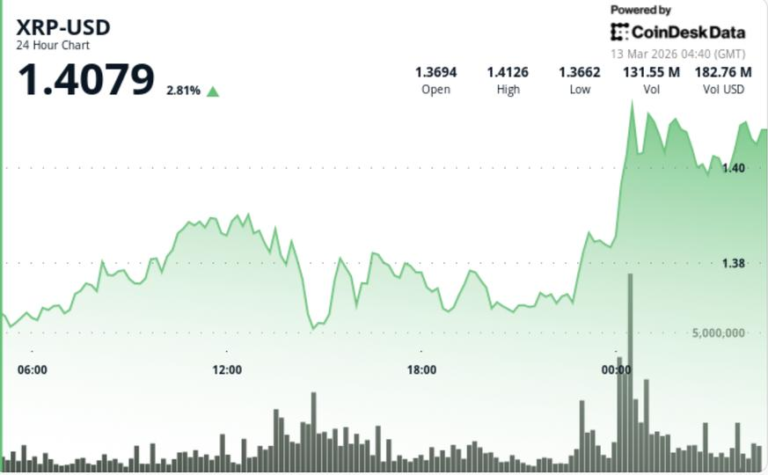
XRP pushed higher after breaking a months-long descending trendline, with a surge in trading volume confirming renewed momentum above the $1.39 resistance zone.

News Background

  • XRP has struggled to sustain rallies through early 2026 as sellers repeatedly defended a descending resistance line formed by lower highs since January.
  • The latest move marks the first decisive break above that structure, shifting short-term sentiment as traders reassess whether the corrective phase may be ending.
  • Fund flows offered a mixed backdrop. U.S.-listed XRP ETFs recorded roughly $3.9 million in outflows during the session, extending a short streak of redemptions even as technical momentum improved.
  • Meanwhile, activity on the XRP Ledger continued to rise. Daily transactions recently climbed to around 2.7 million, among the highest levels in recent months, partly driven by projects focused on tokenizing real-world assets.

Price Action Summary

  • XRP climbed from about $1.37 to $1.41 during the 24-hour session
  • Price cleared the $1.39 resistance zone that capped rallies earlier this year
  • Trading volume surged to roughly 205 million tokens, more than triple the recent average
  • The token traded within a roughly $0.057 intraday range during the breakout

Technical Analysis

  • The key technical development was XRP’s break above the descending trendline that had defined its downtrend since early 2026.
  • The move came with a sharp expansion in trading volume, suggesting the breakout reflected active participation rather than thin liquidity.
  • After the breakout, price briefly tested the $1.41 area before consolidating slightly lower.
  • On shorter timeframes, XRP held above the $1.40 zone, forming a sequence of higher lows that indicates buyers are attempting to establish the former resistance area as support.
  • If this structure holds, it would confirm a shift from the previous pattern of lower highs that dominated the past several months.

What traders say is next?

  • Traders are now watching whether XRP can hold above the $1.39–$1.40 area.
  • Maintaining that level would confirm the trendline breakout and could open the door for a move toward the next resistance zones around $1.44 and $1.50.
  • A failure to hold above the breakout level, however, could pull XRP back toward the $1.34–$1.37 support band and signal the move was a short-term liquidity sweep rather than the start of a sustained trend reversal.

BVI Financial Services Conference Examines Global Financial Crime Risks and Reaffirms BVI’s Commitment to Integrity

0

WHY THIS MATTERS

Financial crime continues to evolve rapidly as digital technologies, cross-border financial flows and geopolitical instability reshape the global financial system. Conferences like the BVI Financial Services Conference highlight the growing pressure on international financial centres to strengthen transparency, improve anti-money laundering (AML) frameworks and collaborate more closely with regulators, law enforcement and industry stakeholders. As criminal networks increasingly exploit jurisdictional fragmentation and complex financial structures, stronger cooperation across borders has become essential to detect and disrupt illicit activity.

Government officials, regulators, law enforcement authorities and financial services professionals gathered at the BVI International Arbitration Centre on 5 March for the BVI Financial Services Conference 2026, an event examining the evolving global landscape of financial crime and the responsibilities of international financial centres in safeguarding the integrity of the global financial system.

Hosted by BVI Finance as part of Financial Services Week, the conference was held under the theme “The Changing Face of Financial Crime: Money Laundering, AML & Transparency in an Era of Political Uncertainty.” The event brought together international experts and local stakeholders to discuss emerging risks, regulatory developments and the growing expectations placed on professional intermediaries and financial centres.

The conference was moderated by Rhodni Skelton, Director of Marketing & Business Development at BVI Finance, and opened with welcome remarks from George Weston, Chair of the Board of BVI Finance and Partner at Harneys, who framed the event within the wider programme of Financial Services Week and highlighted the importance of confidence, collaboration and credibility in the financial services sector.

Government Reaffirms Commitment to a Trusted Financial Centre

In his remarks, Premier and Minister of Finance, the Hon. Dr. Natalio Wheatley, reaffirmed the Territory’s commitment to ensuring the Virgin Islands remains a responsible and trusted international financial centre.

“The Virgin Islands is firmly committed to combating illicit finance and ensuring that our jurisdiction remains unattractive to those who seek to misuse financial systems for criminal purposes,” the Premier said. “Our objective is clear: we want a financial services sector that is transparent, compliant and built on integrity.”

The Premier also highlighted the Territory’s progress under its Financial Action Task Force (FATF) Action Plan, noting the positive progress reported at the recent FATF Plenary in Mexico City and commending the coordinated efforts of the Attorney General’s Chambers, regulators and law enforcement authorities working collaboratively across government.

Delivering the conference opening address, Hon. Lorna Smith, OBE, Minister for Financial Services and Economic Development, emphasized the resilience and global reputation of the BVI’s financial services sector and the importance of maintaining strong regulatory standards in an increasingly uncertain geopolitical environment.

“For over four decades, we have been a leading jurisdiction, continuously developing our infrastructure, legislation and regulatory regimes to respond to the evolving demands of a complex global financial landscape,” Minister Smith said. “Transparency and integrity remain at the heart of our approach, and through continued regulatory enhancement and international cooperation we will ensure that the Virgin Islands remains a trusted and forward-looking partner in the global fight against illicit finance.”

Minister Smith also highlighted the Territory’s progress in strengthening its regulatory framework, including legislative reforms, enhancements to the beneficial ownership regime and the continued development of the VIRRGIN platform, with the legitimate interest access regime scheduled to go live on 1 April.

Keynote: Global Instability and Financial Crime

The conference featured a keynote address by Professor Michael Levi, Professor of Criminology at Cardiff University and one of the world’s leading authorities on financial crime and anti-money laundering policy.

His keynote, titled “The Changing Face of Financial Crime: Global Instability, Evolving Threats and the Future of AML Frameworks,” examined the impact of geopolitical tensions, emerging criminal typologies and the evolving international AML architecture.

“Fraud is now a long-term part of the crime problem and also of the money laundering problem,” Professor Levi said. “Criminals only need to be as sophisticated as we make them, which means jurisdictions must continually adapt their systems to detect and disrupt illicit activity.”

He also emphasized the importance of ensuring AML frameworks remain focused on real-world outcomes.

“AML should ultimately be a tool for reducing social harm and crime harms. When we lose sight of that objective, the system risks becoming more about process than impact.”

Following the keynote, Attorney General Hon. Dawn Smith joined Professor Levi in a fireside chat, exploring legislative reform, enforcement realities, global cooperation and the future of AML policy in small but globally connected jurisdictions.

Cross-Border Fraud and Enforcement

The conference also featured Session I: “Fraud, Corruption & Predicate Crime – Trends, Typologies and Enforcement,” delivered by Martin Kenney, Founder and Head of Firm at MKS Law, a globally recognized specialist in cross-border asset recovery.

Kenney discussed the complexities of modern fraud investigations, including asset tracing across multiple jurisdictions and the increasing role of digital assets in financial crime.

“There is not a self-respecting major fraud case in the world today that does not involve a cross-border element,” Kenney said. “Criminal networks exploit complexity and jurisdictional fragmentation, which means effective responses require strong cooperation between regulators, investigators and the private sector.”

He also highlighted the human impact of financial crime.

“Fraud is not a theoretical issue. When individuals lose their life savings through deception, the damage goes far beyond financial loss. Asset recovery is about restoring justice and restoring a sense of dignity and confidence to victims.”

Panel Discussions: Illicit Finance Risks and Gatekeeper Responsibilities

A panel discussion moderated by Claire Abrehart of Harneys Fiduciary examined emerging illicit finance risks facing the Territory and featured:

  • Errol George, Director, Financial Investigation Agency
  • Leon Wheatley, Director of Authorisation and Supervision, BVI Financial Services Commission
  • Ayana Glasgow, Director of Financial Services, Government of the Virgin Islands

The panel explored sector-specific vulnerabilities, trends in international cooperation, beneficial ownership transparency and opportunities to strengthen domestic collaboration among regulators and law enforcement authorities.

The conference concluded with Session II: “Professional Enablers & Gatekeeper Risk,” moderated by Sherri Ortiz, CEO of Sterling Compliance Limited, and featuring:

  • George Weston, Partner, Harneys
  • Simone Martin, Founder, IGNUS Solutions
  • Raven Kelly, Managing Director, Ocorian
  • Lesia Grazette, Head of Compliance, Praxis

The session examined the evolving concept of professional enablers, the responsibilities of lawyers and corporate service providers as gatekeepers to the financial system and the importance of strong compliance cultures, meaningful verification of beneficial ownership information and continuous monitoring of complex structures.

Financial Services Week Promotes Dialogue and Collaboration

The conference formed part of the broader programme of Financial Services Week, which aims to deepen public understanding of the financial services industry, while fostering dialogue between government, regulators and industry stakeholders.

Elise Donovan, CEO of BVI Finance, emphasized the importance of these conversations in helping the industry navigate an increasingly complex global environment.

“In today’s rapidly changing climate, it is vital that leaders recognize the shared responsibility to not only uphold compliance standards but to actively combat illicit finance,” Donovan said. “Financial Services Week provides an important platform for these conversations, bringing together experts to share insights on the evolving nature of financial crime and the role international finance centres play in maintaining transparency and trust.”

She added that the British Virgin Islands continues to position itself as a responsible and forward-looking financial centre.

“As a trusted and stable international finance centre, the BVI remains committed to strengthening awareness, supporting informed dialogue and helping the industry adapt to the increasingly complex landscape of anti-money laundering and financial crime prevention.”

Participants concluded that maintaining the integrity and reputation of international financial centres requires ongoing vigilance, strong cooperation across jurisdictions and a continued commitment to the highest global standards of transparency and compliance.

The conference concluded with a networking lunch, providing an opportunity for continued engagement among government officials, regulators, private sector leaders and international guests.

FF NEWS TAKE
The fight against financial crime is becoming increasingly global, complex and technology-driven.

Events like the BVI Financial Services Conference show how international financial centres are working to balance competitiveness with stronger transparency and compliance standards. As fraud, money laundering and cross-border financial crime continue to evolve, cooperation between governments, regulators and the private sector will be critical in protecting the integrity of the global financial system.


Will private credit break the Bitcoin price?

0

There is a growing risk that a looming crisis in the private credit market, fueled by rising redemptions and defaults, could spill over into Bitcoin (BTC) and crypto markets, according to analysts.

Key takeaways:

  • The $2 trillion private credit sector faces a crisis from defaults, redemptions, and limited oversight.

  • A liquidity crunch may force investors to sell readily accessible assets, like Bitcoin, first.

  • Historical crises show Fed interventions often lead to strong Bitcoin price rallies as a hedge against money supply expansion.

The private credit ticking time bomb?

The private credit sector, the non-bank lending sector that has grown to over $2 trillion from $500 billion in the past five years, is flashing warning signs of an impending crisis. 

Fueled by low rates and investor hunger for high yields, it now rivals traditional banks but lacks the same oversight.

Related: Will Bitcoin crash if oil prices hit $100 per barrel?

In 2024, the International Monetary Fund (IMF) warned that the private credit sector “warranted closer watch,” adding:

“Rapid growth of this opaque and highly interconnected segment of the financial system could heighten financial vulnerabilities given its limited oversight.”

Private credit assets under management to double by 2030. Source: Preqin

Now, the private credit market shows cracks that threaten triggering a financial crisis.

BlackRock, the world’s largest asset manager, with over $10 trillion under management, limited withdrawals from its $26 billion flagship credit funds, reported Bloomberg.

Blue Owl Capital halted redemptions amid software sector woes from AI disruptions, while UBS warns of default rates hitting 15% in worst-case scenarios. 

On Wednesday, Reuters reported that JPMorgan restricted lending to its private credit funds while Morgan Stanley and Cliffwater Private Credit Fund joined the growing list of asset managers under distress.

Source: X/Max Crypto

”Bond King” Jeffrey Gundlach, founder at Double Line said that the private credit fund of funds in 2026 closely mirrors CDO-squared in early 2007, before the 2008 global financial crisis.

“Financial repression is incoming,” market analyst MartyParty said in an X post on Thursday, attributing the problems to the sector’s rapid growth in the face of ‘increasing scrutiny’ over liquidity during periods of investor outflows.

“Either the Fed injects liquidity, or we go into crisis.”

Global conflict and macroeconomic uncertainties exacerbate this, potentially delaying Fed easing while putting pressure on equities and the Bitcoin price.

As Cointelegraph reported, futures markets are pricing less than a 1% chance of Fed rate cuts at the March 18 FOMC meeting.

Liquidity crunch could crash Bitcoin price, at first

While the withdrawal limitations directly affect the private credit market, the implications extend far beyond traditional finance.

Withdrawal limits are a “big deal for crypto,” crypto investor Paul Barron said in a recent post on X, adding:

“When giants like Blackrock lock the gates on private funds, it signals a ‘liquidity crunch.’ Investors stuck in private credit might sell their ‘liquid’ assets (Bitcoin/ETH) to raise cash elsewhere.”

This means that if investors cannot access funds from illiquid private credit portfolios, they may turn to assets that can be sold instantly in public markets.

Bitcoin, which trades 24/7, often serves as the first pressure valve. Its price dropped sharply by 50% in March 2020 as the market priced in the COVID-19 crisis.

But this usually forces government interventions: emergency liquidity injections and rate cuts, aimed at averting systemic collapse.

In 2020, Fed actions post-crash fueled Bitcoin’s surge to its previous all-time high of $69,000 by year-end from $4,400, a 1,400% rally.

Cryptocurrencies, Bitcoin Price, Markets, Price Analysis, Market Analysis, Liquidity
BTC/USD weekly chart. Source: Cointelegraph/TradingView

Similarly, during the March 2023 banking turmoil, Bitcoin initially sold off on contagion fears, then rallied more than 200% as markets priced in a Fed pause on rate hikes.

This suggests that a private credit breakdown might ultimately result in the further expansion of the money supply, sending BTC price to new highs.

As Cointelegraph reported, BitMEX co-founder Arthur Hayes will wait untill until the Fed loosens its monetary policy before buying any more Bitcoin. BTC price will then rise to $250,000, he predicted.