
Home Blog Page 776

Smart Money Still Selling Ethereum? Futures CVD Shows $5.7B Bearish Pressure

0

Trusted Editorial content, reviewed by leading industry experts and seasoned editors. Ad Disclosure

Ethereum is currently testing key resistance levels as the broader cryptocurrency market attempts to recover from the recent period of volatility and downward pressure. After weeks of corrective price action, ETH has begun to stabilize, with buyers gradually pushing the asset higher as traders reassess market conditions and liquidity flows across digital assets.

While price action suggests the possibility of a short-term rebound, derivatives market data indicate that bigger structural changes may be unfolding beneath the surface. According to a recent analysis from CryptoQuant analyst Arab Chain, the ETH Binance Futures Smart Money CVD (90D) indicator is beginning to reflect notable shifts in the demand dynamics within Ethereum’s derivatives market on Binance.

The indicator tracks the cumulative difference between aggressive buy orders and aggressive sell orders executed through market orders in the futures market. Because these orders represent traders willing to immediately execute trades, the metric provides valuable insight into real-time demand pressure from more active market participants.

According to the latest data, aggressive buying volume in Ethereum futures on Binance recently reached approximately $4.583 billion, while aggressive selling volume totaled around $4.576 billion. As a result, the daily Taker Delta recorded a positive value of roughly $7.15 million, indicating a slight advantage for buyers during that session as the market attempted to regain momentum.

Smart Money CVD Still Reflects Dominant Selling Pressure

Despite the recent session showing a slight advantage for buyers, the broader structure of Ethereum’s derivatives market remains tilted toward selling pressure. According to the analysis, the 90-day rolling Smart Money CVD still registers a negative reading of approximately -$5.71 billion, indicating that aggressive selling activity has outweighed aggressive buying over the past three months.

Ethereum Binance Futures Smart Money CVD | Source: CryptoQuant

In practical terms, this means that market participants using market orders have been more willing to sell Ethereum than to accumulate it during that period. Because the CVD tracks the cumulative difference between buy and sell orders executed directly in the market, sustained negative values typically reflect a market environment dominated by sellers closing positions or initiating short trades.

However, analysts note that negative CVD readings do not automatically translate into immediate downward price movement. Market dynamics can sometimes produce a different outcome through a mechanism known as liquidity absorption.

In such situations, large buyers place substantial limit orders in the order book, allowing them to absorb selling pressure without significantly pushing the price higher in the short term. This behavior can create a temporary equilibrium where aggressive sellers continue to hit bids while patient buyers gradually accumulate supply.

If this absorption process persists, it may eventually reduce sell-side pressure and lay the groundwork for a potential shift in market momentum.

Ethereum Tests Long-Term Support Zone After Multi-Month Correction

The weekly chart shows Ethereum attempting to stabilize after a prolonged corrective phase that began following its rejection near the $4,800 region in 2025. Since that peak, price action has formed a clear sequence of lower highs and lower lows, confirming a sustained bearish structure across higher timeframes.
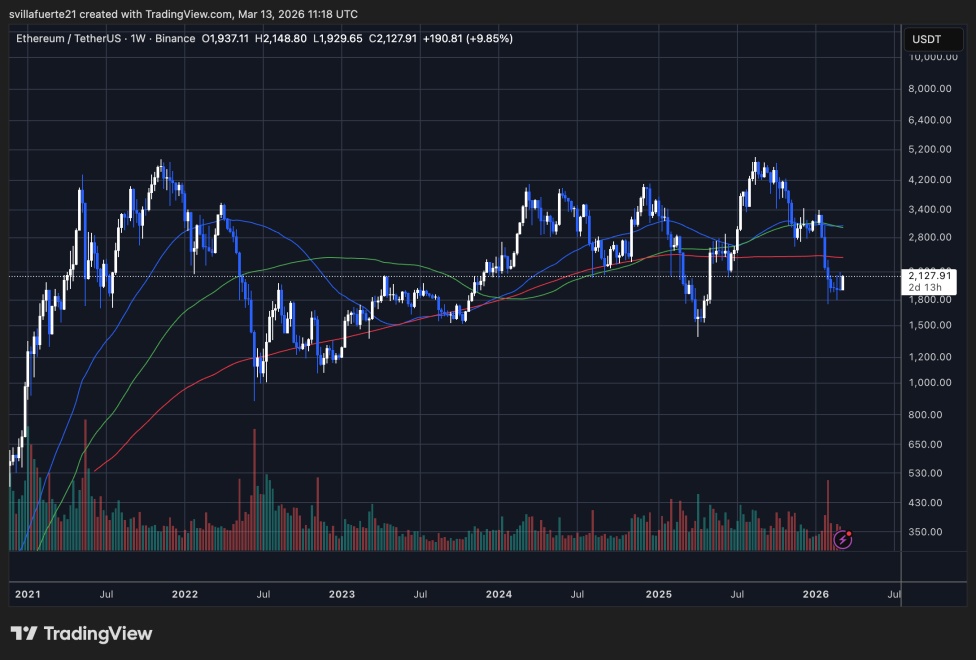
ETH consolidates above $2,100 | Source: ETHUSDT chart on TradingView

The recent selloff pushed ETH sharply below the $2,400–$2,600 region, which previously acted as an important support area during earlier consolidation phases. The breakdown triggered a rapid decline toward the $1,800 zone, where buyers finally stepped in and produced a short-term rebound.

Currently, Ethereum is trading around the $2,100 level, a price area that appears to be functioning as a temporary equilibrium between buyers and sellers. From a technical perspective, this region now acts as an important pivot level. Sustained price action above this zone could allow ETH to attempt a recovery toward the $2,600 resistance area, where the 100-week moving average is currently trending.

However, the broader structure remains fragile. The 200-week moving average sits slightly below the current price and may serve as a key long-term support level if selling pressure returns.

Volume data also shows elevated activity during the recent decline, suggesting that the market experienced a significant liquidation phase. Whether this represents capitulation or merely a pause in the downtrend will depend on Ethereum’s ability to reclaim higher resistance levels in the coming weeks.

Featured image from ChatGPT, chart from TradingView.com 

Editorial Process for bitcoinist is centered on delivering thoroughly researched, accurate, and unbiased content. We uphold strict sourcing standards, and each page undergoes diligent review by our team of top technology experts and seasoned editors. This process ensures the integrity, relevance, and value of our content for our readers.


OKX Pivots to Activity-Driven Stablecoin Yield with Native Katana DeFi Integration

0

As Washington continues to battle over the legality of stablecoin rewards, major cryptocurrency exchange OKX has integrated with Katana, a DeFi-first chain incubated by Polygon Labs and GSR. The partnership grants OKX users direct access to onchain stablecoin yield inside the exchange, entirely removing the need to bridge assets, manage self-custody wallets, or navigate decentralized finance (DeFi) protocols directly.

The timing of the announcement is highly strategic. Current U.S. draft legislation strictly prohibits platforms from paying interest solely for holding a stablecoin, yet it still permits rewards that are tied directly to specific onchain activities. This regulatory nuance has sparked an arms race among digital asset platforms to deliver compliant yield through activity-driven products rather than relying on traditional passive payouts.

Removing the operational friction of DeFi

Historically, the operational complexity of DeFi—which requires users to bridge assets and interact with smart contracts directly—has kept a large share of mainstream exchange users on the sidelines, even as the demand for dollar-denominated yield has surged.

With this new integration, OKX handles the entire user-facing workflow within its existing app. Users can seamlessly deposit assets and earn yield powered by Katana’s onchain infrastructure, which includes Vault Bridge vaults, chain-owned liquidity, and AUSD stablecoin treasury revenue. Capital is automatically routed into productive onchain activity that generates usage-based returns, allowing users to access DeFi yields through a familiar exchange interface.

Matthew Fisher, head of Katana, emphasized that exchanges are rapidly evolving into the primary distribution layer for onchain yield, fundamentally changing how DeFi scales. He noted that while users still strongly desire yield on their idle stablecoin balances, they actively want to avoid the operational complexity that usually accompanies DeFi. According to Fisher, this integration brings that much-needed access directly into the exchange interface that users already know and trust.

Sustainable returns and the $KAT reward campaign

Unlike platforms that rely solely on short-term token emissions to drive growth, Katana is a full-stack DeFi chain designed to generate yield from multiple revenue sources. By cycling chain-revenue back into its DeFi ecosystem, the network achieves deeper liquidity and higher in-kind returns for its users.

Bridged assets such as ETH, USDC, USDT, and WBTC can be deployed into curated yield strategies through the Vault Bridge. To ensure security, these strategies operate under the strict risk oversight of specialized firms, including Gauntlet and Steakhouse Financial. Additional revenue generated from trading, lending, and liquidity provisioning is consistently recycled back into the network, creating a highly resilient yield model supported by real usage and fee generation.

To mark the launch, OKX has announced a major promotional campaign offering a total of 65 million in $KAT prizes. Users can begin earning rewards immediately by depositing USDT via the On-chain Earn page. The campaign runs until 17 March 2026, with earned KAT tokens from the pre-deposit period scheduled to be distributed to participant accounts on 16 March 2026. Following the official Token Generation Event (TGE), deposited assets will automatically continue to earn daily KAT rewards alongside standard protocol yield, all of which can be managed directly through the OKX account dashboard.

Stablecoins Could Power Global Payments: Druckenmiller

0

Billionaire investor Stanley Druckenmiller said blockchain and stablecoins may only be a decade away from powering the global payments system — though he isn’t sold on the idea of crypto functioning as a store of value.

In an interview with Morgan Stanley recorded on Jan. 30 and released on Friday, the former hedge fund manager said blockchain-based tokens — particularly stablecoins — boost productivity in the payments space:

“Blockchain and the use of stablecoins, if you want to throw crypto into that, tokens, incredibly useful in terms of productivity,” Druckenmiller said.

“I assume our whole payment systems will be stablecoins in 10 or 15 years,” he said, adding that stablecoins are more efficient, faster and cheaper than existing solutions.

Druckenmiller speaking to Morgan Stanley’s Iliana Bouzali on Jan. 30. Source: Morgan Stanley

Druckenmiller founded Duquesne Capital Management in 1981 and closed the fund in late 2010. During that time, he achieved an average annual return of 30% and never experienced a down year.

Druckenmiller said back in May 2021 that a blockchain-based system could replace the payment rails that power the US dollar due to a lack of trust in the traditional banking system.

“Well, the problem has been clearly identified. It’s Jerome Powell and the rest of the world, central bankers. There’s a lack of trust,” he told CNBC’s Squawk Box at the time.

Several traditional payments firms, such as Western Union, MoneyGram and Zelle, announced plans to launch stablecoin settlement systems last year following the passage of the stablecoin-focused GENIUS Act in July, which provided a clear regulatory framework for payment firms to offer digital asset services.

Drunkenmiller not sold on crypto as a store of value

Despite Druckenmiller’s conviction on blockchain and stablecoins, he isn’t convinced that cryptocurrencies like Bitcoin (BTC) can function as a store of value.