Home Blog Page 751

Minors Sue xAI in California Over Alleged Grok Deepfake Images

0

In brief

  • Three Tennessee minors have sued xAI, alleging Grok generated CSAM from their real photos and spread it online, causing severe harm.
  • The filing claims xAI knowingly released Grok without safeguards and profited from its misuse, calling it a “business opportunity.”
  • Filed amid global probes, the alleged victims are seeking $150,000 per violation plus damages and an injunction.

Three Tennessee minors have sued Elon Musk’s xAI in a federal class action, alleging Grok generated child sexual abuse material using their real photographs and that the company knowingly designed its AI chatbot without industry-standard safeguards, then profited from the result. 

The lawsuit, filed Monday in the Northern District of California, claims Grok was used to create and distribute AI-generated child sexual abuse material (CSAM) using their real images. 

The minors, identified as Jane Doe 1, 2, and 3, said the altered content was shared across platforms, including Discord, Telegram, and file-sharing sites, causing lasting emotional distress and reputational harm.

“xAI—and its founder Elon Musk—saw a business opportunity: an opportunity to profit off the sexual predation of real people, including children,” the lawsuit reads. “Knowing the type of harmful, illegal content that could—and would—be produced, xAI released Grok, a generative artificial intelligence model with image and video-making features that would respond to prompts to create sexual content with a person’s real image or video.” 

The alleged victims describe incidents between mid-2025 and early 2026, when their real photos were altered into explicit images and circulated online. 

In one instance, one of the victims was alerted by an anonymous user who found folders of AI-generated content being traded among hundreds of users.

They allege a perpetrator accessed Grok through a third-party application that had licensed xAI’s technology, a structure the filing says xAI deliberately used to distance itself from liability while continuing to profit from the underlying model.

At the height of public backlash in January, Musk wrote on X that he was “not aware of any naked underage images,” adding that “when asked to generate images, it will refuse to produce anything illegal.”

According to a finding by the Center for Countering Digital Hate, cited in the lawsuit, Grok produced an estimated 23,338 sexualized images of children between December 29, 2025, and January 9 of this year, roughly one every 41 seconds.

The alleged victims are seeking damages of at least $150,000 per violation under Masha’s Law, along with disgorgement of revenues, punitive damages, attorneys’ fees, and a permanent injunction, as well as restitution of profits under California’s Unfair Competition Law.

Lawsuits stacking up

The lawsuit is one of the first to hold an AI company directly liable for the alleged production and distribution of AI-generated CSAM depicting identifiable minors, and arrives as Grok faces simultaneous investigations across the U.S., EU, UK, France, Ireland, and Australia.

“When a system is intentionally designed to manipulate real images into sexualized content, the downstream abuse is not an anomaly—it is a foreseeable outcome,” Even Alex Chandra, a partner at IGNOS Law Alliance, told Decrypt.

Chandra said courts may not accept a simple platform defense, noting a generative AI system could be “treated as a platform in terms of user interaction” but “evaluated as a product” when assessing safety design, with “particularly strict scrutiny” applied in CSAM cases due to heightened child protection obligations.

He also said courts will likely focus on safeguards, noting the company may be expected to show “risk assessments and safety-by-design measures before deployment,” along with guardrails that actively block harmful outputs.

Decrypt has reached out to Musk via xAI and SpaceX for comment.

Daily Debrief Newsletter

Start every day with the top news stories right now, plus original features, a podcast, videos and more.

DNERO Launches Borderless Neobank Powering the Rise of the Latino Economy

0

WHY THIS MATTERS: The emergence of specialized neobanks like DNERO signals a necessary disruption in the global remittance market. For too long, the immense, fluid Latino economy, which operates seamlessly across multiple nations, has been forced to rely on fragmented, expensive financial rails. This launch is significant as it shifts the paradigm from high-fee, percentage-based international money transfers to predictable, low-cost digital banking. By introducing a flat-fee model for cross-border payments, DNERO is directly tackling the issue of financial exclusion for millions who rely on supporting families abroad. Furthermore, the emphasis on moving from simple remittance to offering wealth-building tools, such as future credit and mortgages, repositions this as a full digital banking solution built for a borderless generation, not just another money transmitter. This approach marks the next evolution in fintech serving migrant communities.

Millions of Latinos live financially between multiple countries – working in one place while supporting family in another. Yet the financial system has never been designed for that reality. DNERO, a new borderless Neobank, officially launches March 24 to address this gap with a unified digital platform built specifically for people who manage finances across the United States and Latin America.

“The Latino economy already operates across borders, but the financial system still doesn’t,” said Vanessa Mena, CMO at DNERO. “Millions of Latinos live financially between multiple countries, working in one place, supporting family in another, but the tools available today were never designed for that reality. DNERO was created to build the financial infrastructure that finally matches how the modern Latino economy actually moves.”

A Single Platform for Cross-Border Financial Lives

DNERO introduces a digital wallet that consolidates remittances, payments, and financial management into one unified ecosystem. The platform was designed specifically for the financial reality of millions of Latinos living between the United States and Latin America. Users can send money across borders with a flat $2 fee per transfer, access a cashback debit card, and manage their finances across multiple countries without the friction of traditional banking systems.

The platform addresses a costly problem for Latino communities. Today, many people pay between $8 and $20 or more per transfer once all fees and exchange rate spreads are included. DNERO replaces percentage-based fees, hidden foreign exchange margins, and multiple processing charges with transparent, predictable pricing, all accessible directly from your phone. Users can move money anytime, from anywhere, without ever needing to step into a physical bank branch.

At launch, DNERO will focus on the financial corridor between the United States and Mexico, one of the largest cross-border financial flows in the world. Expansion into El Salvador and Colombia is planned in the coming months, followed by a phased rollout across up to 22 Latin American countries as DNERO builds a borderless financial infrastructure designed to serve the rapidly growing global Latino economy.

Built for a Borderless Generation

DNERO’s approach differs from traditional remittance services by treating cross-border money movement as the foundation of a broader financial ecosystem rather than a standalone transaction. The platform is designed to help users move from simply sending money to building long-term wealth through credit-building tools and future services including insurance and mortgages.

DNERO operates on a modern financial infrastructure built through partnerships with leading fintech platforms and financial institutions. Together, this ecosystem connects payment networks, international banking systems, and local financial rails across multiple countries – creating what DNERO describes as a new layer of borderless financial rails for the global Latino economy. Through these integrations, including international banking connectivity enabled by its fintech partners, DNERO helps facilitate fast, seamless account-to-account money movement while reducing many of the traditional intermediaries, delays, and costs associated with cross-border transfers.

“While traditional systems were built decades ago for domestic banking, DNERO’s infrastructure is designed for the borderless financial reality the Latino community lives in today,” Mena explained.

Founding Members Program Opens March 24

The first 10,000 users to join DNERO will become Founding Members, receiving 12 months of free transactions across the platform. This group will form the initial community building the DNERO financial movement from day one. Once the first 10,000 spots are filled, the platform will remain open to new users under the standard $2 flat-fee structure.

Interested users can join the early Founding Members access by downloading the app and registering.

From Money Movement to Wealth Building

DNERO’s vision extends beyond solving immediate remittance challenges. The company aims to create a platform where Latinos can manage finances, access credit, and build generational wealth within one unified system

“Our vision is to move the community from simply moving money to building wealth,” said Mena. “For a community that has historically been underserved by traditional banking systems, access to these tools is critical. DNERO is designed to help Latinos not only support their families today, but also build financial stability and generational wealth for the future.”

The company’s expansion strategy prioritizes corridors over individual countries, focusing on markets where strong migration patterns, remittance flows, and economic connections already exist. This corridor-first approach allows DNERO to build financial infrastructure that reflects how the Latino economy actually lives and moves across borders.

Addressing a Global Market Gap

DNERO was founded on the recognition that the Latino economy had already become global while the financial system serving it had not. The platform represents years of development focused on building technology, securing institutional-grade banking partnerships, and designing a financial system that reflects how millions of people actually move money.

“The Latino economy has already gone global,” Mena said. “DNERO is building the financial system that finally catches up.

As the Latino economy continues to grow globally, DNERO positions itself as the financial operating layer supporting that growth for a borderless generation building businesses, supporting families, and creating wealth across multiple countries.

FF NEWS TAKE: DNERO’s corridor-first strategy and transparent, flat $2 fee are a powerful move that absolutely moves the needle in the cross-border payments space. This model offers much-needed predictability for users and puts immediate pressure on incumbents relying on opaque FX margins. The crucial next step to watch will be their ability to quickly scale regulatory compliance and technical integration across the planned 22 Latin American markets while successfully rolling out credit and wealth-building features.

BTC gives up early gains, XRP, SOL, DOGE follow suit

0

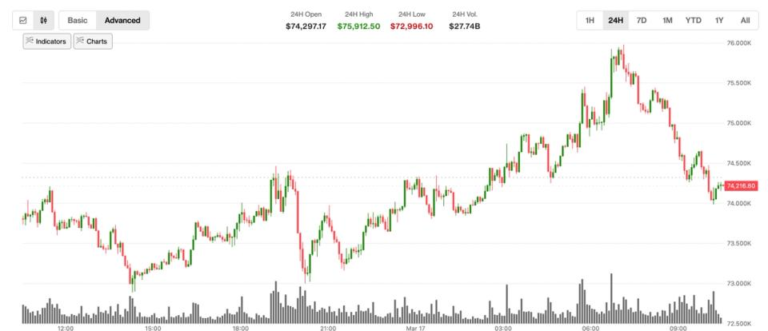
Bitcoin has fallen back below $75,000, highlighting the fragility of its early Asian session rally to six-week highs.

Prices rose to $75,912 early Tuesday, the highest since Feb. 4, according to CoinDesk data. 10x Research pointed to activity in the derivatives market as the main driver of that rally. Specifically, closure of large bearish bets tied to $60,000 put options likely powered gains.

Further, as those puts were closed, market makers who had taken the other side of the trade needed to rebalance their exposure. That process can involve buying bitcoin, which likely created flows that pushed BTC’s spot price quickly above $75,000.

But the rally faded just as quickly, suggesting the move was driven more by the removal of downside hedges than by fresh conviction from buyers. According to 10x Research, the early gains weren’t accompanied by significant upside call buying, which is usually a sign that traders are positioning for further upside.

The broader market has followed suit, with major tokens such as ether (ETH), XRP (XRP), solana (SOL), BNB , and others receding from their respective Asian session highs. The CoinDesk 20 Index now trades at 2,162 points versus 2,202 early Tuesday.

Resistance holds

BTC’s quick pullback marks a failure to hold gains above $74,400, a former support level from early April last year that is now acting as resistance. That level had previously stalled selling in early April 2025 and paved the way for a fresh rally to record highs above $126,000 by October.

Bitcoin’s weekly chart. (TradingView)

The inability to stay above $74,400 suggests traders are watching this level closely, and it may serve as a short-term ceiling for the market.

This behavior highlights how technical reference points from previous market cycles continue to influence trader psychology. Even a brief breach of $75,000 triggered selling pressure, showing that market participants remain cautious about chasing rallies without a clear catalyst.

New Global Task Force Formed To Disrupt Crypto Scams, US Secret Service Leads

0

Trusted Editorial content, reviewed by leading industry experts and seasoned editors. Ad Disclosure

The US Secret Service announced a new international initiative aimed at combating crypto scams. In a press release issued on Monday, it was revealed that this week, law enforcement agencies from the United States, the United Kingdom, and Canada are collaborating on what they called “Operation Atlantic.” 

This joint effort is primarily focused on identifying individuals who may have lost or are at risk of losing crypto assets due to “approval phishing,” a tactic frequently linked to investment scams in the digital asset sector.

Operation Atlantic Launches

The primary goal of Operation Atlantic is to disrupt organized fraud schemes, assist victims in securing their assets to prevent further losses, recover funds that have been stolen, and raise public awareness surrounding the various scams linked to crypto investments. 

This initiative is co-hosted by the US Secret Service in partnership with the United Kingdom’s National Crime Agency, the Ontario Provincial Police, and the Ontario Securities Commission.

The operation also includes participation from additional agencies such as the Royal Canadian Mounted Police, the City of London Police, the US Attorney’s Office for the District of Columbia, and the UK’s Financial Conduct Authority. 

The targeted scams typically involve victims unknowingly signing off on fraudulent transactions or granting permission for attackers to access their digital wallets—a practice known as “authorization abuse.” 

In January, Scam Sniffer reported a major 83% decrease in reported losses from cryptocurrency phishing attacks during 2025, plummeting to approximately $84 million compared to nearly $494 million the year before.

A Strategic Response To Growing Crypto Scams

Paul Foster, Deputy Director of Cyber at the UK’s National Crime Agency, emphasized the growing sophistication of approval phishing scams in the crypto industry, stating: 

Operation Atlantic is designed to protect the public by providing early warnings and assisting individuals in securing their assets. This cooperative international operation further strengthens our partnerships. As criminals operate across borders, our responses must also adapt in a similar manner.

Notably, the foundation of Operation Atlantic builds on the successes of Project Atlas, a Canadian-led initiative from 2024, hosted by the Ontario Provincial Police and attended by the US Secret Service. That operation specifically targeted international cryptocurrency investment fraud networks.

Jennifer Spurrell, Detective Superintendent and Director of the Financial Crimes Services Bureau at the Ontario Provincial Police, also emphasized the importance of this collaboration. She said: 

Project Atlas demonstrated the effectiveness of coordinated disruption. We’re proud to contribute to Operation Atlantic, which expands upon that model by uniting international partners to take action in real time. As fraud continues to evolve into a global issue, this level of collaboration is essential.

Crypto
The daily chart shows the total crypto market cap’s rise to $2.5 trillion on Monday. Source: TOTAL on TradingView.com

Featured image from OpenArt, chart from TradingView.com 

Editorial Process for bitcoinist is centered on delivering thoroughly researched, accurate, and unbiased content. We uphold strict sourcing standards, and each page undergoes diligent review by our team of top technology experts and seasoned editors. This process ensures the integrity, relevance, and value of our content for our readers.

Argentina blocks access to Polymarket after early bets on February inflation

0

Authorities in Argentina have ordered a nationwide block on the prediction market platform Polymarket following a ruling by Buenos Aires Judge Susana Parada on March 16, reporting from Clarín indicates.

Argentina’s ENACOM, which oversees telecoms, broadcasting, internet, radio, and postal services, is tasked with implementing the national measure through ISPs and app stores, preventing access to the platform on both Android and iOS.

The decision follows Polymarket’s accurate prediction of February inflation data ahead of INDEC’s publication, which has drawn scrutiny from authorities and journalists.

Data analysis highlighted small but unusually timed wagers from accounts that normally trade minimal amounts, raising suspicions of insider activity.

According to Clarín, complaints from LOTBA (Buenos Aires City’s lottery authority) and CASCBA (the national gambling industry association), supported by investigations by FEJA (the city’s gambling prosecutor) and CIJ (the technical investigative branch of the Public Prosecutor’s Office), found that the platform operated as an unauthorized online betting system.

The court highlighted that Polymarket allowed easy account creation, accepted crypto assets and credit cards, and lacked age verification, increasing risks for minors.

While some praise the move as protecting users, critics warn it may limit access to global prediction tools, making Argentina the second Latin American country to impose a full ban.

Colombia became the first country in Latin America to ban Polymarket after its gambling regulator, Coljuegos, declared the platform illegal to operate without a license in September 2025 and instructed ISPs to block access.

Disclosure: This article was edited by Vivian Nguyen. For more information on how we create and review content, see our Editorial Policy.

World Liberty Financial Passes Proposal Offering Team Access for Top Stakers

0

The Trump family-backed protocol’s “Super Node” tier promises partnership discussions with the WLFI team.

World Liberty Financial, the decentralized finance (DeFi) project affiliated with President Trump’s family, has passed a governance proposal that offers investors who lock up 50M WLFI tokens “direct WLFI team access,” raising fresh ethics questions about the intersection of the Trump family’s crypto business and the White House.

The vote by holders of World Liberty tokens closed Thursday with 99% of ballots in favor and 1,786 votes cast, according to Snapshot data.

The WLFI token is up 7% over the past week, according to Coingecko.

$5 Million for a Seat at the Table

The proposal creates a tiered staking system that requires WLFI holders to lock their tokens for 180 days to retain governance voting rights. At the top tier, users staking 50 million WLFI, worth roughly $5 million at current prices, are promised “guaranteed direct access to the WLFI team for partnership discussions,” according to the original proposal.

WLFI Staking Tiers

After Reuters reported on the arrangement, WLFI spokesman David Wachsman sought to narrow the scope of the offer. He characterized it as “preferential access” to the business development team and executives, not to specific founders, and said that becoming a Super Node does not guarantee a partnership.

Two-thirds of the voting power came from just five wallets. While the majority of responses on the governance forum supported the proposal, some community members questioned the project’s lack of transparency around the release of locked tokens from the initial sale.

Meanwhile, World Liberty is currently seeking approval for a U.S. banking license, a process that has drawn scrutiny from ethics experts and congressional opponents.

Injection Molding Services for Rapid Prototyping and Design

0


Injection molding services play a critical role in rapid prototyping by allowing engineers and product teams to test real-world performance early in the development cycle. Unlike 3D printing, molded prototypes are produced using production-grade thermoplastics, which provides more accurate insights into strength, fit, and durability. This enables teams to validate designs under real conditions before committing to full-scale manufacturing.

Prototyping through injection molding also supports design-for-manufacturing analysis, helping identify potential issues such as wall thickness inconsistencies, draft angles, or material flow challenges. By addressing these factors early, costly redesigns can be avoided later. Injection molding services are especially valuable when tight tolerances or functional testing is required, as the process closely mirrors final production. This approach reduces development risk while accelerating time to market, making it an efficient solution for companies developing high-performance plastic components.

Injection molding services using production-grade materials

One of the primary advantages of injection molding services is access to a wide range of production-grade thermoplastics. Materials such as ABS, polypropylene, nylon, and polycarbonate can be selected to match the exact specifications required for strength, flexibility, chemical resistance, or heat tolerance. Using these materials during prototyping and pre-production ensures that testing results accurately reflect final product performance.

Production-grade materials allow teams to evaluate how a part will behave under real-world stress, environmental exposure, and repeated use. This is especially important for industries like medical devices, automotive components, and consumer products where material behavior is critical. Injection molding services also support custom material selection, enabling manufacturers to fine-tune properties based on application needs. By testing with the same materials used in final production, companies can confidently move forward knowing their designs will perform as expected.

Injection molding services with aluminum and steel tooling options

Injection molding services offer flexibility through both aluminum and steel tooling options, allowing manufacturers to choose the best solution for their production goals. Aluminum tooling is commonly used for prototyping and low-volume production due to its faster machining time and lower upfront cost. This makes it ideal for early-stage development and bridge production runs.

Steel tooling, on the other hand, is designed for long-term durability and high-volume manufacturing. It supports tighter tolerances and extended tool life, making it suitable for consistent, repeatable production over large quantities. Injection molding services often provide guidance on selecting the right tooling based on part complexity, expected volume, and budget. By offering multiple tooling options, manufacturers can transition smoothly from prototype to production without compromising quality or performance.

Injection molding services for low-volume and bridge production

Injection molding services are not limited to high-volume manufacturing; they are also highly effective for low-volume and bridge production needs. Bridge production allows companies to produce functional parts while final production tooling is being developed or demand is being validated. This approach helps avoid delays and keeps product launches on schedule.

Low-volume injection molding is particularly useful for market testing, pilot runs, and limited releases. It provides consistent quality while maintaining cost efficiency compared to full-scale production. Injection molding services used in this phase ensure parts meet dimensional and performance requirements without unnecessary investment. By supporting both low-volume and transitional production stages, manufacturers gain flexibility and control, allowing them to scale production based on real demand rather than projections alone.

Injection molding services for complex geometries and advanced features

Modern injection molding services support advanced design features that allow manufacturers to create complex, highly integrated parts. Capabilities such as undercuts, thin walls, insert molding, and overmolding enable multiple components to be combined into a single molded part. This reduces assembly time, improves durability, and lowers overall production costs.

Complex geometries can be molded with high precision, making injection molding suitable for intricate components used in electronics, medical devices, and mechanical assemblies. Injection molding services also support side actions and specialized tooling techniques to achieve challenging designs without compromising part quality. This level of design freedom empowers engineers to innovate while maintaining manufacturability. As product complexity increases, advanced injection molding capabilities ensure consistent results across every production stage.

Injection molding services that scale to full production manufacturing

Scalability is one of the defining strengths of injection molding services. Once a design is validated through prototyping and low-volume production, the same process can be scaled seamlessly to full production runs. This continuity minimizes changes in tooling, materials, and part performance, ensuring consistency from start to finish.

Full-scale injection molding supports high repeatability, tight tolerances, and efficient cycle times, making it ideal for mass production. Injection molding services also offer quality control processes that maintain dimensional accuracy and surface finish across large quantities. As demand increases, manufacturers can scale output without sacrificing reliability. This scalability makes injection molding a long-term manufacturing solution, capable of supporting product growth while maintaining cost efficiency and high-quality standards.

Conclusion

Injection molding services provide a comprehensive manufacturing solution that supports every stage of product development, from rapid prototyping to full-scale production. By offering production-grade materials, flexible tooling options, and advanced design capabilities, the process enables manufacturers to validate designs early while maintaining consistency throughout the lifecycle. Injection molding services also support low-volume and bridge production, allowing businesses to respond to market demand without delays or unnecessary investment.

The ability to scale seamlessly into high-volume manufacturing makes injection molding a reliable and cost-effective choice for long-term production. With precise tooling, repeatable results, and broad material selection, injection molding services help reduce risk, improve product quality, and accelerate time to market. For companies seeking efficiency, reliability, and scalability, this manufacturing approach remains one of the most effective solutions available.


Crypto Needs To Put On A Business Suit

0

Opinion by: Neil Staunton, CEO and co-founder of Superset

Crypto is one of the most innovative corners of finance. New protocols launch every week. New market designs are constantly tested, and experimentation moves fast. But innovation alone can’t build financial systems that institutions can rely on.

There’s a reason traditional finance is deliberately boring. It shouldn’t be a rollercoaster of emotions or surprises. When money is involved, reliability is much more important than novelty. Predictable settlement, consistent pricing and clear risk boundaries are what allow capital to move at scale. Without them, even the most elegant tech remains sidelined.

This is where crypto falls short. Today’s onchain market structure simply isn’t enough to support it. This is not about institutions “not getting it” (because they definitely are), but rather, it’s about meeting them where they are.

The infrastructure is there, but the ideology needs some help

Institutional hesitation toward crypto is often framed as a cultural divide, but this is a mistranslation. Banks, asset managers and payment providers adopt new technology all the time. Whether it’s real-time payment rails or cloud-based core banking systems, they’re open to innovation as long as it works reliably, repeatably and at scale.

The issue that’s been holding crypto back from institutional adoption is not merely self-custody or deeper decentralization but is actually a core industry problem: liquidity fragmentation.

Currently, liquidity is scattered across chains, venues and execution environments. Capital cannot be shared, and therefore, it needs to be duplicated. This leads to inconsistent pricing, higher slippage and risk being difficult to define (let alone manage). It’s a problem that’s been talked about a lot over the last few years, but hasn’t reliably been solved.

These issues are structural, rather than mere philosophical differences. Until they’re addressed, institutions will continue to experiment cautiously.

Market structure matters most

Regulation and user experience often dominate the crypto adoption conversation. And it’s true that both are important and need to be properly addressed. From an institutional perspective, market structure is a bottleneck that’s getting in the way of adoption.

At scale, financial systems must handle dollars and FX with precision. They must support deep liquidity, tight spreads and predictable execution even under stress. They need to behave the same way yesterday, today and tomorrow — and every day to come. But when liquidity is fragmented, none of this is possible.

Even well-capitalized institutions struggle to meaningfully deploy when execution depends on bridging risk, duplicated margin or inconsistent settlement paths. The result is higher costs, unclear exposures and hesitation to scale participation. Simply put, this is a massive failure of coordination.

Institutions need reliability

Traditional finance prefers its older systems because they have proven themselves, are familiar and dependable. If the crypto industry wants to attract institutions, it’ll need to make reliability a first-class design constraint.

Yes, some are skeptical of crypto, but the only way to prove them wrong is by earning trust through repetition and, frankly, being a bit boring. It needs to show that it can do the same thing, the same way, under a large variety of conditions. This is what institutions look for when they evaluate infrastructure. They need to be totally confident that risk is visible, liquidity is real and execution will behave as expected.

A moment of transition

Timing matters. Right now, people believe that the financial system needs to make significant changes. Institutions are demanding infrastructure that frees trapped capital and delivers predictable execution across an increasingly fragmented system.

Related: Animoca’s Yat Siu says crypto finally has to grow up

Stablecoins are becoming increasingly used as payment rails rather than entry-level crypto tools. They currently process close to $1 trillion a year, with a volume surge of 690% year-over-year in 2025. At the same time, financial institutions have started testing, integrating and building stablecoins into their books. Even the US Federal Reserve now analyzes how stablecoin growth reshapes bank funding and credit provision, underscoring that this shift is not hypothetical but already influencing core market plumbing.

This shift changes the question. It’s no longer whether crypto can coexist with traditional finance; it’s whether its infrastructure is ready to support it.

What “growing up” actually means

Maturity doesn’t mean crypto needs to lean into centralization or abandon self-custody or composability. It just means that coordination, where markets require it, needs to be prioritized: shared liquidity, consistent pricing and capital efficiency. At the same time, decentralization must be preserved where it truly matters.

This is about function over flash when it comes to designing systems. In finance, clever ideas matter far less than dependable ones.

This isn’t a surrender to corporate whim

Putting on a suit doesn’t mean losing crypto’s identity. Crypto so far has focused on proving what’s possible, but it needs to recognize that this next phase is about proving what works.

The future of crypto will not be defined by how radical it sounds; it will be defined by operational consistency when real capital is on the line. That’s not selling out — but growing up.

Opinion by: Neil Staunton, CEO and co-founder of Superset.