Home Blog Page 745

Arizona Files Charges Against Kalshi, Calling Prediction Market an ‘Illegal Gambling Operation’

0

In brief

  • Arizona Attorney General Kris Mayes filed criminal charges against Kalshi, alleging the platform is an “illegal gambling operation.”
  • The 20 criminal counts include 16 related to betting and wagering, and 4 counts regarding violations of election wagering.
  • Kalshi preemptively sued the state last week, a tactic it has utilized in other states as well.

Prediction market platform Kalshi was hit with criminal charges in the state of Arizona for allegedly operating an illegal gambling service and allowing unlicensed election wagering, the state’s attorney general announced. 

Arizona AG Kris Mayes filed the charges, which includes 20 criminal counts against KalshiEx LLC and Kalshi Trading LLC, the firms behind the popular prediction market platform.

“Kalshi may brand itself as a ‘prediction market,’ but what it’s actually doing is running an illegal gambling operation and taking bets on Arizona elections, both of which violate Arizona law,” said Mayes in a statement. “No company gets to decide for itself which laws to follow.”

Of the 20 counts, 16 are class 1 misdemeanors related to betting and wagering, with 4 counts charging violations of election wagering, which are class 2 misdemeanors. The election wagering counts note bets on three Arizona state races in 2026, as well as the 2028 presidential election. 

“Arizona law prohibits operating an unlicensed wagering business, and separately bans betting on elections outright,” the press release from the Attorney General’s office reads. 

The charges dropped just days after Kalshi sued the state of Arizona, seeking relief amid the potential of “irreparable harm from [Arizona’s] threats to enforce preempted state laws.” 

This maneuver, not the first of its kind from Kalshi, is something that Mayes’ office called “an attempt to avoid accountability under Arizona law.”

The firm also filed a preliminary injunction against Ohio, which was recently denied by a federal court judge who said in her ruling that “the balance of equities and public interest thus cut in favor of the state.” Kalshi has since filed for an appeal.

“Kalshi is making a habit of suing states rather than following their laws. In the last three weeks alone, the company has filed lawsuits against Iowa and Utah, and now Arizona,” said Attorney General Mayes in a statement. “Rather than work within the legal frameworks that states like Arizona have established, Kalshi is running to federal court to try to avoid accountability.” 

She concluded that her state “will not be bullied into letting any company place itself above state law.” 

Earlier this month, a court ruling in Nevada increased the risk that the prediction market firm could face a restraining order in the state. It was also the subject of a class action lawsuit regarding its handling of payouts related to a market based on the former Iranian leader Ayatollah Ali Khamenei.

The firm was last valued in December around $11 billion, but is reportedly seeking nearly a $20 billion valuation, according to a recent report from the Wall Street Journal. 

Daily Debrief Newsletter

Start every day with the top news stories right now, plus original features, a podcast, videos and more.


SEC Clarifies How Federal Securities Laws Apply to Crypto Assets

0

The SEC has issued an official interpretation clarifying the application of federal securities laws to crypto assets and transactions, marking a significant step in regulatory clarity for the industry.

The U.S. Securities and Exchange Commission and the Commodity Futures Trading Commission have jointly released a sweeping interpretive guidance that formally classifies major crypto assets and activities under federal securities law, a long-awaited move that ends years of regulatory ambiguity that industry participants described as “regulation by enforcement.”

The guidance, Release No. 33-11412, establishes a five-category taxonomy for crypto assets and clarifies the legal status of a range of on-chain activities including staking, mining, airdrops, and token wrapping.

A New Taxonomy

At the heart of the document is a classification system that divides crypto assets into five categories: digital commodities, digital collectibles, digital tools, stablecoins, and digital securities.

The most consequential determination for the market is the SEC’s explicit designation of 16 major tokens as digital commodities — assets that derive their value from the programmatic operation of a functional crypto network rather than from the managerial efforts of a centralized party. The list includes Bitcoin (BTC), Ether (ETH), Solana (SOL), XRP, Cardano (ADA), Avalanche (AVAX), Chainlink (LINK), Dogecoin (DOGE), and eight others. As digital commodities, these assets are not securities and fall outside SEC jurisdiction, though they could be subject to CFTC oversight as commodities under the Commodity Exchange Act.

NFTs, Meme Coins, and Fan Tokens

The guidance also formally addresses NFTs and meme coins, classifying them as digital collectibles — assets with artistic, entertainment, social, or cultural value. Examples cited include CryptoPunks, Chromie Squiggles, and the meme coin WIF. The SEC notes that meme coins are typically acquired for non-investment purposes, their value driven by supply and demand rather than any issuer’s efforts, and are therefore not securities.

However, the agencies drew one notable bright line: fractionalizing a digital collectible — splitting a single NFT into multiple ownership interests — could constitute a securities offering, because it introduces elements of shared investment and reliance on managerial efforts.

Fan tokens received a nuanced treatment, with the SEC noting they have “hybrid characteristics” and could also be classified as digital tools.

Staking and Mining Get a Safe Harbor

One of the most practically significant sections of the guidance covers protocol staking and protocol mining, both of which the SEC determined are not securities transactions. The ruling covers solo staking, third-party custodial staking, and liquid staking arrangements — provided that staking providers do not guarantee fixed returns, do not use deposited assets for speculation or rehypothecation, and function as administrative agents rather than active managers of investor funds.

Liquid staking receipt tokens — the tokenized receipts issued to depositors in liquid staking protocols — are similarly deemed non-securities when they represent non-security underlying assets. This determination is significant for protocols like Lido and Rocket Pool, which issue tokens such as stETH and rETH.

Wrapped Tokens Also in the Clear

The guidance also provides clarity on token wrapping, concluding that redeemable wrapped tokens — one-for-one representations of an underlying crypto asset, such as wrapped Bitcoin (WBTC) — are not securities when the underlying asset is itself a non-security. The SEC specifies that wrapped token providers cannot use deposited assets for any purpose, including lending or trading, for this safe harbor to apply.

From “Regulation by Enforcement” to a Written Framework

The joint release comes after years of industry frustration with SEC enforcement actions against crypto firms, which many characterized as the agency’s primary tool for defining the regulatory perimeter. The guidance explicitly acknowledges those criticisms, noting that the SEC’s previous approach prompted complaints that it was pursuing actions rather than “developing a tailored regulatory framework that accommodates crypto asset innovation.”

The new framework grows out of work by the SEC’s Crypto Task Force, established in January 2025 under then-Acting Chairman Mark T. Uyeda, and was formalized as “Project Crypto” under Chairman Paul S. Atkins following a White House working group report on digital asset markets released in July 2025. On January 29, 2026, Atkins and CFTC Chairman Michael S. Selig announced the initiative would proceed jointly between both agencies.

The SEC emphasized that the guidance does not replace the Howey test — the Supreme Court precedent used to determine what constitutes an investment contract — but rather articulates how the agency interprets its application to crypto assets. Importantly, the guidance supersedes prior SEC staff statements on topics including meme coins, stablecoins, proof-of-work mining, and staking.

What Remains a Security

The document makes clear that assets structured as digital securities — tokenized stocks, bonds, or other traditional financial instruments recorded on a blockchain — remain fully subject to securities law regardless of their on-chain format. It also reaffirms that any non-security crypto asset can become subject to an investment contract if issuers make explicit promises of profit tied to their own managerial efforts — the classic token sale model — and that such investment contracts must be registered or exempt.

The agencies are soliciting public comment on the guidance and indicated the framework may be revised or expanded based on feedback.

This article was written with the assistance of AI workflows. All our stories are curated, edited and fact-checked by a human.

SEC, CFTC Issue Landmark Crypto Guidance Defining US Regulatory Boundaries

0

The Securities and Exchange Commission (SEC) and Commodity Futures Trading Commission (CFTC) on Tuesday issued a joint interpretation clarifying how federal securities laws apply to crypto assets, marking one of the most comprehensive attempts yet to define regulatory boundaries in the United States. Federal Crypto Policy Shift: SEC, CFTC Outline Jurisdiction and Token Types The […]

Bitcoin Price Dances Near $75,000 As Market Questions ‘Decoupling’ Narrative

0

Bitcoin price traded near $75,000 on Tuesday, after extending an eight-day streak that has pushed the asset close to a key psychological level.

The move marks a sharp recovery from February lows near $60,000 and has renewed debate over whether the market has found a bottom.

The world’s largest cryptocurrency broke above $75,000 yesterday during U.S. trading hours after weeks of tight consolidation. The rebound has lifted prices close to early February levels and placed focus on whether bitcoin price can hold its ground.

Analysts at Bitfinex said the recent strength reflects relative outperformance but warned against calling it a structural shift.

“The recent strength above $75,000 does show relative outperformance, but calling it a true ‘decoupling’ is premature,” analysts wrote to Bitcoin Magazine. They pointed to stabilizing ETF flows, fresh demand from new structured products, reduced leverage, and tighter on-chain supply as key drivers.

Bitcoin has outperformed traditional risk assets in recent sessions. Still, analysts noted that it remains tied to broader liquidity conditions. A sustained break from macro correlation would require bitcoin price to continue rising despite tighter financial conditions such as higher yields and a stronger dollar.

For now, the $75,000 to $78,000 range is seen as a critical test. Holding that zone could signal strong spot demand and supply absorption. Failure to do so may suggest the rally is part of a broader positioning reset.

Bitcoin price speculation

Data from Nansen supports the view that the current move is driven by more than speculation. Exchange outflows have remained steady in recent weeks, indicating that investors are moving bitcoin into long-term storage rather than selling into strength.

ETF inflows have also stayed consistent, with roughly $763 million in weekly demand. Corporate buying has added to the trend. Strategy disclosed a $1.57 billion bitcoin purchase, one of the largest this year.

Nansen analyst Nicolai Søndergaard wrote to Bitcoin Magazine that this reflects balance sheet accumulation rather than short-term trading.

“These are balance sheet decisions rather than speculative buys,” he said, adding that derivatives activity has amplified the move. Rising futures open interest and short liquidations contributed to the break above $75,000.

Macro conditions remain a key variable. Geopolitical tensions tied to the Iran–Israel War and shifting expectations around interest rates continue to shape sentiment. Easing concerns around the Strait of Hormuz helped support risk appetite over the weekend.

Markets are now focused on the Federal Reserve’s March 18 decision. A neutral stance could support further upside, while a hawkish signal may trigger profit-taking.

Bitcoin price has staged similar recoveries in past cycles without confirming a lasting bottom. Traders are watching whether the asset can maintain support above $75,000. A sustained hold could open a path toward $80,000.

How Argentina’s gambling regulators and casinos convinced courts to ban Polymarket – DL News

0

  • Buenos Aires City Court’s ban on Polymarket applies nationwide.
  • Prosecutors said Polymarket operated without a betting permit.
  • Buenos Aires lawmakers debating bill that proposes crypto betting ban.

Argentine gambling regulators and casinos have succeeded in convincing a court to issue a nationwide ban on the crypto-powered betting site Polymarket.

The Buenos Aires City Court issued a nationwide ban on the platform following two official complaints from the Buenos Aires City Lottery and the Argentine Chamber of Casino Halls, Bingo Halls and Annexes, also known as CASCBA.

The lottery, a state-owned firm, regulates, grants permits to, and taxes all gambling operators active in Buenos Aires. CASCBA, meanwhile, is an industry group that comprises Argentinian land-based gaming operators, including casinos and bingo halls.

“Internet providers have been instructed to take the necessary steps to enforce the ban,” the Buenos Aires Public Prosecutor’s Office said, per Argentinian media outlet Paginá 12.

The ban comes after critics hit out at Polymarket bets on Argentine inflation data last week, suggesting some customers may have obtained official government data prior to its publication.

It also marks another setback for Polymarket and other crypto-powered prediction markets, which have already faced pushback from courts and gambling regulators in the United States. In January, a court in Massachusetts banned Polymarket rival Kalshi from operating in the Bay State for “failing to play by” its sports betting rules.

‘Unlicensed sports betting’

Both the lottery and CASCBA’s legal cases centred around the contention that Polymarket allows Buenos Aires residents to place bets on an unlicensed platform.

The complaint won the backing of public prosecutors, who assigned members of their dedicated gambling prosecution team to the case.

Prosecutors told the court the platform was “functioning as a secret online betting system” and did not require users to complete identity or age verification checks.

“This meant that anyone, including children and adolescents, could access the platform and start betting without any kind of control mechanism in places,” prosecutors told the court.

Crypto betting controversy

Prosecutors also complained that Polymarket allowed Argentine customers to place bets using cryptocurrencies and credit cards.

While gambling firms can offer crypto and credit card betting in Buenos Aires, they must obtain a special permit from the lottery to do so.

But lawmakers have already expressed their disdain for firms that let customers gamble on credit or by using crypto.

Deputies in the Argentine capital are currently debating a private member’s bill that seeks to ban the use of crypto and credit cards completely for online casinos and other betting sites.

Polymarket has already faced blocking orders from courts in France, Romania, and other European nations.

The platform currently offers odds on a range of Argentina-related markets, including whether the country will adopt the US dollar before its own June 30 deadline.

It also offers odds on President Javier Milei’s chances of serving the full term of his presidency before the 2027 general election.

Polymarket did not immediately respond to a request for comment.

Tim Alper is a News Correspondent at DL News. Got a tip? Email him at tdalper@dlnews.com.

Arizona Challenges Kalshi’s Federal Status With Unlicensed Gambling Charges

0

Arizona prosecutors have filed charges against prediction market operator Kalshi, alleging the company ran an unlicensed gambling operation and accepted illegal election wagers within the state. Prediction Market Kalshi Charged in Arizona for Sports and Election Betting Arizona Attorney General Kris Mayes on March 17 filed a 20-count criminal information in Maricopa County Superior Court […]

Alibaba Launches Enterprise AI Agent Platform

0

Chinese tech giant Alibaba launched a new agentic AI platform for businesses, as interest in autonomous AI systems accelerates across the country’s technology sector.

Dubbed Wukong, the platform, like OpenClaw, the OpenAI-affiliated personal agent framework, is designed to coordinate multiple AI agents, enabling them to automate and complete a range of complex tasks such as editing documents, transcribing interviews and conducting research.

The platform is now available for invitation-only beta testing.

The release, on March 16, came just a day after Alibaba revealed a broader restructuring push under its newly established Alibaba Token Hub business group, with a renewed focus on enterprise AI.

According to a post on Alizila, the company’s news portal, the unit will bring together several of Alibaba’s AI-focused divisions, including: the Tongyi Laboratory model research team; its model-as-a-business operations, the Qwen AI assistant unit; the Wukong enterprise platform arm; and its wider AI innovation business.

Related:Nvidia Devises a More Secure OpenClaw Stack for Enterprises

The restructuring, the post said, is a means of seizing the “historic opportunity” presented by the rise of AI agents and artificial general intelligence (AGI).

“We are standing at the threshold of an AGI inflection point,” the post said. “Billions of AI agents are poised to take on an ever-greater share of digital work. And these agents will increasingly become the primary interface between people and the digital world.”

Last month, the company also unveiled a new Qwen AI model, Qwen3.5, designed to complete complex tasks with more autonomy than previous models. 

The updates reflect Alibaba’s ambition to consolidate its AI capabilities amid intensifying competition in the rapidly evolving agentic AI market. These AI agents have greater control and autonomy than traditional chatbots, and tech companies have been racing to develop their own offerings.

Many of these agents are built on the increasingly popular open source agentic platform OpenClaw. Meta acquired another personal agent platform, Moltbook, on March 10. Nvidia on March 16 introduced NemoClaw, a platform designed to improve security for OpenClaw users.

Earlier this month, Chinese tech giant Tencent launched a suite of user-friendly personal agent products. Meanwhile, startup Zhipu AI unveiled its own version of OpenClaw, AutoClaw, featuring an AI agent preloaded with more than 50 commonly used skills.

Mastercard’s (MA) $1.8 billion deal ‘a clear answer’ to stablecoin’s unstoppable dominance

0

Mastercard’s planned $1.8 billion acquisition of stablecoin infrastructure firm BVNK is reinforcing a growing view on Wall Street that stablecoins are moving from a niche crypto tool to a core layer of global payments.

Analysts say the deal signals a shift in how traditional financial networks see blockchain-based money movement. “Stablecoins are integral to the future of payments,” said Mizuho analyst Dan Dolev, framing the acquisition as validation that digital dollars are becoming embedded in mainstream financial infrastructure.

Mastercard said Tuesday that it would acquire BVNK, a London-based firm that enables businesses to send, receive, store and convert stablecoins across more than 130 countries, for $1.8 billion. The company processed over $30 billion in stablecoin payments in 2025, according to analyst estimates.

For investors, the move helps answer lingering questions about Mastercard’s crypto strategy.

“BVNK is a clear answer,” TD Cowen analysts, who rate the company a Buy with a $671 price target, wrote, adding that the deal connects onchain payment rails with Mastercard’s existing network. The firm said the acquisition demonstrates that stablecoins can serve as a complementary infrastructure layer rather than a direct competitor to card networks.

That distinction has become central to the investment case. Earlier concerns that stablecoins could bypass traditional payment companies have given way to a different view: that they may instead improve how money moves behind the scenes.

Cantor Fitzgerald, which has an Overweight rating and a $650 price target on the stock, said the acquisition positions Mastercard for a coming “stablecoin adoption wave,” particularly as demand grows among financial institutions and fintech firms for faster and cheaper cross-border payments.

In recent months, this “wave” of demand has become clear as many traditional financial giants scramble to adopt stablecoin as their settlement rails. Even bitcoin purists, such as Jack Dorsey, who would have dreamt of a world where payments are done via Bitcoin blockchain, are reluctantly giving in to customers’ demand for stablecoin.

Those use cases are already taking shape.

Stablecoins are increasingly used for business-to-business payments, global payroll and remittances, where traditional systems can take days to settle. By contrast, blockchain-based transfers can move funds in minutes and operate around the clock.

BVNK’s platform adds that capability directly into Mastercard’s ecosystem, enabling 24/7 settlement and reducing reliance on intermediaries in cross-border transactions.

A long-term bet

While the financial gains for Mastercard from this acquisition may be small, the credit card giant has its eye on the bigger prize.

Financially, the acquisition is not expected to have a significant near-term impact. BVNK generated about $40 million in revenue as of late 2024, meaning the contribution to Mastercard’s earnings will likely be modest.

Instead, the deal will enable Mastercard to make a longer-term bet to become a front runner on a rapidly evolving industry poised to revolutionize how money moves.

Stablecoin transaction volumes have already reached an estimated $350 billion annually, and are expected to grow as regulatory clarity improves and more institutions enter the market.

Stablecoin supply since 2019 (Visa/Allium)

For payments giants like Mastercard, the push into stablecoin infrastructure is about protecting core business lines, not just experimenting with crypto rails, according to Harvey Li, founder of Tokenization Insight.

“Card networks are the most exposed payment rail to stablecoin disruption,” he wrote in a Tuesday note.

Meanwhile, Oppenheimer analysts, who have an Outperform rating and $683 price target, said the deal expands Mastercard’s ability to support end-to-end digital asset flows, including converting between fiat currencies and stablecoins. It also aligns with the company’s broader push toward interoperability between traditional finance and blockchain networks.

William Blair analysts led by Andrew Jeffrey said: “We see Mastercard’s BVNK acquisition as further affirmation of the stablecoin market for cross-border commerce, rather than B2C payments, which are well served by card.” The bank has an outperform rating on the stock.

More deals to come?

As stablecoins enable faster, cheaper and always-on transfers, they threaten to bypass traditional card-based settlement systems. That pressure is pushing incumbents to adapt quickly – often through acquisitions rather than in-house development.

Before Mastercard’s BVNK deal, payments giant Stripe acquired stablecoin infrastructure and issuer startup Bridge last year for $1.1 billion. Global Morgan Stanley was one of the lead investors in crypto infrastructure provider Zerohash’s $104 million fundraising round last year.

The ultimate goal behind those deals is to embed stablecoins into existing payment flows, enable large-scale conversion between fiat and digital dollars, and extend card products into 24/7 programmable payment systems.

“It’s about rewiring how money moves across their network,” Tokenization Insight’s Li said.

BVNK sits at a key junction in that transition. It handles the movement of stablecoins across blockchains, wallets and traditional accounts, making them critical to bridging crypto and fiat systems. In fact, the deal shows that BVNK is a crucial player in the upcoming stablecoin growth, as both Mastercard and Coinbase were in talks last year to acquire the firm at a valuation of up to $2.5 billion. Coinbase dropped out of the deal talks last year, leaving Mastercard to make the move at the $1.8 billion valuation.

If the stablecoin growth momentum and this deal are anything to go by, it’s a testament to how quickly stablecoins have moved from the margins to the center of financial infrastructure and may open the gate for further deals in the sector.

Mastercard and its peer Visa’s shares were trading roughly flat on Tuesday.

Read more: Stablecoin market hits $312 billion as banks, card networks embrace onchain dollars

Bitcoin Buyers Return After February Selloff – Is the Downtrend Losing Momentum?

0

Trusted Editorial content, reviewed by leading industry experts and seasoned editors. Ad Disclosure

Bitcoin is trading firmly above the $70,000 level and has recently tested the $76,000 region, signaling renewed momentum as activity across the cryptocurrency market intensifies. The move higher suggests that buyers are gradually regaining control after a period of volatility, with traders closely watching whether the current rally can sustain itself as macroeconomic uncertainty continues to shape global markets.

According to a recent CryptoQuant report, Bitcoin has shown a notable degree of resilience despite escalating geopolitical tensions involving Iran, an environment that has contributed to growing instability across several traditional asset classes. In contrast to Bitcoin’s recent strength, both equities and commodities are beginning to exhibit market structures that analysts increasingly describe as potentially topping formations.

This resilience is particularly striking given the broader macro backdrop. The upcoming Federal Reserve FOMC meeting is widely expected to deliver no change in interest rates, with market probabilities currently indicating roughly a 99% chance that policy will remain unchanged. Instead, investors are expected to focus primarily on the Fed’s forward guidance, especially whether policymakers begin to reopen the discussion around the possibility of future rate hikes.

Despite these headwinds, several on-chain and market signals suggest that Bitcoin’s underlying demand dynamics may be beginning to improve.

Buyer Activity Returns to Bitcoin Spot Markets

According to CryptoQuant analyst Darkfost, recent data from the Bitcoin Spot Net Volume Delta chart suggests that market dynamics are gradually shifting back in favor of buyers. The indicator, which tracks the difference between aggressive buying and selling volume in spot markets, shows that demand is slowly returning on major exchanges such as Binance and Coinbase.

Bitcoin Spot Net Volume Delta (USD), Coinbase & Binance | Source: CryptoQuant

While the change remains relatively modest, it represents a clear improvement compared to the market conditions observed in February, when selling pressure dominated both retail and institutional flows. At that time, the 30-day moving average volume delta was deeply negative, reaching approximately -$145 million on Binance and -$88 million on Coinbase. These readings indicated that most participants were actively selling, reinforcing the broader market weakness seen during that period.

More recently, however, the trend has begun to reverse. The same 30-day averages have now moved back into positive territory, with the delta standing around +$21 million on Binance and +$14 million on Coinbase. This shift suggests that buyers are gradually regaining influence within the spot market.

Even so, Darkfost notes that the signal still requires confirmation. Market liquidity remains relatively thin, meaning that sustained demand will be necessary to solidify the recovery.

If this buyer-driven dynamic continues to strengthen, it could eventually support a breakout from Bitcoin’s current consolidation range.

Bitcoin Tests Resistance After Sharp Recovery From February Lows

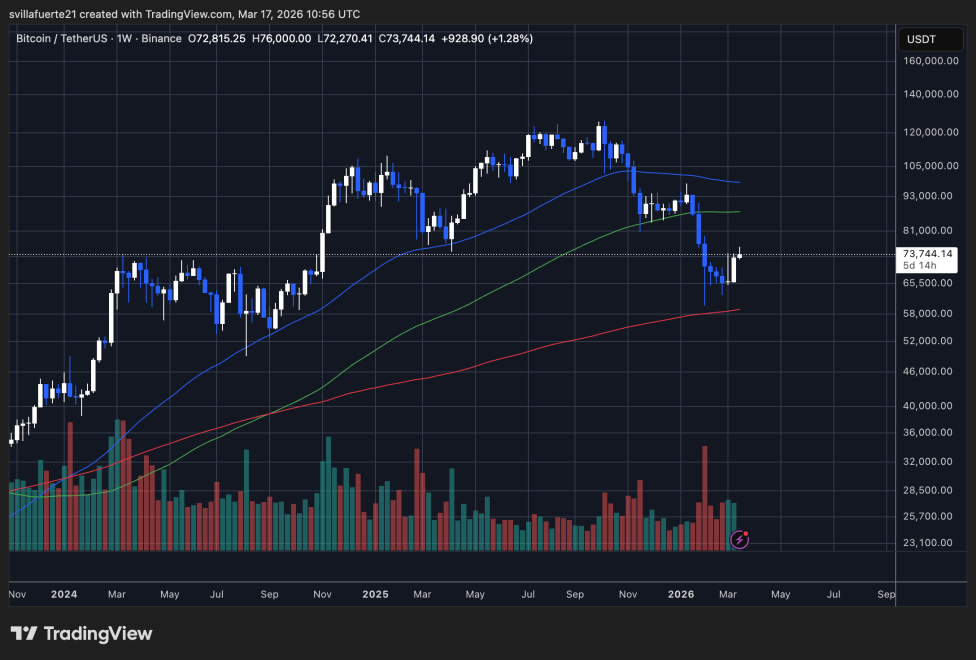
The weekly Bitcoin chart shows the asset recovering momentum after the sharp correction that unfolded earlier in 2026. BTC is currently trading around $73,700, following a strong rebound from the February lows near the $63,000–$65,000 region, where buyers stepped in and triggered a rapid recovery.

BTC testing critical resistance | Source: BTCUSDT testing TradingView

That decline represented one of the most significant pullbacks of the current cycle, briefly pushing price below key short-term moving averages and triggering a wave of liquidations. However, the market quickly stabilized as demand reappeared, allowing Bitcoin to reclaim the $70,000 level and test the $76,000 resistance zone during the latest weekly candle.

From a structural perspective, Bitcoin remains within a broader bullish market framework, as price continues to trade above the 200-week moving average, which historically acts as a long-term support level for the asset. At the same time, BTC is now approaching the 100-week moving average, a level that could act as dynamic resistance in the short term.

The $74,000–$76,000 range, therefore, represents a critical resistance area. A sustained breakout above this zone could open the door for a continuation toward the $85,000 and $93,000 levels, where previous consolidation and liquidity clusters exist.

If Bitcoin fails to break through resistance, the market may enter a consolidation phase between $70,000 and $76,000 as traders reassess momentum.

Featured image from ChatGPT, chart from TradingView.com 

Editorial Process for bitcoinist is centered on delivering thoroughly researched, accurate, and unbiased content. We uphold strict sourcing standards, and each page undergoes diligent review by our team of top technology experts and seasoned editors. This process ensures the integrity, relevance, and value of our content for our readers.

Kalshi faces criminal charges in Arizona over sports and election contracts

0

Arizona Attorney General Kris Mayes filed criminal charges against Kalshi Tuesday, charging the prediction markets platform with operating an unlicensed gambling business and offering election wagering in the state, actions she said violated the state’s laws.

Mayes charged KalshiEx LLC and Kalshi Trading LLC with 20 counts, alleging the platform accepted bets from Arizona on a wide range of events in violation of Arizona law, including sports and elections, like contracts betting on the outcomes of the 2028 presidential race and 2026 state gubernatorial race.

“Arizona law prohibits operating an unlicensed wagering business, and separately bans betting on elections outright,” the attorney general said in a statement.

The charges come just days after the Commodity Futures Trading Commission (CFTC) signaled a more supportive federal stance toward prediction markets, issuing new guidance and launching a rulemaking process under Chairman Mike Selig.

That effort asserted the CFTC’s “exclusive jurisdiction” over event contracts and frames platforms like Kalshi as regulated derivatives venues rather than gambling operators, setting up a direct clash with states such as Arizona that continue to treat sports and election-related contracts.

“Sadly, a state can file criminal charges on paper thin arguments,” a Kalshi spokesperson said in a statement. “States like Arizona want to individually regulate a nationwide financial exchange, and are trying every trick in the book to do it. As other courts have recognized and the CFTC affirms, Kalshi is subject to federal jurisdiction. It’s different from what sportsbooks and casinos offer their customers, and it should not be overseen by a patchwork of inconsistent state laws.”

Different courts have ruled in different ways on whether prediction market providers are subject to state laws. A federal judge in Nevada ruled last year that the company’s sports-related contracts are subject to state gaming regulators. A Massachusetts state court similarly found that sports-related conduct might be subject to state regulations in that state. A federal judge in Tennessee ruled the other way earlier this year, at least temporarily blocking state regulators from enforcing a cease-and-desist against Kalshi.

Notably, most of these contracts and cases were related to sports gambling, and not election-related bets, as Arizona’s case is.

In her statement, Mayes said, “Kalshi may brand itself as a ‘prediction market,’ but what it’s actually doing is running an illegal gambling operation and taking bets on Arizona elections.”

She added that state law prohibits both unlicensed wagering businesses and betting on elections outright.

The charges escalate a widening legal fight between Kalshi and state regulators. The company sued Arizona on March 12 in a preemptive move, part of a broader strategy that has recently included litigation against Iowa and Utah, Mayes’ filing added. Arizona officials also criticized the approach, saying Kalshi is attempting to bypass state-level gambling rules by turning to federal courts.

“Kalshi is making a habit of suing states rather than following their laws,” Mayes said. “In the last three weeks alone, the company has filed lawsuits against Iowa and Utah, and now Arizona.”

Mayes criticized Kalshi saying that instead of operating within the legal frameworks such as Arizona’s, “Kalshi is running to federal court to try to avoid accountability.”

The filing also cited a recent federal court setback for Kalshi in Ohio, where a judge denied the firm’s request for a preliminary injunction and affirmed the state’s authority to enforce its gambling laws.

Kalshi has positioned its event contracts as federally regulated derivatives rather than gambling products, a distinction now being tested across multiple jurisdictions.