Strategy (MSTR) has, for the first time last week, used its perpetual preferred stock as the primary vehicle to accumulate bitcoin, marking a potential shift in how the company funds its bitcoin strategy.
The company Monday announced it purchased 22,337 BTC in the preceding week, its fifth-largest acquisition on record.
Issuance through its STRC perpetual preferred stock was $1.18 billion, equivalent to roughly 16,800 BTC at the average price of $70,000, far exceeding the $396 million raised via its common stock at-the-market (ATM) program, which had historically been the primary tool used to build its bitcoin holdings, now totaling 761,068 BTC.
At STRC’s current 11.5% dividend rate, the $1.18 billion issuance implies roughly $135 million in annual dividend obligations. This has pushed the company’s total annual dividend burden above $1 billion.
That said, the company has set aside approximately $2.25 billion in USD reserves to fund these obligations, providing a buffer amid rising capital costs.
With the company’s common stock down more than 70%, it appears incentivized to support a higher share price without further dilution.
As a result, common equity may be used more selectively, primarily when mNAV (multiple to net asset value) is meaningfully above 1 or when the company looks to build USD reserves. In practice, this suggests reduced reliance on common stock sales, while leaning more heavily on STRC, which avoids issuing new common shares.
Taken together, Strategy is increasingly funding bitcoin accumulation through its preferred capital base, with STRC now at the center of that approach.
Another dividend increase incoming?
STRC is showing early signs of pricing pressure. The preferred has now spent three consecutive days trading below its $100 par value following its March 15 ex-dividend date. With its one-month volume-weighted average price below par, the company may look to increase the dividend by a further 25 basis points to support the price.
Read More: The math behind Strategy’s path to 1 million bitcoin by the end of 2026
F5 BIG-IP Next for Kubernetes accelerated with BlueField DPUs improves token throughput, reduces cost per token, and enables secure multi-tenant AI infrastructure, transforming AI factories for the agentic era
F5 (NASDAQ: FFIV), the global leader in delivering and securing every app and API, today announced expanded capabilities in its ongoing collaboration with NVIDIA to accelerate and optimize AI inference infrastructures.
The expanded integration combines F5 BIG-IP Next for Kubernetes with NVIDIA BlueField-3 DPUs, creating an intelligent, telemetry-aware infrastructure layer that increases token throughput with better GPU utilization, reduces latency, and enables secure multi-tenant AI platforms at scale.
In AI systems, tokens represent the measurable unit of AI output—the words, symbols, or data fragments generated and processed during inference. The volume and velocity of token production ultimately determine user experience, infrastructure efficiency, and revenue per accelerator.
As enterprises and GPUaaS providers race to monetize AI and move from AI experimentation to revenue-generating services, infrastructure efficiency has become a defining metric. Success is increasingly measured not simply by deployed GPU capacity, but by token economics, sustained token throughput, time to first token (TTFT), cost per token, and revenue per GPU accelerator. The F5 and NVIDIA joint solution is designed to directly address these metrics.
Optimizing tokenomics through intelligent AI infrastructure
The shift from application-centric inference to agent-driven AI workflows demands new architectural approaches to optimize token throughput and reduce costs. BIG-IP Next for Kubernetes now leverages NVIDIA NIM statistics, Dynamo runtime signals, and GPU telemetry to make inference-aware routing decisions before execution. By matching workloads to the most appropriate accelerators in real time, the solution increases sustained utilization while reducing latency and re-compute.
“AI infrastructure is no longer just about access to GPU or scaling their deployments. It has evolved into maximizing economic output per accelerator,” said Kunal Anand, Chief Product Officer, F5. “Together with NVIDIA, we are enabling AI factories to treat token production as a measurable business metric. BIG-IP Next for Kubernetes provides the intelligence and governance required to increase GPU yield, reduce cost per token, and scale shared AI platforms confidently.”
Validated infrastructure efficiency: A structural uplift
The performance numbers speak for themselves. In testing validated by The Tolly Group, BIG-IP Next for Kubernetes, accelerated by NVIDIA BlueField-3 DPUs, delivered up to a 40% increase in token throughput, a 61% faster time to first token (TTFT), and a 34% reduction in overall request latency.
These are not incremental gains. By offloading networking, TLS/encryption, AI-aware load balancing, and traffic management to NVIDIA BlueField-3 DPUs, BIG-IP Next for Kubernetes preserves host CPU capacity and frees GPUs to do what they were built for: sustained, high-throughput inference at scale. The result is improved GPU utilization, reduced queuing delays, and increased token yield—enabling lower cost per token within a fixed infrastructure footprint. Critically, no model modifications were required, making these gains immediately deployable across existing AI factory infrastructure. For enterprises and NeoCloud providers competing on token economics, this is the difference between infrastructure that constrains AI output and infrastructure that accelerates it.
“NVIDIA’s accelerated computing infrastructure coupled with F5’s AI-aware Application Delivery and Security Platform unlocks superior AI factory tokenomics—delivering scalable and cost-effective inference without making any changes to the models,” said Kevin Deierling, SVP, Networking, NVIDIA. “Together, F5 and NVIDIA are empowering enterprises to scale AI factory inference efficiently and economically.”
Built for agent-driven AI and multi-tenant AI platforms
Modern AI workloads are increasingly agent-driven, persistent, and context-aware. They demand intelligent traffic control that traditional load balancing cannot provide. The enhanced BIG-IP Next for Kubernetes solution can now support:
Inference-aware routing for agentic AI workflows
Integration with NVIDIA DOCA Platform Framework (DPF) to simplify NVIDIA BlueField DPU deployment and lifecycle management
EVPN-VXLAN with dynamic VRFs for secure network-level multi-tenancy
Integrated security, token governance, and observability within Kubernetes AI environments
These capabilities enable enterprises and NeoCloud providers to securely share GPU infrastructure across business units or external customers while preserving performance isolation and predictable service levels.
A control plane for AI factory economics
F5 and NVIDIA provide enterprises with validated tools and best practices to optimize inference architecture. With these advancements, BIG-IP Next for Kubernetes is positioned to become a strategic control plane for AI factory economics, governing token consumption, optimizing traffic flows, and maximizing infrastructure return on investment.
Rather than overprovisioning to compensate for inefficiencies, organizations can now extract greater economic value from every GPU already in production. The result is improved revenue per GPU, lower operational overhead, and scalable AI services built for sustained growth. By combining NVIDIA’s infrastructure telemetry and DPU acceleration with F5’s traffic intelligence and security capabilities, the companies are helping enterprises transform AI factories into efficient, monetizable platforms ready for the agentic era.
Bitcoin’s rise from an obscure digital asset to a global financial instrument is again in focus this St. Patrick’s Day. On March 17, 2012, Bitcoin traded near $5. Thirteen years later, it has reached roughly $75,000.
This is a massive expansion driven by increasing demand and a fixed supply model.
Bitcoin’s early years were defined by sharp price swings and thin liquidity. In 2013, the asset surged from under $50 to more than $600 before retracing below $300 by 2015.
These cycles repeated over time, with each rally followed by a correction.
In 2017, Bitcoin crossed $1,000 and later accelerated higher before entering another downturn. By 2021, it had climbed past $50,000 as institutional participation began to take shape. Pullbacks in 2022 and 2023 tested conviction, but the broader trend remained intact.
In late 2025, BTC surged above $125,000 before pulling back to $60,000 earlier this year.
Each cycle introduced new participants and strengthened market infrastructure, contributing to a more resilient asset over time.
Historical Bitcoin prices on Saint Patrick’s Day 🍀
Institutional access is growing despite Bitcoin’s fixed supply
One of the most significant developments in the current cycle is the expansion of institutional access. Spot Bitcoin exchange-traded funds in the United States have created a direct pathway for large pools of capital to enter the market.
These products have recorded sustained inflows, including single-day totals exceeding $500 million, reflecting strong demand from asset managers, pension funds and retail brokerage accounts. The result is a steady accumulation of BTC within regulated investment vehicles.
As more capital flows through these channels, available supply on exchanges has tightened, reinforcing upward pressure on price.
Bitcoin’s monetary policy continues to differentiate it from traditional assets. The protocol enforces a hard cap of 21 million coins, limiting total supply regardless of demand conditions.
This scarcity is reinforced through halving events, which reduce the rate of new issuance. The most recent halving in April 2024 cut block rewards from 6.25 BTC to 3.125 BTC, lowering the number of new coins entering circulation each day.
Historically, these supply shocks have preceded major upward moves, as reduced issuance meets sustained or increasing demand.
Corporate and traditional finance interest
Beyond financial markets, Bitcoin has gained traction among corporations and policymakers. Public companies have continued adding Bitcoin to their balance sheets, treating it as a reserve asset rather than a speculative position.
Most popular of all these is Strategy, the bitcoin treasury company led by executive chairman Michael Saylor. The company purchased another 22,337 bitcoin for about $1.57 billion last week, continuing one of the largest corporate accumulation strategies in the crypto market.
The acquisition brings the firm’s total holdings to 761,068 bitcoin. Strategy said its cumulative BTC holdings were acquired for roughly $57.61 billion at an average price of about $75,696 per coin.
The stash represents more than 3.4% of the fixed 21 million supply of BTC, reinforcing MSTR’s status as the largest corporate holder of the asset.
Bitcoin’s changing market structure
Bitcoin’s market structure is shifting as ownership consolidates among long-term holders, institutions and corporate buyers. This has reduced the influence of short-term speculation and improved overall stability, even as volatility persists.
Bitcoin has remained resilient through recent turbulence, supported by steady institutional demand and continued accumulation. Analysts point to a clear return of large buyers, with ETF inflows and spot demand helping push prices back above $70,000 after weeks of range-bound trading.
Data shows institutional conviction holding firm. Despite a sharp drawdown since late 2025, ETF outflows have remained limited compared to earlier inflows, signaling that investors are maintaining positions rather than exiting.
This growing base of committed capital reflects a broader shift. Institutional investors entering the market today tend to have high conviction, often allocating with a long-term view rather than reacting to short-term price moves.
Research also highlights the expanding role of ETFs and corporate treasury strategies in reshaping BTC ownership. Institutional vehicles now account for a meaningful share of supply, while a large portion of coins remains inactive, reinforcing the dominance of long-term holders.
At the same time, on-chain data suggests the market may be in a late-stage bear phase, historically tied to accumulation. Analysts say current conditions point to continued consolidation, with long-term investors positioning for the next cycle.
This proved unsustainable as heavy resistance sent BTC/USD lower, leading to concerns of a fakeout for Telegram channel Technical Crypto Analyst.
“Bitcoin is trending upward inside a rising channel and approaching the $74K–$79K resistance zone; while structure remains bullish above the trendline, a rejection from current levels could trigger a pullback toward the $68K support area,” it wrote on the day.
Traders stayed wary, doubling down on existing doubts about the fate of Bitcoin’s relief rally.
“Still nothing on HTF that suggests the bear market has bottomed. No divs, no volume at lows, no reversal pattern, etc,” trader Roman wrote in his latest analysis on X, referring to higher time frames.
Roman argued that market participants were “hyping up” a comparatively modest uptick in price, and that history demanded a longer bear market.
BTC/USDT one-week chart. Source: Roman/X
On the latter point, trader Jelle agreed, pointing to the 0.618 Fibonacci retracement level as a key price point.
“Every bear market has been shallower than the one before it – but all of them have happened well below the 0.618 retracement, after months of boring sideways PA,” he told X followers.
“Even if we don’t get the usual drawdown, I’m pretty sure the boredom chop is coming. Patience.”
BTC/USD chart with Fibonacci retracement level. Source: Jelle/X
Analyst eyes Bitcoin “outperformance” versus gold
Macro conditions were cooler compared to the start of the week. US stocks continued a modest rebound, while WTI crude oil remained below the $100 per barrel mark.
Related: Bitcoin sparks ‘bull trap’ warning after BTC price rejects at $76K
Gold, however, teased a breakdown from $5,000 support, retesting that level for the third consecutive day.
Calls for Bitcoin to steal the spotlight from the precious metal thus grew louder.
“Stand by for the outperformance of the decade,” crypto analyst James Easton commented on the weekly BTC/XAU chart.
BTC/XAU one-week chart. Source: James Easton/X
This article does not contain investment advice or recommendations. Every investment and trading move involves risk, and readers should conduct their own research when making a decision. While we strive to provide accurate and timely information, Cointelegraph does not guarantee the accuracy, completeness, or reliability of any information in this article. This article may contain forward-looking statements that are subject to risks and uncertainties. Cointelegraph will not be liable for any loss or damage arising from your reliance on this information.
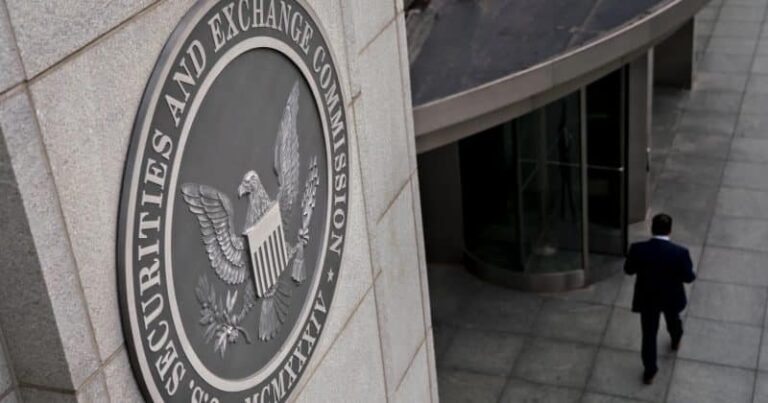
SEC Chair Paul Atkins said Tuesday that the agency is implementing a token taxonomy and investment contract interpretation aimed at ending years of uncertainty over when crypto assets fall under federal securities laws.
Speaking at the DC Blockchain Summit on March 17, Atkins said the framework would classify digital commodities, digital collectibles, digital tools, and payment stablecoins under the GENIUS Act as categories that are not deemed securities. He said only digital securities, meaning tokenized forms of traditional securities, would remain clearly subject to securities laws under the new interpretation.
The SEC’s broader guidance issued the same day also said the interpretation addresses activities including Bitcoin mining, airdrops, and protocol staking.
Atkins also said a crypto asset that is not itself a security could still fall under federal securities laws if it is offered and sold as part of an investment contract. He said the SEC’s interpretation would address when that investment contract ends, which could free the underlying asset from the agency’s statutes once essential managerial efforts have been completed or permanently ceased.
According to Atkins, a key part of that framework is requiring project teams to clearly disclose the representations and promises tied to those efforts so buyers understand the rights they are purchasing.
Beyond that interpretive framework, Atkins previewed what he called Regulation Crypto Assets, a broader rulemaking vision that would create what he described as compliant paths forward for crypto issuers and developers.
He said the SEC should consider a startup exemption that could let developers raise up to $5 million over as long as four years, as well as a fundraising exemption that could allow up to $75 million in a 12 month period with required disclosures. He also proposed an investment contract safe harbor that would provide more certainty around when certain crypto assets are no longer subject to securities laws.
Atkins said he expects the Commission in the coming weeks to consider releasing such a proposal for public comment. At the same time, he stressed that only Congress can fully future proof crypto regulation through comprehensive market structure legislation, pointing to bipartisan work on Capitol Hill and specifically referencing the CLARITY Act as a foundation for the framework he described.
Disclosure: This article was edited by Estefano Gomez. For more information on how we create and review content, see our Editorial Policy.
For the first time, the U.S Securities and Exchange Commission has sought to clearly define different types of crypto assets and how the regulator will approach them, issuing those new standards Tuesday alongside its sister agency that’s responsible for commodities.
The SEC’s interpretive guidance, which doesn’t yet carry the weight of a formal new rule, has been promised by its leader, Chairman Paul Atkins, who was put in place by President Donald Trump to enact a pro-crypto agenda. And it was issued in partnership with the Commodity Futures Trading Commission, just days after the two agencies agreed on a formal relationship in which they plan to regulate crypto and other industries as close partners.
“After more than a decade of uncertainty, this interpretation will provide market participants with a clear understanding of how the Commission treats crypto assets under federal securities laws,” Atkins said in a statement.
The previous chairman of the SEC, Democratic appointee Gary Gensler, had declined to commit to tailored policies for the crypto sector, leaving a longstanding gap in its regulator certainty in the world’s most important market. Atkins said the new “token taxonomy” interpretation on Tuesday takes a stance that Gensler’s agency refused to: “Most crypto assets are not themselves securities.”
Atkins spoke about it at the Digital Chamber’s DC Blockchain Summit, and his agency is planning to launch a formal rulemaking process “in a week or two,” which will have further crypto “proposals in that we’ll be addressing,” he said in response to a question from CoinDesk after his remarks. That proposal — expected to be more than 400 pages — will include his plans for an “innovation exemption” for crypto firms.
But Tuesday’s guidance issued with the CFTC was a significant step, and it outlined the classification of four categories of crypto tokens in the regulators’ legal perspective.
“The interpretation then clarifies that only one crypto asset class remains subject to securities laws, namely digital securities, which are traditional securities in new technology,” he said. “This distinction returns the SEC to its core mission and statutory authority of protecting investors involved in securities transactions.”
Additionally, those investment contracts that are securities don’t necessarily keep that status permanently, he said.
“We’re not the securities and everything commission anymore,” he said Tuesday at the Digital Chamber’s DC Blockchain Summit, just minutes after releasing the new standard. The line drew enthusiastic applause from the crypto crowd.
The guidance seeks to define digital commodities, digital collectibles, digital tools, stablecoins and digital securities. It also clarifies how U.S. securities laws should treat airdrops, protocol mining, protocol staking and the wrapping non-security crypto assets.
“For far too long, American builders, innovators, and entrepreneurs have awaited clear guidance on the status of crypto assets under the federal securities and commodity laws,” said CFTC Chairman Mike Selig.
Atkins said that the legislation being devised in Congress to establish new crypto laws will be the only way to guarantee the permanence of pro-digital assets policy shifts. In the new guidance, the commission is saying that a digital asset becomes a security when its issuer offers it as an investment in a common enterprise that comes with promises of profits based on the management’s efforts. Such an investment contract ends, though, when “either the issuer has fulfilled its representations or promises or the issuer has failed to satisfy its representations or promises,” at which point it wouldn’t be regulated as a security anymore.
The SEC says its reach into digital securities does not include airdrops, protocol staking and protocol mining.
The CFTC’s Selig said his agency was also signing on to the same taxonomy, as part of the two agencies’ push toward “harmonization.”
“I think the signal is clear now that it’s time to build in the United States,” he said.
Atkins told a group of reporters after the Washington event to “hold on to your seats,” because the agency is getting dozens of proposals ready, including some on digital assets.
The crypto rally is took a pause on Tuesday ahead of Wednesday’s Federal Reserve decision.
After briefly topping $76,000 overnight, bitcoin BTC$74,669.28 pulled back to around $74,000 during the U.S. session, modestly higher over the past 24 hours.
Crypto stocks mostly booked modest gains, with stablecoin issuer Circle (CRCL), bitcoin miner Bitdeer (BTDR) standing out advancing 5% and 12%, respectively. The Nasdaq closed with a 0.5% gain and the S&P 500 rose 0.25%.
It’s almost universally expected that the Fed will leave benchmark interest rates unchanged at 3.50%-3.75% tomorrow. But given rapidly rising oil prices and their possible effect on inflation thanks to the war in Iran, the focus shifts to Jerome Powell’s messaging and policymakers’ outlook for future rates.
Bitfinex analysts said the key question is whether policymakers still signal rate cuts in 2026 or are moving towards the idea of no further monetary ease. A more hawkish outcome could weigh on risk assets by strengthening the dollar, they said.
Powell’s take on the recent oil advance will also be in focus. Treating it as a temporary shock would support sentiment, while a more stagflationary view could limit the Fed’s flexibility.
Also coming on Wedesday is the February Producer Price Index report. Tyically not having nearly the weight of the Consumer Price Index, the PPI will be a bit more closely followed given its timing ahead of the Fed meeting.
“A hot PPI number followed by a hawkish FOMC would be the most damaging combination for equities and risk assets,” the Bitfinex team continued.
That backdrop is already showing up in market expectations toward a higher-for-longer rate path, according to Vetle Lunde, head of research at K33.
The probability of rates staying unchanged through the July meeting has jumped to over 60% from 22% last month, with potential cuts now pushed further into late 2026, he said in a Tuesday note.
For now, price action will likely remain muted. “We expect the $74,000–$76,000 region to cap price momentarily,” Bitfinex analysts concluded.
WASHINGTON, D.C. — The Senate’s stalled crypto market structure bill is making progress behind-the-scenes, the chairman of the body’s Banking Committee said Tuesday.
Senator Tim Scott, who heads the banking panel overseeing the market structure bill, said at the Digital Chamber’s DC Blockchain Summit that lawmakers may see a new draft of at least stablecoin language as soon as this week.
Stablecoin yield has been the most publicly debated issue in the market structure bill, but lawmakers have remained engaged, Scott said.
“I believe that this week we will have the first proposal in my hands to take a look at,” he said. “If that actually happened before the end of this week, and I think that it will, we’ll at least know that the sketch looks like the person. If that’s the case, I think we’re gonna be in much better shape.”
He credited Democratic Senator Angela Alsobrooks, Republican Senator Thom Tillis, and the White House’s Patrick Witt for their efforts on yield.
Other outstanding issues have also been negotiated, particularly over the past month, he said, pointing to concerns lawmakers had about U.S. President Donald Trump and his family’s crypto projects, the lack of bipartisan commissioners at the major regulatory agencies and know-your-customer regulations.
“I think we’re very close to landing the plane on the ethics issue, on quorum,” Scott said. “We know that that’s a big issue for our friends on the other side of the aisle, so we’re fixing that as well. I think we’re moving forward with some [nominations], which is great news that we were able to get some out of the other side. I think the issue of DeFi is something that [Senator] Mark Warner’s held on tightly, AML [anti-money laundering] being a very important part. So I think we’re working on that issue.”
Two Democratic lawmakers in the US Congress have introduced legislation in response to “government corruption” over bets on prediction markets platforms.
In a Tuesday announcement, Texas Representative Greg Casar and Connecticut Senator Chris Murphy said they had introduced the Banning Event Trading on Sensitive Operations and Federal Functions (BETS OFF) Act after several Polymarket accounts made “highly unusual bets” that a war between the US and Israel against Iran would begin.
Murphy said on March 4 that it was likely that people with “inside information” of US President Donald Trump’s plan to bomb Iran had made the bets.
“We shouldn’t live in a country where someone sitting in the situation room making decisions about whether to invade or to bomb, decisions about war and peace, life and death, that those decisions could be driven by the fact that they have hundreds of thousands of dollars riding on the decision,” said Casar.
Source: Representative Greg Casar
The bill is the latest twist in US lawmakers’ efforts to crack down on prediction market platforms and accounts allegedly using insider information to profit from government actions. Last week, California Senator Adam Schiff introduced the DEATH BETS Act to prevent prediction markets platforms from listing events contracts related to war, terrorism, assassination and individual deaths.
Related: Arizona AG files charges against Kalshi over ‘illegal gambling‘
Platforms like Polymarket and Kalshi offer bets on a variety of outcomes, including sporting events and US politics. However, users betting on the specifics of the US-Israel conflict with Iran have ignited controversy in many areas of government. On Monday, a military correspondent with the Times of Israel said that he had received death threats over his report of the date when an Iranian missile had struck Israel, all “in order to resolve a prediction on Polymarket.”
War-related bets still live on Polymarket
As of Tuesday, Polymarket still offered users the opportunity to place bets on the outcomes of several potential decisions in the US-Israel conflict against Iran, including on whether the US would send ground forces into the country, when a ceasefire might happen, and changes to Iranian leadership.
“The promise of prediction markets is to harness the wisdom of the crowd to create accurate, unbiased forecasts for the most important events to society,” said Polymarket in a note on Middle East markets. “That ability is particularly invaluable in gut-wrenching times like today. After discussing with those directly affected by the attacks, who had dozens of questions, we realized that prediction markets could give them the answers they needed in ways TV news and [X, formerly Twitter] could not.”
Kalshi, in contrast, offered event contracts related to the Iranian conflict but not on specific military actions, such as if the country might reach a nuclear deal with the US and whether Trump or other elected officials might visit Iran.
Magazine: Would Bitcoin really be at $200K if not for Jane Street? Trade Secrets
Cointelegraph is committed to independent, transparent journalism. This news article is produced in accordance with Cointelegraph’s Editorial Policy and aims to provide accurate and timely information. Readers are encouraged to verify information independently. Read our Editorial Policy https://cointelegraph.com/editorial-policy
Bitcoin (BTC) is closing in on its average entry price for US spot BTC exchange-traded fund (ETF) investors at $79,900. The narrowing gap between Bitcoin’s market price and the ETF holders’ cost basis coincides with onchain data that shows early signs of accelerated buying from investors.
Bitcoin ETF breakeven level nears key trend test
Bitcoin’s sustained price rally above $70,000 puts a key investor cohort back in focus. The ETF cost basis level acted as support in mid-2024, and a break above this level brings many ETF holders closer to breakeven.
The flow data adds further context to this shift. According to Bitcoin researcher Axel Adler Jr., the ETF flows flipped positive after persistent outflows through mid-February.
The seven-day average has since moved to steady inflows, with daily flows peaking above 3,300 BTC on March 2. The ETF holdings have expanded to 1,291,618 BTC from 1,264,982 BTC, a 26,636 BTC increase over the past month.
Investors’ ETF cost basis also aligns with a key daily trend. A decisive move through this range marks a reclaim of the 100-day exponential moving average (EMA) on the daily chart for the first time since October 2025.
A move above the 100-day EMA signals a shift into a long-term uptrend, which also reinforces the bullish momentum. It also serves as a key trend filter where sustained price action above it often leads to continued upside gains.
The order flow across major exchanges shows a gradual shift in market behavior. Crypto analyst Darkfost noted that the 30-day volume delta on Binance and Coinbase has turned positive after sustained selling pressure in February. Both the retail and institutional flows are now collectively skewing toward accumulation.
Bitcoin spot net volume delta on Coinbase, Binance. Source: CryptoQuant
Bitcoin’s futures data reinforces this trend. Amr Taha noted that Binance’s cumulative volume delta (CVD) has rebounded by nearly $6 billion from its lows, tracking a rise in aggressive market buying since BTC traded near $63,000.
The metric remains below zero, though a significant portion of earlier sell pressure has now been absorbed during the recovery.
Bitcoin: Binance cumulative net taker volume. Source: CryptoQuant
CryptoQuant data shows that short-term holder activity also aligns with this shift. The spent-output profit ratio (SOPR) metric, which shows whether coins are sold at a profit or loss, has moved back above 1, signaling that the selling pressure has eased and coins are now trading around or above their cost. Analyst miracleyoon said,
“While this capitulation was not as severe as the August 5, 2024, event (which saw SOPR approach ~0.9), the series of recent capitulation signals appears sufficient to have flushed out weak hands.”
The data suggests that Bitcoin remains on track to test the $80,000 level, but a move above the key breakeven zone may determine the strength and direction of the trend in the coming weeks.
Related: Bitcoin analysis sees $68K support as gold slips at key $5K level
This article does not contain investment advice or recommendations. Every investment and trading move involves risk, and readers should conduct their own research when making a decision. While we strive to provide accurate and timely information, Cointelegraph does not guarantee the accuracy, completeness, or reliability of any information in this article. This article may contain forward-looking statements that are subject to risks and uncertainties. Cointelegraph will not be liable for any loss or damage arising from your reliance on this information.