PayPal has expanded access to its stablecoin PayPal USD (PYUSD) to 70 markets, allowing users worldwide to send, hold, and receive the token while enabling faster, lower-cost global transactions.
PayPal Expands PYUSD Across 70 Markets
On Tuesday, payments giant PayPal announced that its USD-pegged stablecoin, PYUSD, will be available to users in 70 markets worldwide following its expansion into 68 new countries this month.
The fintech launched the stablecoin in August 2023 after initially pausing development due to scrutiny of PayPal’s issuance partner, Paxos. That same year, PayPal received a subpoena from the US Securities and Exchange Commission (SEC) related to its stablecoin.
As crypto regulation gained momentum and financial watchdogs loosened their grip under the Trump Administration, the Commission concluded its 16-month investigation into PYUSD without enforcement action in February 2025. Since then, PYUSD’s total market capitalization has reached $4.1 billion, a fivefold increase over the past year.
Previously, only customers in the US and the UK had access to the PYUSD. However, the latest expansion has made PYUSD available to users across multiple global regions, including Asia-Pacific, Europe, Latin America, and North America.
This includes Colombia, Costa Rica, the Dominican Republic, the Faroe Islands, Greenland, Guatemala, Honduras, Panama, Peru, Singapore, the United Kingdom, and the United States. Meanwhile, users in the remaining markets will have access to PYUSD in the coming weeks.
Users in the newly supported regions will be able to hold, send, and receive the stablecoin directly on their PayPal accounts, enabling faster settlement and lower cost than traditional payment methods.
Users will also be eligible to earn rewards on their stablecoin holdings, but rewards won’t be available to users in Singapore or the United Kingdom, the official announcement noted. Existing holders in the United States receive an annual 4% reward.
PayPal Eyes ‘More Inclusive, Global Commerce Ecosystem’
The payments giant affirmed that this geographical expansion marks a critical step in its stablecoin push to build “the liquidity, utility, and ubiquity of PYUSD necessary to create a more inclusive, global commerce ecosystem.”
While consumers and businesses worldwide are seeking faster, more seamless global transactions, the current system still incurs excessive charges and adheres to outdated timelines, May Zabaneh, Senior Vice President and General Manager of Crypto at PayPal, noted, adding that the company is working to change that.
“Enabling PYUSD in users’ accounts across 70 markets gives people faster access to their funds, lower-cost ways to send money across borders, and a more direct path to participating in the global economy, and that is what drives commerce forward for everyone,” she affirmed in the official announcement.
“Now you’re really opening up not only access—especially in places where they need it most— but also cross-border transfers and volume, where the pain is felt so high,” Zabaneh also told Fortune.
The stablecoin was initially launched on Ethereum and later expanded to other networks, including Tron, Avalanche, Aptos, and Sei, through LayerZero in September. In addition, YouTube added a new payout option last December that allows US creators to receive earnings in PYUSD.
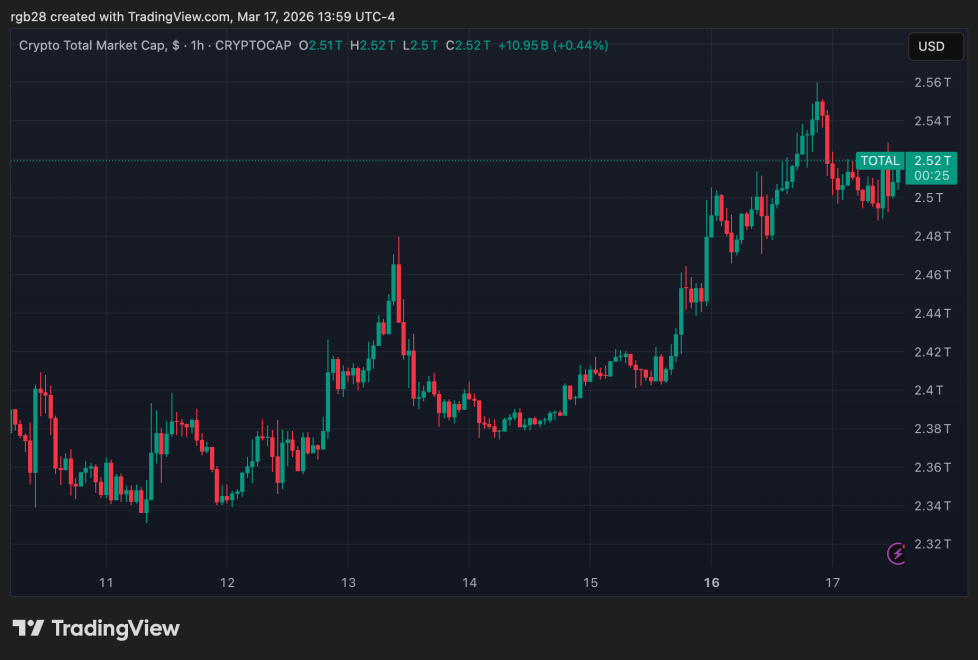
The total crypto market capitalization is at $2.52 trillion in the one-week chart. Source: TOTAL on TradingView
Featured Image from Unsplash.com, Chart from TradingView.com

Editorial Process for bitcoinist is centered on delivering thoroughly researched, accurate, and unbiased content. We uphold strict sourcing standards, and each page undergoes diligent review by our team of top technology experts and seasoned editors. This process ensures the integrity, relevance, and value of our content for our readers.