

While the company had announced that it would be sunsetting the Horizon World experience, the in-house digital world for VR headsets, it has now backpedaled. Nonetheless, the experience is now being tailored to mobile platforms, where it has enjoyed more popularity. Meta’s Is Saving Its Metaverse for VR Headsets, but Focusing on Mobile From Now […]
Top Altcoins Today: APEMARS Next Big Play With Ethereum, XRP and Solana
The cryptocurrency market is entering another phase of renewed momentum as investors evaluate projects across multiple sectors of the blockchain ecosystem. Infrastructure networks such as Ethereum and Solana continue expanding their developer communities, while data and interoperability platforms like Chainlink and Polkadot are strengthening the backbone of decentralized applications. At the same time, early stage projects are drawing attention from participants searching for positioning before broader market exposure arrives. Historically, many major cryptocurrencies began as small communities and experimental networks before evolving into widely recognized platforms.
This balance between established blockchains and emerging innovations creates an ongoing debate around the top 12 altcoins to buy today. While large networks provide proven technology and adoption, early stage projects sometimes offer entry opportunities before exchange listings and global recognition. One project appearing in early stage discussions is APEMARS, which is currently conducting a Stage 12 presale while building a community before public trading begins.
-
APEMARS Stage 12 Momentum: A Presale Quietly Entering the Top 12 Altcoins to Buy Today Conversation
The presale is currently operating in Stage 12, where the token price is $0.00012506. According to the project roadmap, the intended listing price is $0.0055, creating a visible gap between early participation levels and potential future exchange trading. This structure is designed to reward early supporters who recognize opportunities before wider market visibility.
Community traction is already forming. The project has sold 12.5 billion tokens, raised approximately $313K, and attracted more than 1,445 holders. These signals indicate a growing base of participants joining the ecosystem before the token reaches exchanges.
Another distinguishing element is the APETRON Burn system, a deflationary mechanism designed to reduce token supply as the presale progresses. Unsold tokens are permanently removed during scheduled burn events at Stages 6, 12, 18, and 23, gradually decreasing the circulating supply and introducing scarcity over time.
Stage 12 Entry Window and Presale Structure
At the current Stage 12 price of $0.00012506, the difference between presale entry and the intended $0.0055 listing price represents a theoretical 4,297 percent ROI window. While crypto markets remain unpredictable, staged presales continue attracting participants who want exposure before broader exchange listings.
Buying APEMARS during Stage 12 involves a straightforward process:
- Visit the official APEMARS presale platform
- Connect a wallet such as MetaMask or Trust Wallet
- Choose the amount of APRZ tokens to purchase
- Confirm the transaction
With its staged pricing model and deflationary token design, APEMARS is increasingly appearing in conversations about the Top 12 altcoins to buy today.
-
XRP’s Global Payments Vision Continues Driving Adoption
XRP remains one of the most widely recognized digital assets in the blockchain industry. Developed by Ripple, the network focuses on improving international payment infrastructure by enabling faster and cheaper cross border transactions.
Traditional global payment systems often take several days to settle international transfers. XRP technology enables near instant settlement, significantly improving efficiency for financial institutions and payment providers.
Because of its real world use case in financial infrastructure, XRP continues appearing in discussions about the Top 12 altcoins to buy today, particularly among investors interested in global payment solutions.
-
Apeing: The Degen-Driven Meme Coin Ready to Make Waves
Apeing is not just another meme coin; it’s a culture-first project built by a team of true degens. With the slogan “We’re Degens, We’re Not Thinking, We’re APEING,” the coin taps into the raw energy, community engagement, and viral momentum that have historically driven some of the biggest meme coin rallies. Unlike many hype-driven projects, Apeing emphasizes structure, transparency, and security while still embracing the fun, irreverent spirit of meme culture.
The project follows an audit-first approach, prioritizing third-party verification before launching its presale. This ensures that early supporters can participate with confidence, knowing the smart contract and ecosystem have been properly vetted.
The whitelist system further strengthens early-stage engagement, allowing community members to gain access before the general public and maximize their positioning ahead of the official sale.
-
Solana’s High Speed Blockchain Continues Expanding
Solana has become one of the fastest growing blockchain networks due to its high transaction throughput and low fees. The network can process thousands of transactions per second, making it attractive for decentralized finance platforms and NFT marketplaces.
Developers often choose Solana for projects that require scalability and high speed performance. The ecosystem includes decentralized exchanges, gaming platforms, and tokenized assets.
This rapidly expanding ecosystem keeps Solana firmly positioned among the Top 12 altcoins to buy today.
-
Polkadot Connects Blockchains Through Interoperability
Polkadot focuses on solving one of blockchain’s biggest challenges: interoperability between networks. Instead of operating as a single blockchain, Polkadot enables multiple specialized chains to communicate with each other.
This multi chain structure allows developers to create customized blockchains that remain connected to the broader Polkadot ecosystem. The network’s parachain architecture allows projects to operate independently while sharing security.
Polkadot’s innovative architecture ensures its continued relevance among the Top 12 altcoins to buy today.
-
Hedera’s Enterprise Governance Model Stands Out
Hedera operates on Hashgraph technology, which aims to provide faster consensus and greater efficiency compared to traditional blockchains. The network is governed by a council of major global corporations including Google, IBM, and Boeing.
This governance model provides a level of institutional credibility that distinguishes Hedera from many other blockchain networks.
Because of its enterprise focus and corporate partnerships, Hedera frequently appears in lists analyzing the Top 12 altcoins to buy today.
-
Filecoin’s Decentralized Storage Network Powers Web3
Filecoin addresses a critical need in the digital economy: decentralized data storage. Instead of relying on centralized cloud providers, the network allows users to rent out unused storage space across a distributed system.
This decentralized approach strengthens data security while reducing reliance on traditional cloud infrastructure providers.
As the decentralized web continues evolving, Filecoin remains an important infrastructure project among the Top 12 altcoins to buy today.
-
Chainlink’s Oracle Network Connects Blockchain and Real World Data
Smart contracts require reliable external data to function correctly. Chainlink solves this challenge by providing decentralized oracle networks that deliver real world data to blockchain applications.
These data feeds power decentralized finance protocols, insurance platforms, and numerous other blockchain applications.
Because of its crucial role in the Web3 ecosystem, Chainlink consistently appears in discussions about the Top 12 altcoins to buy today.
-
VeChain Brings Blockchain Into Supply Chain Management
VeChain focuses on integrating blockchain technology with supply chain logistics. The platform allows companies to track products throughout manufacturing, shipping, and distribution.
Industries such as luxury goods, agriculture, and pharmaceuticals have explored VeChain’s solutions for improving transparency and preventing counterfeiting.
By connecting blockchain with real world business applications, VeChain maintains a place among the Top 12 altcoins to buy today.
-
Tron’s Expanding DeFi Ecosystem Continues Growing
Tron has built a large ecosystem focused on decentralized finance, digital content distribution, and stablecoin transactions. The network processes massive volumes of stablecoin transfers daily.
Its high transaction throughput and active developer ecosystem allow users to access decentralized exchanges, lending platforms, and staking opportunities.
Because of its expanding ecosystem, Tron continues appearing in the Top 12 altcoins to buy today discussions.
-
Avalanche Supports Scalable Blockchain Infrastructure
Avalanche introduced a unique subnet architecture that allows developers to create customized blockchains while maintaining compatibility with the broader Avalanche ecosystem.
This flexibility enables projects to launch decentralized finance applications, gaming platforms, and enterprise blockchain solutions.
Avalanche’s scalability and developer friendly tools make it a strong candidate among the Top 12 altcoins to buy today.
-
Polygon Strengthens Ethereum’s Scaling Future
Polygon operates as a Layer 2 scaling solution designed to improve Ethereum’s transaction efficiency. By reducing fees and increasing transaction speeds, Polygon helps make decentralized applications more accessible.
The network supports numerous DeFi platforms, NFT projects, and Web3 applications that benefit from its lower costs.
Because it strengthens Ethereum’s scalability while maintaining compatibility with the broader ecosystem, Polygon continues ranking among the Top 12 altcoins to buy today.
Conclusion
The cryptocurrency market continues evolving as investors evaluate both established blockchain networks and emerging projects entering the ecosystem. Infrastructure platforms such as Ethereum, Solana, Polkadot, and Chainlink continue powering decentralized applications and financial innovation.
At the same time, networks such as Avalanche, Polygon, VeChain, and Hedera are expanding blockchain adoption into enterprise systems, supply chains, and scalable infrastructure solutions.
Meanwhile, early stage projects remain an important part of the market cycle. The APEMARS Stage 12 presale, currently priced at $0.00012506, has already sold 12.5 billion tokens, raised $313K, and attracted 1,445 holders.
With its staged pricing structure and deflationary APETRON Burn system, APEMARS is gradually building community momentum before reaching exchanges, placing it among projects appearing in discussions about the Top 12 altcoins to buy today.

For More Information:
Website: Visit the Official APEMARS Website
Telegram: Join the APEMARS Telegram Channel
Twitter: Follow APEMARS ON X (Formerly Twitter)
FAQs About the Top 12 Altcoins to Buy Today
What are the Top 12 altcoins to buy today according to analysts?
Analysts often mention projects with strong ecosystems, real world applications, or early stage growth potential when discussing the Top 12 altcoins to buy today. Networks like Ethereum, Solana, XRP, and Chainlink are frequently included due to their infrastructure roles in Web3. At the same time, emerging projects and presales are sometimes watched by investors seeking earlier market positioning.
Why do investors pay attention to crypto presales?
Crypto presales allow participants to access tokens before they are listed on exchanges. Because presale tokens are often distributed in stages with gradually increasing prices, early participants sometimes receive lower entry levels. This is why presales occasionally appear in discussions about the Top 12 altcoins to buy today.
What stage is the APEMARS presale currently in?
The APEMARS presale is currently in Stage 12, where the token price is $0.00012506. According to the project roadmap, the intended listing price is $0.0055, and the presale has already sold 12.5 billion tokens, raised $313K, and attracted over 1,445 holders.
What is the APETRON Burn system used by APEMARS?
The APETRON Burn system is a deflationary mechanism that permanently removes unsold tokens during specific presale stages. These burn events occur at Stages 6, 12, 18, and 23, gradually reducing supply and introducing scarcity within the ecosystem.
Summary
The cryptocurrency market includes a wide range of projects, from established blockchain networks to emerging early stage initiatives. Major ecosystems such as Ethereum, Solana, Polkadot, Chainlink, and Avalanche continue driving innovation across decentralized finance, Web3 applications, and blockchain infrastructure.
At the same time, platforms like VeChain, Hedera, Filecoin, Polygon, and Tron focus on specific sectors such as supply chain management, decentralized storage, enterprise adoption, and scalable blockchain solutions.
Alongside these large networks, early stage projects are also gaining attention. The APEMARS Stage 12 presale, currently priced at $0.00012506, has sold 12.5 billion tokens, raised $313K, and attracted 1,445 holders. With its structured presale model and deflationary APETRON Burn system, the project is building a growing community before exchange listings.
Together, these developments continue shaping discussions about the Top 12 altcoins to buy today as the cryptocurrency market evolves.

SEC Chair Explains Why NFTs Aren’t Securities

After the US Securities and Exchange Commission (SEC) outlined four broad categories of digital assets that fall outside securities laws, Chair Paul Atkins offered further clarity on why nonfungible tokens (NFTs) generally do not meet that definition.
In a Wednesday interview with CNBC, Atkins reiterated that the agency’s recent interpretive release identified four types of digital assets that are typically not considered securities: digital commodities, digital tools, digital collectibles such as NFTs, and stablecoins.
During the interview, host Andrew Ross Sorkin pressed Atkins on digital collectibles, noting they could more easily resemble securities depending on how they are structured.
“Well, that’s true with anything,” Atkins replied, emphasizing that the SEC’s analysis still hinges on the facts and circumstances of each asset, particularly whether it involves an investment contract under longstanding legal precedent.
Atkins said digital collectibles are generally treated as items that are bought and held, similar to physical collectibles, rather than as investment contracts — the defining feature of securities.
“Some of these collectibles, like a baseball card, a meme or one of those memecoins, NFTs — those are something that somebody buys,” he said. “It’s an immutable purchase… it’s not something like another asset where people are trading it.”
Related: SEC chair Paul Atkins floats ‘safe harbor’ exemptions for crypto
SEC continues to move away from enforcement-led crypto policy
The securities regulator has recalibrated its approach to digital assets under Atkins, a shift that has coincided with the arrival of a more crypto-friendly Trump administration in early 2025.
“We’re breaking with the past,” Atkins said during the CNBC interview, describing the SEC’s push to provide clearer guidance and a more predictable regulatory framework for the digital asset sector.
Last year, Atkins criticized the agency’s previous reliance on “regulation through enforcement” and pledged to move away from that approach. He also pointed to tokenization as a key innovation that regulators should support rather than restrict.
He has since reiterated that past regulatory missteps have left the United States lagging behind in crypto development by as much as a decade, and has vowed to reverse that trend.
Related: CFTC issues ‘no-action’ letter for crypto wallet provider Phantom
Cointelegraph is committed to independent, transparent journalism. This news article is produced in accordance with Cointelegraph’s Editorial Policy and aims to provide accurate and timely information. Readers are encouraged to verify information independently. Read our Editorial Policy https://cointelegraph.com/editorial-policy
Don’t Celebrate Bitcoin Yet: The Trend Is Still Bearish, And This Is Why
Trusted Editorial content, reviewed by leading industry experts and seasoned editors. Ad Disclosure
Bitcoin’s brief rally above $75,000 this week led to bullish optimism in some corners of the crypto market, but technical analysis shows the trend might still be bearish. A close look at BTC’s daily and weekly charts tells a more sobering story, one that shows that the crypto king might continue on a lower correction move in the coming days.
Bitcoin Is Still Trapped Inside A Bear Flag
Bitcoin’s price recovery into the mid-$70,000s this week is not enough on its own to confirm that Bitcoin is out of danger. According to crypto analyst CrypFlow, the bigger trend is starting to look constructive on higher timeframes, but the daily chart still shows a bearish structure that has not been invalidated. Until that changes, the latest bounce may be nothing.
The daily candlestick timeframe chart shows that BTC has spent the past several weeks since early February consolidating within a rising channel structure. This is a pattern that, in the context of a prior downtrend, is technically classified as a bear flag.
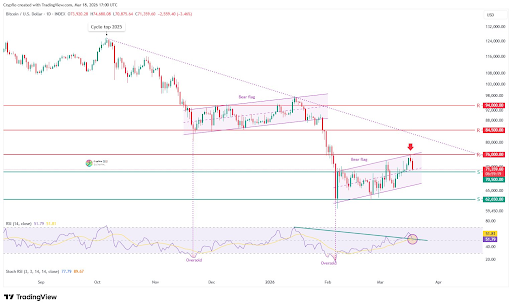
The chart shows Bitcoin rallying into the upper boundary of the flag near the $76,000 area before getting rejected. That same region also lines up with a major resistance band marked on the chart, reinforcing the idea that bulls have not yet done enough to flip the structure. The BTC price has since fallen back toward the middle of the channel, leaving the leading cryptocurrency at a short-term decision point.
As seen in the chart below, a similar bear flag was formed from mid-November 2025 to late January 2026, and this eventually led to the breakdown to $60,000 in early February 2026.
The $70,000 To $76,000 Zone Now Matters More Than Ever
The current battle is taking place between the midline of the flag and the recent rejection zone is at $76,000. At the time of writing, Bitcoin is trading at $70,610, which places it close to support around $70,000. If BTC closes the week below $70,000, then the bear flag projects the price on the path to at least $65,000.
In a separate analysis, CrypFlow turned attention to the weekly timeframe and raised a more macro-level concern using Bitcoin’s Gaussian Channel indicator. This model looks at how Bitcoin has behaved across full market cycles.
According to the analyst, Bitcoin has never formed its cycle bottom before the Gaussian Channel flips from green to red. Each major bottom has come after that transition has already taken place. This pattern played out consistently in 2015, 2018, and again in 2022, where the final lows only arrived once the channel had fully turned bearish.
Interestingly, the Gaussian Channel transitioned from green to red after Bitcoin’s low in early February, not before. Although the Bitcoin price is still holding above $60,000 for now, the implication is that this level may not be the final bottom.
Featured image from Pixabay, chart from Tradingview.com

Editorial Process for bitcoinist is centered on delivering thoroughly researched, accurate, and unbiased content. We uphold strict sourcing standards, and each page undergoes diligent review by our team of top technology experts and seasoned editors. This process ensures the integrity, relevance, and value of our content for our readers.
Gold Falls 11%, Biggest Weekly Fall Since 1983

Gold tumbled another 3.5% to $4,488 per ounce on Friday, marking an 11% fall for the week and the largest weekly loss the precious metal has seen since 1983 as geopolitical instability and uncertainty in the Middle East continue to weigh on the markets.
Gold has fallen more than 15% since Feb. 28, when the US and Israel first attacked Iran, erasing part of the rally that pushed its price up to the $5,500 mark in late January and casting doubt on its safe haven status.
TradingView confirmed that March 16-20 was gold’s worst-performing week since 1983. The 11% weekly fall was slightly larger than the last week of January, when gold shot up to about $5,320 before diving to $4,650, a drop that saw more than $2 trillion shaved off the precious metal’s market cap in days.
The war with Iran is also disrupting global oil flows, particularly in the Strait of Hormuz, causing fears of a prolonged energy crisis.
US President Donald Trump said on Friday that he is considering “winding down” its military efforts in the Middle East. However, the US has sent thousands of additional troops to the region as airstrikes continue.
At the same time, traders are anticipating that the US Federal Reserve will hold interest rates steady this year, making bonds and other yield-bearing investments more appealing than gold.
The Federal Reserve chair, Jerome Powell, also noted on Wednesday that higher energy prices would push up inflation, at least over the short term.
Bitcoin has clawed back lost ground on gold this month
Gold has outperformed Bitcoin (BTC) over the past 12 months, increasing 48.5% while the cryptocurrency has retraced 16.5% over the same timeframe.
Related: Bitcoin price aims to hold $70K amid rising inflation concerns
Bitcoin has responded better to the Iran conflict, however, up more than 11.6% to $70,535 since the US and Israel’s first attack on Iran.
Magazine: Is China hoarding gold so yuan becomes global reserve instead of USD?
Cointelegraph is committed to independent, transparent journalism. This news article is produced in accordance with Cointelegraph’s Editorial Policy and aims to provide accurate and timely information. Readers are encouraged to verify information independently. Read our Editorial Policy https://cointelegraph.com/editorial-policy
Ripple Redefines Enterprise Payments with Unified Stablecoin Platform and Global Adoption

Ripple, a provider of blockchain-based enterprise solutions, unveiled a major expansion of its Ripple Payments platform. Designed to move money seamlessly across both traditional and digital rails, the upgraded solution integrates new product functionality and highlights accelerating customer adoption. According to the firm, this expansion cements Ripple’s role as a comprehensive, one-stop shop for enterprise-ready digital asset solutions.
As the world’s largest financial institutions race to bring stablecoin payments to market, Ripple claims to stand apart by offering the only licensed, end-to-end platform built to support both fiat and digital money movement at a global scale. Backed by deep regulatory coverage and new capabilities in managed custody and collections, the platform is actively enabling fintechs to confidently operate within the emerging onchain economy.
A unified journey from collection to payout

Ripple aims to redefine the global money movement journey by removing the frustrating need to stitch together multiple, disjointed solutions across different vendors, regions, and time zones.
Crucially, this new functionality heavily leverages Ripple’s recent corporate acquisitions. By integrating Palisade, which specialises in custody and treasury automation, and Rail, known for virtual accounts and collections, Ripple’s solution now allows customers to manage their entire financial flow within a single unified platform. Users can collect, hold, exchange, and payout in both fiat currencies and stablecoins. Furthermore, the system includes the ability to provision named virtual accounts and wallets, completely automate collection flows, and seamlessly exchange and settle funds directly into operational accounts.
Monica Long, President at Ripple, emphasized the necessity of robust infrastructure.
“For the global financial system to evolve, fintechs and financial institutions need infrastructure that treats digital assets with the same rigor as traditional finance,” Long stated. “Success in this space requires enterprise-grade infrastructure, extensive licensing, and deep liquidity — capabilities few can match. Ripple has built the blueprint for blockchain-based enterprise solutions designed to operate at global scale for regulated finance.”
While Ripple notes that much of the broader industry remains stuck in the pilot phase, its own product suite is already live across more than 60 major markets worldwide. The platform provides the global rails necessary to scale operations rapidly through simplified onboarding and reliance on a single provider.
Global momentum and strategic partnerships
Fintechs and financial institutions have undeniably led the way in stablecoin adoption. Global annual transaction volumes for stablecoins surged to an astonishing $33trillion last year. This intense momentum is driving a highly active ecosystem where stablecoins now account for 30 per cent of all onchain transaction volume as mainstream utility continues to accelerate.
With more than $100billion in processed volume to date, Ripple Payments is seeing strong adoption among major financial players worldwide who are leveraging stablecoins to explicitly address cross-border liquidity and settlement inefficiencies. Notable recent adoptions include:
-
Corpay: A global leader in business payments, Corpay is utilizing Ripple’s managed custody and liquidity management to instantly fund and settle positions across the Asia-Pacific region using RLUSD, entirely eliminating the need for costly pre-funding.
-
AMINA Bank: The very first European bank to adopt Ripple Payments, AMINA is a FINMA-regulated Swiss crypto bank. It leverages Ripple’s infrastructure to power near real-time, cross-border flows for its institutional clients, effectively bridging stablecoin and fiat rails where traditional banking infrastructure falls short.
-
Banco Genial: A leading digital bank in Brazil, Banco Genial is leveraging the platform to enable rapid cross-border payouts directly from Brazil.
Underpinning this technological expansion is Ripple’s strict compliance-first mindset. The firm remains one of the most trusted and heavily licensed crypto companies in the industry, boasting a portfolio of over 75 global licenses and Money Transmitter Licenses (MTLs), which notably includes a New York Department of Financial Services (NYDFS) Trust Company Charter.
FOMC Leaves Interest Rates Steady at March Meeting

The Federal Open Market Committee (FOMC) announced on Wednesday that it would hold the Federal Funds rate steady at 3.5-3.75%, as it monitors macroeconomic impacts from the ongoing war in the Middle East.
Economic activity has expanded at a “solid pace,” Federal Reserve Chairman Jerome Powell said, adding that consumer spending remains “resilient,” while business investment continued to grow.
However, the housing sector remains weak, and the labor market shows signs of softening, Powell said, while inflation remains “somewhat elevated” above the Fed’s 2% target.
This higher inflation and weak labor market are creating a tension between the Federal Reserve’s dual mandate of maximizing employment and stabilizing prices, Powell said. He added that the war in the Middle East has further clouded the economic outlook. He said:
“The implications of events in the Middle East for the US economy are uncertain in the near term. Higher energy prices will push up overall inflation, but it is too soon to know the scope and duration of the potential effects on the economy.”
Interest rate policy impacts risk asset markets like cryptocurrencies and equities, with lower rates stimulating asset prices and higher rates acting as a restrictive force on risk asset prices, as investment capital flows from riskier asset classes to government bonds.
Related: Fed holds rates amid higher inflation outlook: Bitcoin bounces to $72K
Traders see no chance of rate cuts, while analysts say liquidity will flow
97% of market participants forecast no change in interest rates at the April 2026 FOMC meeting. While 3% forecast a rate hike of 25 basis points (BPS), according to data from the Chicago Mercantile Exchange (CME).
A rate hike of 25 basis points would spike the Federal Funds Rate to a range between 3.75% and 4.00%.

Arthur Hayes, a market analyst and co-founder of the BitMEX crypto exchange, said he is waiting for the Fed to slash rates before he resumes buying Bitcoin (BTC).
Hayes also said that the ongoing war between the US and Iran would likely cause the Federal Reserve to ease monetary policy to finance the war.
Others, like macroeconomist Lyn Alden, say that the Federal Reserve has entered a “gradual print” phase in which new money is steadily being created, slowly raising all asset prices.
Magazine: Is China hoarding gold so yuan becomes global reserve instead of USD?
Cointelegraph is committed to independent, transparent journalism. This news article is produced in accordance with Cointelegraph’s Editorial Policy and aims to provide accurate and timely information. Readers are encouraged to verify information independently. Read our Editorial Policy https://cointelegraph.com/editorial-policy
From FOMO to Apathy: Altcoin Volumes Reflect Deepening Market Fatigue

Trusted Editorial content, reviewed by leading industry experts and seasoned editors. Ad Disclosure
The altcoin market continues to struggle under sustained selling pressure, with weakness persisting for several months as broader conditions remain unfavorable for risk assets. Despite intermittent relief rallies, most altcoins have failed to establish meaningful recoveries, reflecting a market still dominated by caution rather than conviction.
Recent insights shared by CryptoQuant analyst Darkfost reinforce this view. The analysis of trading volumes across Binance and other major exchanges highlights a clear and persistent decline in investor interest. Activity levels have dropped significantly compared to previous expansion phases, signaling reduced participation from both retail and institutional traders.
This trend comes as the broader bear market remains firmly in place. Altcoins are not only failing to recover but are also underperforming Bitcoin, which continues to absorb the majority of available liquidity. In risk-off environments, capital typically consolidates into stronger assets, leaving higher-beta altcoins more exposed to prolonged downside.
At the same time, macro conditions continue to weigh on sentiment. Ongoing geopolitical tensions and global economic uncertainty are limiting risk appetite, discouraging aggressive positioning in speculative assets. In this context, the altcoin market reflects a structural contraction, where declining volumes and sustained selling pressure point to a prolonged phase of weakness rather than an imminent recovery.
Altcoin Volumes Collapse as Market Participation Contracts
Darkfost further contextualizes the current weakness by pointing to a sharp decline in altcoin trading volumes across major exchanges. On Binance, volumes have dropped to approximately $7.7 billion, while other leading platforms combined account for around $18.8 billion. These figures mark a significant contraction in activity, reinforcing the view that investor participation has materially declined.

The contrast with previous market phases is stark. During more active periods such as October and February 2025, Binance recorded between $40 billion and $50 billion in altcoin trading volume, while other exchanges reached levels between $63 billion and $91 billion. The current environment, therefore, reflects a substantial loss of liquidity and engagement.
In relative terms, Binance now represents roughly 40% of total altcoin trading volume, underscoring its dominance as the primary venue for activity. This concentration suggests that liquidity is not only shrinking but also becoming more centralized.
Importantly, prior volume spikes coincided with local market tops, often driven by FOMO, where late entrants provided exit liquidity for more strategic participants. In contrast, today’s depressed volumes indicate a lack of speculative demand. Historically, however, such conditions have often preceded opportunity, as the most attractive setups tend to emerge when interest is minimal and positioning remains light.
Altcoin Market Cap Breaks Down as Structural Weakness Persists
The OTHERS chart, which tracks the total crypto market cap excluding the top 10 assets, highlights a clear deterioration in altcoin structure over recent months. After peaking near the $300B–$350B range in 2025, the market has entered a sustained downtrend, with the latest reading hovering around $176B, reflecting a significant contraction in capital allocated to smaller assets.
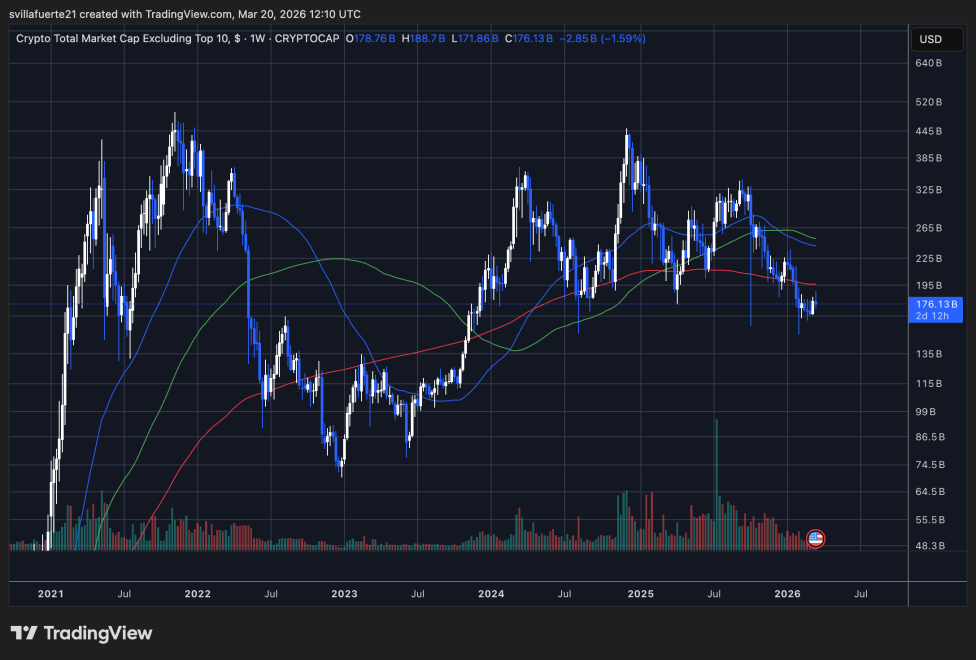
From a technical perspective, the structure remains weak. Price is trading below the 50-week, 100-week, and 200-week moving averages, all of which are now flattening or sloping downward. This alignment confirms that the broader altcoin market is still in a corrective phase, with no clear signs of a trend reversal.
The recent bounce from local lows appears corrective rather than impulsive. Attempts to reclaim the $200B level have failed, indicating persistent supply overhead and limited follow-through demand. Volume spikes during declines further suggest that distribution phases have dominated, with sellers remaining active on rallies.
Historically, this type of structure tends to precede prolonged consolidation or further downside before a base is established. However, it also reflects conditions where relative undervaluation begins to emerge. For now, the key level to watch is the $170B region—losing it could accelerate downside, while reclaiming $200B would be the first signal of structural recovery.
Featured image from ChatGPT, chart from TradingView.com
Editorial Process for bitcoinist is centered on delivering thoroughly researched, accurate, and unbiased content. We uphold strict sourcing standards, and each page undergoes diligent review by our team of top technology experts and seasoned editors. This process ensures the integrity, relevance, and value of our content for our readers.
Grayscale eyes Hyperliquid with new HYPE ETF filing

Grayscale has filed an S-1 registration statement for a HYPE ETF, a proposed product that would hold Hyperliquid’s native token and list on Nasdaq under the symbol GHYP.
The filing shows the trust is designed to track the value of HYPE held by the vehicle, less expenses, and notes that the product may eventually include staking rewards if certain conditions are met, though staking is not currently active for the trust.
The filing adds to a broader push to bring Hyperliquid into traditional markets. Reuters reported in October that 21Shares had also filed for a HYPE ETF, showing that asset managers are moving quickly to package exposure to the token as institutional appetite broadens beyond Bitcoin and Ether.
That interest is tied to Hyperliquid’s growth on chain. DefiLlama data shows the network has processed about $191.4 billion in perpetual volume over the past 30 days, about $9.4 billion over the past 24 hours, and roughly $4.1 trillion cumulatively, with open interest near $7 billion.
The Grayscale prospectus also underscores how central Hyperliquid has become to the onchain derivatives trade. The filing describes the network as a fully onchain order book venue built around perpetual futures and spot markets, rather than the automated market maker model used by many decentralized exchanges.
Price action has followed that momentum, with HYPE last trading near $39, down about 0.6% on the day but still up roughly 45% since late February.
The latest rally has also come as Hyperliquid expands beyond crypto native markets. Investor interest has risen as traders use the platform’s 24/7 venue to speculate on commodities and other real-world exposures.
Hyperliquid also reached a new milestone today, with its newly launched S&P 500 perpetual market topping $100 million in 24-hour volume and quickly becoming one of the chain’s 10 largest markets.
Disclosure: This article was edited by Estefano Gomez. For more information on how we create and review content, see our Editorial Policy.
Ripple Survey Shows 72% of Finance Leaders See Digital Asset Revolution Happening Now

Digital asset adoption has become an immediate priority, with 72% of global finance leaders warning that action is needed now to stay competitive as stablecoins, custody, and tokenization rapidly move into core financial operations. Digital Asset Adoption Surges Across Global Finance Sector Mounting competitive pressure is pushing financial institutions toward digital asset adoption. Ripple published […]