
Bitcoin price remains rocky, and BTC and equities ETF outflows soar as the US and Israel-Iran war enters a fourth week.

Bitcoin price remains rocky, and BTC and equities ETF outflows soar as the US and Israel-Iran war enters a fourth week.

A new taxonomy from the venture firm identifies seven barrier clusters keeping most traditional yield sources off-chain, and argues that stablecoin growth is pulling them closer.
Electric Capital published a research report on Monday, cataloging 501 distinct sources of real-world yield and cross-referencing them against tokenized assets with meaningful on-chain traction today.
The venture firm found that only 34 of those yield sources have any on-chain presence above $50 million, and they cluster in familiar territory: U.S. Treasuries, private credit, corporate bonds, and non-U.S. sovereign debt.
The remaining 93% fall into seven groups defined by what’s blocking tokenization, ranging from legal structuring challenges for asset-backed securities to real-world integration hurdles for commodities and compute infrastructure.
Perhaps the report’s sharpest observation concerns distribution. Of 35 yield-bearing non-stablecoin RWAs above $50 million, only two have crossed 2,000 holders. While some of that is by design — BlackRock’s BUIDL requires a $5 million minimum — the data underscores how dependent most tokenized assets remain on a handful of large deployers and vault curators.
The report highlights how Centrifuge’s JAAA, a tokenized AAA CLO that held $743 million at the time of data collection, lost 44% of its value in a single day on March 9 after Sky’s Grove protocol redeemed $327 million in one transaction.
BlackRock’s BUIDL faces a similar dynamic: its top 10 holders control 98% of supply, and those holders are largely other protocols — Ethena, Ondo, and Sky.
Electric Capital argues five compounding forces will pull new asset types on-chain: a growing stablecoin base with diversifying yield preferences, competition among protocols for differentiated products, vault infrastructure that absorbs duration risk, tranching layers that expand buyer bases, and leverage loops that multiply demand for collateral-eligible assets.
The firm also flagged AI infrastructure spending — projected by Goldman Sachs to exceed $500 billion in 2026 — as a catalyst, noting that GPU leasing, data center construction, and energy contracts are natural candidates for on-chain financing.
This article was written with the assistance of AI workflows. All our stories are curated, edited and fact-checked by a human.

Institutional investors are increasingly turning their attention to promising low-cap cryptocurrencies, seeking opportunities beyond the top-tier tokens. Among these, Mutuum Finance stands out as the only affordable crypto under $1 currently being tracked by major whales heading into Q2 2026.
With its growing adoption in the DeFi space and recent roadmap milestones, MUTM has caught the eye of institutional players looking for high-potential altcoins. Analysts note that this project’s combination of low price and utility-focused development could position it for significant growth in the coming months, making it a focal point for savvy investors.
Mutuum Finance (MUTM) is currently building a professional hub for non-custodial capital management. The core of this system is the Peer to Contract (P2C) model. In this setup, users can supply their assets to a shared liquidity pool. When they do this, they receive interest bearing receipts known as mtTokens that grow in value automatically. For example, if a user supplies 1,000 USDT at a 10% Annual Percentage Yield (APY), their balance will reflect a growth of 100 USDT over a year.
The second part of the engine is the Peer to Peer (P2P) marketplace. This allows for more flexibility than standard pools. Borrowers can seek specific rates or deal types for assets that might be too volatile for a general pool. To keep the entire system safe, the protocol uses a strict Loan to Value (LTV) ratio. If a user provides collateral worth $1,000 with an 80% LTV, they can borrow up to $800. If the value of the collateral drops, automated bots handle liquidations to keep the pools healthy.
The financial progress of the native MUTM token reflects a strong interest in these technical goals. The project has successfully secured over $21 million in capital. This growth is backed by a global community that has now surpassed 19,200 individual holders. The total supply of the token is fixed at 4 billion units. To ensure a fair start, the team allocated 45.5% of the supply for the early stages. This means exactly 1.82 billion tokens are moving into the hands of the community before the full release.
The token has already seen a 300% increase from its initial starting price of $0.01, currently sitting at $0.04 in Phase 7. As the project moves through its community rollout, the demand is rising quickly. Participants are moving to secure their positions before the token reaches its confirmed official launch price of $0.06. This represents a total appreciation of 500% from the very first phase. To keep the community active, the platform uses a 24 hour board. This leaderboard rewards the top daily contributor with a $500 bonus. This constant activity shows that the presale demand is far outstripping the remaining phase allocation.
The most significant achievement for the project is the activation of the V1 protocol on the testnet. This working version has already handled over $270 million in simulated volume. This proves that the borrowing and lending engine is hardened and ready for heavy usage. Security remains the primary pillar of this strategy. The protocol holds a high safety score of 90/100 from CertiK, which monitors the smart contracts for any vulnerabilities.
Furthermore, the project has completed a full manual code review by Halborn Security. This firm is known for its rigorous testing of high volume financial systems. Based on these technical layers, many analysts have a positive outlook for the protocol. Some forecasts suggest the token could reach a valuation of $0.35 by late 2026. This opinion is backed by the project’s ability to provide a functional tool that solves the high costs of legacy lending platforms.
The roadmap for the rest of 2026 includes several high impact updates. The team is developing a native over-collateralized stablecoin. This will be minted directly against the interest bearing mtTokens held in the protocol. This is crucial because it allows users to unlock spending power without needing to sell their primary assets. It creates a complete financial environment where all needs are met in one place.
To keep costs low and speed high, the project plans to expand to Layer-2 networks. This will reduce transaction fees and allow for even more users to join the network. By solving the problems of high fees and slow speeds, Mutuum Finance is positioning itself as a primary tool for capital management. The focus on verified safety and functional utility is setting it apart as a primary project to watch in the 2026 market.
For more information about Mutuum Finance (MUTM) visit the links below:
Website: https://www.mutuum.com
Linktree: https://linktr.ee/mutuumfinance

After a strong start to the week, Bitcoin (BTC) is down nearly 5%, alongside the S&P 500, DOW, Nasdaq, and Gold. Crude oil, on the other hand, has risen 7.30% and is up 53% since the US and Israel–Iran war began on Feb. 28.
The collective market weakness highlights a coordinated shift in capital flows as the war continues in the Middle East, with an uptick in outflows from the S&P 500 and Nasdaq 100 exchange-traded funds (ETFs) further highlighting traders’ decision to cut risk.
The Kobeissi Letter reported a combined $64 billion outflow from the S&P 500 (SPX) ETF and Nasdaq 100 ETF (QQQ) over the past three months, the largest on record.
This reverses a $50 billion inflow seen in November and pushes outflows to 5% of the total assets under management.
The spot Bitcoin ETFs mirrored the broader market weakness, recording $253 million in outflows over the past two days.
While the monthly ETF flows remain positive at $1.48 billion, this comes against the backdrop of $6.3 billion in cumulative outflows between November and February, highlighting a fragile recovery in investor demand.
Glassnode data suggests the market is struggling to absorb the selling pressure. The net realized profit-taking briefly accelerated to around $17 million per hour (24-hour average) before losing momentum, after which the BTC price slipped back below $70,000. Glassnode added,
“Broader geopolitical uncertainty appears to be compressing demand depth, limiting the market’s capacity to absorb even moderate realization events.”

Related: Market analyst sees further Bitcoin downside, flags $60K as key level
Market participants are framing Bitcoin’s move against past geopolitical events, drawing parallels between the current US and Israel–Iran war and the Russia-Ukraine war in 2022.
Coincidentally taking place in February four years apart, crypto commentator Carlitosway noted that following Russia’s attack on Ukraine on February 24, 2022, Bitcoin initially sold off before posting a 24% relief bounce in the following four weeks. The momentum faded soon after, as BTC dropped another 64% by November 2022.

A similar sequence is unfolding this month, with BTC rallying nearly 10% at one stage last week since the beginning of the war, but momentum is now slowing down.
Carlitosway linked the weakness to sustained pressure on liquidity, rising energy costs, and continued forced selling during periods of stress, all of which reduce the follow-through demand for Bitcoin.
The pattern points to a more extended stabilization phase, where the recovery may take time as capital rebuilds and the selling pressure clears.
Crypto analyst Finish believed that the recovery path for Bitcoin might take place after a price bottom around $55,000. The analyst added,
“I frankly think that until the Iran war is settled, it’s gonna be hard for $BTC to rise. The environment is risk off, the SPX lost trillions in capitalisation, which leads me to a more neutral stance.”

Related: What happens to Bitcoin if oil price hits $180 per barrel?
This article does not contain investment advice or recommendations. Every investment and trading move involves risk, and readers should conduct their own research when making a decision. While we strive to provide accurate and timely information, Cointelegraph does not guarantee the accuracy, completeness, or reliability of any information in this article. This article may contain forward-looking statements that are subject to risks and uncertainties. Cointelegraph will not be liable for any loss or damage arising from your reliance on this information.

Hyperliquid’s S&P 500 perpetual market topped $100 million in 24-hour volume on Friday, making it one of the 10 largest markets on the booming blockchain.
It’s impressive growth for a market that debuted just days earlier, and it’s the latest sign that blockchain-based traders are eager to trade in futures for traditional assets.
Hyperliquid has become a popular venue for weekend trading of tokenised oil futures amid the war in Iran, topping $1 billion in weekend volume earlier this month.
As traders increasingly use Hyperliquid and other blockchains to trade over nights and weekends, they may become a venue for true price discovery.
Oracles that bring the price of real-world assets onchain give enormous weight to an asset’s most recent price on traditional markets in order to prevent dramatic price swings in relatively illiquid onchain markets, Marcin Kazmierczak, founder of crypto oracle RedStone, told DL News.
“But as we move forward and this trading volume on HIP-3 keeps growing, this divergence between Friday closing and weekend trading can be larger and larger,” he added, referring to a Hyperliquid feature that allows users to deploy new markets without seeking permission from the blockchain’s creators.
Trade[XYZ], the firm that licensed S&P’s index for use on Hyperliquid, has a name for its feature limiting after-hours price movements: “Discovery Bounds.” It rolled out an updated version of this feature on Thursday for six new markets in order to allow prices greater freedom to move as trading outside regular business hours increases.
That feature was first introduced earlier in the week, after one of Trade[XYZ]’s oil markets hit $1 billion in weekend volume.
“To realise the radical concept of 24/7 trading, we made an explicit trade-off: limit the extreme tails of price movement, and the range within becomes substantially more conducive to genuine price discovery,” a pseudonymous employee wrote on X last week.
But Trade[XYZ]’s blockbuster markets have changed that calculus.
“With more participants, deeper liquidity, and higher-signal price movements, we’ve reached a point where the static protections themselves have become the primary constraint on price discovery,” they wrote.
And there’s much more room for onchain markets to reduce their reliance on price signals from traditional markets, according to Kazmierczak — all they need to do is grow.
“The closing price on Friday, it can have a parameter of relevance — let’s call it 90% and then 10% is the price discovery that’s happening [onchain] over the weekend,” Kazmierczak said.
“As more and more volume happens on Hyperliquid, this parameter can be diminished to, let’s call it 80% and maybe 70% and so on. It’s just the question of how much of the volume and the serious players will be playing.”
Aleks Gilbert is DL News’ New York-based DeFi correspondent. Have a tip? Email him at aleks@dlnews.com.

As projections anticipated, Bitcoin’s difficulty adjusted downward at block height 941472, falling 7.76% and easing the path for miners to find blocks over the next two weeks. The network has now logged six difficulty adjustments this year, with the metric sitting nearly 10% below its level at the close of 2025. Lower Bitcoin Difficulty Offers […]

The research finds that the consent-based data-sharing framework has already delivered an estimated £8.3billion in cumulative economic benefits to date. Looking to the future, the long-term annual opportunity across the UK economy could be significantly larger, reaching up to £43billion per year at full maturity and adoption.
Even in the medium term, the growth trajectory is steep. The analysis projects that annual economic benefits could reach £7.4billion within the next five years as adoption continues to scale seamlessly across payments, savings, lending, and cloud accounting.
For small and medium-sized enterprises (SMEs), reducing the cost of administration and lowering transaction costs releases valuable time to focus on growth rather than paperwork. This surge in automation and efficiency is expected to drive the development of new, innovative products, generating an estimated annual GDP uplift of £2.3billion within the next five years.
Simultaneously, open banking-powered tools are helping everyday consumers manage and save their money more effectively while actively accessing fairer finance options. By enabling people to save more and reduce unnecessary living costs, this improved consumer financial management is estimated to deliver a further annual boost to UK GDP of £2.5billion over the same five-year period.
The UK’s open banking ecosystem has reached a critical point of maturity, currently boasting more than 17.51 million live user connections across the country. The infrastructure is supported by a growing network of 145 authorised third-party providers. Furthermore, consumer usage is accelerating; in January 2026 alone, open banking payments rose by 4.3 per cent month-on-month, totalling 36.04 million transactions.
Henk Van Hulle, CEO of Open Banking Limited, emphasized the vital role the technology already plays in modern society. He noted that by helping consumers manage their money better and enabling businesses to operate more efficiently, open banking is contributing meaningfully to economic growth, which is a key component of the Government’s wider growth mission. Van Hulle added that as the UK looks to strengthen productivity, competitiveness, and innovation across financial services, this analysis underlines the important role open banking can play in supporting those ambitions.
Thomas Bull, head of finTech growth at EY, echoed this sentiment, highlighting that open banking is fundamentally changing how people and businesses manage routine financial activity in real time. Bull stated that looking ahead, continued collaboration between the industry, regulators, and the government will be critical to building on this momentum. He stressed that scaling the existing ecosystem will ultimately support the transition towards a broader open finance framework, enabling fairer access to financial services across the UK.

Update (March 18 at 6:52 pm UTC): This article has been updated to include a response from Cynthia Lummis beginning in the eighth paragraph.
Wyoming Senator Cynthia Lummis, one of the main proponents of a digital asset market structure bill in the US Congress, said that the legislation is getting closer to passage despite “things that [she] did not expect” in 2025.
Speaking at the DC Blockchain Summit hosted by the Digital Chamber on Wednesday, Lummis said she had thought that the crypto industry would already be celebrating a “victory lap” for the market structure bill, which passed the US House of Representatives in July 2025. She said that “the main thing” that had held up the legislation was the fight over stablecoin yield and rewards between banking and crypto industry representatives.
“We are so close this time,” Lummis told Summit attendees. “Some of the people that have been very dug in on the issue of yield versus rewards have been working closely with the White House […] working with our members who have been trying to come up with a compromise on that issue. We think we’ve got it.”
Lummis sits on the Senate Banking Committee, which has been responsible for the bill being stalled in Congress after its chair, Tim Scott, indefinitely postponed a January markup on the legislation. The Senate Agriculture Committee advanced its version of the bill in January, but both pieces of legislation will need to be combined in some fashion to address issues related to commodities and securities laws before a vote in the full chamber.
The Wyoming senator said that her colleagues would plan an April markup after the Easter recess. As of Wednesday, the banking committee had not rescheduled a markup on the bill.
Related: Circle’s policy chief tells UK to merge MiCA clarity with US stablecoin rules
Among the issues stoking lawmakers’ debate are tokenized equities, ethics — for elected officials potentially profiting from investments in the crypto industry — stablecoin yield, and decentralized finance. The White House has held three meetings with crypto and banking industry representatives in 2026 in an attempt to move the legislation forward.
“We think we’ve got the DeFi issue put to bed,” said Lummis, adding that there were still some issues over money transmitters and how to clarify the definition of crypto assets as securities or commodities.
A spokesperson for Lummis said that the senator expected a deal on stablecoin yield “in the next few days,” and was working on a deal about ethics language in the bill.
One of the issues for proponents of the market structure bill has been the potential impact of the 2026 midterm elections, held in November and resulting in a new makeup of Congress in January. All 435 House seats and 33 in the Senate are up for grabs, giving Democrats an opportunity to take both chambers from Republicans.
“This may be our only chance to get market structure done,” said Lummis in a Wednesday X post, referring to the White House supporting the bill.
Lummis announced in December that she would not seek reelection.
“If we don’t get the CLARITY Act passed by May, digital asset legislation will not pass for the foreseeable future,” said Ohio Senator Bernie Moreno on Wednesday.
Speaking at the DC Blockchain Summit on Tuesday, Scott said he expected to have a proposal on how to address stablecoin yield in the bill “before the end of this week.” His Republican colleague, Senate Majority Leader John Thune, said last week that he didn’t expect the banking committee to pass market structure before April, instead prioritizing a controversial voting requirements bill.
Magazine: Big Questions: Can Bitcoin save you from the dreaded Cantillon Effect?

Ethereum has flipped bearish following the market’s reaction to the Federal Reserve (Fed) meeting, but its price remains firm above the $2,100 level. Given the bearish conditions, the market dynamics of ETH are starting to shift as key metrics signal a possible liquidity trap ahead at current levels.
After recent price action, an on-chain indicator is triggering fresh concerns around Ethereum and its market dynamics. These kinds of signals are typically seen during volatile periods and could play a crucial role in shaping the altcoins’ next price trajectory in the short term.
Combining signals from multiple metrics, Boris, a crypto trader and on-chain analyst, has outlined the potential formations of a liquidity trap for ETH. Even though price activity may seem stable on the surface, underlying data indicate that liquidity is being concentrated in a way that could surprise traders.
As ETH’s price climbed toward the $2,400 level, the Whale Vs Retail Delta continued to move into negative territory. This trend underscores a key divergence in activity between large holders and smaller investors in the market. Simply put, large holders or whales are reducing their relative activity or exposure, while small traders are becoming more active in the market.
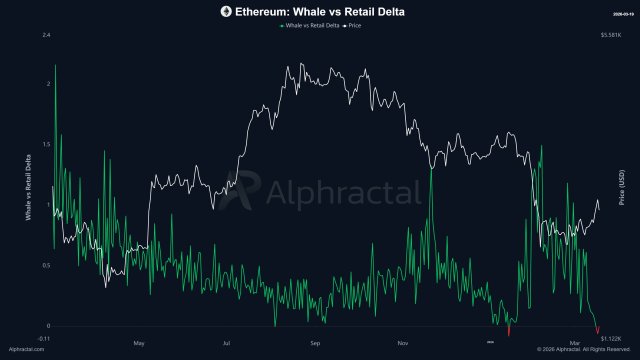
Currently, whale investors are closing their long positions in Ethereum and opening more short positions. Meanwhile, retail holders are doing the opposite as they aggressively open long positions. When institutional players retreat while retail engagement increases, this imbalance frequently indicates a shifting mood under the surface. A trend of this kind is considered a classic liquidity illusion.
Boris highlighted that buying pressure saw robust strength for a period, but those buys were absorbed by sell-side liquidity. As a result, the market has entered a cooling phase. Historically, the current market setup hints at further downside pressure.
Adding to the market trend is the ETH Liquidation Levels metric. Data shows a significant long buildup over the past month, with key liquidity targets at $1,850 and below. While the price is moving up, the market is clearly demonstrating weakening strength underneath.
Ethereum’s recent price action was met with a CME Gap. However, CW, a market expert and investor, reported that the leading action has filled the gap, which was located at $2,117. As the market tries to correct inefficiencies, these gaps, which are frequently created during times of intense price movement, may serve as magnets for subsequent price action.
After closing the gap, a buy wall has been formed around $2,100, and this level aligns with the Fibonacci level of 0.382. If a rebound occurs after reaching the $2,100 level, the next target is around $2,686, a price that corresponds to the 0.382 fib level. Meanwhile, if ETH rises to this level, another CME gap ahead will be filled.
Featured image from Peakpx, chart from Tradingview.com

Editorial Process for bitcoinist is centered on delivering thoroughly researched, accurate, and unbiased content. We uphold strict sourcing standards, and each page undergoes diligent review by our team of top technology experts and seasoned editors. This process ensures the integrity, relevance, and value of our content for our readers.

Unlike Bitwise, Grayscale doesn’t plan to incorporate staking for its Hyperliquid ETF but hasn’t ruled out integrating it in the future.
Crypto asset manager Grayscale has filed for a spot Hyperliquid exchange-traded fund, joining Bitwise and 21Shares in seeking to offer a product tied to the Hyperliquid perpetual futures protocol and blockchain.
The Grayscale HYPE ETF would track the price movement of the Hyperliquid (HYPE) token and trade under the ticker GHYP on the Nasdaq if approved, according to Grayscale’s S-1 registration statement filed with the Securities and Exchange Commission on Friday.
Grayscale listed Coinbase as the custodian but didn’t disclose a management fee for the proposed Hyperliquid product.
Grayscale’s filing comes as Hyperliquid continues to be integrated by crypto platforms and be increasingly relied on by TradFi when traditional markets are closed, as it offers 24/7 trading for tokenized real-world assets like oil and gold.
Grayscale said it may consider incorporating staking rewards into its Hyperliquid ETF at a later date, provided certain conditions are met.
Related: Morgan Stanley files amended S-1 for MSBT Bitcoin ETF
Staking would enable GHYP investors to earn yield on top of potential price appreciation from the HYPE token.
Bitwise filed for its Hyperliquid ETF in September and amended it in December to include staking, while 21Shares also contemplated incorporating staking at a later date in its October filing.
While trading volume on Hyperliquid has cooled off from its August highs, it continues to see between $40 billion and $100 billion in weekly volume — maintaining its position as the most traded perps futures platform, DeFiLlama data shows.
Several competitor platforms like Aster, Lighter and edgeX emerged in 2025, eating into Hyperliquid’s dominance, but still see far less trading volume on most weeks.
Total weekly perps trading volume has been hovering between the $125 billion and $300 billion mark this year — not quite as high as in November but still more than double the trading volumes seen this time a year ago.

Magazine: Human brain cell wetware plays Doom, fly’s mind uploaded: AI Eye