Bitcoin BTC$69,460.83 drifted toward $69,000 on Thursday as the deepening conflict in Iran is spiraling across the Middle East, hitting energy infrastructure and spilling into global markets.
Oil remained at the center of the action, as investors pulled back from risk amid fresh headlines around attacks on energy infrastructure. Prices swung back toward $100 a barrel after a Politico report said the U.S. is not considering a crude export ban, reversing earlier declines and keeping inflation worries alive.
That backdrop weighed on traditional markets, especially as investors began to consider that central banks might delay rate cuts or even mull rate hikes, wary of inflationary pressures from an energy shock and supply disruptions. The S&P 500 and Nasdaq slid nearly 1% in morning trading, both hitting fresh 2026 lows.
The more notable move, though, came from metals. Gold dropped 5% to around $4,500 an ounce, its lowest since early February, while silver fell 6.6%, extending a sharp unwind after weeks of outsized gains.
Crypto, by comparison, looked relatively steady. Bitcoin was last trading around $69,400, down about 2.6% on the day. Most major tokens, including ether (ETH), XRP (XRP), BNB BNB$636.02 and solana (SOL), were all down, but losses stayed under 3%, and the broader CoinDesk 20 Index was off about 2.1%.
Crypto-linked stocks also moved lower, though not to the same extent seen elsewhere. Crypto exchange Coinbase (COIN) slipped 1.7%, bitcoin treasury firm Strategy (MSTR) fell 2.6%, while stablecoin issuer Circle (CRCL) pulled back 6%, giving up some ground after more than doubling over the past three weeks.
Bitcoin holds ground in risk-off move
The simultaneous drop in both gold and bitcoin points to broad de-risking rather than a rotation into safe havens, said Alvin Kan, COO of Bitget Wallet. Rising energy prices are feeding into inflation expectations, reinforcing a “higher-for-longer” interest rate outlook and tightening liquidity — a difficult mix for risk assets, he added.
Still, bitcoin has outperformed gold by around 20% during the initial phase of the Iran conflict, noted Bryan Tan, trader at Wintermute, an unusual dynamic for an asset typically treated as a riskier tech name. But the lack of follow-through above $75,000 suggests markets remain cautious and rangebound.
“When sentiment swings on each headline about the conflict, and correlation to oil prices are so elevated, being flat is a strong position,” he said. “We lean towards reserving dry powder until we see a meaningful confirmation in either direction or a material change in market conditions.”
Eco has integrated Permit3 with Para Transaction Permissions to let users authorize complex cross-chain actions through a single confirmation flow.
Permit3 is designed to enable cross-chain token approvals and transfers with one signature, while remaining compatible with Permit2-style infrastructure.
Para’s permissions interface is meant to show users exactly what wallet, chain and action they are approving before execution.
The integration is aimed at reducing the multiple approvals, signatures and chain switches that often make cross-chain transactions confusing.
Eco, a stablecoin liquidity company building cross-chain payment infrastructure, has integrated its Permit3 authorization system with Para’s Transaction Permissions. The integration is aimed at reducing the multiple wallet prompts and opaque token approvals that have long complicated onchain transactions.
Eco says Permit3 enables cross-chain token approvals and transfers with a single signature, while Para’s permissions layer is designed to show users exactly what they are approving before a transaction is executed.
The companies said the integration allows Para customers to authorize more complex cross-chain actions in one confirmation flow rather than through a series of approvals, signatures and chain switches.
Under the setup, Para acts as the confirmation layer, displaying the wallet, chain and scope of the transaction, while Permit3 handles the reusable permission logic within limits tied to specific assets, contracts, amounts and time windows.
The launch targets one of DeFi’s most persistent usability issues: token approvals that are often broad, difficult to track and easy for users to forget after they are granted. Eco describes Permit3 as a more constrained authorization model, built around scoped and time-bound permissions rather than open-ended access. According to Eco, the protocol is designed for multi-token and multi-chain workflows and allows permissions to expire or be revoked.
It’s important because cross-chain transactions often involve a chain of separate user actions before a final transfer or deposit is completed. A user moving funds from one blockchain to another, for example, may need to approve a token, sign a transaction, bridge assets, switch networks and sign again.
Eco says Permit3 is intended to compress that process by defining the full transaction scope upfront and then executing it within those boundaries.
The integration also has potential relevance beyond consumer crypto applications. Eco and Para are pitching the product toward businesses and developers that need clearer records around who authorized a transaction, under what conditions, and for which assets and chains.
Para’s transaction-permission tooling is designed to let applications surface explicit approval prompts, while Eco says Permit3 adds an auditable permissions layer suited to repeat or automated flows.
The companies highlighted use cases such as scheduled payments, recurring deposits and automated settlements, where users may want to authorize an action once but keep strict controls around how it can be reused.
Eco says Permit3’s “set it once” design includes features such as expirations, allowlists, revocation and policy checks, allowing recurring authorizations to remain constrained to pre-agreed conditions.
Eco has been building out infrastructure around stablecoin movement across fragmented blockchain networks. The company describes itself as a network for real-time money movement across major stablecoins and blockchains, with products focused on routing liquidity and simplifying cross-chain stablecoin usage. Permit3 is open source and available through Eco’s GitHub repository.
Para focuses on wallet and authentication infrastructure for crypto and fintech applications, including embedded wallet technology and transaction approval tools. Its permissions system lets apps present users with a Para-managed approval dialog for transactions and message-signing events, a feature the company says is especially useful when users are interacting with wallets created outside the app itself.
The integration does not eliminate permissions entirely. Users may still need a one-time setup approval for tokens and chains using the Permit3 contract. But the broader objective is to reduce repeat prompts and make cross-chain transaction approvals more intelligible, especially as stablecoin-based payments and automated onchain workflows move closer to mainstream financial use cases.
The article “Eco and Para Launch One-Click Cross-Chain Permissions for Any Wallet” was first published on AlexaBlockchain. Read the complete article here: https://alexablockchain.com/Eco-Para-Launch-One-Click-Cross-Chain-Permissions-for-Any-Wallet/
Read Also: MoneyGram, Pairpoint and eToro Back Midnight’s Privacy Blockchain Before Mainnet
Disclaimer: The information provided on AlexaBlockchain is for informational purposes only and does not constitute financial advice. Read complete disclaimer here.
Image Credits: Eco, Shutterstock, Canva, Wiki Commons
On Friday, global markets will face a trillions-of-dollars quarterly derivatives event known as quadruple witching.
The event occurs on the third Friday of March, June, September, and December, when four major types of derivatives expire simultaneously. These include stock index futures, stock index options, single-stock options, and single-stock futures.
Because traders must close, roll or settle these positions simultaneously, trading activity often surges, and price swings can intensify in the traditional markets.
Exact figures for the March 2026 expiry have not yet been published, though recent events illustrate the scale. In March 2025, roughly $4.7 trillion worth of equity and index derivatives expired during the quarterly event. According to TradeStation, that session saw the highest S&P 500 trading volume of the entire year, while other witching days also recorded above-average activity.
Large expiries like this often force institutions to rebalance portfolios, unwind hedges and adjust risk exposure within a short window. Much of the activity tends to concentrate in the final hour of trading, when liquidity spikes and volatility can increase rapidly.
This quarter’s expiration arrives during an already volatile trading environment. Conflict in the Middle East recently pushed oil prices to $120 per barrel, while gold slipped below $4,600 and bitcoin fell below $69,000. Meanwhile, the VIX volatility index jumped above 35 last week, the highest level in a year, signalling heightened stress in financial markets.
Although quadruple witching originates in traditional finance, it can spill into crypto markets. Bitcoin increasingly trades alongside broader risk assets, meaning sharp moves in equities often ripple into digital markets.
Cole Kennelly, CEO of Volmex Finance, said tomorrow’s event could drive volatility in crypto markets, noting that “quadruple witching could trigger a spike in cross-asset volatility as large derivatives positions expire. This may already be showing up in crypto, with the Bitcoin Volmex Implied Volatility (BVIV) Index trending higher into the event.”
BVIV (TradingView)
How did bitcoin perform on quadruple witching days in 2025
On March 21, bitcoin was slightly down on the day, but the more significant move came later, with prices bottoming a few weeks afterward around $76,000 following the market reaction to President Trump’s “Liberation Day” tariffs.
On June 20, bitcoin declined 1.5% and continued drifting lower, reaching a local bottom near $98,000 just two days later. On September 19, Bitcoin fell over 1% on the day, but the real move unfolded in the following week, with a sharp drop from $177,000 to $108,000. Then, on December 19, bitcoin finished roughly 3% higher at around $85,000, though it remained in a broader drawdown from the October highs.
While price action on the day itself tends to be relatively muted, a consistent pattern of weakness emerges in the days to weeks that follow.
Even if the quad-witching doesn’t add to bitcoin’s volatility on Friday, crypto traders have another event, specifically for digital assets, to keep in mind. Crypto derivatives face their own major quarterly expiry the week after, on March 27, with $13.5 billion set to expire on Deribit, where positioning points to elevated demand for volatility strategies rather than strong directional bets.
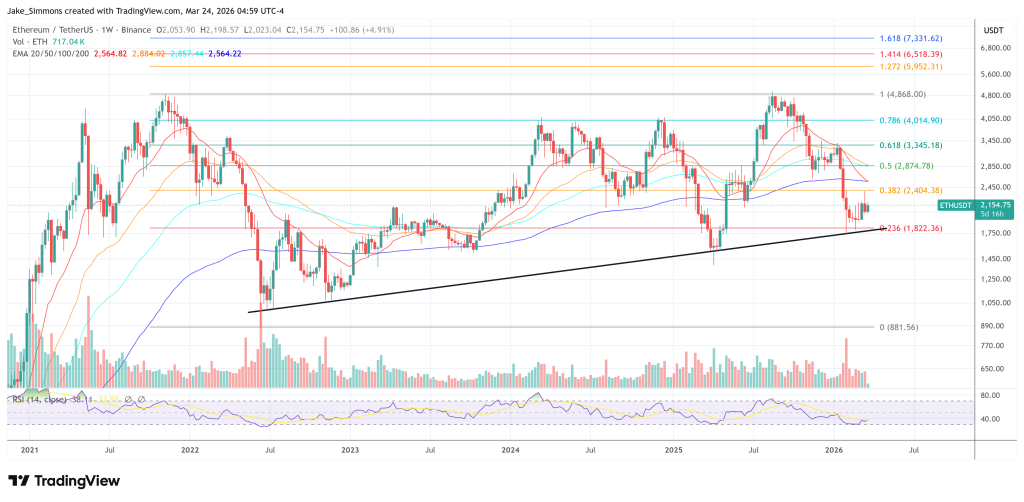
Ethereum is trading above $2,100 on Thursday, down 3% today, while its derivatives market hums with activity. Beneath the surface, futures and options positioning reveal a market leaning cautiously bullish—but not without a few traps waiting to snap shut. Ethereum Derivatives Reveal Tug-of-War Between Bulls and Hedgers Ethereum futures open interest remains elevated across major […]
OP_NET said it is launching a “SlowFi” decentralized finance (DeFi) stack on Bitcoin that uses standard Bitcoin transactions and native BTC fees rather than bridges, wrapped assets or a separate gas token.
According to a Thursday release shared with Cointelegraph, the project is part of a broader push to bring trading and yield-style activity directly onto Bitcoin’s base layer instead of routing it through sidechains, bridges or adjacent networks. OP_NET is betting some users will accept slower and more expensive transactions in exchange for staying fully on Bitcoin.
According to OP_NET co-founder Frederic Fosco, who goes by Danny Plainview, applications run through standard Bitcoin (BTC) transactions using Taproot-based spends, while the platform’s NativeSwap model is designed to support token swaps without wrapped BTC or a separate gas asset. Plainview told Cointelegraph that every transaction on OP_NET is “just a Bitcoin transaction with BTC as the only gas asset.”
The launch lands in the middle of a growing fight inside Bitcoin over whether DeFi-style and data-heavy uses of block space strengthen the network’s fee market or amount to spam that crowds out monetary transactions.
Plainview said a swap would typically cost about $1 to $2 under normal fee conditions and roughly $10 to $20 when blocks are congested, because users pay only standard Bitcoin network fees rather than a separate gas token.
OP_NET cofounder Frederic Fosco, AKA Danny Plainview. Source: OP_NET
OP_NET describes the model as “SlowFi,” arguing that Bitcoin’s roughly 10-minute block times and congestion-driven exit friction can make liquidity stickier and produce longer-lived DeFi cycles than faster chains.
Related: Fireblocks to integrate Stacks for institutional-grade Bitcoin DeFi
Critics say OP_NET brings Ethereum-style DeFi bloat
Plainview framed layer-1 DeFi as a way to support miner revenue as block subsidies decline, arguing that “miners are bleeding” due to Bitcoin’s halving schedule. “The only thing that keeps miners solvent is a fee market,” he said, insisting that OP_NET does not modify Bitcoin consensus.
Related: Animoca, RootstockLabs partner to bring Bitcoin DeFi to Japanese institutions
That view has drawn criticism from Bitcoin users who argue that pushing DeFi-style activity onto layer 1 dilutes Bitcoin’s monetary focus or clogs block space with nonessential transactions. In recent posts on X, some critics described OP_NET as an attempt to bring Ethereum-style crypto infrastructure onto Bitcoin.
Some maximalists argued that any attempt to expand Bitcoin’s use cases beyond money made its proponents “sh*tcoiners” larping as Bitcoiners.
BIP 110 proponents argue against OP_NET. Source: Justin Bechler
Plainview pushed back, saying that any fee-paying Taproot transaction should be treated as a legitimate use of block space.
He warned that drawing moral lines around valid transactions handed de facto control of Bitcoin to whoever defines those categories. He said:
“The whole point is that nobody controls it.”
OP_NET keeps DeFi on Bitcoin base layer
OP_NET enters a field already populated by earlier attempts to bring programmability to Bitcoin, including through RSK and Stacks.
RSK operates as a separate Ethereum Virtual Machine-compatible sidechain with its own RBTC gas token and a federated BTC peg, meaning users move value off mainnet and trust a federation to manage the bridge.
Stacks, by contrast, is a Bitcoin-anchored layer-2 with its own STX token and sBTC mechanism, executing smart contracts on a distinct chain that settles periodically to Bitcoin rather than inside L1 transactions.
By keeping execution and fees directly on Bitcoin and avoiding wrapped BTC or new gas assets, Plainview is betting that some users will accept slower, more expensive transactions in exchange for staying entirely on Bitcoin’s base layer.
Magazine: Bitcoin may take 7 years to upgrade to post-quantum — BIP-360 co-author
Cointelegraph is committed to independent, transparent journalism. This news article is produced in accordance with Cointelegraph’s Editorial Policy and aims to provide accurate and timely information. Readers are encouraged to verify information independently. Read our Editorial Policy https://cointelegraph.com/editorial-policy
As AI agents become a bigger topic in crypto, Pranav Ramesh told CoinDesk that Nasdaq has already been using them across several sections of its business and has sharply expanded that use over roughly the past 18 months.
Ramesh, head of options research at Nasdaq and co-founder and CTO of Leadpoet, said the most meaningful shift has been in trust. “AI agents are relatively new, probably being used more and more over the last six months,” he said, arguing that earlier systems hallucinated too often for sensitive enterprise workflows.
He said Nasdaq is using AI agents in areas including market surveillance, compliance, and market microstructure analysis, and pointed to Nasdaq Verafin’s “Agentic AI Workforce,” which Nasdaq says automates “low-value, high-volume compliance processes” in anti-money laundering work.
Ramesh also pointed to Nasdaq’s AI-powered order type. Nasdaq announced in 2023 that its Dynamic M-ELO order type had become the first exchange AI-powered order type approved by the SEC, using an AI model with more than 140 factors to adjust to real-time market conditions.
For Ramesh, that experience informs how he sees crypto. He said crypto trading platforms are likely to move aggressively on AI agents for both internal operations and retail-facing tools, including position analysis, trade suggestions and execution support. “The crypto trading world is actually going to lead the charge on how AI is used within the retail trading environment,” he said.
He did not describe that shift as fully autonomous. Instead, he said the model he sees taking hold is one in which agents handle most of the analysis and workflow while humans retain final approval. In the interview, he said that at Nasdaq, many systems still stop short of full automation, with human review remaining in the last step.
AI and AI Agents will replace a lot of human labor
Ramesh’s views are also unusually blunt on labor. “Yes, it will take a lot of jobs,” he said of AI agents, adding that he believes lower-level software, customer service and analyst roles are already being displaced as systems become faster, cheaper and more reliable. He framed that as an observable trend rather than a prediction.
And he seems to be right as companies, including the most recent being Crypto.com, which laid off 12% of its staff in a push for greater automation and efficiency through AI. Earlier, crypto research firm Messari parted ways with several of its staff and its chief executive as the company transitioned into what the new CEO called an “AI-first company.” Last month, Block, the payments company founded by Jack Dorsey, announced plans to slash 40% of employees, over 4,000 people, citing improved AI models.
The AI trend lead to founding Leadpoet
That thesis also shaped his path into Leadpoet, the startup he co-founded with Gavin Zaentz. According to a February 2026 company fact sheet, the two met at Nasdaq and founded the company after repeatedly encountering the same problem: outbound tools could generate static lists, but identifying real buying intent still required manual research.
Leadpoet describes itself as an AI-powered lead qualification platform that turns web signals and company context into “decision-ready lead recommendations,” emphasizing “precision over volume.” The company says it supports private deployments so customers can score intent and generate outreach on their own data without exposing it to a vendor.
The fact sheet says Leadpoet uses Bittensor, which describes itself as a decentralized, blockchain-powered AI network that allows participants to contribute models and compute while earning rewards. Ramesh said that a decentralized, competitive structure is part of the appeal, because it can improve models faster than a centralized roadmap.
Leadpoet also says it is a member of NVIDIA Inception, NVIDIA’s startup program for AI companies. NVIDIA describes Inception as a free program that offers technical resources, go-to-market support and access to its broader ecosystem.
In the company’s February 2026 fact sheet, Leadpoet says it reached a $1 million annualized run rate in its first quarter after launch and received backing from DSV Fund and Astrid. In that same material, DSV Fund CIO Siam Kidd said Ramesh and Zaentz combine “deep AI engineering expertise with a real understanding of day-to-day sales.”
Ramesh tied the company directly to what he says he saw inside large institutions adopting AI: agents moving from assistants to systems that can handle real operational work. In crypto, he said, that shift is likely to become visible faster than in many other corners of finance.
Ripple just gave institutions another reason to take crypto custody seriously, rolling out security and staking upgrades built for banks. On paper, that is the news that should light a fire under XRP and boost the bitcoin price prediction. It did not. Instead, capital is rotating elsewhere into projects with real exchange products and ground floor pricing.
Liquidity is flowing hard into an exchange ecosystem built by a PEPE cofounder who already created a coin worth $7 billion. Pepeto has raised $8.1M at $0.000000186 as investors chase real utility and massive return potential that the bitcoin price prediction for large caps simply cannot deliver. Exchange listings are approaching fast.
Bitcoin drops to $69K as hot PPI data and Iran tensions hammer risk assets
Bitcoin dropped 5.5% to $69,361 on March 19, briefly touching $69,200 in Asian trading before recovering slightly. This marks the first close below $70,000 since early February 2026. The decline started as President Trump struck a more aggressive tone on Iran while February PPI inflation data came in far stronger than expected. The Fed kept rates unchanged on March 18 and maintained a cautious tone on inflation.
Fortune reported that Bitcoin was at $72,483 on March 18, down $1,234 from the day before. The Fear and Greed Index hit 23, deep into extreme fear territory.
Total market capitalization contracted 4.8% to $2.49 trillion while 24 hour volume spiked to $122.5 billion. Exchange inflows increased 23% to 18,500 BTC, while whale wallets added 4,200 BTC during the dip, showing smart money accumulation against retail panic.
Top 3 cryptocurrencies to buy while the bitcoin price prediction resets
Pepeto
While the broader market bleeds, Pepeto keeps posting records. The presale has raised $8.1M at $0.000000186, and the real appeal is timing. Pepeto sits in a rare late stage presale with exchange listings approaching, giving investors exposure to a real exchange ecosystem built by a proven founder.
Supply dynamics add more pressure. Staking at 196% APY locks tokens off the market ahead of listings. The team is building PepetoSwap for cross chain swaps, Pepeto Bridge for moving assets between blockchains, and Pepeto Exchange for a complete trading platform. All three products are close to ready for public launch. The smart contract is audited by SolidProof, and the PEPE cofounder behind this project already built a coin worth $7 billion.
At current presale pricing, a modest entry secures billions of Pepeto tokens. Once exchange listings open public trading, the millions of traders who need cross chain tools every day will discover what early buyers already know. That upside profile explains why capital continues to rotate into Pepeto while the bitcoin price prediction resets lower.
XRP
XRP was sitting near $1.42 on March 19 and could not find momentum to push higher as the broader selloff dragged all altcoins down. The bitcoin price prediction pulling BTC below $70,000 took XRP with it. Flows tell a split story with XRP investment products still pulling in cash through ETFs, but retail traders moving the other way as futures open interest declined. Technicals echo the tension. XRP stays below key resistance levels. The $1.30 mark is the line to hold. Lose it, and lower support comes back into view fast.
Hyperliquid
Hyperliquid keeps moving sideways as traders wait for a clear trigger to break the range. The price has held between key support and resistance as sentiment looks split. The long to short ratio shows shorts still leading while funding rates stay positive. Past cycles often jumped after this setup, which keeps some bullish interest alive. But levels matter more than narratives right now. A push above resistance clears the range and targets higher levels. Until then, HYPE drifts without direction. The bitcoin price prediction alongside HYPE both show limited near term upside compared to Pepeto at $0.000000186 before exchange listings.
The bottom line
While the bitcoin price prediction flirts with $68,000 support and XRP stalls at resistance, Pepeto is already executing with real exchange products close to launch. With $8.1M raised, a PEPE cofounder, SolidProof audit, 196% APY staking, and three products at $0.000000186, the presale window is closing as exchange listings approach. Once listings arrive, this price disappears permanently and the countdown is already running.
Click To Visit Pepeto Website To Enter The Presale
FAQs
What is the bitcoin price prediction after the drop? BTC tests $68,000 support. Pepeto at $0.000000186 offers far greater upside before listings.
Why is XRP not rallying on Ripple news? Institutional upgrades take time. Pepeto offers near term growth with exchange products close to launch.
Is Pepeto a better buy than large caps? At presale pricing with real products, Pepeto offers returns large caps mathematically cannot deliver.
Apex Group will adopt the T-REX Ledger as its default multi-chain orchestration infrastructure.
The firm is targeting $100 billion in tokenized assets under administration by June 2027.
Apex Group said it will adopt the T-REX Ledger as its default multi-chain orchestration infrastructure, a move the fund administrator says is meant to help it scale tokenized assets across multiple blockchain networks while keeping investor records and compliance controls synchronized.
Apex Group has set a target of reaching $100 billion in tokenized assets under administration by June 2027.
The move shows how large asset servicers are trying to solve one of tokenization’s more stubborn operational problems: how to distribute regulated assets across several blockchains without fragmenting the ownership record or weakening compliance oversight.
As more issuers test tokenized funds and other onchain financial instruments, transfer agents and administrators face the challenge of maintaining a single authoritative register while assets circulate across different networks and investor venues. That is the role Apex is assigning to the T-REX Ledger.
Apex, which recently highlighted its digital-market ambitions through a collaboration with London Stock Exchange Group’s Digital Markets Infrastructure, is one of the larger global fund service providers moving deeper into blockchain-based servicing.
LSEG said in February that Apex brings about $3.5 trillion in assets under administration to that effort, giving some scale to the latest tokenization push.
Under the new setup, Apex said the T-REX Ledger will serve as a neutral coordination layer that aggregates investor records, compliance checks and transfer controls across connected blockchains and traditional distribution channels.
The idea is not to replace any one blockchain used for issuance or distribution, but to create a shared compliance and recordkeeping layer that platforms can query in real time.
It’s crucial for regulated products, where ownership eligibility, transfer restrictions and KYC or AML checks must remain consistent regardless of where a tokenized fund share is held or traded.
T-REX describes the ledger as the canonical book of record for regulated digital assets, with external chains acting as distribution and liquidity venues rather than the legally binding source of ownership.
The ERC-3643 standard that underpins the system was designed for permissioned tokens, allowing identity verification, transfer restrictions and compliance logic to be embedded directly into tokenized assets.
The ERC-3643 Association says more than $32 billion in assets have already been tokenized using the standard.
Apex said its implementation relies on the T-REX Ledger as a cross-chain orchestration layer, while the broader T-REX and ERC-3643 ecosystem uses identity-linked compliance tooling rather than wallet-only screening. In practice, that means a verified investor can carry credentials across platforms through OnchainID, an open-source identity framework referenced in ERC-3643 materials, with transfers blocked if the credentials no longer meet a fund’s rules or jurisdictional requirements.
The company framed that model as a way to reduce operational duplication as tokenized assets expand beyond a single chain.
Polygon’s infrastructure is also part of the buildout. Polygon’s CDK is designed for custom Layer 2 chains connected to Agglayer, its interoperability framework aimed at linking liquidity and users across networks.
T-REX Ledger is built using Polygon CDK and connected via Agglayer so compliance data can be synchronized across chains without forcing any individual network to surrender control.
“What has been missing is a neutral orchestration layer that whitelists investor identity and brings clarity to KYC and AML across these networks, so transfer agents can maintain the governance and regulatory integrity that regulated markets require,” Apex Founder and CEO, Peter Hughes, said in a statement shared with AlexaBlockchain.
“By adopting the T-REX Ledger as our default multi-chain infrastructure, we are making a long-term commitment to tokenizing assets across our administration platform, with a target of $100 billion by June 2027,” Peter added.
Sandeep Nailwal, CEO of Polygon Foundation, said the project addresses a practical hurdle for institutional tokenization by trying to combine regulatory certainty with access to cross-chain liquidity.
Joachim Lebrun, co-founder of T-REX.network, said the goal is for the T-REX Ledger to become a standard orchestration layer for regulated tokenized assets across the industry.
Financial institutions have shown growing interest in tokenized funds, private-market products and digital cash rails, but scaling those markets has required more than issuance technology alone. It also requires transfer-agency controls, investor identity, and a reliable cross-chain compliance framework that regulators and traditional intermediaries can accept. Apex is betting that tokenization will not scale through isolated chains, but through shared infrastructure that keeps the official record intact while allowing assets to move across multiple chains.
The article “Apex Group Targets $100 Billion in Tokenized Assets With T-REX Ledger Adoption” was first published on AlexaBlockchain. Read the complete article here: https://alexablockchain.com/Apex-Group-Targets-100-Billion-in-Tokenized-Assets-With-T-REX-Ledger-Adoption/
Read Also: MoneyGram, Pairpoint and eToro Back Midnight’s Privacy Blockchain Before Mainnet
Disclaimer: The information provided on AlexaBlockchain is for informational purposes only and does not constitute financial advice. Read complete disclaimer here.
Image Credits: Apex Group, Shutterstock, Canva, Wiki Commons
In today’s newsletter, Dumpling Bullish, independent digital asset commentator, writes about the growing influence of bitcoin’s derivatives stack on its price.
Then, in Ask an Expert, Leo Mindyuk from ML Tech, answers questions about the evolution of bitcoin investment products.
– Sarah Morton
Bitcoin price discovery: no longer just a demand story
For most of its history, bitcoin had a simple pricing logic: limited supply, growing demand and the occasional panic in between. That logic still exists. It just no longer runs the show.
What runs the show now is the derivatives stack sitting atop the asset.
From spot market to leverage system
Over the past decade, bitcoin has moved from a predominantly spot-driven market into a layered derivatives ecosystem. Futures, perpetual swaps, options, exchange-traded funds (ETFs), structured products and prime brokerage lending have transformed the way price discovery occurs.
CME futures launched in December 2017, giving institutions a regulated, scalable way to short bitcoin for the first time and providing a mechanism to express bearish views at the top of what had been a 19x run. The asset saw an 80% drawdown. That did not kill bitcoin. It allowed disagreement to be priced more efficiently.
Then came the 2024 ETF approvals, acting as the foundation for a new derivatives layer inside U.S. equity markets.
Each addition didn’t change what bitcoin is. It changed where and how its price gets discovered.
Three variables that now matter most
Real yields and dollar strength set the macro backdrop. Bitcoin has increasingly traded as a high-beta liquidity asset and when global risk appetite contracts, it sells off alongside equities and other risk assets, regardless of what the blockchain is doing.
Bitcoin 30-day rolling correlation with Nasdaq (QQQ), 2011 – present Source: Newhedge
Derivatives positioning tells the short-term story. CME open interest and perpetual funding rates reveal whether a price move is built on genuine new demand or on leveraged speculation that will eventually unwind violently. When funding rates run persistently positive, the market is paying a premium to be long — and that premium is a fragility signal.
Bitcoin CME futures open interest and price, Dec 2017 – present Source: CME Group via TradingView
ETF options mechanics have introduced a new transmission channel. When institutional investors buy calls or puts on the iShares Bitcoin Trust ETF (IBIT), dealers who sell those options must hedge by trading the underlying ETF and, in some cases, related futures or spot exposure. This hedging is procyclical. When Bitcoin rises, dealers must buy more; when it falls, they must sell. Modest directional moves get mechanically amplified. The result is that a meaningful share of Bitcoin’s short-term volatility is now generated mainly by equity market structure.
Financialization is not extinction
Gold offers a useful parallel. The development of futures and ETFs did not eliminate gold’s scarcity. It integrated gold into global macro portfolios and amplified its volatility during liquidity cycles. Bitcoin is undergoing a similar integration process at a faster pace. It is being absorbed into the global risk budget system. That absorption brings institutional capital, liquidity, and legitimacy. It also brings correlation, reflexivity, and the occasional violent unwind driven by forces that have nothing to do with the protocol.
Scarcity remains intact at the protocol level. But its influence on price is increasingly subordinated to the cost of capital and the mechanics of the derivative stack. Bitcoin is not losing its scarcity narrative. It is gaining a liquidity identity.
Scarcity anchors the asset. Liquidity sets the marginal price.
– Dumpling Bullish, independent digital asset commentator
Ask an Expert
Q:Over the past few years, bitcoin investment products have expanded from spot exposure to futures, options and ETFs. How do you see the evolution of bitcoin financial products shaping the way investors access the asset?
The evolution of bitcoin investment products mirrors the path we’ve seen in traditional asset classes. Early participants primarily accessed bitcoin through direct ownership — buying and holding the asset itself on crypto exchanges. Over time, as institutional interest increased, the market began developing a broader toolkit: regulated futures and options, structured products and regulated fund structures and more recently, spot ETFs.
This expansion is important because it changes bitcoin from simply being a speculative asset to something that can be integrated into portfolio construction and risk management frameworks. Different investors have different needs. Some want direct exposure to the asset’s price movement, while others want regulated vehicles, derivatives for hedging or ways to express more nuanced market views.
As the ecosystem matures, financial products make Bitcoin easier to access through familiar structures, which lowers barriers for institutional investors and broadens the ways the asset can be incorporated into diversified portfolios.
Q: In traditional markets, financial products often evolve from simple exposure to more complex structures like leveraged, inverse, and derivatives-based strategies. Are we starting to see a similar progression in the bitcoin ecosystem?
Yes, and it’s a natural progression. In most asset classes, markets begin with simple spot exposure and gradually develop layers of financial instruments that allow investors to manage risk, hedge positions or express different market views. Bitcoin is following that same trajectory.
Initially, the focus was simply on gaining exposure to the asset itself. Today, we’re seeing a more developed ecosystem that includes derivatives, volatility trading and structured products. These tools allow investors to do much more than just speculate on price appreciation. They can hedge downside risk, trade volatility or construct market-neutral strategies.
What’s interesting is that crypto markets often evolve faster than traditional markets because the infrastructure is digital and global. As liquidity deepens and regulatory frameworks become clearer, we’ll likely see even more sophisticated products emerge that resemble strategies commonly used in equities, commodities and fixed-income markets. For example, I expect growth in various income-generating ETFs — instruments for inversed, leveraged or broader crypto factor-based exposure. Moreover, we will likely see a tremendous growth in crypto option markets.
Q: With the growth of futures markets and the introduction of spot ETFs, how might the next generation of bitcoin products expand investor use cases, whether for hedging, leverage, or more sophisticated portfolio strategies?
Futures markets already allow investors to hedge exposure or express directional views without holding the asset directly. ETFs have made bitcoin accessible through traditional brokerage accounts. The logical next step is products that focus on portfolio outcomes.
As that happens, bitcoin starts to look less like a standalone trade and more like a portfolio building block. That’s ultimately where the market is heading: giving investors the flexibility to express views on the market in much more nuanced and sophisticated ways with the ease of access.
Korean traders are pulling XRP off exchanges at a rapid pace, while whale flows signal accumulation seen ahead of past rallies.
XRP (XRP) has dropped by 10.5% in the past three days, but the decline may be a typical breakout retest within a broader bullish setup, coinciding with a surge in withdrawal activity on Korea’s Upbit exchange.
XRP/USD daily chart. Source: TradingView
Key takeaways:
XRP bull flag breakout underway
XRP broke out of its prevailing bull flag pattern last week and was pulling back on Thursday to retest the former upper trendline as new support, a common move after a breakout.
XRP/USD daily chart. Source: TradingView
Bull flags form when price consolidates inside a downward-sloping channel following a strong rally. Once price breaks above that channel, the old resistance often becomes support on the retest.
For XRP, that key area is around the mid-$1.40s, also aligning with the 20-day exponential moving average (20-day EMA, the green line).
Holding above it would keep the breakout intact and maintain the bull flag’s upside target near $1.70–$1.72, or about 20% above current levels.
XRP record withdrawals from Upbit
XRP’s bullish technical setup aligns with a recent surge in withdrawal activity on South Korea’s Upbit, according to CryptoQuant data.
Since December 2025, wallets across nearly all size cohorts have steadily moved XRP off exchanges, reducing immediate sell-pressure. This trend is typically associated with accumulation phases.
On-chain analyst CW pointed to a similar structure between 2021 and early 2023, when elevated XRP withdrawals from Korean exchanges coincided with a broader accumulation phase.
That period preceded a sharp rally, with XRP climbing from below $1 to above $3, an increase of roughly 500%.
Related: XRP holders hit a record 7.7M: Will price break through $1.60 next?
Upbit has long been an active trading venue for XRP traders, often serving as a barometer to gauge retail sentiment. As of Thursday, XRP trades in South Korean Won (KRW) were the fourth-largest in a 24-hour rolling period.
XRP market dfourth largestoinMarketCap
XRP whale flows signal renewed accumulation
XRP’s whale activity is also starting to support the bullish case.
As of Thursday, the 90-day average whale flow had turned positive after staying negative for most of 2024 and early 2025, a period that saw persistent large-holder selling.
XRPL 90-day whale flow. Source: CryptoQuant
The latest reversal suggests whales are no longer distributing as aggressively and may be shifting back toward accumulation.
Historically, moves from negative to positive whale flow have appeared during the early stages of trend reversals and accumulation-led consolidations. That includes XRP’s climb to $3.55 from around $2.20 during the April–September 2025 period.
This article does not contain investment advice or recommendations. Every investment and trading move involves risk, and readers should conduct their own research when making a decision. While we strive to provide accurate and timely information, Cointelegraph does not guarantee the accuracy, completeness, or reliability of any information in this article. This article may contain forward-looking statements that are subject to risks and uncertainties. Cointelegraph will not be liable for any loss or damage arising from your reliance on this information.