Robinhood has approved a new $1.5 billion share repurchase program, giving the company more than $1.1 billion of additional capacity as management signals confidence in its strategy and financial strength.
The company said it expects to execute the refreshed authorization over about three years, while keeping flexibility to move faster if market conditions allow.
The new plan builds on Robinhood’s earlier buyback efforts. The company first launched a $1 billion repurchase program in May 2024, then raised the total authorization by another $500 million in April 2025.
By February 2026, Robinhood had already spent about $910 million buying back roughly 22 million shares at an average price of $40.64, and its March 2026 investor presentation highlighted a $1.5 billion repurchase authorization as part of a broader capital allocation strategy.
The buyback arrives as crypto markets remain under pressure, a key driver of weakness for Robinhood given its reliance on digital asset trading. Bitcoin hit a record high near $126,000 in early October 2025 and was last trading near $70,000 today, reflecting a sharp decline as risk appetite unwound.
Robinhood stock has followed a similar path, hitting a record high near $154 in early October 2025 and last trading near $69 today, down about 55% from that peak.
The company reported fourth quarter 2025 crypto trading revenue of $221 million, missing analyst expectations, while its digital asset segment has faced sustained pressure since the October market downturn.
Disclosure: This article was edited by Estefano Gomez. For more information on how we create and review content, see our Editorial Policy.
NEW YORK — BNY CEO Robin Vince said the next phase of crypto adoption will depend on large financial institutions, arguing that banks are positioned to connect digital assets with the broader financial system.
“We can act as a very effective bridge between the traditional finance and the digital finance ecosystems,” Vince said during a conversation at the Digital Asset Summit in New York on Tuesday.
His comments come as long-established banks expand their role in digital assets after years of caution. BNY was among the first major custodians to offer digital asset custody, and Vince framed that move as part of a longer pattern of adopting new technologies. “We are a firm that’s grown up with a whole bunch of different technologies,” he said.
Rather than viewing decentralized finance as a replacement for banks, Vince pushed back on the idea that crypto will bypass incumbents. “A technology that’s in search of adopters can sometimes struggle, but we are an adoption vehicle,” he said, pointing to the bank’s existing client base and infrastructure.
That positioning allows the firm to support both sides of the market. “They look to us and say… you can actually be a bridge to us, the digital asset providers, through all the traditional things that you do,” Vince said.
He highlighted tokenization as a key area of focus, including work to create digital versions of traditional products. “We’ve created digital tokens, new share classes for money market funds,” he said, describing how existing funds can be issued in tokenized form to encourage adoption.
In the near term, he expects adoption to focus on areas where current systems fall short. “Loans are clunky. Real estate’s clunky,” he said, suggesting those markets may benefit first from tokenization.
‘Need clarity’
Still, Vince stressed that trust and regulation will shape how quickly the sector grows. “We need clarity and rules of the road,” he said. “That hesitancy slows adoption.”
His comments come as lawmakers are working to establish a regulatory framework for institutional investors to safely invest in the digital assets sector.
In the U.S., while the stablecoin-focused GENIUS Act has passed, a revised version of the Digital Asset Market Clarity Act is still in flux after lawmakers shared updated language with industry participants in a closed-door session on Capitol Hill this week, as they try to clear a path toward a Senate Banking Committee hearing.
Early feedback from crypto insiders suggests the draft’s approach to stablecoin yield remains a sticking point, with language described as narrow and unclear. The latest compromise, shaped in part by pressure from banks, would allow rewards tied to user activity but not interest on stablecoin balances, reflecting ongoing tension between the crypto industry and traditional lenders over how such products should be treated.
Vince added that safety and oversight remain critical for institutional participation. “If it’s the Wild West… the 90% of the financial services community… don’t want to have anything to do with it,” Vince said.
Even so, Vince cautioned that change will take time. “This will be a 5, 10, 15 year journey,” he said, adding that progress will depend on advances in technology, regulation and market participation.
“It’s all of the above,” Vince said. “That shouldn’t stop us from getting excited about getting going.”
BlackRock’s head of digital assets, Robbie Mitchnick, signaled a shift in how large investors view crypto, pointing to artificial intelligence (AI) as a more meaningful driver than the expansion of new tokens.
Speaking about client behavior, Mitchnick described a market that has moved away from broad exposure to smaller assets. He said the turnover among top tokens has been “pretty ferocious,” with only bitcoin BTC$70,225.38 and, later, ether (ETH) maintaining consistent positions. Many newer tokens, he suggested, fail to hold long-term relevance.
That pattern has shaped investor demand. “The majority of that is nonsense,” Mitchnick said at the Digital Asset Summit in New York on Tuesday, referring to the vast number of tokens in circulation. As a result, clients now focus on a narrow set of assets rather than building wide portfolios. Bitcoin and Ethereum dominate allocations, with limited interest beyond those names.
Against that backdrop, Mitchnick pointed to AI as a more significant force shaping crypto’s future role. He stressed that AI is a larger theme than digital assets, but said the two intersect in ways that could matter.
“AI agents are very unlikely to use, you know, Fedwire and SWIFT,” he said. “What is crypto? Crypto is computer-native money… AI is computer-native data and intelligence. And so there’s a natural symbiosis there.”
That framing casts crypto less as a speculative asset class and more as infrastructure. A growing number of bitcoin miners have begun shifting resources toward AI workloads, drawn by steadier revenue and rising demand for computing power. Several listed miners, including Hut 8 (HUT), Core Scientific (CORZ) and Iren (IREN), are either repurposing data centers or signing hosting deals tied to AI and high-performance computing. Others have signaled similar plans, even if mining remains their core business.
Mitchnick also linked AI-driven disruption to bitcoin’s appeal. As new technologies reshape industries and create uncertainty, he suggested bitcoin may serve as a stabilizing allocation. It can act as a diversifier during periods of rapid change.
“There are intersection points that are relevant… there’s clearly an advantage and an opportunity to play a role in the AI economy,” he said.
A down day in crypto became slightly less so in the minutes since U.S. stocks closed for the session.
According to Israeli Channel 12, a one-month ceasefire could soon be announced as part of a package being negotiated by White House envoys Steve Witkoff and Jared Kushner.
Other terms of the deal reportedly include a dismantling of Iran’s existing nuclear capabilities and that country’s vow to “never seek” nuclear weapons.
The news was felt most immediately in the oil market, with Brent Crude dropping from $104 to below $100 in a few minutes.
Trading down throughout the day and sitting near $69,000, bitcoin BTC$70,232.22 quickly popped back to $70,000. U.S. stock index futures also posted small gains on the news.
Circle’s CRCL shares dropped 20% on Tuesday following a recent surge in value for the firm’s stock.
Stablecoin giant Tether announced a long-awaited agreement for an audit from a “Big Four” accounting firm.
Lawmakers are reviewing compromise language to the Clarity Act market structure bill that could impact stablecoin yield.
Stablecoin issuer Circle saw its stock take a 20% dive Tuesday following a double shot of potentially concerning news for the firm behind the prominent USDC stablecoin.
As of the close of trading, CRCL changed hands for $101.24, falling just over 20% on the day—and it’s ticking down further in after-hours trading thus far, as of this writing. Shares of the closely aligned crypto exchange Coinbase also fell nearly 10% on the day, finishing at $181.04.
Early Tuesday, stablecoin rival Tether—issuer of the largest stablecoin by market cap, USDT—said that it had agreed to undergo a full audit by an unnamed “Big Four” accounting firm, one of the last potential hurdles to compliance with the U.S. GENIUS Act. That could make Tether a bigger domestic threat to Circle in the future.
Circle’s share price may also have been impacted by the latest developments with another piece of legislation, the proposed Clarity Act market structure bill that’s still being revised by lawmakers. Crypto lobbyists reviewed compromise language regarding stablecoin yield on Monday, with the banking lobby currently reviewing to see if they’ll get onboard with the version of the language put together by Senators Alsobrooks and Tillis and the White House.
New: Lots of crypto-side worry rn over the proposed stablecoin yield compromise on market structure. But the new language would allow for yield on staked stablecoins, two sources tell me–a potentially significant win for crypto.
Speculation over the reported Clarity Act draft has echoed across social media as crypto industry players grapple with the potential impacts if restrictions on stablecoin yield make it into the final version of the bill—and it’s ultimately passed.
At the time of writing, Coinbase has been offering 3.5% rewards for USDC balances held on its premium Coinbase One platform. The company just ended its USDC rewards program for free exchange users in December. At the time, it had been advertising 4.5% rewards for Coinbase One users, but has since adjusted its rewards rate.
Coinbase competitor Kraken has been offering up to 5% rewards on USDC balances held on its platform. And Binance, the largest centralized crypto exchange by volume, pays users 5.63% on USDC balances held in its wallets. Binance used to offer its own stablecoin, BUSD, but stopped minting new tokens after its issuing partner Paxos ran afoul of New York regulators, who alleged the firm hadn’t done enough due diligence.
Analysts have otherwise been optimistic about Circle. The company’s shares have gained 170% since early February, far outpacing other crypto stocks and the struggling broader stock market.
Just last week, Clear Street analyst Owen Lau raised the firm’s price target for CRCL to $152 after noting that Mastercard’s $1.8 billion acquisition of BVNK, a stablecoin payments infrastructure firm, was bullish for the space.
The CRCL surge had also been driven by a blowout earnings report. Circle announced 72% growth in its USDC stablecoin to $75.3 billion and 77% revenue growth to $770 million in the fourth quarter of 2025, triggering a 35% single-day gain that rippled across crypto markets.
A higher-for-longer interest-rate outlook, reinforced by geopolitical tensions and rising oil prices, had also boosted Circle’s earnings prospects, since the company earns substantial interest on reserves backing its USDC stablecoin.
At the time of writing, there’s more than $78 billion worth of USDC tokens in circulation, and an equivalent worth of cash or cash-like investments being held by its issuer to back those stablecoins.
Daily Debrief Newsletter
Start every day with the top news stories right now, plus original features, a podcast, videos and more.
French cryptography startup Zama is integrating its protocol with Apex-backed T-REX Ledger to add a confidentiality layer for ERC-3643-based tokenized assets, a standard that lets issuers embed identity checks and transfer restrictions into tokenized securities.
Zama, which raised $73 million in Series A funding in 2024 to commercialize fully homomorphic encryption (FHE), said the integration is intended to make confidentiality a built-in feature of tokenized asset infrastructure rather than an added layer.
The integration is designed to allow institutions to use public blockchains without exposing sensitive positions and transaction data, an issue that has limited adoption of public networks for regulated assets.
The announcement comes amid a broader industry debate over how institutions should handle privacy onchain, with zero-knowledge systems, permissioned networks and FHE all competing to become part of the tokenization stack.
Related: T-REX Ledger launches to ease compliance for tokenized assets
Institutional users “shield” ERC‑3643 positions
Zama founder Rand Hindi told Cointelegraph that institutions using T-REX would be able to “shield” existing positions by wrapping ERC-3643 tokens into confidential equivalents, preserving balances 1:1 while encrypting future transfers and resulting balances end-to-end.
Zama described T-REX Ledger as a neutral infrastructure layer built around ERC-3643, where identity and rules-based compliance sit in smart contracts and underlying Know Your Customer data stays offchain, allowing issuers to keep parameters such as interest rates, withholding taxes or liquidation thresholds confidential on public networks.
Hindi said this could reduce the traditional “trade-off” between regulatory compliance and confidentiality by pushing both into shared, programmable infrastructure rather than separate silos.
Competing privacy models are emerging
The integration comes as infrastructure providers debate how institutions should handle privacy and interoperability onchain.
Matter Labs CEO Alex Gluchowski told Cointelegraph that zero-knowledge systems like zkSync’s Prividium were “the only way” that enterprises could “achieve real privacy and onchain interoperability,” particularly when they want private environments that can still settle atomically via Ethereum and other ZK domains.
He said that ZK proofs were designed to let institutions prove transactions were valid without revealing the underlying data, while anchoring security to Ethereum’s base layer.
Related:Moody’s brings credit ratings onchain with Canton Network integration
Digital Asset co-founder Shaul Kfir disputed that ZK was necessary for most real-world assets and said Canton’s permissioned architecture already combined privacy and interoperability without requiring every participant to validate every transaction.
Kfir insisted that cryptographic guarantees could not “substitute for legal enforceability,” pointing to onchain hacks as evidence that institutional systems still relied on legal frameworks to resolve disputes over user intent.
Zama’s FHE pitch
Hindi positioned FHE as complementary to both approaches, saying it addresses what he described as a “shared state problem” affecting both ZK and Canton approaches by allowing networks to run computations on encrypted data from multiple users, rather than relying on data isolation or individual proofs.
That, he argued, made it possible to implement workflows such as confidential, compliant decentralized finance primitives or daily threshold checks for regulators on public infrastructure, with a few seconds of extra latency for encryption and decryption, but no change to T-REX’s underlying throughput or public-chain composability.
Big Questions: Is China hoarding gold so yuan becomes global reserve instead of USD?
Cointelegraph is committed to independent, transparent journalism. This news article is produced in accordance with Cointelegraph’s Editorial Policy and aims to provide accurate and timely information. Readers are encouraged to verify information independently. Read our Editorial Policy https://cointelegraph.com/editorial-policy
Restaurants operate on notoriously thin margins, and credit card processing fees are one of the largest controllable expenses on the books. With the average restaurant paying between 2% and 3.5% per card transaction, a busy establishment doing $50,000 in monthly card sales could be handing over $1,000 to $1,750 every single month just in processing fees.
The right processor can shave hundreds or even thousands off that monthly bill without requiring you to change your POS system or workflow. We looked at the most affordable options for restaurants specifically, factoring in tip adjustment support, POS compatibility, contract flexibility, and overall cost. Here are our top seven picks for restaurant owners.
Toast is purpose-built for restaurants and offers flat-rate processing at 2.49% plus 15 cents for card-present transactions. The POS system is designed specifically for food service operations with table management, online ordering, kitchen display integration, and payroll tools. While the processing rate is not the lowest on this list, the all-in-one nature of the platform saves time and eliminates the need for multiple vendor relationships.
3. Square for Restaurants
Square’s restaurant-specific solution charges 2.6% plus 10 cents for in-person transactions. The free plan includes basic POS features, and the Plus plan at $60 per month adds course management, seat-level ordering, and floor plan customization. For smaller restaurants, cafes, and quick-service spots, the lack of monthly fees on the base plan keeps total costs manageable while still providing essential tools.
4. Heartland Payment Systems
Heartland offers interchange plus pricing with transparent statements and a strong focus on the restaurant vertical. The company provides next-day funding, which is valuable for restaurants managing daily cash flow, and integrates with many popular restaurant POS systems. Monthly fees vary based on volume, but for restaurants doing $20,000 or more per month in card transactions, the interchange plus savings typically outweigh the costs substantially.
5. Clover
Clover offers restaurant-ready hardware with processing rates starting at 2.3% plus 10 cents for in-person transactions. The POS system handles table mapping, employee management, tip pooling, and basic inventory. Hardware costs can add up depending on the configuration you choose, but for restaurants that want an integrated system without cobbling together separate hardware and software solutions, Clover is a practical and widely supported option.
6. National Processing
National Processing provides interchange plus pricing for restaurants with markups starting at 0.18% plus 10 cents per transaction. It also offers a zero-cost processing program for restaurants willing to pass a small surcharge to card-paying customers. With this model, cash-paying customers receive a discount while the business effectively eliminates processing costs. This approach has become increasingly popular among independent restaurants looking to protect razor-thin margins.
7. TSYS (now Global Payments)
TSYS provides customizable interchange plus pricing and works with a wide range of restaurant POS systems and terminal hardware. Rates are not publicly listed, as they depend on negotiation and monthly volume, but mid-to-high volume restaurants can typically secure very competitive pricing. The company is one of the largest processors in the world, which means stability, wide hardware compatibility, and reliable settlement times.
The Bottom Line
Every dollar saved on processing goes directly to your bottom line, and in the restaurant business, those dollars carry more weight than in almost any other industry. Whether you operate a quick-service counter, a full-service dining room, or a multi-location group, your processing costs should reflect your actual volume and transaction profile. Starting your search with the most affordable payment processor ensures you are building your payment infrastructure on the lowest cost foundation possible. Audit your current processing statements, calculate your effective rate, compare it against the options listed here, and make the switch before another month of inflated fees cuts into your margins.
Morgan Stanley is accelerating its bitcoin and crypto strategy, but the bank’s digital asset head says it’s the result of years of preparation, not a sudden rush to catch up.
Speaking at the Digital Asset Summit on Tuesday, Amy Oldenburg emphasized that Wall Street’s move into digital assets reflects a long-term effort to modernize financial infrastructure. “We’ve been on a journey around the entire modernization of financial infrastructure for years,” she said, rejecting the idea that banks are acting out of fear of missing out.
Morgan Stanley has expanded beyond indirect crypto exposure, such as wealthy client bitcoin funds, to offer spot ETFs on its E*Trade platform and has filed to launch its own bitcoin ETF.
Looking ahead, the bank plans to support tokenized equities on its alternative trading system in the second half of 2026.
Oldenburg noted the challenges remain significant. Upgrading legacy systems, coordinating across a global network, and integrating with complex banking infrastructure all slow progress. “We can’t just modernize on our own,” she said.
JUST IN: Morgan Stanley’s Amy Oldenburg said banks are expanding into Bitcoin and crypto after years of infrastructure development, not because of FOMO 🚀 pic.twitter.com/zOv4zUyQjP
Even amid volatile token prices, institutional activity is quietly growing. Stablecoins and faster settlement tools are gaining traction, signaling that Wall Street’s deeper crypto integration is underway — gradually, but steadily.
“This is a natural progression,” Oldenburg said at Strategy World. “We can’t just primarily rent the technology to do this. People expect Morgan Stanley – they trust our brand – to be no fail”
Morgan Stanley’s bitcoin ETF is coming
Back in January, Morgan Stanley filed with U.S. regulators to launch a spot bitcoin ETF, the first major U.S. bank to pursue a fund tied directly to bitcoin’s price.
The proposed Morgan Stanley Bitcoin Trust would hold bitcoin directly, rather than using futures or derivatives, joining firms like BlackRock and Fidelity in the growing $120 billion market for spot bitcoin ETFs.
Phong Le, CEO of Strategy, called Morgan Stanley’s proposed bitcoin ETF a “Monster Bitcoin” bet, estimating that a modest 2% allocation across the bank’s $8 trillion wealth platform could drive $160 billion into BTC.
The fund, set to trade under the ticker MSBT on NYSE Arca, would hold bitcoin directly and use BNY Mellon and Coinbase for custodial and administrative services.
Le highlighted that even a small allocation by wealth managers could exceed flows seen in existing ETFs like BlackRock’s iShares Bitcoin Trust.
While Morgan Stanley has begun offering spot BTC ETFs to clients, SEC approval for the new fund is still pending.
Editorial Disclaimer: We leverage AI as part of our editorial workflow, including to support research, image generation, and quality assurance processes. All content is directed, reviewed, and approved by our editorial team, who are accountable for accuracy and integrity. AI-generated images use only tools trained on properly license material. In Bitcoin, as in media: Don’t trust. Verify.
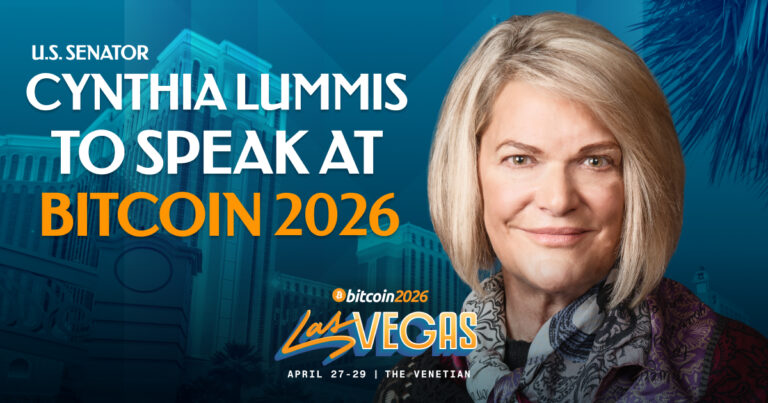
U.S. Senator Cynthia Lummis has been officially confirmed as a speaker at Bitcoin 2026. A Republican senator from Wyoming, Lummis currently serves as Chair of the Senate Banking Subcommittee on Digital Assets — a role she was appointed to in January 2025 to lead the Banking Committee’s efforts on digital asset legislation. She has publicly held Bitcoin since 2013 and has spent her Senate tenure focused on establishing a regulatory and legislative framework for digital assets in the United States.
Her primary legislative effort has been the BITCOIN Act, formally titled the Boosting Innovation, Technology, and Competitiveness through Optimized Investment Nationwide Act, which she introduced in the U.S. Senate as Chair of the Senate Banking Subcommittee on Digital Assets. The bill authorizes the U.S. Treasury to acquire up to one million Bitcoin over a five-year period to stock a strategic reserve, with a mandatory 20-year holding period, and includes a proof of reserves requirement for quarterly public reporting on total holdings. Alongside the BITCOIN Act, Lummis was a co-sponsor of the 2025 GENIUS Act to regulate stablecoins and introduced legislation for a tax exemption on small Bitcoin transactions. More recently, she predicted the crypto market structure bill should advance out of the Senate Banking Committee by late April 2026, stating the talks have reached necessary compromises to move the legislation forward.
Lummis announced in December 2025 that she will not seek reelection in 2026. Her appearance at Bitcoin 2026 comes during the final stretch of her Senate term, with several pieces of legislation she has championed still working through Congress. As recently as February 2026, Lummis pressed Treasury Secretary Scott Bessent on digital asset taxation, including a potential de minimis exemption for small transactions, with Bessent offering to have Treasury’s Office of Tax Policy work with her team on guidance.
With her Senate chapter drawing to a close, Bitcoin 2026 offers a meaningful stage for Lummis to address the community that has watched her carry the Bitcoin policy torch in Washington for years. Few lawmakers have shown up to the conference year after year with active legislation in hand — and with the BITCOIN Act, the CLARITY Act, and stablecoin regulation all in motion simultaneously, her appearance in Las Vegas this April promises to be one of the most substantive policy conversations of the event.
U.S. SENATOR FROM WYOMING CYNTHIA LUMMIS @SENLUMMIS TO SPEAK AT BITCOIN 2026 🇺🇸
“I’m a big proponent of self-custody, of individual wallets, of the sovereignty I have to store my wealth.” ✊ pic.twitter.com/lIMrwcjXFX
— The Bitcoin Conference (@TheBitcoinConf) March 5, 2026
Bitcoin 2026 is Returning to Las Vegas
Bitcoin 2026 will take place April 27–29 at The Venetian, Las Vegas, and is expected to be the biggest Bitcoin event of the year.
Focused on the future of money, Bitcoin 2026 will bring together Bitcoin builders, investors, miners, policymakers, technologists, and newcomers from around the world. The event will feature a wide range of pass types, including general admission passes designed specifically for those new to Bitcoin, alongside premium passes for professionals, enterprises, and institutions.
With multiple stages, immersive experiences, technical workshops, and headline keynotes, Bitcoin 2026 is designed to serve both first-time attendees and long-time Bitcoiners shaping the next era of global adoption.
Past Bitcoin Conferences in the U.S.
Bitcoin’s flagship conference has scaled dramatically over the past five years:
2021 – Miami: 11,000 attendees
2022 – Miami: 26,000 attendees
2023 – Miami: 15,000 attendees
2024 – Nashville: 22,000 attendees
2025 – Las Vegas: 35,000 attendees
🎟️ Get Your Bitcoin 2026 Pass
Bitcoin Magazine readers can save 10% on Bitcoin 2026 tickets using code ‘ARTICLE10‘ at checkout.
Stay at The official hotel of Bitcoin 2026, The Venetian, and get a guaranteed low rate plus 15% off your pass. Be in the middle of where the fun is all happening, and where the networking never ends.
And don’t forget:
Volunteer at Bitcoin 2026 and get Pro Pass access plus exclusive perks.
All students ages 13+ can apply for a Student Pass and get free general admission access to Bitcoin 2026.
📍 Location: The Venetian, Las Vegas 📅 Dates: April 27–29, 2026
For more information and exclusive offers, visit the Bitcoin Conference on X here.
Why Attend Bitcoin 2026?
Bitcoin 2026 is the definitive gathering for anyone serious about the future of money. With 500+ speakers, multiple world-class stages, and programming spanning Bitcoin fundamentals, open-source development, enterprise adoption, mining, energy, AI, policy, and culture, the conference brings every corner of the Bitcoin ecosystem together under one roof.
From headline keynotes on the Nakamoto Stage to deep technical sessions for builders, institutional strategy discussions for enterprises, and beginner-friendly Bitcoin 101 education, Bitcoin 2026 is designed for everyone—from first-time attendees to the leaders shaping Bitcoin’s global adoption.
Whether you’re looking to learn, build, invest, network, or influence, Bitcoin 2026 is where Bitcoin’s next chapter is written.
Bitcoin 2026 Pass Types: Something for Everyone
Bitcoin 2026 offers a range of pass options designed to meet the needs of newcomers, professionals, enterprises, and high-net-worth Bitcoiners alike.
🎟️ Bitcoin 2026 General Admission Pass
Ideal for newcomers and those looking to experience the heart of the conference.
Limited access on Days 2 & 3
Entry to Main Stage
Access to Genesis Stage
Full access to the Expo Hall
🎟️ Bitcoin 2026 Pro Pass
Designed for professionals, operators, and serious Bitcoin participants.
Includes all General Admission features, plus:
Full 3-day access, including Pro Day
Entry to the Pro Pass Reception
Access to Enterprise Hall, Enterprise Stage, and Networking Lounge
Conference App networking features
Access to the Bitcoin For Corporations Symposium
Entry to Compute Village and Energy Stage
Complimentary lunch, coffee, tea, and snacks
Dedicated registration and check-in
Reserved seating at Main Stage
Huge savings when you bundle your hotel and Pro Pass
🐋 Bitcoin 2026 Whale Pass
The all-inclusive, premium Bitcoin 2026 experience.
Includes all Pro Pass features, plus:
Reserved seating at Main Stage
All-inclusive gourmet food and beverages
Entry to Whale Night and Whale Reception
Access to all official after-parties
Networking app access to connect with other Whales
Premium access to The Deep — an exclusive networking lounge with intimate speaker sessions
Complimentary stay at The Venetian when you bundle your whale pass and hotel (use promo code ‘WHALEHOTEL’ here)
This is the most immersive way to experience Bitcoin 2026.
🎉 Bitcoin 2026 After Hours Pass
Your ticket to the night.
Most deals are done with a drink in your hand. Get exclusive access to 3 official Bitcoin 2026 after-parties across Las Vegas — each with a 2-hour open bar — where the real conversations happen and the best connections are made.
Access to 3 official Bitcoin 2026 after-parties
2-hour open bar at each event
Evening events across Las Vegas, April 27–29
Network with Bitcoiners, builders, and industry leaders after hours
More headline speaker announcements are coming soon.
Tether has said it has signed a Big Four accounting firm to audit its reserves.
The stablecoin giant did not reveal which firm.
Tether has for years struggled to get an audit from one of the big accounting firms.
Stablecoin giant Tether has announced it has signed a Big Four accounting firm to audit its reserves after years of struggling to get one to do so.
The San Salvador-based company said Tuesday that the audit would be the “biggest ever inaugural audit in the history of financial markets.”
“At a scale rarely seen outside the world’s largest sovereign institutions and encompassing a uniquely complex mix of digital assets, traditional reserves, and tokenised liabilities, this audit marks a defining moment not only for Tether, but for the evolution of modern finance itself,” the company said in a statement.
The news comes as Tether is making overtures to push into the US market. In January, Tether launched USAT, a stablecoin available to US customers.
USDT, the main stablecoin issued by Tether, may command a $184 billion market cap globally, but it hasn’t been available to US customers for years.
The announcement also comes as stablecoins are becoming more mainstream. Major companies and banks are looking into issuing the tokens after US President Donald Trump signed the Genius Act into law last summer.
Tether did not say which firm would audit its reserves, nor did it immediately respond to questions from DL News.
The Big Four accounting firms are PwC, EY, Deloitte and KPMG. None of them immediately responded to questions from DL News.
What gives?
Tether is a massive company.
Tether alone makes up over half of the total stablecoin market, according to DefiLlama.
Tether has a huge market value. Source: DeFiLlama.
As of December, it holds $122 billion in US Treasury bills, putting it ahead of countries like the United Arab Emirates, Saudi Arabia And Israel.
Yet, despite it being one of the most profitable companies in the world, it has been criticised for years about not being transparent enough about what backs its USDT token.
In 2021, for example, Tether agreed to no longer do business in New York after a two-year state attorney general investigation found the firm had “made false statements about the backing” of USDT.
The company did not publish reports on its reserves from 2014 to 2017. In 2022, it started to publish quarterly attestations, a less thorough review of a company’s financial statements.
Tether said USDT was backed by US treasuries and other assets, and had its reserves attested by other accounting firms.
The company’s CEO, Paolo Ardoino, told DL News in a 2024 interview that the Big Four firms were afraid to work with the crypto giant because they feared it would damage their reputations.
In a Tuesday statement, Ardoino said: “For the hundreds of millions of people and businesses who rely on USDT every day, this audit is not just a compliance exercise; it is about accountability, resilience, and confidence in the infrastructure they depend on.”
Mathew Di Salvo is a news correspondent with DL News. Got a tip? Email at mdisalvo@dlnews.com.