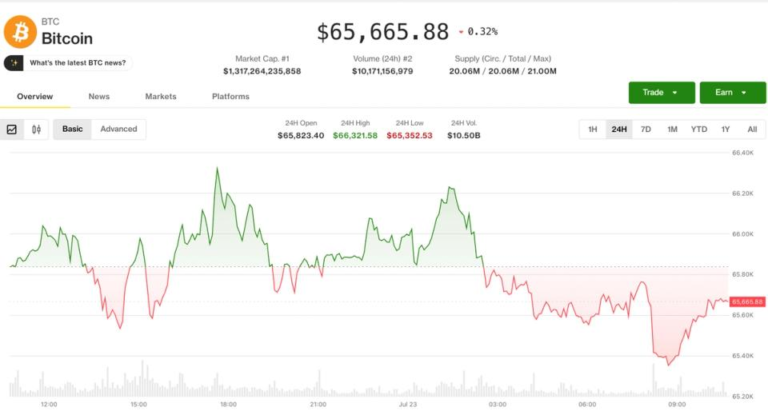
Bitcoin held near $65,000 in Asia morning hours on Friday, barely moving while nearly $800 billion evaporated from the biggest U.S. technology stocks – a rare stretch of independence for an asset that has tracked the AI trade all month.
The largest cryptocurrency traded at about $65,400, down less than 1% on the day and up 3% on the week. Ether slipped 3% to $1,879, and the rest of the majors leaned red. Dogecoin was the worst of them, down 5% on the day to $0.069 and 4% on the week. XRP fell 2% to $1.11, Solana lost 3% to $76, and Hyperliquid’s HYPE dropped to $58, down 4% over seven sessions. The moves were losses, but modest ones against what was happening in equities.
The Magnificent Seven, a colloquial term for the megacap group that has driven U.S. stocks for three years, fell 4.8% on Thursday and shed $797 billion in market value in their worst day since the tariff selloff of April 2025, according to Bloomberg.
The drop dragged the S&P 500 down 1.2% and the Nasdaq 100 down 1.9%, and it left the group 11% below its late-May record, erasing $2 trillion.
On Wednesday, Senate Republicans released the proposed text for the CLARITY Act, which has been met with pushback from Democrats regarding ethics provisions.
The crypto market is consolidating on Thursday, with bitcoin BTC$64,980.78 a modest 0.62% lower since midnight UTC at $65,674 as it settles into a range between $64,000 and $66,800 that has held for the past week.
The price action reflects a market catching its breath. Bitcoin has rallied more than 13% since its July 1 low of $57,750, and after failing to convincingly break above the $66,000 level of resistance on Tuesday, the path of least resistance in the short term appears to be sideways rather than sharply in either direction.
Traditional markets are offering little direction. Nasdaq 100 and S&P 500 futures are both marginally lower by around 0.3%, the dollar index (DXY) is broadly flat, and gold and silver are both pulling back after yesterday’s safe haven rally, leaving crypto without a clear macro catalyst to lean on in either direction.
Derivatives positioning
Period of stasis: The crypto futures market appears to be in a state of stasis, with 24-hour trading volumes down just 1% at $147 billion and open interest (OI) holding steady around $111 billion. The 24-hour long-short ratio, which tracks taker volume, is nearly balanced. Taker volume refers to buy and sell trades executed immediately at ongoing market prices, and the current equilibrium suggests a lack of aggressive directional conviction among traders.
Open interest shifts in major assets: Bitcoin’s futures open interest has slipped back to 743K BTC from the highs of over 760K BTC seen early this week. This decline indicates an unwinding of existing bets as the price rally stalls and valuations pull back slightly. A potential silver lining for bulls is that the drop in OI suggests the price weakness is being driven by long liquidations rather than the entry of fresh shorts betting on a deeper decline. In contrast, ETH’s OI has ticked up during the overnight price drop. However, the price action is still being led by buyers using market orders rather than passive limit orders, as evidenced by ETH’s positive 24-hour OI-adjusted cumulative volume delta (CVD).
Mixed sentiment in altcoins: The broader market shows a split in aggressive leadership. Several coins, including ZEC, HBAR, LTC, AVAX, and SUI, are currently posting positive CVDs, indicating taker-buy pressure. However, there are just as many prominent names on the opposite side of the fence showing negative CVDs, including BTC, XLM, DOGE, and SHIB, signaling that aggressive sellers remain active in those specific markets.
Rising volatility signals potential caution: Bitcoin’s 30-day implied volatility index, BVIV, has now increased for the fifth straight day. Traders may want to keep a close eye on this metric because, since the launch of spot ETFs, the correlation between Bitcoin’s spot price and the BVIV has been consistently negative. Under this regime, an upswing in the BVIV often serves as a warning of an impending price drop. Meanwhile, ether’s volatility index, EVIV, remains relatively stable.
Options flows and evaporating fear: Flows across the Deribit exchange and the OTC desk Paradigm featured notable demand for the BTC $70,000 call option expiring Aug. 7. While some traders were positioned for upside, others simultaneously picked up longer-duration puts as a downside hedge. Ethereum options have also seen a general demand for upside exposure. Broadly speaking, market fear appears to be evaporating as put-call skews for both BTC and ETH slip toward zero. Notably, ETH’s one-week skew briefly turned negative yesterday, marking a temporary bullish shift in sentiment where calls became more expensive than puts.
Token talk
WLFI$0.05727 was the standout mover on Thursday, surging 12.18% to $0.063. The Donald Trump family-linked token has now recovered to a $2 billion market cap, though it remains deep in the red from its all-time high.
MORPHO$1.9733 extended its recent run, rising nearly 4% to $1.989, keeping it among the more consistent AI outperformers of the past fortnight.
Ethena (ENA) added 2% to $0.092, continuing a quiet rehabilitation that has seen it outperform most DeFi peers over the past week despite sitting more than 90% below its September 2025 peak.
Lighter (LIT) continued to slide, falling 2.96% as profit-taking weighs on the token for a third consecutive session following its 200%-plus rally between May and early July.
CoinMarketCap’s altcoin season indicator holds at 51/100 as the market waits for bitcoin to make a decisive move.
The bitcoin BTC$65,082.99 market is facing a macro environment unlike any it has encountered in its 17-year existence.
That’s tied to inflation-adjusted returns on bonds. The 30-year Treasury Inflation-Protected Security (TIPS) is now offering a yield of close to 3%, the highest in 17 years, according to TreasuryBonds.com.
“This is one of the greatest wealth preservation opportunities in decades. Investors can lock in nearly 3% annual returns above inflation for the next three decades, backed by the U.S. government,” the site noted.
In traditional markets, bonds are considered safe havens. When a haven asset offers a 3% return in excess of inflation, it raises the opportunity cost of holding non-yielding or riskier assets like gold and bitcoin. But for many, especially in the crypto community, bitcoin’s decentralized and censorship-resistant nature makes it a superior store of value and safe haven – and that argument is not without merit. Housing prices measured in bitcoin, for instance, appear significantly cheaper than when measured in dollars.
Ether is becoming increasingly attractive from a valuation standpoint, particularly relative to Bitcoin, but onchain data suggests the market has yet to reach a definitive cycle bottom, according to CryptoQuant.
In its latest weekly report, the analytics company said Ether (ETH) is trading roughly 17% below its realized price, or the average onchain acquisition cost of all ETH in circulation, of about $2,300. Historically, ETH trading below its realized price has coincided with periods of market undervaluation and long-term bottoms.
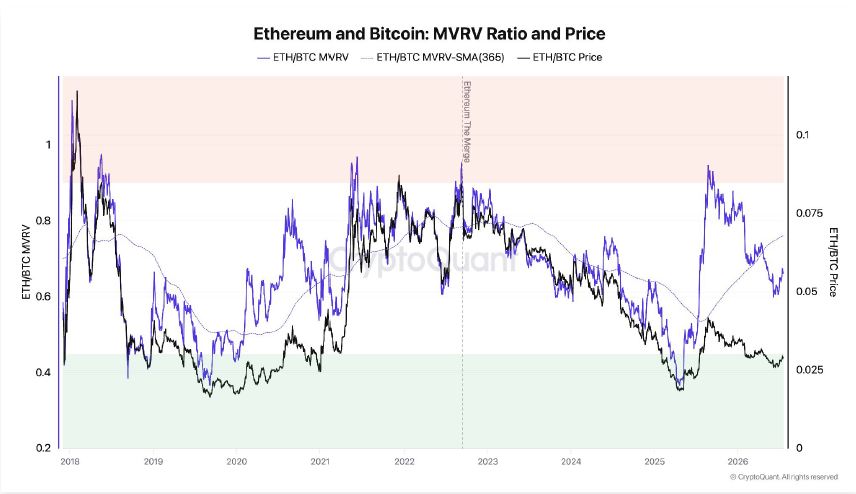
Ether is also showing signs of improving relative to Bitcoin (BTC). CryptoQuant said that ETH’s market value-to-realized value (MVRV) ratio has retreated from extreme overvaluation, exchange inflows have declined, exchange-traded fund (ETF) holdings have begun to recover after months of weakness, and ETH/BTC spot trading volumes have fallen into a range historically associated with market bottoms.
CryptoQuant says two of five key ETH bottoming indicators have been confirmed. Source: CryptoQuant
Even so, only two of CryptoQuant’s five bottoming indicators have reached historical reversal levels. The remaining metrics are improving but have yet to reach the extremes that have marked previous cycle lows, suggesting Ethereum’s bottom may still be forming.
The report comes as Ether briefly climbed above $1,950 this week and Bitcoin topped $67,000, buoyed by optimism surrounding the US CLARITY Act. At the same time, some market analysts have pointed to the potential for capital to rotate out of richly valued AI stocks and back into crypto, a shift that could further support Ether if risk appetite broadens.
The ETH/BTC MVRV ratio has fallen from nearly 0.95 in August 2025 to around 0.65, signaling that Ethereum has become significantly cheaper relative to Bitcoin. Source: CryptoQuant
Related: Grayscale plans regular cash payouts from ETH, SOL staking rewards
Ethereum supply tightens as exchange outflows and staking climb
Ethereum has shown several constructive onchain signals over the past month. During the week beginning June 29, withdrawal activity on Binance, the world’s largest crypto exchange by trading volume, climbed to its highest level in more than three years.
Analysts generally interpret sustained exchange outflows as a sign that investors are moving assets into self-custody or staking rather than keeping them on exchanges for potential sale, although such flows do not guarantee accumulation.
Meanwhile, a record 34% of Ethereum’s circulating supply is now staked, according to Staking Rewards. As Cointelegraph previously reported, higher staking participation reduces the amount of ETH readily available for trading, potentially easing short-term selling pressure if demand remains resilient.
Tom Lee’s Bitmine Immersion Technologies, the biggest corporate ETH holder, continues to accumulate Ether, boosting its holdings by 325,000 ETH over a one-month period, despite sitting on large unrealized losses. It has set a target to hold 5% of the second-biggest crypto.
Related: Will the US get CLARITY this week? Bitcoin’s new $80K target: Hodler’s Digest, July 19
Polymarket plans to challenge France’s decision to block its website, arguing the order prevents users from accessing its market probabilities even though trading from the country has been disabled since November 2024.
France’s National Gambling Authority ordered internet providers to block the platform last week, saying it exposed users to potential losses and offered markets that could be manipulated.
Polymarket said it would challenge the decision through the French legal system and called the order disproportionate because it covers users who visit the site for information rather than to trade.
“We were surprised at the ANJ decision to block access to our entire website because their measure targets people going to Polymarket purely for information,” the company said in a press release.
“We are proud that most people come to Polymarket solely to learn the probability of future events relevant to their everyday life with no intention to trade,” the company added. “Prediction markets help source truth.”
The dispute turns in part on how Polymarket’s contracts should be classified. The company describes them as blockchain-based financial instruments traded directly between users, with prices set by market activity.
A total of nine companies have formed a consortium pledging a combined $15 million over three years to support Bitcoin’s security research and open-source development.
Companies in the newly formed Bitcoin Security Consortium include major crypto market participants, including BlackRock, Coinbase, Strategy, Anchorage Digital, ARK Invest, Block, Blockstream, Fidelity Digital Assets and Galaxy.
The group will focus partly on preparing Bitcoin for advances in quantum computing and will publish material tracking the state of Bitcoin security work for investors and the public.
The $15 million will not be held or allocated by the consortium; instead, members will choose which developers, researchers or organizations it funds. The group said it will not direct Bitcoin development or take positions on proposed protocol changes.
“Bitcoin Core developers do incredibly important work,” BlackRock digital assets head Robert Mitchnick said, adding that the group would make additional funding available for Bitcoin’s long-term security.
The announcement did not disclose individual contributions, initial recipients or how much of the funding represents new commitments.
Galaxy this week launched a separate $5 million initiative for quantum-resistant signatures, wallet migration tools and security audits. The consortium did not say whether that commitment is included in the $15 million total.
This will effectively create a new mass surveillance system. Whatever you may think about the state of privacy protections in the U.S., your current online usage is not necessarily linked to your specific identity. If this bill passes, that will likely change.
The fact that lawmakers are even contemplating a bill that would create a surveillance and censorship regime should be a wake-up call for everyone who values privacy and free expression.
This is a privacy pitfall, not just some benign form of digital “carding.” If the bill passes, the bouncer at the door will now be an online entity that will electronically capture your personal information and save it to a database for an unspecified amount of time. Providing this identifying information would be the price that any user must pay to access legal, First Amendment-protected content on the internet or to communicate with others online.
On top of that, once you turn your personal information over, it’s now vulnerable to leaks, data theft, or misuse. This isn’t just a hypothetical: We’ve already seen several breaches of age verification providers.
The KIDS Act contains multiple sections that will lead to age-gating. For example, a provision in the SAFE BOTS Act section mandates that if a service “knows or should have known” that a user is underage, it can’t offer certain chatbot features. The SCREEN Act section requires hosts of sexually explicit content to figure out if users are “more likely than not” underage before letting them access certain content.
Solomon’s endorsement contrasts with growing opposition from other major banking executives, including JPMorgan Chase CEO Jamie Dimon, who have argued that the legislation could put traditional banks at a competitive disadvantage by allowing crypto companies to offer yield-bearing stablecoin products that resemble bank deposits without being subject to the same regulatory framework.
Speaking to Fox Business in May, Dimon said he was dissatisfied with the latest version of the bill because “it allows them to effectively pay interest on deposits, stablecoins or something like that, without protection that they should have.”
“The banks will not accept it that way,” Dimon said. “I’m not worried about stablecoins but if it happened I’m telling you I will have nothing to do with it and it will eventually blow up.”
JPMorgan has also warned that crypto legislation should close regulatory gaps rather than create new ones. In a blog post published in June, executives at the bank argued that firms offering products that function like traditional bank accounts should face comparable oversight and consumer protections.
The debate over stablecoin rewards has become one of the biggest sticking points in negotiations over the CLARITY Act. Coinbase CEO Brian Armstrong has argued that banks are lobbying lawmakers to restrict stablecoin rewards because they threaten banks’ deposit-based business models, while banking executives contend that crypto firms offering bank-like products should be regulated like banks.
With a court set to consider a reversal of a $5 million settlement from the US Commodity Futures Trading Commission’s (CFTC’s) case with cryptocurrency exchange Gemini, the company has sent $10 million in Bitcoin (BTC) to a super political action committee (PAC) supporting President Donald Trump.
According to the MAGA Inc. Super PAC’s July report to the Federal Election Commission (FEC) filed on Monday, the Gemini Trust Company run by co-founders Cameron and Tyler Winklevoss sent two separate contributions of more than $5 million in Bitcoin on June 19.
The donation, which the PAC may use for independent expenditures to support Trump, was recorded about three weeks after the CFTC filed a joint motion with Gemini in federal court in an attempt to reverse a January 2025 settlement over the company allegedly making false or misleading statements. CFTC Chair Michael Selig claimed at the time that the agency under former US President Joe Biden “politically targeted” the Winklevosses through enforcement actions.
In addition to the recent MAGA Inc. contributions, the Winklevoss brothers each donated $1 million to Trump’s 2024 election campaign and supported the then-candidate through social media posts. Following Trump taking office in January 2025, the twins attended the signing ceremony for a stablecoin payments bill, the GENIUS Act, backed his sons’ crypto mining venture American Bitcoin and contributed $21 million in Bitcoin to the Digital Freedom Fund PAC in an effort to “support President Trump and his administration’s efforts” related to crypto policy.
Related: Crypto companies have spent $189M so far on 2026 US election cycle: Report
Since attorneys filed the joint CFTC-Gemini with the US District Court for the Southern District of New York in May, there has been no decision posted to the public docket. Cointelegraph reached out to the CFTC and Gemini’s counsel, Avi Perry, for comment on the $10 million contribution but did not receive an immediate response. A CFTC spokesperson told Cointelegraph in June that both sides “agreed that the $5 million penalty will not be returned to Gemini” if granted by the court.
In a June letter to Selig, Senator Elizabeth Warren called the joint motion for reversal and other factors as “concerning signs of a CFTC beholden to political pressures and interests of the wealthy insiders, unbound by the rule of law and failing to protect investors and market integrity.”
As of June 30, MAGA Inc. reported receiving more than $397 million.
Selig remains sole CFTC commissioner with no nominations announced
The CFTC chair, a Republican who was confirmed by the US Senate in December 2025, remains the only member in what is usually a bipartisan group of five commissioners heading the agency.
Many lawmakers have been pressing Trump to announce additional nominations for the financial regulator as Congress considers comprehensive crypto market structure legislation, the Digital Asset Market Clarity (CLARITY) Act. The bill is expected to give the CFTC significant authority in regulating and overseeing digital assets.
As of Thursday, the White House had not announced any nominations for CFTC commissioners, leaving Selig to largely direct the agenda’s agenda.
Magazine: Here’s why the CLARITY Act’s ethics deal may be so hard to reach