Farmers in Parana, Brazil, struggling to get banks to loan them cash, became the first to tokenize livestock and place 10 dairy milk cows’ tokens for trade on the country’s B3 national stock exchange. They generated nearly $20,000 in credit backed by their cattle, signaling the potential of tokenizing RWAs as a financing tool.
The dairy cow tokenization in Brazil is a world first and serves as a test in a real-world scenario in which farmers are facing increasingly stringent lending limits imposed by local banks on small agricultural businesses.
“We take the cow, which is a real and tangible asset, and transform it into a digital asset backed by a unique code monitored in real time,” Thiago Martins of Cowmed, a Brazilian Agtec company, told CNNBrasil recently.
Martins and his company did not immediately respond to a CoinDesk request for comment.
“This digitization allows for formal registration with B3 as a movable asset,” Martins added. “The process is simple and gives the producer an advantageous opportunity to finance themselves, opening a new alternative for collateral at a time of strong credit restrictions in agribusiness.”
The European Union will prohibit Belarusian nationals and residents from owning, controlling or managing crypto exchanges and other crypto service providers regulated under the Markets in Crypto-Assets (MiCA) framework starting Aug. 25.
The measure appears in Council Decision (CFSP) 2026/1847, adopted Thursday to amend the EU’s sanctions framework targeting Belarus over its involvement in Russia’s war against Ukraine. The document expands an existing restriction that applied only to companies providing crypto wallet, account or custody services.
The decision enters into force on Thursday, while the expanded crypto provision will apply from Aug. 25.
Under the amendment, Belarusian nationals and residents may not own or control an EU-based entity providing “any other crypto-asset services” as defined under MiCA or hold a position on its governing body.
MiCA’s service categories include operating trading platforms, exchanging crypto assets, executing and transmitting client orders, placing crypto assets, providing transfers, offering investment advice or portfolio management.
EU expands crypto sanctions after MiCA transition ends
The sanctions expansion comes weeks after the end of MiCA’s transition period on July 1. Crypto companies without authorization were ordered to wind down or face enforcement actions.
Related: Ripple secures full MiCA license for crypto services across Europe
The Belarus restriction follows a broader EU push to target crypto platforms and financial networks accused of helping Russia evade sanctions imposed over its war in Ukraine.
On Thursday, as part of its 21st sanctions package against Russia, the EU extended its transaction ban to 14 crypto-related service platforms outside the bloc and introduced a mechanism allowing it to prohibit dealings with any foreign crypto provider used by Russia to evade sanctions. The final package expands on the June 11 proposal, which targeted 11 crypto platforms.
The proposal followed the United Kingdom’s May 26 sanctions against Huobi Global S.A., the Panamanian company behind HTX, over alleged support for Russia-linked financial networks involving sanctioned entities A7 and Garantex.
HTX denied wrongdoing, telling Cointelegraph that regulatory compliance “remains our absolute top priority” and that it strictly adheres to regulatory frameworks in the jurisdictions where it operates.
Magazine: Why Australia’s $17B crypto opportunity depends on regulation
India’s Internet Freedom Foundation (IFF) has condemned a government order directing GitHub to remove repositories for Jack Dorsey’s decentralized messaging app BitChat, calling the move unconstitutional and warning it threatens free speech and open-source software.
The statement came a day after India’s cybercrime agency ordered GitHub to disable access to three BitChat repositories within three hours, saying the decentralized messaging app could be used to bypass internet shutdowns, evade lawful surveillance and facilitate unlawful activities.
In its statement posted on X on Friday, IFF argued the order exceeded the government’s legal authority because it was issued under Section 79(3)(b) of India’s Information Technology Act instead of the country’s formal website-blocking process, which includes procedural safeguards. The group called on the government to withdraw the notice and publish all takedown orders issued under the provision.
The organization also disputed the government’s justification, noting the order did not identify any unlawful content in the repositories and instead argued the app’s decentralized design, which enables communication over Bluetooth without internet access or centralized servers, was itself grounds for removal.
BitChat is a decentralized messaging app that routes encrypted messages between nearby devices over Bluetooth without relying on internet connectivity or centralized servers.
Since its release in July 2025, the app has gained traction during protests, natural disasters and internet shutdowns, with downloads and adoption surging during periods of unrest and internet outages in countries including Madagascar, Nepal, Uganda, Jamaica and Iran.
Magazine: A quantum roadmap would push Bitcoin much higher: Charles Edwards
Cointelegraph is committed to independent, transparent journalism. This news article is produced in accordance with Cointelegraph’s Editorial Policy and aims to provide accurate and timely information. Readers are encouraged to verify information independently.
Perpetual decentralized exchange (DEX) Hyperliquid’s weekly trading volume in tokenized real-world assets (RWAs) exceeded that of all other asset categories combined for the first time.
RWAs generated $25.1 billion in trading volume from July 13 to July 19, accounting for 52% of Hyperliquid’s total weekly volume of $48.2 billion, according to Blockworks data.
“Hyperliquid’s RWA market alone was larger than the combined crypto perpetual volume of every other DEX,” wrote ARK Invest’s research director for digital assets, Lorenzo Valente, in a Thursday X post.
The milestone reflects growing demand for tokenized assets on Hyperliquid. Over the past month, RWA holders grew by 32% to 1.25 million users, while the total value of tokenized RWAs rose by 3.5% to $36.7 billion, according to data aggregator RWA.xyz.
Hyperliquid generated $7.6 million in revenue over the past week, according to DefiLlama. The perp DEX ranked third among crypto applications by weekly revenue, behind stablecoin issuers Tether and Circle, which generated $112 million and $45 million, respectively.
Related: Hyperliquid launches prediction markets for real-world events
Major “structural shift” for crypto markets: Circle co-founder
Crypto-native firms and traditional financial institutions have expanded tokenized asset offerings as they bring more financial assets onto blockchain networks. In March, the NYSE partnered with tokenization platform Securitize to develop blockchain-based stock trading infrastructure with 24/7 trading and settlement.
Circle co-founder and CEO Jeremy Allaire said growing RWA trading on Hyperliquid marks a “major structural shift” in crypto markets, moving “away from speculating on endogenous digital commodities,” in a Friday X post.
Earlier in July, Pantera Capital said perpetual futures could become a dominant trading instrument beyond crypto, as perps offer structural advantages over traditional derivatives, including 24/7 trading, no contract expiries, simpler position management and continuous price discovery.
Hyperliquid’s growth has drawn attention from Wall Street institutions, including NYSE parent Intercontinental Exchange (ICE), whose CEO, Jeffrey Sprecher, urged regulators to create a “level playing field” for launching 24/7 onchain perpetual futures contracts.
Magazine: How Hong Kong is turning tokenized bonds into real market infrastructure
The exchange, already sanctioned by the UK, is now on a list of 18 entities “providing crypto-assets services or payment services“ in defiance of the EU’s measures against Russia.
The US House of Representatives has passed a bill that would ostensibly prohibit members of Congress, their spouses and dependent children from purchasing publicly traded stocks.
In a 232-198 vote in the House on Wednesday, lawmakers approved the Stop Insider Trading Act, sending the bill to the Senate for consideration. Representative Bryan Steil, the Wisconsin lawmaker who sponsored the bill, said that the legislation “ensures no lawmaker can profit off of insider information” and “institutes strict penalties for any violation.”
“We have not had a bill on the House floor on this topic with this opportunity before,” said Steil from the House floor on Wednesday, describing the penalties:
“A fine equal to $2,000 or 10% of the transaction, as well as a disgorgement of profits. Violators would be forfeiting any gain realized if they failed to comply with this legislation.”
Some Democrats are saying that the bill does not go far enough to address potential conflicts of interest, because it allows lawmakers to keep and sell stocks they already own. According to Steil, the bill would require members of Congress to provide seven days’ notice before selling stocks if they already hold assets, creating a deterrent for insider trading.
Related: Only KYC can stop insider trading on prediction markets, Messari says
“[The] bill has major loopholes,” said Senator Elizabeth Warren on Thursday. “Lawmakers can continue owning and selling stocks — so it won’t solve the problem. Not gonna fly in the Senate. Members of Congress should not own, buy, or sell stocks.”
The Stop Insider Trading Act was received in the US Senate for consideration on Thursday after passage in the House.
Unlike the proposed text for the Digital Asset Market Clarity Act, a cryptocurrency market structure bill under consideration in the Senate, Steil’s bill was limited to restricting investments for members of Congress and not the president or vice president and their families. Under CLARITY’s proposed text, all US public officials could be barred from issuing or sponsoring tokens until 2029.
Prediction markets bill also under consideration
House approval of the Stop Insider Trading Act followed Steil’s sponsorship of a similar bill targeting members of Congress trading on prediction market platforms like Kalshi and Polymarket. The Wisconsin lawmaker introduced the Stop Lawmakers from Predicting Act in June to prevent certain public officials, their spouses and children from “wagering on public policy issues and political outcomes.”
Prediction markets drew attention from the public after an incident involving a soldier who allegedly made more than $400,000 betting on Venezuela President Nicolás Maduro, who was removed by US forces in January. Donald Trump’s teleprompter operator also reportedly made more than $100,000 betting on Kalshi event contracts tied to words and phrases in the president’s speeches.
Like the stock trading bill, the prediction markets legislation proposed that violators pay a $2,000 fee or 10% of the value of the prohibited bets on the platforms.
Magazine: Why Wall Street values some crypto firms for AI power, not just crypto
Institutional crypto trading platform LMAX Group is working with Morgan Stanley (MS) and investment bank KBW, part of Stifel (SF), to evaluate strategic options, according to three people familiar with the matter.
The company is exploring a sale or public listing that could value the business at up to $5 billion, the people said, speaking on condition of anonymity because the discussions are private.
While all options remain on the table, including a sale, SPAC merger and IPOs in the U.S. or Europe, a Nasdaq listing is currently the preferred route, one of the people said.
The company is in no rush to go public as crypto markets remain weak, with its core foreign-exchange business providing insulation from the downturn, another person said.
A company spokesperson said LMAX declines to comment on speculation. Morgan Stanley declined to comment. Stifel didn’t respond to a request for comment by publication time.
The London-based firm operates institutional trading venues for foreign exchange and digital assets, providing execution, liquidity and market infrastructure to banks, brokers, hedge funds and asset managers. Regulated by the U.K.’s Financial Conduct Authority, it is known for its agency execution model, transparent order books and low-latency trading infrastructure.
Connecting crypto to TradFi
Deal activity across the crypto sector has accelerated this year as exchanges, fintech companies and market infrastructure firms seek to strengthen their digital asset offerings and capture rising institutional demand.
Poised to become the world’s most prominent “real humans’ network”, the project previously known as Worldcoin aims to establish an identity layer to distinguish unique individuals from automated bots. The protocol relies on custom hardware, known as an Orb, to issue credentials without compromising user privacy.
“World’s technology and proof of human and variations are among the most important building blocks to secure and verify interactions in an increasingly digital driven world,” said Tom Lee, an Eightco Holdings board member who also serves as the chairman of Bitmine, in a statement.
World said the investment comes as it shifts from building the network to scaling the utility.
To date, more than 39 million people have joined the World Network, with more than 18 million humans verified by an Orb, World said in the funding announcement press release. The network has utilized more than 475 million World ID proofs since its launch, scaling its capacity alongside the rollout of its updated, enterprise-ready infrastructure, it added.
World, the Sam Altman-backed digital identity project, unveiled in April what it called its most significant upgrade yet to World ID, positioning the system as “full-stack proof of human” infrastructure aimed at consumers, enterprises and AI agents.
The Crypto Council for Innovation, Digital Chamber and Blockchain Association wrote to US Senate leaders on Friday calling for the chamber to prioritize “floor consideration” of the Digital Asset Market Clarity (CLARITY) Act.
In a Friday letter to Senator Majority Leader John Thune and Minority Leader Chuck Schumer, the three cryptocurrency advocacy groups urged consideration of the CLARITY Act, which Republican lawmakers have been pushing for a vote before the chamber breaks for state work periods in August. Although the bill has advanced through the Senate banking and agriculture committees, some lawmakers said they planned to withhold their votes until key provisions were addressed.
“[We] recognize that constructive bipartisan negotiations remain underway to secure and expand support for this critical piece of legislation,” said the letter. “We appreciate these good-faith efforts of Senators on both sides of the aisle, and we encourage those discussions to continue.”
Source: Crypto Council for Innovation
The CLARITY Act, expected to be one of the most significant pieces of legislation impacting the crypto industry, needs 60 votes to pass in the Senate, where Republicans hold a 52-47 majority over Democrats. Republicans released the text of the market structure bill earlier this week, including ethics provisions that barred public officials from issuing or sponsoring cryptocurrencies, but many Democrats said that the measures don’t go far enough to prevent corruption.
Related: Goldman Sachs CEO backs ‘not perfect’ CLARITY Act as vote expected soon
“Whatever piece of s— they sent back to us, that was not a serious effort,” Senator Ruben Gallego said on Thursday regarding the ethics provisions, according to Politico.
Gallego added:
”[…] After all the work that we’ve done with our Republican colleagues, that they would take the months and months of work and somehow interpret that and turn around and think what they offered was even remotely close.”
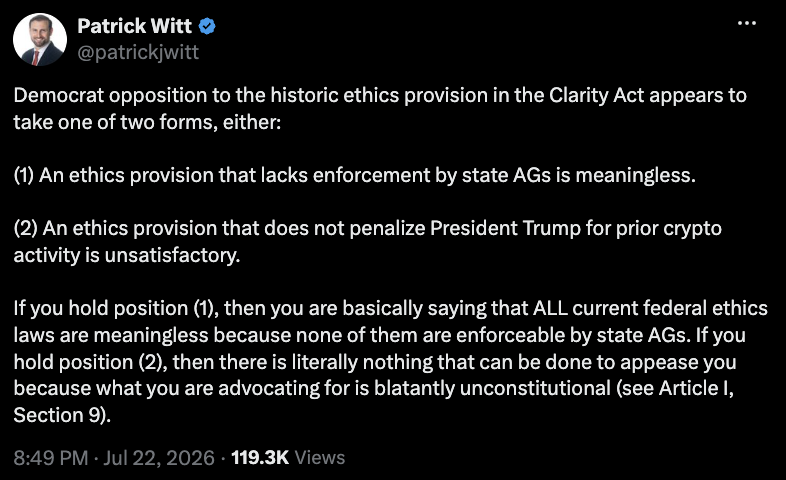
White House crypto adviser on Democratic opposition to CLARITY ethics rules. Source: Patrick Witt
Industry leaders weigh in on CLARITY ahead of potential floor vote
“The status quo in the US isn’t working,” said Coinbase CEO Brian Armstrong in a Wednesday X post. “There’s no federal framework, so bad actors like FTX can harm US customers and much of the industry has gone offshore totally outside US purview. This bill fixes that with strong consumer protections, real tools for law enforcement, and a path for America to lead in this industry.”
Orest Gavryliak, chief legal officer of DeFi platform 1inch, spoke about the bill on Cointelegraph’s Chain Reaction podcast on Friday, saying that CLARITY would help recognize a framework for non-custodial protocols rather than “regulating with enforcement.”
“Some regulators, they try to be friendly to non-custodial protocols or projects, they still try to fit us in into the custodial frameworks and make us use custodial solutions to solve problems that they used to in this legacy custodial or traditional finance, which is wrong [and] doesn’t apply to us at all,” said Gavryliak. “That’s why it’s very important for CLARITY to pass.”
If lawmakers are unable to hold a vote for CLARITY before the Senate breaks in August, it could push consideration into the weeks before the 2026 US midterms, potentially complicating discussions. As of Friday, Kalshi offered users event contracts with a 40.3% chance that the bill would pass before the Senate’s August recess.
Magazine: Here’s why the CLARITY Act’s ethics deal may be so hard to reach
This negotiation over the government conflict-of-interest piece had delayed progress on the Clarity Act for months — now potentially beyond the window in which it could most easily become law in 2026. This week’s release of the final working draft of Clarity included the first ethics language openly circulated, so Democrats are now responding — many of them with disdain.
“Donald Trump raked in more than $1.4 billion from cryptocurrency ventures, and this bill does nothing to prevent him from vacuuming up his next $1.4 billion in crypto profits,” said Senator Elizabeth Warren, the Massachusetts Democrat who is her party’s ranking member on the Senate Banking Committee, referring to the crypto earnings Trump disclosed for 2025. She said the president will “simply ignore the law” as it’s proposed.
So what does the language do? It temporarily bans senior government officials (including the president, vice president, members of Congress and federal judges) from issuing or sponsoring cryptocurrencies.
However, it excuses activity in the past, and there are plenty of crypto business pursuits that don’t check the boxes of issuance or sponsorship, so it’s unlikely Trump would be forced to abandon some of his most prominent ties, such as his ownership stake in World Liberty Financial. He might have to create some legal distance for himself, such as placing certain investments in trusts that he can’t access directly.