
Fidelity called on the US Senate to pass the CLARITY Act, joining industry groups and crypto firms pushing for market structure legislation.

Fidelity called on the US Senate to pass the CLARITY Act, joining industry groups and crypto firms pushing for market structure legislation.

This is where tokenization enters, and where I think the crypto industry has a genuinely important role to play in democratizing weather risk hedging. It’s an initiative that I think is significantly more important than simply offering traditional yield-generating assets like bonds onchain.
The core advantages of putting weather derivatives on a blockchain are not theoretical. Smart contracts can automatically trigger payouts when verified weather data crosses a predetermined threshold, while bypassing manual processing, disputes, delays, and counterparty risk. With tokenized weather derivatives, a farmer in a rain-dependent economy no longer needs a Goldman Sachs relationship to hedge against a failed monsoon. A parametric insurance product built on a smart contract that reads verified rainfall data and pays out automatically is, in principle, exactly the kind of market that properly prices and distributes climate risk.
In Value(s), Carney puts it well: “We need financial markets to work alongside climate policies in order to maximize their impact. With the right foundations, the financial system can build a virtuous circle of better understanding of tomorrow’s risks, better pricing for investors, better decisions by policymakers and a smoother transition to a lower-carbon economy.”
Tokenization also addresses the liquidity and accessibility problems that have stunted the traditional market. Fractional ownership allows weather risk to be divided into smaller units.and the resulting composability facilitates integration of weather derivatives with lending protocols, insurance products and yield-generating instruments. Transparency on every trade, every position, every settlement recorded on a public blockchain addresses the opacity that has historically made price discovery poor and participation limited.
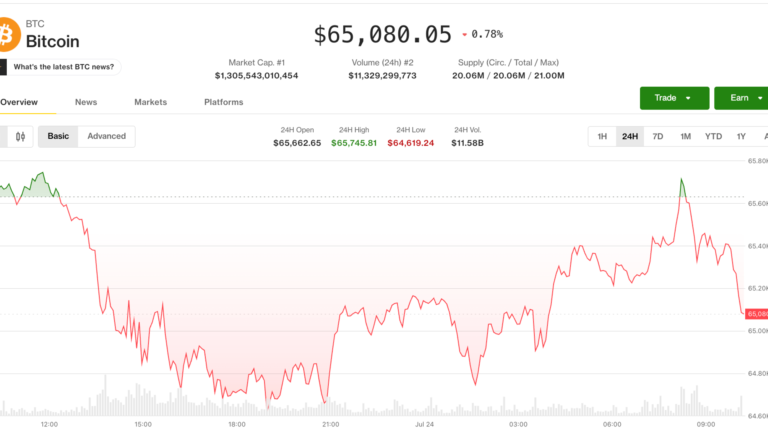
The crypto market is closing out the week on a constructive note, with bitcoin adding as much as 1.1% since midnight UTC to $65,760 as the broader market held its ground despite a macro backdrop that should be applying far more pressure.
Brent crude futures are trading at $97.66 per barrel, the highest since mid-May, as the Iran conflict shows no sign of de-escalating. While previous oil spikes have rattled risk assets including crypto, digital assets are broadly green this morning.
Ether (ETH) mirrored bitcoin’s gain, rising as much as 1.6%, while the likes of HYPE and FET rose more than 2%.
Traditional markets are muted, with S&P 500 and Nasdaq 100 index futures both marginally positive and gold holding above $4,000. The Dollar Index has edged slightly lower.
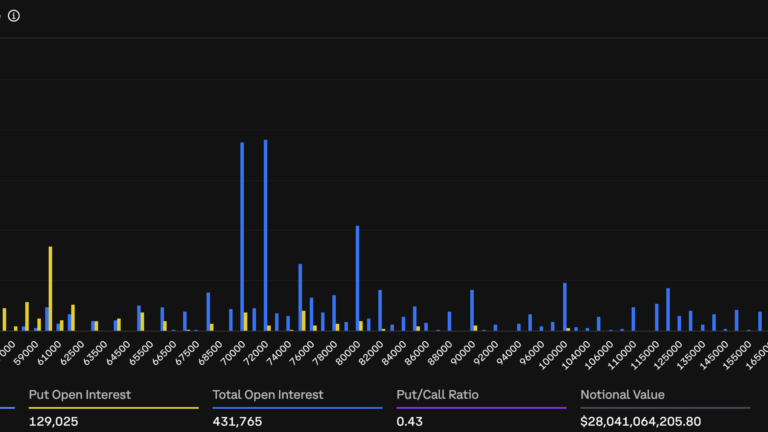
Several large, deliberate trades hit the tape recently, building up this concentration of open interest at $70,000 and $72,000 levels. Laevitas identified a large bull call spread structure, involving buying the $70,000 call and simultaneously selling the $72,000 call.
The bull call spread, as the name suggests, bets on a moderate upswing in prices of the underlying asset, in this case, up to $72,000.
“The structure accounts for approximately 49% and 50% of total call open interest at the $70K and $72K strikes, respectively,” Laevitas noted.
Other notable trades included calendar spreads, a strategy used to profit from volatility changes in short- and near-term expiries.
Another trader or a group of traders bought a large number of calls at $70,000, paying $3.4 million in premium to gain upside exposure.
Jimmy Yang, co-founder of Orbit Markets, an institutional digital asset liquidity provider, pointed out similar trades, saying these have been driven by Clarity Act optimism.
“Earlier this month, we saw decent demand for BTC topside calls, with the 31 July $70,000 and $72,000 strikes being particularly popular. A lot of this positioning was driven by expectations that the CLARITY Act could be passed before the end of the month,” Yang said.

The crypto market continues to mature with growing institutional participation, and memecoins are paying the price.
The combined market capitalization of and shiba inu (SHIB), the two largest memecoins by value, has fallen to $13.27 billion, the lowest in three years and down about 2% this month alone, even though market leader bitcoin has risen by 10%.
A more revealing picture emerges when you measure the top two memecoins against bitcoin’s market cap of $1.30 trillion.
That ratio now stands at just 1.02%, the lowest on record. That’s a dramatic reset if considering where things stood at the peak of memecoin mania in 2021, when DOGE and SHIB together accounted for 7% of bitcoin’s market cap. In other words, for every dollar invested in bitcoin, seven cents were chasing internet joke tokens. Today that figure is just over one cent.
Bitcoin has grown substantially since 2021, meaning memecoins haven’t just lost value in dollar terms, they have ceded ground against the very asset that defines the crypto market cycle.

Total value locked has roughly tripled since mid-July to about $312 million, according to DefiLlama, and Robinhood Chain is now clearing more than $600 million in daily decentralized-exchange volume, putting it among the more active networks in crypto.
Its transaction count has also drawn attention, with more than 138 million in 30 days, per Token Terminal. But the chain’s most-traded tokens are still overwhelmingly memecoins.
On DEX Screener, the top of Robinhood Chain’s trending list is filled with tokens like “Hoodrat,” “Vladhood” and “Swole Doge,” not the tokenized equities the network was built for, which trade on Uniswap but rank well down the volume rankings.

The tokenized stocks generate roughly $55 million in daily volume, under a tenth of the chain’s nearly $600 million in total DEX trading, the data shows. The rest is dominated by memecoins.
Stablecoins remain the single largest presence on the chain, with a combined market value in the hundreds of millions of dollars, and memecoins, such as the Robinhood mascot-themed CASHCAT, that defined the chain’s first weeks, are still active and heavily traded.
The critique three weeks ago was that Robinhood had built expensive infrastructure and attracted only speculation, with little sign that the tokenized-stock business it pitched would materialize.

Crypto markets have struggled for much of the year as weaker trading volumes, concerns over the economy and fading risk appetite weighed on digital assets. The tougher backdrop has hurt market makers, whose revenues depend largely on trading flows and providing liquidity. With spot trading volumes subdued, firms across the sector have faced pressure on profitability.
Mergers and acquisitions are expected to remain a defining theme in 2026 as digital asset firms consolidate to achieve scale, expand product offerings and meet growing institutional demand, according to industry analysts.
Exchanges, market makers, custodians and financial technology providers are looking to acquire complementary businesses to build integrated digital asset platforms, reflecting the maturation of the crypto ecosystem into a more institutional and regulated market.
SBI Financial Services, a subsidiary of SBI Holdings, acquired a 90% stake in B2C2 in December 2020, months after investing $30 million in the firm.
B2C2’s financial results are not disclosed separately. They are reported as part of SBI’s broader crypto-asset business segment. For the fiscal year ended March 31, that segment generated 89.6 billion yen ($550 million) in revenue, up 10.9% from a year earlier, while profit before tax was unchanged at 21.2 billion yen.
SBI Holdings said last month it had agreed to buy cryptocurrency exchange Bitbank for around $289 million.

US-listed spot Ethereum exchange-traded funds (ETFs) logged $70.62 million in net outflows on Friday, ending a five-day inflow streak.
Ethereum funds saw $211.25 million in net inflows over the previous five sessions from July 17 to Thursday, according to SoSoValue data. They still posted $103.9 million in net inflows for the week ended Friday.
Despite the outflows, Ethereum ETFs extended their weekly inflow streak to three straight and have attracted $337.74 million in net inflows so far in July.
Spot crypto ETF flows have become one of the market’s most closely watched gauges of demand for Bitcoin (BTC) and Ether (ETH) through traditional investment products.
Although other jurisdictions, including Hong Kong, have launched similar funds, US-listed ETFs account for the vast majority of assets and trading volumes.
Daily spot Ethereum ETF net flows from July 17 to July 24. Source: SoSoValue
The reversal followed a similar pattern in Bitcoin ETFs, which ended a seven-day inflow streak on Thursday and recorded another $240.08 million in net outflows on Friday.
Bitcoin ETFs also extended their net inflow streak to three consecutive weeks, adding $103.90 million during the week ended Friday and $233.96 million so far in July. They followed a record June, when $4.5 billion flowed out of the funds.
BTC traded just under $64,000 at the time of writing, tumbling from the week’s high of $66,892 on Tuesday, according to CoinGecko. ETH traded at $1,837, down from Wednesday’s weekly high of $1,954.
Related: Bitcoin falls under $64K as surging US bond yields boost Fed rate-hike odds
Following Japan’s recent overhaul of its crypto regulations, which is widely viewed as laying the groundwork for future spot Bitcoin ETFs, crypto management platform XWIN estimated that a mature Japanese spot Bitcoin ETF market could reach about $18.4 billion, equal to roughly 0.13% of the country’s $14.6 trillion in household financial assets.
In an analysis posted at CryptoQuant, XWIN said the estimate assumes demand from existing crypto holders, new retail investors using brokerage accounts and institutional allocators.
The report pointed to the US market as an example, noting that spot Bitcoin ETFs excluding Grayscale’s GBTC have accumulated roughly 1 million Bitcoin, demonstrating how regulated ETF products can connect traditional finance with digital assets.
“The key is access,” XWIN said, adding that a Japanese spot Bitcoin ETF would allow investors to gain Bitcoin exposure through familiar brokerage and custody systems. It characterized the $18.4 billion figure as “an achievable upper-end market scenario.”
Magazine: A quantum roadmap would push Bitcoin much higher: Charles Edwards

The European Union (EU) extended sanctions against Russia to include four designations related to the cross-border A7 network, including its new links to Africa.
The EU is also extending its transaction ban to 14 unnamed crypto-related service platforms based in Georgia, Panama, the United Arab Emirates (UAE), the Marshall Islands, Kyrgyzstan and Belarus.
Chainalysis recently noted that on the A7 network, where the A7A5 stablecoin operates, has processed nearly $120 billion to date and that it is purposely built for Russia’s sanctions evasion.
“We’re hitting over a hundred banks and crypto operators, 40+ vessels in Russia’s shadow fleet, and several oil refineries in Russia and Belarus,” Kaja Kallas, High Representative for Foreign Affairs and Security Policy and chair of the Foreign Affairs Council, said in a statement.
The EU announced its previous package of sanctions against Russia in April, saying it was the “biggest package” of sanctions against the country in two years. In that statement, the EU said “Russia is becoming increasingly reliant on cryptocurrencies for international transactions.”

Farmers in Parana, Brazil, struggling to get banks to loan them cash, became the first to tokenize livestock and place 10 dairy milk cows’ tokens for trade on the country’s B3 national stock exchange. They generated nearly $20,000 in credit backed by their cattle, signaling the potential of tokenizing RWAs as a financing tool.
The dairy cow tokenization in Brazil is a world first and serves as a test in a real-world scenario in which farmers are facing increasingly stringent lending limits imposed by local banks on small agricultural businesses.
“We take the cow, which is a real and tangible asset, and transform it into a digital asset backed by a unique code monitored in real time,” Thiago Martins of Cowmed, a Brazilian Agtec company, told CNNBrasil recently.
Martins and his company did not immediately respond to a CoinDesk request for comment.
“This digitization allows for formal registration with B3 as a movable asset,” Martins added. “The process is simple and gives the producer an advantageous opportunity to finance themselves, opening a new alternative for collateral at a time of strong credit restrictions in agribusiness.”