Nearly two-thirds of US crypto investors are heading into tax season unaware of new reporting rules that could cost them up to $100,000, says a Monday report by Coinbase and CoinTracker shared with DL News.
Based on a survey of 3,000 American crypto investors, the 2026 Crypto Tax Readiness Report found that 61% of respondents said they are unaware of specific new rules introduced by the Internal Revenue Service for reporting 2025 taxes.
“The story this data tells is one of confusion,” Lawrence Zlatkin, Coinbase’s vice-president of tax, said in a statement shared with DL News.
“Users are struggling to navigate the complexities of crypto taxation, which is why it’s so important for us to help bridge that knowledge gap,” Zlatkin said.
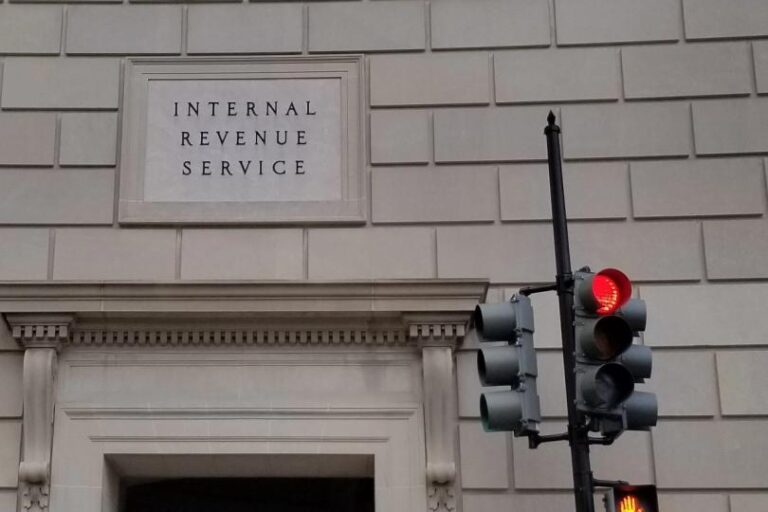
The findings come ahead of April 15, the IRS federal income tax filing deadline for 2025.
Criminal tax fraud can lead to a fine of up to $100,000 and five years in prison, according to Cornell Law School. That would be the worst-case scenario for individuals convicted of serious and intentional wrong-doing, and not for people who made filing errors.
The understanding gap lands at a delicate moment. The new tax rules — found in the IRS’ new Form 1099-DA — means that investors should report gross proceeds from digital assets transactions.
The problem for individual investors is that they are responsible for calculating and reconciling their own adjusted cost basis across platforms as brokers aren’t required to provide cost basis accounting to the IRS for 2025.
“The cost basis issue is uniquely hard to solve,” Shehan Chandrasekera, head of tax strategy at CoinTracker, said in a note shared with DL News.
“If a crypto investor has transactions and transfers between multiple wallets and exchanges or is involved in decentralised finance, it will be almost impossible for them to reconcile crypto taxes manually,” Chandrasekera said.
Other findings
The report described the digital assets industry as an “environment of high compliance intent but low functional understanding highlights a critical need for accessible, accurate, and integrated crypto tax solutions.”
It found that 74% percent of crypto users say they know their activity is taxable, with 56% rating their own knowledge of crypto taxes as excellent.
Crypto investors also look increasingly mainstream. Of the people polled, 76% say they also invest in traditional stocks, and 83% hold other assets such as bonds, property or commodities.
Lance Datskoluo is DL News’ Europe-based markets correspondent. Got a tip? Email him at lance@dlnews.com.
By Omkar Godbole (All times ET unless indicated otherwise)
The crypto market started the week on a positive note, but further gains may be limited as signs of fresh capital inflows remain weak.
Ether (ETH) and solana (SOL) prices have risen over 3% since midnight UTC, with BTC up nearly 2% and XRP lagging at 1.5%. The CoinDesk 20 Index has gained 2% to 1,941 points.
The demand side, however, appears weak. The 11 U.S.-listed spot bitcoin exchange-traded funds (ETFs) registered a net outflow of $296.18 million, snapping a four-week streak of inflows, according to data source SoSoValue. Ether ETFs bled over $200 million. These funds are seen as a proxy for institutional appetite for cryptocurrency.
The other route through which capital flows into the digital asset market is stablecoins, or tokenized versions of fiat currencies such as the dollar, and that is also flashing a red signal.
The growth in the market cap of Tether’s USDT, the world’s largest dollar-pegged stablecoin, has stalled at around $184 billion over the past two weeks. The market cap of Circle Internet’s (CRCL) USDC, the second-largest, has declined nearly 1.5% to $77.77 billion.
“Last week, Stablecoins experienced a $-1.1 billion decrease, a negative signal, compared to previous minting, which is in the 2nd percentile. During the last 30 days, a total of $0.8 billion was minted,” Markus Thielen, founder of 10x Research, said in a note to clients Monday.
Veteran chart analyst Peter Brandt said bitcoin’s current price action aligns with classic technical analysis patterns, and prices could fall to as low as $49,000. Options show a bias for put options across all time frames, a sign of lingering downside fears among traders.
Still, a sudden shift in sentiment, perhaps triggered by a potential U.S.-led ceasefire in the Iran conflict, could spark a rally in bitcoin and other risk assets. However, the BTC price would need to establish a firm foothold above $75,000 to signal a full bullish reversal. Stay alert!
Read more: For analysis of today’s activity in altcoins and derivatives, see Crypto Markets Today
What to Watch
For a more comprehensive list of events this week, see CoinDesk’s “Crypto Week Ahead”.
Crypto
Macro
Earnings (Estimates based on FactSet data)
March 30: Nano Labs (NA), pre-market
Token Events
For a more comprehensive list of events this week, see CoinDesk’s “Crypto Week Ahead”.
Governance votes & calls
Unlocks
Token Launches
March 30: BASED token generation event to occur.
Conferences
For a more comprehensive list of events this week, see CoinDesk’s “Crypto Week Ahead”.
Market Movements
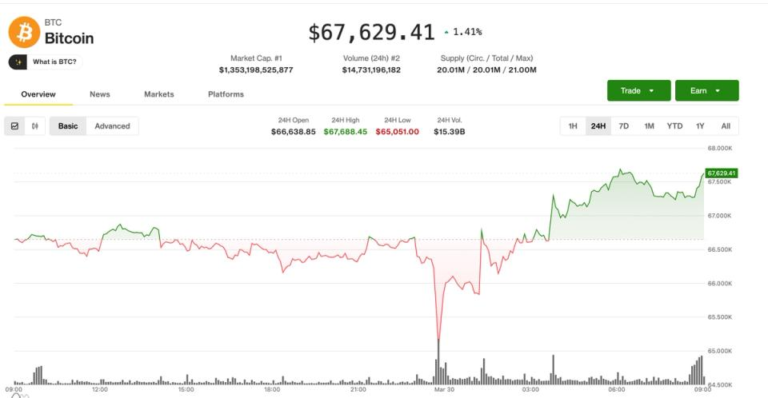
BTC is up 1.48% from 4 p.m. ET Sunday at $67,388.07 (24hrs: +1.41%)
ETH is up 2.78% at $2,051.71 (24hrs: +2.87%)
CoinDesk 20 is up 2.05% at 1,940.98 (24hrs: +1.61%)
Ether CESR Composite Staking Rate is down 6 bps at 2.70%
BTC funding rate is at 0.0007% (0.7939% annualized) on Binance
DXY is up 0.23% at 100.09
Gold futures are up 1.55% at $4,561.70
Silver futures are up 2.38% at $71.20
Nikkei 225 closed down 2.79% at 51,885.85
Hang Seng closed down 0.81% at 24,750.79
FTSE 100 is up 0.54% at 10,021.13
Euro Stoxx 50 is unchanged at 5,501.70
DJIA closed on Friday down 1.73% at 45,166.64
S&P 500 closed down 1.67% at 6,368.85
Nasdaq Composite closed down 2.15% at 20,948.36
S&P/TSX Composite closed up 0.23% at 31,960.70
S&P 40 Latin America closed down 0.75% at 3,473.97
U.S. 10-Year Treasury rate is up 2 bps at 4.44%
E-mini S&P 500 futures are up 0.35% at 6,435.00
E-mini Nasdaq-100 futures are up 0.28% at 23,394.00
E-mini Dow Jones Industrial Average futures are up 0.31% at 45,566.00
Bitcoin Stats
BTC Dominance: 58.52% (0.21%)
Ether-bitcoin ratio: 0.03048 (1.36%)
Hashrate (seven-day moving average): 1,018 EH/s
Hashprice (spot): $31.84
Total fees: 1.63 BTC / $108,730
CME Futures Open Interest: 121,295 BTC
BTC priced in gold: 14.9 oz.
BTC vs gold market cap: 4.49%
Technical Analysis
NVDA’s price has crossed below the bull market trendline support. (TradingView)
The chart shows weekly price swings in Nvidia (NVDA) in candlestick format.
Prices have dropped 7% over the past two weeks, breaking out of a trendline that characterized the bullish trend from late 2022 lows.
This breakdown suggests weakening momentum and raises the risk of a deeper correction.
NVDA is the bellwether of all things AI and has had a positive correlation with bitcoin in the past.
Crypto Equities
Coinbase Global (COIN): closed on Friday at $161.14 (–7.06%), +2.38% at $164.98 in pre-market
Galaxy Digital (GLXY): closed at $18.00 (–8.21%), +2.78% at $18.50
MARA Holdings (MARA): closed at $8.02 (–6.53%), +2.00% at $8.18
Riot Platforms (RIOT): closed at $12.80 (–8.60%), +2.19% at $13.08
Core Scientific (CORZ): closed at $15.07 (–4.56%), +1.53% at $15.30
CleanSpark (CLSK): closed at $8.66 (–6.88%), +3.58% at $8.97
Exodus Movement (EXOD): closed at $6.48 (–5.40%), –3.40% at $6.26
CoinShares Bitcoin Mining ETF (WGMI): closed at $35.19 (–5.10%), +2.87% at $36.20
Circle Internet Group (CRCL): closed at $93.66 (–4.69%), +2.28% at $95.80
Bullish (BLSH): closed at $34.43 (–5.52%), +0.78% at $34.70
Crypto Treasury Companies
Strategy (MSTR): closed at $126.03 (–5.19%), +1.88% at $128.40
Strive Asset Management (ASST): closed at $9.85 (–5.33%), –0.25% at $9.83
Sharplink (SBET): closed at $6.04 (–7.50%), +3.57% at $6.26
Upexi (UPXI): closed at $1.00 (–6.54%), +2.00% at $1.02
The Ethereum Foundation has accelerated its treasury staking push, deploying $46.2 million in Ether in its largest move to date after the recent BitMine sale.
On Monday, the foundation’s treasury multisignature wallet made 11 deposits into the Ethereum Beacon Deposit Contract, each of roughly 2,047 Ether (ETH), totaling 22,517 tokens worth roughly $46.2 million, according to data from Arkham Intelligence.
The Ethereum Foundation started staking ETH in February, depositing 2,016 ETH and outlining plans to stake up to 70,000 ETH, with rewards reinvested into research, ecosystem development and grants.
EF staking ETH. Source: Arkham
The foundation also deposited a smaller 31 ETH tranche earlier this month, bringing the total staked holdings to roughly 24,564 ETH as it shifts to staking to generate yield, rather than relying on periodic ETH sales, which have historically drawn criticism.
Related: Ethereum builders propose ‘economic zone’ to tackle L2 fragmentation
EF sells 5,000 ETH to BitMine in OTC deal
The new staking move comes after the EF completed an over-the-counter (OTC) sale of 5,000 Ether to BitMine Immersion Technologies, valued at about $10.2 million. The foundation said proceeds would support core operations, including protocol research, ecosystem growth and community grants.
The transaction marked the foundation’s second direct OTC sale to a corporate buyer, following a 10,000 ETH sale to SharpLink Gaming in July 2025.
The EF currently holds about $361 million in onchain assets, with the vast majority, roughly $360.8 million, held in Ether on the Ethereum network, alongside small balances across networks like Arbitrum, Optimism and Bitcoin, according to Arkham.
Related: Ethereum risks losing No. 2 spot as stablecoins gain ground
Ether price risks further decline
Ether fell below the $2,000 level over the weekend, raising the risk of a deeper correction. Analysts, including Onur, CryptoWZRD and Ted Pillows, pointed to repeated failures at $2,200 and weakening momentum, with some warning ETH could fall toward the $1,750–$1,850 range.
Demand for Ether has also turned negative, hitting its lowest level in 16 months, according to Capriole Investments.
Magazine: Ethereum’s Fusaka fork explained for dummies — What the hell is PeerDAS?
Cointelegraph is committed to independent, transparent journalism. This news article is produced in accordance with Cointelegraph’s Editorial Policy and aims to provide accurate and timely information. Readers are encouraged to verify information independently. Read our Editorial Policy https://cointelegraph.com/editorial-policy
U.S. president Donald Trump posted on Truth Social Monday that the United States is “in serious discussions with a new, and more reasonable, regime” to end military operations in Iran, the first public acknowledgment of a regime change in Tehran since the conflict began five weeks ago.
The phrase “new regime” suggests the leadership structure that existed when the war started is no longer in place.
In the same post, however, Trump demanded the Strait of Hormuz be “immediately open for business” and threatened to “blow up and completely obliterate” Iran’s electric generating plants, oil wells, and Kharg Island if a deal is not reached shortly. He added that desalination plants were also under consideration.
These are all targets the U.S. has deliberately avoided hitting for the duration of the five-week conflict.
The combination of a potential ceasefire with a new government and the most explicit threat to civilian and energy infrastructure yet makes this a two-sided headline that the market will struggle to price cleanly.
The de-escalation signal is that talks are happening with a new regime and “great progress” has been made. The escalation signal is that the president just publicly listed every piece of critical infrastructure he’s prepared to destroy if those talks fail.
Bitcoin jumped to $67,580 on the news, up 1.3% in the past 24 hours. Ether outperformed, up 3.1% to $2,064. Solana gained 1.9% to $84.09 and XRP added 1.0% to $1.35. The weekly picture is still uniformly red — with BTC down 1.3%, XRP 1.2%, SOL 2.2% — but Tron continues to quietly outperform the entire majors complex, up 1.3% in 24 hours and 5.3% on the week.
The bounce squeezed a lot of shorts on the way up, meanwhile. CoinGlass data shows $9.32 million in short liquidations in the last hour alone against just $207,000 in longs.
Traders took on $340 million in liquidations over a 24 hours window, absorbing the bulk at $242.25 million from the overnight flush before the Trump post landed. The largest single order was a $9.8 million BTCUSD liquidation on Bybit.
In its latest post to Telegram channel subscribers, analytics resource Technical Crypto Analyst wrote:
“BTC is showing a clear shift in structure on the 4H, with price forming lower highs and losing the 68–69k support, which now acts as resistance; this confirms short-term bearish momentum, and unless price quickly reclaims 69–70k, the path of least resistance remains downward toward the 65k demand zone.”
Last week, Cointelegraph reported on $70,000 rapidly becoming new resistance, with a key long-term trend line at $68,300 unable to function as support.
“BTC’s local uptrend is over – as expected – and price is starting to move lower again,” trader Jelle continued on Monday.
“Testing the previous lows as resistance as we speak; bears are back in the drivers’ seat.”
BTC/USD one-day chart. Source: Jelle/X
Others also focused on the continuing breakdown of Bitcoin’s second bear flag of 2026 — something that has already sparked sub-$50,000 BTC price targets.
“Repeating the exact same bear flag breakdown like we saw in January,” trader Roman summarized.
Iran war rattles stocks with inflation in focus
Macro markets remain highly sensitive to developments in the US-Iran war, and these keep coming as April arrives.
US President Donald Trump reported a “big day” militarily to start the week amid reports of plans for a ground invasion of Iran.
BREAKING: President Trump is weighing a military operation to extract nearly 1,000 pounds of uranium from Iran, per WSJ.
Details include:
1. This is considered a “complex and risky” mission that would likely put American forces inside the country for days or longer
Asia stock markets opened sharply down on Monday as the impact of the oil-supply crisis made its presence felt.
“The ongoing tensions means that tanker traffic through the Strait of Hormuz remains limited, which continues placing strains on global energy markets along with uncertainty over access to fertilizer products for farming,” trading resource Mosaic Asset Company commented in the latest edition of its regular newsletter, “The Market Mosaic.”
“That’s weighing on the S&P 500, which has now closed out five consecutive weeks with a loss.”
Mosaic noted that the S&P’s red streak was now the longest since the 2022 Russia-Ukraine war.
“The growing risk of lasting damage on the global economy from high energy prices is pressuring the stocks market,” it continued.
“But perhaps the most consequential spillover impact is on the outlook for inflation, and implications for interest rates on both the short- and long-end of the yield curve.”
Federal Reserve target rate probabilities (screenshot). Source: CME Group FedWatch Tool
As Cointelegraph reported, crypto markets joined stocks in a comedown in late March as the odds of the Federal Reserve cutting interest rates in 2026 faded. At the same time, bets of a recession coming this year increased to their highest since last September.
Fed Chair Jerome Powell is due to take to the stage on Monday, potentially offering more insight into officials’ positions on the economy. Powell will participate in a moderated discussion at the Harvard University Principles of Economics Class.
“The outlook for rate cuts by the Federal Reserve is in jeopardy, while long-term rates are jumping higher as well due to uncertainty around inflation,” Mosaic added.
“The 30-year Treasury yield is close to breaking higher from an ominous pattern that could mean sharply higher rates ahead.”
March risks becoming sixth red BTC price month
Bitcoin bulls have little to boast about as March comes to a close, with BTC/USD about to seal its sixth consecutive month of losses.
Data from CoinGlass shows the result on a knife-edge ahead of the monthly close, with a “green” finish still possible.
If Bitcoin ends March lower than its starting price, it would mark the first six straight “red” months since the 2018 bear market.
“Very slow month so far all things considered. Bitcoin pretty much flat on the month just like last year,” trader Daan Crypto Trades commented about the CoinGlass data.
Daan Crypto Trades noted that over Bitcoin’s history, April has always been comparatively strong.
“Historically speaking, April is bitcoin’s 3rd best month in average returns,” he added.
Trader XO observed that in February 2019, following Bitcoin’s first six-month losing streak, monthly gains totaled 11%.
“If April sees an early sweep into the $55–60K range, it could create a compelling setup for mean-reversion longs imo… (much depends on the overall macro landscape),” they told X followers.
“That said, the higher timeframe structure remains in control until a clear contextual ‘structural’ shift is confirmed.”
Bitcoin whales flip defensive
Bitcoin whales have sparked concerns about future downward pressure on BTC price action.
After an “aggressive” accumulation period at the start of 2026, whales have started reconsidering their exposure, per data from onchain analytics platform CryptoQuant.
“A clear divergence has formed: on-chain buying has ceased while large-scale inflows to exchanges are rising,” contributor Sunny Mom wrote in a “QuickTake” blog post.
“Although the price continues to oscillate around $67K, the data suggests the market is entering another phase of hand-overs (re-distribution).”
Bitcoin exchange whale ratio (screenshot). Source: CryptoQuant
CryptoQuant noted increasing whale presence among exchange inflows, with their wallets accounting for more of the largest inbound transactions.
“Furthermore, the stablecoin ratio remains at a low level, reflecting a slowdown in sidelined capital flowing into the market,” Sunny Mom added, referring to stablecoin trends.
“Without fresh liquidity, any attempt by whales to realize gains from their previous on-chain accumulation must rely on existing liquidity, making the price highly sensitive to selling pressure.”
Bitcoin exchange stablecoin ratio (screenshot). Source: CryptoQuant
Newer holders sit on “massive supply overhang”
Offering a hint of optimism this week, onchain analytics platform Glassnode sees promise in overall demand tendencies at current prices.
Related: Bitcoin value ‘off the chart’ as BTC price metric hits record lows in 2026
Between $60,000 and $70,000, it notes, new BTC buyers have their aggregate cost basis.
“BTC sits at the lower bound of the new buyers’ cost basis range ($60k–$70k),” it wrote in an X post on Monday.
“Supply accumulation in this range is notable, but the cluster is thinner than historical analogs that preceded a strong recovery.”
Bitcoin short-term holder cost basis distribution heatmap. Source: Glassnode
For a sustained rebound to begin, demand simply needs to ramp up — something not yet underway as traders stay nervous about geopolitical and macroeconomic shocks.
“The accumulation setup is constructive in form, not yet in magnitude,” Glassnode added.
Previously, Cointelegraph analyzed the various aggregate cost bases of Bitcoin investor cohorts, including that of short-term holders (STHs), the majority of whom are now underwater on their BTC holdings.
Last week, CryptoQuant calculated STH share of the overall supply at 5.7 million BTC, with 92% sitting on losses.
“That’s a massive supply overhang,” it warned.
Bitcoin STH in profit/loss. Source: CryptoQuant/X
This article is produced in accordance with Cointelegraph’s Editorial Policy and is intended for informational purposes only. It does not constitute investment advice or recommendations. All investments and trades carry risk; readers are encouraged to conduct independent research before making any decisions. Cointelegraph makes no guarantees regarding the accuracy or completeness of the information presented, including forward-looking statements, and will not be liable for any loss or damage arising from reliance on this content.
The crypto market staged a recovery on Monday with bitcoin BTC$67,442.95 rising by 2.1% since midnight UTC and ether (ETH) adding 3.1%. Stronger gains occurred in the altcoin market, with tokens such as chiliz (CHZ), FET$0.2416 and optimism OP$0.1077 notching advances of more than 6%.
Despite the improvement in sentiment, investors remained uneasy as the conflict with Iran enters a fifth week. While Pakistan expressed readiness to host “meaningful” peace talks, the markets aren’t buying it yet. Brent crude jumped to $108 per barrel over the weekend, signaling deep skepticism that a resolution is near. It was trading in the low $70s before the start of hostilities.
U.S. stock index futures responded well to Pakistan’s comments: Nasdaq 100 futures and S&P 500 futures both advanced 0.25%, and the dollar index (DXY) was little changed at 100.2 points.
The crypto market remains in a bearish trend on higher time frames, characterized by a series of lower highs and lower lows dating back to October. Bitcoin has remained in the same trading range since early February, failing to break above $75,000 to the upside or below $62,800 to the downside.
Derivatives positioning
Growth in bitcoin futures open interest (OI) has stalled since hitting a near two-month high of 748.65 BTC on Saturday. Near-zero perpetual funding rates and negative 24-hour cumulative volume delta (CVD) suggest a bias for bearish, short positions.
BTC OI declined notably during the spot price bounce from the Asian-session low of around $65,000. It shows that the rally is largely spot-driven and has yet to win the backing of leveraged traders.
On Bittfinex, the number of BTC/USD longs hit the highest since November 2023. Historically, this has been a contrary indicator, coinciding with price selloffs.
OI in most major tokens, including XRP, ETH, DOGE and SOL, has held largely flat over 24 hours.
AVAX and LTC stand out with double-digit percentage gains in futures OI, a sign of capital inflows. Most inflows, however, seem tied to bearish bets, as indicated by their negative CVDs.
Bitcoin’s 30-day implied volatility index is under pressure again, falling to nearly 55% after hitting 58% over the weekend. Overall, the index continues to indicate market calm despite the Iran war-led turmoil in traditional markets. Ether’s volatility index suggests the same.
On Deribit, BTC and ETH puts continue to cost more than calls across all time frames in a sign of lingering downside worries. Dealer gamma is predominantly negative between $65,000 and $70,000, which means dealers could buy low and sell high, potentially keeping prices range-bound.
Token talk
The CoinDesk Memecoin Index (CDMEME) and the DeFi Select Index (DFX) were the two best-performing benchmarks on Monday, rising by 2.8% and 2.2%, respectively, while the bitcoin-dominant CoinDesk 20 (CD20) added 1.5%.
The perceived strength of the altcoin market can be attributed to a market-wide lack of liquidity. When prices tumbled Friday, the amount of supply on exchanges outweighed demand. This sent several assets well into “oversold” territory” as the move was exaggerated, leading to today’s relief rally.
This liquidity void has plagued the crypto market since October, when a $19 billion liquidation event wiped out market structure, leaving several traders and market makers stranded in its wake.
In order to break that cycle, bitcoin, the market’s anchor, needs to trade back above $80,000 and consolidate, which would mean gains could rotate into the more speculative altcoin market to establish macro levels of support.
Traveling from the grey skies of London to the crisp, canal-side air of the Eye Filmmuseum in Amsterdam, I arrived at The Banking Scene with a single question: In an era of digital exhaustion, how does a bank stay relevant? The theme, “Rethinking Relevance,” wasn’t just a marketing slogan; it was a survival manual for an industry facing the “agent-first era.”
The day kicked off with a high-tempo keynote that set the stage for the massive transformation ahead. Peter, our keynote speaker, didn’t just talk about AI; he let his AI agent, Sarah, hijack the stage. “Assistants ask permission,” Sarah told us. “Agents, like me, take the stage.”
From Puppets to Actors
Peter’s breakdown of the AI evolution was a wake-up call for many. He described the journey from the “puppet” (simple chatbots) to the “servant” (assistants) and finally to the “actor”—the true agent.
“If you’re still building chatbots, you will get some bad news later on today.”
This shift is fundamental because agents don’t wait for a swipe or a click; they act. Peter argued that we are reaching the end of the mobile era, which has become a “remote control of my life” but one that leads to “digital exhaustion.”
The future is ambient, embedded, and face-to-face AI.
Cutting Through the “Agent Washing”
One of the most insightful discussions of the day featured Sára Hanniker, Head of AI Solutions at FinShape. In a market currently flooded with “agent washing”—where every legacy tool is suddenly rebranded as an agent—Sára provided much-needed clarity.
She noted that while banks have long claimed to be a “goldmine for data,” they haven’t known what to do with it. “The back is what to do with this knowledge, how to act upon them, how to be proactive,” she explained. Sára’s vision for a true AI Financial Assistant moves beyond simple alerts. Instead of just stating your balance dropped, an agent should interact:
“I saw that your balance increased. What about saving more? And then you can discuss it with your client… the AI could say, okay, then let’s set up a recurring transfer.”
She emphasized that this isn’t just a technology problem, but a cultural one. “How to change the mindset, how to achieve this cultural shift, and yes, to learn how to utilise the data,” is the real challenge for established institutions.
Digital Assets: Beyond the POC
The afternoon shifted focus to the complex world of digital assets and infrastructure. The panel, featuring experts like Anoush (Zodiac Custody), Sergei (Rabobank), and Sarah Liebing (Dutch Central Bank), tackled why, after a decade of pilots, we aren’t at “global digital asset domination” yet.
The Cash Leg Gap: Xavier noted that while tokenizing assets like bonds is “the easy part,” the cash leg remains a “menu of imperfect options.”
Liability and Risk: “Institutional investors… need to know the full remediation path when something goes wrong, and that just isn’t clear,” Xavier warned.
Central Bank Movement: Sarah Liebing provided a more optimistic view from the Dutch Central Bank (DNB), noting that they are moving from “idea and just a pilot” to actual products, with settlement in wholesale CBDC expected by Q3.
Anoush pointed out that the technology is solved, but the legal frameworks are the hurdle. “Innovating even where you may not have the end answer immediately… shouldn’t stop the innovation in the interim,” she argued.
The Human Element: The “Orchestrator”
A recurring theme throughout the day was the impact on people. Peter noted that 92 million jobs are at risk according to the World Economic Forum, leading to an “identity crisis.” However, he suggested a pivot from being a “specialist collaborator” to a “generalist orchestrator.”
“We should be hiring people for what they can oversee and what they can validate. They should be hired for how good they are as an orchestrator.”
This requires maintaining “human judgment” and “critical thinking” to ensure we don’t suffer from “atrophy of the mind” by delegating everything to machines.
Final Thoughts
As the sun set over the IJ River, the takeaway was clear: the industry is moving from “waiting to seeing technology act.” Whether it’s through the agentic workflows championed by Sára Hanniker or the infrastructure shifts discussed in the digital asset panels, the “puppet” era of banking is over.
A massive well done to Rik Coeckelbergs and Andrew Vorster for curating an event that was as challenging as it was inspiring. Bringing together regulators, incumbents, and disruptors in one room is no easy feat, but they managed to create a space where the “rethinking” actually happens. Amsterdam remains the beating heart of European fintech, and I’m already looking forward to next year’s progress report.
More than half of cryptocurrency investors don’t understand the fundamental concept of taxability when it comes to their digital asset holdings, according to a survey by the U.S.-listed crypto exchange Coinbase (COIN) and Cointracker, a crypto tax and portfolio tracking platform.
The 2026 Crypto Tax Readiness Report found that only 49% correctly understand that crypto is taxable anytime it is sold, while almost a quarter mistakenly believe simple transfers trigger tax events.
Despite the majority of users having good intentions when it comes to crypto tax compliance, the multi-platform reality of crypto ownership exacerbates the so-called cost basis problem, deducting the original purchase price of an asset to report capital gains.
The survey found users averaged 2.5 platforms/wallets with 83% using self-custodial wallets, and only 35% reporting that they’d adjusted their cost basis in the past. The survey, conducted in late 2025, surveyed 3,000 U.S. crypto users.
The confusion around cost basis in the new 1099-DA forms is made worse thanks to a degree of overreporting built into the new regime, Coinbase says. This is because everyday activities like stablecoin payments and Ethereum gas fees trigger taxable events, while generating little meaningful tax revenue.
Coinbase said it expects to issue over four million 1099-DAs Forms to customers with under $600 of proceeds – added to the fact that over 60 percent of its customers have incomplete cost basis data due to the way digital assets move across wallets and platforms.
“Today, that means every stablecoin payment, every small DeFi [decentralized finance] transaction, every gas fee is technically a taxable event,” Coinbase said. “The compliance burden this imposes on ordinary Americans isn’t just inconvenient – it’s a direct threat to the adoption and innovation the GENIUS Act was designed to unlock.”
Despite the wrinkles, the move to standardized reporting of crypto taxes will help adoption in the long run, said Matt Price, director of investigations at blockchain analytics firm Elliptic. Price, a former IRS special agent focused on criminal investigations, sees this as a shift toward targeted enforcement rather than the broad, manual investigations of the past.
Also a former head of investigations at Binance, Price understands the complexity of doing crypto taxes, having been paid partly in crypto by Binance and having to account for a volatile asset in the form of a payment.
“How do you even report it?” Price said in an interview. “I didn’t even have a 1099 to report that, so I had to essentially do all of my own accounting to file accurate taxes to account for that information.”
As such, the arrival of 1099-DA forms means welcome standardization that simply brings crypto in line with what other financial products have had for years and mirrors the approach of the 1099-B for brokerages.
“There’s certainly nuance and it’s a fair point that the basis is harder to calculate given the high frequency of trading,” Price said. “But there are some parallels to that in traditional investments as well; I don’t know how many retail traders are running algo trades on Schwab, for example, but that is also a very similar type of trade. If they can figure it out, I think the industry can probably figure it out.”
Pierre Rochard, CEO of The Bitcoin Bond Company, warned US banking regulators that their sweeping Basel III capital rewrite leaves unresolved how Bitcoin-related activities should be treated, a gap he says could create legal risk and shape how much capital banks must hold against the asset.
In a formal comment submitted March 29 to the US Federal Reserve, the Federal Deposit Insurance Corporation and the Office of the Comptroller of the Currency, Rochard said agencies cannot finalize rules that effectively determine capital treatment for Bitcoin (BTC)-related activities without clearly explaining the framework and evidence behind that treatment.
The regulators’ March 19 proposals, a package that would comprehensively overhaul the existing US bank capital framework, did not mention Bitcoin, crypto or digital assets a single time. It covers credit risk, market risk, operational risk and counterparty exposures for the largest US banks, but leaves uncertainty over how existing categories apply to BTC holdings, lending, custody and derivatives.
The gap matters because Basel already imposes a harsh capital treatment on certain unbacked crypto exposures, but the US proposals do not say whether that framework will apply to Bitcoin-related activities. For banks, that leaves the economics of custody, lending, derivatives and direct holdings unresolved.
The Bitcoin Bond Company’s letter to regulators. Source: Pierre Rochard
Rochard argued that regulators cannot leave that question unresolved and said a final rule that quietly imposes (or preserves) a capital treatment for Bitcoin-related activities without explicit explanation could face legal vulnerability.
Rochard presses regulators over Bitcoin treatment
He pointed to the Basel Committee’s crypto asset framework, known as SCO60, which assigns a 1,250% risk weight to unbacked crypto assets such as Bitcoin. According to Rochard, US regulators must clarify whether they intend to adopt that standard, apply elements of it selectively, or rely instead on existing domestic capital categories.
Related: Bitcoin advocate group to fight Basel’s ‘toxic’ treatment of cryptocurrency
Rochard noted that the same agencies have recently been explicit about other digital assets. On March 5, they issued a tokenized securities FAQ stating that eligible tokenized securities should generally receive the same capital treatment as their non-tokenized counterparts and that the capital framework is “technology neutral,” giving banks clear guidance on that front. By contrast, there is still no comparable explanation for how Bitcoin exposures should be treated.
Without that clarity, banks would be left to interpret how rules apply to direct Bitcoin holdings, Bitcoin-collateralized lending, custody services and derivatives exposure, increasing uncertainty across the industry.
Before the proposal’s release, some analysts had expected the re-proposal could ease capital requirements and potentially unlock liquidity for Bitcoin-related activities.
“The fiat system should stop sabotaging itself,” Rochard said in his comment on X. “Bitcoin banking rules would improve bank net interest margins and lower interest rates for borrowers.”
Cointelegraph reached out to Rochard for comment, but had not received a response by publication.
Magazine: Bitcoin may take 7 years to upgrade to post-quantum — BIP-360 co-author
Cointelegraph is committed to independent, transparent journalism. This news article is produced in accordance with Cointelegraph’s Editorial Policy and aims to provide accurate and timely information. Readers are encouraged to verify information independently. Read our Editorial Policy https://cointelegraph.com/editorial-policy
Bitcoin ETFs recorded net outflows of $290 million last week, with Friday’s $225.5 million exodus marking the heaviest single-day bleed.
BlackRock’s IBIT shed $201.5 million on Friday alone, the largest single-fund outflow of the week.
Flows turned negative as geopolitical tensions escalated and ceasefire expectations weakened.
More than $290 million exited Bitcoin ETFs last week as a broad “risk-off” shift continues to grip global markets amid rising geopolitical and macro pressures.
Farside Investors’ data shows cumulative weekly outflows of roughly $296 million between March 24 and March 27, led by heavy redemptions from BlackRock’s IBIT and other major funds.
The sharpest single-day move came primarily from IBIT on Friday, with $225.5 million of total U.S. spot Bitcoin ETF outflows, capping a volatile week that began with strong inflows of $167.2 million on Monday before sentiment reversed.
“Risk-off is clearly the mood amongst markets,” Josh Gilbert, market analyst at eToro, told Decrypt, pointing to Bitcoin’s slide to a three-week low and the S&P 500’s fifth consecutive weekly loss—its longest losing streak since 2022.
“The macro forces working against it are compounding,” he said. “Triple-digit oil is fuelling inflation fears, which pushes rate cut expectations further out, which in turn removes the very catalyst that risk assets need to find a floor.”
Geopolitical risk escalated Monday after President Donald Trump told the Financial Times he could “take the oil in Iran” and potentially seize Kharg Island, the country’s major fuel hub.
Gilbert said a ceasefire could spark a “strong relief rally,” but warned that, without credible de-escalation, markets will remain defensive with “more choppy sessions ahead.”
Peter Chung, head of research at Presto Labs, told Decrypt the “risk-off” tone was the primary driver, though he noted last week’s outflow “doesn’t seem that dramatic compared to the recent trends.”
“I think what drove it was the general risk-off trend as the expectation for the ceasefire waned as the peace talks faltered towards the end of the week,” he added.
Pratik Kala, head of research at Apollo Crypto, echoed that read, attributing the outflows to “risk-off sentiment and end of quarter rebalancing,” while telling Decrypt the $290 million figure is “quite normal.”
He added how Bitcoin’s relative strength against other asset classes remains “notable and very supportive”—and cautioned against reading structural significance into weekly flow data.
“ETF inflows/outflows are not only directional funds—there is a lot of basis trading done by hedge funds,” Kala said. “Therefore, there are no hard limits or thresholds that would signal a structural change.”
Gilbert said Bitcoin had held up relatively well through the conflict and had been “a surprising standout despite its risk status as an asset,” but warned that ongoing tensions show it is “in no way immune to this indiscriminate sell-off.”
He noted the market is increasingly pricing in a Fed rate hike, “a far cry from the multiple cuts the market was pricing in just months ago,” and flagged Fed Chair Jerome Powell’s scheduled remarks as a potential further pressure point.
On Myriad, a prediction market owned by Decrypt’s parent company Dastan, sentiment leans bearish, with users pricing a 56.8% likelihood of Bitcoin falling to $55,000 rather than climbing to $84,000.
Bitcoin is trading at $67,574, up 1.4% in the last 24 hours, after sliding into the $65,000 range earlier Monday, according to CoinGecko data.
Daily Debrief Newsletter
Start every day with the top news stories right now, plus original features, a podcast, videos and more.