For the first time in six years, the bitcoin BTC$67,728.31 hashrate, the total computational power securing the network, fell during the first quarter. It is currently down around 4% year to date, hovering around 1 zettahash per second (ZH/s).
Over the past five years, the rate has surged from roughly 100 exahashes per second (EH/s), a 10-fold increase, according to Glassnode data. Each year, the metric rose during the first quarter and ended with strong full-year growth in excess of 10%. In 2022, the figure almost doubled.
BTC Hashrate YoY (Glassnode)
The AI Pivot
The shift in 2026 reflects changing economics across the bitcoin mining sector. With production costs near $90,000 per bitcoin and the spot price closer to $67,000, margins are negative. In response, many publicly listed miners are switching to artificial intelligence and high-performance computing infrastructure, where returns are higher and more predictable.
This transition is being funded through debt issuance and bitcoin sales, reducing reinvestment into bitcoin mining. As a result, hashrate growth is becoming more sensitive to the cryptocurrency’s price, with weaker prices likely to trigger further declines as smaller operators exit.
While a falling hashrate may raise concerns about network security, decentralization may matter more than absolute size. Publicly listed U.S. miners have accounted for over 40% of the global hash rate, and a reduction in their influence could lead to a more geographically distributed network. In that sense, the current shift may ultimately support decentralization.
Despite the slowdown, CoinShares still forecasts hashrate growth to around 1.8 ZH/s by the end of 2026, conditional on bitcoin recovering toward $100,000.
Read More: End of bitcoin ‘HODL’: public miners going all-in on AI, signaling more BTC selling
A majority of crypto users remain unclear on basic tax rules, with fewer than half correctly identifying when transactions become taxable, a new survey found.
Only 49% of respondents correctly understand that crypto becomes taxable when it is sold, while nearly a quarter believe simple transfers can trigger tax events, according to a 2026 Crypto Tax Readiness Report published by Coinbase and CoinTracker.
The findings come from a survey of 3,000 US crypto users conducted between Sept. 9 and Oct. 3, ahead of the 2025 tax reporting season.
When is crypto taxable. Source: Coinbase
The survey noted that crypto investors show a clear willingness to comply with tax rules, with 74% saying they are aware that crypto is taxable, while 65% said they have already reported activity in the past. “This refutes the misconception of widespread crypto tax avoidance,” the survey states.
Related: Brazil’s finance minister shelves crypto tax policy due to election: Report
New IRS rules complicate tax reporting
The survey also pointed to some key challenges complicating crypto tax reporting. For one, crypto investors often hold assets across multiple platforms, with an average of 2.5 wallets or exchanges and 83% using self-custody. This fragmentation makes it harder to track cost basis, which is needed to calculate gains and losses.
New reporting rules add to the challenge. From the 2025 tax year, brokers will issue Form 1099-DA but won’t include cost basis, leaving users to reconcile transactions themselves across platforms that don’t share data.
56% of crypto users say their knowledge of crypto tax reporting is good. Source: Coinbase
Despite these challenges, most users rely on traditional tools. Around 78% use general tax software and 52% turn to accountants, while only 8% use crypto-specific tax services. At the same time, interest in AI is growing, with nearly half of respondents saying they would use it to calculate taxes and 30% open to relying on it for the entire process.
Related: US lawmakers publish crypto tax proposal without Bitcoin tax exemption
IRS moves to mandate digital crypto tax forms
Earlier this month, the IRS proposed new rules that would require crypto exchanges to deliver tax forms electronically, removing the option for paper copies. Under the proposal, brokers could end relationships with users who refuse digital delivery, and users would no longer be able to withdraw consent once given.
Exchanges must continue issuing Form 1099-DA to report transaction proceeds, though cost basis tracking will remain the responsibility of investors.
Cointelegraph is committed to independent, transparent journalism. This news article is produced in accordance with Cointelegraph’s Editorial Policy and aims to provide accurate and timely information. Readers are encouraged to verify information independently. Read our Editorial Policy https://cointelegraph.com/editorial-policy
Trusted Editorial content, reviewed by leading industry experts and seasoned editors. Ad Disclosure
The imminent SpaceX IPO has drawn attention to DOGE, with eyes on how the Dogecoin price could react to the public listing of Elon Musk’s company. This is because of the affinity that the world’s richest man has for the foremost meme coin, which has brought about a connection between DOGE and developments around him.
Dogecoin Price Briefly Rises On SpaceX IPO Speculations
The Dogecoin price notably rose close to the psychological $0.10 level following reports that Elon Musk’s SpaceX could file for an IPO soon. According to a Reuters report, the space company is reportedly looking to raise up to $80 billion at a $1.75 trillion valuation. This could make the IPO the largest ever, topping Saudi Aramco’s 2019 IPO.
The Dogecoin price reacts to developments surrounding a potential SpaceX IPO, given Elon Musk’s relationship with DOGE. As such, the meme coin has been known to react to developments around the world’s richest man. It is also worth noting that DOGE has a direct connection to SpaceX through the long-planned DOGE-1 lunar mission, which aims to send a physical Dogecoin to the moon.
Elon Musk recently revived talks about the mission, stating that it could maybe happen next year. As such, the SpaceX IPO represents a huge positive for the Dogecoin price. DOGE also has a connection with SpaceX through the X social media platform, which is now part of SpaceX following its acquisition of xAI.
X is planning to roll out its payment services, with speculations that the social media platform could integrate DOGE payments. The Dogecoin price rose when Musk announced that X Money will launch to the public next month. A potential integration could serve as the catalyst to send the Doge price higher.
DOGE Has One Of The Best Setups Right Now
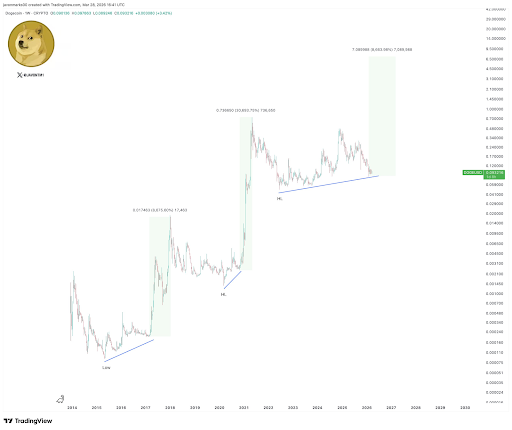
Ahead of the SpaceX IPO, crypto analyst Javon Marks said in an X post that the Dogecoin price has one of the best setups in the market right now. His accompanying chart showed that DOGE could soon bottom and rally to as high as $7 in the next bull run, marking a new all-time high (ATH) for the meme coin, surpassing its current ATH of $0.73.
This Dogecoin price rally to $7 is expected to happen between 2027 and 2028, which could mark the start of the next bull run. Marks made this prediction based on DOGE’s historical performance in past bull runs. The foremost meme coin notably saw gains of over 8,000% and 30,000% in the 2017 and 2021 bull runs, respectively.
Source: Chart from Javon Marks on X
At the time of writing, the Dogecoin price is trading at around $0.09270, up almost 2% in the last 24 hours, according to data from CoinMarketCap.
DOGE trading at $0.09 on the 1D chart | Source: DOGEUSDT on Tradingview.com
Featured image from Pngtree, chart from Tradingview.com
Editorial Process for bitcoinist is centered on delivering thoroughly researched, accurate, and unbiased content. We uphold strict sourcing standards, and each page undergoes diligent review by our team of top technology experts and seasoned editors. This process ensures the integrity, relevance, and value of our content for our readers.
This month, Bitcoin’s hashrate fell 6% after the US and Israel attacked Iran, highlighting Iran’s significant crypto mining activity.
Bitcoin price, meanwhile, remains lackluster. Higher 4% yields on US Treasury bonds have added pressure, and investors are seeking less risky prospects amid geopolitical tension.
Less appetite for crypto trading has proven problematic for Robinhood. The trading platform’s stock is down 16% on the month, and leadership has announced a stock buyback program.
Prediction markets marked a record number of transactions, representing a more than 2,800% increase since this time last year.
Here’s March by the numbers:
Bitcoin lacks momentum as 4% US Treasury bond yields put pressure on price
Yields on five-year US Treasury bonds are up 4% in March, putting pressure on Bitcoin price. While showing some gains in mid March, the asset ended the month much where it started, around $67,000.
As per an analysis from Cointelegraph, fears of a drawn-out conflict between the US and Israel against Iran have led investors to cut out risk. A sell-off in bonds, along with a nine-month high of 4% in yields, suggests that traders are building cash positions.
Bitcoin hashrate falls nearly 6% after US and Israel attack Iran
On Feb. 28, the United States and Israel launched a joint special military operation in Iran called “Operation Epic Fury.” One month later, the Bitcoin (BTC) hashrate is down almost 6%.
Bloomberg crypto and digital assets strategist Dushyant Shahrawat said in a recent interview that Iran is one of the world’s largest Bitcoin miners, accounting for some 6-8% of global hashrate, and 70% of mining activities are conducted by the military.
Disruptions to the country’s energy infrastructure and diversion of military priorities to defense have thus hit Iran’s ability to mine Bitcoin.
Prediction market transaction top 192 million
Transactions on prediction markets like Polymarket and Kalshi topped 192 million in March. That represents a 24% increase from last month and a 2,880% increase compared to the same time last year, according to Dune analytics.
Related: Lawmakers push another bill to curb prediction market insider trading
Prediction markets are growing in popularity, but in the United States, they face state regulators who say they facilitate a form of gambling. At least 11 states have taken legal action against them.
On March 20, Carson City District Court Judge Jason Woodbury upheld a regulator’s move to temporarily ban prediction market Kalshi in Nevada.
Arizona has brought criminal charges against Kalshi for allegedly “running an illegal gambling operation and taking bets on Arizona elections, both of which violate Arizona law.”
Other states like Utah and Pennsylvania are currently considering legislation that would bring prediction markets under state gambling or gaming laws. Kalshi says that it answers only to federal regulation under the Commodity Futures Exchange Commission (CFTC).
Euro-denominated stablecoins account for 85% of non-dollar volume
Stablecoins backed by the euro have emerged as a favorite alternative to assets backed by US dollars. Some 85% of non-dollar stablecoin volumes occur in euros, according to a March report from Dune.
While euro-denominated coins initially only represented some 50-70% of the non-dollar market, they began expanding significantly in 2024. Now they represent 85% of total transferred volume. Euro stablecoins are also dominant in regard to participation, with user share rising to over 78%.
Dune attributes this increase to more confidence in stablecoins among institutions, thanks in large part to the Markets in Crypto-Assets regulatory package (MiCA).
Robinhood stock down 16% on month
Robinhood stock has decreased over 16% in March, from nearly $80 to $66 as of publishing time.
The stock and crypto trading company’s share price has been struggling in recent months. Over the last six months, it dropped over 50%. Uncertainty over the regulation of new verticals like prediction markets and social trading, along with a collapse in crypto trading revenues are creating structural obstacles for the company.
Revenue from crypto transactions reportedly dropped 38% year-over-year as of Q4 2025. Crypto app volumes dropped 58%.
To address the problem, Robinhood has approved a $1.5 billion share buyback program in March, which will execute over the next three years.
Strategy’s Bitcoin holdings are 11% in the red
Amid a lackluster price action on the month, Strategy’s Bitcoin portfolio is at an 11% loss. The average cost of Bitcoin in its portfolio is $75,669. Bitcoin is trading around $67,800 at publishing time.
Data collected March 30.
Still, the company has continued its regular Bitcoin purchases. It made two this month: one for 17,994 Bitcoin on March 9 and another for 22,337 Bitcoin on March 16, amounting to roughly $2.7 billion at publishing time.
The software company has financed most of its Bitcoin purchases through high-yield stock offerings, like Stretch (STRC). This allows the company to buy Bitcoin without diluting its MSTR common shares.
The company’s chair, Bitcoin bull Michael Saylor, said recently that 80% of STRC buyers are retail investors. “Retail investors prefer low-volatility, high-yield digital credit,” he said.
Magazine: XRP yet to ‘price in’ 3 bullish catalysts, Bitcoin to $80K? Trade Secrets
Cointelegraph Features publishes long-form journalism, analysis, and narrative reporting produced by Cointelegraph’s in-house editorial team with subject-matter expertise. All articles are edited and reviewed by Cointelegraph editors in line with our editorial standards. Research or perspective in this article does not reflect the views of Cointelegraph as a company unless explicitly stated. Content published in Features does not constitute financial, legal, or investment advice. Readers should conduct their own research and consult qualified professionals where appropriate. Cointelegraph maintains full editorial independence. The selection, commissioning, and publication of Features and Magazine content are not influenced by advertisers, partners, or commercial relationships. This content is produced in accordance with Cointelegraph’s Editorial Policy.
Decentralized finance (DeFi) lending platform Aave has launched its V4 protocol on Ethereum after a binding onchain governance vote cleared its deployment.
On Monday, Aave announced the launch of its V4 protocol on Ethereum, introducing infrastructure designed to “expand onchain markets into real-world credit markets.” The company said this includes structured lending, fixed-rate borrowing and tokenized asset-backed credit.
The rollout follows a Snapshot vote that gained near-unanimous support for a subsequent Aave Improvement Proposal (AIP), a binding onchain vote that opened on March 26 and closed on Sunday. The proposal passed with about 433,000 votes in favor, or roughly 60%, versus about 282,000 votes against, or nearly 40%.
Aave’s path to V4 followed months of governance disputes. BGD Labs said it was leaving in February, citing an “asymmetric organizational scenario,” followed by the Aave Chan Initiative in March over concerns about governance standards and voting dynamics.
The launch marks a push by Aave to expand beyond traditional DeFi lending into more complex credit markets, and shows the protocol can still execute major upgrades despite prolonged governance disputes.
AIP voting results. Source: Aave
Aave V4 rolls out a modular design for onchain credit markets
Aave V4 introduces a modular design that separates shared liquidity from market-specific risk, allowing different credit markets to operate with distinct parameters while drawing from a common liquidity pool.
According to Aave Labs founder and CEO Stani Kulechov, the upgrade is designed to shift DeFi toward more active use of existing liquidity. “Aave V4 shifts the focus to the demand side, putting that liquidity to work across real credit markets,” he said.
An Aave spokesperson told Cointelegraph that V4 is designed to support a broader range of market structures, including institutional use cases.
Related: How a 2.85% price error triggered $27M in liquidations on Aave
Though specific implementations have not been revealed, the spokesperson told Cointelegraph that the architecture enables features like institution-specific markets, borrowing against custodied assets and real-world asset integration.
The spokesperson added that Aave will take a measured approach to rolling out V4, starting with conservative parameters and a limited initial scope.
Alongside the launch, Aave introduced Aave Pro, a new interface designed for advanced users to access V4’s markets. It also announced an integration with Chainlink as the protocol’s oracle provider, supplying price feeds and other data used in lending markets.
Magazine: China’s ‘50x’ blockchain boost, Alibaba-linked AI mines Bitcoin: Asia Express
Cointelegraph is committed to independent, transparent journalism. This news article is produced in accordance with Cointelegraph’s Editorial Policy and aims to provide accurate and timely information. Readers are encouraged to verify information independently. Read our Editorial Policy https://cointelegraph.com/editorial-policy
Palm Beach, Florida — March 30, 2026 — Barron Trump was recently spotted enjoying a quiet evening walk with a young Goldendoodle puppy near Mar-a-Lago, drawing attention from a handful of onlookers in the area.
The sighting took place Sunday evening as the 20-year-old kept a low profile while strolling along with the energetic dog. Dressed in casual athletic wear, he appeared calm and at ease, occasionally guiding the playful puppy as it moved excitedly along the path.
Observers noted that the dog, estimated to be just a few months old, had the distinctive fluffy coat and friendly expression typical of a Goldendoodle. Its lively behavior and affectionate nature made it clear that the puppy is still adjusting to its surroundings.
One witness described the moment as surprisingly down-to-earth:
“He looked completely relaxed. It felt like a normal person walking their dog, not someone constantly in the public eye. The puppy was full of energy, and he handled it patiently.”
Unlike many public sightings involving well-known figures, no photos or videos were captured. Those present chose to respect Barron’s privacy and simply observed from a distance.
Close Friend Shares Details About the Puppy
Additional insight came from Rodolfo Castillo, a longtime friend of Barron and co-founder of SOLLOS Yerba Mate. He confirmed that Barron recently welcomed the puppy into his life.
According to Castillo, the dog is named Duke and had been a long-considered decision.
“Barron has talked about getting a dog for a while,” he said. “He finally decided the time was right. Duke is very smart, playful, and fits perfectly with his routine.”
Castillo also mentioned that Barron plans to introduce the puppy more publicly once it becomes fully comfortable and receives basic training.
“He’s really enjoying the experience. He’s been sharing small moments with friends, like videos of Duke playing and exploring. It’s something that’s clearly made him happy.”
A Rare Addition to the Family
The appearance of Duke is notable, as the family of Donald Trump has not been known for keeping pets in recent years.
There had been earlier discussions years ago about bringing a dog into the household, but those plans never materialized during their time in the White House.
Balancing Privacy and Personal Life
Currently studying at New York University, Barron has largely stayed out of the spotlight, focusing on academics and personal interests.
Sources suggest that having a pet may offer a sense of routine and companionship, especially given the constant attention associated with his family background.
As word of the sighting spreads, many have expressed curiosity and positivity about this new chapter in his life.
Looking Ahead
Whether Duke will make future public appearances remains uncertain. However, the recent sighting indicates that the young Goldendoodle is already becoming an important part of Barron’s day-to-day life.
For now, the quiet evening walk offered a rare glimpse into a more personal and relatable side of someone who is often kept out of public view.
Zcash (ZEC) is a wager that the rise of AI surveillance will make financial privacy more valuable, and the crypto market is underpricing that possibility, according to asset manager Grayscale.
“Zcash is nearly 10 years old but may be entering a new chapter. Use of its shielding technology is increasing, and new capital is entering the ecosystem to support wallet development and Zcash mining,” analyst Michael Zhao wrote in a Friday report.
ZEC is a privacy-focused cryptocurrency that uses zero-knowledge proofs to hide transaction details, allowing users to shield the sender, receiver and amount, while still verifying transfers on a public blockchain.
Designed as a more confidential alternative to bitcoin BTC$67,388.59, the largest cryptocurrency, it aims to function as a closer approximation to digital cash in an otherwise transparent crypto ecosystem.
The token has seen multiple boom-and-bust cycles, most notably during crypto bull markets when its privacy narrative gained traction. In late 2025, ZEC surged to nearly $700, sharply outperforming much of the market as investors switched into smaller-cap assets with differentiated use cases.
The move proved short-lived. Prices retraced quickly, falling more than 60% in the following months as momentum faded and larger assets like bitcoin regained favor. The volatility underscores a recurring pattern for Zcash: sharp upside during narrative-driven rallies, followed by steep drawdowns when that narrative loses urgency.
ZEC makes up about 0.3% of the $1.6 trillion crypto “currencies” segment, according to Grayscale, a share it said reflects expectations that privacy stays marginal. If that view changes, even slightly, the upside could be significant.
Grayscale pointed to rising use of Zcash’s shielded transactions, now the majority of activity, as evidence that demand for privacy already exists onchain. But the firm said the market still treats privacy as an afterthought rather than a core monetary feature.
This is part of a broader structural shift. Just as digitization and the internet reshaped financial privacy debates in prior decades, Zhao argued AI and blockchain transparency could trigger a third wave, one where confidential transactions become more valuable.
In that scenario, Zcash’s design positions it as a direct analogue to cash, a property the analyst said is increasingly scarce in digital finance.
Still, there are risks, the report cautioned. Regulatory treatment remains uncertain despite Zcash’s selective disclosure tools. Execution risk persists given the network’s reliance on complex upgrades, and long-term concerns like quantum computing that apply across crypto, including ZEC, the report added.
ZEC was trading 5% higher over 24 hours, around $224.80, at publication time.
Read more: AI rout hits software stocks, but Grayscale says blockchains stand to benefit
Midas said it raised $50 million to solve a persistent pain point for onchain yield investors: liquidity.
The firm, which turns institutional yield strategies into blockchain-based tokens, closed a Series A funding round led by RRE and Creandum with backing from firms including Framework Ventures, Franklin Templeton and Coinbase Ventures.
The raise comes as institutions explore tokenized portfolios, with liquidity and settlement speed still limiting broader adoption. Many tokenized investment products operate through vault-like structures, deploying user funds into strategies such as lending or yield farming across DeFi protocols. While they can generate steady returns, they often lock up capital, forcing investors to wait for redemptions.
Midas will use the new funding to build and roll out a system that allows users to exit positions instantly, instead of waiting for days.
Dubbed Midas Staked Liquidity (MSL), the feature aims to end withdrawal delays with a separate liquidity layer that sits alongside its products. Instead of unwinding positions each time an investor exits, the system uses pre-allocated capital to fulfill withdrawals on demand.
“This raise gives us the capital to scale the infrastructure behind it, enabling instant redemptions, deeper liquidity, and broader strategy access without sacrificing transparency or yield,” said co-founder and CEO Dennis Dinkelmeyer.
Since starting its 2024, Midas said it issued $1.7 billion in tokenized assets, distributing $37 million in yield to investors.
Prospects of interest rate rises are no longer just the U.S. story. Traders are now betting the Bank of Japan (BoJ) could tighten too as the resource-scarce nation faces inflation risks from the ongoing Iran war.
Traders see a roughly 69% chance of the BoJ raising its benchmark borrowing cost at the April 28 meeting, according to data tracked by Bloomberg. Action in options tied to U.S. interest rates shows traders expect the Fed to raise borrowing costs in the coming weeks.
BoJ’s policy meeting summary released Monday showed one member calling for a bigger rate hike in response to the conflict in the Middle East and its inflationary impact on Japanese society. Comments also noted that any move would factor in incoming economic data and anecdotal signals from the market.
The Fed’s tightening is a well-known headwind for risk assets, including bitcoin. The Bank of Japan can be just as impactful. Years of ultra-low rates encouraged traders to borrow in yen and invest in higher-yielding markets (the so-called carry trade), keeping borrowing costs suppressed globally and greasing rallies in risk assets.
So, a shift toward tighter policy in Tokyo could reverse these flows, sending ripples across markets and potentially deepening the crypto bear market. The BoJ has already raised its interest rate to 0.75% from -0.1% over the past two years while simultaneously ending its massive asset purchase program. Yet, rates in Japan remain significantly lower than the 3.5% seen in the U.S.
The bank, therefore, has plenty of room to hike if the Iran crisis worsens, potentially driving higher energy prices and imported inflation in Japan and other oil-dependent countries.
Easier said than done
Hiking rates, however, will be a challenging task given Japan’s strained fiscal situation. The country’s debt-to-GDP ratio stands at a staggering 240%, meaning higher rates could sharply increase borrowing costs and strain government finances.
Economists have said that Japan is caught between a rock and a hard place. If it hikes rates and allows government bond yields to rise, it could put Japan’s debt sustainability at risk. If it keeps rates low, the yen will likely depreciate significantly, adding to inflation concerns.
Strains are already evident in the FX market. The Japanese yen continues to weaken and is currently just around 160 per U.S. dollar, its weakest level since mid-2024. The JPY has depreciated by 54% since 2021.
Bitcoin (BTC) buyers made a tepid comeback on Monday, pushing BTC price to its intraday high of $67,860. Analysts said that Bitcoin remains in a bear market, with several metrics pointing to a potential bottom below $50,000.
Key takeaways:
Bitcoin price turns $70,000 into resistance, clearing the path for a deeper correction.
Bitcoin’s short-term holder realized price bands moved lower, with a potential bottom around $46,000.
Historical retracement levels and a bear flag breakdown point to $39,000–$41,000 as the final low for BTC price this cycle.
Bitcoin’s “path of least resistance” is downward
Data from TradingView captured ongoing BTC price gains, up 1.5% on the day to trade at $67,750, as $69,000-$70,000 became new resistance.
Analyzing Bitcoin’s price action on lower time frames, Telegram trading resource Technical Crypto Analyst said losing the $68,000-$69,000 support “confirms short-term bearish momentum,” adding:
“Unless price quickly reclaims $69K–$70K, the path of least resistance remains downward toward the $65K demand zone.”
Related: Worst six months since 2018? Five things to know in Bitcoin this week
“Great bounce upwards, but nothing confirmed as of yet on Bitcoin,” MN Capital founder Michael van de Poppe said in a Monday post on X.
It “all depends on macroeconomic events; however, I’d rather see a breakout above $71K for confirmation,” he added.
“On the other hand, a classic little sweep to $65K just before the push upwards would signal that we’re going to get that momentum.”
BTC/USD four-hour chart. Source: X/Michael van de Poppe
Analyst Kyle Chassé said that with the Fear and Greed index still in the “extreme fear zone” and the order books showing more shorts than longs, the market leans “towards more downside.”
Crypto fear and greed indeed. Source: X/Kyle Chassé
Where will the Bitcoin price bottom?
Bitcoin’s 46% drawdown from its $126,000 all-time high has seen the cost basis of short-term holders (STH) — the average price of entities who have held BTC for less than 155 days — drop from $113,500 to $83,200.
“This is a sign that the pricing for a potential bottom has also moved lower,” said CEO and founder at Alphractal Joao Wedson in an X post on Monday.
Similarly, the lower line of the STH realized pricing bands (blue line) has also moved “even lower, which could confirm that Bitcoin may form a bottom around $50K or slightly below,” Wedson added.
The chart below shows that Bitcoin bottomed out just below the lower band of the STH realized price during the 2022 bear market.
Analyst Willy Woo said that the bear market bottom for Bitcoin could be between its realized price, currently at $54,000, and the Cumulative Value-Days Destroyed (CVDD), now at $45,500.
“Old school onchain models suggest a BTC bottom between $46K-54K. ”
Bitcoin pricing models. Source: X/Willy Woo
The CVDD measures the cumulative value of “Coin Days Destroyed” (long-term holders selling) relative to the market’s age, creating a rising “floor” price during bear markets.
Crypto analyst Crypto Jelle said Bitcoin’s bear market lows have historically formed between the 0.618 and the 0.786 retracement levels, which are at $57,600 and $39,000, respectively.
BTC/USD weekly chart. Source: X/Jelle
As Cointelegraph reported, the current “last stages” of the bear market are producing predictions of as low as $41,000, based on a bear flag breakdown.
This article is produced in accordance with Cointelegraph’s Editorial Policy and is intended for informational purposes only. It does not constitute investment advice or recommendations. All investments and trades carry risk; readers are encouraged to conduct independent research before making any decisions. Cointelegraph makes no guarantees regarding the accuracy or completeness of the information presented, including forward-looking statements, and will not be liable for any loss or damage arising from reliance on this content.