Home Blog Page 629

Investors Pull $414M From Crypto Funds As Inflation, Iran War Jitters Mount

0

Trusted Editorial content, reviewed by leading industry experts and seasoned editors. Ad Disclosure

Spot Bitcoin ETFs snapped a four-week run of gains last week, posting $296 million in net outflows after pulling in more than $2.2 billion earlier in the month. The crypto reversal was swift — and it wasn’t limited to Bitcoin.

Ether Takes The Hardest Hit

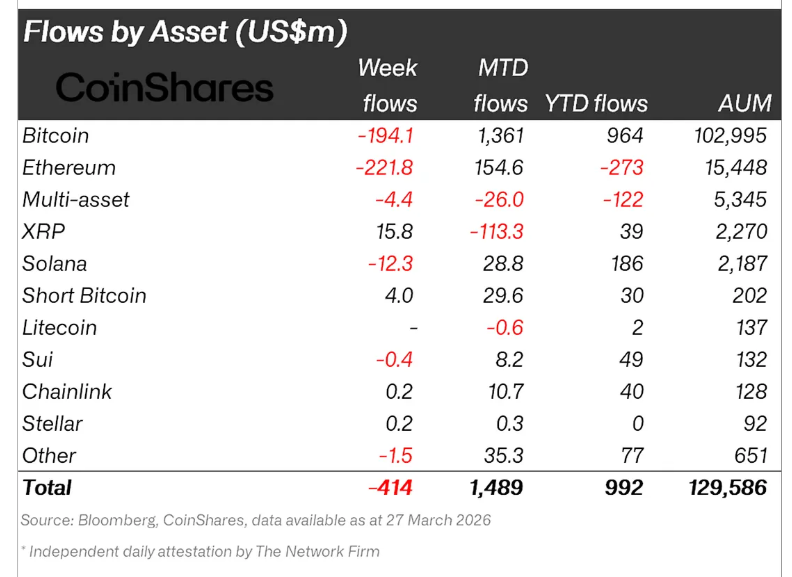
Ether led all assets in outflows, shedding $222 million in a single week. That brought its year-to-date total into the red, with a net loss of $273 million — the worst performance among tracked assets.

Spot Ether ETFs also recorded $206 million in outflows for a second straight week, a sign that institutional demand for the second-largest cryptocurrency has been cooling steadily.

Bitcoin fared better in the long run. Despite $194 million leaving Bitcoin funds last week, the asset remains up $964 million in net inflows for the year.

A small group of investors even moved in the opposite direction — short-Bitcoin products drew $4 million in fresh capital, suggesting some are betting on more losses ahead.

Across the board, total assets under management in digital asset products dropped to close to $130 billion.
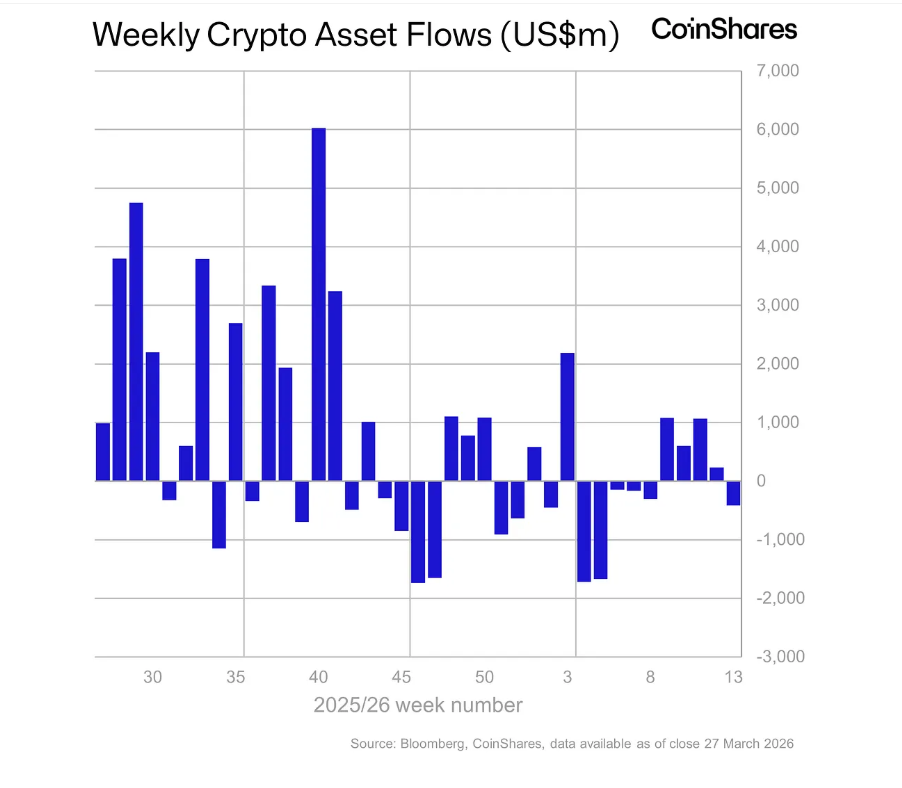
According to CoinShares head of research James Butterfill, that figure puts the market back at levels not seen since early February — broadly in line with where things stood in April 2025 during the first wave of US President Donald Trump’s tariffs.

Solana lost a little over $12 million over the same period. XRP was the exception. Reports from CoinShares show the token attracted close to $16 million in new capital, standing apart from the widespread exodus hitting nearly every other major asset.
What Spooked Investors

Three things rattled markets last week: inflation fears, shifting expectations around US interest rates, and rising tensions in the Middle East.

The most consequential of the three may be the rate outlook. Expectations heading into the June Federal Open Market Committee meeting moved away from potential cuts and toward possible hikes — a major shift that historically pushes investors away from riskier assets.

BTCUSD now trading at $67,744. Chart: TradingView

Digital assets tend to feel that pressure quickly. When borrowing costs look like they’re going up, money moves toward safer ground.

A Five-Week Streak Comes To An End

The $414 million in total outflows snapped what had been five consecutive weeks of inflows. Data from CoinShares shows the pullback reflected a broader shift toward risk-off behavior among investors, driven more by macroeconomic forces than anything specific to crypto markets.

Whether last week marks a turning point or a brief pause will likely depend on what signals come out of the Fed in the weeks ahead. For now, the money has moved — at least temporarily — to the sidelines.

Featured image from Getty Images, chart from TradingView

Editorial Process for bitcoinist is centered on delivering thoroughly researched, accurate, and unbiased content. We uphold strict sourcing standards, and each page undergoes diligent review by our team of top technology experts and seasoned editors. This process ensures the integrity, relevance, and value of our content for our readers.


Solayer Pay Upgrade Cuts Annual Plan 48% to Boost Stablecoin Payment Adoption

0

  • The Solayer Pay card upgrade slashed the annual subscription fee by over 48% to $20.
  • Solayer Pay users will now earn more cashback through community efforts.
  • This Solayer Pay upgrade will catalyze the mainstream adoption of stablecoins through the Solayer’s InfiniSVM network.

Solayer Pay, a stablecoin neobank, has received a new uplift in March 2026. The Solayer Pay card is now cheaper to own, and rewarding to hold for the entire community of users.

The Solayer Pay team announced its annual subscription plan has been slashed by nearly half. Furthermore, the Solayer Pay card has upped the democratization of stablecoins in real-world cases through the Solayer Labs’ InfiniSVM network, a high-performance layer one (L1) chain with compatibility of the Solana Virtual Machine (SVM).


Source: Solayer_Pay

Additionally, the Solayer Pay card is now cheaper to deposit funds by 50%. Specifically, this Solayer Pay upgrade cut the deposit fee from 1% to 0.5%. As such, batch payments involving less than a dollar are possible with the Solayer Pay card.

Solayer Pay upgrade catalyzes user growth sentiment 

The March 2026 Solayer Pay upgrade is a huge milestone for the Solayer ecosystem as stablecoins go mainstream globally. Furthermore, this Solayer Pay change will allow users to earn 12.5% in deposit fees from their invited referrals.

Essentially, the Solayer Pay team will share 25% of every invited user with the two involved parties, that is, the person whose referral code was used and the user of the code who makes deposits.

“Spend stablecoins irl and earn when your friends deposit. When your friends deposit, you earn 12.5% of their deposit fee, they get 12.5% back. You share the link, we share the bag,” the Solayer Pay announcement stated.

The reduction of Solayer Pay’s deposit fee and the annual subscription plan by 50% in addition to the clearer referral program will play a huge role in helping the community sell the card to more users easily. Moreover, the Solana ecosystem has huge numbers and the Solayer Pay taps on accelerated SOL via InfiniSVM. 

What’s the expected implication for the Solayer ecosystem?

This key upgrade of the Solayer Pay card reaffirmed the team’s confidence in evolving with the Solana (SOL) demand for Stablecoins, through the InfiniSVM network. Furthermore, the Solana web3 ecosystem has experienced a sharp uptick in stablecoin growth since the enactment of the U.S. Genius Act, a federal law focused on stablecoins and digital assets infrastructure.

Source: Solayer_Pay

As such, Solayer Pay will be at the core machine catalyzing the organic growth of the Solayer’s InfiniSVM network and in extension the Solana ecosystem. Moreover, the Solana ecosystem has made significant growth under its current status, but it needed an accelerated chain, led by the InfiniSVM network, to onboard billions of global users and enable mass payments at affordable rates.

With the new upgrade, Solayer Pay is well-positioned to be a magnet to real-world users of stablecoins, especially catalyzed by the revenue-generating model.

Overall, this upgrade positions Solayer Pay as a powerful bridge between digital assets and everyday finance, paving the way for faster, cheaper, and more accessible stablecoin transactions worldwide.”


Hoskinson Slams Ripple Over Crypto Competition Push

0

Trusted Editorial content, reviewed by leading industry experts and seasoned editors. Ad Disclosure

Cardano founder Charles Hoskinson used a lengthy weekly livestream to level one of his sharpest recent attacks at Ripple, arguing that the company is backing legislation that could entrench incumbents, weaken DeFi protections, and make it harder for new crypto projects to compete.

The core of Hoskinson’s complaint was not aimed at XRP holders, but at what he described as Ripple’s policy posture in Washington and the behavior of CEO Brad Garlinghouse. In Hoskinson’s telling, Ripple is pushing for rules that would classify new tokens as securities by default while benefiting from carve-outs that would leave larger, established players in a stronger position.

Hoskinson Takes Aim At Ripple Over Competition Fight

Hoskinson said Garlinghouse was “trying to pass a bill that makes everything by default a security until proven otherwise,” calling that framework a non-starter for the broader market. He argued that such an approach would effectively recreate the kind of regulatory pressure that former SEC Chair Gary Gensler brought to the sector, only this time through legislation supported by industry actors rather than enforcement alone.

“He’s trying to pass a bill that makes everything by default a security until proven otherwise, which was the treatment Gary Gensler inflicted on his own ecosystem,” Hoskinson said. “It’s a non-starter, because he knows that he’s going to get an exemption and it reduces competition. So, [expletive] the whole industry. It’s bad behavior.”

That argument sat at the center of a wider rant about market structure, lobbying, and what Hoskinson sees as crypto’s growing willingness to trade open competition for regulatory protection. He said he had already laid out “four different attack vectors” the SEC could use if such a bill were enacted, and warned that the damage would not stop with token issuers.

According to Hoskinson, the proposal would also leave open-source developers exposed by stripping out protections for DeFi builders. “The bill also removed all developer protections for DeFi developers,” he said. “Who takes care of the Tornado Cash people and these other people writing open-source software? We can’t live in a space where you have transitive unlimited liability.”

He extended that point with one of the livestream’s longer analogies, arguing that holding software developers liable for downstream use of their code would amount to a category error. “You write code and people you’ve never met use that code in places you’ve never been to and you’re held absolutely liable for that,” Hoskinson said. “That’s equivalent to you writing a book, someone reads the book and murders somebody based on a character in your book and then you get charged with murder. It’s basically the same thing.”

Hoskinson also took aim at what he described as the XRP community’s reflexive defense of Ripple whenever he criticizes the company. He said there is “no path for people to listen to the content” of his argument because any criticism of Garlinghouse is treated as an attack on XRP itself. He pushed back on that framing by noting that he publicly supported Ripple when the SEC sued the company years ago, but said that did not obligate him to back its current lobbying goals.

“Guys, I did support you when you got sued by the Securities Exchange Commission,” he said. “There’s videos of me. You can pull them up from years ago where I said it was the wrong decision.”

From there, Hoskinson shifted into one of crypto’s oldest fault lines: token distribution. He argued that Ripple had no need for outside help in its legal fight because the organization “gave themselves a mammoth premine,” saying the company already had the resources to defend itself and pursue acquisitions. He contrasted that with Cardano, saying, “I didn’t give myself 70% of the ADA supply.”

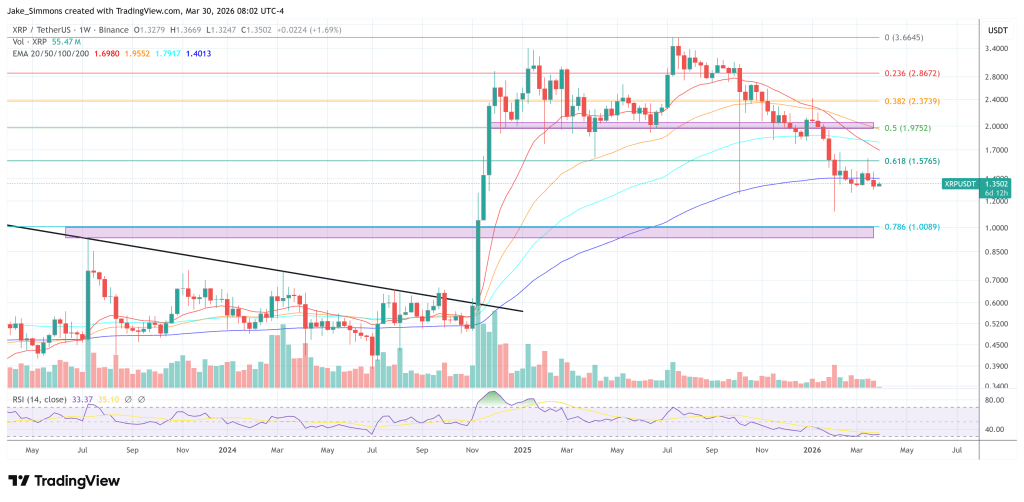
At press time, XRP traded at $1.35.

XRP price chart
XRP falls below the 200-week EMA again, 1-week chart | Source: XRPUSDT on TradingView.com

Featured image created with DALL.E, chart from TradingView.com

Editorial Process for bitcoinist is centered on delivering thoroughly researched, accurate, and unbiased content. We uphold strict sourcing standards, and each page undergoes diligent review by our team of top technology experts and seasoned editors. This process ensures the integrity, relevance, and value of our content for our readers.
Aave launches v4 on Ethereum, aiming to expand DeFi Into real-world credit markets

0

Aave, one of the largest decentralized lending platforms, debuted its long-awaited v4 upgrade on Ethereum, aiming to push DeFi beyond crypto trading and into broader financial markets.

The upgrade has been in development for about two years and is designed to make it easier to use Aave for a wider range of lending and borrowing activities, including those tied to real-world assets.

The introduction follows months of internal debate over governance and value flow through the protocol. Disputes over interface fees, contributor roles and proposals to redirect product revenue to the decentralized autonomous organization (DAO) have highlighted tensions between decentralization and coordination, even as the work progressed.

At a basic level, v4 changes how Aave organizes its markets. Instead of grouping everything together, the new system allows different types of lending markets to operate separately while still sharing the same pool of funds.

That means users could eventually borrow and lend against more than just crypto tokens.

For Aave Labs founder Stani Kulechov, the shift reflects a broader change in how decentralized finance is evolving. “Lending is based on trust… you need lending conditions that reflect market conditions,” he said in an interview with CoinDesk.

The upgrade is designed to better handle that complexity. By separating different market types while sharing liquidity, Aave aims to support everything from traditional crypto lending to more complex situations like institutional borrowing and real-world assets.

It also opens the door for others to build on top of the protocol more easily.

“It also means that other teams can come and build and expand that infrastructure,” Kulechov said.

Another goal is to make better use of the capital already in the system.

“There’s some technical improvements where the float … can be reinvested,” Kulechov said, referring to idle funds that can now be deployed more efficiently.

The new version went live with a limited set of markets and conservative settings. More features are likely to be added following governance decisions.

“DeFi is stronger than ever,” Kulechov said. “A lot of these opportunities will come from value outside of DeFi.

Read more: Aave labs proposes ‘Aave Will Win’ plan to send 100% of product revenue to DAO

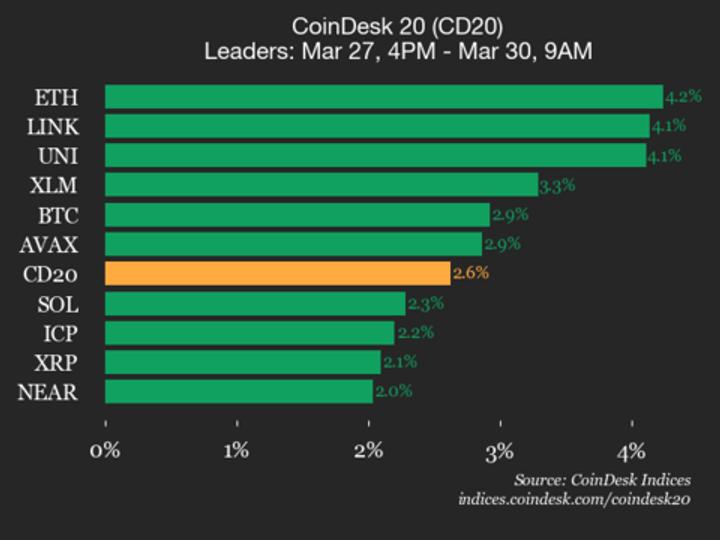
CoinDesk 20 performance update: Ethereum (ETH) price rises 4.2% over weekend

0

Chainlink (LINK) joined Ethereum (ETH) as a top performer, up 4.1% since Friday.

Russia’s developed a cure for its economic headache — but there’s a catch

0

With the Russian economy in the grips of an economic slowdown, the Kremlin has devised a silver bullet – in the shape of the digital ruble.

But there’s just one problem ahead of the coin’s September 1 rollout: Nobody wants to use it.

“I won’t be going anywhere near the digital ruble,” said Dima, a Moscow resident who asked DL News to withhold his surname. “What good could it possibly do me?”

Dima isn’t alone. Conspiracy theory-type videos about how the government plans to spy on citizens with the digital ruble have been circulating for years, even on Russia’s heavily censored social media platforms.

Russia’s conundrum comes as a warning to central banks all over the world that look to create blockchain-based versions of fiat currencies. The EU says a digital euro will help it unlock the potential of tokenised markets, while China has also unveiled ambitious plans to revamp its own digital yuan project.

But public support for central bank digital currency projects remains frighteningly low everywhere from Boston to Brussels.

Lack of appetite

A poll last year found that 51% of Russians are unwilling to adopt the digital ruble, with only just over a third saying they were even willing to “try” using it once.

Only 7% said they felt they’d been “well-informed” about the project by the central bank.

Bankers are just as vocal about their disdain for the CBDC launch.

“As an individual, I don’t understand why we need a digital ruble,” German Gref, the CEO of Sberbank, Russia’s biggest bank, said last year. “And as a bank [CEO], I don’t yet understand the need for this very well either.”

However, there are signs the banking sector may eventually come around to the Kremlin’s way of thinking.

“There’s zero enthusiasm for the digital ruble in the Russian banking world right now. Most agree with Mr Gref on this front,” an employee at a Russian bank told DL News on condition of anonymity. “But there’s more at play than just the domestic picture. If the CBDC somehow makes cross-border trading easier for Russian companies, we bankers will probably change our tune rather quickly.”

Adoption solutions

The central bank is acutely aware it faces an adoption problem. That’s why it has taken a tough stance on the matter.

While citizens will be free to choose whether or not they want to use the digital ruble, the same won’t be true for businesses.

The regulator has demanded that all major banks and retailers start offering their clients CBDC services starting September 1.

Medium-sized banks and stores will have an extra year to follow suit, with the rest ordered to comply by 2028.

Will this heavy-handed approach to CBDC adoption work? The jury is out, say experts.

“There’s a demand-side vacuum,” Yuriy Brisov, a legal expert and a partner at the consultancy Digital and Analogue Partners, told DL News. “Russia already has one of the most advanced cashless payment ecosystems in the world. The digital ruble solves no problem that Russian consumers actually experience.”

Fighting corruption

The Russian central bank aims to fix two major problems with the digital ruble. The first is corruption.

Russian Ministry of Internal Affairs statistics show the number of bribery-related crimes shot up by 25% year-on-year in 2025, reaching an all-time high. The ministry counted a total of 107,200 economic crimes last year, resulting in material damages worth almost $5 billion.

The digital ruble will provide Russia with “one of its most important tools in the fight against corruption and financial crime,” Anatoly Aksakov, head of the State Duma’s committee on the financial markets, told Russian newspaper Rossiyskaya Gazeta earlier this year.

The security and transparency of the digital ruble, combined with smart contract technology, will help cut bribable people out of the loop, Aksakov said.

The central bank is also looking to use the digital ruble to track budget spending.

“The state will know exactly where its budget funds are being spent,” Aksakov said.

Busting sanctions

The other major issue plaguing the Russian economy is economic sanctions.

After several years of positive growth, the Kremlin has recently admitted that Russia’s GDP in January 2026 decreased by 2.1% year-on-year, with the sanctions-ridden oil and gas sector’s revenues falling to their lowest levels since 2020.

The Kremlin and the central bank had to act fast after Washington severed Russian banks’ access to the interbank messaging platform SWIFT and froze state-linked dollar accounts.

Russia’s economic gurus have launched domestic analogues to SWIFT and a whole host of other global trading infrastructure. But all these advances still don’t do away with the need for the dollar. Or at least, not yet.

The ruble, the yuan, the rupee — experts say none of these currencies has a capitalisation high enough to function as a reserve currency.

The digital ruble, however, could bypass the need to use a reserve currency in the first place, by allowing Russia and its partners to effectively trade using their own currencies.

“Cross-border settlements to bypass SWIFT restrictions are the real use case [for the digital ruble],” Yuriy Brisov, a legal expert and a partner at the consultancy Digital and Analogue Partners, told DL News. “But the central bank cannot easily market a sanctions-circumvention tool as a consumer product.”

Using CBDC interoperability platforms, such as the China-led mBridge solution, could let Russian traders pay for goods using the digital ruble — and Chinese vendors could receive payments in digital yuan.

Firms have already used the mBridge platform to conduct over $55 billion worth of trade deals. Both China and India, Russia’s biggest trading partners, are fast-tracking their own CBDC projects, with a view to using them in cross-border trade. The same is true of Russia’s closest local allies, including Belarus and Kazakhstan.

But as grand as Moscow’s digital ruble plans are, they may still come to naught if the public remains opposed to using the new coin.

Tim Alper is a News Correspondent at DL News. Got a tip? Email him at tdalper@dlnews.com.

Record-high Oil Prices May Precede Bitcoin Price Crashes

0

Historical data shows Bitcoin bear markets deepening when oil prices rally to record highs. Will Monday’s $105 WTI price lead to a BTC crash?

Key takeaways:

  • $105 WTI crude often triggers Bitcoin price corrections, with history showing a 14% to 27% sell-off within weeks.

  • The BTC to oil correlation remains uncertain as events like Mt. Gox and the Terra-Luna collapse likely deepened previous crypto bear markets.

Oil prices surged to $105 on Monday, reaching their highest level in nearly four years. Historically, this specific threshold has aligned with major Bitcoin (BTC) price corrections. However, since these occurrences only took place once in 2014 and twice in 2022, a more granular analysis is required to determine if current market fears are justified.

Are $105 oil prices a bearish signal for Bitcoin?

On June 12, 2014, West Texas Intermediate (WTI) climbed above $105 after the Islamic State (ISIS) advanced into northern Iraq and captured Mosul and Tikrit.

Bitcoin/USD (blue, left) vs. WTI oil (red, right). Source: TradingView

While the price action in the first week was muted, Bitcoin faced a 21% correction in less than 10 weeks, falling to $468 from $600. It would take over two years for Bitcoin to reclaim the $600 level. The next instance would happen almost 8 years later. On March 1, 2022, WTI prices surged above $105 following the escalation of the Russia-Ukraine war.

Bitcoin/USD (blue, left) vs. WTI oil (red, right). Source: TradingView

Bitcoin price faced a 14% correction within seven days, trading down to $38,100 from $44,370 on March 1, 2022. However, the losses were entirely reversed within less than a month, despite oil prices remaining above the $105 level. 

2022 Russian oil embargo’s impact on Bitcoin price

The most recent instance of WTI oil prices surging above $105 occurred on May 4, 2022, after the European Commission formally proposed a phased-in embargo on all Russian oil imports.

Bitcoin/USD (blue, left) vs. WTI oil (red, right). Source: TradingView

Bitcoin prices faced a steep 27% crash over the next 7 days, and investors endured a much longer bear market as its price entered a 19-month bear market before finally reclaiming the $39,700 level. While oil prices remained below $100 for several years, they returned to triple digits this week.

Related: Hyperliquid whale opens $53M Bitcoin short: Should traders take notice?

US President Donald Trump said that his preference would be for the US to control the oil industry in Iran “indefinitely,” according to Yahoo Finance. While $105 oil is seen as a bearish sign for Bitcoin, three events in 12 years do not prove a correlation.

Other factors, like the Mt. Gox exchange liquidation in February 2014 and the Terra-Luna ecosystem collapse in May 2022, likely caused those prolonged bear markets. Thus, pinning a Bitcoin crash on an arbitrary oil price threshold seems far-fetched.