Nishad Singh, the former head of engineering at FTX, will pay $3.7 million to resolve his case with the US commodities regulator over his alleged role in the collapse of the crypto exchange and the misappropriation of user funds.
As part of the supplemental consent order, Singh will be required to pay a disgorgement of $3.7 million and imposes a five-year ban on trading in markets and an eight-year registration ban, blocking him from obtaining a license to operate in the sector, the US Commodity Futures Trading Commission (CFTC) said in a statement on Wednesday.
“The initial consent order and supplemental consent order resolve the CFTC’s enforcement action against Singh,” it added.
FTX’s bankruptcy in November 2022 sent shock waves through the crypto industry, erasing billions in market liquidity, shattering user confidence and prompting authorities to accuse its leadership of fraud.
David Miller, the CFTC’s director of enforcement, ruled out additional restitution or civil monetary penalties for now and said the current penalties reflect Singh’s cooperation with authorities.
“The defendant engaged in, and aided, significant violations of the Act and CFTC regulations as the former FTX head of engineering, and the consent orders reflect the severity of these violations,” Miller said.
Source: US Commodity Futures Trading Commission
“But this resolution also reflects the Commission’s commitment to rewarding and incentivizing material assistance in Division investigations,” he added.
Singh charged by multiple agencies after FTX collapse
Attorneys for Singh said he was grateful this latest matter was at an end, and were “pleased that the CFTC recognized our client’s limited role in the underlying conduct and his extensive cooperation,” according to Bloomberg.
The CFTC accused Singh of personally misappropriating millions of dollars in assets and charged him in February 2023 with two counts: fraud by misappropriation and aiding and abetting fraud committed by former FTX CEO Sam Bankman-Fried.
Related: FTX Recovery Trust to distribute $2.2B to creditors in March
In April 2023, Singh entered into the consent order, was found liable for the charges and agreed to cooperate with the commission’s investigators. The regulator originally sought a range of penalties, including restitution, civil monetary penalties and permanent trading and registration bans.
In a separate case brought by the Securities and Exchange Commission in February 2023, Singh was accused of misusing customer funds and committing fraud by misappropriation, in violation of securities laws. The case was settled in December with Singh receiving an eight-year industry ban.
After FTX collapsed, US prosecutors also indicted Singh and four of his colleagues on charges including fraud and campaign finance violations. He faced decades in prison if found guilty, but after testifying against Bankman-Fried and cooperating with prosecutors, he received time served and three years of supervised release.
Magazine: Ripple joins Singapore sandbox, Bhutan’s big Bitcoin selloff: Asia Express
Cointelegraph is committed to independent, transparent journalism. This news article is produced in accordance with Cointelegraph’s Editorial Policy and aims to provide accurate and timely information. Readers are encouraged to verify information independently. Read our Editorial Policy https://cointelegraph.com/editorial-policy
Changpeng Zhao addressed quantum computing concerns, stating the crypto industry can upgrade to quantum-resistant algorithms to mitigate threats.
Binance co-founder Changpeng Zhao posted on X on April 1, 2026, addressing growing concerns about quantum computing’s threat to cryptocurrency. CZ stated that the crypto industry can upgrade to quantum-resistant, or post-quantum, cryptographic algorithms to neutralize the risk, urging users not to panic over the potential threat.
CZ emphasized that upgrading to post-quantum algorithms is straightforward in theory, though he did not detail specific timelines or implementation plans. His comments come as debates persist in the crypto community about which protocols and assets—including Bitcoin’s original coins—may be vulnerable to quantum computing advances.
Sources: CZ (Changpeng Zhao) on X | BeInCrypto
This article was generated automatically by The Defiant’s AI news system from publicly available sources.
Open banking is creating new opportunities across financial services, but questions remain over how widely institutions can participate as frameworks mature and delivery demands grow.
Here, Irfan Ahmed, regional business solutions director at global payments solution provider BPC, explores why the next challenge may lie less in regulation itself and more in the capacity institutions have to build, support and scale API connectivity.
Irfan Ahmed, regional business solutions director, BPC
Open banking is becoming bigger, broader and more operationally demanding. That change is playing out in different forms across markets.
In the UK, open banking now supports more than 17 million active user connections, with £8.3 billion in cumulative value already delivered across payments, savings, lending and accounting.
In Australia, the Consumer Data Right now covers almost every consumer account, and attention has shifted to whether institutions have the tools to make use of it. In the UAE, open finance is being built around mandatory participation, service initiation and shared infrastructure rather than narrow data access alone.
Much of the discussion so far has centred on regulation, standards and rollout timetables. The harder part starts inside the institution once those frameworks have to be turned into working services.
Some banks can support the ongoing task of building, maintaining and monitoring API integrations. Others struggle to keep pace once the workload becomes continuous. That gap usually shows up in the day‑to‑day work of onboarding partners, supporting new versions and meeting regulatory updates.
Where the real pressure sits
The strain becomes clearer once API delivery stops being a project and starts becoming part of normal operations. It turns into a steady flow of updates, onboarding, monitoring and support running alongside core system change, digital channels and regulatory deadlines. It touches multiple product teams and quickly becomes part of everyday operations.
Even institutions with established digital teams feel it once they move beyond a small number of connections. For mid‑tier banks and fast‑growing players, it tends to surface earlier.
Most teams are not short of ideas or intent. What they lack is the time and capacity to turn those ideas into live, reliable services while keeping everything else running. That constraint plays a big part in determining how widely institutions can participate.
Why capacity shapes participation
The banks with the capacity to support ongoing API work tend to move faster. They can take on new connections, respond to regulatory updates and bring new services to market without forcing trade‑offs elsewhere. For everyone else, progress depends on what can be fitted around core system work, digital channels and mandatory change.
That difference shows up in delivery timelines. Some institutions can move from idea to live service in months; others take far longer, not because the ideas are weaker but because the teams behind them are already stretched. The gap between what banks want to offer and what they can realistically deliver starts to widen.
Capacity affects more than timing. It changes what gets built in the first place. Banks with more room can try a broader range of use cases and respond faster when customer or partner demand shifts. Banks under tighter delivery pressure tend to cut the list much earlier. The safer projects move first. The more speculative ones wait.
That is how participation starts to narrow. Institutions with more delivery capacity move first, and the gap widens as the workload grows.
How participation broadens
If open banking is going to reach more institutions, the delivery work needs to be easier to take on. Low‑code and no‑code tools help by turning API delivery into something product teams can configure and manage without relying on large engineering groups. They reduce the amount of bespoke build work and make it possible to support more connections with the same resources.
API banking-as-a-service takes that a step further. Instead of every bank maintaining its own integrations, versioning and monitoring, much of that operational work sits in a managed layer. Institutions can focus on the services they want to offer rather than the mechanics of keeping each connection running.
Most teams can manage the first few use cases. The pressure builds once the work becomes continuous: new partners to onboard, new versions to support, new requirements to meet. At that point, progress depends less on appetite and more on how much capacity can be freed from other programmes.
Australia’s own ecosystem reporting points in the same direction: once coverage is in place, the harder task becomes turning that framework into something simpler to use and easier to build on.
Participation widens when the delivery work becomes manageable for more than the largest players. Regulation can set direction, but easier deployment and lower operational overhead are what allow more institutions to take part.
In our work with banks and fintechs, the institutions that make faster progress are usually the ones that reduce the amount of bespoke integration work from the start. They give teams a workable way to test early, avoid turning every new connection into a separate engineering project, and make ongoing API support easier to manage across the business.
BPC delivery models
That is also the logic behind the delivery models BPC has invested in through SmartVista. The platform has been shaped by a long-standing focus on technological excellence, but also by a practical understanding that large upfront investments in hardware, databases and proprietary platforms can limit participation.
For many institutions, especially smaller and mid-tier players, the challenge is not only whether they want to take part in open banking, but whether they can do so without adding another layer of costly infrastructure and operational complexity.
And to address that, BPC has steadily moved SmartVista towards a cloud-friendly, modular architecture built around microservices and containerisation and with wide set of APIs. With cluster-based deployment through Kubernetes and OpenShift, institutions gain a delivery model that makes systems easier to deploy, update and scale, while also improving fault tolerance, resilience and disaster recovery.
The same thinking shapes BPC’s open API layer. SmartVista has been strengthened through a unified Open API framework, aligned with internal technical requirements and industry standards. Combined with sandbox environments, low-code/no-code integration tools and supporting SDKs, that gives banks, fintechs and third-party providers a faster path to integration and a more manageable way to support API connectivity over time.
It also supports an API banking-as-a-service model for business teams, backed by an integration engine with API management, configurable workflows, third-party onboarding and integration with strong customer authentication solutions. The platform provides the infrastructure needed for PSD2 and UK open banking, while enabling secure extension into fintech, e-commerce, e-government and other domains.
The result is a lighter delivery model, with faster testing, fewer operational bottlenecks and more room to add services and connections without forcing the same level of engineering effort for every new use case.
What open finance needs next
If open banking and open finance are going to spread beyond the institutions with the deepest technology benches, the delivery model has to widen too. Regulation can open the door, but participation depends on whether institutions can step through it without building every layer from scratch.
That is what will decide whether open finance becomes a genuinely broad market or remains concentrated among the banks and fintechs with the biggest engineering teams. The next phase depends on making participation easier to deliver, easier to support and easier to scale.
Low‑code tools, no‑code workflows and managed service models are part of what makes that broader participation possible.
Ripple on Thursday introduced native digital asset capabilities inside its enterprise treasury management system, letting corporate finance teams hold, view and manage XRP and RLUSD alongside traditional fiat balances for the first time within a single platform.
The two features, called Digital Asset Accounts and Unified Treasury, are built on GTreasury, which Ripple acquired in 2025. That system processed $13 trillion in payments volume last year for clients ranging from small businesses to Fortune 500 companies. The digital asset layer adds to that existing infrastructure rather than replacing it.
Digital Asset Accounts let treasury teams create a Ripple-native digital asset account inside the platform. Balances in XRP, RLUSD, and other supported tokens appear alongside cash positions with real-time fiat valuations using live exchange rates.
Transactions are recorded automatically with native notional amounts, fiat equivalents, and market price at the time of each event, creating an audit trail without manual entry. The system captures balances at 15-decimal precision to match on-chain accuracy and eliminate rounding discrepancies that cause reconciliation problems.
Unified Treasury connects digital asset holdings from multiple external custodians through the same API connectivity layer Ripple Treasury already uses for bank integrations.
“Digital assets have arrived at the CFO’s desk, and the question has shifted from whether to engage to how to do so without disrupting existing operations,” said Renaat Ver Eecke, SVP at Ripple Treasury.
The launch positions Ripple Treasury ahead of competing TMS providers, none of which currently offer native digital asset management.
Ripple said the two features are the first in a broader digital asset framework that will expand to cross-border settlement, intercompany payments, and overnight yield on idle cash through repo markets, all powered by stablecoins.
Trusted Editorial content, reviewed by leading industry experts and seasoned editors. Ad Disclosure
XRP is struggling to push above current levels. The market is uncertain. And the chart is not offering any comfort — three moving averages sit above the current price, each one a layer of resistance the market has not found the strength to challenge.
A CryptoQuant report tracking XRP’s technical structure on Binance has produced a reading that leaves little room for interpretation. The 30-day moving average stands at approximately $1.40. The 90-day moving average sits near $1.64. The 200-day moving average is at $2.06. The current price is below all three — not approaching them, not testing them, but trading beneath each one simultaneously across the short, medium, and long-term timeframes.
That alignment has a name in technical analysis. It is a bearish stack — a configuration in which every major trend reference the market uses to orient itself is pointing in the same direction. Sellers are in control across every timeframe. Buyers have not demonstrated the sustained demand required to reclaim even the nearest average.
The first threshold that matters is $1.40. Not because reclaiming it resolves the situation — it does not — but because without it, the medium and long-term averages above remain irrelevant. The recovery, if it comes, must start there.
XRP Cannot Fix Its Own Chart. It Needs Bitcoin to Help.
The report adds a dimension to the technical picture that the moving average structure alone cannot capture. XRP’s correlation with Bitcoin currently stands at approximately 0.87 — a reading that describes near-total directional alignment between the two assets. XRP is not trading on its own fundamentals, its own on-chain developments, or its own demand dynamics in any meaningful independent sense. It is trading as a high-beta expression of wherever Bitcoin goes next.
Binance XRP Correlation & Moving Average | Source: CryptoQuant
That dependency cuts both ways, and the report names both directions honestly. If Bitcoin continues to struggle — capped below $70,000, under whale selling pressure, lacking upside momentum — that weakness will transmit directly to XRP, adding a second layer of downward force on top of an already bearish technical structure. If Bitcoin stages a sustained rally, that momentum will carry XRP with it, potentially providing the external catalyst the chart cannot generate internally.
The verdict the report delivers is unambiguous. XRP remains under clear technical pressure. The downtrend is continuing. Sellers are in control across every timeframe. Nothing in the current data suggests that the condition is about to change on its own.
The one number that changes the conversation is $1.40. Reclaiming the 30-day moving average does not end the downtrend. It signals, for the first time, that the momentum behind it may be slowing — and that is the only first step available from here.
XRP Tests Breakdown Zone as Long-Term Structure Weakens
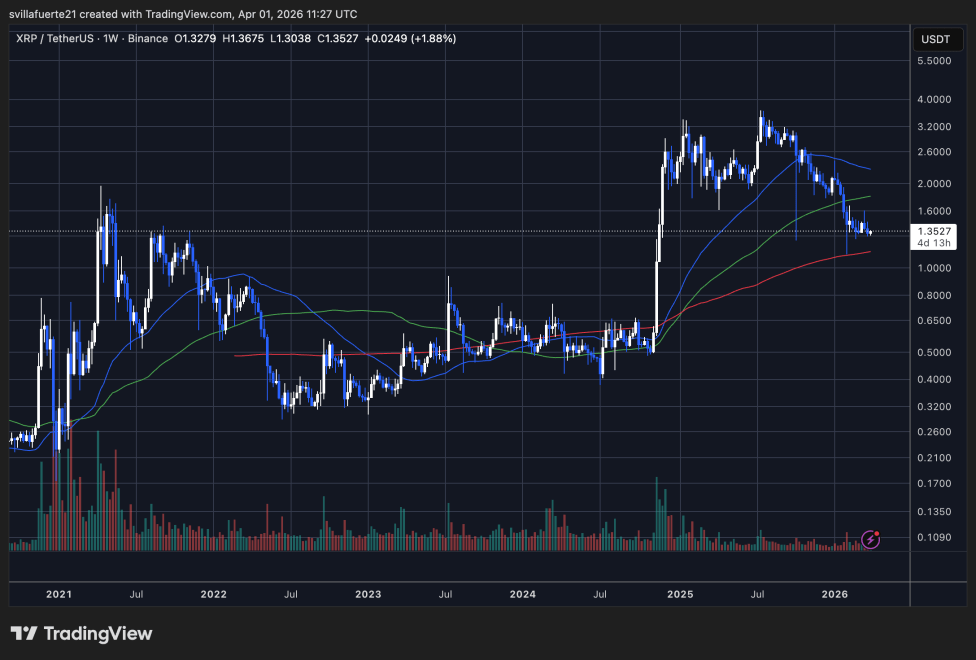
On the weekly timeframe, XRP is now trading near $1.35 after a sharp rejection from the $3.00–$3.50 region, confirming a decisive loss of bullish momentum. The chart shows a clear transition from expansion to distribution, followed by a breakdown that has brought price back into a historically significant range.
XRP consolidates around a critical level | Source: XRPUSDT chart on TradingView
Price is currently sitting below the 50-week moving average, which has started to slope downward, signaling weakening short-term structure. The 100-week moving average is also above the current price and flattening, while the 200-week moving average remains lower but is now the next key support to monitor. This alignment reflects a market that is no longer trending upward and is instead attempting to find a new equilibrium.
The rejection from the recent highs was accompanied by increased volume, suggesting strong participation during the distribution phase. In contrast, the current consolidation is occurring with relatively lower volume, indicating reduced conviction from both buyers and sellers.
Importantly, XRP is now testing a zone that previously acted as resistance during 2021–2022 and later flipped into support. Whether this level holds will likely determine the medium-term direction. A sustained break below could open the path for a deeper retrace, while stabilization here may form the basis for a longer accumulation phase.
Featured image from ChatGPT, chart from TradingView.com
Editorial Process for bitcoinist is centered on delivering thoroughly researched, accurate, and unbiased content. We uphold strict sourcing standards, and each page undergoes diligent review by our team of top technology experts and seasoned editors. This process ensures the integrity, relevance, and value of our content for our readers.
The Central Bank of Nigeria has officially launched an anti-money laundering and counter-financing of terrorism supervisory pilot program. The new pilot is designed to align Nigeria with the Financial Action Task Force (FATF) Recommendations 15 and 16—specifically the travel rule, which requires virtual asset service providers to share originator and beneficiary information for transactions.
Only a few years ago, the Nigerian crypto landscape was defined by friction. In February 2021, the CBN effectively barred commercial banks from servicing crypto exchanges. However, following the lifting of that ban in December 2023 and the subsequent enactment of the Investments and Securities Act of 2025, the focus has shifted from exclusion to integration.
According to a press release, the CBN has handpicked a select group of fintech and crypto entities to participate in this initial phase. These include the Africa Stablecoin Consortium, Flutterwave, Juicyway, Koinkoin, Kucoin and Paystack. However, the CBN was careful to note that participation “does not confer any regulatory status, approval, or licensing right.” Instead, it is a controlled and structured environment for the bank to study business models and operational risks.
Under the pilot, participating VASPs are obliged to submit monthly data on AML/CFT performance and undergo audits of customer onboarding, sanctions screening and transaction monitoring. They must also demonstrate credible plans to track cross-border digital asset flows.
“The Pilot is designed to develop a structured understanding of AML/CFT/CPF risks, business models, and operational practices across participating entities,” the CBN stated. “It also supports VASPs in strengthening their AML/CFT/CPF frameworks in line with emerging supervisory expectations.”
The bank emphasized that all data collected will be protected under the Nigeria Data Protection Act of 2023.
By bringing exchanges like Kucoin and payment giants like Flutterwave into a formal supervisory loop, the CBN aims to weed out bad actors while ensuring that Nigeria—one of the world’s most active crypto markets—remains a stable node in the global financial system.
The CBN has already scheduled subsequent phases of the pilot, though it confirmed these are not open to external expressions of interest at this time.
FAQ ❓
What did the CBN launch? Nigeria’s central bank introduced an AML/CFT supervisory pilot program.
Which FATF rules apply? The pilot aligns with FATF Recommendations 15 and 16, including the Travel Rule.
Who is participating? Selected fintechs and crypto firms like Flutterwave, Kucoin, Paystack, and others joined.
What is the goal? The program tests compliance, data reporting, and risk controls to strengthen Nigeria’s crypto oversight.
Yellow Network co-founder Alexis Sirkia has challenged the traditional token generation event (TGE) playbook by launching the $YELLOW token directly on the company’s own infrastructure, bypassing the industry-standard multi-exchange listing model.
In an interview with The Fintech Times, Sirkia, who serves as the “Captain” of the broader Yellow ecosystem, explained that the current exchange-led distribution model suffers from structural flaws where liquidity remains siloed and fragmented across isolated protocols.
“The core flaw in the current model is that liquidity is siloed,” said Sirkia. He noted that market makers currently manage liquidity separately on each venue, creating inefficiencies and hidden counterparty risks. To address this, Yellow introduced a Layer-3 trustless clearing layer that connects participants in a unified network using state channels for off-chain trading and secure on-chain settlement.
This shift toward what Sirkia calls “TrustFi” intends to improve capital efficiency by removing the need for market makers to park assets on multiple exchanges. “Market makers can provide deep liquidity across the entire ecosystem without ever giving up custody of the assets,” Sirkia added, highlighting that this non-custodial approach addresses the primary concerns of institutional players regarding asset control.
The launch also serves as a strategic move to avoid the common “liquidity trap,” where high initial valuations and low circulating liquidity often lead to aggressive post-launch sell-offs. By launching on yellow.pro, the network aims for more sustainable price discovery similar to the early days of Bitcoin. As part of this long-term alignment, Yellow returned more than US $8 million of external VC investment to ensure the token supply remains with genuine users and builders rather than short-term speculators.
While the self-hosted launch presents engineering challenges regarding speed and reliability, Sirkia views the event as a certification moment to prove the infrastructure can handle high-volume market conditions. Looking ahead, he envisions a change in market structure where centralized exchanges function primarily as retail on-ramps, while the bulk of institutional clearing moves to decentralized networks.
“It is about extending the foundational principles of Bitcoin being trustless and non-custodial to everyday, high-frequency financial applications,” Sirkia concluded.
Trusted Editorial content, reviewed by leading industry experts and seasoned editors. Ad Disclosure
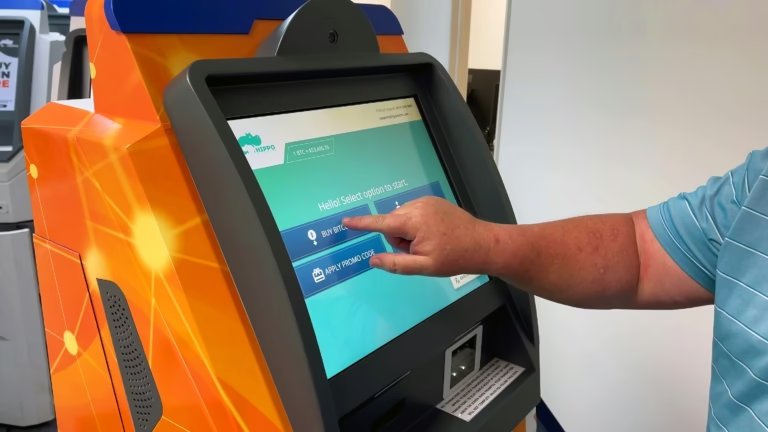
Haverhill, Massachusetts, is moving toward a citywide ban that would force all crypto ATMs and kiosks out within 60 days, with operators facing $300 daily fines if they do not comply.
The proposal also gives the city a hard line on a problem officials say has already led to fraud complaints, money laundering concerns, and little practical recourse for users who lose money.
Council Vote Puts Ban On Track
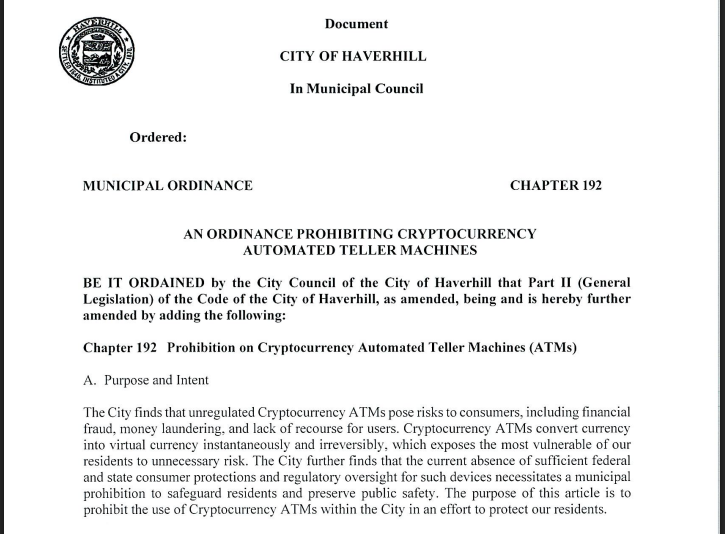
The ordinance was introduced on March 17 by Mayor Melinda E. Barrett and cleared an initial City Council vote 11-0, putting it on the council’s agenda for further review.
According to the city’s agenda, the measure would amend local code to prohibit cryptocurrency ATMs altogether. City officials said they see the lack of state and federal rules as a reason for local action.
The move places Haverhill in a growing group of US communities taking aim at crypto kiosks after reports of scams and other illegal activity.
Source: Haverhill City Council
In Minnesota, a lawmaker introduced a bill in February that could ban crypto kiosks, building on a 2024 law that already imposed limits on ATM operators.
Haverhill’s proposal does not stand alone; it fits a pattern that has been spreading city by city and state by state.
Crypto ATMs are often marketed as a simple way to buy digital assets, but local officials have increasingly treated them as a weak point in consumer protection.
In Haverhill’s case, the city said users may have little ability to recover funds once a transaction is complete. That concern was central to the proposed ordinance, which framed the machines as a risk to residents rather than a convenience for them.
BTCUSD now trading at $68,494. Chart: TradingView
Bitcoin Depot Faces Rising Pressure
The proposed ban also lands at a rough time for Bitcoin Depot, one of the largest crypto ATM operators in the US. The company’s stock has fallen more than 90% over the past six months and was trading at $2.06 on Nasdaq on Tuesday, according to the report.
Haverhill-area data from CoinATMRadar and Bitcoin Depot pointed to eight or more machines in the local area.
Bitcoin Depot has been dealing with pressure on several fronts. Connecticut banking regulators issued a temporary cease-and-desist order in March, which effectively suspended its money transmission license.
Authorities in Iowa and Massachusetts have also sued the company, accusing it of helping facilitate crypto scams.
Featured image from Unsplash, chart from TradingView
Editorial Process for bitcoinist is centered on delivering thoroughly researched, accurate, and unbiased content. We uphold strict sourcing standards, and each page undergoes diligent review by our team of top technology experts and seasoned editors. This process ensures the integrity, relevance, and value of our content for our readers.
The U.S. and allies have intensified military actions against Iran, causing the odds of a US-Iran ceasefire by April 7 to drop to 8% YES, down from 26% a week ago.
Traders are losing confidence in a ceasefire soon. The April 7 ceasefire market is nearly inactive at 8% YES. The April 15 and April 30 markets are also bearish, at 18% and 38% YES. New military actions suggest a slim chance for a ceasefire.
The US forces entering Iran by April 30 market holds at 52% YES, indicating possible further escalation. The Iranian regime fall by June 30 market is at 10.5% YES, reflecting slight expectations of regime instability after Supreme Leader Ali Khamenei’s assassination.
Trading volume shows $205,330/day in the ceasefire market, with $15,138 needed to move the price 5 points, indicating moderate market activity. The forces entering Iran market is more active, with $1.97M traded daily and $37,215 required for a 5-point move, suggesting significant bets.
Military actions may not signal a major conflict shift. Current odds suggest a bleak ceasefire outlook but might overstate immediate ground troop involvement. A YES share for an April 7 ceasefire pays $1 at just 8¢, offering a 12.5x return if diplomacy unexpectedly advances.
Watch for CENTCOM updates and diplomatic moves from Oman or Qatar for signs of easing tensions.
Markets Impacted
Get prediction market intelligence as a structured API feed. Early access waitlist.
Caltech researchers estimate a working quantum computer could be operational before 2030 using far fewer qubits than previously thought, as crypto industry assesses vulnerability exposure.
Researchers at Caltech announced that a functional quantum computer may be feasible by 2030, requiring only 10,000 to 20,000 qubits rather than the millions previously estimated. The revised timeline comes as Google’s Quantum AI team identified approximately 6.9 million BTC as potentially vulnerable to quantum attacks, though no such capable machine currently exists.
The Caltech findings suggest the crypto industry faces a compressed timeline to develop quantum-resistant security measures. Bitcoin and other cryptographic systems relying on current encryption standards could face theoretical attack vectors once quantum computers reach the projected capability threshold, prompting ongoing discussions about protocol upgrades and post-quantum cryptography adoption.
Sources: BSCNews
This article was generated automatically by The Defiant’s AI news system from publicly available sources.