Home Blog Page 591

Trump’s Iran diplomacy post jolts crypto markets higher as equities wobble

0

Donald Trump posted about “serious discussions” with Iran’s new regime on Truth Social Monday, and crypto markets responded the way crypto markets do — by going up while everything else went sideways.

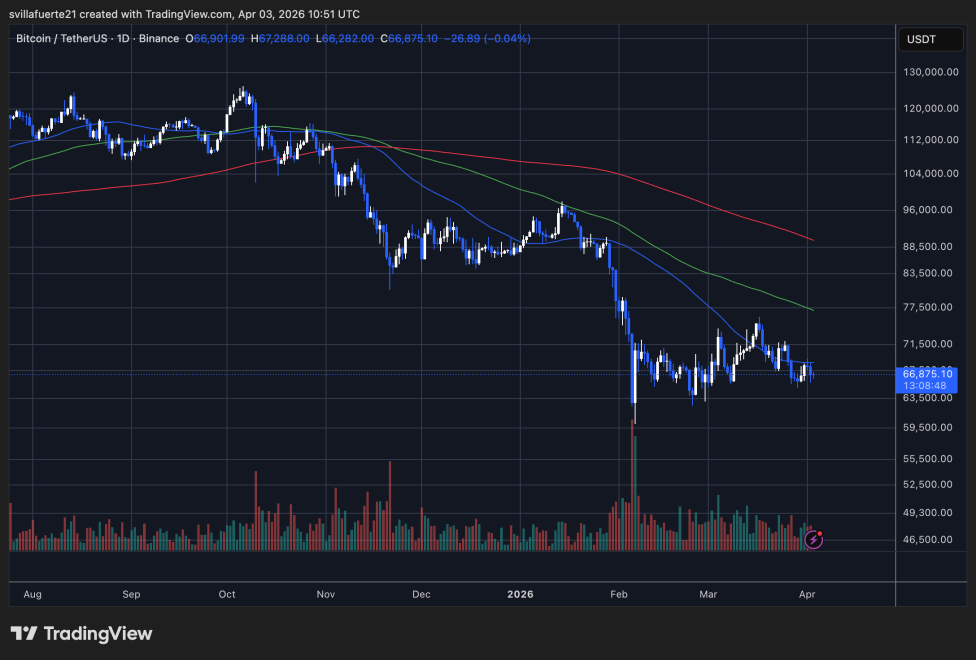
Bitcoin jumped 2.2% in 24 hours to approach $68K, Ethereum surged 4.4% past $2,070, and Solana gained 3.4% toward $84. Meanwhile, equities wobbled like a shopping cart with a bad wheel, unsure whether to price in diplomacy or escalation.

The post that moved markets

Here’s the thing about Trump’s Truth Social dispatches: they’ve become their own asset class of volatility. Monday’s entry was a masterclass in mixed signals.

The post claimed productive engagement with Iran’s new regime, framing it as a diplomatic opening. But Trump being Trump, it came packaged with an explicit threat to obliterate Iran’s energy infrastructure if negotiations stall.

Carrot and stick, except the stick is a cruise missile aimed at oil refineries.

For traditional markets, this kind of ambiguity is poison. Equity traders have to model both scenarios — a deal that eases Middle East tensions and a confrontation that disrupts global energy supply chains. The result was predictable indecision, with major indices struggling to find direction.

Crypto, operating on a different emotional frequency entirely, chose optimism. Or at least chose to buy the dip that had been building for the prior week. Bitcoin’s 24-hour gain of 2.2% looks modest until you consider it came after a brutal 5.1% decline over the preceding seven days. The bounce felt less like conviction and more like a market catching its breath.

The numbers behind the bounce

Let’s put some context around these moves. Bitcoin near $68K represents a recovery from what had been an uncomfortable slide. At $68K, BTC sits roughly 8% below its all-time high — close enough to smell it, far enough to be annoying.

Ethereum’s 4.4% daily gain was the standout performer among the majors, pushing above $2,070. That’s a notable move for an asset that has spent much of 2025 underperforming Bitcoin on a relative basis. ETH catching a stronger bid than BTC on a geopolitical catalyst is worth watching — it could signal renewed risk appetite further out on the curve.

Solana climbed roughly 3.4% to approach $84, while XRP held steady near $1.34. Across the broader market, algorithmic stablecoins had the best week of any category, gaining 21.8% over seven days — a stat that says more about rotation into niche narratives than any macro thesis.

But here’s the number that should give everyone pause: the Fear and Greed Index sits at 8. That’s “Extreme Fear” territory, and it’s been parked there for at least a week. In English: despite Monday’s green candles, the broader market mood remains deeply pessimistic. The last time sentiment was this grim for this long, it coincided with either a major bottom or the prelude to further pain. Historically, readings below 10 have been rare, occurring during events like the FTX collapse in November 2022 and the COVID crash in March 2020.

A single-day bounce on a geopolitical headline doesn’t cure that kind of structural anxiety.

Why crypto reacted differently than stocks

The divergence between crypto and equities on this news is actually the most interesting part of the story. Traditional markets have to care about oil prices, defense spending, and the second-order effects of Middle Eastern diplomacy. Crypto doesn’t — or at least pretends not to.

What crypto does care about is dollar weakness, liquidity expectations, and risk-on sentiment. And here’s where Trump’s Iran post gets interesting for digital assets specifically. If diplomacy succeeds, it could ease global tensions that have been supporting dollar strength and energy prices. A weaker dollar and lower oil historically correlate with crypto rallies. If diplomacy fails and conflict escalates, the resulting chaos could drive a flight to alternatives — including Bitcoin, which some investors still view as a hedge against geopolitical instability.

In other words, crypto found a way to be bullish on both outcomes. Whether that logic holds up beyond a 24-hour trading window is another question entirely.

There’s also the liquidity angle. Geopolitical uncertainty often pushes central banks toward more accommodative policy. Traders may be front-running the idea that escalation in the Middle East — or even the threat of it — makes interest rate cuts more likely. More liquidity means more fuel for risk assets, and crypto is the riskiest asset class most portfolios touch.

Look, the honest interpretation is probably simpler. Bitcoin had dropped 5% in a week, fear was at extreme levels, and any catalyst would have triggered a relief bounce. Trump’s Truth Social post just happened to be the match near the kindling.

What investors should actually watch

The diplomatic situation with Iran matters, but not in the way most crypto Twitter accounts would have you believe. This isn’t about Bitcoin becoming a “peace dividend” or a “war hedge” — those narratives are unfalsifiable and therefore useless for making decisions.

What actually matters is the follow-through. If Iran talks progress and geopolitical risk premiums decline globally, watch for dollar weakening and a broader risk-on rotation that could lift crypto alongside equities. If talks collapse and Trump follows through on infrastructure threats, watch oil prices and Treasury yields — those are the transmission mechanisms that would actually impact crypto positioning.

The Fear and Greed Index at 8 is arguably the most important data point right now. Extreme fear readings have historically been better entry points than exit signals, but they’re also not precise timing tools. Markets can stay terrified for weeks before turning. The divergence between deep pessimism in sentiment and a modest price bounce on Monday suggests the market hasn’t resolved its internal debate about direction.

Ethereum’s relative outperformance is worth monitoring over the coming days. If ETH continues to lead BTC on recovery moves, it could indicate that risk appetite is genuinely returning rather than just short-covering in the most liquid asset. Conversely, if Monday’s gains evaporate by Wednesday, the 5% weekly decline was the real signal and the bounce was noise.

For the broader competitive landscape, moments like this highlight crypto’s evolving role in the geopolitical conversation. Five years ago, a presidential social media post about Iran would have had zero measurable impact on Bitcoin. Today, it moves markets in minutes. That says something about institutional participation and the degree to which crypto has been absorbed into the macro trading playbook — for better or worse.

Bottom line: A single Truth Social post gave crypto a green day during a deeply fearful market, but one bounce doesn’t make a trend. With sentiment still at extreme fear levels and Bitcoin down 5% on the week, the real test is whether this diplomatic catalyst has legs or whether it’s just another headline that fades by Friday. Watch the Fear and Greed Index more than the Iran headlines — that’s where the actual story about market direction lives.

Disclosure: This article was edited by Estefano Gomez. For more information on how we create and review content, see our Editorial Policy.

Build or Buy: How AI Is Changing the Decision | BBD and Unconventional Ventures

0

As artificial intelligence reshapes software development, one long-standing question is being asked again with renewed urgency: should organisations build their own systems, or buy existing solutions?

In this discussion featuring Theodora Lau of Unconventional Ventures and Matthew Barnard of BBD Software, the answer is not as straightforward as technology headlines might suggest.

AI has undeniably lowered the barrier to entry for building software. Development is faster, prototyping is easier, and the cost equation is shifting. What was once considered too expensive or time-consuming to build is now being reconsidered. Projects that previously defaulted to SaaS solutions are increasingly back on the table as viable custom builds.

But speed alone does not solve everything.

As both speakers emphasise, enterprise environments — particularly in financial services — require far more than rapid development. Accuracy, security, scalability, and regulatory compliance remain critical. In industries dealing with money, being “almost right” is not enough. Systems must be robust, auditable, and reliable under pressure.

This is where the distinction between building and buying becomes more nuanced.

Off-the-shelf solutions offer maturity, embedded expertise, and proven functionality. They often represent years of intellectual property and refinement. However, they can also come with compromises — organisations may only use a fraction of the functionality while paying for the full product.

On the other hand, custom builds provide flexibility and the ability to tailor solutions precisely to business needs. With AI accelerating development, that option is becoming more attractive. But it introduces its own challenges: long-term maintenance, governance, scalability, and the complexity of bringing software into production.

The conversation also highlights an important shift in where differentiation occurs.

Core systems — particularly in areas like accounting or payments — tend to remain standardised. Differentiation is increasingly found in customer experience, interface design, and how services are delivered, rather than in the underlying infrastructure itself. AI enables this by allowing organisations to personalise and adapt experiences more quickly.

Looking ahead, one of the most significant trends is the move towards agent-based systems and more structured enterprise AI adoption. Rather than relying on ad hoc “vibe coding,” organisations are beginning to formalise how AI is integrated into development processes, focusing on accuracy, governance, and repeatability.

At the same time, the industry is likely to see changes in pricing models, greater regulatory scrutiny, and ongoing debate around risk, control, and transparency.

The conclusion is not that one approach will replace the other. Instead, the future lies in balance.

Building and buying will continue to coexist — with AI shifting the boundary between them, but not removing the need for careful, context-driven decision-making.

Bitcoin (BTC) hashrate falls as miners shift capital to AI infrastructure

0

For the first time in six years, the bitcoin hashrate, the total computational power securing the network, fell during the first quarter. It is currently down around 4% year to date, hovering around 1 zettahash per second (ZH/s).

Over the past five years, the rate has surged from roughly 100 exahashes per second (EH/s), a 10-fold increase, according to Glassnode data. Each year, the metric rose during the first quarter and ended with strong full-year growth in excess of 10%. In 2022, the figure almost doubled.

BTC Hashrate YoY (Glassnode)

The AI Pivot

The shift in 2026 reflects changing economics across the bitcoin mining sector. With production costs near $90,000 per bitcoin and the spot price closer to $67,000, margins are negative. In response, many publicly listed miners are switching to artificial intelligence and high-performance computing infrastructure, where returns are higher and more predictable.

This transition is being funded through debt issuance and bitcoin sales, reducing reinvestment into bitcoin mining. As a result, hashrate growth is becoming more sensitive to the cryptocurrency’s price, with weaker prices likely to trigger further declines as smaller operators exit.

While a falling hashrate may raise concerns about network security, decentralization may matter more than absolute size. Publicly listed U.S. miners have accounted for over 40% of the global hash rate, and a reduction in their influence could lead to a more geographically distributed network. In that sense, the current shift may ultimately support decentralization.

Despite the slowdown, CoinShares still forecasts hashrate growth to around 1.8 ZH/s by the end of 2026, conditional on bitcoin recovering toward $100,000.

Read More: End of bitcoin ‘HODL’: public miners going all-in on AI, signaling more BTC selling

Only 49% of Crypto Users Understand when Taxes Apply, Survey Finds

0

A majority of crypto users remain unclear on basic tax rules, with fewer than half correctly identifying when transactions become taxable, a new survey found.

Only 49% of respondents correctly understand that crypto becomes taxable when it is sold, while nearly a quarter believe simple transfers can trigger tax events, according to a 2026 Crypto Tax Readiness Report published by Coinbase and CoinTracker.

The findings come from a survey of 3,000 US crypto users conducted between Sept. 9 and Oct. 3, ahead of the 2025 tax reporting season.

When is crypto taxable. Source: Coinbase

The survey noted that crypto investors show a clear willingness to comply with tax rules, with 74% saying they are aware that crypto is taxable, while 65% said they have already reported activity in the past. “This refutes the misconception of widespread crypto tax avoidance,” the survey states.

Related: Brazil’s finance minister shelves crypto tax policy due to election: Report

New IRS rules complicate tax reporting

The survey also pointed to some key challenges complicating crypto tax reporting. For one, crypto investors often hold assets across multiple platforms, with an average of 2.5 wallets or exchanges and 83% using self-custody. This fragmentation makes it harder to track cost basis, which is needed to calculate gains and losses.

New reporting rules add to the challenge. From the 2025 tax year, brokers will issue Form 1099-DA but won’t include cost basis, leaving users to reconcile transactions themselves across platforms that don’t share data.

56% of crypto users say their knowledge of crypto tax reporting is good. Source: Coinbase

Despite these challenges, most users rely on traditional tools. Around 78% use general tax software and 52% turn to accountants, while only 8% use crypto-specific tax services. At the same time, interest in AI is growing, with nearly half of respondents saying they would use it to calculate taxes and 30% open to relying on it for the entire process.

Related: US lawmakers publish crypto tax proposal without Bitcoin tax exemption

IRS moves to mandate digital crypto tax forms

Earlier this month, the IRS proposed new rules that would require crypto exchanges to deliver tax forms electronically, removing the option for paper copies. Under the proposal, brokers could end relationships with users who refuse digital delivery, and users would no longer be able to withdraw consent once given.

Exchanges must continue issuing Form 1099-DA to report transaction proceeds, though cost basis tracking will remain the responsibility of investors.

Magazine: Clarity Act risks repeat of Europe’s mistakes, crypto lawyer warns