Moving abroad is often imagined as a fresh start, and with 14.1% of the EU population made up of expats, the appeal of building a life in a new country remains strong.
But the experience is rarely straightforward. Research from digital insurance platform Feather found that many expats face an immediate mix of emotional and practical strain, from admin overwhelm (60%) and unexpected living costs (27%) to fear of isolation (21%) and worries about healthcare (11%).
Nearly a third (31%) said they were not aware of the emotional and practical pain points before making the move. Another 33% said they experienced a “relocation honeymoon phase”, putting off life admin in the excitement of the first few weeks, only for that stress to build later on.
Feather’s Relocation Reality Check examines the pressure points expats face in their first year abroad, including when stress peaks, what tends to trigger it and what helps people begin to feel settled.
The biggest stressors were navigating a new job and income (39%), finding somewhere to live (31%), language barriers (27%), cost of living surprises (27%) and local bureaucracy (21%).
More broadly, the findings suggest the emotional impact of relocation is often underestimated. More than half of expats (54%) said the emotional stress of moving abroad was greater than expected.
Despite that, the longer-term picture is more positive. Seven in 10 said the move ultimately improved their quality of life, while 32% said it increased their confidence.
Rob Schumacher, CEO and co-founder of Feather, says: “At Feather, we see every day that moving abroad is about much more than paperwork. It’s an emotional journey as well as a practical one. Our goal is to make that transition easier by removing the stress around things like insurance and giving expats the confidence to focus on building their new life.
That’s why we enable our customers to discover, compare, and sign up to policies in minutes, online, and in a language they understand. Through the Relocation Reality Check, Feather hopes to shine a light on the emotional reality of relocating, helping expats feel seen, understood, and better supported throughout the journey. Because moving abroad isn’t just about paperwork and packing boxes, it’s about building a new life.”
To explore the full Relocation Reality Check report and discover practical tips for navigating a move abroad visit feather-insurance.com/en-de/blog/relocation-reality-check.
The most visible bitcoin buyers in the world are buying at near-record pace. It is not enough.
A CryptoQuant weekly report showed overall 30-day apparent demand at negative 63,000 BTC as of late March, meaning the broader market is selling far faster than institutions can absorb. ETF purchases hit approximately 50,000 BTC in the rolling 30-day window, the highest since October 2025. Strategy’s accumulation held steady at roughly 44,000 BTC. Together, the two largest institutional channels absorbed about 94,000 BTC in March.
If institutions bought 94,000 BTC and net demand is still negative 63,000, the rest of the market — such as retail, older whales, miners, funds — sold approximately 157,000 BTC in the same period.
At least four other independent indicators are pointing in the same direction.
The whale reversal
Large holders, wallets with 1,000 to 10,000 BTC, have turned from the market’s biggest buyers into its biggest sellers on a scale CryptoQuant describes as one of the most aggressive distribution cycles on record.
A year ago, these wallets were collectively adding 200,000 bitcoin to their holdings. Today they are collectively removing 188,000. That is a nearly 400,000 BTC swing from accumulation to distribution in roughly 18 months.
Mid-tier holders, wallets with 100 to 1,000 BTC, are still technically accumulating but the pace has collapsed more than 60% since October 2025, from nearly 1 million BTC in annual additions to 429,000. They haven’t stopped buying. They’ve dramatically slowed down.
The realized price compression
Bitcoin’s spot price at in the $67,000-$68000 range sits 21% above its realized price of $54,286, the average cost basis of every coin on the network weighted by its last transaction. That means the average holder is still in profit, which historically means the market has not bottomed, as CoinDesk noted earlier in the week.
In 2022, the signal that marked the actual cycle low was spot falling below realized price. Bitcoin traded under its aggregate cost basis from June through October of that year, and the deepest point, roughly 15% below realized, coincided almost exactly with the low near $15,500.
The current setup is not that. But the gap is closing fast. In late 2024, when bitcoin traded above $119,000, the premium to realized price was roughly 120%. That has compressed to 21% in about 15 months, one of the fastest approaches to the realized price line outside of outright crashes.
The sentiment disconnect
The Fear and Greed Index has been stuck between 8 and 14 for the past month, deep in extreme fear territory. Yet bitcoin ETFs drew over $1 billion in net inflows in March.
That combination of extreme fear alongside strong institutional buying is unusual. It means the flows are not translating into broader confidence, but that institutions are buying into a market that the rest of the participants do not want to be in.
The widely-followed Coinbase Premium Index reinforces this. The metric, which measures whether bitcoin trades at a premium or discount on Coinbase relative to other exchanges and serves as a proxy for U.S. institutional appetite, has been persistently negative since bitcoin’s all-time high above $126,000 in early October 2025. Even with prices in the $65,000 to $70,000 range, American buyers have not stepped back in at scale.
The war pattern
The behavioral explanation for the demand drain is visible in the price action of the past five weeks. Bitcoin has spent the entire Iran conflict grinding between $65,000 and $73,000, selling on every escalation headline, rallying on every de-escalation headline, and ending up roughly where it started. Monday’s 4% equity rally on ceasefire optimism gave back by Wednesday after Trump’s address promised to hit Iran “extremely hard.”
The pattern of hope, headline, reversal repeats with such regularity that the dominant strategy has become not to have a position at all. That shows up in the demand data as gradual withdrawal rather than panic selling.
The drawdown is compressing, not ending
The current drawdown from October’s all-time high above $126,000 is roughly 47%, significantly less severe than the 84% to 87% crashes that followed the 2013 and 2017 peaks. Fidelity Digital Assets analyst Zack Wainwright noted in late March that bitcoin’s growth is becoming “less impulsive,” with a reduced probability of extreme downside events as the asset matures.
“Bitcoin’s drawdowns compressing to about 50% is a sign of a maturing market structure,” said Jason Fernandes, co-founder and market analyst at AdLunam. “As liquidity deepens and institutional participation increases, volatility naturally compresses on both the upside and the downside.
The drawdown compression framing matters for the demand data. If bitcoin is maturing into an asset where 50% corrections replace 85% crashes, then the current contraction may not resolve with the violent capitulation flush that marked previous cycle bottoms.
What could change this
Two catalysts sit on the near-term horizon.
Morgan Stanley received approval this week for a bitcoin ETF charging just 14 basis points, 11 below the category average. The product opens access to 16,000 financial advisors managing $6.2 trillion, a channel that has not previously had direct bitcoin ETF exposure.
Strategy’s STRC preferred equity product saw hundreds of millions in inflows around its recent ex-dividend date, providing the funding mechanism for its 44,000 BTC monthly accumulation. If that repeats and accelerates each month, it adds a new source of sustained buying pressure.
However, it would remain a single company running a leveraged bitcoin strategy.
CryptoQuant’s own report identifies a potential short-term bounce toward $71,500 to $81,200 if the Iran conflict de-escalates, corresponding to the Lower Band and Trader On-chain Realized Price resistance zones.
These two metrics track the average cost basis of short-term and active traders respectively, and that have historically acted as ceilings during bear market rallies. Bitcoin currently trades below both.
The read across all five data sources is that bitcoin’s demand structure is thinning from the inside.
That does not mean the current range floor breaks, but that the floor depends entirely on whether ETFs, Strategy, and the new Morgan Stanley channel can continue absorbing what the rest of the market is trying to get rid of.
CHICAGO, Apr. 1, 2026 – ProSight Financial Association today announced the launch of the ProSight Enterprise Risk & Compliance Solution, a truly integrated suite of cloud-based software solutions designed for small and mid-sized banks and credit unions seeking to eliminate manual, error‑prone processes and improve coordination across risk, compliance, audit, and operational functions.
Drawing on ProSight’s 100+ years of experience serving the financial services industry through the merger of BAI and RMA, the integrated solution has been designed specifically to meet the unique needs of smaller banks and credit unions. The solution makes it easy to centralize workflows, standardize processes, and provide clear, role‑specific insights that help reduce operational and regulatory risk. Its modular design allows organizations to implement individual components at their own pace or deploy the full platform at once—enabling easier and faster adoption and more effective collaboration across departments that frequently operate independently. As a result, organizations see the return on their investment more quickly.
“ProSight is a trusted resource for industry-specific information, analytics, and solutions that help strengthen and advance organizations and the industry more broadly,” said Debbie Bianucci, President and CEO of ProSight. “The ProSight Enterprise Risk & Compliance Solution is a powerful example of how ProSight leverages our deep industry expertise to provide solutions designed specifically for banks and credit unions in their efforts to build a strong culture of risk and compliance.”
“Financial services organizations are under constant pressure to do more with less, all while navigating a complex regulatory landscape and changing customer expectations,” said Ed Marcheselli, Managing Director at ProSight. “We understand the frustration that comes from relying on manual, error-prone processes—especially for teams who aren’t compliance or risk specialists. The ProSight Enterprise Risk & Compliance Solution is designed to take that burden off staff members, making it easier for every department to work together, reduce mistakes, and deliver better outcomes for customers. At ProSight, we are committed to working with banks and credit unions to deliver meaningful innovation that’s both practical and cost-effective in addressing the real-world challenges they face every day,” Marcheselli added.
The ProSight Enterprise Risk & Compliance Solution includes seven integrated modules:
ProSight Learning Manager – Streamlined planning, assignment, and management of training programs, including compliance, risk management, professional development, and more. ProSight Learning Manager is the industry’s leading learning management system and is used by more than 2,000 financial services organizations in the United States.
ProSight Policy Manager – Content and workflow tools for creating, updating, communicating, and tracking organizational policies and procedures, and meeting regulatory requirements.
ProSight Vendor Manager – Collaboration processes to manage relationships with external suppliers, contractors, and service providers in one environment.
ProSight Enterprise Risk Manager – A system to identify, assess, monitor, and mitigate all types of risks across the enterprise.
ProSight Business Risk Manager – A solution to understand and document the inherent risks in the products and services your organization provides.
ProSight Audit Manager – A single, secure repository for all audit activities, documentation, and progress tracking, supporting both internal and external auditors.
ProSight Board Manager – Tools to organize board activities, including meetings, shared documents, communications, and governance responsibilities.
Polymarket removed a market tied to the fate of a missing US service member after mounting backlash, saying the listing violated its “integrity standards.”
The controversy erupted after a prediction market appeared asking whether US authorities would confirm the rescue of a pilot reportedly shot down over Iran, with most users (over 60%) betting that they wouldn’t be rescued until Saturday.
US Representative Seth Moulton condemned the market, calling it “disgusting” and expressing concerns over people speculating on the fate of a potentially injured service member. “They could be your neighbor, a friend, a family member. And people are betting on whether or not they’ll be saved,” Moulton wrote.
In response, Polymarket said it had taken the market down immediately, adding that it should not have been listed and that the company is reviewing how it passed internal safeguards. The platform did not provide further detail on what specific rule had been breached.
Related: Polymarket expands into equities and commodities with Pyth price feeds
Polymarket under scrutiny over rules
While Polymarket said it took the market down because it did not meet its integrity standards, the platform did not specify which rule had been violated, prompting further scrutiny from users.
“I’m looking at the “Market Integrity” page, and I checked the TOS, and I don’t see which prohibition is relevant here,” Jack Newsham, a correspondent on Business Insider’s national desk, wrote on X.
As Cointelegraph reported, Polymarket has seen a sharp rise in fees and revenue after expanding its fee model on March 30, with daily fees jumping from about $363,000 to over $1 million and revenue nearing $1 million at its peak. The increase follows broader taker fees across categories like finance, politics and tech, as the platform ramps up monetization.
Related: Crypto VC Paradigm is developing a prediction market terminal: Fortune
Insider trading concerns rise on prediction markets
There have also been growing concerns about insider trading on prediction markets. Last month, it was reported that a group of traders made about $1 million by correctly betting on the timing of US strikes on Iran, with some placing trades just hours before the attacks. The activity, which involved newly created wallets focused almost entirely on strike-related bets, raised insider trading suspicions.
To address these concerns, at least 42 Democratic lawmakers have urged the US Commodity Futures Trading Commission and the Office of Government Ethics to warn federal employees against using non-public information to trade on prediction markets.
Big Questions: Is China hoarding gold so yuan becomes global reserve instead of USD?
Cointelegraph is committed to independent, transparent journalism. This news article is produced in accordance with Cointelegraph’s Editorial Policy and aims to provide accurate and timely information. Readers are encouraged to verify information independently. Read our Editorial Policy https://cointelegraph.com/editorial-policy
Koala, the travel Insurtech recently acquired by CarTrawler, has announced a new partnership with European airline Volotea to deliver a suite of modern, customer-centric insurance and passenger protection solutions to the carrier’s passengers.
CarTrawler, the leading B2B technology platform for car rental and mobility solutions to the global travel industry, acquired Koala in 2025 as part of its strategy to expand beyond car rental and build a multi-product platform. The Volotea partnership represents one of the first examples of CarTrawler partners activating Koala’s insurance capabilities at scale.
Through the partnership, Volotea’s more than 11 million annual passengers now have access to a range of flexible, easy-to-use protection products designed to remove friction at some of the most stressful moments of travel. These include comprehensive Travel Insurance, Baggage Insurance covering delayed and lost baggage, and innovative flexibility products such as Flight Disruption Insurance.
Koala’s products are built around automation and simplicity, eliminating traditional insurance pain points such as paperwork, proof requirements and lengthy claims processes. Flight delays and cancellations are monitored in real time, with eligible passengers proactively compensated, while baggage issues and early trip interruptions are resolved quickly and transparently.
The new insurance offering is available to Volotea passengers within the booking flow, as well as post-booking, allowing protection to be added at multiple stages of the journey. All products are available across Volotea’s network and supported in multiple languages, reflecting the airline’s diverse European footprint.
This collaboration builds on the existing relationship between Volotea and CarTrawler, which has powered Volotea’s car rental proposition since 2023. With Koala now part of the CarTrawler group, the partnership demonstrates how CarTrawler’s expanded platform enables airline partners to access multiple ancillary products through a single, trusted ecosystem.
Léo Tordjman, CEO of Koala, commented, “We’re excited to partner with Volotea to close the gap between travel insurance expectations and reality. By building fully automated products from scratch, we remove the traditional friction of insurance while creating new revenue opportunities for our partners and seamless protection for customers at every stage of their journey.”
Álex Baró, Deputy Chief Commercial Officer, stated: “We’re delighted to partner with Koala to offer our passengers a new generation of protection solutions that are simple, flexible and fully integrated into the booking journey. At Volotea, we’re committed to enhancing the customer experience at every stage of travel, and this partnership allows us to provide greater peace of mind while continuing to expand our ancillary offering in a seamless and customer-centric way.”
Trusted Editorial content, reviewed by leading industry experts and seasoned editors. Ad Disclosure
Taiwanese authorities have approved a new draft of their crucial crypto legislation, introducing severe penalties for unlicensed or fraudulent activities related to stablecoins and other digital assets.
Taiwan Approves $6M Fines To Combat Crypto Fraud
On Friday, local news outlets reported that the Executive Yuan passed the draft of the Virtual Asset Service Act (VASA) on April 2, marking a major step to regulate crypto assets in Taiwan.
The VASA, introduced by the Financial Supervisory Commission (FSC) last year, supports the efforts by Taiwanese authorities to establish a comprehensive crypto framework for Virtual Asset Service Providers (VASPs) and stablecoin issuers.
In 2024, the FSC overhauled its Anti-Money Laundering (AML) framework to include crypto businesses, adding stricter AML guidelines for VASPs and requiring all digital asset firms to complete the AML registration by September 2025.
Premier Cho Jung-tai explained that the new framework, which will be implemented in four gradual phases, includes industry self-regulation and an AML compliance registration system. The measures aim to enhance the security of virtual asset transactions, pilot custody services, and support the growth of domestic financial innovation, he added.
According to the reports, the draft requires VASPs to operate exclusively in this field and meet specific standards for their company name, organizational structure, and capital. Financial institutions can also operate VASP services in addition to their other businesses, if approved.
In addition, special regulations would be customized to suit the nature of each service provider. For instance, trading platforms would be required to establish clear guidelines for listing and delisting virtual assets.
The draft also includes heavy penalties for unlicensed and fraudulent activities, with offences involving crypto falsification, concealment, or price manipulation risking 3-10 years in prison and fines of up to NTD 200 million, worth $6.25 million.
Meanwhile, firms that issue stablecoins without a license could face up to seven years in prison and fines of up to NTD 100 million, or about $3.13 million, according to the draft.
New Stablecoin Regulations To Prohibit Interest Payments
Officials outlined the main differences between the recently passed VASA draft and the FSC’s original text regarding stablecoin guidelines, which include issuance and redemption regulations, restrictions on interest or returns, and internal control and cybersecurity management.
Under the new draft, the issuance and redemption of stablecoins must be conducted at face value, and issuers may not refuse redemption requests from holders. Issuers are also prohibited from paying interest or returns to holders on the stablecoins they issue, aligning with international trends.
Lastly, issuers must establish and maintain robust internal control and audit systems, along with information security management mechanisms, to ensure the proper issuance and redemption of stablecoins.
FSC Deputy Chairman Chen Yen-liang asserted that stablecoin issuance is not currently limited to banks, but noted that the financial institutions are “generally better positioned to meet the relevant requirements” due to their capital strength and risk management capabilities.
For other operators, different capital thresholds and operating guarantee requirements would be set based on the nature of their business, with further details to be announced after the legislation officially passes.
In December, FSC Chairman Peng Jin-long revealed that the island’s first regulated stablecoin could debut this year. As reported by Bitcoinist, stablecoin-centered regulations would be developed within six months after the VASA’s approval, setting the launch of locally issued tokens pegged to the NTD or the USD to the second half of 2026.
Deputy Chairman Chen added that the regulator would adopt a “gradual opening” model, and relevant regulations would be developed by authorities alongside the Central Bank.
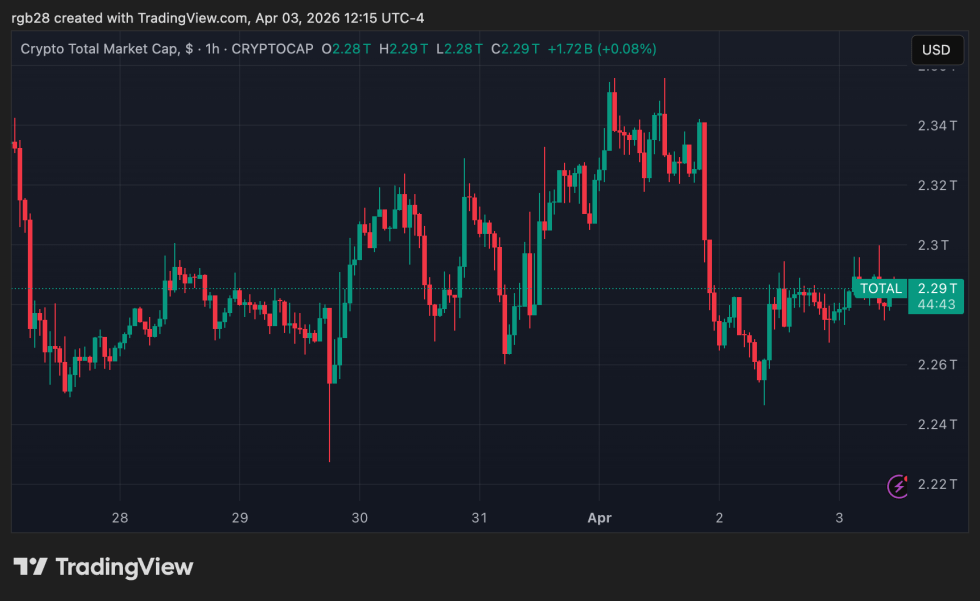
The total crypto market capitalization is at $2.29 trillion on the one-week chart. Source: TOTAL on TradingView
Featured Image from Unsplash.com, Chart from TradingView.com
Editorial Process for bitcoinist is centered on delivering thoroughly researched, accurate, and unbiased content. We uphold strict sourcing standards, and each page undergoes diligent review by our team of top technology experts and seasoned editors. This process ensures the integrity, relevance, and value of our content for our readers.
Bitcoin (BTC) traders holding 100–10,000 BTC realized losses at an average of $337 million per day in Q1 2026, the worst quarter since 2022, according to data from Glassnode.
Key takeaways:
Bitcoin dropped more than 20% after whales last realized losses at a comparable pace in 2022.
Long-term holders are also selling at a loss, indicating capitulation and potentially more downside in price.
BTC whales, sharks realized $30.91 billion loss in 2026
Realized Loss tracks the total dollar value of losses locked in when BTC is sold on-chain below its purchase price. In 2026, two significant wallet cohorts show signs of capitulation.
They are addresses holding 100–1,000 BTC, or “sharks” that often represent mid-sized funds or wealthy investors, and those holding 1,000–10,000 BTC, which are considered whale-sized entities.
In Q1, Bitcoin’s sharks (yellow) realized losses at an average of $188.5 million per day, while whales (orange) comprised another $147.5 million daily.
BTC realized loss by wallet size. Source: Glassnode
Combined, these large entities have locked in roughly $30.91 billion in realized losses so far in 2026.
Bitcoin’s realized losses in Q1 2026 for these high-net-worth entities rank among the most severe on record, trailing only Q2 2022’s roughly $396 million daily average.
BTC realized loss by wallet size (2022). Source: Glassnode
In Q2 2022, BTC’s price dropped by over 50% and another 20% by the year’s end. It kept falling as the Terra collapse, Celsius freeze, and Three Arrows failure triggered panic across crypto, draining liquidity and confidence.
In 2026, pressure on Bitcoin has come from different sources, including Iran war-driven inflation fears, quantum-security risk, and broader stress in the AI-led risk trade.
Related: Bitcoin supply in profit heads to ‘true bear market’ levels
Therefore, whales and sharks are cutting their losses now because they expect the Bitcoin price to drop further as macro risks mount. This sentiment raises the odds of a 2022-like bear market, with a bottom in Q4 2026.
Bitcoin’s long-term holders add to downside risks
Another sign that Bitcoin’s sell-off may not be over comes from Glassnode’s Long-Term Holder Realized Loss chart, which tracks losses locked in by investors who held coins for more than six months before selling.
That figure remains elevated at around $200 million per day on a 30-day average basis since November 2025.
BTC realized loss by LTH/STH (30-day MA). Source: Glassnode
“A meaningful cooldown toward levels below $25M per day would represent a more compelling signal of exhaustion in selling pressure,” Glassnode analysts said in their weekly report published on Wednesday, adding:
“A prerequisite for the base formation that historically precedes a sustainable bull market transition.”
Together, these headwinds have already fueled calls for a deeper BTC correction, with some analysts pointing to the $40,000–$50,000 range as a possible bottom.
This article is produced in accordance with Cointelegraph’s Editorial Policy and is intended for informational purposes only. It does not constitute investment advice or recommendations. All investments and trades carry risk; readers are encouraged to conduct independent research before making any decisions. Cointelegraph makes no guarantees regarding the accuracy or completeness of the information presented, including forward-looking statements, and will not be liable for any loss or damage arising from reliance on this content.
Ethereum’s share of non-USD stablecoin supply has fallen from 90% in early 2023 to 65% as of February 2026, though it remains the primary issuance chain.
Ethereum’s dominance in non-USD stablecoin supply has shrunk to 65% as of February 2026, down from 90% in early 2023, according to data published by Dune and Visa on Thursday. Despite the decline, Ethereum remains the default chain for stablecoin issuance, though other blockchains are catching up in market share.
While Ethereum leads in issuance, it ranks only fifth by unique senders across stablecoin networks. The absolute growth in activity has been significant, with unique senders increasing from 2,000 to 12,000 year-over-year as of February 2026, indicating expanded user adoption across the stablecoin ecosystem.
Sources: Dune
This article was generated automatically by The Defiant’s AI news system from publicly available sources.
For decades, managing money required a bank account. Salaries, savings, payments—everything flowed through the same system. In 2026, a new model is gaining traction: platforms that combine fiat access with crypto infrastructure. They handle deposits, conversions, savings, and liquidity in one place. The result looks less like a trading app and more like a modern financial account.
What a Bank Account Does
A standard bank account performs four basic jobs:
Store fiat money safely
Send and receive payments
Offer some interest on savings
Provide access to credit (overdrafts, loans, cards)
These jobs are stable, regulated, and familiar. Most people trust them without thinking twice. But they also come with real constraints. One significant drawback is that savings yields are usually low, often below inflation. They usually depend on central banks’ benchmark rates. For example, the current deposit facility rate of the European Central Bank is just 2%.
Another constraint is the lack of flexibility. Some services still run on business hours or batch processing.
How Crypto Platforms Address These Constraints
Inflexibility of traditional bank accounts comes from product silos: a savings account cannot be used for payments; a loan is a fixed amount with a fixed schedule.
Crypto platforms approach these same needs differently, not by separating functions but by integrating them.
Clapp: A Unified Fiat–Crypto System
Clapp.finance connects fiat and crypto within one platform. Users can deposit EUR, convert to crypto, manage assets, and withdraw back to fiat without leaving the system
The platform combines trading, savings, credit, and portfolio management into a single interface. Instead of moving funds across services, users operate within one app.
This structure aligns more closely with how bank accounts function, but applied to digital assets.
Clapp Savings Model Offers Yield With Clear Terms
Traditional savings accounts offer low but predictable returns. Crypto introduces higher yield, but often with complexity or restrictions.
Clapp structures savings into two models.
Flexible Savings provides daily interest with full liquidity. Funds remain accessible at all times, and interest compounds automatically. Rates reach up to 5.2% APY
Fixed Savings offers defined terms and locked rates, with returns up to 8.2% APR depending on duration
Both products support fiat and crypto assets. This allows users to manage yield without moving funds across platforms.
The model mirrors traditional savings logic: liquidity for short-term use, fixed terms for higher returns.
Clapp Credit Line Offers Liquidity Without Selling Assets
Banks provide access to credit. In crypto, this function is often inefficient.
Clapp uses a credit line model instead of fixed loans. Users deposit crypto as collateral and receive a borrowing limit.
Interest applies only to the amount used. Unused credit carries 0% APR when the Loan-to-Value ratio is kept under 20%. There is no fixed repayment schedule, and limits restore automatically after repayment.
This allows users to access fiat or stablecoins without selling assets or interrupting long-term positions. The structure resembles a credit facility rather than a traditional loan.
Portfolio Management as a Core Function
Managing assets is central to both banking and investing.
Clapp includes tools for tracking performance, simulating strategies, and maintaining allocation through automated rebalancing
These features reduce reliance on external analytics tools and support structured decision-making.
Instead of reacting to market movements, users can define allocation rules and maintain them over time.
Regulation and Infrastructure
A platform that handles fiat and crypto must operate within regulatory frameworks.
Clapp is registered as a Virtual Asset Service Provider in the Czech Republic and as a Digital Asset Service Provider in El Salvador. It follows KYC and AML requirements across jurisdictions
Assets are secured through institutional-grade custody infrastructure. This aligns with standards used in regulated financial systems.
Final Take
Fiat and crypto are no longer separate systems operating in parallel. They are converging inside the same apps and accounts.
Bank accounts still dominate for stability, insurance, and predictability. For most users, they are not going away.
But all-in-one crypto platforms such as Clapp can handle everything that a bank account does poorly: higher yields, 24/7 access, integrated credit, and the ability to hold both fiat and digital assets in one place.
Trusted Editorial content, reviewed by leading industry experts and seasoned editors. Ad Disclosure
The crypto market is yet to have an altcoin season the likes of what was seen back in 2021, despite the Bitcoin price hitting new all-time highs over the last two years. This has alluded to the fact that the Bitcoin dominance over the market remains very high, thus not leaving any room for altcoins to run. Nevertheless, this has not deterred the expectations of an altcoin season among investors, and many believe that when it finally comes, it will be more explosive than 2021.
Altcoin Market Is Winning Against Bitcoin
Bitcoin has often led the cryptocurrency and by extension, its performance has influenced the advent of altcoin seasons. This is due to the way altcoins measure up to the leading cryptocurrency with each cycle, and this one looks to be prepping for a major rally.
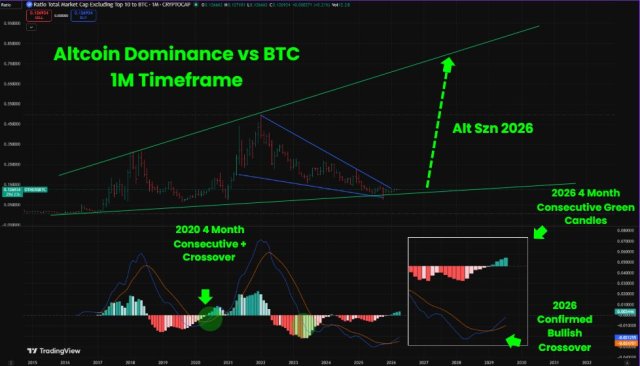
According to analyst Mark Chadwick on X, altcoins are already bringing a major bullish pattern against Bitcoin. This comes as the ALT/BTC chart has marked its fourth consecutive green monthly candle, and this has led to the confirmation of a bullish crossover.
The crypto analyst pointed out that the last time altcoins made such a bullish crossover against Bitcoin was back in 2021. The result of this was the most explosive altcoin season that the crypto market has seen to date, leading altcoins on runs that saw their values rise by many multiples.
Source: X
Why This Altcoin Season Will Be Better Than The Last
Despite the last altcoin season being one of legendary status, Mark believes that it will pale in comparison to what’s coming. A number of reasons were given for this as to why it will be a better altcoin bull market, and this has to do with the broader market optics.
Firstly, the analyst points out that the Fed is putting billions of dollars into the financial market. This is bullish as liquidity tends to drive growth. Next is that the Clarity ACT that will provide formal regulation for cryptocurrencies by putting them into categories of either securities or commodities.
Another bullish factor that the analyst points out is that the SEC is now pro-crypto with the Trump administration. Then, there is the fact that there has been rising activity from the NYSE and NASDAQ when it comes to crypto trading.
The last two of the catalysts given have to do with adoption. The first is the fact that Fannie Mae, the US Federal National Mortgage Association, announced last week that it will begin allowing Bitcoin as collateral for loans. Also, there is the fact that Mastercard is now building crypto rails to allow for payments using blockchain technology.
Taking all of these into account, Mark believes that it is a “setup of epic proportions.” If this plays out as expected, then the next altcoin season could surpass the previous one, and altcoins would end up winning against Bitcoin.
Altcoin market continues to struggle | Source: Crypto Total Market Cap Excluding BTC on Tradingview.com
Featured image from Dall.E, chart from TradingView.com
Editorial Process for bitcoinist is centered on delivering thoroughly researched, accurate, and unbiased content. We uphold strict sourcing standards, and each page undergoes diligent review by our team of top technology experts and seasoned editors. This process ensures the integrity, relevance, and value of our content for our readers.