While those applications have become increasingly visible, the infrastructure that enables deposits, withdrawals and settlement has largely remained behind the scenes.
Fun is one of the companies building that infrastructure. The firm said it powers 100% of deposits and withdrawals on Polymarket and deposit flows into Aave’s largest vaults, while processing more than $3 billion in monthly transaction volume.
The company has raised more than $75 million to date.
From payment rails to funding flows
Fine said today’s crypto payments ecosystem remains unnecessarily fragmented, with developers forced to stitch together different card processors, banking partners, crypto assets, blockchains and bridges to create funding experiences.
Instead of relying on individual payment rails, platforms should optimize around the end goal of getting users funded as quickly and seamlessly as possible, he says.
“In Web2, payments are highly fungible,” Fine said. “In Web3, they’re much more complex because every payment method behaves differently. Teams keep rebuilding the same infrastructure over and over again instead of building unified optimized funding flows.”
That shift means many existing crypto payment businesses risk becoming obsolete, according to Fine. Companies built around converting fiat into crypto or moving assets between blockchains are solving an intermediary step that users never cared about in the first place, he argued.
Round-the-clock trading is one part of the plans exchanges have for traditional assets. Coinbase and Binance want customers to trade crypto, stocks and other products through one account, a model both have described as an “everything exchange” or financial super app.
Coinbase is preparing to offer U.K. customers equities and derivatives alongside crypto after securing investment-services authorization from the Financial Conduct Authority under rules based on the Markets in Financial Instruments Directive, or MiFID.
The authorization allows Coinbase to offer traditional shares to retail customers and crypto, equity and commodity perps to eligible institutional and advanced traders, the company said.
“Perpetual futures are a core focus of what Coinbase is trying to bring to market,” said Keith Grose, U.K. CEO at Coinbase, in an interview with CoinDesk. “We’re really focused on being the ‘everything exchange.’”
Grose said the longer-term plan is to bring spot crypto, perpetual futures, traditional equities, and eventually tokenized versions of other assets into one place. That could allow customers to use positions across different markets as collateral or borrow against their equities.
Using stocks as collateral
Binance is testing another part of the model by allowing some high-net-worth clients to use tokenized stock positions as collateral for other trades.
“We recognize you could have Nvidia or SpaceX stock, a tokenized version,” Jan said. “You could actually have a tokenized stock put on our exchange, and we’ll use that as collateral for you to trade something else. It could be a crypto derivative.”
The attacker working through Coldcard-generated keys is now emptying wallets worth a few thousand dollars each.
Galaxy Research flagged a third wave of sweeps early Sunday, roughly 208 bitcoin drained from 1,912 addresses between Friday midday and Saturday morning UTC.
That is just over a tenth of a bitcoin per victim. The July 30 opening wave averaged close to a full coin, 1,083 bitcoin from 1,196 addresses in 41 minutes.
Observed losses across all three waves now total 1,367 bitcoin, nearly $89 million, from 4,585 addresses.
Wave three sends each victim’s coins to its own destination rather than the handful of shared collector addresses that made the first two easy to map, and parks them in pay-to-witness-script-hash outputs, a format that can carry multisignature or timelock conditions, instead of the plain single-key outputs used before.
It batched an average of six victims into each sweep where wave one took exactly one at a time, and it scanned only the default derivation path, the standard branch of the key tree a wallet checks first, instead of testing several branches per seed.
Holders of Strategy’s (MSTR) high-yielding preferred stock STRC will not see a dividend increase in August.
Led by Executive Chairman Michael Saylor, Strategy is maintaining the current 12% dividend on the shares.
STRC investors may have been expecting as much as a 50-basis-point hike in the dividend as Strategy has customarily raised the payout anytime the stock traded sizably below its par value ($100) for the month.
As recently as July 1, Strategy had lifted the dividend 50 basis points following June’s plunge in STRC to as low as $71.
While that hike — along with Strategy’s sale of some bitcoin to fund dividends, and a bit of stabilization in the price of bitcoin — helped STRC bounce in July to the current $89.46, that level is still significantly below par.
CEO Phong Le yesterday said Strategy’s Corporate Objective is for STRC to trade at $99-$100 over time.
Nevertheless, the company is under no obligation to raise the dividend and chose not to do so this month.
Cointelegraph is committed to providing independent, high-quality journalism across the crypto, blockchain, AI, and fintech industries.
All news, reviews, and analyses are produced with full journalistic independence and integrity. For more details on our standards and processes, please read our Editorial Policy.
An affiliate of a political action committee (PAC) funded largely by contributions from cryptocurrency companies Ripple Labs and Coinbase has poured more cash into ads for next week’s primary race in Michigan’s 13th Congressional District.
According to Federal Election Commission (FEC) filings as of Thursday, the Protect Progress PAC had spent more than a combined $2 million on media to support Michigan Representative Shri Thanedar in the state’s 13th district and oppose his Democratic challenger, Donavan McKinney.
The most recent filings effectively doubled what the PAC had reported spending a week prior, with an additional $884,240 on ads to support Thanedar and more than $150,000 to oppose McKinney.
Source: FEC
During his time in the US House of Representatives, Thanedar voted in favor of the stablecoin-focused GENIUS Act legislation and the crypto market structure bill currently under consideration in the Senate, the Digital Asset Market Clarity (CLARITY) Act. He also cosponsored the Promoting Innovation in Blockchain Development Act in an effort to protect developers.
In a July 21 statement on the PAC spending supporting Thanedar, McKinney said “the crypto lobby is paying my opponent back for helping Trump make over $1 billion since taking office.” He was likely referring to the US President disclosing that he earned more than $1.4 billion from crypto investments in 2025, including from his memecoin, Official Trump (TRUMP) and through his family’s business, World Liberty Financial. Many Democrats have accused Trump of using his position to profit from the presidency through laws like GENIUS.
Cointelegraph reached out to Thanedar’s and McKinney’s campaigns for comment on the PAC expenditures but did not receive an immediate response.
Related: US senators sent revised ethics rules to White House for CLARITY Act: Report
Protect Progress is an affiliate of the Fairshake PAC, which was responsible for spending more than $170 million in the 2024 US election cycle through media supporting candidates it considered favoring crypto industry-aligned policies. The Michigan primary is scheduled for Tuesday, but the PAC and its affiliates have already poured millions of dollars into 2026 races in Texas, Illinois and other states.
The US consumer advocacy group Public Citizen reported in June that Fairshake and its affiliates were responsible for spending more than $82 million out of the roughly $189 million crypto companies had used in the 2026 election cycle. Fairshake reported holding a $193 million war chest as of January.
PAC spending in Washington and Alabama with primaries looming
In addition to Michigan’s primaries, the Fairshake affiliate Defend American Jobs PAC spent more than $65,000 on media to support a Republican running in Washington’s 4th congressional, according to FEC filings. Washington is scheduled to hold primaries the same day as Michigan.
Alabama, scheduled to hold primaries on Aug. 11, has also been a focus for Fairshake. FEC filings showed that Defend American Jobs spent more than $511,000 on media to support Jerry Carl Jr., a Republican who represented the state’s 1st congressional district from 2021 to 2025. Notably, the former Alabama lawmaker was one of the wealthiest in the state’s House delegation, with a reported net worth of up to $15 million in 2023.
Magazine: Crypto lobby spending on Republicans far outpaces Democratic support
The obvious objection is that this is leveraged speculation in new language, and that traditional markets keep their frictions for good reasons. Both points have force. A funding rate is not a substitute for the price discovery that settlement enforces, and continuous leverage on volatile assets concentrates risk in ways periodic markets do not. But those are arguments for building the structure carefully, not for assuming it will not be built. The demand is already here, and it moves toward the venue that offers universal access to global assets, whether stocks, crypto or FX.
There is one place crypto’s progress this cycle has not yet reached. Over the past year, tokens acquired real economic rights, revenue shares, buybacks and votes, while projects with nothing behind them were delisted and some of the strongest teams chose IPOs over token launches. Even the IPO no longer sits outside this system: SpaceX’s shares changed hands as synthetic pre-IPO perpetuals on Hyperliquid for weeks before its June 2026 listing, trading tens of millions of dollars a day in May and swelling to roughly $1.3 billion on debut day as investors shut out of the traditional allocation turned to crypto rails. The market structure beneath perps has not fully followed. The next stage is to build that alignment in, with the transparency now expected across the rest of crypto. That consolidation is happening on centralized venues as much as onchain: the largest exchanges now run multi-asset books where equities, crypto and FX clear side by side, and a single centralized platform accounted for more than half of all real-world-asset perp volume in May 2026. The pull is structural rather than speculative, with 52% of Bitget’s users already holding both stocks and crypto.
Russia has expanded its cryptocurrency mining restrictions to Moscow, with the ban set to take effect on Aug. 15, 2026, and remain in place through Dec. 31, 2032.
Russia’s Resolution No. 936, signed by Prime Minister Mikhail Mishustin on July 25, 2026, amends an earlier mining restriction order issued in December 2024, according to records published on Pravo.ru.
The updated rules add Moscow, the Moscow Region and several territories in Russia’s Kursk Region to the list of restricted areas. The measure expands existing restrictions on cryptocurrency mining in areas facing electricity supply concerns. The ban also covers eight municipal districts and the city of Lgov in Kursk Region.
Earlier restrictions were also introduced in several Russian regions, including parts of Buryatia and the Zabaykalsky Krai, where a mining ban is set to run from April 1, 2026, through March 15, 2031.
The Moscow Region’s Energy Ministry previously said a mining ban was needed because of growing electricity demand, according to TASS. The ministry estimated that Moscow and the Moscow Region have 65 data centers connected to the power grid with a combined capacity of 734 megawatts (MW), including 19 data centers in the Moscow Region with 233 MW of capacity.
Related: BitRiver founder charged in Russia over alleged $8M fraud
Cointelegraph is committed to independent, transparent journalism. This news article is produced in accordance with Cointelegraph’s Editorial Policy and aims to provide accurate and timely information. Readers are encouraged to verify information independently.
Unlike AI, which has driven a surge in demand for graphics processors to train and run large language models, quantum computing targets a different class of challenges. Researchers say the technology could accelerate molecular simulations, optimize complex logistics networks, advance materials science and improve cryptography.
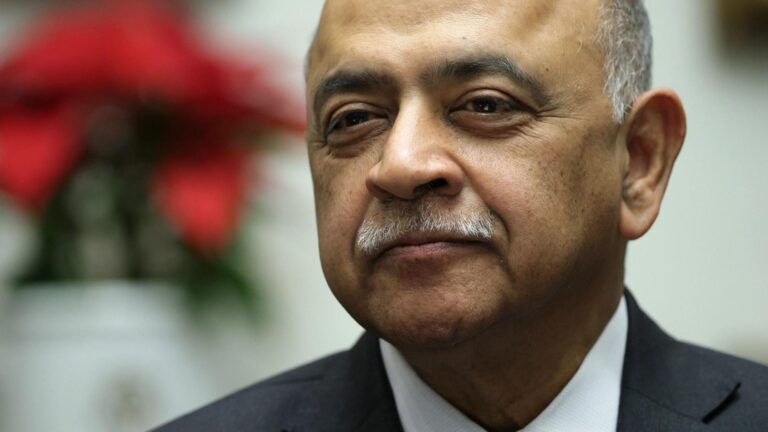
Krishna said IBM has already demonstrated some of that potential, using quantum computers to uncover properties of materials that conventional computers had been unable to model. Those insights could eventually contribute to longer-lasting batteries, new materials, fusion energy research and drug discovery.
Growing confidence around commercialization has been matched by rising investment. In May, IBM announced plans for a standalone quantum chip foundry backed by a $1 billion commitment from the U.S. Department of Commerce through the CHIPS incentive program, alongside a matching $1 billion investment from the company. Other developers have also expanded manufacturing capacity and research partnerships as they push toward fault-tolerant quantum computers.
The industry’s progress is also drawing attention from the digital asset sector. Several publicly traded bitcoin BTC$62,995.57 miners, including MARA Holdings (MARA), Riot Platforms (RIOT) and CleanSpark (CLSP), have diversified into AI and high-performance computing, leveraging their data centers and power infrastructure for new computing workloads.
Quantum computers won’t simply slot into today’s AI data centers. They require entirely different hardware and operating environments, meaning the industry will need new facilities and supply chains as the technology matures.
Crypto holders used to focus on diversifying their coins. Now, following a $70 million Coldcard exploit, they’re being told to diversify their wallets as well.
On Saturday, Binance founder Changpeng Zhao, known as CZ, asked crypto holders to split their funds across multiple wallets following a major security failure in popular Coldcard hardware devices.
“Even hardware wallets can have bugs. Even old wallets (with long history) can have bugs. How to mitigate? Split your funds in a few wallets maybe? This has a different set of risks. Nothing is 100%. Stay informed. Stay SAFU!,” he said.
On July 30, some bitcoin users discovered that funds from their Coldcard wallets had been stolen in a series of unexpected transactions. The attacker exploited a firmware flaw dating to March 2021 that weakened the randomness used to generate recovery seeds on certain Coldcard models. By reconstructing private keys offline, the attacker was able to drain funds without ever physically accessing the devices.
Initial reports said about 594 BTC, worth $38 million at the time, were drained from around 500 wallet in a 25-minute window. Subsequent analysis by Galaxy Research expanded the scope to 1,082.65 bitcoin, valued at approximately $70 million, drained from 1,196 addresses over about 41 minutes. Many of the affected wallets had sat dormant for years.
Coldcard maker Coinkite has acknowledged the bug, apologized, and released emergency firmware updates. The company has advised users who generated seeds on affected versions to create entirely new seeds on patched devices and carefully migrate funds, noting that simply updating firmware does not secure an already-created vulnerable seed.
The episode has renewed debate over the limits of self-custody. Hardware wallets are widely viewed as one of the strongest options for securing bitcoin offline, yet the Coldcard case shows that even long-established devices can harbor critical flaws that remain undetected for years.
CZ’s suggestion of diversification acknowledges that spreading risk comes with its own practical challenges, including more complex key management.