For banks, modernisation has long been a priority — but often a slow-moving one.
In this conversation, Radha Suvarna, Chief Product Officer for Payments at Finastra, explains why that is beginning to change. The catalyst is not just new infrastructure or changing customer expectations, but the growing impact of artificial intelligence.
According to Finastra’s latest findings, 96% of institutions are already using or planning to use AI, reinforcing just how central it has become to banking strategy. But what stands out is not simply adoption — it is how AI is interacting with existing transformation agendas.
Modernisation and AI are no longer separate initiatives.
Traditionally, banks have focused on modernising their technology stack through cloud-native, microservices-based, and API-enabled platforms. These investments are designed to make systems more flexible and future-ready. At the same time, AI has been explored as a way to enhance data analysis, improve decision-making, and personalise customer experiences.
What is different now is the way these two trends are converging.
AI is accelerating modernisation by enabling faster experimentation. With the help of AI-driven coding tools and testing agents, banks can develop and iterate on new solutions more quickly than before. This reduces the time and cost associated with innovation, allowing institutions to test ideas, learn from failures, and refine approaches at speed.
At the same time, modern platforms are what make AI experimentation possible in the first place.
Without flexible, scalable infrastructure, deploying and scaling AI use cases becomes significantly more difficult. Cloud-native architectures and API-driven systems provide the foundation needed to integrate AI into core operations and customer-facing services.
The result is a reinforcing cycle.
AI drives faster modernisation. Modernisation enables more effective use of AI. Together, they create a multiplying effect that enhances both internal efficiency and customer experience.
This shift is also changing how banks approach innovation.
Experimentation is becoming a central theme. Institutions are recognising that not every AI use case will succeed, but the ability to test, fail, and iterate quickly is itself a competitive advantage. The organisations that can do this effectively — supported by modern infrastructure — are better positioned to capture the value of emerging technologies.
In that sense, the story is not just about AI adoption. It is about how banks are reshaping their entire approach to technology transformation.
The convergence of AI and modernisation is no longer theoretical. It is already underway — and it is redefining how banks build for the future.
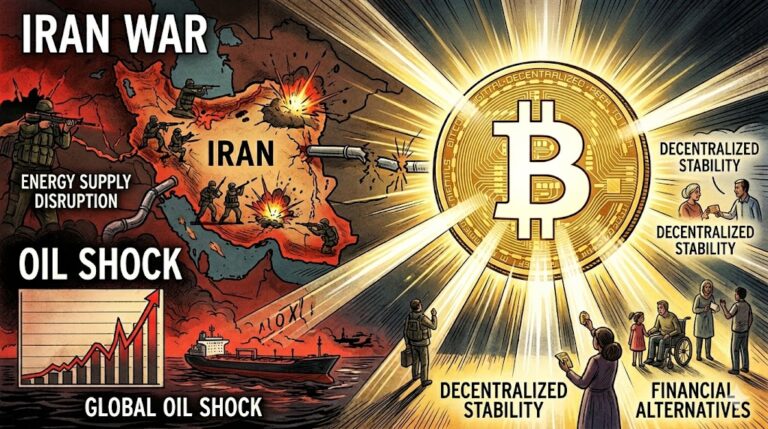
Since the U.S. and Israel began striking Iran on February 28, 2026, markets have had to wrestle with the financial and economic implications. The IEA described the disruption through Hormuz as the largest supply shock in the history of the global oil market. The strait normally carries about a quarter of maritime oil trade and is involved in about a fifth of global petroleum liquids consumption.
The Iran war has made monetary infrastructure visible again
The Strait of Hormuz is obviously a physical chokepoint. However, trade also depends on a monetary chokepoint. Cross-border payments usually move through correspondent banks, intermediary banks, screening layers, and trade-finance channels. Correspondent banking is an essential part of the global payment system for cross-border transactions, which involve a chain of linked correspondent banks. When that chain is stressed, settlement risk rises alongside freight and energy risk.
That is what this war has forced markets to confront. Reuters reported on April 9 that ship traffic through Hormuz was running at well below 10% of normal volumes, with just seven ships crossing in the prior 24 hours against roughly 140 normally. Iran’s posture around routing, permissions, and possible tolls made clear that access has become conditional.
Once trade access becomes conditional in the physical corridor, the other lever to pull is the monetary one. Here’s some important context.
OFAC prohibits U.S. banks from operating correspondent accounts for Iranian banks. In August 2025, the U.S. Treasury sanctioned the developer of Iran’s Cross-Border Interbank Messaging System, saying it had been built to let Iran and its partners route around controls on more widely used payment systems and to facilitate ties with foreign banks, including links involving Bank of Kunlun.
With the Iran war disrupting a major segment of global trade, it is practically inevitable that U.S. dollar rails will be used to try and force a resolution. If Iran wants money in exchange for Strait access, then it will need something else for monetary settlements.
Bitcoin really shines here
Bitcoin is an open settlement network. It does not require a correspondent bank, a reserve-currency issuer, or a central payments operator to authorize transfers. Although this does not remove friction from sanctions law, price volatility, or custody, Bitcoin nevertheless has a very different institutional dependency profile—one that could become extremely meaningful and useful in this context.
Consider that:
A kinetic conflict can freeze cargo and supply lines.
A banking crisis can freeze the payment for those items.
A sanctions regime can force transactions into narrower channels with more intermediaries and more approval points.
Yet Bitcoin remains an open monetary rail.
On March 3, researchers tracked millions of dollars worth of crypto leaving Iranian crypto exchanges after the strikes. Iran’s 2025 crypto transaction volume was roughly $8 billion to $11 billion. Clearly we see open digital rails attracting more use when domestic and cross-border financial channels are under pressure.
This is where Bitcoin shines. Gold is a neutral asset, but it is slow to move and impossible to trustlessly transmit in digital form (tokenizing the gold requires trust). Bank money is efficient inside the existing system, but fully dependent on that system. Stablecoins are useful, but they usually still depend on issuers, banks, and redemption channels. Stablecoin issuers will, if compelled, freeze addresses. Therefore, stablecoins are really just a fancy addendum to the existing financial system.
Bitcoin is the largest liquid non-sovereign bearer asset that can be transferred natively over its own network. This utility seems to be getting more valuable, as we’ll see below.
Why this creates an opportunity for BTC
Please consider the cumulative returns of assets since the Iran War started. I use the commodity spot ETFs to ensure an apples-to-apples comparison on elapsed time (so that everything is trading during U.S. market hours):
Asset
Cumulative Total Returns from Feb 27 to April 10
IBIT (Bitcoin)
11.75%
IWM (U.S. Small Caps)
0.14%
SPY (U.S. Large Caps)
-0.68%
VXUS (Global Equities, excluding U.S.)
-2.93%
TLT (Treasury Bonds)
-4.07%
GLD (Gold)
-9.64%
SLV (Silver)
-18.72%
Data from Yahoo Finance
This was an environment where long-duration bonds fell, gold fell, silver fell, international equities lagged, and Bitcoin exposure outperformed all of them.
This simply does not fit a “risk-off” narrative for Bitcoin. It does not fit a clean “inflation-hedge” narrative either.
The market appears to have priced several channels at once:
higher energy costs
inflation expectations (also exacerbated by recent PPI and CPI numbers)
weaker conviction around rate cuts
slower global activity
greater value assigned to neutral monetary mobility
Gold had fallen 10% since the war began, arguably because higher energy prices fed inflation fears and pushed out expectations for rate cuts. That same mechanism helps explain weakness in TLT (increasing inflation expectations would push long term rates higher). If the dominant transmission channel is an oil shock with inflation consequences, longer duration and metals do not behave like safe havens.
Bitcoin (IBIT) vs traditional safe havens like metals and U.S. T-Bonds since Iran War start.
Bitcoin was and is different. BTC-linked exposure outperformed while investors were confronting supply disruption, payment fragmentation, and more visible political control over access. That makes Bitcoin easier to price as strategic monetary optionality. The asset is scarce, portable, liquid, and non-sovereign. These features appear to have mattered more than the traditional safe-haven attributes associated with gold or long duration bonds.
Now, I want to be clear. This does NOT mean BTC is about to become a dominant trade currency (though this isn’t impossible either). The market might assign more value to an asset that remains transferable when institutional access becomes less predictable. This is all I am saying and, given the evidence, we can argue that this is happening right now.
Conclusion
The Iran war may have thrust a core feature of Bitcoin into the spotlight. It is a scarce asset and an open monetary rail. That combination matters more when trade routes, banks, sanctions, and state power start constraining one another.
If this really happens, Bitcoin stops looking like a speculative allocation to macro portfolios and starts looking more like resilient monetary infrastructure with valuable optionality. Every geopolitical fracture makes this easier to see.
World Liberty Financial minted 25 million USD1 stablecoins on Monday morning and burned 3 million through its TokenGovernor contract, on-chain data shows, as the Trump-linked venture continues managing the fallout from a lending position that trapped depositors on DeFi protocol Dolomite.
The activity follows WLFI’s statement last week, posted in response to CoinDesk’s reporting on the Dolomite transactions, that it had repaid $25 million of the roughly $75 million it borrowed against its own governance token.
The venture deposited billions of WLFI tokens as collateral and borrowed stablecoins that were partially routed to Coinbase Prime, pushing Dolomite’s USD1 lending pool to near-100% utilization and leaving other depositors unable to fully withdraw.
Monday’s mint was funded through BitGo Custody and executed via WLFI’s USD1 Mint Authority contract. The 3 million USD1 burn moved from an address starting 0x2ce to the TokenGovernor contract before being sent to the null address, permanently removing the tokens from circulation.
Smaller test transactions of $10, $10,000, and $40,800 in USD1 were sent to a previously inactive address in the hours before the mint, a pattern consistent with wallet verification ahead of larger transfers.
The net effect is a $22 million increase in USD1 circulation. The simultaneous mint and burn indicates active supply management rather than a simple expansion.
However, the burn raises its own question of where those 3 million USD1 came from and why they were retired rather than redeployed.
Stablecoin issuers routinely burn tokens when collateral is redeemed, but WLFI has not disclosed the specific reason.
It is not yet clear whether the newly minted USD1 is intended to replenish Dolomite’s lending pool, fund additional treasury operations, or serve another purpose.
WLFI’s governance token has fallen roughly 15% since CoinDesk first reported the Dolomite transactions on April 9. Dolomite co-founder Corey Caplan is an advisor to World Liberty Financial.
CoinDesk has reached out to World Liberty Financial for comment in European morning hours.
Strategy, the Virginia-based software company turned Bitcoin treasury vehicle, disclosed on Monday that it bought 13,927 Bitcoin for roughly $1 billion during the period April 6 to April 12 using proceeds generated from its at-the-market (ATM) program.
Strategy has acquired 13,927 BTC for ~$1.00 billion at ~$71,902 per bitcoin and has achieved BTC Yield of 5.6% YTD 2026. As of 4/12/2026, we hodl 780,897 $BTC acquired for ~$59.02 billion at ~$75,577 per bitcoin. $MSTR$STRC https://t.co/xVKjg2cEVP
With the latest purchase, Strategy’s total holdings now stand at 780,897 BTC, valued at over $55 billion at current market prices. The stash represents more than 3.7% of every Bitcoin that will ever exist.
How it was funded
Strategy didn’t tap its Class A common stock (ticker MSTR) for this purchase.
According to a recent SEC filing, the entire billion came from selling roughly 10 million shares of its variable-rate STRC preferred stock through an at-the-market program.
The MSTR equity ATM, which still has capacity to issue about 27 billion shares, went untouched. Three preferred stock programs, STRF, STRK, and STRD, also saw no activity, collectively retaining roughly 7.7 billion shares of additional issuance capacity.
The average price paid for this batch was around $71,902 per coin, slightly above the roughly $70,600 where Bitcoin was trading at the time of the announcement.
Executive Chairman Michael Saylor noted that Strategy has achieved a 5.6% “BTC Yield” year to date in 2026. That metric, which the company invented to track the growth of Bitcoin per diluted share, has become the primary way Saylor frames shareholder value.
Disclosure: This article was edited by Vivian Nguyen. For more information on how we create and review content, see our Editorial Policy.
The following is a fintech and wider digital and economic development of the Caribbean nation of the Bahamas in 2026.
The Bahamas’ fintech story in 2026 is one of quiet global significance. While small in population, the country has positioned itself at the forefront of digital currency innovation and financial modernisation in the Caribbean. In many ways, it offers a preview of how small island economies can leverage fintech not just for efficiency but for resilience.
With a population of only over 400,000 people, the Bahamas’ economy is valued at approximately $15 billion, driven primarily by tourism and financial services, which together account for the majority of gross domestic product (GDP) and tourism. GDP per capita stands at around $36,000, placing the country among the highest-income economies in the Caribbean.
Digital economic transformation: resilience through innovation
The Bahamas’ digital transformation is closely tied to its need for economic resilience. As a small island state vulnerable to external shocks, whether economic or environmental, the country has prioritised digital infrastructure and financial innovation as part of its broader development strategy.
Government priorities have included: expansion of digital public services, strengthening financial sector competitiveness, and supporting digital payments and financial inclusion
Internet penetration exceeds 90 per cent, and mobile usage is widespread, providing a strong foundation for digital services.
Financial services sector and fintech
The Bahamas is a popular tourist destination IMAGE SOURCE GETTY
The Bahamas’ financial services sector is well-developed and internationally connected, with a strong regulatory framework and a significant offshore financial services presence. However, digital transformation has accelerated markedly in recent years.
The Central Bank of The Bahamas (CBB) has been at the centre of this evolution, particularly within the last few years.
Key initiatives include:
Sand Dollar (CBDC) expansion – The Bahamas was the first country in the world to launch a retail central bank digital currency called the Sand Dollar. Since its introduction, the central bank has continued to expand its use cases, focusing on financial inclusion, government payments and retail transactions.
Digital payments ecosystem development – Efforts have been made to increase adoption of digital payments, including mobile wallets and electronic transactions, reducing reliance on cash.
Financial inclusion initiatives – The Sand Dollar and broader digital strategies have been used to extend financial services to underserved communities, particularly across the archipelago’s dispersed islands.
The Bahamas has strengthened its regulatory environment for fintech, including frameworks for digital assets and financial innovation.
For instance, the initial legislative framework to regulate digital assets businesses, the Digital Assets and Registered Exchanges Act, 2020 (“Prior DARE Act”), was initially introduced in 2020. Afterwards, in 2022, the Government released a White Paper, The Future of Digital Assets in The Bahamas. This outlined the country’s vison and framework for the country’s digital assets policy through to this year.
In 2024, a new Digital Assets and Registered Exchanges Act came into force and repealed and replaced the Prior DARE Act.
These initiatives reflect a forward-looking regulatory approach, where innovation is carefully structured and aligned with national priorities.
Financial inclusion: high access, targeted digital expansion
The financial hub is Nassau, home to domestic banks, international financial institutions and regulators. One of the largest banks is Bank of The Bahamas, which plays a key role in retail banking and financial inclusion initiatives.
According to the World Bank, the Bahamas has relatively high levels of financial inclusion, with approximately 90 per cent of adults holding a bank account. However, geographic dispersion across islands has historically created access challenges, particularly in remote communities. The focus is increasingly on ensuring consistent access across all islands, rather than simply increasing overall inclusion rates.
The Bahamas’ fintech ecosystem is relatively small, with an estimated 40 fintech and digital financial service providers, but it punches above its weight in terms of innovation and regulatory leadership.
Key players include the likes of Island Pay (digital payments provider and Sand Dollar wallet operator) and Kanoo (mobile payment solutions and financial services). These firms operate within a tightly regulated ecosystem, where innovation is closely linked to public infrastructure.
Conclusion: small scale, global relevance
The Bahamas’ fintech journey demonstrates that scale is not a prerequisite for leadership. By leveraging technology to overcome geographic constraints, the Bahamas is building a more resilient and inclusive financial system. It is offering lessons for both small states and larger economies alike.
Richie is a global economic development advisor and Managing Partner of Santos-Diaz LLC, specializing in international trade and foreign direct investment across the UK, Middle East, and North America. With over 15 years of experience and a Masters from SOAS University of London, he has advised high-level governments and multinational corporates while contributing to major outlets like Forbes and the World Economic Forum. Currently based in Dubai, he leverages his background in emerging markets and RegTech to bridge the gap between global policy and private sector growth.
View all posts
Executive Economic Development Advisor (Emerging Markets) | Contributor
Financial institutions have “accelerated” their participation in crypto markets this year, while retail investors have pulled out, said Exodus CEO JP Richardson on Sunday.
“This might be the first cycle in crypto history where institutions are in a bull market, and retail doesn’t even know it,” the crypto executive said.
Richardson cited a few examples, such as the stablecoin market capitalization all-time high this year, Morgan Stanley’s Bitcoin (BTC) ETF launch, Schwab starting a waitlist for spot Bitcoin trading, Franklin Templeton announcing a crypto division and Fannie Mae accepting Bitcoin-backed mortgages.
“In 2018 and 2022, institutions pulled out with retail. This time, they accelerated,” he said.
This shift could signal that crypto has evolved from volatile, retail-driven hype cycles to a more mature, institution-led market with steadier accumulation, deeper liquidity and reduced reliance on emotional spikes or panic selling.
Cost of living crisis keeping retail away
MN Fund founder and crypto YouTuber Michaël van de Poppe echoed the sentiment in an X post on Sunday, stating, “It’s super clear that retail isn’t interested in crypto.”
“Almost everyone has a hard time paying their bills on a monthly basis,” he added, referring to the escalating cost-of-living crisis and inflationary pressures.
“That’s why this cycle won’t be the retail cycle. It’s the institutional cycle and will take longer.”
Related: Bitcoin price falls under $71K as US-Iran war tensions spark sell-off
CryptoQuant analyst “Darkfost” noted that retail activity hit a nine-year low earlier this month, reporting that inflows from small accounts with less than 1 BTC reached a record low on Binance.
“Retail investors are clearly absent from the market,” he said.
The analyst added that some retail investors may have recently left the crypto market to move into equities and commodities, which have also delivered strong performances.
Retail trading activity on Binance has dried up. Source: Darkfost
Near-term sentiment remains fragile
CoinEx exchange chief analyst Jeff Ko told Cointelegraph on Monday that near-term sentiment “remains fragile and heavily macro-driven, especially by oil, the dollar, and inflation expectations.”
“At this stage, the move still looks more like a macro risk premium overwhelming the near-term bid than a genuine deterioration in crypto appetite.”
He said he was more confident over the medium term, adding, “I do not expect oil prices to remain elevated given the underlying supply-demand fundamentals.”
Cointelegraph is committed to independent, transparent journalism. This news article is produced in accordance with Cointelegraph’s Editorial Policy and aims to provide accurate and timely information. Readers are encouraged to verify information independently. Read our Editorial Policy https://cointelegraph.com/editorial-policy
Bitcoin BTC$70,868.15 failed once more to break out of its monthslong trading range over the weekend, selling off below the key resistance level at $74,000 to trade recently at $70,600.
Ether (ETH) and the altcoin market followed suit, as ETH tumbled from April 11 high of $2,320 to $2,190. It remains little changed since midnight UTC.
The selloff came as Brent crude oil jumped back above $100 per barrel after U.S. President Donald Trump ordered a blockade at the Strait of Hormuz. The conflict with Iran has been a direct driver of risk asset price action over the past month, with U.S. equities and crypto being inversely correlated to oil and the U.S. dollar.
For now, bitcoin and the broader crypto market remain in a trading range that has persisted since early February, failing to break above $75,000 to the upside while holding firm above $63,000 to the downside.
Derivatives positioning
Futures tied to most major tokens, including bitcoin and ether, have declined slightly over the past 24 hours. The move indicates traders are scaling back risk after President Trump ordered a blockade of the Strait of Hormuz, triggering a surge in oil prices.
While oil prices have surged 5%, open interest (OI) in Binance’s crude futures declined by more than 1%. Activity on the decentralized platform Hyperliquid picked up over the weekend, with combined OI in Brent and WTI futures topping $1 billion.
Futures tied to ADA$0.2382 saw strong capital inflows, with open interest jumping to the most since Feb. 26. This is not necessarily bullish, as both perpetual funding rates and the 24-hour cumulative volume delta remain negative, suggesting that the inflows are being driven largely by traders chasing downside positioning or actively building short exposure rather than accumulating long positions.
Except for HYPE, LINK, AVAX, TRX and ZEC, all top 25 coins have seen negative CVD, indicating that sell-side aggression is offsetting buy-side aggression across the market.
A negative CVD indicates that more participants are selling by actively hitting bids than buying by lifting asks.
Bitcoin and ether’s options-based implied volatility metrics remain low across most time frames, suggesting the market is pricing in calmer, slower price movements. The volatility curve is also fairly flat, showing no strong expectation of sudden future spikes.
Still, downside concerns persist. BTC puts are currently trading at a 5-point or more premium across all time frames, indicating stronger demand for downside protection. ETH puts are also elevated, though to a noticeably lesser degree than BTC.
Block flows featured call calendar spreads and straddles, with these two strategies accounting for over 50% of total activity over the past 24 hours, indicating investor preference for time decay and volatility over a clear directional bias.
Token talk
The CoinDesk Memecoin Index (CDMEME) and the DeFi Select Index (DFX) were both in the black on Monday alongside the altcoin-dominant CoinDesk 100 (CD100), while the bitcoin and indexes dominated by the biggest tokens lost ground following oil’s price increase to above $100 per barrel.
DeFi token AAVE was one of the top performers, rising around 5%, followed by HYPE and JUP, which added about 2%.
But it was the memecoins that dominated Monday’s gains: BROCCOLI, BAN and 币安人生 posted gains in excess of 10%, demonstrating investor appetite for highly speculative tokens in what is otherwise a very flat market.
CoinMarketCap’s “Altcoin Season” indicator is at 36/100, higher than February’s sub-20 low, but beneath the 50/100 it hit last month.
Geopolitical tensions resurfaced following the breakdown of Iran-U.S. talks in Pakistan, driving risk aversion in traditional markets and lifting oil prices. Major cryptocurrencies, however, remain resilient, though questionable market activity in obscure tokens like RAVE and other negative developments create poor optics at an inopportune time.
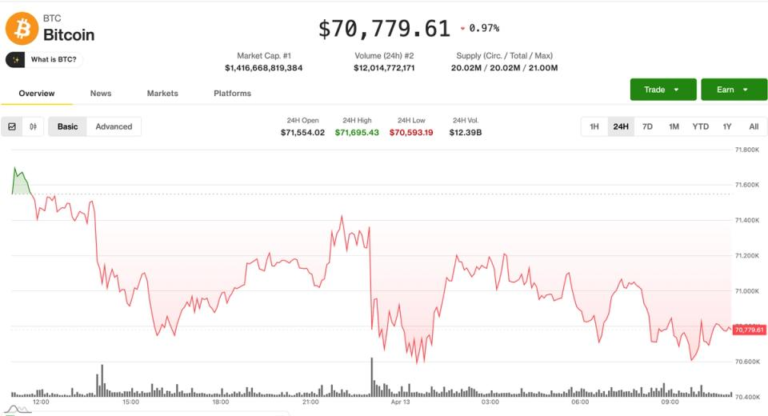
Bitcoin BTC$70,803.44 is down less than 1% over 24 hours, but not out and holds above the pivotal $70,000 level. Ether (ETH), XRP (XRP), solana (SOL) are resilient, too. BTC’s immediate prospects depend on whether it can stay above $70,000.
“70k is the line. It has been defended repeatedly because it is where dip buyers show up and where short term risk is managed,” Marex analysts wrote in an email. “If it holds, the market can stabilize quickly. If it breaks, the next move tends to accelerate because liquidity below the figure is thinner than people think.”
Beyond the war headlines, fundamentals such as flows and macroeconomic factors favor a sustained move above $70,000 and toward $88,000, other analysts said.
The optics, however, are turning increasingly negative, with obscure tokens suddenly rallying to prominence in a sign of froth. RAVE surged an eye-watering 248% in 24 hours and over 3,400% in a week, breaking into the top 50 by market capitalization. The token is tied to RaveDAO, which is pitched as a bridge between EDM culture and blockchain-based experiences, a narrative that, on the surface, appears compelling.
Social media posts suggest team-led buying and cases of liquidations in thin liquidity as catalysts for the surge. Multiple observers point to a significant portion of supply being controlled by insiders, with large wallets reportedly moving tokens to exchanges.
This kind of pump suggests that speculative froth remains in the market, undermining the view that bitcoin has already bottomed. Durable bottoms typically form only after such excesses and opportunistic schemes have been flushed out.
Persistent hacks or exploits and shady trading aren’t helping either. Early today, an attacker exploited a vulnerability in Hyperbridge, minting a large amount of bridged DOT and extracting funds. At the same time, controversy continues to swirl around World Liberty Financial and its dealings, including rising tensions with early backer Justin Sun.
Taken together, these developments may undermine confidence, keeping the bulls at bay even as BTC shows resilience.
In another signal that not everyone is bullish, veteran analyst Peter Brandt said he expects prices to drop to $66,000 before recovering. BTC’s turn lower from a key trendline resistance also suggests that. Stay alert!
Read more: For analysis of today’s activity in altcoins and derivatives, see Crypto Markets Today . For a comprehensive list of events this week, see CoinDesk’s “Crypto Week Ahead.”
What’s trending
Today’s signal
BTC vs HYPE in 2026. (TradingView)
The chart compares bitcoin’s price performance with Hyperliquid’s HYPE token. While bitcoin has dropped 19%, HYPE has surged 60% this year.
HYPE’s outperformance shows that native tokens of projects with strong use cases and activity figures can decouple from weakness in the market leader.
Hyperliquid has become a go-to venue for traders looking to speculate on traditional assets and macro-driven events, particularly over weekends. That’s evident in the surge of oil futures activity on Hyperliquid, where Brent and WTI contracts have collectively seen $1 billion in open interest over the past 24 hours.
Reporting from the front lines of the U.S. market, correspondent Amrit Kang details a “transformative” third phase of fintech evolution, where the industry has abandoned broad, speculative growth in favor of a concentrated focus on AI-driven utility, institutional-grade infrastructure, and the strategic pursuit of profitability.
Q1 is officially in the books but if you’ve spent any time around the fintech ecosystem lately, you’ll know the real story is just getting started.
After a few days at a fintech meetup in Las Vegas, I’ve been reflecting not just on the numbers from the first quarter, but on something far more important: sentiment. The conversations, the conviction, and the capital flows all point to a U.S. market that’s not slowing down it’s gearing up for its next phase as we move decisively into Q2.
Capital is concentrating and accelerating.
One of the clearest themes from Q1 is that fintech funding hasn’t disappeared; it’s become more focused. Rather than broad, speculative bets, we’re seeing capital flow into larger, more established players companies that already have distribution, data, and defensibility. These firms are doubling down, investing heavily in AI capabilities, embedded finance, and infrastructure to future-proof their platforms. The race isn’t just about growth anymore it’s about staying relevant in an AI-first financial world.
Recent U.S. fintech headlines reinforce this shift. Payment giants and digital banking platforms are expanding their AI layers from fraud detection to personalized financial insights while regulators are paying closer attention to how these technologies are deployed. At the same time, partnerships between banks and fintechs are back in focus, particularly as compliance expectations tighten and the cost of going it alone rises.
A tale of two Fintechs
The U.S. market remains the ultimate proving ground; but timing is everything. There’s a hard truth that continues to surface, especially for UK and European fintechs: entering the U.S. isn’t just difficult it’s unforgiving.
Take Monzo. Their decision to pull back from U.S. operations and refocus on the UK and Europe is a case study in timing and market fit. Despite strong brand recognition and a loyal customer base at home, they struggled to gain meaningful traction in a highly competitive and structurally different U.S. market.
And then there’s Revolut a very different story. Their initial U.S. entry pre-COVID didn’t land as planned. But instead of retreating, they recalibrated. They built relationships, adapted their product, and leaned into persistence. Now, as they reportedly move closer to securing a U.S. national banking charter, they’re positioning themselves for a much more aggressive expansion. If and when that approval comes through, expect a very different chapter in their U.S. journey.
The lesson? Entering the U.S. too early can burn capital before product-market fit is achieved. Entering too late means fighting entrenched incumbents with deeper pockets. The winners are those who time it right and stay adaptable.
Stablecoins are no longer a side narrative they’re becoming infrastructure.
Another major theme gaining momentum is the rise of stablecoins as a practical financial tool. What was once seen as a niche crypto use case is rapidly evolving into something far more foundational.
In the face of ongoing geopolitical uncertainty and currency volatility, traders and institutions alike are increasingly turning to stablecoins for settlement, liquidity, and cross-border movement. In the U.S., there’s also growing regulatory attention on how these assets should be governed suggesting that policymakers are beginning to accept that stablecoins are here to stay.
More importantly, fintechs themselves are starting to integrate stablecoin rails into their offerings, particularly in payments and remittances. The narrative is shifting from speculation to utility and that’s a significant inflection point.
So, what does this all mean for Q2?
If Q1 was about recalibration, Q2 looks set to be about execution. The U.S. fintech market is entering a phase where scale, compliance, and technological edge especially in AI will define the next wave of winners. Global players will continue to eye the U.S., but only those with the right timing, strategy, and resilience will break through.
And beneath it all, new financial infrastructure from AI to stablecoins is quietly reshaping how money moves.
The momentum is real. The stakes are higher. And if the conversations in Vegas were anything to go by, Q2 won’t just be busy it’ll be transformative.
Watch this space.
Amrit Kang is Vice President, and a key player in strengthening the fintech bridge between London and New York City. Through her role at London & Partners, London’s growth agency, she has supported more than 200 tech companies on their international expansion journeys, helping founders navigate new markets, access clients and investors, and scale globally.
With over 15 years of experience working with tech start-ups and scale-ups worldwide, Amrit brings deep expertise across fintech, venture capital, and financial services. Having lived and worked in both London and New York, she offers a unique transatlantic perspective and works closely with financial institutions, investors, and innovation leaders to connect them with high-growth, innovative companies.
Amrit is widely recognized for her impact on the fintech ecosystem and has been named an Inspiring Fintech Female by the Women’s FinTech Network. She is a regular speaker at industry conferences and events, where she shares insights on emerging fintech trends and the sub-sectors attracting venture capital investment. She also leads an all-female team, actively supporting the development and confidence of women in financial services.
Prior to her work in fintech, Amrit studied and practiced criminal defense law, developing strong analytical and problem-solving skills. She has also founded and successfully sold her own business, giving her first-hand experience of the entrepreneurial journey.
An active member of New York’s fintech community, Amrit is known for her collaborative approach and willingness to share her network and expertise to support founders and innovators.
Bitcoin (BTC) held $70,000 at the weekly close as markets reacted to a breakdown in US-Iran negotiations and escalating tensions around the Strait of Hormuz.
A breakdown in US-Iran negotiations sends oil surging above $100 per barrel, with the Strait of Hormuz now blockaded.
US PPI inflation data is due amid signs that the oil crisis is far from the only driver of price increases.
Bitcoin manages a weekly close above $70,000, but a trader says new lows remain on the roadmap.
Profit-taking is what keeps Bitcoin unable to hold the $70,000 mark for long, analysis confirms.
Overall sell-side pressure is easing, while long-term holders boost BTC exposure on Binance.
Iran breakdown sends oil above $100
The US-Iran war is once again the main topic of debate among market participants after the sudden breakdown in negotiations over the weekend.
On Sunday, US President Donald Trump announced sweeping measures to blockade the Strait of Hormuz with an eye to controlling oil transport in the future.
In one of several posts on Truth Social, Trump wrote that “at some point, we will reach an ‘ALL BEING ALLOWED TO GO IN, ALL BEING ALLOWED TO GO OUT’ basis” on Hormuz.
“It appears that Trump’s long-term plan is to blockade Hormuz, gain control, then begin letting traffic flow freely,” trading resource The Kobeissi Letter commented in a response on X.
“However, if this is possible to fully obtain, it will be a long process that would further restrict the flow of traffic for at least another 2 months, according to our analysis.”
Source: Truth Social
Fears immediately focused on markets’ reaction, but this ended up tempered, with S&P 500 futures losing around 0.6%. Oil, however, gained rapidly, trading near $105 per barrel after 8% daily upside.
CFDs on WTI crude oil one-hour chart. Source: Cointelegraph/TradingView
Kobeissi added that in the absence of diplomacy, Hormuz now appeared to be the US’ “top priority” going forward.
“We expect a volatile week ahead,” it added.
US PPI due as analysis warns of inflation contagion
As Cointelegraph reported, oil prices have a pronounced impact on US inflation gauges, notably the Consumer Price Index (CPI), which was released last week.
The coming days will see the March print of the Producer Price Index (PPI), this also set to reflect the start of the war.
Commenting, trading resource Mosaic Asset Company warned that recent inflation data was already pointing to catalysts beyond the conflict.
“While headlines coming out of the Middle East are capturing investor attention, a pair of consumer inflation reports released last week continues showing upward pressure on prices,” it wrote in the latest edition of its regular newsletter, “The Market Mosaic.”
Mosaic flagged both CPI and Federal Reserve’s “preferred” measure, the Personal Consumption Expenditures (PCE) index, the latest update for which was released on April 9.
PCE revealed “more recent annualized rates over the past three and six months are accelerating higher.”
“That shows inflation pressures outside of what’s expected following war in the Middle East and impact on energy prices,” Mosaic added.
US core PCE data (screenshot). Source: Mosaic Asset Company
As a result, the Fed may end up enacting “tighter” monetary policy, keeping interest rates steady or even raising them, despite repeated demands by Trump and other officials to do the opposite.
The latest data from CME Group’s FedWatch Tool shows that markets already see no rate cuts coming before the second half of 2027.
Fed target rate probabilities (screenshot). Source: CME Group
Bitcoin often exhibits volatile reactions to US inflation reports, particularly when those differ considerably from expected values.
Trader: Bitcoin price needs “one more low”
Bitcoin managed to avoid major losses on the back of the latest geopolitical setback, wicking to near $70,500, per data from TradingView.
The weekly close at around $70,850 thus preserved key price levels in the form of the 200-week exponential moving average (EMA) trend line and the old 2021 all-time high.
“Why haven’t we bottomed yet? Because AT LEAST 1 more low would give us reversal signals on HTF,” he told X followers in a post on Sunday.
Roman has long been among those calling for deeper long-term lows for BTC/USD, with his targets circling the $50,000 mark.
One of the prerequisites for abandoning the bear market, he said, was a bullish divergence on the relative strength index (RSI) versus price.
“RSI bull divs, bear momentum loss, likely see volume start to shift, & possible reversal pattern. All things we saw at the 2022 bottom,” he added.
BTC/USD one-week chart with RSI data. Source: Cointelegraph/TradingView
As Cointelegraph reported, RSI is already beginning to offer key bullish signals, with another trader saying that the indicator was copying the end of the 2022 bear market “nearly perfectly.”
Profit taking caps BTC price upside
Macro events aside, Bitcoin continues to suffer from a familiar problem on short time frames, analysis says.
In an X post at the weekend, onchain analytics platform Glassnode said that each time BTC/USD passes $70,000, the urge to take profit among traders results in the rally quickly fizzling.
“Another bounce to >$70k range was exhausted by >$20M/Hour profit realization,” it confirmed.
The phenomenon was recorded last week after Bitcoin made multiple attempts to flip the $70,000 to support.
“As price probed the $70K region, Realized Profit/hour spiked above $20M, signalling a local exhaustion,” Glassnode wrote at the time.
“A pattern consistent since February 2026: Every approach to the $70k–$80K band meets thin liquidity and profit-taking pressure, capping the bounce.”
Bitcoin realized profit data. Source: Glassnode/X
Sellers ease off as “calmer phase” enters
Talk of Bitcoin “short squeezes” getting easier has surfaced among analysts recently amid increasing signs of seller exhaustion.
Related: Bitcoin analysis sees $55K BTC price ‘iron bottom’ by December 2026
In its latest commentary, onchain analytics platform CryptoQuant added evidence to support the theory that bulls could retake control of the market at current levels.
“Bitcoin’s short-term holder pressure on Binance has entered a calmer phase,” contributor Amr Taha reported in one of its “Quicktake” blog posts on Monday.
Taha referred to more recent Bitcoin investor cohorts hodling coins for up to six months without selling.
“The 7-day standard deviation of realized profit/loss pressure fell to 217, marking its lowest reading since February, compared with the previous low of 277,” he reported about their profit/loss ratio.
“The move signals that short-term holders are sending coins to Binance with less aggressive profit-taking and less panic-driven loss realization, reducing near-term distribution pressure on the market.”
A further post additionally revealed rising demand for BTC on major global exchange Binance.
“Bitcoin is showing a healthier holding structure as whale transfer pressure to Binance continues to ease while long-term holder demand strengthens,” Taha added.
The increase in long-term holders’ realized cap — the combined value of their BTC holdings when they last moved — passed the $50 billion mark for the first time in nearly a year this week.
Bitcoin STH, LTH net position realized cap change (screenshot). Source: CryptoQuant
This article is produced in accordance with Cointelegraph’s Editorial Policy and is intended for informational purposes only. It does not constitute investment advice or recommendations. All investments and trades carry risk; readers are encouraged to conduct independent research before making any decisions. Cointelegraph makes no guarantees regarding the accuracy or completeness of the information presented, including forward-looking statements, and will not be liable for any loss or damage arising from reliance on this content.