Financial institutions have “accelerated” their participation in crypto markets this year, while retail investors have pulled out, said Exodus CEO JP Richardson on Sunday.
“This might be the first cycle in crypto history where institutions are in a bull market, and retail doesn’t even know it,” the crypto executive said.
Richardson cited a few examples, such as the stablecoin market capitalization all-time high this year, Morgan Stanley’s Bitcoin (BTC) ETF launch, Schwab starting a waitlist for spot Bitcoin trading, Franklin Templeton announcing a crypto division and Fannie Mae accepting Bitcoin-backed mortgages.
“In 2018 and 2022, institutions pulled out with retail. This time, they accelerated,” he said.
This shift could signal that crypto has evolved from volatile, retail-driven hype cycles to a more mature, institution-led market with steadier accumulation, deeper liquidity and reduced reliance on emotional spikes or panic selling.
Cost of living crisis keeping retail away
MN Fund founder and crypto YouTuber Michaël van de Poppe echoed the sentiment in an X post on Sunday, stating, “It’s super clear that retail isn’t interested in crypto.”
“Almost everyone has a hard time paying their bills on a monthly basis,” he added, referring to the escalating cost-of-living crisis and inflationary pressures.
“That’s why this cycle won’t be the retail cycle. It’s the institutional cycle and will take longer.”
Related: Bitcoin price falls under $71K as US-Iran war tensions spark sell-off
CryptoQuant analyst “Darkfost” noted that retail activity hit a nine-year low earlier this month, reporting that inflows from small accounts with less than 1 BTC reached a record low on Binance.
“Retail investors are clearly absent from the market,” he said.
The analyst added that some retail investors may have recently left the crypto market to move into equities and commodities, which have also delivered strong performances.
Retail trading activity on Binance has dried up. Source: Darkfost
Near-term sentiment remains fragile
CoinEx exchange chief analyst Jeff Ko told Cointelegraph on Monday that near-term sentiment “remains fragile and heavily macro-driven, especially by oil, the dollar, and inflation expectations.”
“At this stage, the move still looks more like a macro risk premium overwhelming the near-term bid than a genuine deterioration in crypto appetite.”
He said he was more confident over the medium term, adding, “I do not expect oil prices to remain elevated given the underlying supply-demand fundamentals.”
Cointelegraph is committed to independent, transparent journalism. This news article is produced in accordance with Cointelegraph’s Editorial Policy and aims to provide accurate and timely information. Readers are encouraged to verify information independently. Read our Editorial Policy https://cointelegraph.com/editorial-policy
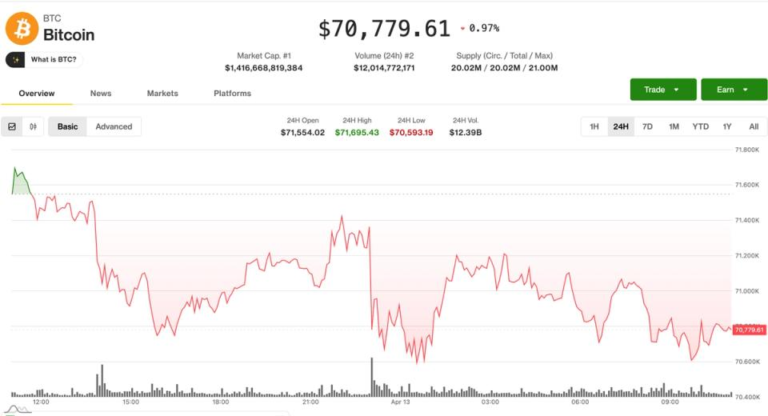
Bitcoin BTC$70,868.15 failed once more to break out of its monthslong trading range over the weekend, selling off below the key resistance level at $74,000 to trade recently at $70,600.
Ether (ETH) and the altcoin market followed suit, as ETH tumbled from April 11 high of $2,320 to $2,190. It remains little changed since midnight UTC.
The selloff came as Brent crude oil jumped back above $100 per barrel after U.S. President Donald Trump ordered a blockade at the Strait of Hormuz. The conflict with Iran has been a direct driver of risk asset price action over the past month, with U.S. equities and crypto being inversely correlated to oil and the U.S. dollar.
For now, bitcoin and the broader crypto market remain in a trading range that has persisted since early February, failing to break above $75,000 to the upside while holding firm above $63,000 to the downside.
Derivatives positioning
Futures tied to most major tokens, including bitcoin and ether, have declined slightly over the past 24 hours. The move indicates traders are scaling back risk after President Trump ordered a blockade of the Strait of Hormuz, triggering a surge in oil prices.
While oil prices have surged 5%, open interest (OI) in Binance’s crude futures declined by more than 1%. Activity on the decentralized platform Hyperliquid picked up over the weekend, with combined OI in Brent and WTI futures topping $1 billion.
Futures tied to ADA$0.2382 saw strong capital inflows, with open interest jumping to the most since Feb. 26. This is not necessarily bullish, as both perpetual funding rates and the 24-hour cumulative volume delta remain negative, suggesting that the inflows are being driven largely by traders chasing downside positioning or actively building short exposure rather than accumulating long positions.
Except for HYPE, LINK, AVAX, TRX and ZEC, all top 25 coins have seen negative CVD, indicating that sell-side aggression is offsetting buy-side aggression across the market.
A negative CVD indicates that more participants are selling by actively hitting bids than buying by lifting asks.
Bitcoin and ether’s options-based implied volatility metrics remain low across most time frames, suggesting the market is pricing in calmer, slower price movements. The volatility curve is also fairly flat, showing no strong expectation of sudden future spikes.
Still, downside concerns persist. BTC puts are currently trading at a 5-point or more premium across all time frames, indicating stronger demand for downside protection. ETH puts are also elevated, though to a noticeably lesser degree than BTC.
Block flows featured call calendar spreads and straddles, with these two strategies accounting for over 50% of total activity over the past 24 hours, indicating investor preference for time decay and volatility over a clear directional bias.
Token talk
The CoinDesk Memecoin Index (CDMEME) and the DeFi Select Index (DFX) were both in the black on Monday alongside the altcoin-dominant CoinDesk 100 (CD100), while the bitcoin and indexes dominated by the biggest tokens lost ground following oil’s price increase to above $100 per barrel.
DeFi token AAVE was one of the top performers, rising around 5%, followed by HYPE and JUP, which added about 2%.
But it was the memecoins that dominated Monday’s gains: BROCCOLI, BAN and 币安人生 posted gains in excess of 10%, demonstrating investor appetite for highly speculative tokens in what is otherwise a very flat market.
CoinMarketCap’s “Altcoin Season” indicator is at 36/100, higher than February’s sub-20 low, but beneath the 50/100 it hit last month.
Geopolitical tensions resurfaced following the breakdown of Iran-U.S. talks in Pakistan, driving risk aversion in traditional markets and lifting oil prices. Major cryptocurrencies, however, remain resilient, though questionable market activity in obscure tokens like RAVE and other negative developments create poor optics at an inopportune time.
Bitcoin BTC$70,803.44 is down less than 1% over 24 hours, but not out and holds above the pivotal $70,000 level. Ether (ETH), XRP (XRP), solana (SOL) are resilient, too. BTC’s immediate prospects depend on whether it can stay above $70,000.
“70k is the line. It has been defended repeatedly because it is where dip buyers show up and where short term risk is managed,” Marex analysts wrote in an email. “If it holds, the market can stabilize quickly. If it breaks, the next move tends to accelerate because liquidity below the figure is thinner than people think.”
Beyond the war headlines, fundamentals such as flows and macroeconomic factors favor a sustained move above $70,000 and toward $88,000, other analysts said.
The optics, however, are turning increasingly negative, with obscure tokens suddenly rallying to prominence in a sign of froth. RAVE surged an eye-watering 248% in 24 hours and over 3,400% in a week, breaking into the top 50 by market capitalization. The token is tied to RaveDAO, which is pitched as a bridge between EDM culture and blockchain-based experiences, a narrative that, on the surface, appears compelling.
Social media posts suggest team-led buying and cases of liquidations in thin liquidity as catalysts for the surge. Multiple observers point to a significant portion of supply being controlled by insiders, with large wallets reportedly moving tokens to exchanges.
This kind of pump suggests that speculative froth remains in the market, undermining the view that bitcoin has already bottomed. Durable bottoms typically form only after such excesses and opportunistic schemes have been flushed out.
Persistent hacks or exploits and shady trading aren’t helping either. Early today, an attacker exploited a vulnerability in Hyperbridge, minting a large amount of bridged DOT and extracting funds. At the same time, controversy continues to swirl around World Liberty Financial and its dealings, including rising tensions with early backer Justin Sun.
Taken together, these developments may undermine confidence, keeping the bulls at bay even as BTC shows resilience.
In another signal that not everyone is bullish, veteran analyst Peter Brandt said he expects prices to drop to $66,000 before recovering. BTC’s turn lower from a key trendline resistance also suggests that. Stay alert!
Read more: For analysis of today’s activity in altcoins and derivatives, see Crypto Markets Today . For a comprehensive list of events this week, see CoinDesk’s “Crypto Week Ahead.”
What’s trending
Today’s signal
BTC vs HYPE in 2026. (TradingView)
The chart compares bitcoin’s price performance with Hyperliquid’s HYPE token. While bitcoin has dropped 19%, HYPE has surged 60% this year.
HYPE’s outperformance shows that native tokens of projects with strong use cases and activity figures can decouple from weakness in the market leader.
Hyperliquid has become a go-to venue for traders looking to speculate on traditional assets and macro-driven events, particularly over weekends. That’s evident in the surge of oil futures activity on Hyperliquid, where Brent and WTI contracts have collectively seen $1 billion in open interest over the past 24 hours.
Reporting from the front lines of the U.S. market, correspondent Amrit Kang details a “transformative” third phase of fintech evolution, where the industry has abandoned broad, speculative growth in favor of a concentrated focus on AI-driven utility, institutional-grade infrastructure, and the strategic pursuit of profitability.
Q1 is officially in the books but if you’ve spent any time around the fintech ecosystem lately, you’ll know the real story is just getting started.
After a few days at a fintech meetup in Las Vegas, I’ve been reflecting not just on the numbers from the first quarter, but on something far more important: sentiment. The conversations, the conviction, and the capital flows all point to a U.S. market that’s not slowing down it’s gearing up for its next phase as we move decisively into Q2.
Capital is concentrating and accelerating.
One of the clearest themes from Q1 is that fintech funding hasn’t disappeared; it’s become more focused. Rather than broad, speculative bets, we’re seeing capital flow into larger, more established players companies that already have distribution, data, and defensibility. These firms are doubling down, investing heavily in AI capabilities, embedded finance, and infrastructure to future-proof their platforms. The race isn’t just about growth anymore it’s about staying relevant in an AI-first financial world.
Recent U.S. fintech headlines reinforce this shift. Payment giants and digital banking platforms are expanding their AI layers from fraud detection to personalized financial insights while regulators are paying closer attention to how these technologies are deployed. At the same time, partnerships between banks and fintechs are back in focus, particularly as compliance expectations tighten and the cost of going it alone rises.
A tale of two Fintechs
The U.S. market remains the ultimate proving ground; but timing is everything. There’s a hard truth that continues to surface, especially for UK and European fintechs: entering the U.S. isn’t just difficult it’s unforgiving.
Take Monzo. Their decision to pull back from U.S. operations and refocus on the UK and Europe is a case study in timing and market fit. Despite strong brand recognition and a loyal customer base at home, they struggled to gain meaningful traction in a highly competitive and structurally different U.S. market.
And then there’s Revolut a very different story. Their initial U.S. entry pre-COVID didn’t land as planned. But instead of retreating, they recalibrated. They built relationships, adapted their product, and leaned into persistence. Now, as they reportedly move closer to securing a U.S. national banking charter, they’re positioning themselves for a much more aggressive expansion. If and when that approval comes through, expect a very different chapter in their U.S. journey.
The lesson? Entering the U.S. too early can burn capital before product-market fit is achieved. Entering too late means fighting entrenched incumbents with deeper pockets. The winners are those who time it right and stay adaptable.
Stablecoins are no longer a side narrative they’re becoming infrastructure.
Another major theme gaining momentum is the rise of stablecoins as a practical financial tool. What was once seen as a niche crypto use case is rapidly evolving into something far more foundational.
In the face of ongoing geopolitical uncertainty and currency volatility, traders and institutions alike are increasingly turning to stablecoins for settlement, liquidity, and cross-border movement. In the U.S., there’s also growing regulatory attention on how these assets should be governed suggesting that policymakers are beginning to accept that stablecoins are here to stay.
More importantly, fintechs themselves are starting to integrate stablecoin rails into their offerings, particularly in payments and remittances. The narrative is shifting from speculation to utility and that’s a significant inflection point.
So, what does this all mean for Q2?
If Q1 was about recalibration, Q2 looks set to be about execution. The U.S. fintech market is entering a phase where scale, compliance, and technological edge especially in AI will define the next wave of winners. Global players will continue to eye the U.S., but only those with the right timing, strategy, and resilience will break through.
And beneath it all, new financial infrastructure from AI to stablecoins is quietly reshaping how money moves.
The momentum is real. The stakes are higher. And if the conversations in Vegas were anything to go by, Q2 won’t just be busy it’ll be transformative.
Watch this space.
Amrit Kang is Vice President, and a key player in strengthening the fintech bridge between London and New York City. Through her role at London & Partners, London’s growth agency, she has supported more than 200 tech companies on their international expansion journeys, helping founders navigate new markets, access clients and investors, and scale globally.
With over 15 years of experience working with tech start-ups and scale-ups worldwide, Amrit brings deep expertise across fintech, venture capital, and financial services. Having lived and worked in both London and New York, she offers a unique transatlantic perspective and works closely with financial institutions, investors, and innovation leaders to connect them with high-growth, innovative companies.
Amrit is widely recognized for her impact on the fintech ecosystem and has been named an Inspiring Fintech Female by the Women’s FinTech Network. She is a regular speaker at industry conferences and events, where she shares insights on emerging fintech trends and the sub-sectors attracting venture capital investment. She also leads an all-female team, actively supporting the development and confidence of women in financial services.
Prior to her work in fintech, Amrit studied and practiced criminal defense law, developing strong analytical and problem-solving skills. She has also founded and successfully sold her own business, giving her first-hand experience of the entrepreneurial journey.
An active member of New York’s fintech community, Amrit is known for her collaborative approach and willingness to share her network and expertise to support founders and innovators.
Bitcoin (BTC) held $70,000 at the weekly close as markets reacted to a breakdown in US-Iran negotiations and escalating tensions around the Strait of Hormuz.
A breakdown in US-Iran negotiations sends oil surging above $100 per barrel, with the Strait of Hormuz now blockaded.
US PPI inflation data is due amid signs that the oil crisis is far from the only driver of price increases.
Bitcoin manages a weekly close above $70,000, but a trader says new lows remain on the roadmap.
Profit-taking is what keeps Bitcoin unable to hold the $70,000 mark for long, analysis confirms.
Overall sell-side pressure is easing, while long-term holders boost BTC exposure on Binance.
Iran breakdown sends oil above $100
The US-Iran war is once again the main topic of debate among market participants after the sudden breakdown in negotiations over the weekend.
On Sunday, US President Donald Trump announced sweeping measures to blockade the Strait of Hormuz with an eye to controlling oil transport in the future.
In one of several posts on Truth Social, Trump wrote that “at some point, we will reach an ‘ALL BEING ALLOWED TO GO IN, ALL BEING ALLOWED TO GO OUT’ basis” on Hormuz.
“It appears that Trump’s long-term plan is to blockade Hormuz, gain control, then begin letting traffic flow freely,” trading resource The Kobeissi Letter commented in a response on X.
“However, if this is possible to fully obtain, it will be a long process that would further restrict the flow of traffic for at least another 2 months, according to our analysis.”
Source: Truth Social
Fears immediately focused on markets’ reaction, but this ended up tempered, with S&P 500 futures losing around 0.6%. Oil, however, gained rapidly, trading near $105 per barrel after 8% daily upside.
CFDs on WTI crude oil one-hour chart. Source: Cointelegraph/TradingView
Kobeissi added that in the absence of diplomacy, Hormuz now appeared to be the US’ “top priority” going forward.
“We expect a volatile week ahead,” it added.
US PPI due as analysis warns of inflation contagion
As Cointelegraph reported, oil prices have a pronounced impact on US inflation gauges, notably the Consumer Price Index (CPI), which was released last week.
The coming days will see the March print of the Producer Price Index (PPI), this also set to reflect the start of the war.
Commenting, trading resource Mosaic Asset Company warned that recent inflation data was already pointing to catalysts beyond the conflict.
“While headlines coming out of the Middle East are capturing investor attention, a pair of consumer inflation reports released last week continues showing upward pressure on prices,” it wrote in the latest edition of its regular newsletter, “The Market Mosaic.”
Mosaic flagged both CPI and Federal Reserve’s “preferred” measure, the Personal Consumption Expenditures (PCE) index, the latest update for which was released on April 9.
PCE revealed “more recent annualized rates over the past three and six months are accelerating higher.”
“That shows inflation pressures outside of what’s expected following war in the Middle East and impact on energy prices,” Mosaic added.
US core PCE data (screenshot). Source: Mosaic Asset Company
As a result, the Fed may end up enacting “tighter” monetary policy, keeping interest rates steady or even raising them, despite repeated demands by Trump and other officials to do the opposite.
The latest data from CME Group’s FedWatch Tool shows that markets already see no rate cuts coming before the second half of 2027.
Fed target rate probabilities (screenshot). Source: CME Group
Bitcoin often exhibits volatile reactions to US inflation reports, particularly when those differ considerably from expected values.
Trader: Bitcoin price needs “one more low”
Bitcoin managed to avoid major losses on the back of the latest geopolitical setback, wicking to near $70,500, per data from TradingView.
The weekly close at around $70,850 thus preserved key price levels in the form of the 200-week exponential moving average (EMA) trend line and the old 2021 all-time high.
“Why haven’t we bottomed yet? Because AT LEAST 1 more low would give us reversal signals on HTF,” he told X followers in a post on Sunday.
Roman has long been among those calling for deeper long-term lows for BTC/USD, with his targets circling the $50,000 mark.
One of the prerequisites for abandoning the bear market, he said, was a bullish divergence on the relative strength index (RSI) versus price.
“RSI bull divs, bear momentum loss, likely see volume start to shift, & possible reversal pattern. All things we saw at the 2022 bottom,” he added.
BTC/USD one-week chart with RSI data. Source: Cointelegraph/TradingView
As Cointelegraph reported, RSI is already beginning to offer key bullish signals, with another trader saying that the indicator was copying the end of the 2022 bear market “nearly perfectly.”
Profit taking caps BTC price upside
Macro events aside, Bitcoin continues to suffer from a familiar problem on short time frames, analysis says.
In an X post at the weekend, onchain analytics platform Glassnode said that each time BTC/USD passes $70,000, the urge to take profit among traders results in the rally quickly fizzling.
“Another bounce to >$70k range was exhausted by >$20M/Hour profit realization,” it confirmed.
The phenomenon was recorded last week after Bitcoin made multiple attempts to flip the $70,000 to support.
“As price probed the $70K region, Realized Profit/hour spiked above $20M, signalling a local exhaustion,” Glassnode wrote at the time.
“A pattern consistent since February 2026: Every approach to the $70k–$80K band meets thin liquidity and profit-taking pressure, capping the bounce.”
Bitcoin realized profit data. Source: Glassnode/X
Sellers ease off as “calmer phase” enters
Talk of Bitcoin “short squeezes” getting easier has surfaced among analysts recently amid increasing signs of seller exhaustion.
Related: Bitcoin analysis sees $55K BTC price ‘iron bottom’ by December 2026
In its latest commentary, onchain analytics platform CryptoQuant added evidence to support the theory that bulls could retake control of the market at current levels.
“Bitcoin’s short-term holder pressure on Binance has entered a calmer phase,” contributor Amr Taha reported in one of its “Quicktake” blog posts on Monday.
Taha referred to more recent Bitcoin investor cohorts hodling coins for up to six months without selling.
“The 7-day standard deviation of realized profit/loss pressure fell to 217, marking its lowest reading since February, compared with the previous low of 277,” he reported about their profit/loss ratio.
“The move signals that short-term holders are sending coins to Binance with less aggressive profit-taking and less panic-driven loss realization, reducing near-term distribution pressure on the market.”
A further post additionally revealed rising demand for BTC on major global exchange Binance.
“Bitcoin is showing a healthier holding structure as whale transfer pressure to Binance continues to ease while long-term holder demand strengthens,” Taha added.
The increase in long-term holders’ realized cap — the combined value of their BTC holdings when they last moved — passed the $50 billion mark for the first time in nearly a year this week.
Bitcoin STH, LTH net position realized cap change (screenshot). Source: CryptoQuant
This article is produced in accordance with Cointelegraph’s Editorial Policy and is intended for informational purposes only. It does not constitute investment advice or recommendations. All investments and trades carry risk; readers are encouraged to conduct independent research before making any decisions. Cointelegraph makes no guarantees regarding the accuracy or completeness of the information presented, including forward-looking statements, and will not be liable for any loss or damage arising from reliance on this content.
Robotics is more than humanoid robots; it’s a toolkit for creating intelligent machines.
Simpler technologies can outperform complex systems in specific applications.
Innovative business models can drive success by sharing value with partners.
Partnerships with larger companies carry inherent risks but are crucial for innovation.
Effective navigation systems were vital to the initial design of the Roomba.
Consumer perception significantly impacts product success in the robotics market.
Separating debris collection in vacuums enhances efficiency.
In-store demonstrations and media coverage were pivotal for Roomba’s success.
Unexpected advertisements can dramatically boost sales.
Storytelling is a critical component of successful marketing strategies.
The Roomba’s design evolved from consumer feedback and technological limitations.
Innovative vacuum design was a breakthrough in robotic cleaning technology.
Press coverage can substitute for traditional advertising in product launches.
Understanding consumer expectations is crucial for product development.
Effective marketing can transform a product’s market reception.
Guest intro
Colin Angle is chairman and CEO of iRobot Corporation, the company he co-founded in 1990. Under his leadership, iRobot launched the Roomba robot vacuum in 2002, creating the home robot category and selling tens of millions of units worldwide. His early work at MIT’s Artificial Intelligence Laboratory and on NASA’s Sojourner Mars rover laid the foundation for practical robotics.
The broader definition of robotics
Robotics is not limited to humanoid forms; it’s a toolkit for creating smart machines.
This idea that robotics isn’t a thing it’s a toolkit was a early lesson that I was taught
— Colin Angle
The concept of robotics as a toolkit emphasizes versatility.
Robotics was a box of parts that allowed you to make smart machines
— Colin Angle
This perspective reframes how we view the potential of robotics.
Robotics can solve a wide range of problems beyond humanoid tasks.
Capable of doing interesting things and to solve a problem
— Colin Angle
Understanding this broader definition is crucial for innovation in the field.
Simplicity in technology
The insect-like robot Genghis outperformed more complex robots in rugged terrain.
This little silly robot was able to successfully climb over very rugged terrain
— Colin Angle
Simpler technologies can be more effective in certain applications.
Genghis challenged assumptions about the need for advanced computing power.
More successfully than robots that were using supercomputers
— Colin Angle
The effectiveness of Genghis highlights the value of simplicity.
This insight encourages reevaluation of technology complexity in design.
The success of simpler robots can inspire new approaches in robotics development.
Innovative business models
Working at cost and sharing value with partners was a breakthrough for iRobot.
The breakthrough for us actually was a business model that we discovered
— Colin Angle
This model addressed both risk and value creation.
I would work at break-even but we would split the value
— Colin Angle
Partnerships were risky but necessary for commercial success.
That was a deal that’s pretty risky
— Colin Angle
Resource dependency is crucial for innovation in partnerships.
Understanding these dynamics is key for startups collaborating with large corporations.
The importance of navigation in Roomba’s design
Effective navigation was crucial for the Roomba to clean entire rooms.
We knew we needed a better navigation system
— Colin Angle
Early navigation systems had significant technological limitations.
There was no navigation system good enough to give you an actual position
— Colin Angle
The Roomba’s design was influenced by these navigation challenges.
Navigation technology was a critical factor in the Roomba’s development.
Ensuring complete room coverage was a key design goal.
This insight highlights the importance of technological innovation in product design.
Consumer perception and product value
Early consumer feedback indicated that dragging a cloth was not valuable.
If it was only dragging an electrostatic cloth it was not valued by the consumer
— Colin Angle
Consumer perception is crucial for product success in the market.
It’s just a dress it’s dragging a piece of cloth on your floor
— Colin Angle
Understanding consumer expectations is vital for product development.
The Roomba’s design evolved based on consumer feedback.
This insight underscores the importance of aligning product design with consumer perceptions.
Market success depends on meeting consumer expectations and perceptions.
Innovative vacuum design
The Roomba’s vacuum design separated large debris and small dust collection.
By breaking vacuuming into two pieces we’d invented a new way of vacuuming
— Colin Angle
This design was a breakthrough in robotic cleaning technology.
Efficiency was enhanced by separating debris collection.
The innovation addressed challenges in vacuum design and battery limitations.
Understanding these challenges was crucial for the Roomba’s development.
This insight highlights the importance of innovation in product design.
The Roomba’s success was driven by technological advancements in vacuum design.
Marketing and media coverage
In-store demonstrations and press coverage were key to Roomba’s success.
It demoed really well but combine that with the press
— Colin Angle
Media coverage can substitute for traditional advertising in product launches.
We had a 150 articles written about the Roomba immediately after launch
— Colin Angle
Effective marketing strategies are crucial for product success.
The Roomba’s initial success was driven by innovative marketing efforts.
Understanding the role of media coverage is vital for product launches.
This insight highlights the importance of marketing in driving product success.
The impact of unexpected advertising
A single unexpected ad can significantly boost product sales.
We sold 250,000 Roombas in six weeks after that ad
— Colin Angle
Effective marketing can transform a product’s market reception.
Pepsi basically made an ad for you without even telling you
— Colin Angle
Understanding the impact of advertising on consumer behavior is crucial.
This insight highlights the power of effective marketing strategies.
Unexpected advertisements can drive sales dramatically.
The Roomba’s success was influenced by unexpected marketing boosts.
The role of storytelling in marketing
Companies often underestimate the importance of storytelling in marketing.
We kinda realized we knew nothing about marketing
— Colin Angle
Effective storytelling can enhance a company’s marketing efforts.
Started hiring people into the company that could help tell our story better
— Colin Angle
Understanding the role of narrative and branding is crucial for marketing strategies.
Storytelling is a critical component of successful marketing.
This insight reflects a critical understanding of marketing dynamics.
Enhancing storytelling can improve a company’s market presence and product success.
Disclosure: This article was edited by Editorial Team. For more information on how we create and review content, see our Editorial Policy.
WHY THIS MATTERS: The introduction of a purpose-built Model Context Protocol (MCP) for the core is a critical architectural pivot in the evolution of agentic banking. For years, financial institutions have struggled to bridge the chasm between flexible, cloud-native AI tools and their rigid, legacy core banking systems, fearing compliance gaps and operational risk. This server provides a secure, standardized connection, finally making AI-assisted workflows practical for everyday front-office operations. By translating conversational AI requests into approved core functions, Nymbus is laying the groundwork for a new competitive advantage: the ability to execute complex actions like fraud investigation or account management through a single interface, delivering genuine efficiency gains instead of mere chatbot answers. This move signals that responsible AI integration, rather than just adoption, is the next major battleground for core providers.
Nymbus, a modern banking platform for U.S. banks and credit unions, announced the launch of the Nymbus MCP Server, one of the first secure Model Context Protocol (MCP) servers purpose-made for core banking. Built for the Nymbus Banking Platform, the server gives financial institutions a secure, standardized, and controlled way to connect AI-powered experiences to the core through a single interface.
Designed for front-office banking operations, the server currently provides 19 tools that enable AI assistants to support common banking actions such as customer lookup, account management, money movement, and debit card controls. It translates banking capabilities into a format AI agents can securely use to call approved core functions through a large language model, while Nymbus handles the complexity behind the scenes. Financial institutions determine which tools are enabled, which user roles can access them, and where additional review or approval is required.
The result is a practical foundation for financial institutions looking to apply AI to everyday service and operational workflows. For example, a member service agent using an AI assistant can verify a customer, review account details, and initiate an approved debit card freeze workflow through a single conversational interface, without toggling between systems. Similar AI-assisted workflows can help institutions accelerate research-heavy processes such as fraud investigation, case handling, and operational follow-up, improving efficiency while keeping employees in control of the work.
“AI creates real value in banking when it helps institutions get work done, not just generate answers,” said Jeffery Kendall, Chairman and CEO of Nymbus. “With the Nymbus MCP Server, we are giving banks and credit unions a practical way to put AI into everyday workflows while maintaining the control, consistency, and accountability they need to operate with confidence. Our server simplifies common front-office work today while laying the groundwork for more intelligent, agentic banking experiences in the future.”
The Nymbus MCP Server is built on Nymbus’ AI-enabled, open integration architecture and robust analytics layer. Where legacy cores often require custom integrations for every AI tool or use case, the Nymbus MCP Server provides a single, standardized connection layer. That architecture allows institutions to move faster, scale AI-assisted workflows more consistently, and create a stronger foundation for future innovation across internal channels and teams.
Nymbus designed its MCP Server specifically for the regulatory and operational realities of financial services, with token-based authentication, role-based access controls, PII masking in logs, encrypted connections, full audit logging, and granular controls over how institutions choose to deploy and use AI. Together, these capabilities help financial institutions support security, access, and recordkeeping requirements associated with banking compliance programs, while giving them the flexibility to start small, focus on specific use cases, and expand over time within institution-defined guardrails, while keeping data security top of mind.
Because the server is built on the open MCP standard, it also creates a flexible foundation for the next generation of banking interactions, where AI can move beyond answering questions to assisting employees and coordinating tasks across systems within institution-defined controls.
“Financial institutions are looking at AI as a way to improve service, strengthen operations, and create competitive advantage, but they need a practical path to do that responsibly,” said Matthew Terry, Chief Technology Officer at Nymbus. “The Nymbus MCP Server helps banks and credit unions augment existing processes with AI-assisted workflows that can speed up research, reduce manual effort, and support better decisions, while giving each institution granular control over what is enabled, how it is used, and where governance and auditability are required.”
The Nymbus MCP Server is available as part of the Nymbus Banking Platform. To learn more, go to https://www.nymbus.com/solutions/core/.
FF NEWS TAKE: This is a definitive step in normalizing AI access to sensitive data, effectively moving the needle on operational efficiency in core banking. The industry’s next challenge will be the adoption race. We expect competitors, particularly those serving regional banks and credit unions, to rapidly announce similar, controlled middleware solutions to accelerate AI integration. The true win for Nymbus is standardizing the Model Context Protocol as the secure language between the LLM and the ledger, setting a crucial precedent for auditability and control.
StarkWare is restructuring into two business units and cutting staff as it pivots from scaling Ethereum toward building revenue-generating products of its own — a shift forced by a more than 99% collapse in revenue on its flagship Starknet network.
The changes were outlined during a company-wide town hall hosted by CEO Eli Ben-Sasson, where he told employees StarkWare would restructure into two independent units and focus on building revenue-generating products in-house. A transcript of the address to staff was reviewed by CoinDesk.
Starknet chain revenue, which peaked near $6 million in a single month in late 2023, stood at roughly $48,000 through the first half of April 2026, according to DefiLlama data. The decline is partly industry-wide, with Starknet’s competitors equally impacted, as Ethereum’s EIP-4844 upgrade in March 2024 slashed Layer 2 fee revenue across the board.
Total Value Locked (TVL), however, remains above $200 million.
Ben-Sasson told employees the company now needs to “take our technological superiority… and convert it into meaningful revenue, meaningful usage,” signaling a shift away from a pure infrastructure focus toward building products that can drive demand directly.
He added that StarkWare would prioritize building “things that can be done by no other team, in no other way,” focusing resources on products with “immense potential revenue” rather than broad experimentation.
“I started in this field in 2013, almost 13 years ago, and I’ve seen quite a number of winters,” Ben-Sasson said at the town hall. “I think what marks this winter is that there’s a very clear vacuum in leadership across blockchain, and it affects even things like Bitcoin and Ethereum.”
The company will spin up a new revenue-focused Applications unit led by researcher Avihu Levy.
Levy’s promotion comes days after he published a paper outlining Quantum Safe Bitcoin, or QSB, a method for making bitcoin transactions resistant to quantum attacks without requiring changes to the protocol.
The approach replaces traditional signature schemes with hash-based proofs but comes with significant tradeoffs, requiring extensive off-chain computation and costing an estimated $75 to $200 per transaction, versus roughly $0.33 for a standard bitcoin payment.
QSB offers an alternative to BIP-360, a long-pending proposal to add quantum resistance to Bitcoin at the protocol level that was merged to Bitcoin’s improvement proposal repository in February but could take years to activate.
Ben-Sasson did not name Bitcoin or quantum safety as the Applications unit’s target, saying only that StarkWare would focus on products “that cannot be done by any of our competitors” and build with “minimal dependencies on external L1s or external application teams.”
More details, he told staff, would come next week.
A spokesperson for StarkWare declined a request to comment.
TAO has fallen more than 18% in the last 24 hours amid a spat between the network’s founder and a leading ecosystem contributor.
The subnet operator, Covenant AI, is leaving BitTensor after alleging centralized control by the project’s founder, Jacob Steeves.
Steeves denied the claims, but the market reacted negatively regardless.
Tensions between the founder of BitTensor and a prominent firm building on the decentralized AI network have helped put TAO, the native BitTensor token, into a spiral, falling 18.5% in the last 24 hours amid the public drama.
The plunge comes as Covenant AI, one of the best-known subnet operators on BitTensor’s network, announced its intentions to leave the ecosystem altogether, alleging malfeasance by BitTensor founder Jacob Steeves, who it claims has acted out against the firm building on his network.
“When a single actor can suspend a subnet’s emissions, override an owner’s authority over their own community spaces, publicly deprecate projects without process, and use token sales as a coercive mechanism to compel compliance, that is not decentralization,” Covenant AI founder Sam Dare posted on X.
“It is centralized control with decentralized branding,” he added.
Dare alleged that Steeves suspended Covenant’s subnet emissions, the method by which TAO distributes tokens to miners and validators for performance within subnets. He also alleged that Steeves exerted his control over Covenant’s community spaces, hampering the firm’s ability to communicate with its community.
But Steeves denied the claims, alleging that it was Dare in fact who was deprecating community channels and deleting posts from within.
“I do not have the ability to suspend emissions,” Steeves posted on X.
The firm operated three subnets—or markets dedicated to producing a specific AI task—on the network. For example, its Templar subnet (SN3) was focused on decentralized pre-training, while Basilica’s (SN39) focus was on decentralized compute—distinct parts of the artificial intelligence stack.
“We cannot in good conscience continue to build on a network where the foundational claim we make to our investors, that this infrastructure is decentralized and permissionless, is contradicted by the reality of how the network is actually governed,” Dare said in his statement on the incident.
“It is therefore with deep frustration that we announce Covenant AI’s departure from the BitTensor network,” he added.
The firm’s trio of subnets now show as “deprecated” among other active subnets according to BitTensor block explorer, Taostats.
TAO recently changed hands around $272.70, having erased nearly all the gains since Covenant’s model training was noted on the “All-In Podcast.” The token is down about 64% from its all-time high of $757 from May 2024.
Daily Debrief Newsletter
Start every day with the top news stories right now, plus original features, a podcast, videos and more.
Just yesterday, CoinDesk reported that despite lingering war risks, analysts foresee bitcoin rallying to $88,000 and higher on the back of several crypto-specific factors, including bullish market flows.
But now, some 16 hours later, the price chart is saying: not so fast.
Bitcoin’s BTC$70,734.80 price has run directly into one of the most pivotal technical levels – a descending trendline that has been in place since October, when Bitcoin peaked above $126,000. And right on cue, the price has turned lower from the trendline resistance.
BTC’s daily chart. (TradingView)
What is a descending trendline and why does it matter
A descending trendline is drawn by connecting a series of progressively lower price peaks over time. Think of a ball dropped from a great height: as it bounces, each rebound is lower than the last. Now imagine linking those lower highs with a straight line – that’s the descending trendline, capturing the fading strength behind each bounce.
In markets, this reflects diminishing buying power, with sellers increasingly asserting control over price action. The longer the trendline holds, and the more often price turns lower from it, the more significant it becomes, signaling a sustained bear phase.
In bitcoin’s case, this particular trendline has been sloping downward since the $126,000 peak in October 2025. That’s roughly six months of lower highs and six months of the market telling you: the trend is down.
This is what traders call a textbook bear market trendline.
The rejection
Since early February, bitcoin has rallied from nearly $60,000 to over $71,000. The sounds bullish on the surface, and in isolation, it is. But zoom out, and you will see immediately that this is a recovery rally within the broader downtrend represented by the descending trendline.
That trendline was tested overnight, and since then, prices have turned lower. This is what aficionados of technical analysis call a trendline rejection, and it means that sellers have overpowered buyers exactly where the bear-market trendline predicted they would.
The market probed resistance, found it, and turned back. Until BTC can close above this trendline on meaningful volume — not just poke through it intraday — this line remains in control, and the broader downtrend remains intact.
Fundamentals tell you what should happen, and analysts on Sunday cited several fundamental datasets, such as Coinbase premium ETF inflows and macro, as catalysts for a rally to $88,000.
However, the price chart tells you what is happening, and right now, the textbook rejection at the six-month bear market trendline is signalling caution for the bulls.
What to Watch From Here
The trendline is the key variable, based on which two scenarios could unfold.
First, the latest rejection at the trendline invites stronger selling pressure, leading ot a deeper decline to $65,000.
The second scenario involves BTC grinding back up, punching through the trendline. That would be a significant positive development, one that would start to align the chart with the bullish fundamental story.
Until the second scenario plays out, the chart and the bull case are telling two different stories.