Home Blog Page 49

US Senate Will Vote on CLARITY Crypto Bill ‘Without Any Question’ This Week: Tim Scott

0

Cointelegraph is committed to providing independent, high-quality journalism across the crypto, blockchain, AI, and fintech industries.

All news, reviews, and analyses are produced with full journalistic independence and integrity. For more details on our standards and processes, please read our Editorial Policy.

Tether expands tokenization platform to Saudi Arabia, starting with real estate

0

Tether, best known for issuing USDT, the world’s most widely used stablecoin, is expanding its push into real-world asset tokenization to bring institutional-grade real estate asset onchain in Saudi Arabia.

The company said Thursday that its tokenization platform, dubbed Hadron, will provide the technology to issue and manage tokenized real estate assets for institutional investors in the country. Tether is teaming up with Saudi partners First Data and fintech company BKN301 on the effort.

The operating model could later expand beyond real estate into energy, infrastructure finance and other real-world assets, the firms said.

The announcement marks Tether’s latest effort to expand beyond stablecoins into tokenization, a fast-growing application of blockchain rails in finance. The firm launched Hadron in 2024 to simplify asset tokenization and is also the issuer of the largest tokenized gold offering, the $2.6 billion XAUT.

Banks and asset managers have increasingly turned to tokenization to represent traditional assets such as money market funds, private credit, real estate and equities on blockchains, arguing the technology can streamline settlement, broaden investor access and improve capital efficiency. Citi projected that the tokenized securities market could reach $5.5 trillion by 2030.

Putin Signs Russia Crypto Bill Into Law

0

Russian President Vladimir Putin has signed a law creating a regulated framework for cryptocurrency markets in the country.

Putin signed bill No. 1194918-8, titled “On Digital Currencies and Digital Rights,” into law on Tuesday, according to official records from the State Duma, Russia’s lower house of parliament. The legislation establishes rules for crypto market participants, including exchanges, brokers, custodians and other crypto service providers.

The law requires crypto exchange operators to meet regulatory requirements and join a financial market self-regulatory organization. It limits retail investors to buying approved crypto assets through intermediaries, with an annual cap of 300,000 rubles ($3,700) per intermediary. Qualified investors will be allowed to purchase any cryptocurrency without such restrictions.

The core provisions of the law take effect on Sept. 1, 2026, while some measures, including rules for non-resident digital depositories, will take effect on July 1, 2027. The law also maintains a ban on using crypto assets to pay for goods and services inside Russia.

The State Duma approved the legislation after final readings in late July. Under the law, the Bank of Russia will oversee the regulated crypto market, issue related rules and determine which crypto assets licensed intermediaries can offer.

Related: Russia expands crypto mining ban to Moscow through 2032

Cointelegraph is committed to independent, transparent journalism. This news article is produced in accordance with Cointelegraph’s Editorial Policy and aims to provide accurate and timely information. Readers are encouraged to verify information independently.

Taurus Brings Crypto Custody Onshore to Meet US Infrastructure Sovereignty Demands

0

  • Taurus is preparing to deploy its HSM-based digital-asset custody platform inside MPCH’s high-security US facilities.
  • The arrangement gives banks, custodians and government agencies a domestic hosting option while Taurus retains control of its cryptographic operations.
  • It addresses growing demands around infrastructure sovereignty, resilience and data residency.

Taurus is preparing a U.S.-hosted version of its digital-asset custody platform for banks, government agencies and other regulated institutions seeking greater control over where their cryptographic infrastructure operates.

The Swiss financial-technology company will deploy its hardware security module-based platform within facilities operated by MPCH, a New York-based provider of cryptographic infrastructure and managed secure sites.

It offers Taurus a domestic deployment option without transferring control of its private-key technology or cryptographic processes to MPCH.

Under the proposed structure, MPCH will provide a dedicated secured area, physical infrastructure and managed operational services. Taurus will continue operating the HSM technology that generates, stores and uses the cryptographic keys controlling customer assets.

The companies have not disclosed the facilities’ locations, launch date, expected capacity or initial customers.

Domestic Hosting Becomes a Sales Requirement

The partnership reflects a change in how U.S. financial institutions evaluate digital-asset custody providers.

Banks have long been allowed to provide cryptocurrency custody services. More recent guidance from the Office of the Comptroller of the Currency also confirmed that national banks may outsource permissible crypto activities, including custody and transaction execution, provided they maintain appropriate third-party risk controls.

There is no blanket federal rule requiring all bank custody infrastructure to remain inside the United States.

However, infrastructure location can become a procurement condition for institutions handling sensitive data, government assets or systemically important operations. Federal banking guidance asks institutions to assess the location of third parties, subcontractors and associated data, alongside cybersecurity, disaster recovery and business-continuity arrangements.

That makes domestic hosting commercially important even when it is not explicitly mandated by law.

For Taurus, the MPCH arrangement could reduce a potential barrier when pitching U.S. banks, federal agencies and regulated custodians that are unwilling to place critical signing infrastructure in an overseas facility.

A Defense-Linked Infrastructure Provider

MPCH is a dual-use cryptographic infrastructure company serving financial institutions, blockchain networks and national-security environments.

Its U.S. defense subsidiary, Ti22, is a prime contractor to U.S. Special Operations Command through SOFWERX, according to MPCH. It operates dedicated secure sites, air-gapped recovery systems and managed security operations for institutional and defense clients.

MPCH’s infrastructure combines purpose-built facilities with hardware-backed signing, biometric controls, chain-of-custody records and round-the-clock monitoring. Its sites include geographically separated, air-gapped recovery environments designed to remain isolated from normal network access.

The defense relationship does not mean Taurus’ customers will use classified government infrastructure. It does give Taurus access to an operator whose security model was built for both regulated finance and national-security applications.

“Financial institutions need the flexibility to deploy digital asset infrastructure in a way that meets their specific security, resilience, and regulatory requirements,” Milena Kohlhofer, strategic partnerships executive at Taurus, said in a statement shared with AlexaBlockchain.

“Our collaboration with MPCH will expand the deployment options available to U.S. institutions by combining secure, domestic infrastructure with Taurus’ enterprise-grade custody technology,” Milena added.

Why Does It Matter?

Digital-asset custody is not simply a question of storing cryptocurrency.

The custodian must control the private keys authorizing transactions while preventing attackers, insiders or infrastructure providers from gaining unilateral access. A failure in that control layer can result in assets being transferred irreversibly.

Taurus’ platform supports on-premise, cloud and hybrid deployments and uses HSMs alongside multiparty computation. HSMs place key generation and transaction signing inside tamper-resistant hardware rather than exposing raw private keys to ordinary servers or applications.

The MPCH deployment separates responsibilities further.

MPCH controls the physical perimeter and supporting infrastructure. Taurus retains responsibility for the HSMs and cryptographic operations. Customers can therefore gain domestic infrastructure without handing signing authority to the facility operator.

That division may appeal to institutions seeking to avoid concentrating software, keys, physical custody and operational control with one provider.

Banks Are Moving From Tests to Production

Taurus has already demonstrated that its technology can be embedded inside the infrastructure of a large U.S. custodian.

In 2025, State Street established a production environment using Taurus technology within a year of announcing their partnership. The deployment included blockchain connectors and HSM integration for a private permissioned network.

State Street also connected Taurus’ custody and tokenization platforms to a Hyperledger Besu network and began rolling out tokenization initiatives. The bank said the architecture could support tokenized funds, securities and digital settlement instruments.

The MPCH arrangement addresses a different part of the adoption process.

Rather than adding new asset or tokenization capabilities, it gives Taurus another way to satisfy physical-security, infrastructure-residency and operational-resilience requirements during institutional procurement.

That could help Taurus compete with U.S.-regulated custodians and infrastructure providers that already market domestic operations as part of their compliance offering.

Preparing for New Cryptographic Standards

Taurus and MPCH are also positioning the infrastructure as a foundation for eventually adopting post-quantum cryptography.

Quantum computers capable of breaking today’s widely used public-key algorithms do not yet exist at the required scale. Institutions nevertheless face lengthy testing, certification and systems-integration cycles before changing the cryptography used in critical infrastructure.

NIST finalized its first three post-quantum cryptography standards in August 2024, including two standards for digital signatures and one for establishing shared encryption keys. The agency has urged organizations to begin preparing for migration.

Taurus said compatible HSMs could allow institutions to introduce supported post-quantum signature methods through firmware and certification upgrades rather than replacing the entire custody architecture.

“A controlled environment for HSM-based infrastructure, together with Taurus’ cryptographic agility, gives institutions a stronger foundation to prepare for future post-quantum migration while retaining control over their cryptographic operations and custody environment,” Kohlhofer said.

That remains a future capability for now.

The more immediate value of the partnership is simpler: Taurus can offer U.S. institutions a domestically hosted custody environment while keeping control of the cryptographic machinery that ultimately controls their digital assets.

The above article “Taurus Brings Crypto Custody Onshore to Meet US Infrastructure Sovereignty Demands” was first published on AlexaBlockchain. Read the complete article here: https://alexablockchain.com/taurus-brings-crypto-custody-onshore-to-meet-us-infrastructure-sovereignty-demands/

Read Also: This is the First U.S.-Chartered Depository Bank to Offer Stablecoin Invoicing

Disclaimer: The information provided on AlexaBlockchain is for informational purposes only and does not constitute financial advice. Read complete disclaimer here.

Blockchain.com wins Cayman custody license after MiCA and FCA approvals

0

Blockchain.com secured a VASP custody license from the Cayman Islands Monetary Authority, expanding its regulated crypto services in the region.

Hyperliquid ETF demand cools as competition heats up: JPMorgan

0

Inflows into Hyperliquid (HYPE) exchange-traded funds (ETFs) have largely ground to a halt after surging in May and June, reflecting growing concerns over the protocol’s competitive outlook, according to Wall Street bank JPMorgan (JPM).

The bank said Hyperliquid ETFs led non-bitcoin crypto funds in inflows relative to assets under management in May and June, though that momentum faded in July and early August.

“We see significant challenges to the market share of decentralized platforms such as Hyperliquid,” analysts led by Nikolaos Panigirtzoglou said in a Thursday report.

Hyperliquid has been one of crypto’s biggest breakout stories this year, with its HYPE token surging as traders flocked to the protocol’s decentralized perpetual futures exchange.

The rapid growth has turned Hyperliquid into one of the largest crypto ecosystems outside bitcoin and ether, attracting institutional capital, corporate treasury buyers and ETF issuers.

According to JPMorgan analysts, the cooling demand comes as decentralized derivatives platforms face mounting competition from regulated centralized exchanges.

The report said the rollout of U.S.-regulated crypto perpetual futures products could shift trading activity away from offshore decentralized venues such as Hyperliquid, which remain exposed to concerns around licensing, compliance and investor protections.

Bitget Joins Bhutan’s Bitcoin-Funded City as It Takes Shape as the Next Dubai for Crypto Firms

0

Bhutan is trying to build its own version of Dubai’s crypto hub in Gelephu, using a sovereign Bitcoin treasury, clean hydropower and a fast-track regulatory regime to attract global digital-asset firms.

In latest devlopment, leading crypto exchange Bitget has agreed to establish a presence in Bhutan’s Gelephu Mindfulness City. Bitget’s presence will offer the economic hub its most prominent global retail crypto-exchange partner to date.

The cooperation agreement creates a framework for Bitget to form a local legal entity, open an office and hire employees in the special administrative region. It will also prepare an application for a Financial Services Licence.

The agreement does not itself authorize Bitget to operate an exchange from GMC.

Any regulated activity remains subject to approval from the Gelephu Financial Services Office, or GFSO, the city’s independent regulator for traditional finance and digital assets.

That distinction matters as Bhutan tries to turn sovereign interest in Bitcoin into a broader financial-services industry.

“Bhutan is approaching digital assets with a rare mix of long-term thinking, clean-energy advantage and regulatory clarity,” Bitget CEO Gracy Chen said in a statement shared with AlexaBlockchain.

“GMC is the emerging hotbed for digital finance, and Bitget looks forward to contributing exchange experience, infrastructure knowledge and local talent development as this ecosystem grows,” Chen added.

From Bitcoin mining to financial infrastructure

Bhutan began mining Bitcoin through state-owned Druk Holding and Investments in 2019, using electricity generated by the country’s hydropower system.

The strategy allowed Bhutan to convert periods of surplus electricity into a globally tradable asset. Crypto investment proceeds have also been used to support government finances, including public-sector salary increases, according to DHI’s chief executive.

Bhutan’s approach was initially closer to sovereign treasury management than industrial policy.

Gelephu Mindfulness City represents the next stage. Instead of only producing or holding Bitcoin, the country is attempting to attract exchanges, custodians, asset managers, market makers and tokenization companies that can build businesses around digital assets.

GMC was established by Royal Charter in December 2024 as a highly autonomous special administrative region. It covers more than 2,600 square kilometres along Bhutan’s southern border with India.

The project is intended to diversify an economy that remains heavily dependent on hydropower, tourism and public-sector activity.

It also seeks to address a more immediate problem: the migration of young Bhutanese workers searching for better employment overseas. More than 10% of the country’s young population left between 2022 and 2023, according to Reuters.

Digital finance, AI, and high-performance computing offer Bhutan industries that can be built without the manufacturing scale or large domestic market required by conventional economic hubs.

That is the strategic logic behind the Bitget agreement.

An exchange office alone will not transform the local economy. But hiring, compliance operations, technical support and relationships with other financial firms could help create the skilled workforce that GMC needs.

A regulatory system built for financial and crypto firms

GMC is using a separate legal and regulatory framework rather than relying solely on Bhutan’s national financial rules.

Its Financial Services Act 2025 covers conventional finance and virtual-asset activity under a single omnibus law. The regime is supplemented by rulebooks covering areas including business conduct, prudential standards, market infrastructure, anti-money-laundering controls and virtual assets.

The framework initially draws on laws used by Abu Dhabi Global Market, an international financial centre based on English common law.

That gives prospective firms a legal structure that is more familiar than an entirely untested domestic system. GMC is progressively replacing those borrowed provisions with its own legislation.

Applicants for virtual-asset licences must present their business model and risks to the GFSO before being invited to apply.

Successful applicants first receive in-principle approval. They must then establish a local company, open a bank account, provide regulatory capital, secure office space and hire key personnel before receiving a full licence.

Those substance requirements explain why Bitget’s planned office and local recruitment are important.

They also prevent GMC from becoming merely an offshore registration address for companies whose management and operations remain elsewhere.

“Our objective is to build a world-class digital asset ecosystem founded on robust regulation, institutional standards and long-term economic value,” GMC board director Jigdrel Singay said.

“Partners such as Bitget play an important role in bringing global expertise while contributing to the development of local capabilities and the broader financial ecosystem,” Jigdrel added.

What crypto firms could gain from GMC

GMC’s main advantage is not access to Bhutan’s small domestic consumer market.

Its potential value lies in a combination of regulatory autonomy, clean energy, proximity to India and a government willing to make digital assets part of its economic-development strategy.

The city has introduced an accelerated pathway for companies already licensed in established financial centres such as Singapore, Hong Kong and Abu Dhabi.

GMC has also promoted coordinated access to licensing, corporate registration and banking. Its investment office advertises government coordination, long-term leases and continuing support for companies establishing operations in the city.

For Bitcoin miners and high-performance computing operators, Bhutan offers access to renewable hydropower.

For exchanges, custodians and asset managers, the greater attraction may be the ability to work within a jurisdiction that is designing its financial rules around digital assets from the outset.

The location could also become useful for companies seeking links with India while avoiding the regulatory uncertainty that has constrained parts of India’s domestic crypto industry.

However, access to Indian customers would remain governed by Indian law. A GMC licence would not automatically allow a company to market or provide regulated services across the border.

Bhutan is assembling an ecosystem, not relying on one exchange

Bitget is joining a growing group of digital-asset firms working with the city.

GMC previously partnered with Cumberland DRW involving liquidity infrastructure, local hiring and Bitcoin reserve management.

It also selected Matrixdock, a Matrixport business, to launch gold-backed token on Solana.

In latest devlopment, institutional digital-asset manager 3iQ has agreed to help develop investment infrastructure and manage part of GMC’s Bitcoin treasury through market-neutral strategies.

Custody provider Ceffu said in June that it had secured Financial Services License by the Gelephu Financial Services Office (GFSO).

These agreements cover different pieces of a potential financial centre: exchange access, custody, liquidity, tokenization and treasury management.

Bitget fills the consumer-facing exchange and market-infrastructure gap.

Bhutan has also experimented with blockchain beyond investment markets. The country integrated its national digital-identity system with Ethereum in 2025.

Earlier in 2025, It also enabled tourist to pay for goods and services with 100 +cryptocurrencies through Binance Pay.

Taken together, the initiatives show a coordinated strategy.

Bhutan is using Bitcoin mining to generate capital, blockchain for public infrastructure and GMC to attract private companies that can create jobs and financial activity.

Lessons from Abu Dhabi and Dubai

The model has precedents.

Abu Dhabi Global Market used a common-law legal system and a dedicated digital-asset framework to attract crypto companies alongside banks and asset managers. By December 2025, more than 20 firms licensed by its regulator were conducting activities involving virtual assets or fiat-referenced tokens.

ADGM ended 2025 with 12,671 active licences across all sectors, an increase of 30% from a year earlier. The result shows how regulatory autonomy can help a new financial district develop quickly when it is supported by capital, infrastructure and international connectivity.

Dubai followed a more crypto-specific route by creating the Virtual Assets Regulatory Authority. Its public register now covers firms with full licences and those holding in-principle approvals.

Those centres offer an important lesson for GMC.

Regulatory clarity can attract licence applications, but successful hubs also require banks, skilled workers, housing, transport links, reliable telecommunications and credible enforcement.

Bhutan starts with advantages in clean energy, political commitment and a recognizable national Bitcoin strategy.

It starts at a disadvantage in market size, aviation connectivity and the depth of its financial workforce.

The 10,000-Bitcoin commitment

Bhutan raised the scale of the project in December 2025 when it announced a Bitcoin Development Pledge of as much as 10,000 Bitcoin to support GMC and long-term national development.

The pledge gives GMC something most new economic zones lack: a potentially substantial pool of digitally native capital aligned with the industry it wants to attract.

But the wording is important.

A pledge of “up to” 10,000 Bitcoin does not mean the full amount has already been transferred into a city-controlled fund or committed for immediate spending. Bhutan’s sovereign Bitcoin balances have also changed materially as coins have been transferred or sold.

The economic outcome will therefore depend on how the assets are deployed.

Bitcoin can finance infrastructure and attract partners. It can also expose development plans to price volatility, custody risks and political scrutiny if spending and treasury-management arrangements are not transparent.

Why the Bitget agreement matters

The Bitget deal is significant because it moves GMC from institutional partnerships toward a company with a large global retail and trading operation.

It is also a test of whether foreign firms are prepared to establish substantive operations rather than simply sign cooperation agreements.

The next milestones will be more important than the announcement itself: incorporation, a formal licence application, regulatory approval, an operational office and measurable local hiring.

If those steps follow, Bitget could help anchor an exchange, custody and liquidity cluster around GMC.

If they do not, the agreement will remain one of several preliminary commitments attached to a city that is still under construction.

Bhutan’s larger strategy is nevertheless becoming clearer.

The kingdom is no longer treating Bitcoin only as an asset mined with excess hydropower. It is trying to use that advantage to build a regulated technology and financial centre capable of generating jobs, foreign investment and new sources of national income.

Bitget’s planned arrival is evidence that the strategy is attracting industry attention.

The above article “Bitget Joins Bhutan’s Bitcoin-Funded City as It Takes Shape as the Next Dubai for Crypto Firms” was first published on AlexaBlockchain. Read the complete article here: https://alexablockchain.com/bitget-joins-bhutan-bitcoin-funded-city-as-it-takes-shape-as-the-next-dubai-for-crypto-firms/

Read Also: This is the First U.S.-Chartered Depository Bank to Offer Stablecoin Invoicing

Disclaimer: The information provided on AlexaBlockchain is for informational purposes only and does not constitute financial advice. Read complete disclaimer here.
Few and Far founder Taj Tarsha charged with misusing funds from $10 million raise

0

Federal prosecutors in Manhattan charged the founder of non-fungible token (NFT) startup Few and Far with securities fraud and wire fraud.

The prosecutors alleged that Taj Tarsha diverted more than $10 million raised from investors into online gambling, cryptocurrency speculation and personal expenses instead of building the company’s marketplace.

The 34-year-old raised the funds from at least 67 investors beginning in February 2022 through Simple Agreements for Future Tokens (SAFTs), the U.S. Attorney’s Office for the Southern District of New York said in a statement.

SAFTs give a project’s financial backers the right to receive tokens once they are available. Few and Far’s investors had the right to receive 95 million FAR tokens while funding development of the company’s planned decentralized NFT marketplace.

The prosecutors allege Tarsha began misappropriating investor funds almost immediately after the fundraising closed.

The alleged misconduct was uncovered in a June 2023 audit, according to the statement. Prosecutors claim Tarsha falsely told investors that bonuses he received were tied to token presale milestones and that company funds were being used to advance the project.

Bitcoin nears $65,000 as oil, inflation hopes keep macro bid alive

0

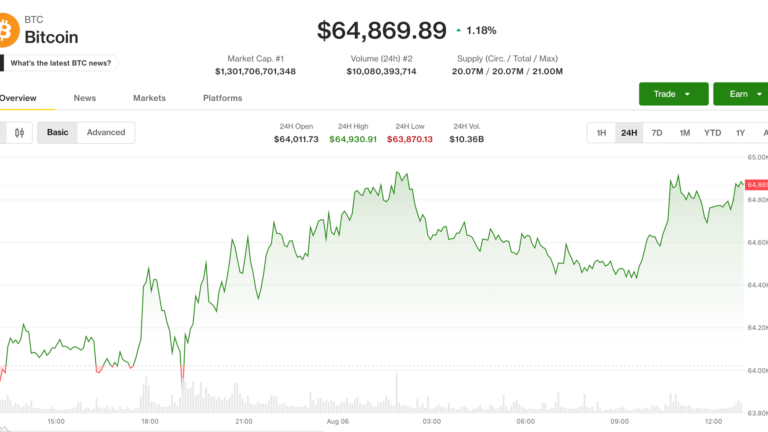
Bitcoin hovered near $64,830 on Thursday, up 0.8% over 24 hours and 1.3% on the week, while trading inside a narrow band, CoinDesk data show. Ether rose 2.1%, but most other majors barely moved, leaving the market less in rally mode than in wait-and-see mode.

The bid under bitcoin is coming from macro hopes rather than fresh crypto demand. President Donald Trump pointed to strong employment, better manufacturing data and cooling inflation, while also raising the possibility of a deal to reopen the Strait of Hormuz.

A reopening would likely pressure oil lower, easing inflation worries and giving Treasury yields and the dollar room to fall. That is the setup risk assets want, and bitcoin is trading like some of it may arrive.

The problem is that the trade still depends on several steps lining up. Lower oil has to feed into lower inflation expectations. Lower inflation expectations have to pull down real yields and the dollar.

Its roughly 63% correlation with the S&P 500 also means equity sentiment may matter more than crypto-native flows in the near term. A calmer Middle East backdrop helps risk appetite, but it can also reduce the safe-haven demand that supported bitcoin earlier in the summer.

The levels to watch are real yields and the dollar. If both fall alongside oil, bitcoin has a cleaner path above the top of its recent range. If yields stay firm, the macro case remains theoretical and bitcoin likely stays pinned near $65,000.

Crypto firm RedotPay says it will defend itself ‘vigorously’ against Binance lawsuit

0

RedotPay, which describes itself as the world’s largest stablecoin payment card issuer, told CoinDesk Wednesday it will defend itself “vigorously” against a $470 million Binance lawsuit alleging it poached 470,000 users.

“RedotPay is aware of legal proceedings initiated by Binance and will vigorously defend all claims,” the firm said in an emailed statement. “The Company rejects the unfounded allegations made against it and its co-founders.”

Binance affiliates filed a lawsuit against the founders of the Hong Kong-based stablecoin payments company, alleging they diverted nearly half a million Binance customers to the competing platform in a scheme that caused nearly $473 million in losses, according to a Bloomberg report.

“Since March 2026, the Binance Group has discovered that RedotPay Group had been allowing and encouraging Binance Pay funds to be used, without segregation, for the prohibited use within RedotPay, including card top-ups for RedotPay Card,” Binance said in the filing, according to Bloomberg.

“While Binance does not comment on ongoing litigation, where necessary we will use courts and other forums to pursue what is right,” a spokesperson told CoinDesk via email.