Bitcoin developer Kevin Loaec, who flagged the risk on X this week, said large holders could be targeted first. Doing nothing will be a safer option, he stated, as coins that never move cannot be replayed because there is no signed transaction to copy.
⚠️IMPORTANT⚠️In the next couple of days, a new shitcoin will fork off Bitcoin. It is a big security risk for people who just believe they will get an “airdrop” and want to sell it, to get more bitcoin. I will write more about it, but here is the TLDR: 👇
— Kevin Loaec 🧙♂️🐟 (@KLoaec) August 6, 2026
How BIP-110 makes this possible
The reason any of this is happening is a proposal called BIP-110, which would keep pictures, text and other non-payment data out of bitcoin transactions for a year.
Changing bitcoin’s rules requires miners to agree, and they register that agreement by marking the blocks they produce. BIP-110 needs 1,109 marked blocks out of a 2,016-block stretch, or 55%. (A block is the batch of transactions miners add to the ledger roughly every ten minutes.)
That route is closed but the proposal has a second one written into it. From block 961,632, expected this weekend, computers running BIP-110 software will reject any block that does not carry the mark, whether miners agreed or not.
Almost every block being mined right now does not carry it. So those computers will start rejecting the chain that nearly all of bitcoin’s mining power is building.
If some miners continue building a BIP-110-compatible branch while the rest keep mining bitcoin as usual, two competing versions of the transaction history could emerge. It stalls if nobody keeps extending the minority branch, it stalls.
Justin Mateen, a director of the board at American Bitcoin (ABTC), the mining company backed by U.S. President Donald Trump’s family, purchased nearly $1.93 million worth of the company’s stock over two consecutive trading sessions this week, following the company’s latest earnings report.
According to regulatory filings, Mateen bought about 145,000 Class A shares on Aug. 5 for roughly $925,000 at an average price of $6.40 per share. He followed that with the purchase of about 162,000 shares on Aug. 6 for approximately $1 million at an average price of $6.19 per share.
Combined, the purchases amounted to 306,981 shares for approximately $1.93 million.
Following the transactions, Mateen beneficially owns 492,297 shares of American Bitcoin’s Class A common stock, reflecting adjustments made after the company’s recent reverse stock split.
Mateen is a co-founder of Tinder and an ABTC board member since March 2025.
Cointelegraph is committed to providing independent, high-quality journalism across the crypto, blockchain, AI, and fintech industries.
All news, reviews, and analyses are produced with full journalistic independence and integrity. For more details on our standards and processes, please read our Editorial Policy.
Trump Media (DJT) is unwinding parts of its crypto push, including scrapping plans to establish a publicly traded CRO token accumulation company, which it unveiled near the height of last year’s digital asset treasury boom.
Trump Media, Crypto.com and special purpose acquisition company Yorkville Acquisition mutually terminated plans for Trump Media Group CRO Strategy, the firms said Friday, citing “prevailing market conditions, and shifting business and stakeholder priorities.”
The proposed venture would have created a publicly traded company focused on accumulating the native token of Cronos CRO$0.05312 and earning additional returns by staking those holdings. Trump Media itself bought $105 million of CRO in September 2025 as part of a broader partnership with Crypto.com that included plans to integrate token rewards into its products.
CRO fell as much as 5% following the news.
The companies are also walking away from a separate partnership under which Crypto.com would have serviced certain planned exchange-traded funds (ETFs), from Yorkville America. Trump Media is also scaling back plans to build Crypto.com-powered prediction markets directly into Truth Social, Axios reported earlier.
Additionally, the OFAC also sanctioned a network of foreign exchange houses, shell companies and individuals on Friday that it said helped Iran’s shadow banking system move hundreds of millions of dollars, including funds tied to overseas oil sales.
“The Iranian regime’s reliance on digital assets and shadow banking networks is further evidence that Economic Fury is working,” Treasury Secretary Scott Bessent said in a statement. “Whether in dollars, rials, or crypto, Treasury will hunt down and dismantle the illicit financial networks that keep the regime afloat.”
The designations came as the U.S.-Iran war has raised the stakes of Washington’s push to cut Tehran off from foreign currency and global financial markets. Cryptocurrencies may offer sanctioned entities another route to move funds when banks cut them off, but blockchain transactions can also leave a public trail that investigators and analytics firms can follow.
Friday’s action is the latest in a string of U.S. measures against Iran’s crypto finance network.
In January, the Treasury sanctioned Zedcex and Zedxion, the first crypto exchanges targeted under its Iran-specific financial sanctions. In June, the Treasury blacklisted Nobitex and several other Iranian crypto exchanges as part of its campaign against Tehran.
Last month, the U.S. sanctioned four crypto wallets linked to Iran’s central bank, after which Tether, issuer of the largest stablecoin USDT USDT$0.9992, froze about $131 million held in the wallets. It also sanctioned two Iranian maritime insurance entities over an alleged scheme that funneled funds to the IRGC.
The chairman of the UK’s Reform party has called for an investigation following reports of a $50,000 political donation linked to former FTX CEO Sam “SBF” Bankman-Fried.
According to a Friday report from the Telegraph, Reform UK chair Lee Anderson called for the parliamentary commissioner for standards to probe Defense Secretary Wes Streeting over reported $50,000 in donations from a think tank in 2022 and 2023. The reported donations came from Labour for the Long Term, whose founder reportedly accepted a $675,000 gift from Bankman-Fried before sending funds to Streeting.
Notably, Reform leader Nigel Farage is set to face voters next week in a by-election triggered by his resignation as a member of parliament amid his own crypto scandal. The UK politician received $6.7 million in donations from crypto billionaire Christopher Harborne and financial assistance from George Cottrell, a convicted fraudster linked to a crypto casino. Farage claimed that the contributions were “gifts.”
Under UK law, unincorporated associations are permitted to give more than $675 directly to politicians, according to the International Bar Association. The regulations offer a loophole for companies with business in the UK to be used as “conduits for foreign or dark money” to lawmakers without reporting the source of the funds.
Related: Crypto companies have spent $189M so far on 2026 US election cycle: Report
According to the Telegraph, Streeting asked Labour for the Long Term for a list of its donors before accepting the $50,000, but Bankman-Fried’s name was not included. The defense secretary reportedly said that he had never had any contact with the former FTX CEO, who is currently serving 25 years in prison after his conviction on seven felony charges.
David Lawrence, who founded the think tank, said Streeting’s contribution was funded by a donor other than the former CEO, and that Labour for the Long Term ”did not receive any donations from the FTX Foundation or Mr. Bankman-Fried,” according to the Telegraph.
US court issues mandate upholding SBF’s conviction
Earlier this week, the US Court of Appeals for the Second Circuit issued a formal mandate upholding Bankman-Fried’s felony conviction and 25-year sentence.
The appeals court announced its ruling in June, giving the former CEO fewer legal routes to seek a potential early release from prison. Bankman-Fried still has the option of appealing to the US Supreme Court or waiting for a potential presidential pardon from Donald Trump.
Magazine: How Fake World Assets and onchain gacha became crypto’s latest craze
The company’s deteriorating financial performance compounded these concerns. BitMEX continued to lose market share throughout the sale process as trading activity migrated to larger centralized exchanges and decentralized perpetual futures platforms. This made potential acquirers reluctant to pay the revenue multiple typically reserved for growing businesses, the person said.
Both and BitMEX and Exodus did not respond to requests for comment by publication time.
The exchange was reportedly seeking a valuation of around $1 billion during the process, although it is unclear whether formal bids were ever submitted.
BitMEX was one of crypto’s most influential exchanges, pioneering the perpetual futures contract in 2016 with the launch of its XBTUSD perpetual swap. Unlike traditional futures, perpetuals have no expiry date and instead use a funding-rate mechanism to keep prices aligned with the underlying asset, allowing traders to maintain leveraged long or short positions indefinitely.
The product revolutionized crypto derivatives trading, was rapidly adopted across the industry, and today accounts for the vast majority of crypto derivatives volume on other exchanges such as Binance, Bybit and Hyperliquid.
The company announced on July 24 that it would wind down operations following a strategic review by its parent, HDR Global Trading, and immediately halting new account registrations ahead of its planned Sept. 23 closure.
Ethereum researchers just wanted to reduce staking incentives. Instead, they sparked one of the biggest debates over the network’s economics since the Merge.
Ethereum Improvement Proposal EIP-8363, or “Tapered Issuance Burn,” would gradually reduce staking rewards as more and more Ether is locked up to secure the network — eventually cutting new protocol issuance to zero once 50% of ETH’s supply is staked.
Its authors, including Ethereum Foundation’s Justin Drake and Ethereum Community Conference (ETHCC) co-founder Jerome de Tychey, argue that Ethereum has reached the point where additional staking provides diminishing security returns, while diluting holders who choose not to stake.
In other words: Ethereum should stop paying for security it no longer needs.
There’s just one problem, a lot of people hate the idea.
From DeFi builders to staking providers and institutional investors, critics argue it could weaken decentralization, disrupt Ethereum’s lending markets and undermine confidence in the network’s monetary policy. As Ether.fi founder Mike Silagadze puts it:
“This is so disappointing on every level. […] This is bad for decentralization, this is bad for Ethereum adoption, and this is bad for the credibility of the network.”
Dr. Steve Berryman, Bitwise’s head of client partnerships for Ethereum, tells Magazine:
“Institutional adoption requires certainty and playing with the issuance at the margin would cause uncertainty and institutions hate uncertainty.”
So is Ethereum really paying too much for security, or is EIP-8368 a solution in search of a problem?
Is Ethereum over-staked?
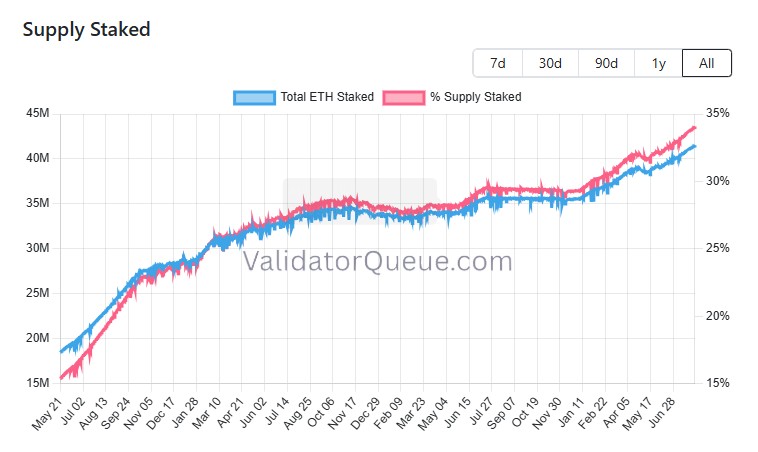
Ethereum currently has around 41.5 million ETH staked, earning 2.67%, and representing 34.07% of the entire supply, according to the Ethereum Validator Queue.
EIP-8363, Tapered Issuance Burn. Source: Jerome de Tychey
While more ETH locked up generally makes the network harder to attack, EIP-8368’s authors argue those security gains become increasingly marginal while Ethereum continues issuing rewards to validators.
EIP-8363 would gradually remove that incentive, and the authors argue Ethereum should stop subsidizing additional staking once the network is sufficiently secure.
Yet not everyone agrees that the problem even exists in the first place. It’s certainly true that the amount staked has increased substantially in 2026, up 15% since the start of the year.
Berryman argues that market forces are already slowing participation without the need to change Ethereum’s issuance policy.
“We will come to a natural ceiling probably by the end of this year,” he says, arguing that yields falling to around 2% are unlikely to attract significantly more ETH to be locked up in staking. “People need a certain amount of liquidity,” he says.
Related: Ethereum Foundation adds SEAL 911 co-founder to board as privacy focus grows
Berryman says recent growth has largely been driven by institutional entrants such as Bitmine and BlackRock, but argues that once those players complete their staking allocations, participation is likely to plateau again.
Source: Validatorqueue.com
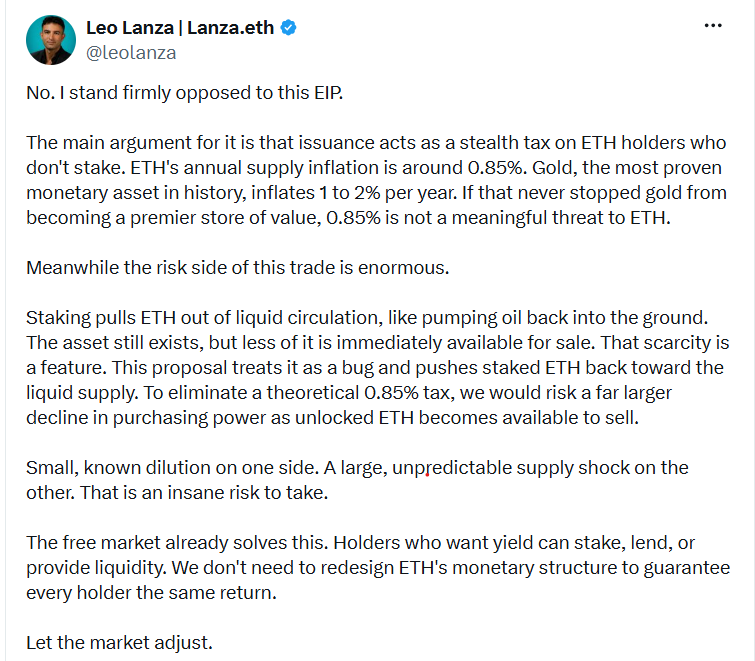
Ethereum commentator Leo Lanza, who also opposes the proposal, challenges the core assumption that issuance on Ethereum represents a meaningful “stealth tax” on non-stakers.
Ethereum’s annual inflation remains below 1%, he says, arguing that even gold, widely viewed as the world’s premier monetary asset, expands its supply by roughly 1% to 2% annually:
“The free market already solves this […] Let the market adjust.”
Could the cure be worse than the disease?
Supporters of EIP-8368 argue the change would curb unnecessary issuance and discourage staking from becoming overly concentrated among large custodians and liquid staking providers. But critics say the proposal risks creating bigger problems than it’s trying to solve.
Greg Koumoutsos, technical research lead at the Lido Labs Foundation, says today’s staking ratio of around one-third of ETH supply does not appear unhealthy, though he agrees it is reasonable to think proactively about excessive staking.
More importantly, he argues the proposal oversimplifies what Ethereum’s issuance is actually paying for:
“Ethereum is not only paying for slashable ETH; it is paying for decentralization, operator diversity, censorship resistance, and network resilience.”
Koumoutsos says lower issuance is not automatically a better security policy unless those broader trade-offs are also taken into account.
Another factor to consider is that liquid staking is now deeply integrated into Ethereum’s DeFi ecosystem, and staking derivatives are widely used as collateral and in lending and yield strategies.
“It will obviously kill a huge chunk of DeFi which is built around the staking ecosystem,” Silagadze argues.
Stani Kulechov, founder of Aave, Ethereum’s largest decentralized lending protocol, says that reducing staking rewards risks undermining that broader ecosystem.
“My concern is… those who are fine with ETH beta and yield might also sell ETH for other yielding assets […] Ethereum should not be punished for its growth.”
Related: Ethereum, Solana led crypto hack losses in H1 2026: Blockaid
Smaller validators will bear the cost
Another concern with the proposal is that lowering staking rewards could actually increase concentration among the largest participants.
“I stand firmly opposed to this EIP.” Source: Leo Lanza
That’s because independent validators do not benefit from the economies of scale that larger staking businesses, exchanges or institutional operators do. Lower protocol rewards could make solo staking uneconomical while larger organizations continue operating. Koumoutsos says:
“A solo validator has real costs: some ideological solo stakers may remain, but many marginal solo validators will not, and fewer new ones will enter, if any.”
He adds that centralized platforms also stake for reasons beyond yield, such as customer retention, regulatory positioning and product integration, which makes them less likely to reduce their participation.
Koumoutsos also warns that even within delegated staking, lower rewards could favor centralized custodial products over onchain staking protocols, which face higher maintenance, governance and upgrade costs.
A debate over more than staking
Supporters say lower issuance would strengthen Ether’s long-term monetary profile. But critics argue that continually adjusting Ethereum’s monetary policy undermines its claims to be predictable and reliable.
Berryman argues institutions value predictability more than marginally higher yields, and that changing the curve creates yield governance risk. “Institutional investors will price accordingly,” he says.
He also says institutions value staking not because the yield is especially high, but because it provides a predictable return while they hold ETH:
“It’s not broken, why try and fix it?”
Silagadze agrees, saying, “Any nation state or large institution looking at this will justifiably have a dramatic loss of confidence in the governance and stability of Ethereum.”
The proposal’s rollout also drew criticism for being published just two days before the Aug. 6 deadline for proposals to be considered for the next Ethereum network upgrade.
Silagadze says that a change with “far reaching implications for all of DeFi” should not have been published on such a short timeline.
The fierce backlash has shown how difficult it has become to change Ethereum’s economics, especially when every adjustment creates winners and losers across staking, DeFi and institutional markets.
Magazine: Ethereum’s much-hated staking ‘tax’ may already be obsolete
Cointelegraph publishes long-form journalism, analysis and narrative reporting produced by Cointelegraph’s in-house editorial team with subject-matter expertise. All articles are edited and reviewed by Cointelegraph editors in line with our editorial standards. Some articles contain affiliate links, from which Cointelegraph may earn a commission. These relationships do not influence which products we review or our editorial conclusions. Content published in here does not constitute financial, legal or investment advice. Readers should conduct their own research and consult qualified professionals where appropriate. Cointelegraph maintains full editorial independence.
The US Senate’s delay of a vote on crypto market structure legislation could give Hong Kong and Singapore more time to strengthen their positions as digital asset hubs, according to First Digital founder and CEO Vincent Chok.
On Friday, Thune’s office confirmed to Cointelegraph that the Senate would not vote on the legislation before the August recess. Thune cited Democratic opposition and said the bill would be a priority when senators return in September.
Chok, whose company issues the FDUSD stablecoin, said the delay could give jurisdictions with clearer regulatory frameworks an advantage in attracting capital and talent as US uncertainty weighs on institutional adoption.
He said the postponement leaves institutions without clear rules on market structure, custody and oversight. “Markets can adapt to slower timelines, but what they struggle with is prolonged uncertainty,” he said in a statement sent to Cointelegraph.
Delay fuels concerns over enforcement and offshore innovation
Chok said regulatory progress outside the US would continue regardless of the CLARITY Act’s timetable.
“For Asia, this delay gives regional financial hubs like Hong Kong and Singapore additional time to demonstrate that clear regulation can coexist with innovation,” he said.
Maylea Ma, deputy general counsel at decentralized exchange aggregator 1inch, said that if Congress ultimately failed to enact the legislation, the industry could face a return to “regulation by enforcement.” Market participants would remain dependent on agency interpretations, case-by-case enforcement and a fragmented patchwork of state money transmitter and securities rules, she said.
Related: CLARITY Act failure could send crypto valuations lower: Bernstein
Ma contrasted that uncertainty with the European Union, where the Markets in Crypto-Assets Regulation (MiCA) is already in force. She said 1inch would continue operating under its conservative, non-custodial and self-custody-focused model while awaiting greater legal certainty in the US.
Wellington-Altus chief market strategist James E. Thorne offered a more politically charged response, calling the postponement a “fold” by Thune and a victory for Senator Elizabeth Warren and the regulatory status quo. He said continued ambiguity would push innovation offshore while other jurisdictions develop clearer regimes.
“Regulation should have been passed years ago,” he wrote on X. “Instead, Washington chose to live in ambiguity, letting Warren and the bank lobby weaponise uncertainty, the SEC and the Fed went along for the ride, and now Thune is keeping the CLARITY Act stuck in procedural limbo.”
Magazine: 10 weirdest things ever tokenized… including farts
The U.S. labor market showed weakness for the second consecutive month in July, possibly giving the Federal Reserve room to hold rates in place despite high inflation.
According to the government’s Nonfarm Payrolls Report released Friday morning, the U.S. lost 23,000 jobs last month. That was far below the consensus expectation of a gain of 80,000 jobs, and down from June’s addition of 20,000 (revised down from an originally reported 57,000).
May’s job gains were also revised sizably lower — down to 63,000 from an originally reported 129,000.
The last negative jobs print was in February, when the U.S. lost 156,000 jobs.
The unemployment rate dipped to 4.1%, compared with the expected 4.2% and June’s 4.2%.
Market reaction is swift, with U.S. stock index futures gaining and interest rates dipping. Also moving higher are precious metals, with gold now up 3% for the day and silver up just shy of 6%. There’s little action in crypto, with bitcoin remaining modestly higher on the session at $65,000.