Home Blog Page 444

Crypto giant GSR launches its first ETF to give investors an easy way to bet on the big three

0

Crypto trading firm GSR has launched its first exchange-traded fund (ETF), entering a fast-growing segment of the digital asset market as investor demand for regulated crypto exposure continues to rise.

The GSR Crypto Core3 ETF, trading under the ticker BESO on Nasdaq, offers exposure to three major cryptocurrencies, including bitcoin , ether (ETH) and solana (SOL). The fund carries a 1% management fee and includes both active portfolio management and the ability to earn staking rewards on eligible assets.

The launch comes as crypto ETFs have gained traction with both retail and institutional investors seeking easier access to digital assets through traditional brokerage accounts. While most U.S.-listed crypto ETFs to date have focused on single assets, particularly bitcoin, some have moved to basket funds, similar to Core3, which bundles multiple tokens into a single product and adjusts allocations on a weekly basis.

GSR said the fund aims to reflect two main themes in crypto markets: bitcoin’s role as a macro asset and the growth of blockchain platforms such as Ethereum and Solana, which support applications like stablecoins and tokenized assets.

“The fund allocates actively across the three assets and rebalances weekly based on research-driven signals designed to pursue additional returns,” GSR said in a press release.

Framework Digital Advisors will serve as the fund’s investment adviser.

The move expands GSR’s business beyond trading and market making into asset management.

The firm has spent more than a decade providing liquidity and over-the-counter trading services in crypto markets and is now looking to package that expertise into investment products.

The ETF also introduces staking rewards, a feature not commonly available in traditional investment vehicles but one that has been added to some existing crypto ETFs, including the largest, BlackRock’s iShares Bitcoin Trust (IBIT). This feature the fund to generate yield from certain blockchain networks while holding assets.

“GSR has spent over a decade building efficient crypto markets, and with Core3, we are extending that expertise into a product accessible to a broader range of investors,” GSR CEO Xin Song said.


The Rise of Shadow AI in Financial Institutions: By Rom C

0

There’s a quiet shift happening inside banks right now—and most leadership teams are underestimating it.

Employees are already using AI. Not in pilot programmes. Not in controlled sandboxes. In their day-to-day work.

And in many cases, no one is tracking it.

This isn’t a future risk. It’s already embedded in how work gets done.

It doesn’t look like a problem

If you ask around internally, you’ll hear fairly harmless use cases.

Someone in a client-facing role uses AI to refine an email. An analyst summarises a long report. A team drafts internal documentation faster than before.

Individually, none of this feels like a breach of policy—or even particularly risky.

That’s exactly why it’s spreading so quickly.

There’s no procurement process. No onboarding. No integration. Just a browser tab and a prompt.

And once someone sees the productivity gain, they don’t go back.

The policy says one thing. Reality says another.

Most institutions now have clear guidance on AI usage. In some cases, access to public tools is restricted entirely.

But that hasn’t stopped adoption.

People use personal devices. They retype sensitive details instead of copy-pasting. They find workarounds.

Not because they’re trying to bypass controls—but because the alternative is slower, and the expectation to deliver hasn’t changed.

This creates a familiar but uncomfortable pattern:

officially restricted, unofficially everywhere.

The real issue isn’t usage. It’s invisibility.

The conversation around AI risk often focuses on extreme scenarios—model hallucination, bias, regulatory exposure.

But the more immediate issue is far simpler.

No one has a clear view of what data is being shared, where, and how often.

Think about the cumulative effect of small, everyday actions:

  • Client information used to “improve tone”
  • Internal reports pasted for summarisation
  • Snippets of sensitive context shared to get better outputs

None of these trigger alerts. None of them look like incidents.

But over time, they create a pattern of exposure that no existing control framework is designed to handle.

Why this is different from previous waves

Banks have dealt with shadow IT before. Cloud storage, messaging apps, personal devices—it’s not new.

But AI changes the nature of the problem.

It’s not just about where data goes. It’s about how it’s transformed in real time.

A single prompt can combine multiple sources of sensitive information, reshape it, and send it outside the organisation in seconds.

And unlike traditional systems, there’s often no audit trail that compliance teams can rely on.

The uncomfortable truth

Right now, many institutions are operating under an assumption that isn’t holding up:

That policy and restriction are enough to contain the risk.

They aren’t.

What’s happening instead is that AI usage is moving into spaces that are harder to see, harder to measure, and harder to control.

That’s a much more difficult problem to solve later.

What needs to change

The question isn’t whether employees should be using AI. That’s already been decided in practice.

The real question is whether institutions are willing to acknowledge how it’s actually being used.

Because once you accept that reality, the approach has to shift:

  • From restriction to visibility
  • From static policy to real-time control
  • From assumed compliance to observable behaviour

Without that shift, the gap between governance and reality will continue to widen.

Why this matters now

This isn’t a slow-moving trend.

AI adoption inside organisations is compounding—quietly, unevenly, and without central coordination.

Which means the window to put the right controls in place before it becomes a regulatory or reputational issue is smaller than it looks.

By the time it shows up as a formal incident, it will have been happening for months.

Shadow AI isn’t a fringe behaviour. It’s becoming standard practice.

The only real question is whether institutions choose to surface it—and manage it deliberately—or continue operating as if it’s not already part of their environment.

Strategy (MSTR) Surges Over 25% In 5 Days As Bitcoin Pumps

0

Shares of Strategy posted over 25% in gains during the last five trading days, driven by a record-breaking Bitcoin acquisition and a surge in bitcoin’s price above $78,000. The move underscored the company’s leverage to Bitcoin price movements and its continued reliance on preferred stock issuance to fund treasury expansion.

Strategy’s stock opened April from a closing low near $119 on April 2, then ground higher throughout the month as Bitcoin prices recovered. By April 17, shares closed at $166.52 — a gain of more than 40% from that early-month trough.. On April 17 alone, shares surged 11.8% in a single session on volume that far exceeded the daily average.

Bitcoin price breaks above $78,000 and Strategy’s $2.54 billion purchase

Bitcoin price crossed $78,500 this morning up from an opening near $76,000 and continuing a recovery that began the prior week. The move put Bitcoin up 11.1% from one month earlier and marked its highest level since early February.

Strategy disclosed on April 20 that it purchased 34,164 BTC between April 13 and April 19, 2026, at an average price of $74,395 per coin, for a total outlay of approximately $2.54 billion. The acquisition is the company’s third-largest single purchase on record and the largest weekly accumulation since November 2024.

The purchase pushed Strategy’s total Bitcoin holdings to 815,061 BTC — surpassing BlackRock’s 802,823 BTC held through its spot Bitcoin ETF products and making Strategy the single largest corporate holder of Bitcoin. The cumulative cost of all holdings now stands at approximately $61.56 billion, with an average purchase price of $75,527 per coin.

STRC preferred stock funds the bulk of the buying

Of the $2.54 billion raised to fund the acquisition, approximately $2.18 billion came from the sale of 21,795,389 shares of STRC — Strategy’s Variable Rate Series A Perpetual Stretch Preferred Stock — while $366 million came from the sale of 2,165,000 shares of MSTR Class A common stock. STRC accounted for roughly 86% of the financing, reflecting Strategy’s stated pivot away from common equity dilution.

STRC recorded a $1.156 billion single-day trading volume on April 13, a record for the instrument. Strategy also proposed shifting STRC dividend payments from a monthly to a semi-monthly schedule — a structural change designed to improve liquidity and reduce reinvestment delays for income-focused shareholders.

The dividend on STRC remained at an annualized rate of 11.50% for April 2026, the first month at that rate without an increase after seven consecutive monthly hikes since the stock’s IPO in July 2025. The April 30 dividend payment stands at $0.958333 per share. Strategy retains $19.46 billion in remaining STRC capacity and $26.73 billion available under its MSTR common stock offering program.

Back-to-back purchases for Strategy

The 34,164 BTC purchase followed a $1 billion acquisition of 13,927 BTC completed between April 6 and April 12, which was funded entirely through STRC proceeds. That earlier purchase brought total holdings to 780,897 BTC before the larger transaction the following week. The two-week run added nearly 48,091 BTC to Strategy’s balance sheet, representing one of the most aggressive accumulation periods in the company’s history.

Earlier in 2026, Strategy also acquired 22,337 BTC for $1.57 billion in March and 1,031 BTC on March 23 — part of a sustained accumulation campaign that has continued despite Bitcoin trading below Strategy’s average cost basis for much of the first quarter. As of Q1 2026, the company reported a $14.46 billion unrealized loss on its digital asset holdings, offset by a $2.42 billion deferred tax benefit.

Editorial Disclaimer: We leverage AI as part of our editorial workflow, including to support research, image generation, and quality assurance processes. All content is directed, reviewed, and approved by our editorial team, who are accountable for accuracy and integrity. AI-generated images use only tools trained on properly license material. In Bitcoin, as in media: Don’t trust. Verify.

Kraken filed 56 million crypto tax forms for 2025. One-third were below $1

0

Crypto exchange Kraken says it filed 56 million crypto-transaction forms with the U.S. Internal Revenue Service (IRS) for the 2025 tax year. Roughly 18.5 million of them covered transactions worth less than $1, and over half were for $10 or less.

Only 8.5% of the newly introduced Form 1099-DAs cleared $600, the threshold that triggers reporting for non-employee compensation, and 74% were for less than $50, the company said in a Wednesday blog post.

Each form is also sent to the customer and creates a reconciliation task for the taxpayer who receives it. On top of that, standard tax software does not handle crypto transactions. Kraken estimated the additional burden on an active crypto holder at $250-$500 a year for dedicated tax software, on top of standard filing costs.

“The hours taxpayers spend reconciling these micro-transactions, often with incomplete data, generate costs wildly disproportionate to any revenue the IRS will collect from them,” Kraken said.

The Tax Foundation estimates individual returns already cost Americans a combined $146 billion in time and expenses, the exchange said, and the National Taxpayers Union Foundation puts the average time for non-business filers at about 13 hours and $290 per return.

Brokers reporting for 2025 provide gross proceeds without cost basis, meaning the form shows what was sold, but not what it was bought for. Kraken said it fielded thousands of client questions about forms that captured only one side of the calculation.

Two problems

Kraken pointed to two parts of the tax code that cause problems. One is the lack of a de minimis, or low-level, exemption for crypto payments, which means even small purchases with crypto can trigger a taxable event that needs to be declared.

“Imagine you walk into a Steak ’n Shake and pay for a $7.99 meal with Bitcoin through a payment app. You have triggered a taxable event,” Kraken wrote as an example. “You are technically required to look up the cost basis of the specific Bitcoin you spent, calculate whether you had a gain or loss on that fraction of a coin, and report it on Form 8949.”

That’s the same argument libertarian think tank Cato Institute recently made. According to the institute, buying a cup of coffee every day with BTC “can result in over 100 pages of tax filings.”

The second issue is staking. Rewards earned on staked assets are treated as ordinary income at the moment of receipt, based on the token’s market price that day. Most holders keep those tokens instead of selling them, meaning they owe tax on tokens that haven’t been sold.

If the token price falls between receipt and filing, the tax can exceed the asset’s current value. Kraken calls this phantom income and says a large share of the sub-dollar 1099-DAs it issued were staking distributions.

Legislation moving through Congress includes a de minimis provision, but is limited to stablecoins. Kraken is pushing for a broader inflation-indexed exemption, paired with anti-abuse guardrails to prevent structuring.

The exchange is also asking Congress to let taxpayers elect when staking rewards are taxed, either at receipt under current rules or at sale, when a gain or loss is realized.

Kraken says its systems and those of other exchanges already support both reporting methods, but the choice needs to be authorized.

WalletConnect Integrates with TradFi-Focused Chain Canton Network

0

WalletConnect’s ecosystem of 700 crypto wallets and 70,000 dApps now supports the enterprise- and privacy-focused blockchain network.

WalletConnect has added support for Canton Network, a blockchain built for institutional finance. The two companies first revealed the partnership at EthCC in Cannes, during a panel moderated by The Defiant’s senior editor Olivia Capozzalo, before releasing the news publicly today, April 22.

The deal aims to bring Canton’s privacy-focused infrastructure to WalletConnect’s global ecosystem, enabling access to stablecoin payments, tokenized real-world assets, and DeFi applications. According to a press release viewed by The Defiant, the crypto infrastructure firm’s ecosystem supports 700 crypto wallets, 70,000 decentralized applications, and 55.5 million users, all of which can now connect to the protocol, which is within the top-20 chains by market cap, per CoinGecko.

Canton currently boasts over $8 trillion in tokenized assets processed monthly and more than $350 billion in U.S. Treasuries settled daily, per the release.

Data from RWAxyz shows that all of the nearly $330 billion in tokenized RWAs on Canton are represented asset value, meaning they use the blockchain for recordkeeping and operational efficiency, but don’t allow for on-chain distribution.

WalletConnect CEO Jess Houlgrave framed Canton’s privacy model as “a requirement for institutions to work at scale.”

The announcement arrives, however, amid an ongoing debate over Canton’s self-description as a “public, permissionless blockchain” — a characterization many in the industry contest. As The Defiant has reported, critics argue that Canton is closer to a permissioned database than a true blockchain, with validator admission controlled by a governance committee of incumbent institutions.

Canton has been accumulating serious institutional momentum in recent months. JPMorgan’s USD-denominated deposit token is set to be issued natively on Canton in phases throughout 2026, as The Defiant reported, and the DTCC selected Canton to tokenize a subset of U.S. Treasury securities it holds, citing the platform’s privacy features, per The Defiant’s earlier coverage.

The broader race for institutional-grade privacy is heating up on multiple fronts: Boundless, a ZK proving network, recently integrated with the XRP Ledger to bring native zero-knowledge proof verification to the Layer 1 for the first time, enabling institutions to build financial applications on XRPL that execute privately while maintaining regulatory compliance, as The Defiant reported.

This article was written with the assistance of AI workflows. All our stories are curated, edited and fact-checked by a human.

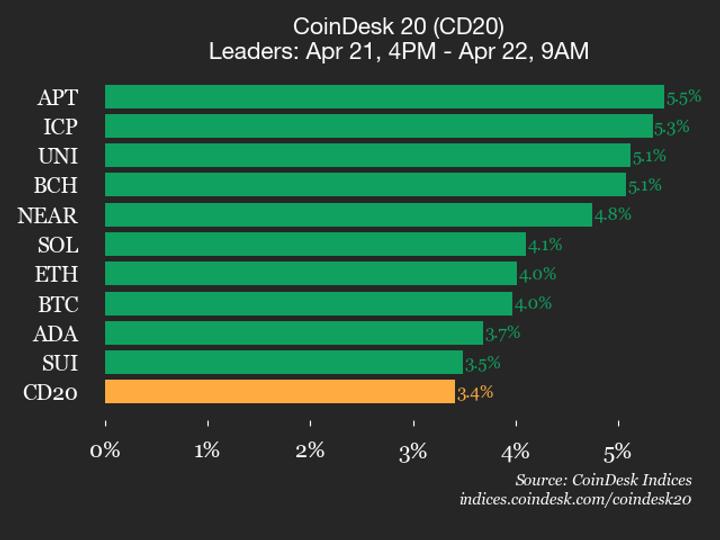
Aptos (APT) rises 5.5%, leading index higher

0

CoinDesk Indices presents its daily market update, highlighting the performance of leaders and laggards in the CoinDesk 20 Index.

The CoinDesk 20 is currently trading at 2157.12, up 3.4% (+71.19) since 4 p.m. ET on Tuesday.

All 20 assets are trading higher.

Leaders: APT (+5.5%) and ICP (+5.3%).

Laggards: XLM (+0.9%) and CRO (+1.9%).

The CoinDesk 20 is a broad-based index traded on multiple platforms in several regions globally.

Brokeree Unveils a New Interface for Its Social Trading Platform

0

Brokeree Solutions, a global provider of technology solutions for multi-asset brokers, has introduced a new interface for its flagship Social Trading product. 

The redesigned interface reorganizes information into role-specific views and interactive dashboards, allowing admins, signal providers, and followers to navigate the platform more naturally and interpret activity more quickly. Instead of long, sequential pages, key information is now surfaced through visual elements and contextual navigation that reflect how users interact with Social Trading.

“Usability has always been central to how we build at Brokeree Solutions. With Social Trading platforms maturing, we decided to upgrade its UI to help users experience all its features,” said Andrey Kamyshanov, Co-founder and Managing Partner at Brokeree Solutions. “Over time, systems like Brokeree’s Social Trading accumulate data and operational rules. If the interface doesn’t evolve alongside that complexity, even a powerful product becomes harder to operate. This update is about making an established Social Trading system easier to navigate and manage at scale, without changing how it works or how brokers and traders already rely on it.”

Key Highlights

For administrators, the new home view provides an interactive overview of server and copying activity, with visual indicators that link directly to relevant sections of the platform. Copying performance is now easier to interpret through graphical representations that distinguish successful copies, skipped actions, and errors.

Provider and follower portals adopt the same visual language, introducing performance heatmaps that highlight winning and losing trading days, along with clearer views of payments and subscriptions. In the follower profile, the connected trading account is now explicitly displayed, giving subscribers better context around their copied activity.

Alongside the interface update, the platform’s navigation menu now has two new dedicated tabs: Product and System. This approach mirrors the configuration logic already used in Brokeree’s Prop Pulse product, reinforcing consistency across the company’s product ecosystem. Existing settings remain the same in scope, but are grouped into clearly defined categories for client, provider, and follower accounts, replacing long scrolling configuration pages with a more structured experience.

  • Ratings Module parameters

The Social Trading Ratings Module has received a UI update focused on usability. It allows admins to define which parameters traders see and use, limiting displays to five parameters for cleaner presentation while maintaining the ability to manage many more behind the scenes. On the other hand, providers and followers can choose which parameters to display and use for sorting and filtering. Navigation within the module has also been simplified with a new “go-to” pagination feature to allow faster movement between result pages.

“Our user research showed that brokers and traders spend significant time navigating through data to extract insights. The redesign directly addresses this friction point,” said Anton Sokolov, Head of Product at Brokeree Solutions. “Much of the work was about restructuring how information is accessed rather than introducing new features. By reworking navigation and presentation, we reduced friction in accessing key data and actions while keeping existing workflows intact. That balance is important for brokers who operate live environments and can’t afford disruption.”

The new interface is available to all Social Trading users. For more information, contact sales via sales@brokeree.com 

About Brokeree Social Trading

The global copy trading market is experiencing rapid expansion, and at the center of this growth is the need for robust, flexible platforms that serve brokers, providers, and followers simultaneously. Brokers use Brokeree’s Social Trading as an infrastructure that supports cross-server signal sharing across MT4, MT5, and cTrader servers. It offers provider and follower account grouping, subscription and risk management, and fee calculation within a single infrastructure. Social Trading can be extended with optional components such as Ratings Module and a mobile app, which lets brokers control how strategies are presented and accessed by end users.

About Brokeree 

Brokeree Solutions is an international provider of technological solutions for multi-asset brokers worldwide. With 12 years of industry expertise, the company specializes in turnkey solutions development, trading platform servicing, and consultation for retail brokers using MetaTrader 4/5 and other trading platforms. Brokeree Solutions’ extensive product portfolio includes flagship systems like Social Trading, PAMM, Prop Pulse, and Liquidity Bridge, offering comprehensive technologies that address almost any broker’s needs.

Scammers Target Stranded Ships In Iran With Bitcoin Fees

0

Fraudsters are targeting global shipping firms with fake payment demands in Strait of Hormuz transit schemes, seeking fees in Bitcoin and Tether as vessels remain stranded amid conflict in the Gulf.

Greek maritime risk firm MARISKS said unknown actors have sent messages to shipowners claiming to represent Iranian authorities and offering safe passage through the chokepoint in exchange for bitcoin payments. 

The firm warned that the communications are fraudulent and not linked to Tehran.

The alerts come as tensions between the United States and Iran disrupt one of the world’s most critical energy corridors. The waterway once carried about a fifth of global oil and liquefied natural gas flows. Military activity and shifting restrictions have left hundreds of vessels stalled west of the passage, with about 20,000 seafarers affected.

According to MARISKS, the messages instruct companies to submit vessel documentation for review by “Iranian Security Services,” after which a transit fee would be set in Bitcoin or Tether. The senders claim ships would then receive clearance to pass without interference at a scheduled time.

MARISKS said at least one vessel may have fallen victim to the scheme. The firm linked the case to a ship that attempted to exit the strait and came under fire, though it could not confirm the connection. 

Reuters reporters could not verify which companies received the messages.

Bitcoin as a means of payment in Iran

Earlier this month, Iran reportedly planned to require shipping companies to pay transit tolls in bitcoin for vessels passing through the Strait of Hormuz, linking the move to one of the world’s most critical energy corridors. 

The policy would issue payment requests before transit and require settlement in bitcoin within a short window, designed to bypass traditional financial rails while maintaining control over access during a US–Iran ceasefire period.

Security analysts warn that any such payment request carries legal and financial risk. Even if funds do not reach sanctioned entities, companies could face exposure under sanctions regimes tied to Iran.

Editorial Disclaimer: We leverage AI as part of our editorial workflow, including to support research, image generation, and quality assurance processes. All content is directed, reviewed, and approved by our editorial team, who are accountable for accuracy and integrity. AI-generated images use only tools trained on properly license material. In Bitcoin, as in media: Don’t trust. Verify.

DeFi Platform Volo Hit by $3.5M Vault Attack, Begins Recovery Efforts

0

Decentralized finance (DeFi) protocol Volo has disclosed a security breach that resulted in the loss of approximately $3.5 million in digital assets, marking the latest incident in a series of exploits targeting DeFi platforms.

In a Wednesday post on X, the team said the attack affected select vaults and involved assets including Wrapped Bitcoin (WBTC), Matrixdock Gold XAUm and USDC (USDC). “We detected the attack, immediately notified the Sui Foundation and ecosystem partners to contain the damage, and froze the vaults to prevent any further exposure,” the team wrote.

The protocol added that around $28 million in total value locked across other vaults is safe, with the exploit limited to three isolated vaults and no shared vulnerability identified. It also revealed plans to absorb the losses rather than pass them on to users, though details of any remediation plan have yet to be finalized.

Volo is a liquid staking DeFi platform on the Sui blockchain, allowing users to stake their Sui (SUI) tokens and receive voloSUI (VSUI) in return. DeFi is already on edge, as the exploit comes as another liquid restaking protocol, Kelp, was hacked for approximately $293 million over the weekend, which has had a ripple effect across the broader ecosystem.

Related: Kelp DAO attacker moves $175M in Ether after exploit: Arkham

Volo freezes a portion of lost funds

In two separate updates, Volo said it has frozen or blocked roughly $2 million of the stolen funds so far. In the first update, the protocol said that roughly $500,000 linked to the breach has already been frozen. In a later update, the team claimed it had successfully blocked an attempt by the attacker to bridge 19.6 WBTC, effectively removing those funds from the hacker’s control.

“We are now working with ecosystem partners to determine the best path to return these funds to Volo,” the protocol wrote.

Volo recovery updates. Source: Volo

Crypto hacks claim $17 billion in 10 years

As Cointelegraph reported, more than $17 billion has been stolen in crypto over the past decade, with private key compromises identified as one of the major contributing attack vectors, according to DefiLlama.

Related: ZachXBT asks MemeCore to explain valuation and token supply

Roughly 22.3% of incidents are linked to brute-force key compromises, 18.2% to unknown methods and 10% to phishing attacks on multi-signature wallets. The findings show that many of the biggest losses stem from wallet security and user-side weaknesses rather than protocol bugs.

Magazine: 53 DeFi projects infiltrated, 50M NEO tokens could be ‘given back’: Asia Express