Former FTX CEO Sam Bankman-Fried, serving a 25-year sentence for his role in misusing user funds at the crypto exchange, has dropped a motion in federal court requesting a new trial for his criminal case, but still has a pending appeal of his conviction and sentence.
In a Wednesday filing in the US District Court for the Southern District of New York, Bankman-Fried responded to a March 23 letter from Judge Lewis Kaplan ordering the former FTX CEO to answer whether he received any assistance from lawyers for a pro se motion — a filing on his own behalf without an attorney. Kaplan’s order followed US prosecutors raising doubts whether the convicted company founder filed for an extension of his request for a new trial by himself in March, just a few days after his mother, Barbara Fried, though lacking standing, sent a letter to the court on her son’s behalf.
“I am the author of this letter, but did consult with my parents about it, since it concerns both of them,” said Bankman-Fried, referring to an extension to file for a Rule 33 motion for a new trial, adding:
“As I have had to focus on responding to these questions rather than drafting a response to the prosecution’s opposition, and because I do not believe I will get a fair hearing on this topic in front of you, I am now requesting to withdraw the Rule 33 motion, without prejudice to renewing it after my direct appeal and the related request for reassignment have been ruled upon.”
Letter from Sam Bankman-Fried, made public on Wednesday. Source: Courtlistener
Bankman-Fried requested in February that a different judge rule on his motion for a new trial, claiming that Kaplan showed “extreme prejudice.” He also awaits a decision on his appeal of his conviction and sentence in the US Court of Appeals for the Second Circuit. Neither filing was apparently affected by Bankman-Fried’s letter, posted to the public docket on Wednesday.
Related: Interview with SBF’s parents drops chance of pardon on betting markets
Bankman-Fried, known as SBF, was once the CEO of one of the largest crypto exchanges globally before he was convicted of fraud and charges related to his misuse of customer funds in 2023 and later sentenced to 25 years in prison. As of Wednesday, he was housed at the Federal Correctional Institution, Lompoc I, in California.
Is SBF still seeking Trump pardon?
Following his incarceration, the former FTX CEO has made several public statements through interviews and his social media accounts signaling plans to apply for a presidential pardon from Donald Trump.
His request for a new trial included claims that former US President Joe Biden’s Justice Department “threatened multiple witnesses into silence or into changing their testimony“ at his criminal trial. He has also posted to X praising Trump’s crypto policies and the president’s military actions in Iran.
In a January New York Times interview, Trump said that he had no intention of pardoning the convicted former FTX CEO.
Magazine: Your guide to surviving this mini-crypto winter
Cointelegraph is committed to independent, transparent journalism. This news article is produced in accordance with Cointelegraph’s Editorial Policy and aims to provide accurate and timely information. Readers are encouraged to verify information independently. Read our Editorial Policy https://cointelegraph.com/editorial-policy
The $292 million exploit tied to KelpDAO is the latest in a long line of crypto bridge hacks, underscoring how the systems designed to connect blockchains have become some of the easiest ways to break them.
The incident involved KelpDAO’s use of LayerZero’s cross-chain messaging system, a type of infrastructure widely used to move data and assets between blockchains.
Bridges are meant to let users move assets from one blockchain to another, like from Ethereum to a different network. But instead of acting as seamless connectors, they have repeatedly turned into weak points, draining billions of dollars over the past few years.
So why does this keep happening?
Crypto ecosystem leaders say the answer is not just bad code or careless mistakes. The problem is more fundamental; it is in how bridges are built in the first place.
The core problem: trusting the middleman
To understand the issue, it helps to look at what a bridge actually does.
If you move tokens from one blockchain to another, the second chain needs proof that your tokens existed and were locked on the first one. In an ideal world, it would verify that itself. In reality, that is too expensive and complex.
“Most bridges don’t fully verify what happened on another chain,” said Ben Fisch, CEO of Espresso Systems. “Instead, they rely on a smaller system to report it. That [second] system becomes the thing you trust.”
So instead of independently checking the truth, bridges outsource it, often to small validator groups or external networks like LayerZero or Axelar. That shortcut creates risk. In the Kelp DAO-related exploit, attackers targeted the data feeding into the bridge.
“Attackers compromised nodes and fed the system a false version of reality,” Fisch said. “The bridge worked as designed. It just believed the wrong information.”
Bridge hacks often look different on the surface. Some involve stolen keys, others faulty smart contracts. But experts say those are symptoms of a deeper issue. The real problem lies in how the systems are designed.
“Anything that can go wrong will go wrong, and bridge hacks are a perfect example,” said Sergej Kunz, co-founder of 1inch. “You see code vulnerabilities, centralization issues, social engineering, even economic attacks. Usually it’s a mix.”
How bridges work
For users, bridges look simple. You click a button and move assets from one blockchain to another. Behind the scenes, the process is more complicated.
First, your tokens are locked on the original blockchain. Then a separate system confirms that the tokens are locked. This system usually consists of a small group of operators or validators. Those operators then send a message to the second blockchain saying the tokens were locked so new ones can be issued. If that message is accepted, the second chain creates a new version of your tokens. These are wrapped tokens, like rsETH or WBTC.
The problem is that this process depends on trusting whoever sends that message. If attackers compromise that system, they can send a false message and create tokens that were never backed on the original chain.
“The worst case is when the system isn’t really checking anything,” Fisch said. “It’s just trusting someone else’s version of events.”
When one failure spreads
Given how often bridges fail, why has the industry not fixed them?
Part of the answer comes down to incentives. “Security is often not the top priority,” Kunz said. “Teams focus on launching quickly, growing users and increasing total value locked.”
Building secure systems takes time and money. Many DeFi projects operate with limited resources, making it difficult to invest heavily in audits, monitoring and infrastructure.
At the same time, projects are racing to support more blockchains. Each new integration adds complexity. “Every new connection adds more assumptions,” Fisch said.
Bridge hacks rarely stay contained. Bridged assets are used across lending protocols, liquidity pools and yield strategies. If those assets are compromised, the damage spreads.
“Other platforms may treat a hacked asset as legitimate,” Kunz said. “That’s how contagion happens.” Users are rarely told how a bridge actually works or what could go wrong.
There are ways to make bridges safer. Fisch says one key step is removing single points of failure by relying on independent data sources rather than shared infrastructure.
In practice, these “data sources” are computers that watch blockchains and report what happened. They might be run by the bridge itself, by outside networks like LayerZero, or by infrastructure providers. But many rely on the same underlying services, meaning a single compromised source can feed bad data across multiple systems.
“If everyone is relying on the same source, you haven’t reduced risk,” he said. “You’ve just copied it.”
Other approaches include hardware protections and better monitoring to catch misconfigurations early. Some developers are also working on designs that verify data directly using cryptography instead of intermediaries.
Kunz believes a more fundamental shift is needed. “As long as we rely on validator-based bridges, these problems will continue,” he said.
Read more: North Korea’s crypto heist playbook is expanding and DeFi keeps getting hit
At MPE 2026, Anurag Chitlangia, Senior Product Manager at Uber, gave a candid look into the massive challenges and opportunities facing global merchants when it comes to payments. Based in Amsterdam, Chitlangia’s work centers on ensuring smooth, interoperable payment integrations between Uber and various third-party platforms like ChatGPT or Instacart. For the user, this means they can seamlessly transact across different digital experiences without friction.
For a global giant like Uber, the toughest puzzle is how to build a scalable payments platform and its highlighted that the goal is to operate across many geographies and still offer a perfect user experience; all while avoiding the build-up of incremental operational expenses in the back office. The scale is huge as Uber operates in over 80 markets and deals with 80+ different kinds of payment methods. This deep, global exposure is Chitlangia’s secret weapon, allowing his team to “cross-pollinate” lessons and ideas from one market to bring it to another. This approach helps Uber speed up its go-to-market strategy and significantly reduce mistakes when expanding into a new region.
Looking ahead, Uber is particularly excited about the move to agentic payments, where AI agents handle transactions autonomously, a shift of which presents interesting questions for merchants around how to build trust, manage the chain of responses, and securely store data when an agent is making decisions. Solving trust in this new payments ecosystem is the key challenge facing the industry. Chitlangia concluded by noting that the payments ecosystem is massive and he’s looking forward to seeing the innovations other merchants and companies are bringing to the table.
Kalshi, one of the leading prediction market firms, has issued another set of insider-trading disciplinary actions against users accused of making improper trades based on their inside knowledge of their own political situations, including an ex-reality TV star in Virginia who said he did it intentionally.
“Cases like these demonstrate Kalshi’s commitment to policing all types of unfair or improper trading on our platform,” the company said in a statement posted on its website on Wednesday. “Regardless of the size of a trade, political candidates who can influence a market based on whether they stay in or out of a race violate our rules.”
Two of the cases were said to admit they were in the wrong, and Kalshi — a trading platform regulated by the Commodities Futures Trading Commission — said they received a more modest response than the Virginia politician who defied the process. These are the three:
Mark Moran, a former investment banker and participant on HBO’s Fboy Island, said in a Wednesday post on social media site X that he placed the Kalshi bet on his own candidacy in the Virginia U.S. Senate race to expose the company for “destroying young men” and pretending to care about enforcement. “As senator, I will go after Kalshi and impose significant penalties on them — 25% — a vice tax — to pay down our national debt.”Kalshi imposed a five-year suspension, $6,229 fine and disgorgement of any profits, noting: “As a candidate, Moran qualified as a direct decision maker for this contract and had direct influence on the outcome of the underlying event.”
Matt Klein, a state lawmaker who is running as a Democrat for a U.S. House seat in Minnesota, also made a bet on his own candidacy, but he settled with Kalshi, accepting a 5-year suspension and a $540 penalty.Kalshi concluded that “Klein cooperated with the inquiry into this trading activity and agreed to finally resolve this matter by accepting the Compliance Department’s conclusions, paying a financial penalty, and accepting a restriction from trading on the exchange.”
Ezekiel Enriquez, like Klein a candidate for a U.S. House seat, was accused of betting on the details of his own election in Texas. The conservative Republican and supporter of President Donald Trump was said to cooperate similarly with Kalshi and was given a 5-year suspension and $784 fine.
Kalshi’s rules are set out in its website’s compliance section. While it’s not detailed in the firm’s member agreement, fines and suspensions like those given in these latest cases are detailed within Kalshi’s corporate “rule book,” and the determination of penalties lets the company fine a member at a level “sufficient to deter recidivism” — meaning enough to keep people from doing it again.
The company had begun publicly announcing insider-trading matters with the February exposure of cases that included a producer of the popular online entertainer, Mr. Beast. The CFTC has praised the platform for being a front-line enforcer, though the agency has noted that such cases could also trigger federal enforcement.
The events-contract industry has been under tight scrutiny during its explosive rise in popularity. The businesses are still wrestling with doubts from prominent critics that they can manage contracts without insider abuse.
Kalshi, in particular, has also been at the forefront of legal clashes with state regulators and law enforcement officials over whether its activity is legally permissible in their states. CFTC Chairman Mike Selig has come to the industry’s aid by insisting that the activity belong solely under the federal regulator’s jurisdiction, and he’s begun fighting that point in court.
Read More: MrBeast editor nabbed by prediction market firm Kalshi for alleged insider trading
Thailand’s Securities and Exchange Commission (SEC) is seeking public comment on proposed rule changes that would allow licensed digital asset businesses to apply directly for derivatives licenses, removing the requirement to establish separate entities.
The proposed revisions would build on earlier changes recognizing digital assets as eligible underlying assets for futures contracts, expanding the scope of Thailand’s derivatives market while introducing additional requirements to manage conflicts of interest and strengthen oversight.
Source: The Securities and Exchange Commission, Thailand
The proposal could lower barriers for crypto companies to enter the derivatives market by allowing them to apply for licenses within existing entities, rather than establishing separate companies, while bringing those activities under tighter regulatory oversight.
The regulator said the changes are intended to provide investors with additional tools for hedging and portfolio management, as well as bringing standards for derivatives exchanges and clearing houses in line with international practices.
The proposed changes are open for public consultation until May 20, with feedback from industry participants expected to inform the final framework.
Related: Thailand proposes tighter scrutiny of funders behind crypto firms
Crypto derivatives expand as US moves toward approval
Thailand’s proposal comes as crypto derivatives expand globally and momentum builds toward regulatory approval in the United States.
On Tuesday, Blockchain.com introduced perpetual futures trading in its self-custody wallet, allowing users to open leveraged positions using Bitcoin (BTC) as collateral without transferring funds to an exchange. Underpinned by Hyperliquid, the feature offers access to more than 190 markets with as much as 40x leverage.
Other exchanges have taken a similar approach. Earlier this year, both Kraken and Coinbase launched perpetual futures tied to equities for non-US users as part of a broader push toward 24/7, multi-asset trading.
While most of these products remain largely unavailable in the United States, that could change soon. In March, Michael Selig said the Commodity Futures Trading Commission is working to enable crypto perpetual futures, adding the agency could move on the products “within the next month or so.”
In the meantime, exchanges appear to be positioning for potential approval. Last week, Kraken parent Payward agreed to acquire Bitnomial, a US-regulated derivatives venue, in a move aimed at expanding access to products including perpetual futures for US clients.
Magazine: How to fix insider trading on platforms like Polymarket and Kalshi
Cointelegraph is committed to independent, transparent journalism. This news article is produced in accordance with Cointelegraph’s Editorial Policy and aims to provide accurate and timely information. Readers are encouraged to verify information independently. Read our Editorial Policy https://cointelegraph.com/editorial-policy
Trusted Editorial content, reviewed by leading industry experts and seasoned editors. Ad Disclosure
Despite experiencing a notable decline of nearly 50% from its all-time high of $126,000, the demand and interest in Bitcoin on the institutional level have not yet lost their momentum. Even during multiple market drawdowns, a massive accumulation of BTC was still strongly observed among many large firms across the cryptocurrency and financial landscape.
New Bitcoin Purchase Propels MicroStrategy
A crucial shift is taking place in Bitcoin accumulation among large firms across the sector. In the Bitcoin institutional race, Strategy formerly known as MicroStrategy has become a prodigy in BTC accumulation after years of acquiring the leading asset.
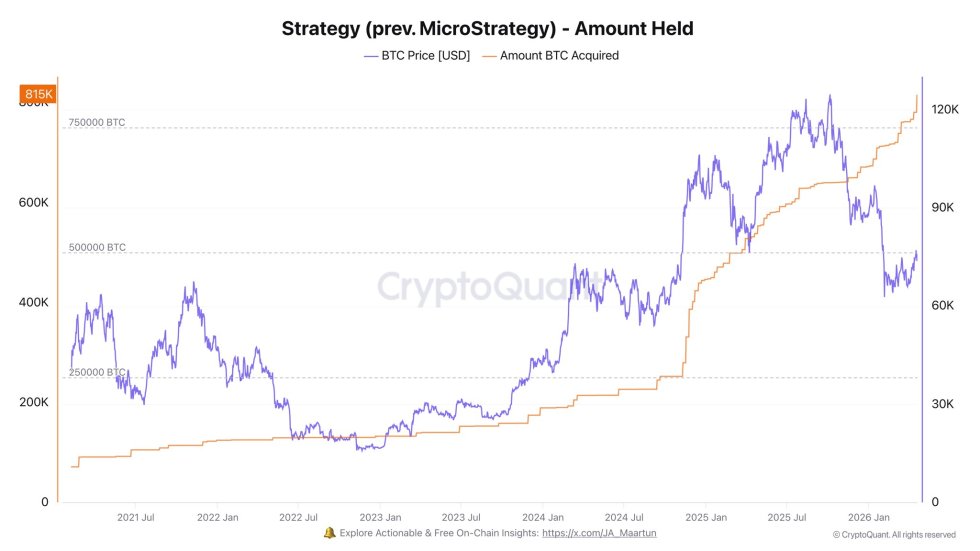
According to a recent report from Darkfost, a market expert and verified author at CryptoQuant, the company founded by Michael Saylor, a prominent figure in the crypto space, has now surpassed BlackRock, the largest asset manager, in total BTC acquired.
This flip comes after Strategy’s most recent BTC purchase, which saw over 34,164 BTC being scooped up. The aggressive accumulation approach has strengthened MicroStrategy’s position as one of the biggest corporate holders in the market and once again demonstrated its steadfast dedication to the crypto king.
Source: Chart from Darkfost on X
Following the latest acquisition, the company now holds over 815,061 BTC, while BlackRock’s IBIT now controls over 802,823 BTC as of April 17. This event indicates a wider trend of increasing corporate conviction in Bitcoin as a strategic asset, in addition to highlighting the growing competition among institutional participants in the crypto and finance space.
With its current stash, Strategy now holds more than 4% of BTC’s total supply. As a result, the company continues to move closer to its initial stated objective of holding around 5% to 7% of the total supply in circulation.
Despite holding a huge amount of BTC, Strategy suffered notable losses as the asset’s price fell below the firm’s realized price of $75,527. However, after several market shifts, the price of Bitcoin has now moved back above Strategy’s realized price at the time of the post. Darkfost stated that this brings an end to the period of unrealized losses that started in early February this year. As of today, Strategy has once again projected profits of $242 million.
The BTC Bear Market Still Alive
While Bitcoin’s price has slightly picked up pace following the market rebound, underlying signals continue to point to weakness in the broader trend. Such signals imply that BTC’s recent upward trend is likely to be temporary, and a decline is still heavily on the table.
After navigating multiple on-chain metrics, Alphractal, a data analytics platform, highlighted that BTC’s bear market is not over yet, suggesting impending bearish periods. Over time, the Short-Term Holder Realized Price vs the Long-Term Holder Realized Price has been a key indicator in determining whether the market is still in a bear or bull phase.
Alphractal noted that the bear market will only end when the STH Realized Price drops below the LTH Realized Price. The platform’s analysis is backed by historical trends where this setup signaled the end of the bear market phase. At this point, it is crucial to monitor this current reading to determine whether the same pattern holds in the ongoing cycle.
BTC trading at $77,894 on the 1D chart | Source: BTCUSDT on Tradingview.com
Featured image from Pngtree, chart from Tradingview.com
Editorial Process for bitcoinist is centered on delivering thoroughly researched, accurate, and unbiased content. We uphold strict sourcing standards, and each page undergoes diligent review by our team of top technology experts and seasoned editors. This process ensures the integrity, relevance, and value of our content for our readers.
Elon Musk’s Tesla’s (TSLA) bitcoin BTC$78,521.31 holdings were unchanged in the first quarter of 2026, with the company continuing to hold its 11,509 BTC stockpile.
The company booked an after-tax impairment loss of $173 million on its digital asset holdings, according to its first quarter earnings report.
The value of that stash declined as bitcoin fell from around $90,000 at the start of the year to roughly $68,000 by the end of March.
Tesla reported better-than-expected earnings but missed on revenue. For the first quarter, the firm reported revenue of $22.39 billion, slightly below than analyst estimates of $22.71 billion. Earnings per share came in at $0.41, higher than consensus forecast of $0.37.
TSLA stock was trading 4% higher in after-hours trading.
Tesla’s bitcoin journey
Tesla initially bought bitcoin in February 2021, acquiring 43,200 BTC for roughly $1.5 billion. About a month later, the company sold around 4,320 BTC, roughly 10% of its position, to test market liquidity.
By July 2022, amid the bear market, Tesla had cut its position to 9,720 BTC. A small increase in January 2025 brought holdings to 11,509 BTC, where they have remained since.
What has been the economic development, wider digital and fintech developments been in the North African country of Libya in 2026?
Libya’s fintech and wider digital ecosystem in 2026 is best understood as a story of reconstruction through technology. In a country where institutional fragmentation, liquidity constraints and reliance on hydrocarbons have long defined economic reality, digital finance is emerging not as a luxury but as a necessity. The shift is gradual, uneven, yet increasingly consequential.
Libya’s economy remains overwhelmingly dependent on oil and gas, which accounts for over 90 per cent of exports and the bulk of government revenues. Whilst gross domestic product (GDP) per capita is around $7,500, which is amongst one of the highest in Africa, the country has experienced problems. Notably, after the fall of former ruler MuammarGaddafi, the country went through a civil war that even today it is trying to recover from. Also, the country faces income disparity and different extremes in terms of its economic development and recovery.
Digital economic transformation: necessity driving innovation
Libya’s digital transformation is shaped less by ambition and more by necessity. Years of instability have strained traditional banking systems, leading to chronic liquidity shortages and heavy reliance on cash. In this context, digital solutions are emerging as a means to restore efficiency and trust.
Key areas of focus the past few years include expansion of mobile and internet infrastructure, digitisation of government payments and services, and development of electronic payment systems to reduce cash dependency.
Despite its fairly recent challenges, Libya’s internet penetration is estimated at 75 per cent, with mobile penetration exceeding 100 per cent, creating a foundation for digital adoption.
As highlighted in various regional analyses and The Fintech Times’ broader coverage of emerging markets, Libya’s trajectory reflects a wider pattern: digital finance often advances fastest where traditional systems face the greatest constraints.
Financial services sector
Libya capital Tripoli skyline view IMAGE SOURCE GETTY
The country’s financial centre is Tripoli, where regulatory institutions and financial infrastructure are concentrated. One of the largest banks is Jumhouria Bank, which has been central to retail banking and is increasingly involved in digital service rollouts. Others include the likes of Wahda Bank.
Libya’s financial system has historically been characterised by its limited banking infrastructure outside major cities like Tripoli, low levels of trust in financial institutions and persistent cash shortages. These factors have accelerated the push towards digital financial services.
Banks and telecom operators have increasingly introduced payment cards and POS networks, mobile banking applications, and electronic salary and government payment systems.
The Central Bank of Libya (CBL) has played a pivotal role in steering this transition.
First, in terms of expansion of electronic payment infrastructure, the CBL has prioritised the rollout of POS terminals and card-based payment systems to reduce reliance on cash and improve transaction efficiency.
Second, with regards to salary digitisation programmes, public sector salaries have increasingly been paid electronically. This is helping to formalise transactions and reduce pressure on physical cash distribution.
Third, pertaining to support for mobile banking and digital wallets, commercial banks have been encouraged to develop mobile banking platforms, enabling remote access to financial services. In addition, this year, new regulations were introduced allowing foreigners legally residing in the country to access electronic wallet services.
Fourth, with respect to strengthening oversight of payment systems, regulatory frameworks for electronic payments have been gradually enhanced, focusing on stability and operational integrity.
Finally, with respect to early-stage fintech and interoperability efforts, whilst the likes of open banking is such at an early stage, there is growing recognition of the need for interoperable systems, data-sharing frameworks and digital identity solutions to support future innovation.
This approach reflects a broader regulatory philosophy: prioritising stability, trust and incremental progress over rapid disruption.
Financial inclusion and fintech
Financial inclusion in Libya remains constrained. According to the World Bank, estimates suggest that less than half (40 per cent) of adults have access to a formal bank account. This reflects structural barriers such as limited infrastructure and low trust in institutions.
However, digital financial services are beginning to expand access, particularly through mobile banking platforms, electronic payments, and government-led digitisation initiatives. These tools are helping to reduce reliance on cash and provide new entry points into the financial system.
Nonetheless, key challenges remain. These are geographic disparities in access, limited financial literacy and economic informality.
Enter fintech. Libya’s fintech ecosystem is very much in an infant, with an estimated 20 fintech and digital financial service providers operating primarily in payments and banking-led solutions.
Key players include Sadad Libya. They provide electronic payment services, including bill payments and merchant solutions.
Other players have been taking note of the Libyan market from overseas. For example, this year, Visa established a new sub-regional structure comprising Egypt, Libya, and Sudan. The move forms a key part of Visa’s strategic growth plans for the wider North Africa, Levant, and Pakistan region.
Beyond just financial services, others like telecoms have been supporting the growth of the ecosystem. For example, Libyana Mobile Phone Company is supporting mobile-based financial services through telecom infrastructure.
Unlike more mature fintech markets, Libya’s ecosystem is bank-led and telecom-supported, with limited independent startup activity as highlighted.
Conclusion
In 2026, digital financial services are beginning to reduce reliance on cash, improve efficiency and expand access. While challenges remain, fintech offers a pathway towards a more inclusive and resilient financial system. This is supporting Libya’s broader efforts to rebuild and modernise its economy.
Ethereum’s record 32.33% staking ratio is shrinking liquid supply, reducing sell pressure and potentially supporting an ETH price recovery over time.
Ether (ETH) has fallen about 5.5% against Bitcoin (BTC) over the past week, and a bearish continuation setup now points to the risk of deeper losses ahead.
Key takeaways:
Ether’s bear flag risks 10% correction
The ETH/BTC ratio has been carving out a bear flag pattern since February, consolidating inside a rising parallel channel after a sharp downside move.
In technical analysis, bear flags are typically viewed as continuation patterns. Analysts derive the downside target by taking the height of the previous decline and projecting it lower from the point where price breaks below the flag’s lower trend line.
ETH/BTC daily chart. Source: TradingView
Using that method, the ETH/BTC pair’s measured downside target comes in near 0.026 BTC, about 10% below current levels, in May.
Notably, a similar bear flag breakdown earlier this year preceded a roughly 15% decline, suggesting the current setup could once again favor Bitcoin over Ether in the near term.
Conversely, the bearish breakdown setup may get postponed if ETH/BTC rebounds from the flag’s lower trend line, opening the door for a recovery toward the upper boundary near 0.032 BTC in May.
Ethereum staking ratio hits record levels
Ethereum’s fundamentals are strengthening even as ETH continues to lag Bitcoin.
The network’s staking ratio hit a record 32.33% on April 21, with about 39 million ETH locked across 816,578 validators, according to data resource Token Terminal.
Ethereum staking ratio. Source: Token Terminal
That amounts to roughly $90.26 billion in staked value and marks the first time more than one-third of Ethereum’s circulating supply has been committed to the network.
Earlier this month, the Ethereum Foundation completed its 70,000 ETH staking target, shifting more of its holdings into yield-generating positions instead of potential sell-side supply.
Meanwhile, BitMine Immersion Technologies now holds 4.976 million ETH, or 4.12% of total supply, with around 3.334 million ETH already staked through its validator network.
Overall, it means less ETH is available for active trading. That can reduce selling pressure and support prices in dollar terms over time, especially if demand keeps rising while available supply keeps shrinking.
Related: Ethereum whale opens $90M long bets as ETH price chart eyes $3.2K
Ether has lagged behind Bitcoin partly because Ethereum’s “ultrasound money” thesis has weakened, while Bitcoin continues to benefit from accumulation by firms like Strategy and its accelerating integration into Wall Street portfolios.
This article is produced in accordance with Cointelegraph’s Editorial Policy and is intended for informational purposes only. It does not constitute investment advice or recommendations. All investments and trades carry risk; readers are encouraged to conduct independent research before making any decisions. Cointelegraph makes no guarantees regarding the accuracy or completeness of the information presented, including forward-looking statements, and will not be liable for any loss or damage arising from reliance on this content.
Welcome to our institutional newsletter, Crypto Long & Short. This week:
Jennifer Rosenthal on the need to protect the people actually building DeFi infrastructure.
Alexis Sirkia on how Ethereum’s L2 strategy is failing due to a fundamental design flaw.
Top headlines institutions should pay attention to by Francisco Rodrigues.
Aave’s Market Share Slides After rsETH Exploit in Chart of the Week.
-Alexandra Levis
Expert Insights
Protecting the people building DeFi infrastructure
By Jennifer Rosenthal, chief communications officer, DeFi Education Fund
There has been a consistent uptrend in traditional finance companies announcing DeFi-related initiatives, and it’s exciting that these companies embrace technology innovations that will serve as infrastructure for 21st century finance. There seems to also be a growing understanding that open-source, permissionless, programmable, noncustodial, globally accessible and interoperable technology presents major upgrades for certain parts of the financial system.
If you are new to decentralized finance (DeFi), intend to rely on DeFi or want to connect your customers to DeFi, we at the DeFi Education Fund, a nonpartisan, nonprofit organization, invite you to join us in helping to protect the technology and infrastructure that makes it valuable. There are some high-level policy objectives we believe worth defending:
Protecting Software Developers and Infrastructure
Preserving Self-Custody
Advocating for Open Access and Interoperability
Championing Permissionless Blockchain Infrastructure and DeFi Markets
Supporting Clear Laws and Policies
For months, my team has participated in productive bipartisan, bicameral discussions with members of Congress. We have been impressed by how many Congressional leaders have engaged productively and in good faith to build legislation that reflects a fundamental understanding of neutral, decentralized technology. Software developer protections have come up as a topic of conversation in recent market structure and broader crypto policy discussions. Why? A majority of industry participants agree that if we’re going to use DeFi, we have to protect the people building it.
For example, on February 26, 2026, Representatives Scott Fitzgerald (R-WI), Ben Cline (R-VA) and Zoe Lofgren (D-CA) introduced the bipartisan Promoting Innovation in Blockchain Development Act of 2026 (PIBDA) to protect software developers — who write code but do not control other people’s money — from inappropriate misclassification under criminal code Section 1960. PIBDA clarifies that Section 1960 applies only to those that control customer assets and transmit funds on behalf of customers, aligning the statute with congressional intent and the Treasury Department’s long-standing regulatory interpretation.
In discussing the bill, Rep. Scott Fitzgerald (WI-05) said: “For years, innovators and software developers have been caught in the crosshairs of an aggressive regulatory approach that treats them like criminals. The Promoting Innovation in Blockchain Development Act draws a clear line between those who develop and deploy blockchain software and those who actually move or manage funds. It provides long-overdue legal clarity, protects innovation here at home and allows law enforcement to focus on genuine criminal activity rather than chilling American technological leadership.”
Like the early internet in the 1990s, blockchain technology is a novel innovation evolving faster than existing regulation. Engineers developing open, disintermediated systems do not neatly fit into financial regulations designed for a system that assumes the existence of intermediaries.
As more individuals and companies interact with decentralized infrastructure, our shared voice can play a constructive role in shaping thoughtful and durable policy outcomes. We should collectively support legislative and regulatory initiatives that foster clarity, reduce uncertainty and enable responsible participation across both centralized and decentralized markets.
Thank you for taking DeFi’s tools and technology seriously, and I hope you will join us in defending the policy principles that make building and using DeFi possible.
Principled Perspectives
Ethereum’s scaling problem was never about throughput
By Alexis Sirkia, chairman and co-founder, Yellow Network
Vitalik Buterin recently conceded that most Layer 2 networks are fragmenting Ethereum rather than scaling it. He’s right, but the diagnosis doesn’t go deep enough. The rollup model was never going to deliver a unified scale because it was designed around the wrong assumption: that Ethereum’s limitation was throughput, when the actual constraint was always how value moves between participants.
Rollups addressed congestion by creating parallel execution environments, each processing transactions independently and posting compressed proofs back to the base layer. On paper, that increases capacity. In practice, it produced dozens of isolated liquidity pools that can’t interact without routing assets through bridge infrastructure. The concentration is stark: Base and Arbitrum now capture 77% of all L2 decentralized finance (DeFi) total value locked (TVL), while usage across smaller rollups has declined 61% since June 2025. The long tail is collapsing, and the capital that remains is fragmenting further. Bridge infrastructure has bled $2.5 billion since 2021 for a simple reason: every time value moves between rollups, it passes through a custodial chokepoint. Attackers don’t need to break the chains on either side, they just need to compromise what sits in between.
The industry responded to each bridge exploit by building better bridges. That instinct, while logical at the time, was wrong. The vulnerability isn’t in the bridge implementation. It’s in the premise that value needs to pass through an intermediary at all. State channels eliminate that premise entirely by allowing participants to transact peer-to-peer off-chain, with the base layer serving as the enforcement mechanism rather than the transaction processor. Settlement touches the blockchain only once state-channel transacting finishes, and either party can invoke on-chain enforcement at any point if the counterparty misbehaves.
This isn’t an incremental improvement on the rollup model, but rather a rejection of the assumption that created the fragmentation in the first place. Where rollups multiply execution environments and then try to reconnect them, state channels keep participants connected from the start and only engage the base layer when finality is needed.
The CFTC is preparing to approve the first U.S. framework for perpetual futures, which will pull a meaningful share of $14 trillion in offshore derivatives volume into regulated venues. To put the scale of that shift in context, U.S.-regulated platforms currently handle just 1.6% of global crypto derivatives volume. The infrastructure that absorbs even a fraction of the remaining 98.4% needs to settle cross-chain, in real time, without passing through custodial chokepoints. Rollups, by design, are not candidates for the job.
The 21Shares prediction that most L2s won’t survive 2026 feels pessimistic, but the reason matters more than the timeline. Rollups failed to deliver a unified scale because they treated Ethereum’s constraint as a throughput problem. The market is starting to price in that the real constraint was always trust at the intermediary layer, and the infrastructure that eliminates that layer entirely is where capital and builders will migrate.
Headlines of the Week
ByFrancisco Rodrigues
This week’s headlines highlight that while the bridges between traditional finance and the crypto sector keep on growing, the devastation caused by smart contract exploits is hitting the market.
Chart of the Week
Aave’s Market Share Slides After rsETH Exploit
Aave’s TVL market share has dropped sharply from ~51.5% in February to ~39% today following the April 18 KelpDAO rsETH exploit, which froze rsETH markets and triggered deposit withdrawals. Active loan share proved stickier, falling only ~2% (54% to ~52%), as existing borrowers couldn’t easily unwind. The AAVE token is down ~50% from its January peak, pricing in both bad debt risk and the reputational cost of being DeFi lending’s largest venue when a collateral asset failed.
Listen. Read. Watch. Engage.
Note: The views expressed in this column are those of the author and do not necessarily reflect those of CoinDesk, Inc., CoinDesk Indices or its owners and affiliates.