Home Blog Page 431

LTH Supply Jumps 303,000 BTC

0

Trusted Editorial content, reviewed by leading industry experts and seasoned editors. Ad Disclosure

Data shows the Bitcoin long-term holders have witnessed a notable surge in their supply recently, a sign that market behavior has been shifting.

Bitcoin Long-Term Holder Supply Has Gone Up Over The Past Month

According to data from on-chain analytics firm CryptoQuant, Bitcoin supply has been moving into the hands of the long-term holders recently. The “long-term holders” (LTHs) here refer to the BTC investors who have been holding onto their coins since more than 155 days ago.

Statistically, the longer investors keep their tokens dormant, the less likely they become to transfer them in the future. As such, the LTHs with their relatively long holding time are considered to represent the resolute side of the market.

Now, here is a chart that shows the 30-day netflow in the supply of these Bitcoin diamond hands over the last couple of years:

Bitcoin LTH Supply

The value of the metric appears to have been positive in recent days | Source: CryptoQuant on X

As displayed in the above graph, the Bitcoin LTHs have seen their 30-day netflow sit at notable positive levels recently, suggesting that tokens have been maturing into the cohort. More specifically, 303,500 BTC entered the group over the past month.

In the second half of last year, the LTHs were participating in net distribution, and their selloff intensified as the price plunged in the fourth quarter. The pattern started to shift in January 2026, with HODLing behavior in the market ramping up during the post-February crash consolidation phase.

While this development has happened, the short-term holders (STHs), corresponding to buyers from the last five months, have naturally observed a decline in their supply.

In the same period, the spot exchange-traded funds (ETFs) and Strategy have also absorbed a chunk of the supply, with their holdings rising by 16,800 and 53,000 coins, respectively. Based on the trend, CryptoQuant has noted, “Bitcoin supply is moving into stronger hands.”

In some other news, the latest Bitcoin recovery rally doesn’t find spot demand at its source, as explained by CryptoQuant head of research Julio Moreno in an X post.

Bitcoin Demand

The futures and spot demand in the BTC market compared | Source: @jjcmoreno on X

From the above chart, it’s visible that the change in the BTC spot demand has mostly been negative for the last few months and the latest rally hasn’t seen the trend shift. Meanwhile, the futures market has seen demand climb instead. “The recent Bitcoin price increase is completely driven by demand in the perpetual futures market,” said Moreno.

A similar pattern was witnessed during the January BTC price rally, but without spot demand, that run couldn’t last. “There are risks of a correction if traders start taking profits while spot demand continues to contract,” noted the analyst.

BTC Price

At the time of writing, Bitcoin is floating around $77,600, up 4% in the last seven days.

Bitcoin Price Chart

Looks like the price of the coin has surged recently | Source: BTCUSDT on TradingView

Featured image from Dall-E, chart from TradingView.com

Editorial Process for bitcoinist is centered on delivering thoroughly researched, accurate, and unbiased content. We uphold strict sourcing standards, and each page undergoes diligent review by our team of top technology experts and seasoned editors. This process ensures the integrity, relevance, and value of our content for our readers.


Seven-Day Countdown to MEGA Begins as MegaETH Clears First KPI

0

The deployment of 10 Mega Mafia apps satisfies the first of three performance triggers tied to the long-awaited token launch.

Ethereum Layer 2 blockchain MegaETH has cleared the first of its three self-imposed performance hurdles and scheduled the token generation event (TGE) for its native MEGA token for April 30.

According to MegaETH’s Road to TGE dashboard, all 10 Mega Mafia applications required under KPI-2 are now fully deployed on mainnet. These include stablecoin payments protocol Cap, DEX Kumbaya, onchain game Showdown, lending market Avon, decentralized telecom protocol Ubitel, World, Stomp, HitOne, Nectar AI, and yield tokenization platform Brix.

The milestone triggers a seven-day countdown to MEGA’s launch, the team confirmed on X, ending a stretch of uncertainty that began when MegaETH went live in February without a fixed token launch date, instead tying issuance to three on-chain milestones: a $500 million circulating supply of its native USDM stablecoin with at least 25% deposited into smart contracts, 10 deployed Mafia apps with verified contracts and functioning core loops, or three apps generating $50,000 in daily fees for 30 consecutive days. Per the network’s TGE FAQ, only one KPI needs to be hit to start the seven-day clock.

As The Defiant previously reported, none of those conditions were close to being met in the immediate weeks following the mainnet launch, with the Mafia apps counter sitting at 5 of 10 a week after launch.

MegaETH’s public KPI dashboard shows that USDM circulation currently sits at $62.9 million, or roughly 13% of the $500 million target. The daily fees KPI also remains untriggered.

Tokenomics and Unlocks

MEGA’s total supply is fixed at 10 billion tokens, per the MEGA MiCA Whitepaper. Of that, 53.3% will be released over time as staking rewards tied to four topline KPI goals, 5% was offered in a public Sonar-based token auction, 7.5% was earmarked for an ecosystem and foundation reserve, 9.5% will vest for the team and advisors, and 14.7% was allocated to early investors.

Unlock terms vary by cohort. Echo round investors will see 20% unlocked at TGE, then a one-year cliff followed by a three-year vest, while Fluffle NFT holders unlock 50% at TGE with a six-month linear vest for the remainder. Sonar participants either unlock fully at TGE or accept a one-year lock in exchange for a discount.

The October Sonar auction drew $1.39 billion in commitments for a $50 million allocation, making it one of the most oversubscribed token sales of the cycle. A subsequent USDM pre-deposit bridge campaign was refunded after a multisig misstep in late November.

Once live, MEGA will function as the bidding currency for MegaETH’s proximity markets, where market makers and applications pay to colocate near the sequencer for sub-millisecond latency. The MegaETH Foundation has also committed to using USDM yield to accumulate MEGA tokens through ongoing buybacks.

MEGA premarket perpetuals on Hyperliquid have been trading in the $1.5 billion to $2 billion implied valuation range in recent days, well below the pre-launch peak above $6 billion recorded last October.

This article was written with the assistance of AI workflows. All our stories are curated, edited and fact-checked by a human.

Hashgraph and RiskStream Collaborative Partner to Tokenize $1T Insurance Market Data

0

Hashgraph, the organization driving the development of the Hedera network, has partnered with The Institutes RiskStream Collaborative. The collaboration between the tech firm and the insurance industry’s largest emerging technology consortium aims to develop an interoperable property risk and resilience portal.

The new solution is designed to transform how commercial and residential property risk data is shared, verified, and utilized across the entire insurance sector. By establishing a single, trusted source of truth for property and risk data, the portal will help insurers, brokers, and reinsurers reduce fragmentation, improve data accuracy, and significantly streamline underwriting.

Solving a trillion-dollar data problem
Pat Schmid, president, The Institutes RiskStream Collaborative

According to data from S&P Global, the United States property and casualty insurance market now exceeds $1trillion in direct annual premiums. This massive figure includes approximately $169billion in homeowners premiums and $103billion in commercial property premiums.

Despite the vast scale of risk underwritten across the industry, insurers face persistent challenges:

  • A heavy reliance on a fragmented mix of manual forms, legacy systems, and third-party data sources.

  • Inconsistent data quality and operational inefficiencies that negatively affect underwriting accuracy and pricing.

  • Growing perils, including natural catastrophes, that are actively increasing the complexity and volatility of risk.

Pat Schmid, president of The Institutes RiskStream Collaborative, highlighted the severe inefficiencies in current workflows.

“The process of gathering and sharing data for insurance placement and underwriting today is tedious, highly manual, and inefficient,” Schmid stated. “There are multiple parties within the insurance experience (carriers, brokers, reinsurers, data providers, and so on) that routinely duplicate the same work, with no standardized way to verify, track, or maintain this critical data over time.”

Schmid noted that the vision for the partnership is to tokenize risk assets, creating a persistent, unique identifier that serves as a shared data foundation for the industry. “Property is the perfect place to start,” he added.

A hybrid distributed ledger approach

To build this shared foundation, RiskStream will leverage a hybrid distributed ledger model. This approach combines HashSphere—Hashgraph’s private, permissioned ledger—with the Hedera public network.

This hybrid structure enables sensitive data to be securely managed within a private environment while simultaneously anchoring key records to a public ledger via a token. Ultimately, this improves risk tracking, trust, and interoperability related to the underlying asset without sacrificing data privacy. Furthermore, RiskStream is implementing an EVM-based real-world asset (RWA) approach, which enables more flexible financial and data models through the use of smart contracts.

Kurt Bierbower, chief revenue officer at Hashgraph, emphasized the practical value of this technological architecture.

“HashSphere was built to remove the barriers that have historically hindered adoption of public blockchain solutions by regulated industries,” Bierbower explained. “This partnership demonstrates how hybrid models can unlock real-world use cases at scale. By tokenizing property and risk data, we’re creating a shared foundation of trust that accelerates underwriting and modernizes how risk is evaluated.”

While the initial partnership focuses specifically on tokenizing commercial and residential properties, the organizations plan to eventually expand their data tokenization efforts to other lines of insurance and additional operational processes.

Bitcoin Rally To Near $80K Fuels Sharp Sentiment Rebound Across Crypto Markets

0

Trusted Editorial content, reviewed by leading industry experts and seasoned editors. Ad Disclosure

Over 300,000 Bitcoin have quietly moved into long-term holder wallets in the past 30 days — a shift that analysts say reflects growing conviction among serious investors even as broader market mood remains fragile.

Sentiment Index Climbs To Highest Point Since January

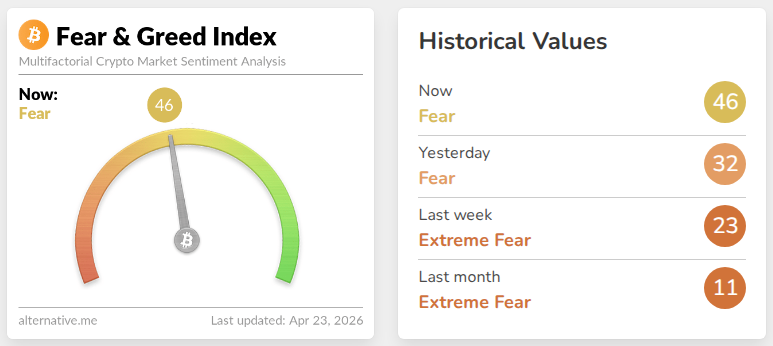
That accumulation is happening against a backdrop of improving, if still cautious, market sentiment. The Alternative.me Crypto Fear & Greed Index surged 14 points in a single day to reach a score of 46 out of 100 — the highest reading since January 18 and the biggest one-day jump in more than three months.

The score remains in the “Fear” zone, where it has been stuck since mid-January, but the speed of the move caught attention across trading circles. Bitcoin itself held near $78k after briefly climbing to $79,500, a gain of roughly 5% over a 20-hour window.

The index score of 46 sits just below the neutral threshold of 50. Getting there matters, but the market still has ground to cover.

Futures Market Leads The Push

Not all of the momentum behind Bitcoin’s rise came from the same place. According to CryptoQuant’s analysis, the rally was driven entirely by demand in the perpetual futures market.

Spot demand — buying on actual exchanges rather than through derivatives — has been contracting, albeit slowly. CryptoQuant flagged that a price correction could follow if traders begin taking profits while spot interest remains weak.

Perp-driven moves without matching spot activity have historically been short-lived, and that pattern is worth watching here.

Strategy, the company formerly known as MicroStrategy, has been among the most aggressive buyers, snapping up 53,000 Bitcoin over the past month alone.

Reports from CryptoQuant indicate the broader supply shift points to coins moving from short-term to long-term holders — a sign, analysts say, that the asset is finding a more stable base of ownership.

BTCUSD currently trading at $77,731. Chart: TradingView

Retail Traders Yet To Return In Force

One notable gap in the recovery is retail participation. Bitwise chief investment officer Matt Hougan has said publicly that everyday traders have not returned to the market at the same volumes seen in previous cycles.

That matters because the Fear & Greed Index draws heavily from retail-driven data points — Google search volume and social media activity related to crypto. Without a pickup in those signals, the index faces a ceiling.

Featured image from Shutterstock, chart from TradingView

Editorial Process for bitcoinist is centered on delivering thoroughly researched, accurate, and unbiased content. We uphold strict sourcing standards, and each page undergoes diligent review by our team of top technology experts and seasoned editors. This process ensures the integrity, relevance, and value of our content for our readers.

Flying Tulip Adds Withdrawal Circuit Breaker After DeFi Exploits

0

Flying Tulip, a decentralized finance (DeFi) platform founded by DeFi developer Andre Cronje, has added a circuit breaker that can delay or queue withdrawals during abnormal outflows, as April DeFi losses climbed amid a string of major exploits. 

According to Flying Tulip’s documentation, the mechanism is designed to slow funds leaving the protocol if outflow capacity is exceeded, giving the team time to investigate suspicious activity and limiting how much an attacker could drain in a worst-case scenario.

Flying Tulip said the circuit breaker works differently across products. In the first version of the circuit breaker, used in its Perpetual PUT product, withdrawals can revert and users must retry later. In the second version, used in Flying Tulip’s stable asset and settlement currency, ftUSD, withdrawals are queued and become claimable after a delay instead of being rejected outright.

Flying Tulip said the circuit breaker is built with a “fail-open” design, meaning transactions would still be allowed if the safety mechanism itself were to malfunction. The platform said users can track the feature through a dedicated status page. 

The design adds a new layer of protection for the DeFi platform as recent industry exploits exposed risks that extend beyond smart contract code. 

Circuit breaker definition. Source: Flying Tulip

Recent exploits put broader security failures in focus

The added attention to outflow controls comes as recent exploits underscored vulnerabilities tied to signers, infrastructure and collateral design rather than only smart contract bugs. 

Amir Hajian, a digital assets researcher at trading firm Keyrock, said the biggest failures in April were increasingly linked to operational and infrastructure weaknesses, including compromised multisigs, configuration flaws and key leaks. 

The new mechanism deployed by Flying Tulip is designed to slow abnormal outflows and give the protocol time to respond when losses stem from failures outside of the smart contract itself. 

Related: Phishing, deepfakes, supply chain attacks to fuel 2026’s biggest crypto hacks: CertiK

Hajian highlighted April’s DeFi losses, which reached over $600 million in the first 18 days of the month, with two incidents accounting for 95% of the damage. 

On April 2, Solana-based decentralized exchange Drift Protocol suffered an exploit, with estimated losses at about $280 million. On April 19, liquid restaking platform Kelp was exploited for about $293 million, prompting lending protocol Aave to freeze rsETH markets on V3 and V4. 

Magazine: 53 DeFi projects infiltrated, 50M NEO tokens could be ‘given back’: Asia Express

Cointelegraph is committed to independent, transparent journalism. This news article is produced in accordance with Cointelegraph’s Editorial Policy and aims to provide accurate and timely information. Readers are encouraged to verify information independently.

New research: Crypto users are increasingly relying on self-custody solutions to send, receive, and grow assets

0

A survey of 3,172 U.S. crypto holders reveals an emerging shift in how people manage digital assets, despite persistent misconceptions among non-users.

Tangem, the Swiss hardware wallet maker and leader in active self-custody solutions, today published From Storage to Participation: The Rise of Active Self-Custody, an independent research report commissioned by Tangem and developed by Protocol Theory, an independent global consumer research and strategic insight firm. Drawing on data from over 3,172 U.S.-based crypto users, the report examines how market participants engage with active self-custody products.

“Self-custody is no longer just about protection — users want to actively manage, grow, and spend their assets without giving up control,” said Darya Karpukova, CCO of Tangem. “Active Self-Custody bridges security and everyday utility, and this report confShare

According to the report, cold wallet users are not just passive long-term holders; they are among the most active participants in the market. Cold wallet users are 1.83x more likely to be active traders than passive holders. Only 9% of cold wallet users are passive holders, compared to 25% of centralized exchange users. Short-term traders are the most likely cohort to use a cold wallet (46%), versus just 11% of passive owners. Cold wallet users are also 20 percentage points more likely to hold stablecoins than CEX users (48% vs. 28%), and 12 percentage points more likely to hold altcoins and other non-core assets, reflecting a more diversified, active approach to asset management.

“Self-custody is no longer just about protection — users want to actively manage, grow, and spend their assets without giving up control,” said Darya Karpukova, CCO of Tangem. “Active Self-Custody bridges security and everyday utility, and this report confirms what our own data has been telling us for some time.”

Active Self-Custody describes a mode of participation in which users engage across three core functions — Store, Grow, and Spend — while maintaining direct control over their assets. The report argues that self-custody is evolving from a passive protection tool into the control layer of the crypto ecosystem: the foundation through which assets are secured, deployed in DeFi, and spent, all without surrendering ownership to a third party.

Tangem says it is also seeing this pattern reflected in its own business performance. In 2025, the company reported $61.3 million in revenue, up 102% year-over-year, and a 50% increase in monthly active users driven by in-app utility, suggesting that demand for more active forms of self-custody is growing.

Despite these patterns among existing users, the report also finds that a substantial gap remains at the broader market level.

“What the data shows is a persistent gap between how self-custody is perceived by non-users and how it is used in practice,” said Jonathan Inglis, Founder & CEO of Protocol Theory. “Cold wallets are still widely associated with passive storage, even as their role increasingly extends across storing, growing, and spending. That gap in understanding is limiting perceived relevance and slowing broader adoption.”

More broadly, the report highlights a central paradox: self-custody is widely valued, yet poorly understood. The data suggest that demand isn’t the barrier; education and experience are, pointing to significant room for growth in adoption as the tools become more intuitive.

  • 66% of users consider self-custody important, and 46% fear major exchange breaches, yet 88% still store assets on centralized exchanges, and only 33% use a cold wallet
  • The top barriers to cold wallet adoption are perceived lack of need (32%) and the belief that cold wallets are only relevant for large holdings or long-term storage, ahead of cost (17%) and complexity (19%)
  • Cold wallet adoption rises by 53 percentage points between users with no wallet knowledge and those with expert knowledge, indicating that familiarity is a major driver of adoption
  • Familiarity with cold wallets (67%) trails centralized exchanges (97%) and hot wallets (86%) by a wide margin

Pantera Capital Urges Satsuma To Dump All Bitcoin As Shares Collapse 99%

0

Pantera Capital is urging Satsuma Technology to liquidate its remaining bitcoin holdings and return capital to shareholders after a steep collapse in the company’s share price.

The crypto investment firm, led by Dan Morehead, is among a group of investors pushing for a full wind-down of Satsuma’s bitcoin position, which totals about 646 BTC, valued near $50 million at current prices. Pantera’s DAT Opportunity Fund holds roughly 6% to 7% of the company, according to Bloomberg reports.

The pressure follows a sharp decline in both Bitcoin and Satsuma’s equity. Shares have fallen more than 99% from their peak in June 2025, when the stock traded near 14 pounds. The stock was recently changing hands near 21 pence, leaving the company’s market value below the value of its bitcoin holdings.

Satsuma confirmed it has received requests from shareholders to return capital. Executive Chairman Ranald McGregor-Smith said the company is reviewing options while balancing the interests of all investors. The firm did not name specific shareholders behind the requests.

The situation marks a reversal for a strategy that gained traction during the last crypto rally. In August 2025, Satsuma raised about £164 million, or $221 million, through a convertible note backed by several digital asset firms, including Pantera Capital, ParaFi Capital, Kraken, and Digital Currency Group. The company positioned itself as an AI-driven bitcoin treasury vehicle, joining a wave of firms allocating balance sheets to digital assets.

Bitcoin’s volatility over the last 6 months 

Market conditions shifted soon after. Bitcoin climbed above $126,000 before falling to near $60,000 earlier this year, cutting into the value of corporate treasury holdings tied to the asset. The drawdown exposed the risks of leveraged or concentrated bitcoin strategies, particularly for firms that raised capital near market highs.

Satsuma’s challenges extend beyond market losses. The company has faced leadership turnover in recent months. A director exited in February, followed by the departure of CEO Henry Elder in March. The changes added to investor concerns about governance and strategic direction.

Tensions between Satsuma and investors have been building since late 2024, when the company sold a large portion of its bitcoin holdings to repay noteholders who declined to convert debt into equity. The move drew criticism from some backers and led to calls for management changes.

Now, investors are pushing for a more direct approach. By selling the remaining bitcoin and distributing proceeds, they aim to preserve value that remains after the equity collapse. The proposal would mark an end to Satsuma’s bitcoin treasury strategy less than a year after it began.

Editorial Disclaimer: We leverage AI as part of our editorial workflow, including to support research, image generation, and quality assurance processes. All content is directed, reviewed, and approved by our editorial team, who are accountable for accuracy and integrity. AI-generated images use only tools trained on properly license material. In Bitcoin, as in media: Don’t trust. Verify.

Pantera wants Satsuma (SATS) to dump its bitcoin as shares crash 99%

0

Digital asset investment firm Pantera Capital is urging London-listed Satsuma Technology (SATS) to liquidate its remaining bitcoin holdings and return cash to shareholders, marking a sharp turning point for a strategy that once drew strong investor enthusiasm, Bloomberg reported on Thursday.

Pantera’s DAT Opportunity Fund, which owns about 6.7% of the company, is among those pushing for a full wind-down of Satsuma’s roughly $50 million bitcoin position (646 BTC) with SATS having lost 99% of its value since peaking at 14 pounds ($18.90) last June.

Satsuma acknowledged receiving requests for capital returns but did not disclose which investors were involved. Executive Chairman Ranald McGregor-Smith said the firm is reviewing options to address these demands while balancing the interests of all shareholders, according to Bloomberg.

In August 2025, Satsuma raised 164 million pounds ($221 million) through an oversubscribed convertible note backed by major crypto investors including Pantera, ParaFi, Kraken, and Digital Currency Group.

Bitcoin then surged past $126,000 before falling 50% to $60,000 by early February, eroding confidence in corporate treasury strategies tied heavily to digital assets.

The collapse in Satsuma’s share price has left its market value below that of its 646 BTC holdings. Leadership turmoil has compounded the decline, with a director exiting in February and CEO Henry Elder stepping down in March.

SATS traded at 21 pence ($0.28) on Thursday, a drop of 12.5% on the day.

Neither Satsuma not Pantera immediately responded to CoinDesk’s request for comment.

More than 100 crypto firms urge Senate to act on market structure bill markup

0

A coalition of U.S. crypto companies and trade groups called on the Senate Banking Committee to proceed with a markup of the Clarity Act, a bill that would create a federal framework for crypto markets.

In a letter to Chairman Tim Scott, Ranking Member Elizabeth Warren Subcommittee Chairwoman Cynthia Lummis and Ranking Member Ruben Gallego, the group argued that action by government agencies alone cannot deliver stable rules.

The letter cites the risk of returning to “regulation by enforcement,” referring to a series of court cases brought by the Securities and Exchange Commission (SEC) and the Commodity Futures Trading Commission (CFTC) that defined policy under President Joe Biden.

More than 100 signatories are backing the effort. These include high-profile companies including Coinbase, Circle Internet, Kraken, Ripple, Andreessen Horowitz, Paradigm, Consensys, Anchorage Digital and Galaxy Digital alongside developer groups, state blockchain associations and university chapters of Stand With Crypto.

The coalition flagged six priorities for lawmakers to address. These include preserving consumer rewards tied to payment stablecoins, defining oversight roles for the SEC and CFTC, and protecting developers who build non-custodial tools.

It also called for disclosure rules that are easier to follow and a federal standard that avoids a patchwork of state laws.

Other major jurisdictions, such as the European Union, have already enacted comprehensive cryptocurrency frameworks, and the group warned that the absence of U.S. legislation risks pushing investment, jobs and development offshore.

“America needs clear, comprehensive rules for digital asset markets. It is a global race to the top, and it is important for the U.S. to lead,” Ji Hun Kim, CEO of the Crypto Council for Innovation, in an email.

“The Senate Banking Committee can build on years of bipartisan work and the GENIUS Act’s success by advancing legislation that delivers regulatory clarity, robust consumer protections, and strong safeguards for developers. A markup will move us closer to durable rules that ensure the U.S. sets the global standard for digital asset markets,” Kim said.

The Committee has not scheduled a markup.

$3,000 Ether Depends On More Than Just Strong Spot ETH ETF Inflows

0

Key takeaways:

  • The spot ETH ETFs recorded ten consecutive days of net inflows, totaling $633 million.
  • Weekly DApps revenue on the Ethereum network fell to $13 million, following a broader decline seen in Solana and BNB Chain.

Ether (ETH) struggled to trade above $2,400 on Thursday, but consistent inflows into Ethereum spot exchange-traded funds (ETFs) reflect the bulls’ attempt to regain momentum. Ether’s price rallied alongside Bitcoin’s (BTC) recovery to $79,000, prompting traders to question whether ETH will attempt a run to $3,000.

Spot ETH ETF daily net flows, USD. Source: SoSoValue

On Wednesday, the ETH spot ETFs completed 10 consecutive days of net inflows, totaling $633 million. This shows that traders are gradually reclaiming confidence after ETH abruptly fell by 42% between Jan. 28 and Feb. 6. The cryptocurrency market crash reduced interest in decentralized applications (DApps), which proved especially burdensome for ETH investors.

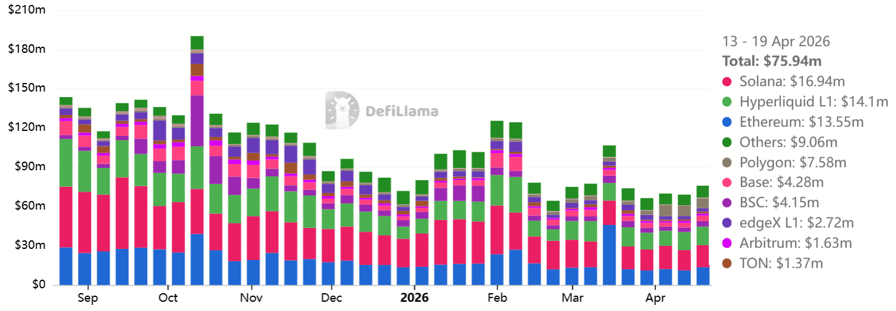
Weekly DApps revenue by chain, USD. Source: DefiLlama

DApp revenues on the Ethereum network dropped to $13 million per week in April, nearly 50% lower than six months prior. However, the decline in decentralized exchange (DEX) volumes has also plagued other major competitors to a similar extent, including Solana, BNB Chain, and Hyperliquid. The aggregate weekly blockchain DApps revenue has fallen to $73 million, down from $130 million in October 2025.

Ethereum well-positioned to capture demand for DApps

Despite recent bullish momentum, ETH is down 22% year-to-date in 2026, while the broader cryptocurrency market capitalization is down 14%. Ether’s underperformance may be interpreted as a buying opportunity, especially as the Ethereum network remains the leader in total value locked (TVL) and its layer-2 solutions have gained significant market share in DEX volumes.

Regardless of the ETF inflows, the demand for bullish leveraged ETH positions has plummeted to its lowest level in four months.

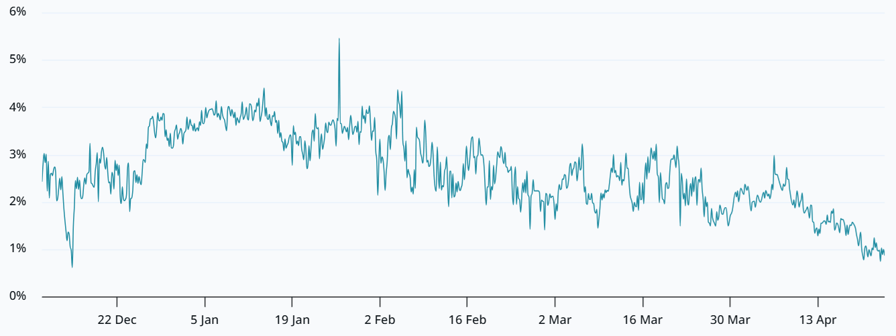
ETH 2-month futures basis rate. Source: Laevitas

The annualized ETH monthly futures premium relative to regular spot markets (basis rate) dropped to 1% on Thursday, well below the 4% neutral threshold. Still, it is incorrect to assume that professional traders are bracing for downside solely due to a lack of confidence in derivatives markets. The uncertain macroeconomic environment might explain trader skepticism, especially after major tech companies’ quarterly earnings disappointed investors.

IBM (IBM US) shares dropped nearly 10% on Thursday due to investor concerns regarding increased competition from the artificial intelligence sector, according to Yahoo Finance. In parallel, Morgan Stanley trimmed its price target on Oracle (ORCL US) due to uncertainty in the margin profile and buildout costs of the company’s expanding investment in AI computing data centers.

Related: BlackRock drives 7-day Bitcoin ETF inflow streak as BTC nears $80,000

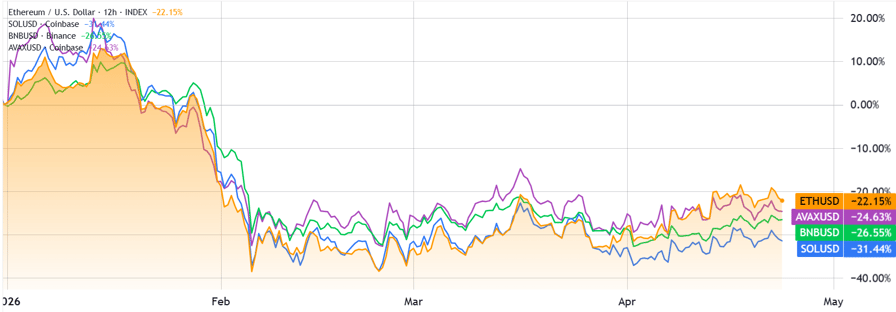
ETH vs. BNB, SOL, AVAX. Source: TradingView

Ether’s potential bullish momentum likely depends on reduced risk aversion toward cryptocurrencies, as its price chart relative to some competitors shows striking similarities. The recent spot Ether ETF inflows, while relevant, are not enough to justify a decoupling, especially as activity in the DApps sector has yet to show signs of improvement.

There is no indication that ETH is bound for $3,000, but the Ethereum network seems well-positioned to capture an eventual pickup in demand for decentralized computation.

This article is produced in accordance with Cointelegraph’s Editorial Policy and is intended for informational purposes only. It does not constitute investment advice or recommendations. All investments and trades carry risk; readers are encouraged to conduct independent research.