Home Blog Page 426

Analyst Reveals The Chances Of Bitcoin Price Crashing Again

0

Trusted Editorial content, reviewed by leading industry experts and seasoned editors. Ad Disclosure

Bitcoin’s recent price behavior has kept traders split between those expecting another leg down and those calling that a bottom is already in. That tension is now feeding different technical analyses, with one analyst arguing that the probability of a deeper crash has dropped significantly based on long-term signals.

Chance Of Bitcoin Making New Lows Is Very Small

Bitcoin has spent months testing the patience of its holders since its all-time high of $126,000 in 2025. According to crypto analyst Sykodelic, there is a compelling case that the drawdown is done and that the probability of Bitcoin revisiting new lows at this point has dropped massively. 

Sykodelic’s rationale leans heavily on the behavior of the Relative Strength Index (RSI) on the weekly candlestick timeframe chart. According to his analysis posted on X, Bitcoin has just printed a powerful bullish break on the weekly RSI, and what makes this particular reading extraordinary is not just where it bounced from but how low it got before doing so. 

Bitcoin
Source: Chart from Sykodelic on X

The weekly RSI has only fallen below 30 on three occasions in BTC’s history, with the most recent being Q1 2026. However, the RSI is now back into the normal zone, and it has broken above a descending trendline that touches lower highs. According to the analyst, this scenario means that the probabilities are now very slim for new lows of any kind.

The Bottom Signals Have Stacked Up

The RSI break did not arrive on its own. Sykodelic noted that multiple bottom indicators have converged simultaneously, a convergence he described as reaching a very high degree. According to him, about 12 important bottom indicators have fired, and Bitcoin is showing it here.

The broader data support his reading. Bitcoin exchange reserves have fallen to seven-year lows while whale wallets are now accumulating more than $2 billion worth of Bitcoin, their highest in over two months. Spot Bitcoin ETFs have recorded $954.05 million in net inflows so far in April, following a $1.32 billion inflow in March, which was the first positive month since October 2025.

Looking at the chart Sykodelic shared, the weekly price structure shows BTC breaking out of a descending trendline above $70,000, a pattern visible across both the price candles and the RSI panel below. Previous breakouts in 2022, 2023, and early 2025 were characterized by a similar RSI breakout of a descending trendline.

All of this contributes to a market environment where downside continuation becomes harder to sustain. Despite his conviction, Sykodelic stopped short of declaring an unconditional all-clear. The most important thing now is seeing how BTC closes the week. At the time of writing, Bitcoin is trading at $75,818, up by 1.4% in the past 24 hours.

Bitcoin
BTC trading at $75,675 on the 1D chart | Source: BTCUSDT on Tradingview.com

Featured image from Pngtree, chart from Tradingview.com

Editorial Process for bitcoinist is centered on delivering thoroughly researched, accurate, and unbiased content. We uphold strict sourcing standards, and each page undergoes diligent review by our team of top technology experts and seasoned editors. This process ensures the integrity, relevance, and value of our content for our readers.

X Generates $1 Billion in Trading Volume Days After Launching Cashtags Feature: X

0

X’s new cashtags trading pilot for stocks and crypto reached an estimated $1 billion in volume within days of its Tuesday launch.

X generated approximately $1 billion in global trading volume following the launch of its cashtags feature on Tuesday, according to Head of Product Nikita Bier. The feature enables users to trade stocks and cryptocurrency directly on the platform, converting social engagement into financial execution at scale. The milestone was reached within days of the pilot going live.

The rapid adoption underscores X’s ability to leverage its massive user base for financial trading activity. The cashtags pilot represents a significant expansion of X’s presence in the retail and institutional trading landscape, combining social networking infrastructure with direct market access for crypto and equities.

Sources: WatcherGuru | BSCNews

This article was generated automatically by The Defiant’s AI news system from publicly available sources.

Houston Fraley on Why Security Is the Foundation of Trust in FinTech

0

Financial technology has expanded quickly over the past decade. Loan applications that once required in-person meetings and stacks of paperwork now happen on a phone screen. Account verification can take minutes. Decisions that once stretched across days are delivered almost instantly. 

That acceleration has reshaped consumer expectations. Convenience is assumed. 

What is not assumed is safety. 

Houston Fraley, CEO of Symple Lending, believes the long-term success of FinTech companies will depend less on speed and more on whether customers feel protected. 

“In financial technology, security is not a feature,” Fraley says. “It is the foundation. If consumers are unsure about how their data is protected, nothing else matters.” 

A More Cautious Consumer 

Early adopters of digital finance focused on usability. Mobile access mattered. So did simplicity and faster approvals. 

Over time, that enthusiasm has been tempered by experience. 

The Equifax breach exposed the personal information of approximately 147 million people in the United States. The incident underscored how closely financial records are tied to identity security and how long the consequences of a breach can last. 

The broader financial impact is also significant. IBM’s 2023 Cost of a Data Breach Report found that the global average cost of a breach reached 4.45 million dollars, the highest level recorded to date. Financial services firms continue to face sustained targeting due to the value of the data they hold. 

Fraley says consumers are no longer passive participants in the discussion. 

“Consumers are paying attention now,” he explains. “They understand that digital access requires responsibility on both sides. If a platform cannot clearly explain how it protects data, people hesitate.” 

That hesitation does not always make headlines, but it can slow adoption and erode confidence quietly. 

Automation With Guardrails 

Automation drives much of the efficiency in FinTech. Algorithms verify identity, assess credit risk, and process documentation. When properly implemented, automation can reduce human error and increase consistency. 

Still, concentration of data within automated systems requires careful oversight. 

“Automation should make systems stronger,” Fraley says. “It should not introduce shortcuts that weaken oversight.” 

Security frameworks such as SOC 2, ISO 27001, and the NIST Cybersecurity Framework are widely used benchmarks for structuring internal controls. These standards address encryption, access management, monitoring procedures, and continuous evaluation of vulnerabilities. 

Security professionals often emphasize that protection is not static. Bruce Schneier has written that security is a process rather than a product, arguing that organizations must reassess risk continuously rather than rely on one-time solutions. 

Fraley approaches the issue from an operational perspective. 

“The technology changes quickly,” he says. “Our responsibility is to make sure protections evolve just as quickly.” 

Clear Communication Matters 

Security practices alone are not enough. Companies must also communicate them effectively. 

Lengthy privacy disclosures filled with technical language rarely inspire confidence. Clarity does. Customers want to know who can access their information, how it is encrypted, and what happens if something goes wrong. 

“People do not need every technical detail,” Fraley says. “But they deserve clarity. They should know who has access to their information and how it is safeguarded.” 

Katie Moussouris, founder of Luta Security, has been a prominent advocate for structured vulnerability disclosure and responsible reporting practices. Clear channels for identifying and addressing weaknesses, she has argued in public forums, strengthen institutional accountability over time. 

Transparency can take tangible forms. Visible certifications. Clear explanations of authentication standards. Defined breach notification procedures. Accessible support when concerns arise. 

Each element reinforces stability. 

Designing for Protection From the Start 

In earlier stages of digital product development, security was sometimes layered onto platforms after core features were complete. That approach has proven risky. 

“Security cannot be an afterthought,” Fraley says. “If it is bolted on at the end, you are already behind.” 

Security by design integrates authentication controls, anomaly detection systems, and layered access permissions at the beginning of the development cycle. It requires coordination between engineering, compliance, and executive leadership rather than siloed oversight. 

Regulatory agencies such as the Consumer Financial Protection Bureau, along with federal banking regulators, establish standards intended to protect consumer data and ensure responsible governance. 

Fraley views regulatory compliance as necessary but not sufficient. 

“Meeting regulatory requirements is expected,” he says. “Going beyond them is what builds trust.” 

Independent penetration testing, third-party audits, and ongoing employee training can extend protection beyond minimum requirements. 

Trust as Strategy 

Competition within FinTech has intensified. User experience and pricing remain central to differentiation, but security increasingly shapes perception. 

“When people feel confident that their information is protected, they engage more freely,” Fraley says. “That confidence leads to stronger relationships.” 

Edelman’s Trust Barometer has consistently found that trust influences purchasing decisions, loyalty, and advocacy. In financial services, where personal data carries long-term implications, those factors can determine whether customers remain engaged over time. 

Confidence compounds. So does skepticism. 

Looking Ahead 

Artificial intelligence tools are improving fraud detection capabilities, identifying irregular behavior patterns more quickly than traditional review processes. Biometric authentication methods such as fingerprint and facial recognition are becoming more common across financial platforms. 

These advances can strengthen defenses when deployed carefully, while also raising new questions about data storage and privacy safeguards. 

“The landscape changes constantly,” Fraley says. “We have to stay vigilant. Security is not something you solve once.” 

Digital finance continues to expand access and streamline financial decision-making. Its continued growth depends on credibility. 

For Fraley, the principle is practical. Innovation can accelerate progress, but trust determines sustainability. 

Security, implemented consistently and communicated clearly, is what allows that trust to endure.

Bulls target $125,000 as U.S.-Iran peace talks trigger risk-on mood

0

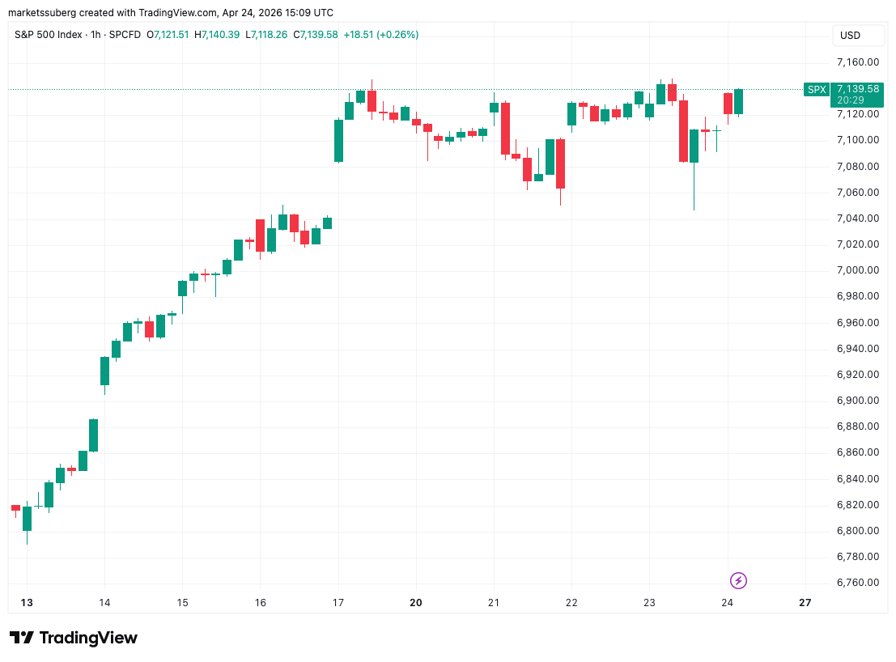
Bitcoin traded around $74,700 in Asian morning hours Friday, down 0.4% over 24 hours but still up 3.5% on the week, as a 10-day rally in global equities paused ahead of next week’s U.S.-Iran ceasefire expiry.

Ether gave back 1.4% to $2,327 but still leads the majors on the weekly tape at 6%, extending the outperformance that emerged earlier this week. XRP held $1.43 with a 6.4% weekly gain, solana ticked up 2.7% to $87.67, BNB added 0.7% to $629.89, and dogecoin was up 5.6% on the week at $0.0976.

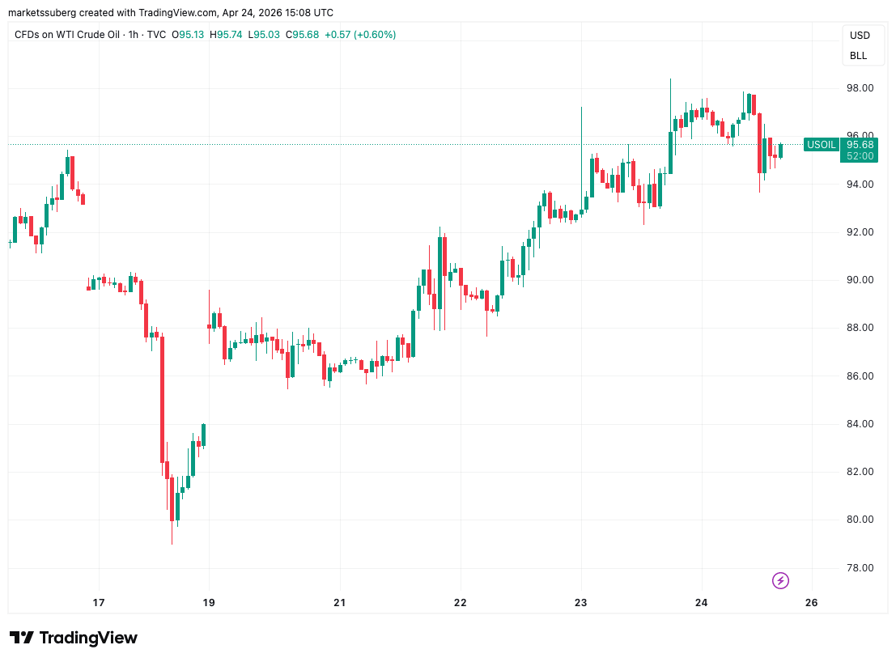
The MSCI All Country World Index closed at a record high Thursday before slipping 0.1% in Asia. The S&P 500 also hit an all-time high. Brent crude fell 1.2% to $98.20 after President Donald Trump said prospects for a permanent Iran ceasefire were “looking very good.”

Trump claimed, without evidence, that Tehran had agreed to give up its nuclear ambitions, turn over nuclear material, and reopen the Strait of Hormuz as part of the deal. Iran has not confirmed those concessions.

A 10-day ceasefire between Israel and Lebanon was announced separately on Thursday, with Israeli Prime Minister Benjamin Netanyahu confirming the truce in a video message. Markets are trading the headlines as if the deal is closer than it is, which is part of why equities have unwound most of the war premium while crude remains near $98 and the Strait of Hormuz is still effectively shut.

However, the setup underneath the flat bitcoin price action is what some traders are paying attention to.

Bitcoin perpetual funding rates have turned deeply negative in recent sessions, reaching levels last seen in 2023. Funding is the periodic payment perpetual futures traders exchange with each other to keep contract prices aligned with spot. When it goes negative, shorts are paying longs, which only happens when the market is heavily positioned against price.

“Funding rates this negative tell you the market is heavily short,” Daniel Reis-Faria, CEO of ZeroStack, said in a note shared with CoinDesk. “If Bitcoin continues to move higher despite that, a lot of those positions could get liquidated, and the move can accelerate quickly.”

Reis-Faria expects bitcoin could reach $125,000 in the next 30 to 60 days if the short base gets squeezed out.

“It’s a reminder that no matter how much shorting is in the market, the amount of buy pressure, especially from large companies, can squeeze those positions out,” he said.

The contrarian read from on-chain analyst CryptoVizArt is that bitcoin’s “True Market Mean,” a metric that estimates the average cost basis of active investors by filtering out lost and dormant coins, suggests the average active holder is currently underwater.

Since 2016, meaningful stretches below the True Market Mean have aligned with bitcoin’s worst periods, including the 2018-19 bear (-57% max drawdown, 282 days) and the 2022-23 unwind after the Luna and FTX collapses (-56%, 339 days).

The two reads do not have to be in conflict. A short squeeze from negative funding and a structural drawdown from underwater holders can both be true, with the former triggering the kind of outsized rally that ultimately gets sold into by the latter.

Which scenario dominates likely depends on whether the U.S.-Iran ceasefire extension holds past next week.

XRP leads bitcoin and ether on weekly gains, but muted volume keeps breakout in check

0

XRP is quietly outperforming the market, but it still hasn’t done enough to break out. The move higher looks steady rather than aggressive, which points to accumulation, but without stronger volume, it’s not a convincing shift yet.

News Background

• XRP is the top weekly performer among major cryptocurrencies, gaining around 6.4% and outperforming bitcoin, ethereum, and BNB over the same period.

• The move comes as broader crypto markets remain mixed, with capital rotating selectively into higher-beta assets rather than driving a full market-wide rally.

Price Action Summary

• XRP climbed to around $1.43, holding a steady upward structure across the week.
• The move developed gradually, with no sharp spikes, indicating controlled accumulation rather than speculative momentum.
• Price remains capped below the $1.44 resistance zone despite multiple attempts to break higher.

Technical Analysis

• The key signal is relative strength. XRP is outperforming peers even without strong volume support.
• Volume remains subdued at roughly 70% of its weekly average, which limits conviction behind the move.
• The structure shows higher lows, but resistance continues to absorb upside near $1.44.
• This combination typically signals consolidation rather than a confirmed breakout.

What traders should watch

• $1.44 remains the key resistance. A clean break is needed to validate upside continuation.
• $1.40 acts as near-term support. Holding above it keeps the structure intact.
• Continued low volume risks a pullback, especially if broader market momentum fades.

Anthropic Releases Good but not Great Claude Opus 4.7

0

Anthropic introduced its latest model, Claude Opus 4.7, on Thursday, noting that it is not as powerful as its limited-release cybersecurity model, Claude Mythos.

Opus 4.7 is more advanced than Opus 4.6 in software engineering, with early users being able to hand off some coding work to the model without oversight, Anthropic said. Opus 4.7 can handle longer-running tasks and pay closer attention to instructions. It is also better at interpreting images and can be more creative when creating slides and documents. 

While Opus 4.7 is not as powerful as Claude Mythos — which triggered a tech-industry scare because of its ability to easily hack software — Anthropic said security professionals can still use it for cybersecurity tasks such as vulnerability research, penetration testing and red teaming. 

“This is a lot more about Opus finding its place within the enterprise for actual business tasks, difficult business tasks, like migrating a database from one platform to another,” said Bradley Shimmin, an analyst at Futurum Group. 

Related:The Real AI Shift Isn’t New Models. It’s Control.

With Opus 4.7, Anthropic aims to address challenges enterprises face when working with frontier models. For example, the vendor included features such as loop resistance, which prevents the model from getting into a loop that requires the human user to start over, and even pushes back against hallucinations within the model. These features make enterprise experiences with models much smoother, the generative AI vendor claimed.

Addressing Enterprise Problems

Anthropic is also being more intentional about making its model more than just another frontier model, forming it into a platform and harness that supports enterprises, Shimmin said.

Capabilities such as how a model manages basic commands or skills, or how it accesses the file system or memory, are not necessarily part of the model but determine how it performs. New features in Opus 4.7, such as auto mode, show the vendor is focusing on providing enterprises with a model that performs more like a platform, with a rich API and a wide range of methodologies that set it apart from frontier models from competitors such as OpenAI and Google, Shimmin added.

A key improvement Anthropic made with Opus 4.7 is in agentic reasoning capabilities, said Arun Chandrasekaran, an analyst at Gartner.

“They have much better benchmarks in terms of coding tasks, which include everything from refactoring, [updating] legacy code and documentation of code,” Chandrasekaran said. “All of these are domains within software development where the 4.7 model shows much better results.”

Related:OpenAI GPT-5.4-Cyber is More Open Than Claude Mythos

The Need for Security

However, even with the improved capabilities of Opus 4.7, the model is still not as powerful as Claude Mythos in preview.

For Shimmin, it seems that Anthropic is walking the line, recognizing that as AI models become more advanced, users need agentic AI to be secured and also to provide security.

“It’s like this multi-faceted sort of situation where it opens up a lot of attack vectors, but it can be used to solve a lot of attack vectors,” he said.

Bitcoin (BTC) bear market bottom indicator that marked every cycle low since 2015 still hasn’t triggered

0

Here is something worth noting about bitcoin . Beneath all the noise from daily price swings, X posts and macro headlines, there is a remarkably simple indicator that has quietly called every major market bottom since 2015. Not once, but every single time.

To the dismay of bulls, it hasn’t fired yet, suggesting the broader bear market may not be over, and the recent bounce to $75,000 from $65,000 could be a temporary recovery.

The indicator

It involves two lines on the price chart. That’s it, no complex formula, analysis of blockchain data needed.

These two lines represent bitcoin’s average price over the past 50 and 100 weeks. They act as simple moving averages, showing near-term and long-term trends in bitcoin’s price.

Most of the time, the 50-week average is above the 100-week line. That’s the natural state for markets that trend upward over time, as is the case with bitcoin.

But occasionally, during periods of peak fear, when selling is relentless, and sentiment has collapsed, the 50-week average falls below the 100-week average. This crossover is known as a bear market signal.

It has occurred three times in bitcoin’s history. Each time, it has coincided with the end of a bear market, marking major price bottoms that have not been revisited since.

In other words, it’s been a contrary indicator, ironically marking bottoms rather than deeper downturns.

Three times, three bottoms

Look at the vertical lines on the chart going back to 2015. These mark the three bearish crossovers – April 2015, February 2019, and September 2022. Each one occurred near the bottoming phase, not precisely at the lowest point, but within the same range.

In 2015, BTC was written off as a failed experiment. Then the crossover happened. BTC subsequently rallied from $200 to nearly $20,000 by the end of 2017. A similar pattern played out after the early 2019 crossover.

The 2022 crypto winter, characterized by several bankruptcies and scams, shattered investor confidence. The downtrend, however, ran out of steam after the crossover happened in September. BTC bottomed out in the final months and later chalked out a rally to $126,000 by October 20205.

Each of these bull runs delivered returns far exceeding those of equities and other major asset classes.

What is it saying now?

As of April 17, the crossover has not happened.

Bitcoin has declined sharply from its October record high of over $126,000 to around $75,000, briefly reaching $60,000 in early February. As a result, the two averages are moving closer together, but the 50-week average still holds above the 100-week average.

The takeaway: If history is any guide, the broader bear market may still be intact and could worsen before finding a bottom. It also means that the recent bounce toward $75,000 is likely a temporary recovery rather than the start of a full-fledged bull market.

That said, historical patterns are just that – patterns – and they do not guarantee future outcomes. If U.S. equities, already at record highs, continue to advance, institutional demand for Bitcoin ETFs could strengthen, potentially supporting a price rally.

Wrapped XRP Now Available Across Major Solana Apps: Solana

0

Solana announced wXRP is live on Titan Exchange, Real, Phantom, Jupiter, and Meteora, expanding cross-chain asset availability on the blockchain.

Solana announced Friday that wrapped XRP (wXRP) is now available across multiple major Solana ecosystem applications, including Titan Exchange, Real, Phantom wallet, Jupiter aggregator, and Meteora. The listing enables Solana users to access XRP-backed assets natively within the Solana network through these popular trading, wallet, and DEX platforms.

The launch expands interoperability between the XRP Ledger and Solana blockchain, allowing users to trade and hold wrapped versions of the Ripple-native asset. wXRP bridges assets across chains, enabling broader liquidity and market access for XRP holders seeking exposure within the Solana DeFi ecosystem.

Sources: Solana

This article was generated automatically by The Defiant’s AI news system from publicly available sources.

Mastercard and Deutsche Bank on Reducing Complexity for Merchants

0

At MPE 2026, Corina Metternich from Deutsche Bank and Katharina Luschnik from Mastercard centered on a shared mission to reduce complexity for merchants in an increasingly diverse and fragmented payments landscape

Luschnik explained that Mastercard’s ambition is to make payment acceptance easier, better integrable, and more consumable for merchants. Specifically, under the Open Finance concept, Luschnik noted that Mastercard helps merchants gain further insights through open banking data and provides an Account-to-Account (A2A) payment method as an alternative to card payments. This infrastructure is delivered in cooperation with Deutsche Bank to provide a ready-to-use A2A payment proposition.

Metternich emphasized Deutsche Bank’s belief that there is no one-size-fits-all for merchants when it comes to accepting payments as the team focuses on understanding a merchant’s specific pain points, advising them on the right mix of payment methods, and helping clients localize their offerings for success in different countries. Metternich confirmed they are seeing a clear shift away from card payments into account-to-account payment methods and more localisation.

Luschnik further detailed Mastercard’s obligation as an infrastructure provider: to adapt to new trends within the payment ecosystem which involves supporting various technologies such as tokenized card details, stablecoins, encryption, security mechanisms, and transaction monitoring. In the context of open finance, the goal is to enrich transactions with data insights and offer A2A payments as a core option, dependent on regional and consumer preference.

Ultimately, both Mastercard and Deutsche Bank agreed that MPE is vital for staying on the pulse of needs of merchants, while also stressing the need to understand merchant pain points and roadmaps, not just for 2026 but for the next few years.

The Whole Entire Universe: 21 Million, One Painting

0

There are 21 million bitcoin. That number is fixed, coded into the protocol, finite. It is one of the most consequential design decisions in the history of money, and yet for most people it remains an abstraction. Green digits cascading down a black screen like something out of The Matrix, or a talking point tossed around on a podcast.

The Japanese artist On Kawara spent nearly fifty years hand-painting a date onto a canvas every day — if he didn’t finish by midnight, he destroyed it. Anik Malcolm spent 900 hours painting 21 million beads. The impulse is the same: make the abstraction physical, make the counting matter, let the labor carry the meaning.

“The Whole Entire Universe” is a concept first conceived in early 2025 and now in its third and most ambitious incarnation: a meticulous, large-format oil painting in which every single bitcoin is represented as an individual bead, painted by hand over the course of more than 900 hours. The work will debut at Bitcoin 2026 at The Venetian Resort in Las Vegas.

The premise was somewhat simple— show 21 million of something. But in working out how to do it, Malcolm stumbled into something closer to a tesseract — a shape that revealed more dimensions the longer he looked at it. Twenty-one million does not divide cleanly into a cube — its cube root is an irrational number. But if you round up to the nearest whole number, 276, and cube it, you get 21,024,576 — exactly 24,576 more than 21 million. That surplus divides evenly by six (one for each face of the cube), yielding 4,096 beads to remove per side. The square root of 4,096 is 64 — a perfect square and a power of two. Which means those removed areas can be halved repeatedly: from 64×64, to 32×32, to 16×16, all the way down to 2×2 — mirroring, with startling precision, bitcoin’s halving mechanism.

He opened the box and the pattern was already inside. To him, the work is not an illustration of Bitcoin — it is a still life of it. The most literal depiction that could be made, rendered in a form so structurally resonant that it has drawn the attention of Adam Back.

From early drawings exhibited in Lugano to digital renderings to the oil painting debuting at B26 — and a planned monumental public sculpture in Roatán — “The Whole Entire Universe” keeps demanding a bigger canvas. 

I spoke with Anik Malcolm about how a simple question produced an extraordinary answer.

BMAG: The Whole Entire Universe began with a deceptively simple premise — make an artwork that shows 21 million of something. How did you land on that idea, and what was it like when your wife — herself an artist and jeweler — suggested a cube of beads? How does that kind of creative exchange between partners work for you? 

Anik Malcolm: The original impetus was literally that simple — it struck me that although the 21M number is so critically important to us as bitcoiners, it’s also a number that is difficult to fathom without seeing. How simultaneously large it is in volume, but also overseeably small and “human” in scale — so I wanted to find a way of bringing the number to life, of making it graspable. My wife Una and I have collaborated on many projects over the years, both in the visual and sonic arts, so we have honed the skill well of making it a constructive flow. I suggested this idea to her in conversation, and her instantaneous response was “a cube of beads.” I loved this both for the fact that a cube is such a deeply ubiquitous symbol in bitcoin, visually and metaphorically, and that the bead was one of the very first methods of exchange — the combination just made perfect sense, and was additionally manageable in scale. I immediately set to working out the practicalities, calculator in hand, and could barely believe what I found..!

BMAG: When you started working out whether 21 million could fit into a cube, you stumbled into a series of mathematical coincidences — 276 cubed, the 4,096 remainder dividing evenly by six, the square root landing on 64 (I can’t help hearing the Beatles lyric “When I’m 64” in my head), a power of two. Walk us through that moment. Did you realize right away what you were looking at, or did it unfold gradually?

Anik Malcolm:  Haha — wow, I hadn’t even made the Beatles connection yet! Fantastic. Yes, it happened very quickly. Obviously the cube root of 21M wasn’t going to be a rational number, so I knew I would have to do some tinkering to make it fit. I naturally started with the idea of rounding the cube root up to 276 and subtracting from there — as you said earlier, to reach 21,024,576, and it was already a rush when the surplus 24,576 divided cleanly into 6, meaning I could give the desired structure symmetry. That rush, however, was greatly amplified by the fact that I felt I recognized the number 4,096, and I was literally shaking when I inputted “square root of 4096” into my calculator, and when I saw the result I was absolutely dumbstruck — Una witnessing the whole process in amusement! The fact that I could not only spread the subtracted number equally over all six sides, but ALSO do so in perfect squares to obtain exactly 21,000,000 felt like a moment of divine providence, as if this symmetry had been encoded from the start and had been waiting to be found, and that there was possibly some deeper significance that someone, some day, might fathom. I knew right away that I had been entrusted with a very meaningful project.

BMAG: The pattern you found — squares halving from 64×64 down to 2×2 — mirrors bitcoin’s halving mechanism. You’ve described the piece as a “still life of Bitcoin.” How much of that connection did you set out to find, and how much of it felt like it was already embedded in the number waiting to be discovered?

Anik Malcolm: Yes — I was actually so moved by the initial finding that it wasn’t until some time later that I realized, to my EVEN greater astonishment, the obvious fact that I could divide 64 into 32, 16, 8, 4, and 2 — not only making the cube much more visually interesting, but in the process also representing both the halving function so deeply integral to bitcoin’s mechanism, but simultaneously also the exponential growth that, conversely, is a direct result of that halving. It felt that this single cube embodied everything that bitcoin is and does, and in such incredible symmetrical elegance — I was, and am still, more than a year later, absolutely in awe of the beauty of it all, which is why I have made it pretty much into my life’s work, for the time being at least. So to answer the question — I didn’t set out to find it at all, which is why I really feel I’m just a messenger, a role which permits me to stand so strongly behind it as it is not my own creation but merely a discovery.

BMAG: The oil painting debuting at Bitcoin 2026 took over 900 hours — each bead representing an individual bitcoin, painted by hand. What does that kind of sustained, meticulous labor do to your relationship with the subject? Does spending that long with 21 million change how you think about the number?

Anik Malcolm: This is a very interesting question, and one I actually pondered much during the process. As it is a two-dimensional representation of a still-theoretical 3D object, I “only” had to paint the 227,701 visible beads — each one, however, three times: body, highlight, shadow, not to mention the underlying grid.

The whole process, as you can imagine, was deeply meditative, and I found that “intrusive” thoughts would affect my efficiency, so that in itself became an exercise in recognizing, accepting, and letting go — a growth process of sorts which many report encountering on their bitcoin journey.

Next, I realized that music that was more demanding of my attention would have the same effect, so over time the playlist evolved into a soundtrack which resonated with the cube’s essence rather than rubbed against it — Arvo Pärt, David Lang, Kjartan Sveinsson, and the like, which I will also provide for listening at B26, as it forms an added dimension to the artwork’s presence.

Thirdly, I started noticing many other patterns within the numbers, many of which linked with Tesla’s “3,6,9” ideas, and I even spontaneously started reciting personal mantras as I painted, dot by dot, in a 3,6,9 pattern!

So I would say that rather than actively applying meaning to the number and its cubic manifestation, I became deeply under its influence as time progressed — physically, mentally, and spiritually. There is a certain “holiness” to bitcoin upon which I feel we all agree to a greater or lesser extent, and my experience of representing it so very literally was a true reflection of that.

BMAG: This concept has moved from drawings in Lugano to digital versions and tutorial videos to a full-scale oil painting, and you’re planning a monumental public sculpture in Roatán. What is it about this particular idea that keeps demanding a bigger format?

Anik Malcolm: Actually, both the Lugano drawings and the B26 painting (each 128×128 cm — about 4’2″) are on the smallest scale at which I could accurately represent the number! Each bead is 2mm (5/64″) — even smaller on the top face — so any smaller would have been unfeasible. I would also like to make a sculpture version of the same or similar size, hopefully within the next 12 months, as 55.2cm (under 2′) is still manageable in size. However, I met someone in Lugano who had spent years looking for a suitable idea for a monumental Bitcoin sculpture in Roatán, and felt that this worked perfectly. Even at a bead size of only 1cm (roughly ⅜”) with a 1cm gap in between for visual and kinetic effect, the cube alone quickly expands to 5.52m (approx. 18′), not counting the supporting structure and elevation from the ground. I feel that being able to be in the presence of all 21 million at such a grand and imposing scale would be an experience that would do bitcoin and all it stands for the appropriate justice.

BMAG: Adam Back has taken notice of the work. But if someone walks up to this painting at B26 with no math background and no particular interest in Bitcoin’s technical architecture — what do you want them to see or infer?

Anik Malcolm: I think my teenage daughter is a good representative of that demographic! She told me the other day that she would frequently come into the room where the painting has been drying “just to look at it for a while.” As I experienced while painting — I feel there is a deeply calming effect that the cube’s sheer symmetry and pattern exudes, floating and glowing in its abyssal setting, and combined with the provided soundtrack it becomes a deeply meditative and engrossing experience. And even on a basic math entry level — there are 21 subtracted squares visible on the painting! (Another beautiful coincidence — 1 square of 64², 4 squares of 32², and 16 squares of 16².) I feel, and hope, that both visitors of B26 and eventually the painting’s future owner will derive deep and sustained pleasure from this calm that was quietly encoded into that magical number, in the way both I and my whole family have during the journey of its creation — the calm methodical truth that is reflective of the bitcoin experience as a whole.

Fix the money. Fix the world.

“The Whole Entire Universe” by Anik Malcolm debuts in the BMAG art gallery at Bitcoin 2026, April 27–29, at The Venetian Resort, Las Vegas. Preview the work and explore more from the BMAG B26 exhibition HERE.  A limited edition shirt based on the painting is available HERE.

The Bitcoin Museum & Art Gallery (BMAG) is the curatorial and cultural programming division of BTC Inc and the Bitcoin Conference. Since 2019, the BMAG conference art gallery has facilitated more than 120 BTC in art and collectible sales. Learn more about BMAG at museum.b.tc. Follow BMAG on twitter @BMAG_HQ.

Bundle your Bitcoin 2026 pass with a stay at The Venetianand get your fourth night free. Use code AFTERS for a free After Hours Pass, or get your pass alone here.