Bitcoin’s BTC$77,557.88 recent gains — it’s added almost 15% this month — aren’t enough to convince some industry observers that the largest cryptocurrency has escaped the bear market it entered in October. It is, after all, still 40% below its record.
There may be deeper drops to come, with some, unidentified, forecasters, predicting a drop to as low as $40,000, a 70% drop from its all-time high. The figure comes from bitcoin analyst James Check, who says such a move is unlikely. While not impossible, he said in a post on X, it would be statistically extraordinary.
“Just to make a point, for the bears who want to see $40k.
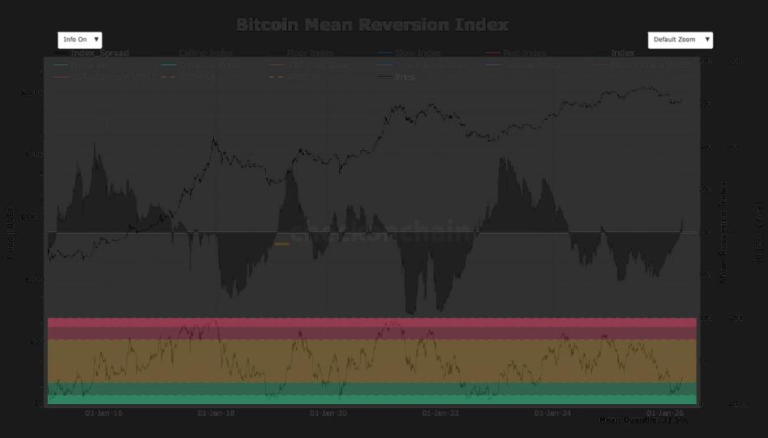
You may well end up right. However, consider that on a mean reversion basis, averaging relative to nine anchors (a mix of technical, onchain, trend, fast, slow etc), it is a Q 0.4 event.
Lower than $2 Bitcoin in 2011.”
After climbing over $126,000 in October, bitcoin slid more than 50% to around $60,000 in February before stabilizing. It was trading Friday near $78,000.
Talking to the bears, Check said their predictions warrant closer scrutiny.
Check points to the Bitcoin Mean Reversion Index, a composite model that averages multiple key valuation metrics, including the 200-week moving average, realized price, power law trend and a number of volume-weighted average price measures. The index ranks bitcoin’s price on a historical percentile basis.
When modeled at $40,000, bitcoin registers as a “0.4 event,” meaning it would fall in the 0.4th percentile of all daily closes.
“That’s below any meaningful deviation across all major anchors,” Check said.
For context, Check says that would be equivalent to bitcoin trading below $2 in 2011 on a relative basis. By contrast, today’s price sits around the 31.5th percentile, historically weak but within normal correction ranges.
“There’s no zero probability in markets,” Check added, “but this would be a near-unprecedented outcome.”
Allica Bank, the UK’s fastest-growing business bank and one of Britain’s newest unicorns, has officially launched its biggest brand campaign to date.
The launch coincides with the publication of the bank’s 2025 annual results, which mark its third consecutive year of profitability and reflect a growing demand from established businesses for a full-service SME banking model.
Record 2025 financial results
Allica’s latest financial data demonstrates significant momentum across its operations. Key highlights from the 2025 results include:
Underlying pre-tax profit rose by 34 per cent to £43.7million.
Gross revenue increased by 27 per cent to £371.3million.
Business Reward Account customers surged by 133 per cent, surpassing 14,000 established businesses.
Since opening for lending in 2020, Allica has achieved a $1.2billion valuation, topping Deloitte‘s UK Tech Fast 50 in both 2023 and 2024, and placing second in the Financial Times’ FT1000 in 2025. It is also officially recorded as the fastest-growing UK fintech in history.
“Like your business bank again”
Representing Allica Bank’s most significant investment in brand marketing to date, the new campaign was developed in partnership with creative agency 20(SOMETHING). The major push spans TV networks including Sky, ITV, and Channel 4, alongside out-of-home advertising across Global’s TFL network and digital channels like YouTube.
Built around the tagline “Like your business bank again,” the campaign targets established businesses—those with between 5 and 250 employees—that have long been underserved by the wider financial sector. According to the bank, these businesses are often considered too big to be served by consumer-focused fintechs, yet too complex for traditional incumbent banks to bother with.
Putting the relationship back into banking
Richard Davies, CEO of Allica Bank
To combat the frustration of being passed between call centres and feeling like a number, Allica has invested heavily in proprietary technology that enables it to offer customers a dedicated relationship manager. Customers can reach their managers directly by phone, email, or WhatsApp, entirely bypassing chatbots and hold music.
The campaign’s adverts use deadpan humour to bring this proposition to life, placing Allica’s relationship managers directly into everyday customer environments—such as shops, factories, and industrial estates—to demonstrate what it looks like when a bank actually knows your business.
Georgie Burks, head of marketing at Allica Bank, noted how strangely impersonal business banking has become.
“You’re passed around, put on hold, treated like a number – and for a lot of business owners, that’s just been accepted as normal,” Burks said. “This campaign challenges that. It shows what it looks like when a bank actually knows your business, and why that shouldn’t be exceptional.”
Richard Davies, CEO of Allica Bank, emphasized the bank’s commitment to stepping up for established SMEs.
“Allica is building the category defining digital bank for established SMEs – a segment who make up a third of the economy but are drastically underserved,” Davies stated. “We’ve built the technology, we’ve built the team and we’ve proven our model works. Now is the right moment to make sure the businesses who need us most know we exist and this campaign is a signal of how seriously we take that.”
A group of cryptocurrency executives, investors and public figures is set to speak Saturday at a private event hosted by U.S. President Donald Trump at his Mar-a-Lago club in Palm Beach, Florida.
The event, billed as “the most exclusive conference in the world,” started with Bill Zanker, co-founder of TRUMP memecoin and was followed by legendary boxer Mike Tyson.
Other high-profile speakers include stablecoin issuer Tether’s CEO Paolo Ardoino, who is expected to address the link between financial inclusion and the U.S. dollar’s global role. Ark Invest founder Cathie Wood and crypto infrastructure provider Alchemy’s CEO Nikil Viswanathan will also speak at the conference, and each will focus on the overlap between artificial intelligence and crypto, a topic that has drawn increasing attention as both sectors expand.
Speaker list at Trump’s event (CoinDesk)
Anchorage Digital CEO Nathan McCauley is scheduled to join a panel on the state of crypto and equities markets, while investor Anthony Pompliano of ProCap Financial is also set to appear on stage.
Speaker list at Trump’s event (CoinDesk)
The lineup also includes traditional finance investors such as Tim Draper and Grant Cardone, as well as author Tony Robbins.
The event is touted as a major cryptocurrency and finance gathering tied to Trump’s broader push to support the digital asset industry since returning to the White House in January 2025. The conference website lists Trump as the keynote speaker and says attendance is limited to the top 297 holders of the $TRUMP token, a meme coin launched in his name.
This will mark the second time such an event has been hosted by the President. That previous dinner prompted Democratic lawmakers to lodge protests and raise concerns about Trump profiting off of his own crypto token while simultaneously championing legislation to support the industry and appointing regulators to oversee crypto.
Since taking over the Oval Office, Trump has backed several crypto-related projects, including the $TRUMP and $MELANIA meme coins, which are tied closely to the public profiles of the president and first lady rather than any underlying utility. Transaction fees generated from trading the coins have produced millions of dollars in revenue for entities linked to Trump and his family.
Nevertheless, since launching around Trump’s second inauguration, the $TRUMP token has fallen about 97% from its peak. The $MELANIA coin has dropped even further, down roughly 99% after a rapid rise and decline.
Read more: It could cost you up to $6 million to grab lunch with Donald Trump
Something important happened in Belgium earlier this year. KBC, the country’s largest bank-insurance group, switched on regulated Bitcoin and Ether trading for retail investors through Bolero, its self-directed brokerage platform.
What matters is not only that a major European bank enabled access to digital assets. It is how that access was introduced: within an existing regulated platform, inside an established client journey, and as part of the broader financial environment customers already use.
That model says a great deal about where the market is heading.
The first era of bank-distributed digital assets was ring-fenced
For the better part of a decade, banks that touched digital assets did so at arm’s length. In many cases, that approach made sense. Digital assets raised difficult questions around custody, governance, compliance, suitability and operational resilience. Regulatory fragmentation across Europe only added to the hesitation.
As a result, digital assets were often treated as adjacent to core banking rather than part of it.
That equation is now changing. Across Europe, institutions are increasingly evaluating digital assets not as a separate category requiring a distinct commercial and operational stack, but as capabilities that may ultimately need to sit within the same control environment as other financial products and services. That shift remains uneven, and institutions are moving at different speeds. But the strategic direction is becoming clearer.
MiCA is the catalyst
The Markets in Crypto-Assets Regulation, or MiCA, has not removed every challenge, nor has it made adoption automatic. But it has helped narrow one of the biggest sources of hesitation for financial institutions: where do digital assets belong operationally?
Before MiCA, offering digital asset services meant navigating a patchwork of national regimes, each with different licensing requirements, custody rules and consumer protection standards. The compliance cost of building a standalone digital asset offering was difficult to justify for a bank already running a profitable brokerage business.
MiCA collapsed that complexity into a single, passportable framework. For the first time, a bank in Belgium, Spain, Germany or France could offer digital asset trading under the same regulatory logic it already applied to securities. The operational question shifted from “should we build a digital asset product?” to “should we add digital assets to the product we already have?” Sparking a fundamentally different conversation, which European banks are answering with remarkable speed.
The pattern is already visible
Look at who has moved in the past twelve months. BBVA went live in Spain. DZ Bank, Germany’s largest cooperative banking group, followed. Société Générale built its digital asset infrastructure through its Forge subsidiary. And now KBC in Belgium.
They are among Europe’s most stringent financial institutions, and they are all arriving at the same architectural conclusion: digital assets belong in the existing stack, not alongside it.
They plugged digital asset capabilities into their existing compliance, reporting and client-facing systems. From the customer’s perspective, buying Bitcoin feels identical to buying a stock. From the bank’s perspective, it runs through the same operational rails. That is the whole point.
Why this changes market structure
First, trust shifts. European banks collectively serve hundreds of millions of retail clients who already have brokerage accounts, verified identities and established banking relationships. When digital assets arrive inside that envelope, the addressable market expands overnight without a single new user signing up for a new platform.
The scale of that opportunity is significant. In the European Union, digital asset ownership is expected to reach around 25% by 2030, up from 9% in 2024 and 4% in 2020. That expansion is being driven in large part by MiCA and by the growing number of bank-led digital asset projects expected to mature over the coming cycle. Banks that move now are positioning themselves to capture that wave through channels they already control.
Second, the customer relationship stays with the bank. In the standalone model, the crypto exchange owns the client. In the embedded model, the bank does. That distinction matters enormously for product development, cross-selling and long-term economics. A bank that offers digital assets alongside equities can eventually offer tokenized bonds, structured products, and digital asset wealth management, all within the same relationship.
Third, the scope expands beyond trading. The same absorption pattern is appearing in payments and settlements. Bloomberg Intelligence estimates stablecoins could account for more than $50 trillion in annual payments by 2030. The question is who will issue and distribute them. As banks begin issuing tokenized deposits and integrating stablecoin capabilities into their payment rails, the competitive dynamics of digital payments shift from “banks versus blockchain” to “which banks move first.”
The real question is not technological but distributional
If this pattern holds, the competitive landscape that emerges will not look like the one crypto was built around. It will not be defined by exchange volumes or token listings. It will be defined by which institutions can offer digital assets as seamlessly as they offer any other financial product, across trading, payments and custody, and which can do so at production scale, not pilot scale.
Some of that capability will be built in-house. Much of it will be acquired. The M&A pattern is already forming: banks that recognize they cannot build fast enough are buying or partnering to acquire digital asset infrastructure, just as they have historically done with market data, settlement and risk systems.
The real shift is distributional. Once digital assets move through bank platforms, the addressable market changes permanently. MiCA made that architecturally possible. The banks are now making it real. The industry should be paying closer attention.
The rapid rise of AI agents is beginning to reshape how payments happen online, and crypto infrastructure is emerging as a natural fit, according to Coinbase’s Jesse Pollak.
“What was almost impossible nine months ago is now totally possible,” Pollak said in an interview with CoinDesk, pointing to the accelerating capabilities of autonomous AI systems. As these agents evolve, one need is becoming clear: they require native ways to transact.
“Agents are defined in software and operating software, they want money as software,” said Pollak, who will be speaking at Consensus Miami 2026 next month.
That shift is fueling interest in so-called “agentic payments,” where AI systems can autonomously pay for services like data access, compute or travel bookings.
Pollak said he hopes a key piece of that stack will be x402, an open-source payments protocol that Coinbase and collaborators like Microsoft, Google, and Mastercard have been developing, which enables on-demand API payments without subscriptions or traditional billing systems.
Instead of relying on legacy rails, blockchain-based payments allow agents to “make a single API call or smart contract call and move money globally, instantly, basically for free,” Pollak said.
Early traction is already visible. According to Pollak, roughly $48 million in payment volume has flowed through X402 so far, with about 95% of transactions occurring on Base, the Ethereum layer-2 network founded by Pollak and incubated by Coinbase. The ecosystem is also expanding quickly, with integrations spanning AI providers, data platforms and travel services that agents can tap into directly.
Pollak said the long-term vision is to create an open marketplace of services that agents can access programmatically, without hitting paywalls or requiring human intervention. “You want agents to be able to run wild,” he said, describing a system where software can seamlessly discover, purchase and use digital services in real time.
While fully autonomous “zero-human” businesses are beginning to emerge, Pollak said the bigger near-term shift will come from people augmenting themselves with AI.
“The top performers are now using agents to become even more top performers,” he said, describing workflows powered by multiple parallel AI systems.
For crypto, the broader challenge remains adoption. Pollak argued the solution isn’t better marketing, but invisibility.
“It’ll be a lot easier to sell crypto when you don’t have to tell people about it, they just experience it,” he said.
Read more: Coinbase’s AI payments system joins Linux Foundation, gathers support from Google, Stripe, AWS and others
Ethos (Nasdaq: LIFE), a leading life insurance technology company on a mission to democratize access to life insurance, and Liberty Mutual Insurance, announced they are working together to expand the reach of Liberty Mutual’s direct-to-consumer life insurance offering. By combining Liberty Mutual’s trusted consumer brand with Ethos’ best-in-class underwriting engine and digital platform, the collaboration marks a significant step forward in making life insurance more accessible, affordable and effortless for American families.
Liberty Mutual will leverage Ethos’ technology platform and proprietary underwriting engine to deliver a seamless, end-to-end digital life insurance experience — fully white-labeled under the Liberty Mutual brand. Customers can instantly qualify for and purchase coverage that fits their needs, with no medical exam and just a few simple health questions.
The offering will launch across Liberty Mutual’s website and distribution partners.
“This partnership advances our mission to help people protect what they’ve built and prepare for the unexpected. By combining trusted protection with a digital-first experience, we’re delivering greater value through easier access and a modern customer experience,” said Daniel Bernstein, Senior Vice President and General Manager of Strategic Partnerships, US Retail Markets, Liberty Mutual. “Ethos has built the kind of platform that lets us deliver on that — instant decisions, no unnecessary friction, and coverage options that fit people’s lives.”
“Liberty Mutual is one of the most recognized and trusted insurance brands in the country, and we couldn’t be more proud to power their life insurance experience,” said Ethos Senior Vice President of Insurance, Chris Fioriotto. “This collaboration is a testament to what happens when a world-class brand and world-class technology come together with a shared belief that protecting your family should be simple, fast, and certain. We built Ethos to make that possible, and Liberty Mutual’s commitment to their customers makes them perfectly suited to bring that vision to even more families.”
The strategic relationship positions Liberty Mutual at the forefront of digitally enabled life insurance, combining the reach and trust of a beloved consumer brand with Ethos’ proven ability to deliver instant, accessible coverage at scale. For consumers, the result is a more intuitive, modern buying experience — with expanded product choice and flexible coverage amounts, all within a seamless digital journey they already know and trust.
Not everything in bitcoin is at risk from a quantum computer.
Bitcoin mining, the process by which new blocks get added to the blockchain, uses a type of math called hashing that quantum computers cannot meaningfully break. The ledger itself and the rule that new bitcoin can only be created through mining would survive a quantum attacker. Blocks would still get produced, and the chain would keep running.
What would not survive is ownership.
Bitcoin wallets are protected by a different kind of math that turns a secret private key into a public address anyone can see. The math works easily in one direction and not at all in the other, which is the only thing stopping a stranger from spending your coins.
Part 1 of this quantum computing series went into physics. A quantum computer is not a faster version of a regular computer. It is a fundamentally different kind of machine, starting at a very cold, very small loop of metal where particles behave in ways they do not behave anywhere else on Earth.
Part 2 walked through what happens when you point that machine at bitcoin. Bitcoin wallets depend on a one-way math problem. Turning a secret private key into a public address takes milliseconds. Going the other way, from public address back to the private key, would take a regular computer longer than the age of the universe.
A quantum algorithm called Shor’s collapses the gap. Google’s paper this month showed the attack could be run with far fewer resources than anyone previously estimated, in a window that races against bitcoin’s own block times.
This piece, the last in the series, is about the response. What is actually at risk, what bitcoin has done about it, and whether a network built to resist coordinated change can coordinate the biggest security upgrade in its history before the hardware catches up.
What’s exposed, what’s safe
The at-risk pool is large.
Roughly 6.9 million bitcoin, about one-third of everything ever mined, sits in wallets whose public keys are already permanently visible onchain. Most of this is early bitcoin from the network’s first years, stored in an address format that published the public key by default. It also includes any wallet that has ever been spent from, because spending reveals the key for whatever remains.
A quantum attacker would not need to race against a transaction in progress. Rather, they could work through the wallets with already exposed keys at their own pace, one by one. Bitcoin’s pseudonymous creator, Satoshi Nakamoto, holds roughly 1 million bitcoin, untouched since the network’s early days, and this stack now sits in the exposed category.
The 2021 Taproot upgrade expanded the problem. Taproot is a change to how bitcoin addresses work, intended to make transactions more efficient and more private.
A side effect was that any bitcoin spent since Taproot activated has published the key protecting whatever remains at that address. This was not a mistake but a reasonable tradeoff at the time, when quantum timelines looked much longer than they do now.
What’s in the works?
While the quantum threat has sparked a heated debate in recent months, and other blockchains are preparing, nothing concrete has emerged from Bitcoin developers yet.
Ethereum, which can be considered one of Bitcoin’s largest competitors among institutional investors looking at the crypto market, has had a formal quantum-resistant program since 2018.
The Ethereum Foundation runs four teams working on the migration full-time, with more than ten independent developer groups shipping weekly test networks. The plan maps specific upgrades across four upcoming network-wide changes, moving Ethereum’s security to new math that quantum computers cannot break. It has even launched a dedicated website, pq.ethereum.org, to publish its progress.
Bitcoin has no equivalent strategy so far.
That doesn’t mean there aren’t any efforts out there to solve it.
One such formal proposal is BIP-360 from a group of developers and researchers. It would add new quantum-safe address types that holders could voluntarily migrate to. A competing proposal from BitMEX Research would install a detection system that triggers defensive action if a quantum attack is observed on the network.
However, neither has broad support from bitcoin’s core developers, and the two proposals solve different halves of the problem.
Nic Carter, one of bitcoin’s prominent advocates, has called it out in the past months.
“Elliptic curve cryptography is on the brink of obsolescence,” Carter wrote on X, referring to the math that secures bitcoin wallets. He described Ethereum’s approach as “best in class” and bitcoin’s as “worst in class,” citing developers who “deny, gaslight, gatekeep, bury heads in sand” rather than engage with the problem.
Adam Back, the Blockstream CEO and a prominent early bitcoin contributor, disagrees on the urgency but agrees on the direction.
“Quantum computing still has a lot to prove. Current systems are essentially lab experiments,” Back said at a conference earlier this month. But he also said bitcoin should prepare now, with optional upgrades built in advance so the network can migrate when needed, rather than scrambling in a crisis.
The coordination problem
So what’s the biggest challenge in implementing effective solutions against Bitcoin’s quantum threat?
Bitcoin’s migration is harder than Ethereum’s for reasons unrelated to the actual math.
Ethereum has a foundation that funds engineering work and a governance process that regularly passes major upgrades. Bitcoin has neither. Its development culture treats any central authority as a failure mode, and its social consensus holds that changes to the protocol should be rare and hard.
Those priors have kept the network stable for nearly two decades, but they also make the quantum problem structurally harder for bitcoin to solve.
Migrating the 6.9 million exposed coins requires decisions the network has spent twenty years avoiding. Should old address formats be frozen after a certain date to protect coins from future theft? Should exposed coins be allowed to move to new quantum-safe addresses using their original keys? What happens to coins whose owners cannot or will not migrate?
Satoshi’s coins are the sharpest example. Freezing old formats protects the coins from theft but makes them permanently inaccessible, including to Satoshi. Leaving the old formats open means those coins sit as a standing prize for whoever builds the first working quantum computer or has access to a quantum computer and wants to attack.
Setting a migration deadline forces Satoshi to either move the coins, revealing their ownership, or lose them. Every option changes bitcoin’s character in ways the network has historically refused to change it.
What happens next
The Google paper’s own framing is a summary of where the industry stands.
A successful attack on the math bitcoin uses “should not be seen as a wake-up call to adopt post-quantum cryptography as much as a potential signal that PQC adoption has already failed.”
This means that by the time the threat becomes visible, the window to respond may already have closed.
Developers now face a question of whether a network built to resist coordinated change can coordinate the biggest security upgrade in its history before the hardware catches up to the theory.
Ethereum’s eight-year head start suggests the correct answer is to start now. Bitcoin’s governance culture suggests the likely answer is to wait until the threat is demonstrated, then move.
Only one of those answers works if the timeline turns out to be shorter than the optimists’ estimate.
Brazilian authorities have moved to shut down 27 prediction market platforms, including Kalshi and Polymarket.
The decision, announced Friday, follows a directive from the Ministry of Finance and enforcement by the National Telecommunications Agency (Anatel), according to state-owned news outlet Agência Brasil. Authorities claimed that such services fall outside Brazil’s current legal framework and therefore operate illegally.
“We have been monitoring the evolution of this sector in Brazil, which suffered a period of anarchy because there were no rules, no oversight, from 2018 to 2022,” Finance Ministry executive secretary Dario Durigan reportedly said during a press conference at the Palácio do Planalto.
The crackdown follows Resolution 5.298 issued by Brazil’s National Monetary Council (CMN) on Friday, which takes effect in early May and sharply limits what prediction market platforms can offer. Under the new rules, contracts tied to sports, politics, entertainment, or social events are banned, as authorities consider them closer to gambling than financial investments.
Only contracts linked to economic indicators, such as inflation, interest rates, exchange rates, or commodity prices, will remain allowed and fall under financial market oversight.
Related: Kalshi bans 3 US politicians for betting on their own election races
Brazil flags prediction platforms as debt risk
Durigan claimed that prediction markets could deepen household debt and expose users to financial harm. “At a time when we are working to reduce debt levels among families, small businesses, and students, we must also prevent new forms of harmful indebtedness,” he said.
The blocked platforms include a mix of international and Brazil-focused services, with major names including Kalshi, Polymarket, PredictIt, Robinhood (via its forecasting feature) and Fanatics Markets.
Banned prediction markets in Brazil. Source: Agência Brasil
Banned prediction markets in Brazil. Source: Agência Brasil
Other affected platforms include ProphetX, Hedgehog Markets, Novig, Polyswipe, PRED Exchange and Stride, alongside several Brazil-focused services such as Palpita, Cravei, Previsao, and MercadoPred.
Related: Prediction market battle gets closer to Supreme Court
More countries ban prediction markets
A growing number of jurisdictions have moved to ban prediction markets, often folding them into gambling or financial regulations. Several European nations, including France, Belgium and the Netherlands, have blocked or penalized platforms operating without authorization.
In the United States, the situation is more fragmented, with an ongoing tug-of-war between federal regulators and individual states over prediction markets.
Magazine: How to fix suspected insider trading on Polymarket and Kalshi
Cointelegraph is committed to independent, transparent journalism. This news article is produced in accordance with Cointelegraph’s Editorial Policy and aims to provide accurate and timely information. Readers are encouraged to verify information independently.
Simply Business, a digital insurance marketplace for small businesses, announced the launch of its business insurance app in ChatGPT in the U.S. The company separately announced the launch of a UK version of the app.
The new application safely connects ChatGPT to the Simply Business indicative pricing functionality, ensuring security, privacy and reliability. Small business owners can immediately receive an indicative price by providing just three pieces of information – business/trade, estimated annual revenue and ZIP code. They are then directed to the Simply Business website to complete the full quote process and securely purchase a policy.
The launch builds on the company’s global technology strategy to leverage AI to simplify the insurance-buying process for entrepreneurs. In October 2025, the company introduced a hyper-personalized AI-powered advisor in the U.S., designed to make the insurance buying process faster, clearer and more intuitive.
The Simply Business app is available on the App Directory within ChatGPT and may appear as a recommendation when users ask questions related to business risk and insurance.
David Summers, Group CEO at Simply Business, said: “In 2005, we set out to change the way small businesses purchase insurance. More than two decades later, we have over 1 million customers worldwide and we are continuing to evolve our capabilities to simplify the way they research and buy insurance. Launching this insurance app in the U.S. and the UK for small businesses in ChatGPT is our latest step in meeting our customers where they are and making the insurance-buying process an easier, better and fairer experience for them.”
Dana Edwards, Group CTO at Simply Business, added: “Small business owners are already using platforms like ChatGPT to research, plan and make decisions. By safely bringing insurance pricing into that environment, we’re removing one more barrier between them and the coverage they need. We designed the app with the safeguards that customers have come to expect – this kind of rapid, responsible innovation is precisely what our global technology platform is built for.”
XRP (XRP) has rallied more than 30% in the last three months, and fresh technical and on-chain signals suggest the XRP/USD pair may have more upside ahead.
A wedge setup sees the price rising roughly 30% by June.
Nearly 35 million XRP in exchange outflows boost upside case
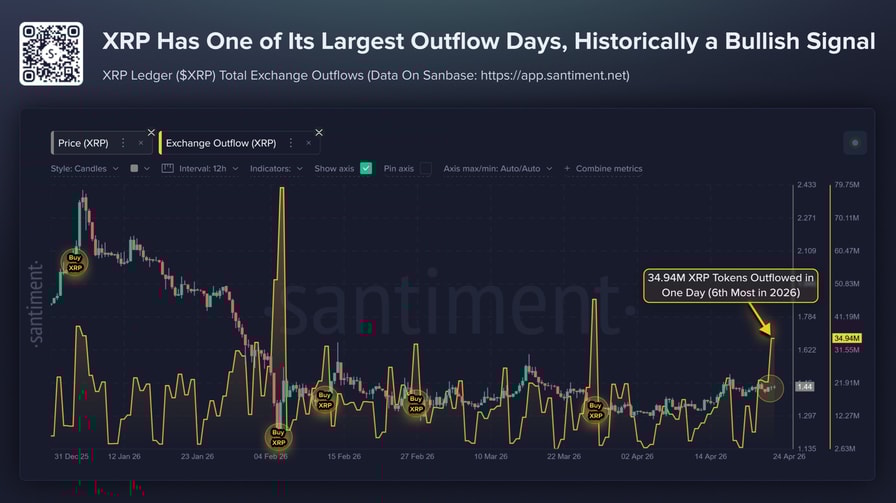
As of Saturday, XRP Ledger (XRPL) had recorded nearly 35 million XRP in exchange outflows in the last 24 hours, logging its sixth-largest daily outflow of the year, according to Santiment.
Large exchange outflows typically suggest investors are moving tokens into private wallets or custody, reducing the amount of XRP immediately available for sale. Earlier this year, these spikes preceded modest rallies in the XRP price.
XRP Ledger exchange outflows versus XRP price. Source: Santiment
In March, a similar spike in exchange outflows preceded a roughly 20% rebound in XRP. February’s outflow surge was followed by an even stronger move, with XRP rising about 48&–50%.
Those precedents strengthen the view that the latest withdrawal spike may lead to higher XRP prices in May.
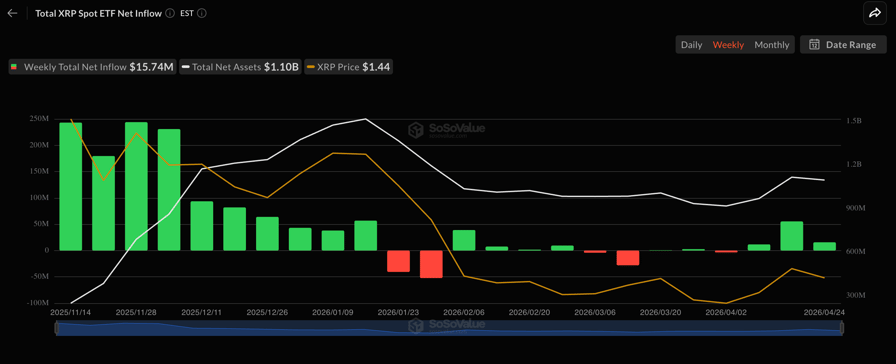
Also, US-based spot XRP ETFs have witnessed three consecutive weeks of net inflows, totaling about $82.88 million as of Saturday, according to SoSoValue data. The streak pushed the total assets under management to $1.1 billion.
XRP ETF weekly net flows. Source: SoSoValue
This indicates an increased institutional appetite for XRP products.
Positive whale flows reinforce upside sentiment
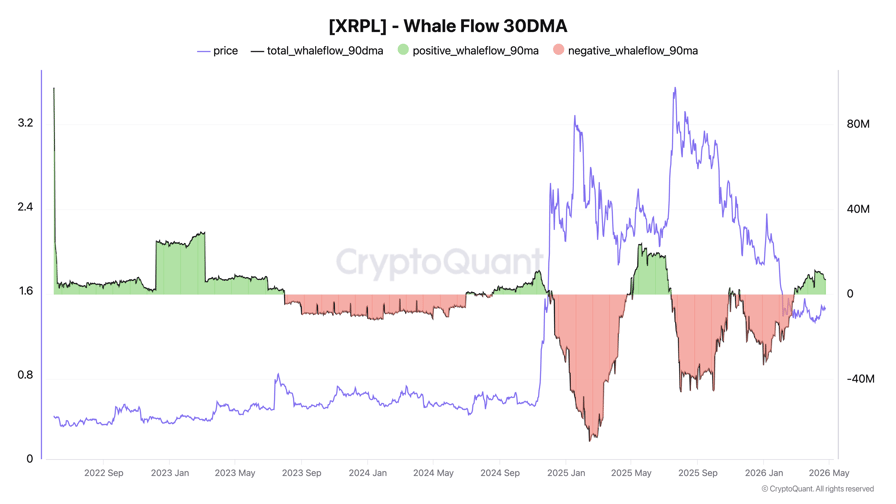
XRP whale flows have also flipped positive, according to CryptoQuant data, suggesting larger wallets are now accumulating rather than distributing.
The 90-day moving average of XRPL whale flows has moved back above zero after spending much of early 2026 in negative territory.
XRP whale flow 30DMA. Source: CryptoQuant
Historically, positive whale-flow regimes have preceded stronger XRP price trends, including the May–July 2025 rally.
The shift supports the broader accumulation narrative already visible in exchange outflows and ETF inflows.
XRP wedge setup hints at 30% rally next
XRP’s technical structure supports the upside case.
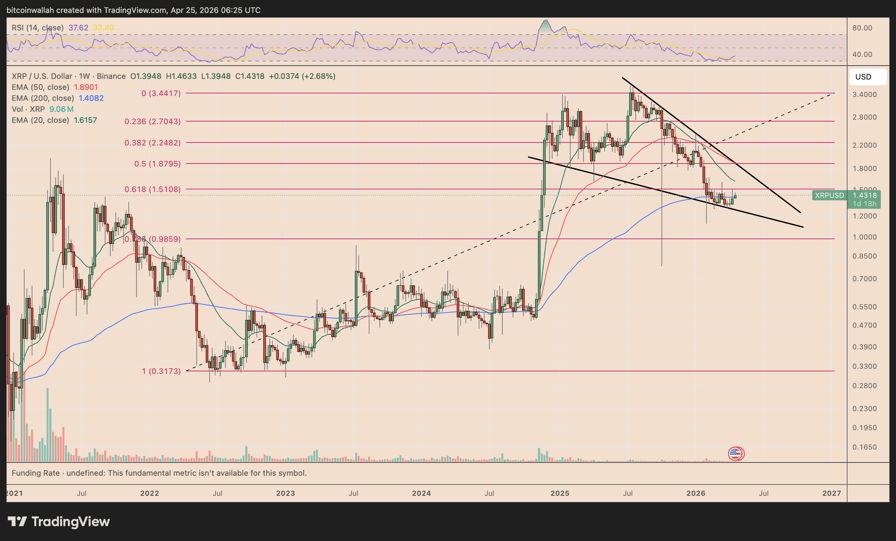
The XRP/USD pair has spent the past two years inside a falling wedge, defined by two downward-sloping, converging trend lines. Its April rebound from the lower trend line support now raises the odds of a move toward the upper boundary.
XRP/USD weekly chart. Source: TradingView
That target zone aligns with the 50-week EMA and the 0.5 Fibonacci retracement near $1.87–$1.89, about 30% above current levels, by June.
Related: XRP holders back in profit as price eyes potential 55% breakout
Conversely, a decisive break below the wedge’s lower trend line risks invalidating the bullish narrative altogether.
It may instead raise the odds of the price declining toward the $0.98 mark, aligning with the wedge’s apex point and the 0.786 Fib line.