Home Blog Page 42

Brazil’s B3 exchange introduces options on BTC, ETH, SOL futures

0

Brazil’s B3 stock exchange has unveiled options on bitcoin , ether (ETH) and solana (SOL) futures, expanding its regulated crypto derivatives offerings.

The contracts bec+ame available for trading on July 6, according to a B3 circular. They include call and put options on bitcoin futures denominated in Brazilian reais, while ether and solana futures are denominated in U.S. dollars.

The options settle into the underlying futures contracts, not the tokens themselves. B3 said the products do not involve custody, transfer or administration of spot cryptoassets.

The contracts trade independently from 9 a.m. to 6:30 p.m. local time, according to B3’s derivatives trading schedule. Exercise is automatic at expiration when the option finishes in the money, unless the holder blocks exercise.

The offering gives traders and asset managers a local venue to hedge crypto exposure, trade volatility and build structured positions without using offshore crypto options markets.

It adds another instrument to B3’s push into regulated crypto products, after the exchange moved to list bitcoin options and ether and solana futures and later prepared bitcoin-linked event contracts.

B3’s bitcoin futures contract is denominated in reais. Its ether and solana futures are denominated in U.S. dollars. All three reference Nasdaq crypto indexes, according to the announcement.

Singapore investment giant Temasek to shun crypto in pivot to AI

0

Singapore’s state-owned investment firm, Temasek Holdings, said it will prioritize AI investments over crypto due to regulatory uncertainty and the lingering impact of a $275 million write-off from the collapse of crypto exchange FTX in 2022.

The firm, with an investment portfolio valued around 518 billion Singapore dollars ($400 billion), plans to increase its AI exposure from 6% of its portfolio in the first quarter of 2026 to 15% by 2031, Nagi Hamiyeh, president of Temasek Global Investments, told CNBC on Wednesday The AI investment cycle has just begun and will continue for decades, he said, while cautioning that valuations in some parts of the industry have run ahead of fundamentals.

Temasek, the state’s largest investment vehicle after GIC Private Ltd., is still dealing with the hit it took following the collapse of FTX. That implosion and other failures exposed weak consumer protections in Singapore, prompting the central bank, the Monetary Authority (MAS), to swing toward stricter supervision, a move that resulted in higher compliance costs and slower licensing, among other challenges.

Bank of Japan may speed up rate hikes. Will it help or work against bitcoin?

0

The Bank of Japan (BOJ) may raise its benchmark interest rate rapidly this year, as the yen slides, eventually pushing it above 2%.

That’s the latest warning from a former Bank of Japan official Tsutomu Watanabe, an economics professor at the University of Tokyo who left the central bank in 1999, according to Bloomberg.

As of now, the official rate is at 1%, the result of recent hikes, and the 10-year benchmark government bond yield hovers above 2.8%, the highest in at least three decades, according to data source TradingView.

Meanwhile, the Japanese yen continues to slide despite recent hikes and hardening Japanese government bond yields. It has depreciated by 60% to 162.36 per U.S. dollar since early 2021, a major decline for one of the most traded currencies in the world. Also, it has dropped 3% so far this year.

Faster potential interest rate hikes by the BOJ may put a floor under the yen, or potentially lift it higher. The question then is whether it will help bitcoin or work against it.

Bitcoin and ether exchange supplies hit historic lows but a rally isn’t guaranteed (

0

“The under-covered angle is that this metric is documenting the end of the exchange-custody era,” Ben Nadareski, CEO of Solstice, said. The bigger story may not be lower exchange balances themselves, but where those assets are moving to.

“Assets are leaving trading venues for two destinations: regulated custody on one side, productive onchain positions on the other,” he said.

Moreover, the argument that bull runs always follow a steady decline in exchange balance is not necessarily true. For instance, in 2022, the supply on exchanges remained low, yet prices crashed hard.

HODLing is real

While the indicator may not be as dependable as before, it doesn’t change the fact that BTC is being accumulated by a variety of market participants in anticipation of a price increase.

“Over 130 public companies now hold bitcoin on their balance sheets, and spot ETFs have absorbed a growing share into regulated custody,” Zalan said.

According to Bitcoin Treasuries, public companies hold about 1,264,579 BTC, private ones 281,752, government entities 649,954, DeFi and other protocols 369,595, while ETFs and exchanges have 1,622,533. Its data also shows treasury companies hold about 7.252 million ETH.

Combined with nearly 7 million bitcoin in dormant wallets, a total of just under 11.2 million bitcoin sits outside active trade, which is about 56.5% of the currently circulating supply of roughly 20.05 million.

Bitcoin ETFs slip back to outflows while ether funds extend their streak

0

U.S. spot bitcoin ETFs lost a net $85 million on Wednesday, ending a three-day inflow run that had pulled in roughly $509 million, per SoSoValue data. Ether ETFs took in about $70 million the same day, a fifth straight session of inflows.

The bitcoin outflow was broad. BlackRock’s IBIT shed roughly $59 million, Grayscale’s GBTC lost nearly $64 million, and Fidelity’s FBTC gave up about $15 million.

Grayscale’s mini BTC fund was the only one in the green at nearly $53 million. Total bitcoin ETF assets fell to about $75 billion.

Ether’s flows came from a narrower base but kept pointing the same way. Fidelity’s FETH led with roughly $69 million, with VanEck’s ETHV adding just over $1 million and every other fund flat. Ether ETF assets sit at about $9 billion.

The split matches the price tape. Bitcoin traded near $62,300 and ether near $1,740, both down about 3% on the day, though ether has outperformed over the past two weeks as the Lean Ethereum roadmap and returning ETF demand gave it a story bitcoin has lacked.

Crypto Protocols Must Reaudit Old Smart Contracts, Experts Warn

0

Blockchain security experts are urging crypto protocols to reaudit their smart contracts as AI tooling is making it easier for hackers to identify vulnerabilities more quickly than ever before. 

“Our data argues for continuous review rather than a one-time audit,” TRM Labs head of policy Ari Redbord told Cointelegraph, adding that “attack techniques are moving faster than a single audit from launch day can account for.”

“An audit built for last year’s attack patterns leaves a protocol exposed to this year’s as bad actors are changing up.”

CertiK reported Monday that hackers stole another $1.32 billion in the first half of 2026 and have adopted increasingly sophisticated strategies in response to strengthened security measures across the industry.

One of those strategies has been to revisit old codebases, CertiK said, adding that the attackers’ efforts have likely been “aided by improved automated tooling for identifying latent vulnerabilities at scale.”

One of the most recent incidents involved privacy-focused blockchain Zcash, where Shielded Labs security engineer Taylor Hornby found a major security vulnerability using a custom auditing agent powered by Anthropic’s Claude Opus 4.8. The bug has since been patched.

The security vulnerability, which existed for four years, could have enabled undetectable counterfeiting inside the Orchard shielded pool, one of the network’s key privacy features.

“The window of maximum vulnerability does not close after launch,” CertiK warned. “Projects operating legacy infrastructure should treat reauditing as a recurring operational requirement rather than a one-time exercise conducted at deployment.”

In December, Anthropic conducted a study finding that AI agents found $4.6 million worth of exploitable vulnerabilities in smart contracts. Meanwhile, there is more than $72.3 billion worth of crypto locked across hundreds of DeFi protocols, giving hackers plenty of incentive to exploit vulnerable smart contracts.

SlowMist’s estimate of total crypto losses from blockchain hacks. Source: SlowMist

Defunct crypto protocols targeted

On June 14, hackers exploited a smart contract vulnerability to steal $2.1 million from the Aztec Connect, which had been shut down since March 2023.

Five days later, a smart contract on the decentralized exchange mySwap was exploited for $300,000, even after the mySwap user interface had been closed to new liquidity deposits for more than six months.

A more fortunate event took place in May, when a white hat, known as “0xflorent,” helped recover 1,003 Ether (ETH) worth over $1.72 million from 48 investors involved in the Hong Coin (HONG) initial coin offering in 2016.

Related: ‘All DeFi unsafe’ claim sparks AI security debate after April hack surge 

The ICO failed to launch after missing its funding target, and the funds remained locked in the smart contract due to a bug in the auto-refund function. 

Reaudits only part of the equation, TRM says

The work doesn’t stop with hardening the codebase and infrastructure, Redbord said, explaining that the broader industry and regulators need to continue finding ways to mitigate malicious cyberactivity from North Korea and disrupt Chinese money laundering networks:

“Protocols can lock their doors, but someone still has to go after the actor breaking in.”

Features: DeFi hacks shake institutional confidence as risks outpace yields 

Bitcoin, ether steady, gold falls as US-Iran strikes escalate

0

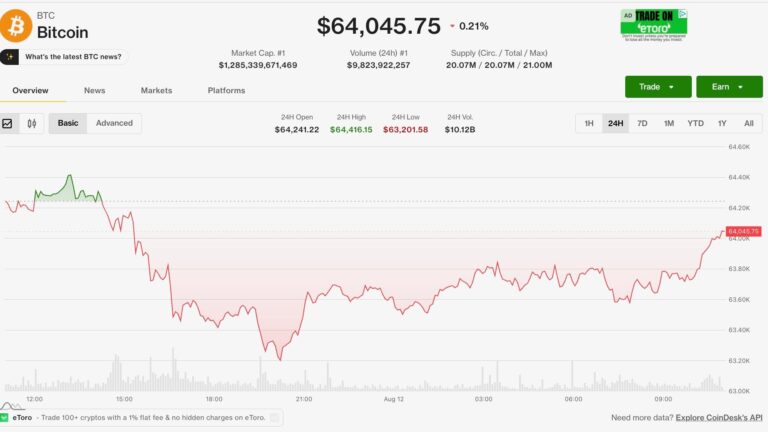
Bitcoin held above $62,000 on Thursday while the assets that are supposed to absorb a war premium moved in opposite directions.

Brent crude climbed 1% to $78.80 a barrel, a third consecutive session of gains, after the U.S. military completed another round of strikes against Iran and both sides raised the prospect of closing the Strait of Hormuz.

Gold extended its slide to a fourth day at around $4,060 an ounce. Government bonds in Japan, Australia and New Zealand fell, extending Wednesday’s global selloff, with two-year Treasury yields pushing toward their 2026 high.

Bitcoin traded at $62,009, down 1.2% over 24 hours and up 1.6% on the week. Ether was at $1,730, also off 1.2% on the day but up 5.7% over seven sessions. Solana was the laggard at $77.25, shedding 1.8% and 1.7% on the week. XRP slipped 0.7% to $1.09, TRON added 4% over seven days, and hyperliquid’s HYPE gained 5.9% on the week despite a 1.2% daily dip.

The escalation reignited inflation concerns and pulled forward rate expectations.

Why traders eye this long-term breakout setup in Ripple-linked token

0

• Volume during that move reached 688,000 XRP, about 120% above the session average, before momentum faded.

• Earlier selling took XRP to a session low near $1.0742 after volume rose to 80.2 million, about 83% above the 24-hour average.

Technical Analysis

• The key development is that XRP continues to defend the $1.00-$1.05 support zone, which analysts say aligns with longer-term moving average and trendline support.

• The near-term chart remains weak despite the small bounce. Lower highs at $1.1133, $1.0993 and $1.0932 show sellers are still capping recovery attempts.

• XRP needs to hold above $1.088-$1.091 to build a cleaner move toward $1.093-$1.095.

• The larger setup remains a compression trade rather than a breakout. Monthly wedge and channel patterns may point to higher targets, but confirmation requires a sustained move above nearer resistance first.

• Relative weakness against bitcoin remains a risk, with the XRPBTC pair testing support near 1,700 sats.

What traders should watch

• $1.00-$1.05 remains the key support zone. Losing it would put $0.90 and then $0.80 back in focus.

• $1.088-$1.091 is the immediate resistance area after capping the latest breakout attempt.

• $1.20-$1.25 is the next major zone, where candle resistance and the 100-day moving average sit.

• A move above $1.40 would be the first stronger sign that XRP is breaking out of its broader compression.

SpaceX Nasdaq-100 Entry Brings Bitcoin Exposure To Passive Index Investors

0

Today (July 7, 2026) SpaceX formally joins the Nasdaq-100 Index. The inclusion comes just weeks after the company’s public debut and follows its disclosure of 18,712 BTC on the balance sheet. JPMorgan estimates that index rebalancing will drive approximately $4.3 billion in passive inflows from Nasdaq-100-tracking funds and ETFs.

This development is more than headline news. It creates a structural, rules-based channel for institutional capital to gain exposure to Bitcoin through a corporate treasury vehicle, without requiring active allocation decisions, new mandates, or direct cryptocurrency purchases.

For corporate treasury teams, capital allocators, and institutional investors evaluating Bitcoin on balance sheets, the move provides a clear data point on how the strategy can intersect with mainstream equity infrastructure.

The Mechanics of Structural Demand

Passive index funds and ETFs must hold securities in proportion to their index weighting. When a new component is added, these vehicles buy shares mechanically. In SpaceX’s case, the estimated $4.3 billion in inflows represents capital that will flow into the stock regardless of short-term views on Bitcoin or the broader crypto market.

SpaceX’s Bitcoin holdings, disclosed in regulatory filings at approximately $1.2 billion in fair value, now sit within one of the most widely held equity indices globally. This is distinct from direct Bitcoin ETF flows or voluntary corporate purchases. It is demand generated by index rules rather than discretionary conviction.

Combined with Tesla and Strategy, the Nasdaq-100 now contains three companies with material Bitcoin treasuries. While SpaceX’s initial weighting will be modest, the precedent matters: high-growth, high-visibility companies can bring Bitcoin exposure into institutional equity portfolios through existing governance and allocation frameworks.

Strategic Implications for Treasury and Allocation Decisions

Corporate Bitcoin strategies have historically been evaluated on two primary dimensions: balance sheet optionality and long-term value preservation. SpaceX’s inclusion introduces a third dimension, potential for structural equity demand tied to index membership.

For treasury operators, this suggests that Bitcoin holdings, when paired with strong underlying business fundamentals, can contribute to broader market visibility and liquidity. Index inclusion often correlates with increased analyst coverage, improved trading volumes, and easier access to capital markets.

For institutional allocators, the development offers a form of Bitcoin beta that fits within traditional equity sleeves. Many large investors already maintain significant Nasdaq-100 exposure through passive mandates. SpaceX’s addition layers incremental Bitcoin exposure into those portfolios without requiring changes to investment policy statements or new product approvals.

This aligns with patterns observed across the corporate treasury landscape. Public companies now collectively hold more than 1.26 million BTC. The strategy is expanding beyond dedicated Bitcoin-focused entities into diversified operating businesses. SpaceX’s move illustrates how the approach can scale into the core of institutional equity markets.

Hypothetical Case Study: Modeling Indirect Bitcoin Demand

To illustrate the mechanism, consider a simplified hypothetical involving a public company that adopts a Bitcoin treasury strategy and later gains meaningful index attention.

Assumptions (illustrative only):

  • Company market capitalization: $12 billion
  • Bitcoin holdings: 8,000 BTC at $63,000 per BTC = $504 million
  • Bitcoin as a percentage of market cap: ~4.2%
  • The company is added to a major equity index, triggering $800 million in passive inflows over time (scaled-down version of larger index events for clarity)

Step-by-step impact:

  1. Passive funds purchase $800 million of the company’s stock to match index weighting.
  2. Because Bitcoin represents 4.2% of the company’s enterprise value in this example, roughly $33.6 million of the passive inflows can be viewed as indirectly supporting the Bitcoin portion of the balance sheet ($800M × 4.2%).
  3. At current prices, this equates to approximately 533 BTC of effective demand created through equity market mechanics rather than direct cryptocurrency purchases.
  4. If the company’s Bitcoin holdings generate ongoing yield or optionality (through lending, collateralization, or strategic use), the passive capital provides a form of “free” liquidity support to the treasury strategy.

While the numbers are simplified and depend on actual market cap, weighting, and Bitcoin valuation at the time of inclusion, the directional point is clear: index membership can create sustained, non-discretionary buying interest that benefits the Bitcoin component of the balance sheet proportionally.

Treasury teams evaluating this path should model similar scenarios using their own projected holdings, target market capitalization, and relevant index weighting assumptions. The exercise highlights how Bitcoin treasury decisions can interact with traditional equity market dynamics in ways that pure cryptocurrency allocations do not.

Looking Ahead

SpaceX’s Nasdaq-100 entry is one data point in a broader evolution. Corporate Bitcoin adoption is moving from early experimentation toward integration with established financial infrastructure. Passive flows, index rules, custody solutions, and regulatory clarity are all contributing to this shift.

For organizations actively building or evaluating Bitcoin treasury capabilities, developments like this reinforce the importance of treating Bitcoin as a strategic balance sheet asset with multiple potential transmission channels into institutional capital markets.Key questions for treasury and allocation teams to consider:

  • How would index inclusion (or the potential for it) factor into your company’s capital allocation framework?
  • What disclosure and governance standards are becoming necessary as Bitcoin treasuries intersect with passive equity vehicles?
  • For allocators: Does exposure through high-quality corporate treasuries warrant a distinct analytical lens alongside direct Bitcoin or ETF holdings?

The corporate Bitcoin strategy continues to mature. Events that embed Bitcoin exposure within widely tracked equity indices represent one of the more durable forms of institutional adoption currently unfolding.

Disclaimer: This content was prepared on behalf of Bitcoin For Corporations for informational purposes only. It reflects the author’s own analysis and opinion and should not be relied upon as investment advice. Nothing in this article constitutes an offer, invitation, or solicitation to purchase, sell, or subscribe for any security or financial product.

Reserve Bank of India (RBI) still favors crypto prohibition amid tax evasion fears

0

Tax authorities, meanwhile, are concerned about widespread underreporting. In the financial year ended March 2023, fewer than a quarter of the 645,000 individuals who transacted in crypto actually declared those gains on their tax returns.

Transactions executed on offshore exchanges and peer-to-peer platforms, especially those denominated in rupees, remain difficult to track, trace and tax.

Indian crypto investors have been operating in a regulatory grey zone since the Supreme Court struck down the RBI’s 2018 ban. It is neither outright illegal nor clearly regulated. A 2021 draft bill to ban private cryptocurrencies was never presented and policy discussions have been repeatedly delayed.

While the government has spoken of balancing innovation with risk management, the latest internal documents suggest key agencies are still not ready to embrace digital assets.

India’s reluctance can partly be explained by its heavy dependence on energy imports and persistent current account deficits. The fragility of this position was recently exposed when tensions with Iran drove oil prices higher, inflating the energy import bill and pushing the rupee to record lows. Authorities are concerned that widespread crypto adoption could accelerate capital outflows, bypassing traditional banking channels and worsening the external deficit.