
Council Speaker Julie Menin sent letters to four companies offering prediction market services to New Yorkers as part of an investigation into their marketing practices.

Council Speaker Julie Menin sent letters to four companies offering prediction market services to New Yorkers as part of an investigation into their marketing practices.
On April 14, Goldman registered the Goldman Sachs Bitcoin Premium Income ETF with the SEC, proposing a structurally similar covered-call product. Balchunas was blunt about what Wednesday’s deal means for that filing.
“Nowww I get why GS never launched the BTC covered call product they filed months ago,” Balchunas wrote. “Better to leapfrog BlackRock’s $BITA vs me too?”
One senior ETF analyst, who asked not to be named, said the deal reflects Goldman’s push to build out its ETF business broadly, noting that BTCI is one of almost 20 funds in the NEOS lineup. “If anything, it shows that bitcoin is just part of the financial world, alongside stocks, bonds, etc.” As of June 30, 2026, Goldman Sachs Asset Management, Innovator from Goldman Sachs Asset Management and NEOS manage more than $130 billion in ETF assets under supervision (AUS), according to the Wall Street bank’s statement.
BlackRock released its own bitcoin income ETF, BITA, on Nasdaq on June 16, about two months ahead of Goldmine’s filing. BITA targets a 15-25% annual yield and sells covered calls on 25-35% of its IBIT holdings. Its expense ratio is 0.65%.
BTCI charges 0.99% and is down 42.55% over the past year, with shares falling from a 52-week high of $65.87 to around $28.40, according to Bloomberg terminal data shared by Balchunas on X. According to the fund’s SEC prospectus, BTCI’s distributions may in part represent a return of capital rather than net investment income, a distinction income investors should weigh.

Just a day after real-time flight tracking website FlightAware filed a lawsuit against prediction markets platform Kalshi over use of its name and data, the flight data company gave notice of voluntary dismissal of the case.
In a Tuesday filing in the US District Court for the Southern District of New York, attorneys for FlightAware said that they had voluntarily dismissed the case against Kalshi. The flight tracking company had filed the lawsuit a day earlier, claiming that Kalshi had used its “data and name to run gambling markets on flight cancellations.”
While the immediate turnaround could suggest a closed-door settlement, neither company had publicly commented on the case as of Wednesday. On Tuesday, a judge ordered Kalshi to show cause why the court should not issue a temporary restraining order over FlightAware’s trademark and data.
Notably, at least one event contract showed that Kalshi had changed its language from “FlightAware“ to “Primary Source Agency” as the entity responsible for verifying data related to the outcome of flight cancellations, including that the trade did not “indicate an endorsement of this product or any affiliation” between FlightAware and Kalshi. Primary Source Agency linked to FlightAware’s website. Cointelegraph reached out to the companies for comment but did not receive an immediate response.
Side-by-side comparison of event contract citing FlightAware data before the lawsuit was dropped (left) and after (right). Source: Kalshi
Related: Kalshi launches sports and crypto perps data feed on DoubleZero
FlightAware’s suit had alleged trademark infringement, breach of contract, injury to its reputation and unfair competition in the latest legal action involving prediction market companies. Kalshi, Polymarket and other prediction market companies face legal action brought by many US state gaming authorities and regulators over alleged illicit sports betting offered to residents.
On Tuesday, the US Commodity Futures Trading Commission (CFTC), whose chair Michael Selig has repeatedly claimed the agency has “exclusive jurisdiction“ over prediction markets, said it had invoked “emergency authority“ to block New York state officials’ attempts to seek a temporary restraining order prohibiting the company from offering event contracts nationwide. The action followed New York authorities filing a lawsuit against Kalshi in July, alleging that the company was operating an unlicensed gambling platform through its contracts on sports and other events.
The CFTC decision echoed the agency’s actions in a Michigan case over Kalshi. In June, a Michigan judge ordered the company to stop offering sports betting contracts to residents until the civil case reached a conclusion. However, the CFTC under Selig ordered Kalshi not to comply with the state order — something the company’s head of enforcement and legal counsel said put it in an “impossible position“ between US state and federal orders.
Magazine: El Salvador’s Bitcoin experiment turns 5: ‘It was for us, not them’
The Bank of England’s Digital Pound Lab has tested how privately issued stablecoins and central bank digital money could handle different parts of the same cross-border trade transaction.
The experiment is part of Phase 2 of the central bank’s Digital Pound Lab. NOBO Finance worked with Dun & Bradstreet and Polygon Labs on the use case, according to details released by the consortium on Wednesday.
The Bank had already named the three firms as Phase 2 participants on June 25. The latest disclosure provides more detail on what their experiment was designed to test.
The central idea is a multi-rail trade-finance transaction.
Under the proposed flow, an exporter receives an advance through a stablecoin rail. The UK importer then makes the final settlement using simulated digital pounds, combining private digital money and central bank money within the same transaction workflow.
No real payments were made.
The Digital Pound Lab is a simulated environment and is not a regulatory sandbox. It involves neither real customers nor real money, according to the Bank of England.
It’s worth noting because the experiment demonstrates a possible architecture rather than proving that the model is ready for commercial deployment.
The trade-finance experiment extends work NOBO conducted during the first phase of the Lab.
NOBO was one of four Phase 1 participants, where it worked with Applied Blockchain. Phase 1 examined potential digital-pound applications using building blocks including programmability, verifiable credentials and common standards.
Phase 2 adds Polygon’s blockchain infrastructure and Dun & Bradstreet’s commercial data.
One workstream focuses on invoice factoring backed by an electronic bill of lading, or eBL. An exporter could use the invoice to obtain financing, with the advance settled over the stablecoin network before the importer completes the transaction using digital pounds.
Polygon supports the stablecoin side through its Open Money Stack, which includes blockchain settlement, wallets and fiat on- and off-ramp infrastructure. Polygon currently reports about $2.7 trillion in cumulative transfer volume across its network.
The arrangement effectively separates payment speed from the final settlement asset.
“For digital money to actually move the world’s trade, its different forms have to work together, public and private, central bank money and stablecoins,” Polygon Labs CEO Marc Boiron said in a statement shared with AlexaBlockchain.
“This experiment tests exactly that, an exporter paid instantly in stablecoins while the importer settles in a digital pound, in a single flow,” Marc added.
The second part of the project tackles a different trade-finance bottleneck: determining whether a small business is creditworthy.
NOBO, Dun & Bradstreet and Polygon are testing an “SME Bankable Profile” that combines transaction information, open-finance data and commercial risk information.
The goal is to create a reusable credit profile rather than forcing a company to repeat much of the verification process whenever it seeks financing.
Dun & Bradstreet supplies commercial intelligence and risk indicators, while Polygon provides smart-contract infrastructure for consent and the transaction lifecycle.
“Trade finance is multi-party by nature, but the workflows, data, and settlement paths still don’t connect cleanly,” NOBO founder and CEO Ayo Ojerinola said.
“The Digital Pound Lab gives us a safe environment to test our innovations, improving coordination across participants, and transforming how cross-border trade actually works today.”
The experiment points to a potentially more consequential role for a digital pound than simply creating another way for consumers to pay.
It tests whether central bank money could act as the settlement anchor while private digital-money networks provide additional functionality and faster movement of funds.
That broadly aligns with the Bank of England’s emerging approach to a “multi-money” system rather than one in which a digital pound replaces private alternatives. The Bank’s recently finalised framework for systemic sterling stablecoins, for example, stresses interoperability and direct access to payment systems so stablecoin redemption can ultimately settle in central bank money.
That interoperability could be particularly useful for trade finance because payment is only one part of the problem.
Invoices, identity checks, credit decisions, shipping documentation and settlement can sit across different systems. Bringing them into a coordinated digital workflow could shorten the period in which an exporter has shipped goods but is still waiting for cash.
The UK’s legal framework has also moved in that direction. The Electronic Trade Documents Act 2023 gave qualifying electronic trade documents, including electronic bills of lading, the same legal effect as their paper equivalents.
The Bank of England is not alone in exploring how public and private forms of digital money can coexist.
The BIS-led Project Agorá is testing a shared infrastructure that connects tokenised commercial-bank deposits with tokenised central-bank reserves for cross-border transactions.
In July, 28 financial institutions and central banks conducted real-value transactions worth about CHF 800,000 across 17 scenarios. The BIS said the exercise demonstrated the feasibility of settling transactions using tokenised deposits and reserves on a programmable multi-currency platform.
Hong Kong has followed a related path. Its e-HKD experiments found that a retail CBDC and tokenised deposits could potentially support programmable and more efficient transactions, while Project Ensemble is developing infrastructure for tokenised assets and money.
The approaches differ, but they share a common premise: the future payment system may contain several forms of digital money that need to operate together rather than one rail replacing all the others.
None of the experiments mean Britain has decided to issue a digital pound.
The Bank of England and HM Treasury remain in the design phase, which is due to end in 2026. The work underway now will feed into a joint assessment of whether the UK should proceed to a further development stage.
Even if policymakers decide to move forward, a digital pound could not be introduced without primary legislation approved by Parliament.
Phase 2 itself has concluded, and the Bank has said it plans to publish further findings from both phases.
The trade-finance experiment therefore provides evidence for a larger policy question.
If Britain eventually introduces a digital pound, the more important issue may not be whether it can compete with stablecoins, but whether central bank money, private digital currencies and commercial financial infrastructure can settle transactions across the same economic workflow without recreating the fragmentation they are intended to remove.
The above article “Bank of England Tests Stablecoins and Digital Pound in the Same Cross-Border Trade Flow” was first published on AlexaBlockchain. Read the complete article here: https://alexablockchain.com/bank-of-england-tests-stablecoins-and-digital-pound-in-the-same-cross-border-trade-flow/
Read Also: This is the First U.S.-Chartered Depository Bank to Offer Stablecoin Invoicing
Disclaimer: The information provided on AlexaBlockchain is for informational purposes only and does not constitute financial advice. Read complete disclaimer here.

Crypto market maker Wintermute plans to invest about $1 billion in high-frequency trading and artificial intelligence data-center infrastructure over five years as it expands into stocks, commodities and foreign exchange.
The London-based firm wants non-crypto markets to generate more than 50% of revenue by the end of 2027, up from 10% now, according to a Bloomberg report citing founder and CEO Evgeny Gaevoy. Wintermute expects to fund the spending with retained earnings.
The push follows a drop in crypto activity. Wintermute’s average daily trading volume fell to about $10 billion this year from $15 billion in 2025 as bitcoin declined to roughly half its October peak above $126,000.
Institutions accounted for a record 72% of spot trading volume on its over-the-counter desk in the first half of 2026.
Gaevoy said the privately held company was profitable in 2025 and expects to remain profitable this year, without providing figures. Wintermute recorded $582 million in profit during the 2021 crypto bull market, according to Forbes.
Bitget is committing $300 million to quantitative trading firms, asset managers and market makers, escalating competition among crypto exchanges to attract the institutions that supply liquidity and trading volume.
The crypto exchange unveiled Project Archimedes, a capital program that combines direct allocations with interest-free loans. Bitget said it aims to support more than 50 trading projects over the next six months.
The program shifts the traditional exchange incentive model beyond trading-fee rebates by putting Bitget’s own capital behind outside trading strategies.
Of the total, $100 million will be allocated through a Capital Provider Program aimed at emerging and growing quantitative firms running market-neutral strategies. Bitget will provide capital while returns are shared under an agreed structure and risk framework, according to the company.
Another $200 million has been earmarked for interest-free lending to more established institutions.
To qualify for those loans, firms will have to satisfy specified trading-volume or position requirements. That links the financing benefit directly to activity on the exchange, potentially giving institutions cheaper funding while giving Bitget additional trading flow and liquidity.
“Strong strategies often reach a point where talent is no longer the constraint but capital might,” Bitget CEO Gracy Chen said in a statement shared with AlexaBlockchain.
“Project Archimedes gives capable teams the acceleration it needs to scale, while aligning capital, risk and execution around sustainable performance. Our goal is to boost over fifty projects in the next six months with this capital,” Gracy added.
The program underscores how competition among crypto exchanges is increasingly moving from retail acquisition toward the economics of professional trading.
Market makers and quantitative funds are particularly valuable to exchanges because their activity can deepen order books and tighten bid-ask spreads. Greater liquidity can, in turn, improve execution for other traders.
Major rivals already use combinations of rebates, lending and infrastructure to court those firms.
Binance operates liquidity programs offering fee incentives and institutional loans. Its institutional lending product allows qualifying clients to receive back all interest charged on loans of as much as $10 million when they meet monthly trading-volume targets.
Bybit similarly combines market-maker incentives with institutional lending. Its lending service offers borrowing starting at the equivalent of 1 million USDT and leverage of as much as five times for eligible institutional traders.
Bitget has experimented with the model before.
In November 2025, the exchange offered qualified institutional participants loans of as much as 2 million USDT interest-free if they satisfied reduced trading-volume requirements, in an initiative intended to encourage liquidity in altcoin markets.
Project Archimedes expands that approach considerably.
The more notable addition is the $100 million Capital Provider Program. Rather than simply lowering the financing cost for established traders, Bitget would supply capital to qualifying strategies and participate in their returns.
That creates a closer economic relationship between the exchange and the firms trading on it.
The timing also reflects how the economics of quantitative crypto trading are evolving.
Market-neutral firms typically try to capture relative pricing discrepancies rather than take outright bets on whether an asset will rise or fall. Strategies can include spot-versus-futures basis trades, differences in perpetual-futures funding rates and arbitrage between trading venues.
As markets become more efficient, execution costs, financing and the amount of collateral required to maintain both legs of a position can materially affect returns.
Recent academic work on perpetual markets illustrates that funding costs are not merely incidental to market making: inventory exposure and funding payments interact directly with trading performance and risk.
That makes cheaper capital a competitive tool for exchanges.
Bitget is pairing the financing program with its Unified Trading Account, which allows spot, futures and margin positions to share a pool of funds rather than requiring assets to be moved between separate trading accounts.
Tokenized equities are one area where Bitget is trying to apply that structure.
The exchange added selected tokenized US stocks and exchange-traded funds as eligible margin assets in June, allowing qualifying users to retain those positions while using them as collateral for futures trading.
That can matter for arbitrage strategies requiring simultaneous positions across spot and derivatives markets.
Instead of dedicating separate pools of capital to both legs, eligible traders can use supported tokenized-stock holdings as collateral for derivatives positions. Bitget says weekend collateral values use the underlying US security’s Friday closing price while traditional stock markets are shut.
The arrangement does not eliminate risk. Leveraged market-neutral strategies can still face liquidations, basis changes, funding-rate reversals and counterparty exposure even when their intended directional exposure is limited.
Bitget said the first phase of Project Archimedes will concentrate on market-neutral strategies with operating histories and measurable risk controls.
Applicants will undergo strategy assessment, due diligence and drawdown reviews, according to the company. Admissions will remain open on a rolling basis, with capital deployed in stages.
Some economically important details have not yet been publicly specified, including how much an individual participant can receive under the $100 million allocation pool, the precise return-sharing arrangements and the thresholds institutions must meet for interest-free financing.
Those terms will help determine how aggressive the program actually is.
Bitget said it plans to disclose participation numbers, capital deployed and the distribution of strategies over time.
The above article “Bitget Launches $300M Project Archimedes for Quant Trading Firms” was first published on AlexaBlockchain. Read the complete article here: https://alexablockchain.com/bitget-launches-300m-project-archimedes-for-quant-trading-firms/
Read Also: This is the First U.S.-Chartered Depository Bank to Offer Stablecoin Invoicing
Disclaimer: The information provided on AlexaBlockchain is for informational purposes only and does not constitute financial advice. Read complete disclaimer here.
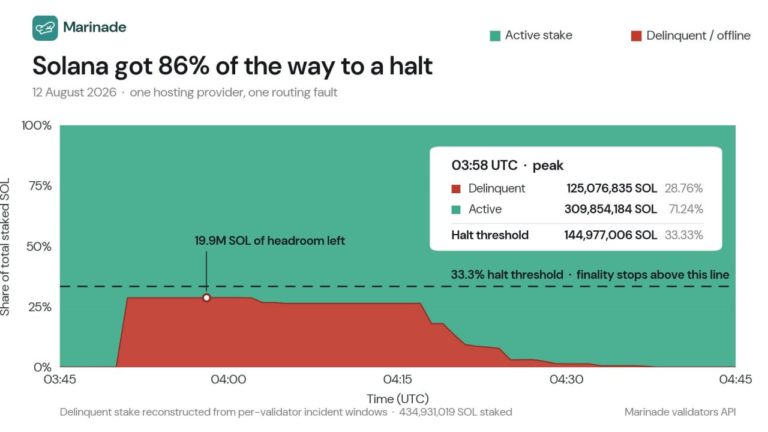
The latest issue started with a bad internet route from Teraswitch’s Miami facility that then spread to data centers across Europe and Asia, cutting off validators in London, Amsterdam, Frankfurt, Singapore and Tokyo. North America stayed online. The company fixed the issue in about 10 minutes, and traffic was flowing again by 4:16 a.m. UTC.
One single network operator, identified as AS2032, controlled more than a quarter of all the tokens people had locked up to secure the network, which was more than the Solana-prescribed safety limit. Almost all of those tokens went offline at the same time. Other companies lost another 14 million tokens in the same short period. Most of the affected validators, including the big one called Helius, stayed offline for the full 33 minutes because their backup systems never switched on.
This whole event is a clear warning: if more than one-third of the network’s tokens ever go offline at once, the entire blockchain freezes for every single person holding SOL, and there is no quick way to fix the bigger damage that would follow.

Fidelity plans to add staking to its Ether fund, with 85% of rewards retained by FETH and quarterly cash distributions planned for investors.

Global, Aug 12, 2026 — Bitget, the world’s largest Universal Exchange (UEX), has released its latest Protection Fund report, showing an average valuation of $351 million in July 2026 as Bitcoin recovered through July, lifting the fund’s U.S. dollar valuation.
The Protection Fund reached a monthly high of $365.9 million on July 21 and recorded a monthly low of $329.8 million on July 1. Throughout July, the fund maintained a valuation above its original $300 million commitment, with reserves supported by Bitget’s 5,500 BTC holdings as Bitcoin traded between $59,968 and $66,521 during the month.
July saw digital asset markets regain momentum after June’s broad correction, with Bitcoin recovering steadily through the first three weeks of the month before easing toward month-end. The appreciation in BTC contributed to a higher average valuation for Bitget’s BTC-denominated Protection Fund, which remained approximately 17% above its original $300 million allocation throughout the month.
Established in 2022, the Protection Fund serves as an additional layer of protection designed to safeguard user assets during extreme market events. The fund’s valuation is published transparently and updated regularly, providing users with clear visibility into available reserves as market conditions evolve.
“Market direction may change, but user protection shouldn’t,” said Gracy Chen, CEO of Bitget. “Our Protection Fund is designed to give users confidence in every market environment. By maintaining substantial onchain reserves and publishing their value regularly, we’re reinforcing transparency as a long-term trust across our platform.”
The Protection Fund operates alongside Bitget’s Proof of Reserves (PoR), which maintains reserves exceeding user assets across major holdings. Together, these measures form part of the exchange’s broader security architecture, combining verifiable asset backing with an additional reserve pool designed to support users during unexpected incidents.
The latest update comes as Bitget continues expanding its Universal Exchange ecosystem across crypto assets, tokenized stocks, commodities, and other financial markets. As users increasingly trade across multiple asset classes within a single platform, maintaining transparent and verifiable safeguards remains a core component of the exchange’s risk management framework.
For real-time tracking of the Protection Fund, please visit here.
Bitget is the world’s largest Universal Exchange (UEX), serving over 125 million users and offering access to over 2M crypto tokens, 500+ tokenized stocks, ETFs, commodities, FX, and precious metals such as gold. The ecosystem is committed to helping users trade smarter with its AI agent, which co-pilots trade execution. Bitget is driving crypto adoption through strategic partnerships such as MotoGP™. Aligned with its global impact strategy, Bitget has joined hands with UNICEF to support blockchain education for 1.1 million people by 2027. Bitget currently leads in the tokenized TradFi market, providing the industry’s lowest fees and highest liquidity across 150 regions worldwide.
Risk Warning: Digital asset prices are subject to fluctuation and may experience significant volatility. Investors are advised to only allocate funds they can afford to lose. The value of any investment may be impacted, and there is a possibility that financial objectives may not be met, nor the principal investment recovered. Independent financial advice should always be sought, and personal financial experience and standing carefully considered. Past performance is not a reliable indicator of future results. Bitget accepts no liability for any potential losses incurred. Nothing contained herein should be construed as financial advice. For further information, please refer to our Terms of Use.
Source: Bitget
The above article “Bitget Protection Fund Reports $351M Average Valuation in July as Bitcoin Recovery Strengthens Reserves” was first published on AlexaBlockchain. Read the complete article here: https://alexablockchain.com/bitget-protection-fund-reports-351m-average-valuation-in-july/
Submit Your Blockchain and Crypto Press Release here.
Disclaimer: This is a press release, provided by the company/ company representative. AlexaBlockchain does not endorse, guarantee, or accept responsibility for the content, accuracy, quality, advertising, products, or other materials presented in this publication. Readers are advised to conduct their own due diligence before taking any actions related to the company mentioned herein. AlexaBlockchain expressly disclaims any liability for damages or losses, whether direct or indirect, arising from or related to the use of or reliance on any content, goods, or services referenced in this press release.

According to a Fortune article in July, Kalshi decided to pause flight cancellation contracts, after social media users expressed concerns over malicious actors causing flight cancellations to collect payouts. And according to Kalshi data, retail participation in the niche aviation series has been modest. For the U.S. flight cancellation bet currently open until Aug. 14, the data reveals only 31,412 total contracts traded, representing $1,842.48 in aggregate dollar volume and only 1,120 contracts held in open interest. The low liquidity here stands in stark contrast with Kalshi’s $148 billion in volume this year alone, that same data shows.
The filing does not state whether the companies reached an agreement or whether Kalshi changed its markets or their settlement source.
Kalshi and FlightAware were contacted via email for comment but neither responded immediately.
FlightAware had accused Kalshi of using its flight data and a trademark without permission to run bets on airline cancellations. The flight tracking firm was seeking damages and an injunction over contracts that allowed users to trade on the percentage of flights canceled nationally or at specific airports.
Kalshi had denied violating FlightAware’s license or infringing its trademark, according to the original complaint. It said its references to FlightAware constituted nominative fair use. The platform had also identified U.S. Department of Transportation flight data as an alternative source for settling the contracts, according to FlightAware’s complaint.