Hyperliquid has published the fee structure for its outcome tokens, the assets that underpin prediction market-style trading on the platform, in a sign that a mainnet launch is getting closer.
Prediction markets have become one of crypto’s fastest-growing areas, with trading volume surging more than 300% in 2025 to $63.5 billion, and Hyperliquid is building the infrastructure to compete with incumbents such as Kalshi and Polymarket.
The key detail in the structure is that opening a position costs nothing. Fees only apply when closing or settling a trade. The document outlines six scenarios covering minting, trading, burning and settlement.
Traders using Hyperliquid’s “aligned quote tokens” get better rates, with taker fees 20% lower and maker rebates 50% higher than standard. The full fee formula has been published for developers.
The broader significance is that HIP-4, the upgrade introducing outcome tokens, would let users trade binary contracts on real-world events alongside Hyperliquid’s existing perpetuals and spot positions in a single account as it looks to compete with platforms like Polymarket, which said earlier this week that perpetual trading is “coming soon.”
Hyperliquid’s previous upgrade, HIP-3, which opened permissionless perpetuals to developers, has grown to more than 35% of all platform trading volume since its introduction in October 2025.
Outcome tokens are currently on testnet only. No mainnet date has been confirmed.
The following is a fintech and wider digital and economic development overview of the Gulf Cooperation Council (GCC) nation of Kuwait in 2026.
Kuwait’s fintech evolution in 2026 reflects a country balancing two identities: a resource-rich, oil-dependent economy and an increasingly digital, services-driven financial system. While the pace of change may appear measured compared to some regional peers, the foundations being laid are deliberate. This is anchored in regulatory oversight, infrastructure investment and a growing appetite for innovation.
Like the rest of most of the Gulf Cooperation Council (GCC), Kuwait’s economy remains heavily reliant on oil. It accounts for over 90 per cent of government revenues and export earnings in Kuwait. Gross domestic product (GDP) per capita stands at around $34,000, placing Kuwait among the highest-income economies globally.
Digital economic transformation: from oil to digital ambition
Kuwait’s broader economic transformation is framed by its Vision 2035 strategy. Like the rest of the GCC with their own strategies, Vision 2035 seeks to diversify the economy, reduce dependence on oil and position the country as a regional financial and commercial hub.
Digitalisation plays a central role in this agenda. Priorities include expansion of digital infrastructure and smart government services, development of a knowledge-based economy and support for entrepreneurship and innovation ecosystems.
Internet penetration exceeds 98 per cent, and smartphone usage is nearly universal, providing a strong foundation for digital financial services.
As highlighted in my previous work, Kuwait’s fintech development is less about rapid disruption and more about structured ecosystem building, where policy, infrastructure and private sector initiatives evolve in tandem.
Financial services sector: digital transformation within a mature system
Kuwait has a long rich history of having a financial services industry in the Middle East region IMAGE SOURCE GETTY
The country’s financial hub is Kuwait City, home to the Central Bank of Kuwait (CBK), Kuwait Stock Exchange and leading financial institutions. Among the largest banks is National Bank of Kuwait (NBK), a dominant regional player that has been at the forefront of digital banking initiatives.
Kuwait’s financial services sector is well-developed, characterised by strong banking institutions, high liquidity and robust regulatory frameworks. However, digital transformation has accelerated significantly the past few years.
Key trends include growth in mobile banking and digital wallets, expansion of contactless and real-time payments, and increasing integration of fintech solutions within traditional banking models
The CBK has played a central role in guiding this transformation.
First, there is KNET and digital payments expansion , which is Kuwait’s national electronic payment system. KNET continues to underpin digital transactions, with increasing adoption of online and mobile payments.
Second, there is the fintech regulatory sandbox, which the CBK expanded. It allows fintech firms to test innovative solutions in a controlled environment, supporting innovation while maintaining stability.
Third, Kuwait has begun advancing open banking frameworks, encouraging banks to adopt APIs and collaborate with fintech firms to enhance competition and customer experience.
Fourth, banks have been encouraged to invest in digital platforms, improving customer onboarding, payments and financial service delivery.
Finally, while still in early stages, the Central Bank has shown interest in a central bank digital currency (CBDC) framework as part of broader financial innovation efforts.
These initiatives in the past few years have been complemented by increased collaboration between regulators and private-sector players, reflecting a shift towards a more integrated and innovation-friendly ecosystem.
Financial inclusion and fintech
Kuwait has achieved high levels of financial inclusion, with approximately 95 per cent of adults holding a bank account, reflecting widespread access to financial services, according to the World Bank.
As a result, the focus has shifted from access to enhancing digital adoption, improving user experience, and expanding the range of financial products. Digital payments, mobile banking and online financial services are increasingly embedded in daily life, particularly among younger and urban populations.
However, opportunities remain in areas such as with small and medium enterprise (SME) financing, digital inclusion for underserved populations (notably the blue-collar migrant workers that form the backbone of the economy like the rest of the region), and expansion of digital financial literacy.
Kuwait’s fintech ecosystem is still developing, with an estimated 120 fintech companies and startups operating across payments, lending, insurtech and digital banking.
Examples of fintechs from Kuwait include: MyFatoorah (payment gateway enabling digital transactions across the region), Tap Payments (payment infrastructure for businesses), uPayments (digital payment solutions mainly for SMEs), and Kem (mobile-first financial platform targeting younger users). These firms highlight Kuwait’s positioning as a regional fintech enabler, leveraging its financial strength and connectivity to support innovation.
Conclusion: steady transformation in a high-income market
Kuwait’s fintech journey is defined by steady, policy-led progress. In 2026, despite regional challenges, digital financial services continue to enhance efficiency, expand innovation and support economic diversification. While not driven by urgency, the country’s approach reflects a long-term vision of wider economic diversification, economic and digital prosperity.
Crypto-related stocks are tumbling across the board on Wednesday with exchanges taking the biggest hit after Robinhood’s earnings miss and escalating tensions between Iran and the U.S.
Robinhood (HOOD), a crypto-friendly digital broker, plunged nearly 14% after it reported late Tuesday an almost 47% decline in crypto-related revenue in the first quarter.
The weakness spilled across the sector as investors took it as a signal for lackluster crypto trading demand. U.S. crypto exchange Coinbase (COIN) and institutional-focused exchange Bullish (BLSH), CoinDesk’s parent company, both fell 8%. Gemini (GEMI), the embattled exchange business of billionaire investors Cameron and Tyler Winklevoss, dropped 6%.
Bitcoin miners Riot Platforms (RIOT) and MARA (MARA) also slid 6%-7%. Strategy (MSTR), the largest corporate bitcoin owner, was down 4%.
The declines were more pronounced than for crypto prices themselves, as bitcoin BTC$76,123.27 edged below $76,000, down 0.5% over the past 24 hours.
Adding to the pressure was President Donald Trump reportedly rejecting an Iranian proposal to end the naval blockade and open the Strait of Hormuz, a critical global oil shipping route.
The Iranian regime’s proposal involved reopening the strait while delaying nuclear negotiations, but the Trump opted to maintain its naval blockade until a broader nuclear deal is reached, Axios reported.
The news sent oil prices surging 6%, with the West Texas Intermediate topping $100 a barrel on concerns that energy supply chains in the Middle East could remain under pressure.
U.S. stocks, meanwhile, are posting just modest losses, with the Nasdaq down 0.35%.
The afternoon session promises more catalysts, the first being the Federal Reserve meeting results. No change in rates is what will be Jerome Powell’s final meeting as chairman. Market participants, however, will be looking to the accompanying policy statement and Powell’s post-meeting press conference for clues about the future direction.
After the U.S. market closes, a slew of big tech firms — including Alphabet (GOOG), Amazon (AMZN), Meta (META) and Microsoft (MSFT)— will report earnings. Traders will eye the firms’ artificial intelligence-related spending as a gauge for the AI trade and infrastructure buildout.
Buyers are struggling to sustain the BTC rebound, suggesting bears are attempting a comeback.
Several major altcoins risk breaking below their support levels, signaling a deeper short-term pullback.
Bitcoin (BTC) rallied above $77,900 on Wednesday, but the long wick on the candlestick shows selling on rallies. On-chain analyst Willy Woo said in a post on X that BTC needs to close above the $79,000 cost basis of recent investors to strengthen the recovery. Woo gave BTC only 30% odds of rising above $79,000 in this attempt.
Another cautious view came from crypto trading account CRYPTOWZRD, who highlighted the risks of downside in June. CRYPTOWZRD said in a post on X that historically BTC has corrected for a few months after a new Federal Reserve chair takes over. With Kevin Warsh slated to take over as the Fed chair in May, could BTC “break the curse,” or will it see a final dip?
Crypto market data daily view. Source: TradingView
Analysts remain divided about BTC’s prospects in the near term. Some analysts believe BTC will breakout to a new all-time high and rally to as high as $250,000 in 2026, while others anticipate a drop below $50,000 to as low as $30,000. Although anything is possible in the cryptocurrency markets, traders should watch crucial support and resistance levels closely rather than becoming overly optimistic or pessimistic based on target projections.
Could BTC and the major altcoins stay above their immediate support levels? Let’s analyze the charts of the top 10 cryptocurrencies to find out.
Bitcoin price prediction
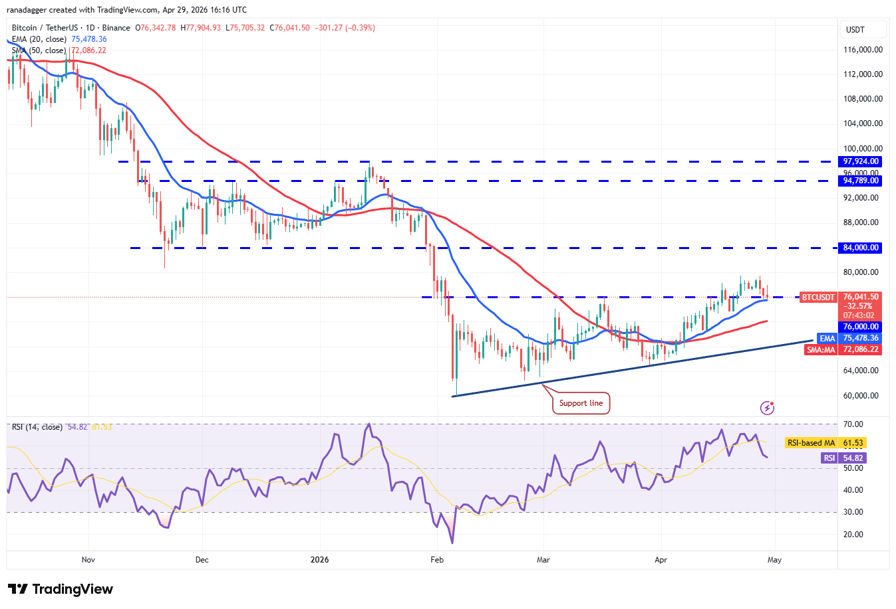
BTC bounced off the 20-day exponential moving average ($75,478) on Wednesday, but the bulls could not sustain the higher levels.
The 20-day EMA is the critical near-term support to watch out for. If the BTC price rebounds off the 20-day EMA with force and breaks above $80,000, it signals that the bulls have flipped the $76,000 level into support. The BTC/USDT pair may then rally to $84,000.
This positive view will be negated in the near term if the price continues lower and breaks below the 20-day EMA. That suggests the bears are active at higher levels. The pair may then tumble to the 50-day simple moving average ($72,086) and later to the support line.
Ether price prediction
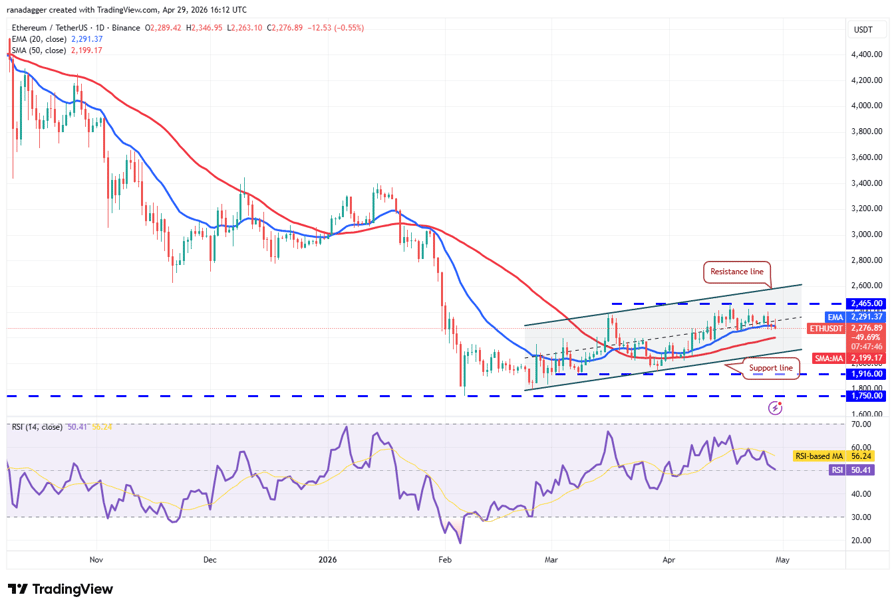
Buyers are attempting to sustain Ether (ETH) above the 20-day EMA ($2,291), but the bears continue to exert pressure.
If the ETH price continues lower and breaks below the moving averages, it suggests that the bears are on a comeback. The ETH/USDT pair may then slump to the support line, where the buyers are expected to step in.
Conversely, if the price turns up from the moving averages, it suggests that the lower levels are attracting buyers. The pair may rise to $2,465 and then to the resistance line of the ascending channel pattern.
XRP price prediction
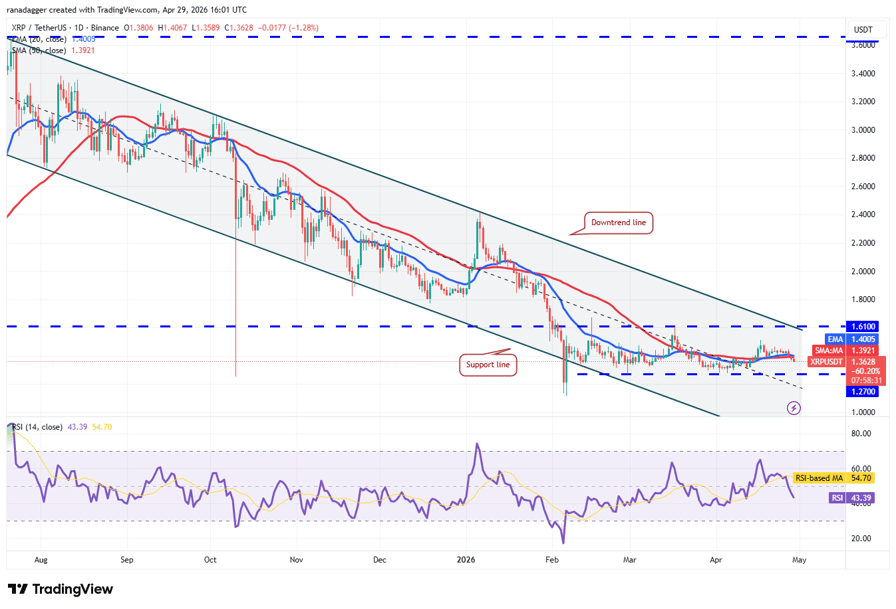
XRP (XRP) fell below the moving averages on Tuesday, indicating that the bears are attempting to take charge.
XRP price may slide to $1.27, where buyers are expected to mount a strong defense. If the price rebounds off the $1.27 support and rises above the moving averages, the recovery may reach the downtrend line. A close above the downtrend line signals a potential trend change.
Conversely, a break below the $1.27 level puts the Feb. 6 low of $1.11 at risk of a breakdown. The pair may then plummet to $1 and then to the support line.
BNB price prediction
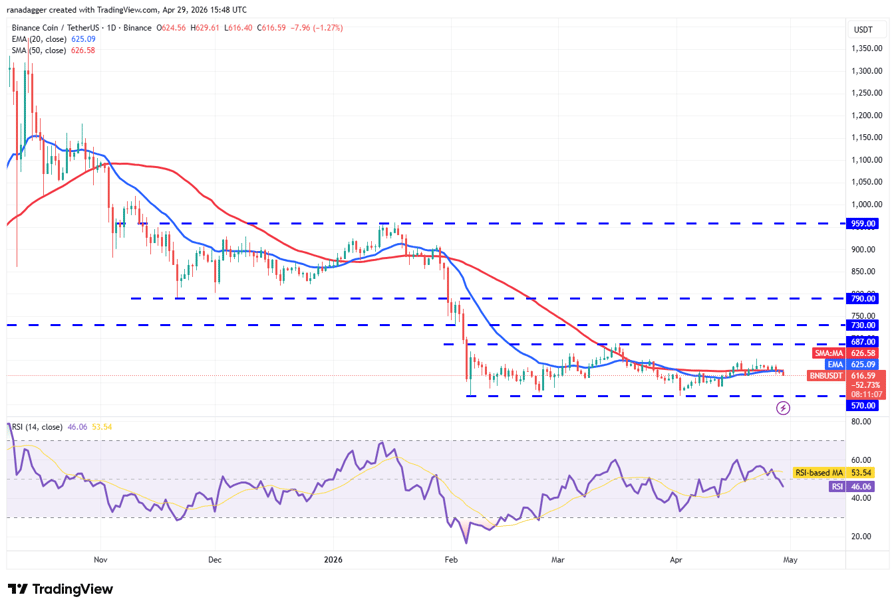
BNB (BNB) remains stuck inside the large range between $570 and $687, signaling buying on dips and selling on rallies.
The flattish moving averages and the RSI just below the midpoint suggest that the BNB/USDT pair may continue consolidating for some time.
Buyers will gain the upper hand if they push the BNB price above $687. If they manage to do that, the pair may surge to $730, then to $790. On the other hand, a break below the $570 support signals the resumption of the downtrend. The pair may then collapse to $500.
Solana price prediction
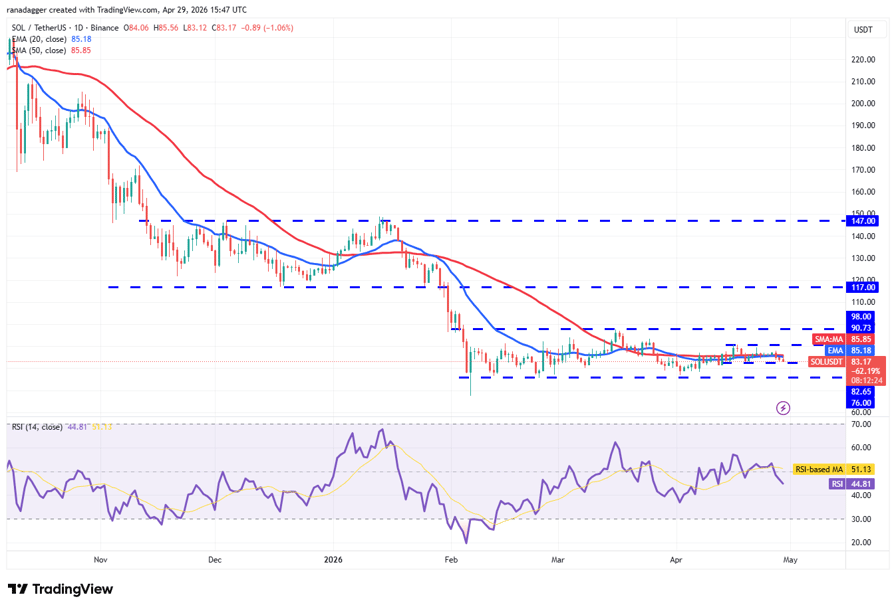
Solana (SOL) has been trading inside a tight range between $82.65 and $90.73, indicating a balance between supply and demand.
If the price breaks below $82.65, the SOL/USDT pair may decline toward the $76 support. Buyers are expected to fiercely defend the $76 level, as a close below it may sink the pair to $67.
On the upside, a break and close above the $90.73 level would indicate a slight advantage for the bulls. The SOL price may then reach the overhead resistance at $98. This is a critical level to watch out for as a break above $98 opens the doors for a rally to $117.
Dogecoin price prediction
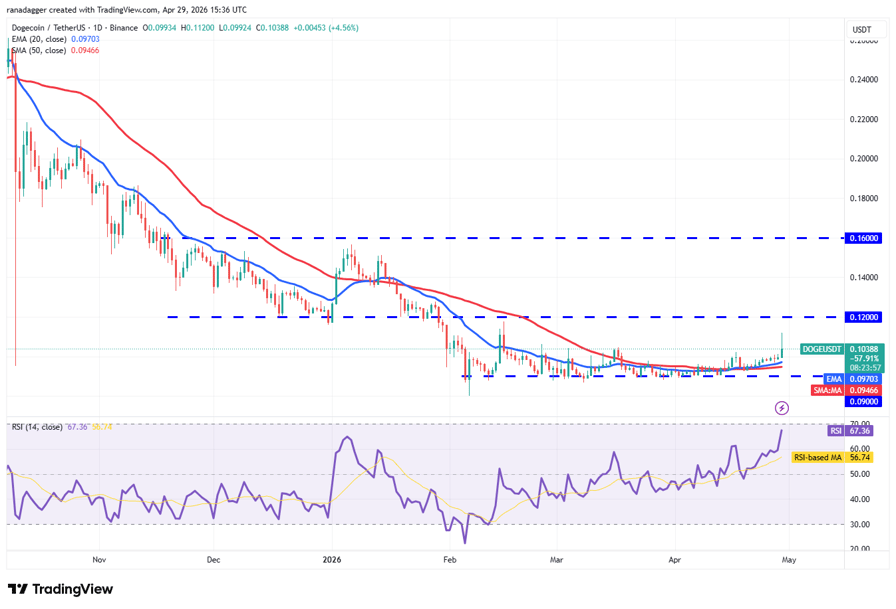
Dogecoin (DOGE) bounced off the 20-day EMA ($0.10) on Monday, indicating buying on dips.
The bulls pushed the DOGE price above $0.11 on Wednesday, but the long wick on the candlestick indicates that bears remain active at higher levels. A break below the 20-day EMA signals that the DOGE/USDT pair may remain range-bound between $0.09 and $0.12 for a few more days.
On the other hand, if the price rebounds off the $0.10 level, it increases the possibility of a rally to $0.12. A close above the $0.12 resistance suggests that the pair may have bottomed out in the short term.
Hyperliquid price prediction
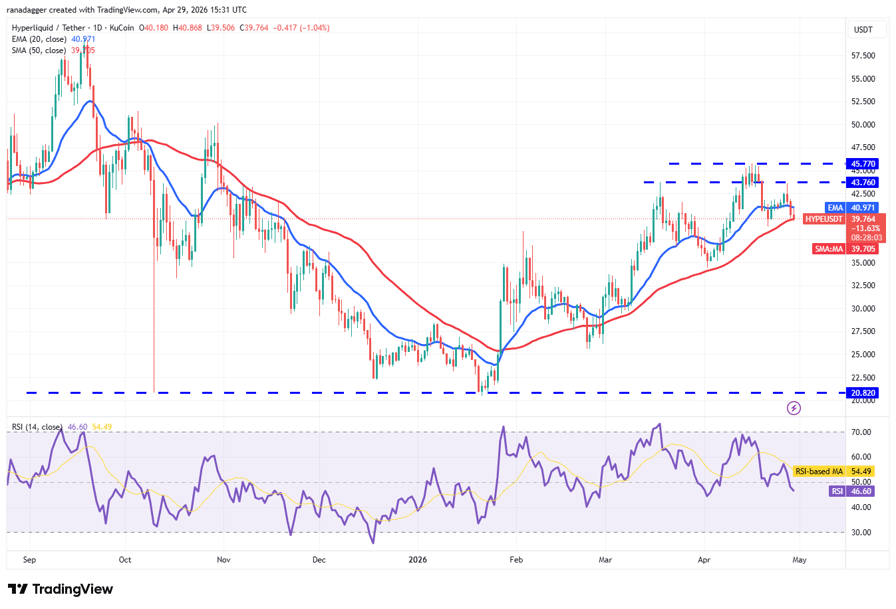
Hyperliquid (HYPE) turned down from the $43.76 overhead resistance on Monday and fell to the 50-day SMA ($39.70) on Tuesday.
Sellers will attempt to strengthen their position by pulling the HYPE price below the 50-day SMA. If they manage to do that, the HYPE/USDT pair may initiate a deeper pullback to $37.77, then to $34.45.
On the upside, the bears will continue to pose a substantial challenge in the $43.76-$45.77 zone. However, if buyers break above the overhead zone, the pair may rally to $50 and then to $51.43.
Related: XRP set for ‘strongest’ 2026 monthly ETF inflows as bulls target $2
Cardano price prediction
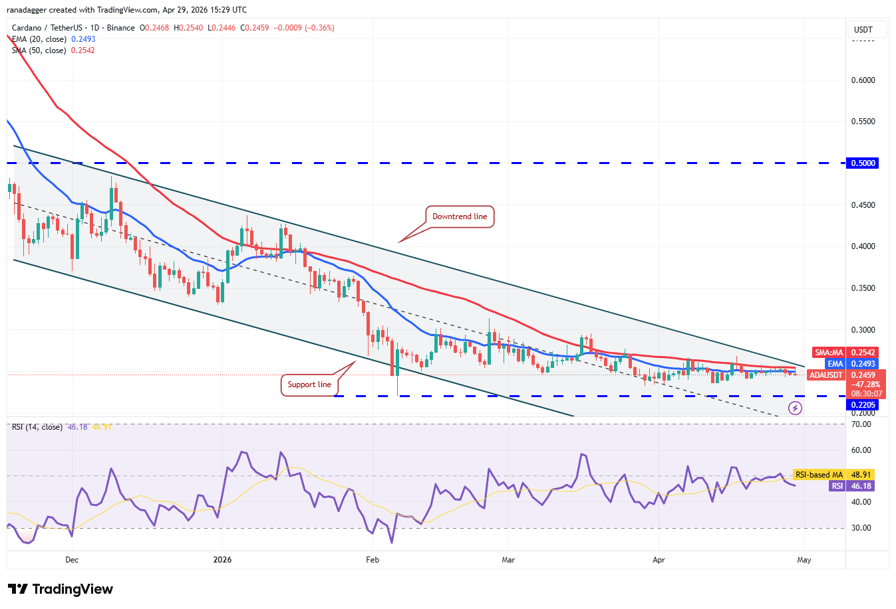
Cardano (ADA) is facing selling near the downtrend line, but a minor positive is that the bulls have not given up much ground to the bears.
That suggests the bulls will again attempt to drive the ADA price above the downtrend line. If they succeed, the ADA/USDT pair may rally to $0.32 and then to $0.37. Such a move signals a potential trend change.
Sellers are likely to have other plans. They will attempt to defend the downtrend line and pull the price to the solid support at $0.22. A close below the $0.22 level indicates the resumption of the downtrend.
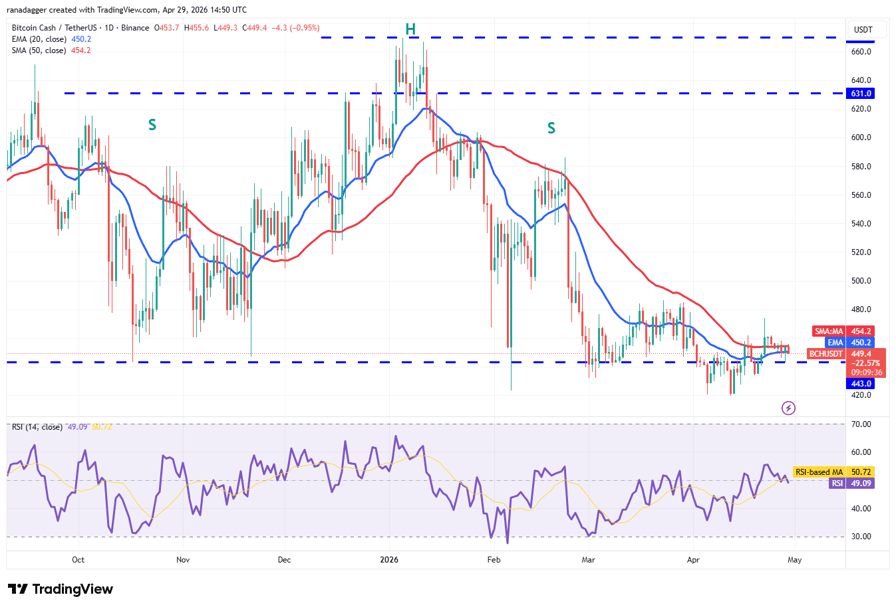
Bitcoin Cash price prediction
Bitcoin Cash (BCH) bounced off the $443 support on Tuesday, but bulls are struggling to push the price above the moving averages.
The flattish moving averages and the RSI near the midpoint do not give either bulls or bears a clear advantage. If the BCH price maintains above the moving averages, the possibility of a rise to the $486 level increases. Sellers are expected to aggressively defend the $486 level, as a close above it opens the door to a rally to $520.
On the downside, a close below the $443 level may sink the BCH/USDT pair to the solid support at $419.
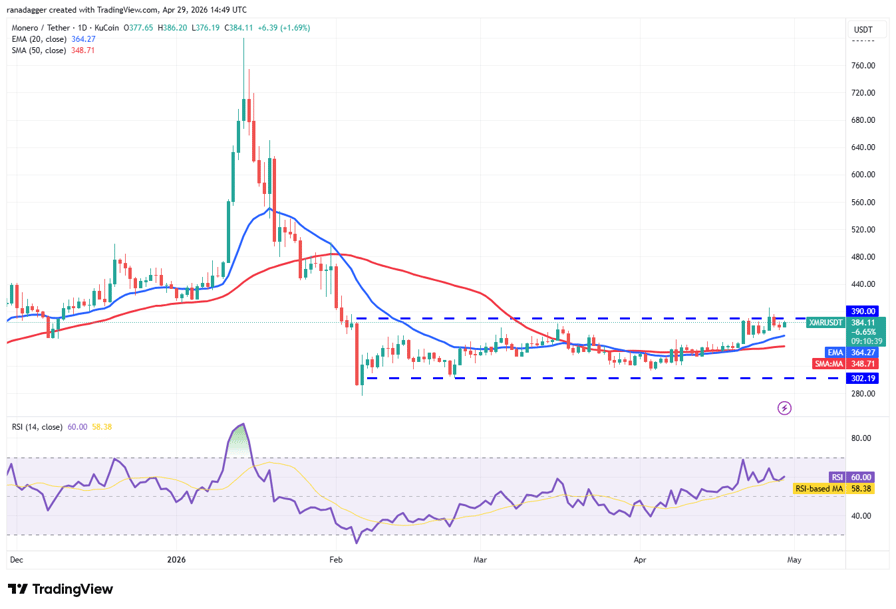
Monero price prediction
Monero (XMR) surged above the $390 resistance on Sunday, but the bulls could not sustain the breakout.
The XMR price pulled back to the 20-day EMA ($364), where the buyers stepped in. If the XMR/USDT pair continues higher and breaks above the $406 level, it signals the start of a new up move toward $500.
Contrary to this assumption, if the price turns sharply lower and breaks below the moving averages, it suggests the pair may remain within the $302 to $390 range for some time.
A study of 1.29M wallets shows users returning more often and trading across more categories, with sports leading at $10.1B and crypto serving as the main onboarding gateway.
Polymarket processed $25.7 billion in trading volume in March, with retail traders driving consistent, repeated activity across an expanding set of real-world markets, according to a new joint report from Bitget Wallet and Polymarket.
The study, based on 1.29 million wallets active in Q1 2026, found that 82.3% of users traded under $10,000, indicating that the platform is overwhelmingly retail-driven. Active days per user rose from 2.5 to 9.9 over the study period, while the average number of categories each user traded expanded from 1.45 to 2.34.
The report frames the shift as behavioral rather than capital-driven, with users returning more frequently and rotating between categories rather than concentrating on one-off events. That tracks with earlier findings from Keyrock and Dune Analytics, which pegged on-chain prediction market monthly volumes as having grown 130-fold since early 2024.
Sports emerged as the largest category on Polymarket in Q1, generating $10.1 billion in volume as the constant cadence of global matches drove recurring engagement. The trend mirrors the broader sports-betting surge that lifted prediction market activity through late 2025 and into the2026 Super Bowl.
Politics generated $5 billion in Q1 volume, including $2.41 billion tied to geopolitics. Unlike past election-driven cycles, the report describes activity as continuously distributed across global news flow, with traders responding to real-time developments rather than discrete events.
Crypto remained the primary entry point for new users, accounting for roughly 40% of early activity. Familiar price action and 24/7 markets make it a natural starting category, though participation broadens as users return. Polymarket recently leaned further into that funnel, launching 5-minute Bitcoin candle markets while teasing a long-rumored POLY token airdrop.
“Prediction markets are becoming less about capital and more about consistent, repeated actions,” noted Bitget Wallet COO Alvin Kan. “What we’re seeing is a behavioral shift: the market is scaling with more taps per day, not bigger trades.”
Elden Mirzoian, director of growth and partnerships at Polymarket, said distribution is becoming as important as the underlying markets, citing the sector’s shift “from episodic trading to more continuous engagement.”
The report cites industry projections of $240 billion in annual volume by year-end 2026, with a longer-term trajectory toward $1 trillion.
Polymarket’s growth has accelerated through a series of structural catalysts. The platform secured CFTC approval to operate in the U.S. in November 2025 and rolled out its U.S. app shortly after, following a $2 billion strategic investment from Intercontinental Exchange. In March, it became MLB’s exclusive prediction market partner. Distribution has also broadened through a native integration in MetaMask, which began routing user bets to Polymarket late last year.
This article was written with the assistance of AI workflows. All our stories are curated, edited and fact-checked by a human.
Bitcoin (BTC) extended its two-day decline on Wednesday after the Federal Open Market Committee (FOMC) minutes confirmed the Fed’s decision to hold “the target range for the federal funds rate at 3-½ to 3-¾ percent.”
While the Fed maintains its goal of achieving “maximum employment and inflation at the rate of 2 percent over the longer run,” the FOMC minutes cited the “developments in the Middle East” as factors fueling an environment of “uncertainty” and the Fed stressed its desire to maintain optionality as it evaluates the “risks to both sides of its dual mandate.”
FOMC minutes with new statements in red. Source: CNBC
The Fed’s hold on rates aligned with market expectations, but Bitcoin remained fragile throughout Chairman Powell’s presser.
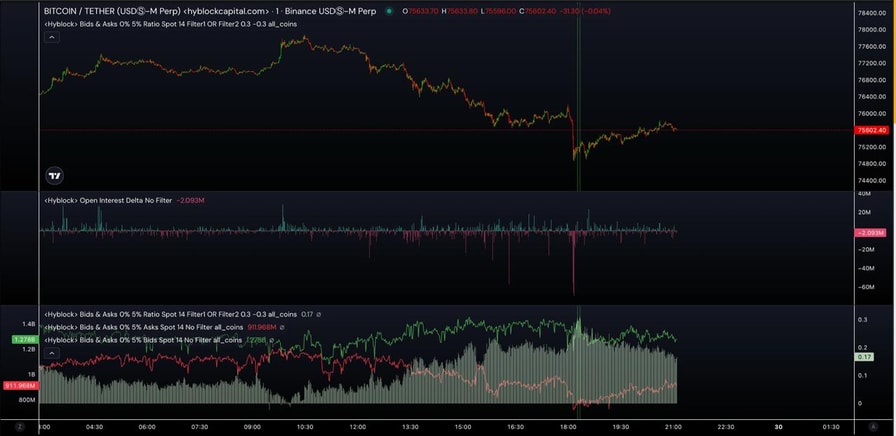
Hyblock CEO Shubh Varma described the price action as “the usual sell the news reaction after the FOMC,” but also noted that BTC “quickly recovered to pre-announcement levels within hours, showing strong underlying conviction.”
Adding data to back his market view, Varma said,
“The global bid ask ratio spiked to 0.3 (one of the highest readings), while open interest fell on the price drop. This is classic post-FOMC position squaring and stop-hunt behavior rather than conviction selling.”
BTC/USDT global bid ask ratio. Source: Hyblock
Will support turn back into resistance?
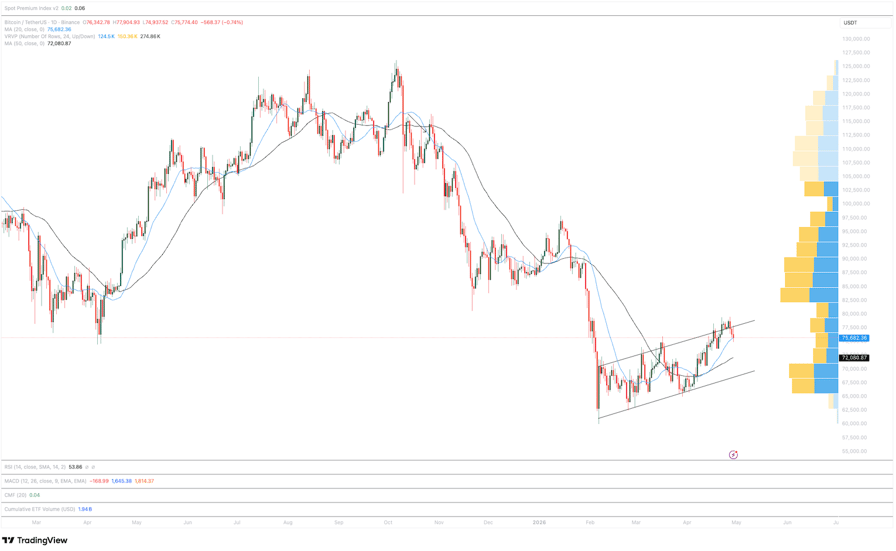
After the FOMC minutes were published, BTC dropped to an intra-day low of $74,937, slightly below the 20-day simple moving average ($75,664) that some traders identified as critical to confirming BTC’s support-resistance flip.
As reported on Monday by Cointelegraph, following the break above the channel resistance on the daily chart, BTC required consecutive daily candle closes above the trendline, followed by a lower support restest in the $76,500 to $75,500 range.
BTC/USDT 1-day chart. Source: TradingView
While all the above have happened, failure to recapture the 20-MA and close above the trendline resistance could be interpreted as a loss of momentum within the bull trend, opening the path for Bitcoin to test the downside boundary of the near-4-month-old channel.
Related: Bitcoin falls as traders cut risk ahead of FOMC: Will Tradfi, spot ETF volumes bolster $70K support?
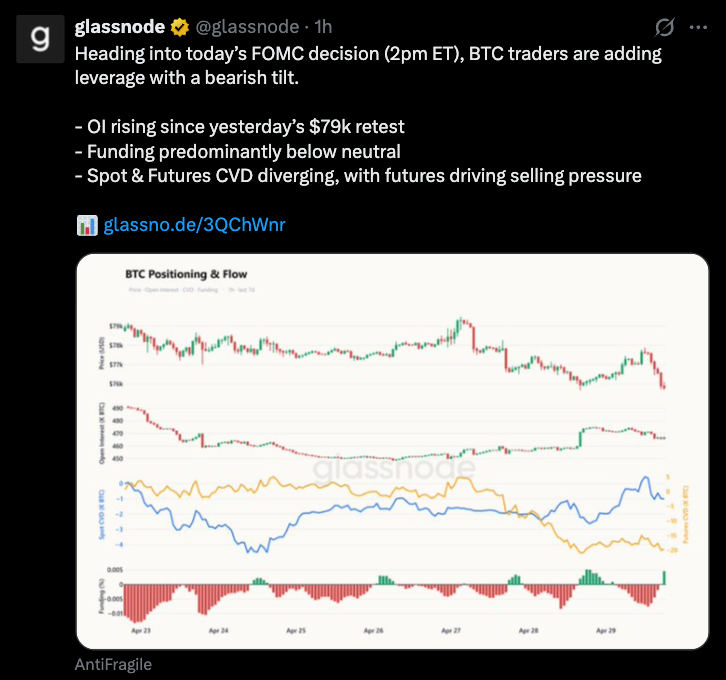
Prior to the Chairman Powell’s presser, Glassnode analysts noticed that Bitcoin traders were adding bearish leverage, citing rising open interest after Tuesday’s rally to $79,000, funding remaining neutral and a divergence between the spot and futures market cumulative volume delta (CVD).
Bitcoin traders turn bearish ahead of FOMC minutes. Source: Glassnode / X
Additional analysis from Glassnode’s The Week Onchain report depicted Bitcoin’s price action as “trapped below market mean,” where $65,000 to $70,000 act as support, but weak demand prevents the formation of sustainable rallies.
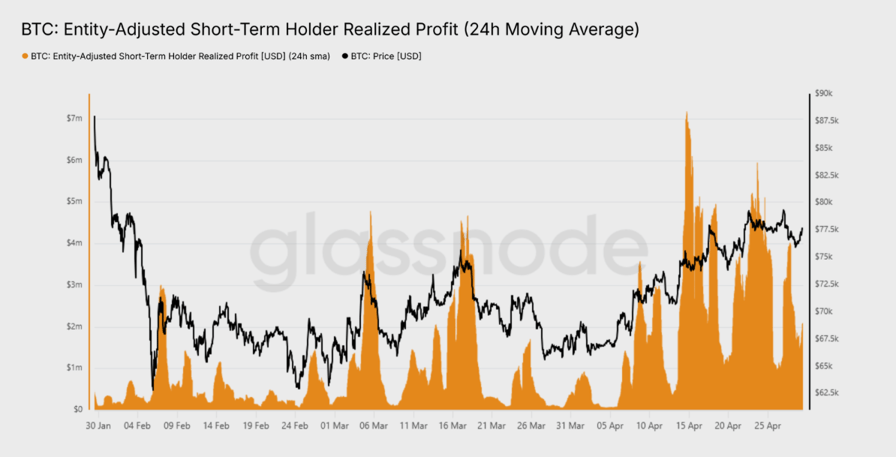
According to the report, Bitcoin failed to overcome its True Market Mean at $79,000 and a surge in short-term holders’ profit taking, along with margin futures flipping net short, has sapped away Bitcoin’s shorter-term bullish momentum.
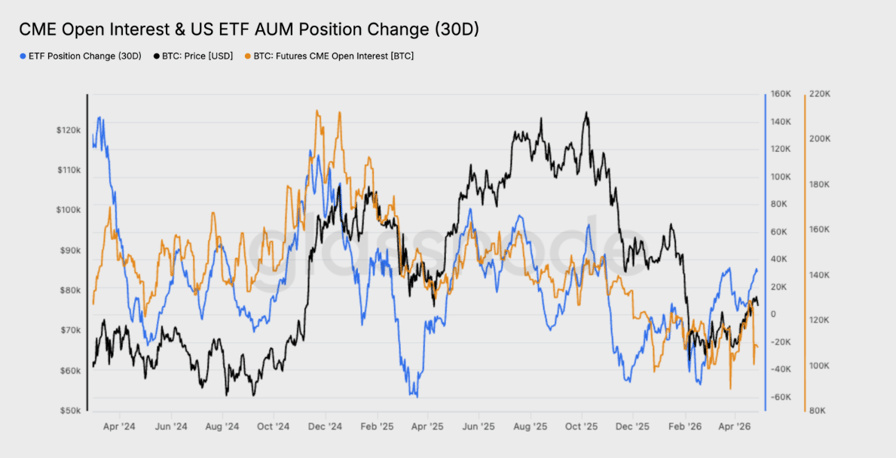
While these factors increase Bitcoin’s sensitivity to a sharper downside move, the analysts said institutional flows into the spot BTC ETFs and rising CME open interest have helped to build a “dense accumulation cluster between $65K and $70K.”
CME open interest, US spot ETF AUM position change. Source: Glassnode
This article is produced in accordance with Cointelegraph’s Editorial Policy and is intended for informational purposes only. It does not constitute investment advice or recommendations. All investments and trades carry risk; readers are encouraged to conduct independent research.
The vulnerability that led to ZetaChain’s recent exploit had been flagged through its bug bounty program before the attack, but was dismissed as intended behavior.
In a post-mortem published Wednesday, the team said the incident has prompted a review of how it handles bug bounty submissions, particularly reports involving chained attack vectors that may appear harmless in isolation but are dangerous in combination.
“This bug was reported and they simply ignored it,” one user wrote on X. “That’s how bug bounty programs work with these protocols currently; they incentivize losses for the protocol, the TVL, and the user’s balance instead of paying the researcher for discovering and fixing the bug,” they added.
ZetaChain lost approximately $334,000 to a premeditated exploit on Sunday that targeted its cross-chain gateway contract. The exploit drained funds across nine transactions on four chains, including Ethereum, Arbitrum, Base and BSC, all from ZetaChain-controlled wallets. No user funds were affected.
Related: Crypto hackers stole $17B over past 10 years: DefiLlama
Attacker exploits small design flaws
ZetaChain said in its post-mortem that the attacker exploited three design flaws that, individually, might have seemed minor, but together opened the door to a full drain. First, the gateway allowed anyone to send arbitrary cross-chain instructions with no restrictions. Second, on the receiving end, it would execute almost any command on any contract, with a blocklist so narrow it missed basic token transfer functions.
Third, wallets that had previously used the gateway had left unlimited spending permissions in place that were never cleaned up. By combining all three, the attacker simply told the gateway to transfer tokens from victim wallets to their own, and the gateway complied.
Source: ZetaChain
“This was not an opportunistic attack,” ZetaChain said in its post-mortem. The attacker funded their wallet through Tornado Cash three days before the exploit, deployed a purpose-built drainer contract on ZetaChain and ran an address poisoning campaign before seeding it into their transaction history via dust transfers.
ZetaChain added that a patch permanently disabling the arbitrary call functionality is being rolled out to mainnet nodes. The platform also removed unlimited token approvals from its deposit flow, replacing them with exact-amount approvals going forward.
Related: Ethical hacker intercepts $2.6M in Morpho Labs exploit
AI DeFi exploit success rate increases
A new study by a16z tested whether an off-the-shelf AI agent could go beyond identifying DeFi vulnerabilities and actually produce working exploits. Using OpenAI’s Codex against a dataset of 20 real Ethereum price manipulation incidents, researchers ran the agent in a sandboxed environment with no access to future transaction data and no guidance on how the attacks worked. The agent succeeded in just 10% of cases.
However, when researchers fed the agent structured knowledge about common attack patterns and exploit workflows, the success rate jumped to 70%.
Magazine: How to fix suspected insider trading on Polymarket and Kalshi
Cointelegraph is committed to independent, transparent journalism. This news article is produced in accordance with Cointelegraph’s Editorial Policy and aims to provide accurate and timely information. Readers are encouraged to verify information independently.
Zeller, Australia’s fastest-growing fintech, has expanded into the United Kingdom, bringing its integrated payment and financial services platform to the country’s 5.7 million small and medium-sized enterprises (SMEs).
The UK launch marks the company’s first global expansion outside of Australia, where it already supports more than 100,000 businesses, including major brands like Domino’s Pizza and airport travel retailer SSP. The fintech, which achieved unicorn status following an A$100 million Series B funding round in 2022, is specifically targeting the high operational costs and outdated technology that continue to plague British merchants.
The £22.7billion friction problem
Ben Pfisterer, co-founder and CEO of Zeller
Zeller’s arrival coincides with new research highlighting the severe financial impact of inadequate payment systems. According to a study conducted by Foresight Factory and commissioned by Zeller, 1 in 2 UK customers abandon a purchase due to checkout friction caused by legacy payment technology. This consumer frustration places over £22.7billion in payments at risk every year.
Ben Pfisterer, co-Founder and CEO of Zeller, noted the stark disparity between the UK’s advanced fintech reputation and the daily reality for its local merchants.
“The UK is one of the world’s most advanced fintech markets and home to millions of small businesses that are vital to the economy,” Pfisterer stated. “But despite progress being made, payments is dominated by legacy providers offering unreliable, outdated, and costly payments hardware, paired with lengthy and time-consuming onboarding processes. UK merchants have been underserved for too long.”
An all-in-one financial ecosystem
To combat these challenges, Zeller offers a fully integrated financial ecosystem. Rather than forcing merchants to stitch together point-of-sale hardware, invoicing, business accounts, cards, and expense management across multiple disjointed platforms, Zeller brings all of these services into a single account.
The fintech has also completely streamlined the onboarding experience. Zeller’s fully digital account creation process takes business owners less than six minutes to complete. This stands in stark contrast to the legacy provider average of five days, with 50 per cent of those traditional providers still requiring an in-person appointment or a pen-and-paper application.
Slashing card processing fees
Beyond operational efficiency, Zeller is set to aggressively challenge competitors on price. The company projects it can save UK merchants up to 35 per cent annually on card processing fees compared to traditional banks and other fintechs. Across the entire UK market, this equates to potential savings of up to £5.2billion per year.
Early indications of merchant demand are already strong, with over 100 UK businesses signing up during the platform’s pre-launch testing phase.
Djihan Chagas, a merchant using the multi-award-winning Zeller Terminal at his London-based retail store Ferro Velho, praised the system’s integration.
“Good design is a big part of our brand, and Zeller Terminal reflects that,” Chagas said. “Combined with the flexibility to take payments in different ways, customise screens and receipts, it fits effortlessly into how we work.”
The shares of Twenty One Capital (XXI), the bitcoin-focused firm, are up over 8% in after-hours trading on Wednesday, after majority shareholder Tether Investments proposed a merger with Strike and Elektron Energy.
Tether Investment, the independent investment arm of the stablecoin issuer, said it intends to vote its shares in favor of combining XXI with Strike, a global bitcoin financial services company founded by Jack Mallers and Elektron Energy, according to a press release. Mallers is also the CEO of XXI.
“If completed, these transactions would position XXI to become the premier listed Bitcoin company in the world: a public company that combines Bitcoin treasury, mining, financial services, lending, capital markets, and strategic consolidation into one integrated platform,” according to the press release.
No terms of timelines were disclosed for the merger.
Led by Raphael Zagury, Elektron Energy manages approximately 5% of the current bitcoin network’s computing power with all-in production costs below $60,000 per bitcoin.
Tether also proposed that Zagury serve as President of the combined entity, pairing his mining and capital markets experience with Mallers’ product and consumer bitcoin leadership.
XXI went public in December of last year through a SPAC merger with Cantor Equity Partners. The company entered the market as a bitcoin treasury firm with 43,514 BTC and is backed by Tether, Bitfinex and Strike CEO Jack Mallers. At the time, it said it would focus on “capital-efficient bitcoin accumulation.”
If the new merger takes place, the company will expand on this previous treasury commitment into other parts of bitcoin services, the press release said.
“The combined transactions would move XXI beyond treasury exposure alone and toward a platform with operating businesses, recurring revenue opportunities, and long-term Bitcoin accumulation capabilities,” the statement added.
Trusted Editorial content, reviewed by leading industry experts and seasoned editors. Ad Disclosure
Bitcoin may have pulled back briefly after days of upward action, but its price is still holding firm above the pivotal $77,000 mark backed by growing bullish sentiment across the broader cryptocurrency market. While BTC’s price has displayed upside momentum, the on-chain indicator points to a steady decline in activity among short-term holders.
Short-Term Holder Activity Cools While Bitcoin Edges Higher
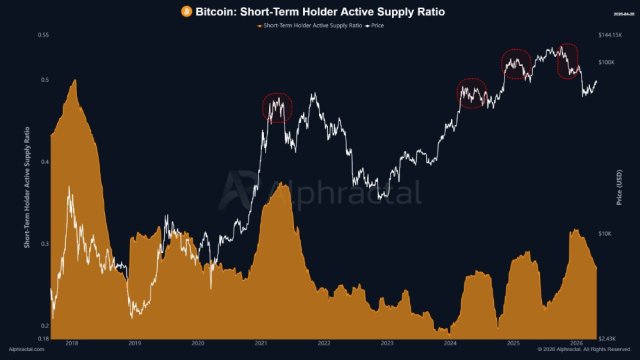
Following its renewed upside performance, a subtle but crucial shift is starting to emerge in the Bitcoin market. This important shift is being observed among Short-Term BTC holders as the STH Active Supply Ratio continues to decline even while price gradually moves in the upside direction.
It is worth noting that this metric represents the percentage of total circulating supply held by these investors, which is defined as native units that have moved at least once in the last 180 days. Furthermore, it measures the portion of supply that price-sensitive players control. Particularly, these are investors who are more likely to react to volatility, market news, and profit opportunities in the short term.
The divergence between the Active Supply Ratio and BTC’s price implies that more recent market players are becoming less active, possibly choosing to hold rather than trade in the face of improving conditions.
In the chart shared by Alphractal, an advanced on-chain data analytics platform, it appears that the ratio has been declining since the beginning of this year. According to the platform, this steady decline in the metric signals reduced BTC movement on-chain by the short-term holders.
Source: Chart from Alphractal on X
Furthermore, Alphractal highlighted that this type of behavior is often seen at a time when market optimism is fading, and activity from short-term holders simultaneously cools down. As the STH active supply drops, this pattern may indicate the early phases of a more sustained and resilient trend.
One Of The Most Important Retests For BTC’s Price
The Bitcoin market has been quite unclear about its next direction as prices face continued sideways price performance. However, the asset is witnessing a critical moment, one that could play a role in determining its next possible trajectory.
On-Chain Mind, a Bitcoin and crypto data analyst, has shared on X that the crypto king is having one of its important tests at the Short-Term Holder Realized Price around the $78,000 level. What makes this move so important is tied to different scenarios in the past where this level has defined the bull and bear regime shifts.
Whatever happens here this week is likely to set the tone for the next few months. Meanwhile, a rejection here, in classic bear-market style, would cause the price to drop further or break through, opening the door to the next Bitcoin bull phase.
BTC trading at $77,073 on the 1D chart | Source: BTCUSDT on Tradingview.com
Featured image from Pngtree, chart from Tradingview.com
Editorial Process for bitcoinist is centered on delivering thoroughly researched, accurate, and unbiased content. We uphold strict sourcing standards, and each page undergoes diligent review by our team of top technology experts and seasoned editors. This process ensures the integrity, relevance, and value of our content for our readers.