Home Blog Page 376

CME to Launch Regulated Bitcoin Volatility Futures in June

0

CME Group plans to launch Bitcoin Volatility futures on June 1, pending regulatory review, giving investors a compliant way to trade expected Bitcoin volatility rather than price direction, according to a company release published Tuesday.

The Chicago-based derivatives marketplace said the contracts will settle to the CME CF Bitcoin Volatility Index, a 30-day measure of expected Bitcoin volatility derived from CME options markets.

CME describes the new contracts as Commodity Futures Trading Commission (CFTC)-regulated futures aimed specifically at Bitcoin volatility, extending the existing US regulatory framework that already covers CME’s Bitcoin and Ether derivatives.

Giovanni Vicioso, CME Group’s global head of cryptocurrency products, said in the release that market participants are seeking regulated products that offer exposure to market moves, and that the new futures would let traders invest in or hedge against future Bitcoin volatility.

The launch would give institutions a regulated way to trade Bitcoin volatility in the US directly through CME’s clearing framework, rather than building similar exposure through combinations of Bitcoin options and futures or using offshore venues.

Related: CME CEO Duffy says exchange is exploring issuing its own token

In the same release, Morgan Stanley managing director and head of derivatives sales David Schlageter said the contracts should help market participants manage portfolio risk by trading volatility itself.

CME Group to Launch Bitcoin Volatility Futures Contracts. Source: PR Newswire.

CME described the contracts as the “first-of-their-kind regulated futures contracts,” distinguishing them from existing crypto-native volatility products offered outside the US-regulated futures framework.

Cointelegraph reached out to CME for additional comment, but had not received a response by publication.

CME’s product keeps Bitcoin volatility trading onshore

Similar products exist elsewhere. Deribit launched BTC DVOL futures in March 2023, tied to its implied-volatility index, while BitMEX introduced its BVOL 30-day historical volatility futures back in January 2015.

CME first introduced cash-settled Bitcoin futures in December 2017 and has since expanded its regulated crypto lineup to include Bitcoin options, Micro Bitcoin futures and options, Ether futures and options and other cryptocurrency contracts.

The group is preparing to move its cryptocurrency futures and options to 24/7 trading from May 29, subject to regulatory review, further aligning its market structure with the always-on nature of digital assets.

That push comes as crypto derivatives continue to dominate trading activity more broadly, with a CoinGlass report estimating 2025 crypto derivatives volume at about $85.7 trillion, and Swiss bank Amina Group finding that derivatives account for roughly three-quarters of all crypto trading.

Magazine: Bitcoin will not hit $1M by 2030, says veteran trader Peter Brandt

Cointelegraph is committed to independent, transparent journalism. This news article is produced in accordance with Cointelegraph’s Editorial Policy and aims to provide accurate and timely information. Readers are encouraged to verify information independently.

Trusted Volumes Confirms $6.7M DeFi Resolver Exploit

0

TrustedVolumes, an independent market maker and resolver used by 1inch Fusion, confirmed it was exploited and said about $6.7 million in stolen funds are being held across three Ethereum addresses.

In a Thursday X post, the market maker said the stolen funds were split across three wallets, with two addresses each holding about $3 million and a third holding about $700,000. TrustedVolumes said it was open to “constructive communication” over a bug bounty and a “mutually acceptable resolution.”

The confirmation came after Web3 security company Blockaid said its exploit detection system had identified an ongoing Ethereum exploit targeting TrustedVolumes. Blockaid said the attack involved a TrustedVolumes-controlled custom swap infrastructure. Blockaid initially estimated that about $5.87 million had been extracted, including Wrapped Ether, USDT, Wrapped Bitcoin and USDC.

Blockchain security company CertiK said the attacker registered as an allowed order signer through a public function, then used that authorization to execute orders that transferred funds from the targets.

The incident highlights the risks around third-party infrastructure used in decentralized exchange execution, where resolvers and market makers can operate their own contracts even when the core protocol and ordinary users are not directly affected. TrustedVolumes operates independently as a liquidity provider for multiple protocols, including 1inch, which said its own systems, infrastructure and user funds were not affected.

Cointelegraph reached out to TrustedVolumes for additional comment but had not received a response by publication. 

Source: TrustedVolumes

1inch says none of its protocols were breached

In an X post, 1inch said reports linking it directly to the TrustedVolumes exploit were “misleading,” adding that “neither 1inch nor any of the 1inch protocols are involved.” The platform said there was “no impact on 1inch systems, infrastructure or user funds.”

1inch co-founder Sergej Kunz also said TrustedVolumes operates independently and is not exclusive to 1inch. “While it is true that 1inch uses TrustedVolumes as a resolver, we are one of many,” Kunz said.

Kunz said the framing of the exploit as a 1inch-related incident was “confusing and harmful,” adding that 1inch is monitoring the situation with security partners and will assist where appropriate.

Related: Andre Cronje says DeFi is ‘no longer DeFi’ as builders debate circuit breakers

Security researcher Vladimir Sobolev, known as Officer’s Notes on X, also told Cointelegraph there was “no risk for 1inch users,” adding that the exploit was related only to TrustedVolumes. 

Sobolev said the exploit points to broader weaknesses in crypto security practices, where vulnerabilities can quickly produce immediate losses. 

“We lack security in general. Blockchains just tend to have an immediate payoff,” Sobolev told Cointelegraph. “We need to pay more attention to kill switches, monitoring, circuit breakers, etc.”

Both Blockaid and Sobolev noted that the attack was carried out by the same operator responsible for the March 2025 1inch Fusion V1 resolver exploit. However, Blockaid said the latest attack involved a different vulnerability.

In March 2025, 1inch said a vulnerability affected resolvers using an outdated Fusion v1 implementation in their own contracts, while end-user funds remained safe. SlowMist later traced about $5 million in stolen assets, including USDC and Wrapped Ether.

1inch and the affected resolver negotiated with the attacker, who returned most of the stolen funds under a bug bounty agreement, according to 1inch and Decurity’s postmortem.

Magazine: North Korea denies crypto hacks, Upbit’s bank tests Ripple: Asia Express

Cointelegraph is committed to independent, transparent journalism. This news article is produced in accordance with Cointelegraph’s Editorial Policy and aims to provide accurate and timely information. Readers are encouraged to verify information independently.

59% of organizations made a “bad AI hire” in the past year, new TestGorilla research reveals

0


Study of nearly 2,000 senior hiring leaders finds 53% now prioritize AI fluency over domain expertise, but a critical gap between definitions and measurement is producing confident wrong hires on both sides of the Atlantic

TestGorilla, the leading skills-based hiring platform, today released The State of Hiring for AI Fluency, revealing a fundamental shift in talent evaluation: AI fluency has overtaken domain expertise as the top hiring priority. 53% of hiring managers now prefer candidates with strong AI fluency over deep subject matter experts.

Although 72% of UK and 71% of US organizations have formally defined AI fluency, and nearly all list it as a hiring requirement, 59% across both markets still made a bad AI hire in the past year.Share

But ambition is outpacing reality. Although 72% of UK and 71% of US organizations have formally defined AI fluency, and nearly all list it as a hiring requirement, 59% across both markets still made a bad AI hire in the past year — a candidate who spoke the language fluently in the interview but couldn’t apply it on the job.

“Organizations are no longer just looking for subject matter experts; they are looking for AI-augmented performers who can use emerging technology to 10x their output,” says Wouter Durville, CEO of TestGorilla. “But a candidate can learn the vocabulary, ‘agentic workflows,’ ‘RAG,’ ‘prompt chaining’ in a single weekend. They can describe a workflow convincingly without ever having built one.”

The Infrastructure Paradox

TestGorilla’s research identifies an “Infrastructure Paradox”: companies are investing in AI hiring frameworks built on the same broken proxies that have failed recruiters for decades. The report flags three critical issues:

  • The Awareness Trap: 37% of organizations set their minimum bar at tool awareness — simply knowing a tool exists.
  • The Subjectivity Trap: 19% leave AI assessment entirely to individual hiring manager discretion. Without a shared rubric, fluency becomes a vibe-check that rewards the best storyteller, not the best hire.
  • Confidence vs. Competence: Interviews are designed to observe communication, not execution. Candidates can speak fluently about AI workflows without ever auditing an output or redesigning one.

A bad AI hire can cost more to fix than a vacancy: in lost output, failed projects, and rehiring costs.

A Transatlantic Divide

The data exposes a sharp split. 33% of US organizations report frequent AI-driven errors, compared to just 13% in the UK. UK employers are also less likely to set the bar at mere tool awareness (29% vs. 45% in the US), showing stronger internal alignment on what AI fluency requires.

The conclusion is the same on both sides: subjective evaluation is no longer fit for purpose. Objective, skills-based assessment is the only reliable path to verifying AI competence.

Morgan Stanley To Launch Crypto Trading On E*Trade In 2026

0

Trusted Editorial content, reviewed by leading industry experts and seasoned editors. Ad Disclosure

Wall Street behemoth Morgan Stanley has launched its long-awaited crypto trading pilot on its E*Trade platform, aiming to challenge major established players with competitive pricing.

Morgan Stanley Debuts Crypto Trading Pilot

Baking giant Morgan Stanley has rolled out a pilot to offer direct crypto trading on its E*Trade platform, with cheaper pricing than its competition, Bloomberg reported on Wednesday.

According to the report, the bank is charging E*Trade users a 50-basis-point fee on the transaction value, placing its prices below those of other major players. For instance, Robinhood’s fees start at 95 basis points, while Coinbase and Charles Schwab’s fees start at 60 and 75 basis points, respectively.

Morgan Stanley is currently offering its crypto trading pilot to a limited number of users, but expects to give access to all of E*Trade’s 8.6 million clients later this year. Jed Finn, Morgan Stanley’s head of wealth management, said in an interview that the launch is “much bigger than trading crypto at a cheaper rate,” adding that “the strategy is disintermediating the disintermediators.”

The banking giant bought E*Trade in 2020 for $13 billion. In May 2025, it introduced plans to allow crypto trading on the platform, following the Trump administration’s efforts to make the US “the crypto capital of the world.”

People familiar with the matter told Bloomberg that executives are preparing an offering to directly convert cryptocurrencies into shares of exchange-traded products (ETPs) without selling the assets. In addition, the bank reportedly plans to add the ability to trade tokenized equities in the second half of 2026.

Morgan Stanley’s Strategic Digital Assets Push

The launch is part of Morgan Stanley’s broader push to expand in the digital assets space, an industry that until recently was off-limits to banks. Over the past few years, the Wall Street giant has been betting on the convergence of traditional finance (TradFi) and decentralized finance (DeFi).

In 2024, Morgan Stanley, which has built one of the most significant Bitcoin Exchange-Traded Fund (ETF) holdings in the US, allowed its managers to offer the funds as an investment option for its wealthy customers.

Last year, it expanded access to crypto fund investments for all clients, moving away from the previous restrictions that limited access to individuals with at least $1.5 million in assets and an aggressive risk tolerance. The shift allowed its financial advisors to present the funds to any client, including those with retirement accounts.

Notably, Morgan Stanley became the first Wall Street bank to debut a spot Bitcoin ETF in April, and made it the cheapest fund in the category. The bank also filed for spot Ethereum and Solana ETFs earlier this year, which are expected to debut this year.

In February, it joined the list of companies applying for a national trust bank charter with the Office of the Comptroller of the Currency (OCC). In its application, the bank said that the charter would be used to conduct crypto trading and staking for its investment clients, reinforcing its strategic push for the broader digital asset industry.

crypto, total

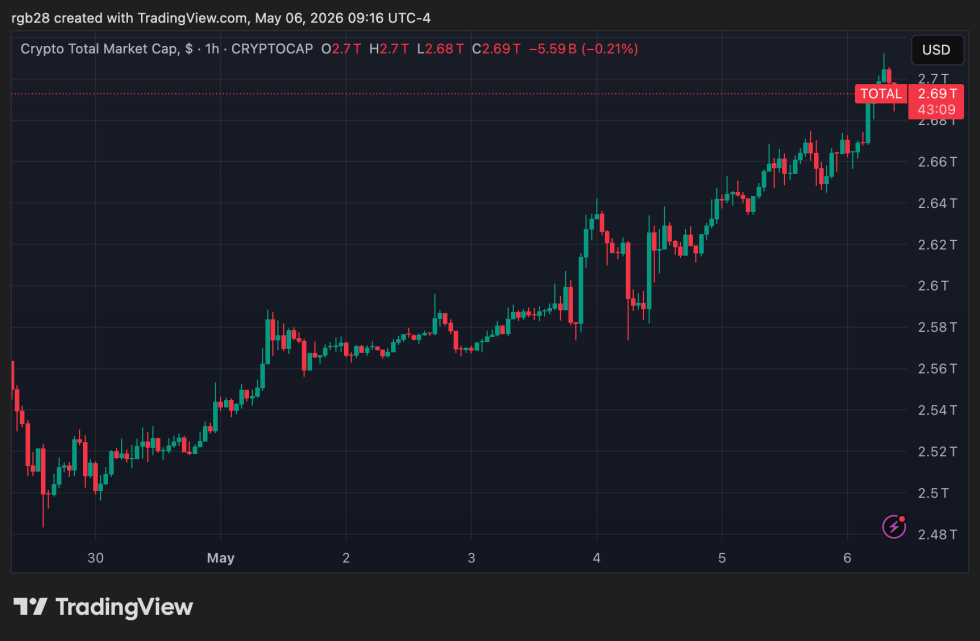
The total crypto market capitalization is at $2.69 trillion in the one-week chart. Source: TOTAL on TradingView

Featured Image from Unsplash.com, Chart from TradingView.com

Editorial Process for bitcoinist is centered on delivering thoroughly researched, accurate, and unbiased content. We uphold strict sourcing standards, and each page undergoes diligent review by our team of top technology experts and seasoned editors. This process ensures the integrity, relevance, and value of our content for our readers.

ADX Hosts Region’s First IOP for a US-Based ETF, Listing First Shari’ah-Compliant Fund

0


Middle East & Africa Wealthtech


The Abu Dhabi Securities Exchange (ADX) Group has further strengthened its position as the Middle East’s most liquid ETF hub. The exchange recently hosted the region’s first initial offering period (IOP) for a U.S.-based ETF, which culminated in the successful cross-listing of the KraneShares Wahed Alternative Income Index ETF (KWIN).

This milestone firmly underscores ADX’s continued push to expand access to global investment products and enhance market accessibility for regional investors.

Global demand and ETF mechanics

The IOP for the new ETF ran from 15 to 21 April. Highlighting strong and diverse international demand, the offering attracted investors from more than 46 different nationalities who subscribed directly through the ADX website.

Developed collaboratively by KraneShares and Wahed Invest, KWIN marks a key regional milestone. Key details of the newly listed ETF include:

  • It is the first Shari’ah-compliant ETF to be cross-listed from the U.S..

  • It represents the fourth ETF overall from the New York Stock Exchange to join the ADX.

  • The fund utilizes an options-based strategy designed to generate income.

  • It tracks the Wahed Shariah Alternative Income Index, which, as of March 2026, contained 306 holdings, including major companies such as Amazon and Lululemon.

Furthermore, KWIN represents the second ETF listing on the ADX since the onset of recent regional geopolitical developments, closely following the KraneShares Artificial Intelligence & Technology ETF (AGIX). According to ADX, this highlights the exchange’s ability to sustain strong momentum and retain investor trust.

A surging ETF ecosystem

The launch of KWIN officially increases the total number of ETFs listed on the ADX to 23. This latest addition brings the total ETF market capitalization on the Abu Dhabi exchange to nearly AED 27 dirhams.

The ADX’s ETF segment continues to experience rapid expansion. In the first quarter of 2026, ETF trading value reached 155 million dirhams, representing a massive 228 per cent year-on-year increase.

This immense growth aligns with broader market performance across the exchange. Over the same period, total trading value across the ADX approached 90 billion dirhams, an increase of 7.5 per cent.

Institutional and foreign engagement

The exchange’s first-quarter metrics also underscore strong international engagement and deep institutional trust:

  • Institutional participation rose to account for 78 per cent of the total trading value.
  • Foreign investors accounted for 47.5 per cent of trading.
  • Transactions from foreign investors exceeded 85 billion dirhams, marking a 22 per cent year-on-year increase.


Three signals pointing to a possible jump to $85,000

0

Bitcoin , the world’s largest digital asset by market value, has risen from roughly $63,000 to over $80,000 in the past three months, according to CoinDesk market data. And key signals that professionals watch closely are now all pointing in the same direction: $85,000.

The rally is not just about price, but about the ripples beneath the surface.

On-chain dynamics

Further gains look likely because bitcoin has topped two levels that on-chain analysts consider among the most important in the market: The True Market Mean at $78,200 and the Short-Term Holder Cost Basis at $79,100.

Here is why those numbers matter. The True Market Mean is the average price active bitcoin investors paid for the coins they currently hold. The metric doesn’t count every bitcoin ever mined, including those sitting dormant for years or lost, but focuses on coins that are actually changing hands between investors.

That makes it a cleaner estimate of the level that matters most to people that are active in the market. When bitcoin trades above it, most active investors are in profit, and when it falls below it, many are underwater. That’s why analysts use it to gauge sentiment, spot periods of market stress or euphoria, and identify potential mean-reversion zones.

Speaking of the short-term holder cost basis, it represents the average acquisition cost for people who acquired coins less than six months ago. Again, this tells us the price that matters to traders, not long-term dormant holders.

Hence, when the spot price breaks above both these levels, it is said to reflect a bullish outlook.

“Should price sustain above these two levels in the coming week, the deep value regime that persisted from early February 2026 through now would rank among the shortest episodes of its kind in Bitcoin market history,” analysts at research firm Glassnode said in a report.

“Attention now shifts to the next major resistance at the Active Realized Price near $85.2k, which tracks the cost basis of all non-dormant supply and represents the next structural threshold the market must reckon with,” they added.

As of writing, bitcoin traded near $80,800, well above the true market mean and the short-term holder cost levels.

Futures market flows

A subtle shift is underway in the futures market that could help push bitcoin higher.

The signal comes from funding rates, the small recurring payments traders make to keep leveraged futures bets open. For most of the past three months, funding rates were negative, indicating unusually heavy demand to bet against bitcoin in futures markets.

Much of that activity likely came from hedge funds and institutional traders running a popular arbitrage strategy: buying bitcoin or spot bitcoin ETFs while simultaneously shorting futures contracts. That trade created steady selling pressure in the futures market even as bitcoin rallied.

Now, funding rates have flipped back to neutral or slightly positive. That suggests many of those short positions have already been closed, removing a key source of downward pressure on the market.

It also raises the possibility of a short squeeze. If bitcoin continues rising, traders still betting against it may be forced (squeezed) to buy back futures contracts to exit their positions, which can accelerate gains.

“The flip toward neutral doesn’t invalidate the carry trade; it indicates that shorts paying for the privilege are no longer present at scale. Either funding migrates back negative as new ETF capital recreates the trade or the squeeze has further to run,” analysts at OG exchange Bitfinex said, explaining potential for more gains ahead.

Options dynamics

The third signal comes from the options market, where traders use contracts to position for or protect against price moves. Calls are bullish bets that give upside exposure if bitcoin rises, while puts are used as insurance against downside risk.

Options positioning is now set up in a way that could amplify the current move higher.

Market makers, the firms that provide market liquidity, have what’s known as “short gamma” exposure around the $82,000 level, with roughly $2 billion sitting near current prices, according to Glassnode.

Short gamma matters because it forces these dealers to hedge in the direction of the prevailing trend, which is bullish, to stay balanced.

In practice, that means as bitcoin pushes higher, dealer hedging itself can add incremental buying pressure, potentially accelerating the rally toward $85,000. Market makers make money by providing liquidity, meaning they try to stay neutral on price direction rather than betting on it.

But this cuts both ways. If the market turns lower, these same dealers would likely have to hedge in the opposite direction, selling into the decline, which can add to downside pressure.

“Short gamma means dealers are positioned in a way that forces them to hedge in the direction of the move, buying as price rises and selling as it falls. This creates a feedback loop that can accelerate price action, which helps explain the recent push toward $83K,” Glassnode explained.

Caveat

None of the things discussed above happens in a vacuum. Bitcoin still trades closely with U.S. tech stocks, so if equities suddenly turn risk-off, it can quickly slow the momentum or even pause the trend altogether.

Coinbase Sued Over Withholding Frozen Crypto From $55M Defi Saver Exploit

Cryptocurrency exchange Coinbase was sued in California federal court over frozen crypto allegedly tied to a $55 million DAI phishing theft from August 2024.

The complaint, filed Monday in a San Francisco federal court, alleges that after laundering the proceeds through crypto mixer Tornado Cash, the attacker deposited part of the “traceable stolen funds” into a Coinbase retail user account, where the funds remain frozen. 

The Puerto Rico-based plaintiff is asking the court to declare him the rightful owner of the frozen assets and order Coinbase to return them. The lawsuit also names an unknown John Doe defendant accused of carrying out the theft.

The lawsuit questions the responsibility of cryptocurrency exchanges in handling stolen funds that were traceably sent to these platforms after an exploit. The complaint claims that Coinbase has “acknowledged” that it holds these traced funds and has “indicated that a court order adjudicating ownership is required before it will release the frozen assets.”

The case highlights a problem in crypto theft recovery where exchanges may freeze suspected stolen funds after receiving alerts, but often require a court order before releasing assets to a claimant.

The lawsuit comes nearly two years after an exploiter stole $55 million in Dai stablecoins through a sophisticated phishing attack that deceived the victim into clicking a malicious link to a fraudulent DeFi Saver login, authorizing the attacker to gain access to his account and wallets.

Cointelegraph has reached out to Coinbase for more details surrounding the stolen funds and the path towards user recovery.

Coinbase sued for funds linked to the $55 million DeFi Saver hack. Source: CourtListener

Crypto wallet drainer was used to facilitate $55 million exploit

The $55 million exploit was carried out using the malicious Inferno Drainer platform, which offers a scam-as-a-service malware for malicious actors seeking to facilitate digital asset theft without the need to exploit code-level protocol vulnerabilities.

In addition to notifying law enforcement, the victim contracted crypto analytics platforms Zero Shadow and Five Stones intelligence to trace the stolen crypto. The companies found evidence linking the laundering of the funds to Ukrainian citizen Okelsiy Oleksandrovych Gorelikhin.

On Nov. 30, 2024, Zero Shadow notified Coinbase that stolen funds linked to the theft had been deposited into a Coinbase address, asking the exchange to conduct due diligence and freeze the assets.

On Dec. 2, 2024, Coinbase confirmed that the address belongs to a Coinbase retail user and that it implemented “friction measures” preventing dissipation of those funds pending investigation.

The court filing argued that the stolen cryptocurrency held in the Coinbase account was “identifiable property traceable to Plaintiff’s stolen assets” and added that the defendant had previously demanded the return of the assets.

Related: Arbitrum voters consider $71M ETH release for Kelp recovery

The year 2024 was a breakout year for scam-as-a-service tools, with usage of Inferno Drainer tripling in the first half of the year, rising from roughly 800 malicious decentralized applications created at the start of the year to over 2,400 by the end of it, according to blockchain security firm Blockaid.

Magazine: AI-driven hacks could kill DeFi — unless projects act now

Cointelegraph is committed to independent, transparent journalism. This news article is produced in accordance with Cointelegraph’s Editorial Policy and aims to provide accurate and timely information. Readers are encouraged to verify information independently.

Bitcoin Mining Could Transform Colombia’s Caribbean Region, President Says

0

Trusted Editorial content, reviewed by leading industry experts and seasoned editors. Ad Disclosure

Paraguay now controls 4.3% of the global Bitcoin network — a figure that caught the attention of Colombia’s president and may be shaping the country’s next big energy bet.

An Indigenous Community At The Center

Colombian President Gustavo Petro went public this week with a proposal to turn the country’s Caribbean coast into a Bitcoin mining hub, citing Paraguay’s rise as proof the model works for developing nations.

In a post on X, Petro named three cities — Barranquilla, Santa Marta, and Riohacha — as potential sites for mining operations.

He also put forward an unusual condition: that the Wayúu people, Colombia’s largest Indigenous community and long-time residents of the Caribbean coast, be made co-owners of any such project.

“It’s an immense boost to the development of the Caribbean,” Petro wrote.

The proposal draws on Colombia’s existing energy profile. According to World Bank data published in April 2024, the country generates about 75% of its electricity from renewable sources — more than twice the global average.

Petro argued that tapping those clean energy supplies for Bitcoin mining would sidestep the environmental concerns he has raised about fossil fuel-powered mining operations.

Paraguay’s Rise Sets The Template

The Paraguay comparison is central to Petro’s pitch. The landlocked South American country tapped hydroelectric power from the Itaipu dam and, based on reports, now ranks fourth globally in Bitcoin mining hashrate — behind only the US, Russia, and China.

BTCUSD currently trading at $81,503. Chart: TradingView

Analysts at Hashlabs have said the mining industry can deliver meaningful economic impact to emerging countries by converting surplus electricity into a cash-generating export.

That opening is growing. US commercial miners are increasingly shifting focus toward artificial intelligence and high-performance computing, where profit margins are higher.

Reports indicate that shift is leaving room for countries with low electricity costs to capture a bigger slice of the global Bitcoin network.

A Short Window To Act

There is one major constraint hanging over Petro’s plan. His presidential term ends in August, giving him roughly three months to move the proposal forward. He is barred by Colombia’s constitution from seeking re-election. Colombia holds its next presidential election on May 31.

Featured image from Unsplash, chart from TradingView

Editorial Process for bitcoinist is centered on delivering thoroughly researched, accurate, and unbiased content. We uphold strict sourcing standards, and each page undergoes diligent review by our team of top technology experts and seasoned editors. This process ensures the integrity, relevance, and value of our content for our readers.

Trump family-backed American Bitcoin’s costs dropped 23% in Q1 as mining industry pivots to AI

0

The Trump brothers’ bitcoin mining venture cut its cost per coin by nearly a quarter in three months, going against industry trends.

American Bitcoin (ABTC) said in a Wednesday filing that its cost to mine one bitcoin fell to roughly $36,200 in the first quarter, a 23% drop from $46,900 in Q4 2025.

That puts it materially below the publicly listed miner average of around $80,000 per bitcoin in late 2025, as CoinDesk reported, and inside the band where mining at current bitcoin prices remains genuinely profitable rather than a managed loss.

The improvement came from spreading higher production volume across a stable fixed-cost base, plus what management called “continued energy pricing discipline.”

The Drumheller site in Alberta, which was switched on and began running miners in late March, added roughly 3.05 exahash of computing power, a measure of how many guesses per second the mining hardware can make to find new bitcoin. Total fleet capacity hit 28.1 exahash by quarter-end, with around 89,000 mining machines running.

As such, American Bitcoin posted an $81.8 million net loss for the quarter, with most of that driven by mark-to-market accounting on its bitcoin holdings as the price dropped roughly 22% over the period.

Revenue came in at $62.1 million versus $78.3 million in Q4 2025, reflecting a lower average revenue per coin mined of $76,000 versus $100,000.

Strip out the non-cash bitcoin revaluation, however, and the underlying mining business was profitable. The company added 1,620 bitcoin to its strategic reserve in the quarter, taking its holdings to roughly 7,021 BTC, a 30% increase in three months.

Of that, 817 came from mining and 803 from open-market treasury purchases. American Bitcoin is now the 16th largest publicly traded bitcoin holder globally.

What makes the quarter notable structurally is the contrast with the rest of the cohort. Public miners have collectively pivoted toward AI and high-performance computing, signing more than $70 billion in cumulative contracts and reducing their bitcoin treasuries by over 15,000 BTC since late 2024 to fund the transition.

ABTC shares were down about 1% in after-hours trading and remain nearly 90% below their September 2025 listing peak of around $1.25.

OpenTrade Raises $17 Million to Expand Stablecoin Yield Platform

OpenTrade, an institutional-grade platform for onchain and real-world asset (RWA)-backed lending and stablecoin yield products, has raised fresh capital to expand its yield infrastructure.

The platform secured $17 million in its latest strategic funding round led by Mercury Fund and Notion Capital, OpenTrade said in a Wednesday announcement seen by Cointelegraph.

The new funding will support the continued expansion of OpenTrade’s permissioned and permissionless yield infrastructure, as well as the growth of its vault-focused service Curation+, CEO David Sutter told Cointelegraph.

“The company also plans to expand its asset management and trading team, increase engineering capacity, and build a dedicated customer success function to support its growing client base,” Sutter said.

CEO positive on regulation amid CLARITY Act debate over stablecoin rules

The raise comes as US lawmakers debate how stablecoin rewards should be regulated under the CLARITY Act, a broader digital asset market structure bill that has been delayed partly by disputes over whether crypto firms should be allowed to offer interest-like incentives on stablecoin balances. Sutter expressed optimism over recent progress around the stalled legislation.

CLARITY is nearing a Senate Banking Committee vote after a compromise between crypto and banking stakeholders. The deal would allow usage-based rewards like cashback or discounts on stablecoin activity but prohibit yield on idle balances.

OpenTrade surpassed $200 million in total value locked (TVL) in April. Source: OpenTrade

“Our structure is derived from securities lending in traditional finance, but adapted to the lending of stablecoins instead of securities,” Sutter said, adding that there may be market-specific nuances affecting availability to institutional or qualified investors.

Sutter told Cointelegraph that the legal architecture underpinning the platform has been purpose-built to offer its products to clients globally while maintaining compliance with existing traditional finance and digital asset regulatory standards.

“There are strong regulatory tailwinds for the industry at large, which will be conducive to continued growth for stablecoins,” Sutter added.

Related: Ripple CEO says market structure bill not ‘done deal,’ despite compromise

Circle Ventures was an early investor in OpenTrade

Founded in 2023, OpenTrade seeks to provide scalable and compliant yield products for fintechs and institutional investors.

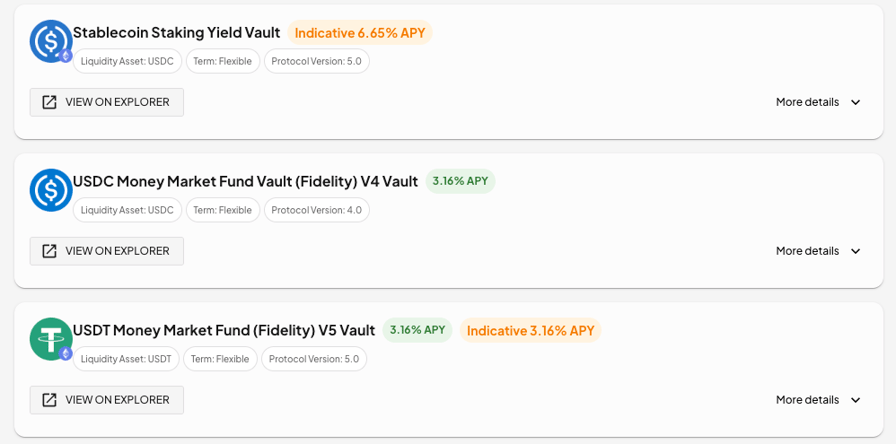
OpenTrade’s infrastructure routes user deposits into tokenized vaults that allocate capital across a mix of yield sources, primarily RWAs such as fixed-income instruments, alongside selected decentralized finance (DeFi) strategies. Each vault follows a defined allocation strategy and operates through smart contract-based mechanisms that manage deposits, track positions and distribute returns.

OpenTrade vaults (an excerpt). Source: OpenTrade

The latest funding round brings OpenTrade’s total funding to $30 million and included backing from prominent industry investor a16z Crypto. The London-based company previously raised $7 million in a strategic round led by Mercury Fund and Notion Capital in June 2025, following a $4 million seed round in November 2024.

OpenTrade also secured funding from investors such as Circle Ventures and Polygon Ventures in May 2023, while announcing plans to launch a platform for USDC-denominated investments and tokenized financial assets.

OpenTrade co-founders Dave Sutter and Jeff Handler previously worked at Centre, a now-dissolved consortium of Circle and Coinbase providing standards governance for the USDC stablecoin.

Magazine: Will the CLARITY Act be good — or bad — for DeFi?

Cointelegraph is committed to independent, transparent journalism. This news article is produced in accordance with Cointelegraph’s Editorial Policy and aims to provide accurate and timely information. Readers are encouraged to verify information independently.