Major altcoins traded sideways on Friday after Trump ordered the Navy to fire on Iranian mine-laying boats.
Crypto markets were relatively calm on Friday as the largest Deribit options settlement of the month cleared roughly $9.87 billion in notional exposure, with traders now turning their attention to next week’s Federal Reserve meeting and a renewed escalation in the Strait of Hormuz.
BTC is changing hands at $78,088, up 0.8% on the day, 2.5% on the week, and 9% on the month. Ether trades at $2,316, flat on the day and down 2.3% over the week. Total crypto market capitalization stands at $2.68 trillion, with $93.8 billion in 24-hour trading volume, per CoinGecko. XRP was held at $1.44, BNB at $638, and Solana at $86.
BTC Chart
The April monthly settlement covered 109,000 BTC contracts with $8.55 billion in notional and 563,000 ETH contracts worth $1.32 billion, per Deribit data. The expiry cleared roughly 25% of total Deribit open interest. Heavy call positioning was concentrated at the $75,000 and $80,000 strikes heading into settlement, according to CoinGlass.
ETF Flows Diverge
U.S. spot Bitcoin ETFs logged $223 million in net inflows Thursday, extending their winning streak to eight consecutive sessions, per SoSoValue. BlackRock’s IBIT continued to anchor the flows.
Spot Ether ETFs broke a 10-day inflow run with $75.9 million in Thursday outflows.
Meanwhile, CoinShares’ weekly report pegged total digital asset fund inflows for the week ended April 17 at $1.4 billion, the strongest weekly print since mid-January.
Hormuz Escalation Resets Risk Backdrop
President Donald Trump posted on Truth Social Thursday that he had ordered the U.S. Navy to “shoot and kill any boat, small boats though they may be, that is putting mines in the waters of the Strait of Hormuz,” and directed minesweeping operations to triple in pace. Iran’s Revolutionary Guard Corps laid fresh mines this week and seized two commercial vessels on Wednesday, per a subsequent statement from U.S. Central Command.
Iran’s Foreign Ministry spokesperson Esmail Baghaei said Tehran’s measures in the strait are “entirely lawful,” according to IRNA. Tanker transits through the waterway, which in peacetime handles roughly 20% of global oil flows, have collapsed since the conflict began.
Fed Meeting Ahead
The Federal Open Market Committee meets April 28 to 29, with CME FedWatch pricing in a near-certainty of an unchanged federal funds rate. The Bureau of Economic Analysis will release Q1 GDP and March PCE on April 30.
The following is a fintech and wider digital and economic development overview of Indonesia in 2026.
As Southeast Asia’s largest economy and most populous nation, Indonesia is no longer simply an emerging fintech market. It is becoming a system where digital finance, policy and infrastructure converge to drive inclusion across a vast and diverse archipelago.
Indonesia’s gross domestic product (GDP) has grown to approximately $1.5trillion, making it the largest in Southeast Asia based on this metric. It is the only country from Southeast Asia a part of the G20. Its economic base is broad, spanning natural resources (coal, palm oil, gas), manufacturing, services and a rapidly expanding digital economy.
Despite this, the country of over 200 million people has a GDP per capita of around $5,500. There is still room to grow but nonetheless the country has achieved its upper-middle-income status and steady growth driven by domestic consumption and digitalisation.
Digital economic transformation: an archipelago connected by platforms
Indonesia’s digital transformation is shaped by geography as much as policy. With over 17,000 islands, digital infrastructure is not simply a convenience but rather a necessity for economic integration.
The government’s broader development agenda, including the Making Indonesia 4.0 roadmap and digital economy strategies, has focused on expanding digital infrastructure and connectivity, supporting e-commerce and digital platforms, and promoting financial inclusion through technology
Internet penetration has reached approximately 75-78 per cent, with over 210 million users, while smartphone adoption continues to rise rapidly.
Indonesia’s digital economy is projected to exceed $150billion in gross merchandise value (GMV) by this year, driven by e-commerce, ride-hailing and digital financial services.
In this context, fintech has become a critical enabler. It is bridging geographic divides and connecting individuals and businesses to the formal economy.
Financial services sector: digital transformation at scale
Indonesia is one of the largest countries in the world in terms of population IMAGE SOURCE GETTY
The country’s financial hub is Jakarta, home to regulators, financial institutions and the Indonesia Stock Exchange. Among the largest banks are the ‘Big Four’ of Indonesia – Bank Mandiri, Bank Rakyat Indonesia (BRI), Bank Central Asia (BCA), and Bank Negara Indonesia (BNI) – each of them respectively have been at the forefront of digital banking initiatives.
As a whole, Indonesia’s financial services sector has undergone rapid transformation, moving from a bank-centric system to a multi-layered digital ecosystem.
Key drivers include the following: First, growth in digital wallets and QR-based payments; Second, expansion of digital lending and buy-now-pay-later (BNPL) services; and Third, integration of financial services into e-commerce and super apps
The Bank Indonesia (the country’s central bank) and the Financial Services Authority (OJK) have played central roles in shaping this ecosystem, especially the past few years.
Key initiatives include:
QRIS (Quick Response Code Indonesian Standard) – QRIS has become a cornerstone of Indonesia’s digital payments infrastructure, enabling interoperable QR-based payments across providers. This year, QRIS supports tens of millions of merchants and processes billions of transactions annually.
Blueprint Sistem Pembayaran Indonesia (BSPI) 2025 – This roadmap outlines the country’s strategy for digital payments, focusing on interoperability, efficiency and financial inclusion
Open banking and API frameworks – Indonesia has advanced open banking initiatives through the Open API Payment Standard (SNAP), enabling data-sharing and collaboration between banks and fintech firms
Central bank digital currency (CBDC) “Digital rupiah” exploration – Bank Indonesia has progressed its digital rupiah (Project Garuda), moving into advanced design and pilot phases between 2024 and this year
Strengthening fintech regulation – The OJK has tightened oversight of digital lending platforms, focusing on consumer protection, licensing and risk management.
Together, these initiatives reflect a coordinated approach to building a secure, interoperable and inclusive financial system.
Financial inclusion and fintech
Vibrant street market in Jakarta with colorful umbrellas and a busy crowd, capturing the lively atmosphere of local commerce and daily life IMAGE SOURCE GETTY
Indonesia has made significant strides in financial inclusion. According to the World Bank, approximately 78 per cent of adults have access to a formal financial account, up from around 50 per cent a decade ago.
Government initiatives such as the National Strategy for Financial Inclusion (SNKI) have played a key role, alongside the expansion of digital financial services.
Digital wallets, mobile banking and agent networks have been particularly effective in reaching rural populations, informal workers, and micro and small and medium enterprises (MSMEs). While gaps remain, particularly in remote regions, fintech has accelerated progress by reducing barriers to access and cost.
Indonesia’s fintech ecosystem is among the largest in the region. Behind Singapore in terms of number, Indonesia has the highest number in Southeast Asia with an estimated 1,200 fintech companies operating across payments, lending, insurtech and wealthtech.
Several companies illustrate the breadth of innovation. These include: GoTo (Super app ecosystem integrating payments, e-commerce and financial services), OVO (Digital payments platform widely used across retail and services), Xendit (Payment infrastructure for businesses across Southeast Asia), and Akulaku (Digital credit and BNPL services to underserved consumers).
These firms operate within a broader ecosystem where platforms, banks and regulators are increasingly interconnected.
Conclusion: inclusion across an archipelago
Indonesia’s fintech journey is defined by its ability to scale inclusion across complexity.
This year, digital finance is connecting millions across islands, reducing barriers and enabling participation. While challenges remain, Indonesia demonstrates how coordinated policy and innovation can transform financial access. This turns Indonesia’s geography from a constraint into an opportunity for inclusive growth.
One of the biggest stock-market debuts in history is six weeks away, and crypto sits in the same liquidity pool it will draw interest from.
SpaceX filed a confidential S-1 with the SEC earlier this month, targeting a $75 billion capital raise at a $1.75 trillion valuation.
If it prices anywhere near that level in its expected June listing, the offering will be more than 2.5 times larger than Saudi Aramco’s $29 billion 2019 record, making it the biggest stock-market debut in history. Polymarket traders assign a 65% probability of a June listing and a 53% probability that the first-day closing market cap exceeds $2 trillion.
SpaceX isn’t alone. ChatGPT maker OpenAI is targeting a Q4 listing at a valuation near $1 trillion. Anthropic is reportedly planning an October debut that could raise more than $60 billion.
If all three reach the public market on schedule, they would pull in more than $240 billion from June through year-end, a figure PitchBook estimates exceeds every venture-backed US IPO combined since 2000.
“After the SpaceX IPO, I think you start to get very bearish equities. That’s the Solana $300 moment,” Alex Good, founder of crypto AI project Post Fiat, said on a recent CounterParty TV interview.
“Right now we’re in this max bid moment, every investment bank is going to upgrade every AI stock because they’re going to get so much fees off of these IPOs.”
Good’s framing captures the mechanical setup, where the three largest listings could be concentrated in a six-month window, preceded by coordinated sell-side optimism from the banks running the deals and followed by the rotation out.
MSCI, the firm that builds many of the benchmark stock indexes institutional portfolios track, modeled a scenario in February that flagged megacap IPOs in 2026 could trigger index-driven flows measured in billions of dollars, sector-rotation effects across global benchmarks, and a compression of liquidity in everything outside the new names.
Crypto sits inside the same risk-on liquidity pool that funds tech and AI equities.
Bitcoin, ether, and the rest of the majors have traded with tightening correlation to Nasdaq and the S&P 500 over the past two cycles. When speculative capital leaves equities for an IPO allocation, some of what leaves is the same capital that would otherwise bid up higher-beta assets, including crypto.
The historical parallel is a point of concern, however. Coinbase listed on April 14, 2021 at the peak of the last bitcoin cycle. Bitcoin hit its all-time high of roughly $64,800 the same day and began a 50% drawdown within six weeks.
Traders who read Coinbase’s IPO as a signal that crypto was going mainstream spent the next six months watching mainstream capital rotate out. The lesson is that institutional milestones frequently mark tops rather than starting lines, because the capital that chases the milestone is the same capital that was previously holding up the asset.
SpaceX is not a crypto company, but two features of the listing connect directly to crypto flows. First, the 30% retail allocation, roughly $22 billion of the $75 billion offering, is three times the typical retail share on a deal this size.
Such a retail allocation nto SpaceX is money that’s not bidding on memecoins, altcoins, or bitcoin itself.
Second, SpaceX itself holds 8,285 BTC worth roughly $600 million in Coinbase Prime custody, making its IPO the first public-market debut of a company with a material bitcoin position disclosed under the new fair-value accounting rules that took effect in late 2024.
The testable signal going forward is whether crypto holds up through the roadshow window in May and June or begins to drift lower as allocators free up room for the SpaceX subscription.
However, a bitcoin rally that extends through the roadshow suggests the spot-ETF bid has decoupled crypto from broader risk-on flows.
Coinbase’s April 2021 peak was one company and $86 billion of market cap absorbed in a single day. SpaceX at $75 billion is not a scaled-up Coinbase. It is a different kind of event, priced into a market that has had five years to learn from the last one.
Whether crypto treats the lesson as learned or learns it again will be visible in the tape starting roughly six weeks from now.
WHY THIS MATTERS: The successful completion of Phase 1 of Akbank AG’s core banking transformation in Germany is not just a technology upgrade; it serves as a crucial validation point for the entire European banking sector. This move signals a decisive shift in how established, regulated financial institutions are tackling their monolithic legacy systems. Akbank AG, under the supervision of BaFin, has demonstrated that a phased, lift-and-shift migration to a cloud-native platform like Mambu is not only achievable for core functions like Retail and Private Banking, but that it immediately translates into tangible business agility. This directly addresses the industry-wide trend of composable banking. By adopting an API-first architecture, the bank has unlocked the ability to rapidly configure new products and integrate specialized services (like the Core+ layer developed by Innovance) far faster than possible with proprietary code. For peers still debating the cloud transition, this case study from the DACH region provides a clear, value-first mandate: modernisation is no longer optional for competitive survival.
Akbank AG, the German subsidiary of Turkey’s leading bank Akbank TAS, has successfully completed Phase 1 of its core banking transformation, to the leading SaaS cloud banking platform Mambu. The transformation was delivered in close partnership with Innovance, Mambu’s strategic technology partner.
The milestone marks a full transition away from Akbank AG’s legacy core system for its Retail and Private segments, with all customers and accounts in these business lines now operating on Mambu’s composable, API-first cloud-native core banking platform. Operating under the supervision of Germany’s financial regulatory authority, BaFin, Akbank AG’s transformation represents a significant example of a regulated European bank modernising its core banking infrastructure through a structured, phased migration strategy.
The new architecture, hosted on Microsoft Azure, combines:
Mambu as the core banking foundation. Its API-first architecture enabled the bank to integrate easily with partners and reduce operational complexity, lowering maintenance effort and improving resilience.
Core+ layer: This custom implementation layer communicates with Mambu and other integration services, acting as the central orchestration and business logic layer.
Implementation partner: Innovance playing a key role in integrating the Core+ architecture with Mambu to enable scalable product modelling, transaction validation and limit management and standardised integration patterns aligned with Akbank AG’s target architecture.
A standout milestone was the delivery of the Limit Proposal Application in 2022, which enabled Akbank AG to launch a digital corporate credit approval process in just four months. The fully integrated ecosystem now includes core banking, accounting, payments, digital channels (web and mobile), wealth management back office, document management, and enterprise financial crime detection components. The composable approach allowed Akbank AG to adjust parameters—such as pricing, fees, and interest settings—directly through configuration rather than code, significantly reducing implementation time.
With Retail and Private Banking now live, the next phase of the transformation covering Corporate Banking and Lending is underway. This next stage will focus on complex lending requirements and the integration of several new systems using Mambu’s composable service structure.
“The industry is undergoing rapid transformation, and customers increasingly expect agility and seamless digital experiences,” said Osman Kara, Core Banking Technologies Vice President at Akbank AG. “With the successful completion of Phase 1 on Mambu, and in close collaboration with Innovance, we have modernised our core banking foundation and established a scalable architecture to support our next phase of growth.”
“Mambu is proud to have powered the transformation of Akbank AG. A show of our strength in the region, as well as our continued partnership with Innovance, this project will transform the banking capabilities of the region, as well as the offerings from Akbank AG. We look forward to the next phase of transformation.” says Mark Geneste, Chief Revenue Officer at Mambu
Yusuf Ürey, Innovance Founder & CEO: “At Innovance, we approach core banking transformation as a long-term capability shift rather than a system replacement. Together with Mambu, we have established a modern technology backbone for Akbank AG that enables continuous evolution, allowing the bank to respond faster to changing customer expectations and market dynamics.”
Mehmet Ali Özcan, Innovance Germany, Managing Director: “In this transformation, we developed the Core+ layer end-to-end to manage business logic, integrations and validations independently, while ensuring seamless interaction with Mambu’s platform. This approach allowed us to simplify system interactions and create a more adaptable and scalable foundation for future banking services.”
The successful migration strengthens Mambu’s footprint in the DACH region and, together with Innovance’s engineering and delivery capabilities, demonstrates the viability of replacing legacy core systems within regulated European banking environments.
FF NEWS TAKE: This achievement undeniably moves the needle by proving that deep, structural core banking transformation is possible within highly regulated European environments. The key takeaway is the architectural split: keeping core logic in the custom Core+ layer while leveraging Mambu’s SaaS backbone for the ledger. The real test now lies in Phase 2, which targets complex corporate lending. The industry must watch how this modular approach handles intricate, high-value lending requirements, which will truly determine the composable model’s total enterprise viability.
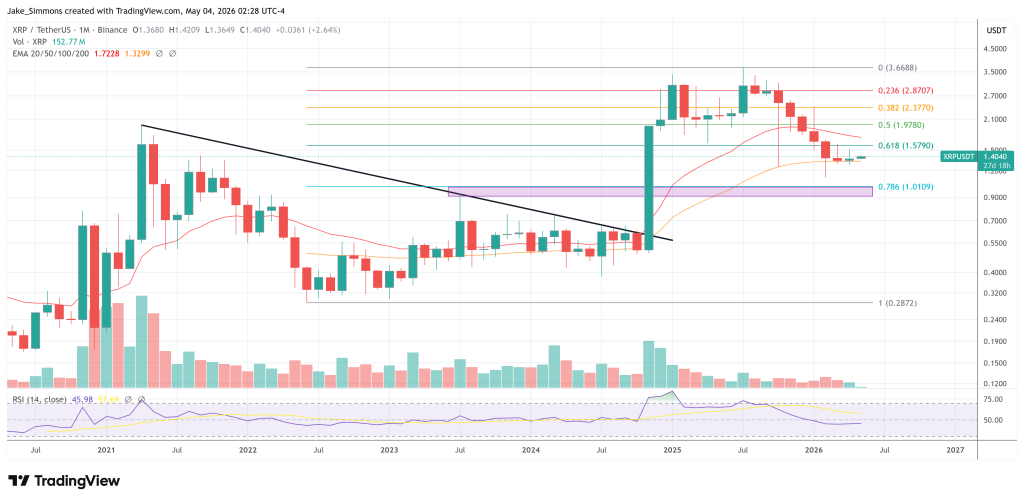
XRP is stuck just below resistance, but the price action is starting to lean one way. Every push higher gets sold, but each pullback is getting shallower. That tells you sellers are still active, but they’re losing control bit by bit. When that balance shifts, the move that follows is usually quick and decisive.
Price is grinding sideways at the top of the range, which is where markets typically resolve after absorbing supply. Add rising participation and steady positioning underneath, and this starts to look less like indecision and more like a setup waiting for a trigger.
News Background
• Spot XRP ETFs saw fresh inflows, extending last week’s strong demand and pushing total institutional positioning above $2.6 billion. This keeps a steady bid under the market even as price stalls.
• Exchange outflows hit one of the largest daily readings this year, with nearly 35 million XRP leaving trading platforms. That typically reduces immediate sell pressure and supports tighter supply conditions.
Price Action Summary
• XRP moved around $1.43-$1.45 after a high-volume push earlier in the session. • The breakout attempt above $1.44 held briefly but failed to extend, leading to sideways consolidation. • Price is now compressing into a narrower range, holding support without reclaiming higher levels.
Technical Analysis
• The dominant structure is a multi-week symmetrical triangle, with lower highs and higher lows squeezing price toward a decision point. • Volume spiked during the initial breakout attempt, but faded into consolidation, suggesting absorption rather than conviction. • Buyers continue defending higher lows, which keeps downside limited for now. • The market is effectively coiling, with neither bulls nor bears in full control.
What traders should watch
• $1.50 is the key breakout level. Clearing it would shift momentum more decisively higher. • $1.39 remains the critical support. Losing it would break the structure and open downside. • The tighter the range gets, the more likely a sharp move follows. Direction will depend on which side breaks first.
Infrastructure is shifting from reactive to preemptive, and that changes the risk profile.
This week, Anthropic committed more than $100 billion to AWS Trainium chip-based infrastructure to secure long-term compute capacity for training and deploying its AI models, including Claude, at a global scale. The spend is expected to unfold over the next decade.
At the same time, Amazon said it will invest $5 billion in Anthropic immediately, with plans to commit up to another $20 billion tied to future milestones. The vendors have been working together since 2023, with Amazon having previously invested $8 billion in Anthropic.
Taken together, the collaboration highlights a broader shift in how AI is being scaled. Instead of reacting to demand, AI vendors are starting to lock in massive amounts of compute, power and infrastructure upfront, a move that raises both the ceiling for AI growth and the stakes if that demand doesn’t materialize as expected.
Related:Canadian, German AI Startups Join Forces to Challenge US Dominance
The developments come the same week engineering leaders from Oracle, Nvidia and Google took the stage at Data Center World 2026 and pointed to a broader shift toward infrastructure purpose-built for AI training and inference.
Overseas, the same pattern is taking shape. This week, Microsoft said it plans to spend $18 billion on AI infrastructure in Australia, part of a broader push to expand capacity across key regions.
Like Anthropic’s commitment to AWS, the investment reflects a shift toward building infrastructure in advance of demand rather than simply reacting to it. It also highlights how global that demand is expected to be, with companies racing to establish regional capacity to support both training and real-time AI workloads.
At the workload level, it’s a different look. Data centers are handling both large-scale training and distributed inference. Training runs on tightly coupled GPU clusters. Inference is about speed and availability across separate locations. That split is changing how infrastructure gets built.
Also in AI This Week:
Other coverage worth paying attention to this week, from how hyperscalers are rethinking AI infrastructure to how that approach is starting to show up in real-world deployments.
How Microsoft and Google Plan and Place AI Workloads
Microsoft and Google detailed how AI is forcing changes in data center design, from how workloads are placed to how power and infrastructure are managed at scale.
SpaceX Agrees to Potential $60B Deal to Acquire Cursor
SpaceX agreed to a potential $60 billion deal to acquire AI coding startup Cursor, signaling growing interest in AI-driven software development capabilities.
Related:GPT-5.5 Boasts Coding Advancements, But Falls Short of Opus 4.7
Accenture Showcases Humanoid Robot Warehouse Pilot
At the Hannover Messe 2026 show in Germany, Accenture showcased a warehouse pilot using humanoid robots, highlighting the progress and challenges of deploying robotics in real-world operations.
How Departing CEO Tim Cook Set Up Apple’s Enterprise Play
Executives at Apple outlined how the company is approaching enterprise growth, with a continued focus on integrating its hardware and ecosystem into business environments.
CIOs Caught in the Middle as AI Startups Disrupt Vertical SaaS
AI startups are reshaping enterprise software by disrupting workflows rather than core systems, leaving CIOs to navigate when and where to adopt them.
Traders can post non-USDC assets as collateral for perps through Unified Trading Accounts, with conservative supply caps at launch.
Decentralized perpetuals exchange Lighter is rolling out Multi-Asset Margin today, enabling traders to post non-USDC assets as collateral for perps trading.
The feature debuts with ETH as the first supported collateral asset, according to Lighter’s documentation. Users deposit a supported asset into their margin balance, and its value, discounted by a loan-to-value haircut, counts toward the account’s margin balance and can be used to open perpetual positions. The upgrade is limited to perpetual futures at launch, with USDC spot trading collateralized by non-USDC assets slated to follow.
Lighter is rolling out the feature with conservative per-user and global supply caps as it onboards additional assets over time, per the docs. Access is restricted to accounts with Unified Trading Accounts enabled, which the team rolled out in February and described at the time as the first phase of a push to allow arbitrary tokens to be used as collateral on the platform.
The documentation highlights two potential use cases. The first is a delta-neutral basis trade, where a user deposits ETH as margin, shorts ETH perps against it, and earns funding. The second is leveraged spot, where deposited ETH is used as margin to buy more spot ETH.
Account risk is tracked through a single unified health check covering both perp positions and spot collateral.
The upgrade arrives as Lighter has lost ground in the perp DEX race since its token launch. The platform currently ranks fourth by 24-hour perp volume at roughly $1.35 billion, per DefiLlama, behind Hyperliquid, Aster, and EdgeX, after leading the market in November and December.
The platform’s LIT token has underperformed since its Dec. 29 debut as airdrop farmers rotated to pre-token competitors, and currently trades at a roughly $930 million valuation.
LIT Chart
This article was written with the assistance of AI workflows. All our stories are curated, edited and fact-checked by a human.
OpenAI released its fourth model upgrade of 2026, as it seeks to compete against Anthropic and Google in the generative AI race and make headway in the sought-after enterprise market.
The vendor introduced GPT-5.5 on April 23, a model update it said excels at coding, introduces fewer security problems and supports agentic autonomy and reasoning. The model understands what a user is trying to do more quickly and is proficient in writing and debugging code, conducting online research, analyzing data and creating documents. It is also token-efficient, using fewer tokens to perform the same task as GPT-5.4. The upgraded model is now available to Plus, Pro, Business and Enterprise users in ChatGPT and Codex. GPT-5.5 Pro and GPT-5.5 Thinking versions are available to Pro, Business and Enterprise users in ChatGPT.
GPT-5.5, like recent model releases from other generative AI vendors, focuses on advancements in reasoning and coding. OpenAI archrival Anthropic, in its latest release, Claude Opus 4.7, improved coding by providing better memory across sessions and long-running tasks, with greater consistency and higher accuracy than previous iterations. Google also focused on advanced coding in Gemini 3.1 Pro.
Related:Canadian, German AI Startups Join Forces to Challenge US Dominance
“Software engineering is heavily touted because it’s the fastest growing domain for generative AI today,” said Arun Chandrasekaran, an analyst at Gartner. “OpenAI wants to be seen as a very strong competitor in that space.”
He added that, beyond coding, OpenAI has also made progress in tool usage (which enables custom agent building) and token efficiency, making GPT 5.5 more inference friendly.
Coding Improvements
On the coding front, GPT-5.5 shows a reduction in the number of bugs or vulnerabilities per line of code, according to Joe Tyler, an AI researcher at Sonar, a company that specializes in code review. After running GPT-5.5 through its LLM evaluation framework, Sonar found that GPT-5.5 produces code faster than an unaided team. Still, its main strength is that the model isn’t as security averse as previous generations, Tyler said.
“If you sum together several bugs and vulnerabilities that this model produces, it’s lower than any other model in the top tier of coding,” Tyler said. But he said that the Anthropic models Opus 4.5 and 4.6 have simpler code and provide more useful developer comments.
GPT-5.5 also appears to fall behind Anthropic’s models on concurrency bugs, Tyler said. These are software errors that occur when a program performs multiple tasks simultaneously. While Opus 4.7 avoids those types of problems most of the time, this issue still needs attention in GPT-5.5.
Related:The AI Race Is Becoming an Infrastructure Contest
“It is very strong in that it doesn’t produce very many bugs and vulnerabilities on average, but it still does introduce bumps and vulnerabilities,” Tyler continued, referring to GPT-5.5 and adding that enterprises looking to use the model must have a verification process in place to monitor the code.
A Need for Evaluation
Enterprises planning to use the model using an API should also have an effective evaluation process, Chandrasekaran said.
“You have to test your existing prompt libraries, your existing APIs and compatibility with these models,” he said, especially with OpenAI releasing updates frequently.
Nevertheless, GPT-5.5 is a good model that enterprises should find well-suited to their coding needs, said Bradley Shimmin, an analyst at Futurum Group.
He said that OpenAI’s focus on integrated reasoning will help enterprises handle difficult tasks autonomously, and its focus on token efficiency is also important. So, enterprises will be able to do more with fewer tokens, which is ultimately less costly.
“We are really starting to enter a period where model makers … and platform makers for AI are all starting to center on supporting these highly autonomous, long-running processes that are complex,” Shimmin said. “You need something mobile. You need something efficient for token utilization, and something that can work over a very sizable, sometimes complex, context window during that period of running. They’re good moves in that regard.”
Related:Microsoft to Spend $18B on AI Infrastructure in Australia
A whale linked to asset manager Fasanara Capital holds a $38 million crypto short position, but will it impact Bitcoin’s price?
Negative futures funding rates at Binance and Bybit point to unusual demand for bearish positioning despite BTC’s recent price gains.
Bitcoin (BTC) struggled to trade above $78,000 on Friday, but the overall setup remains bullish. BTC gained 29% since the $60,100 yearly low on Feb. 6, and many analysts believe it is on the verge of a longer-term breakout. At the same time, a bearish Bitcoin whale on Hyperliquid exchange has maintained a large short position. The whale has made $159 million in profits over the past seven months. Does its positioning provide any signal that the market should pay attention to?
Hyperliquid whale profit and loss data. Source: CoinGlass
The entity behind address 0x7fda…c517d1 (also known as BobbyBigSize) on Hyperliquid exchange excelled during the market crash between October to November 2025 by placing leveraged short bets on Ether (ETH), Hyperliquid (HYPE), Avalanche (AVAX), and Fartcoin, among others. The account has failed to sustain its gains, resulting in a $561,000 loss over the past 30 days.
The whale is bullish on ETH, but bearish on BTC and altcoins
Using algorithmic trading, the whale opened short-duration long positions in Bitcoin and Solana (SOL) in the past, resulting in a staggering $11 billion in trades on Hyperliquid exchange. BobbyBigSize currently holds $19.4 million in assets deposited on the platform. 63% of its trades result in positive outcomes, which is considered highly successful.
BobbyBigSize’s current positions, USD. Source: Hyperdash
Currently, BobbyBigSize holds a $38 million short position in BTC and multiple altcoins. The trader also opened a $21 million leveraged long ETH position last week, indicating short-term confidence. Generally, the portfolio positioning is bearish, suggesting an expectation of a short-term correction.
Related: Critical Bitcoin trend change in works, but analysts say daily close above $80K required
The average trade duration for BobbyBigSize has been slightly longer than two weeks, while the median position has lasted for less than four days, according to Hyperdash data. Arkham data previously linked this address to Fasanara Capital, a London-based institutional asset manager. The company reportedly manages over $5 billion in assets.
Source: X/Arkham
According to Fasanara Digital’s website, it launched in 2018 and manages $400 million across market-neutral strategies and venture investments. In parallel, a quantitative multi-manager approach in various liquid markets manages $150 million. However, the strategy behind the fund’s approach to cryptocurrency was not clearly specified.
Funding rates for BTC and ETH stood slightly positive on Hyperliquid, indicating moderate demand for leveraged long positions. Under neutral circumstances, longs pay 6% to 12% annualized rates to maintain their positions. Currently, funding rates are negative on Binance and Bybit, signaling unusually high demand for bearish leverage.
Algorithmic traders are erratic and unpredictable, and losses by “BobbyBigSize” over the past couple of months evidence that no single trading strategy lasts indefinitely. However, this whale’s bearish positioning aligns with the increased demand for leveraged short positions; therefore, Bitcoin traders should not discard the possibility of a retest of the $75,000 level.
The Ethereum Foundation finalized a 10,000 ETH over-the-counter sale to BitMNR at an average price of $2,387 per token.
The Ethereum Foundation finalized terms of a 10,000 ETH sale at an average price of $2,387 per token via over-the-counter (OTC) trading on April 24, 2026. BitMNR served as the OTC counterparty for the transaction, which valued the sale at approximately $23.87 million based on the stated average price.
The sale represents a significant asset movement by the Ethereum Foundation, which maintains treasury holdings to fund ecosystem development and research. OTC trades of this scale typically indicate institutional-grade transactions executed outside public order books to minimize market impact.
Sources: Ethereum Foundation | Degenerate News
This article was generated automatically by The Defiant’s AI news system from publicly available sources.