“We’re moving into a world where essentially the entire economy is going to be tokenized,” said Joseph Lubin, CEO and founder of Consensys during a Fireside chat Tuesday at Consensus Miami 2026.
In his Fireside chat with The Rollup’s Founder Robbie Klages, Lubin said he believes tokenization is no longer experimental, but inevitable.
The global economy is steadily moving on-chain, and Ethereum is structurally positioned to benefit the most, said the founder of Consensys, a blockchain firm founded in 2014 by Lubin, an Ethereum co-founder. His company focuses on building infrastructure, developer tools, and decentralized applications (dApps) primarily for the Ethereum blockchain.
Lubin traced tokenization back to Ethereum’s origins, describing it as the breakthrough that allowed anyone to issue assets without building a new blockchain.
Now, that early design choice is paying off as financial institutions are increasingly moving their assets onto blockchain rails.
Lubin pointed to the evolution from bitcoin as the first decentralised token to Ethereum’s role in enabling the creation of new tokens without building separate blockchains. He said the technology has reached a level of maturity that is drawing in traditional financial institutions and regulators.
“We’re now sufficiently mature to be attractive to traditional finance organisations and regulators,” he said, pointing to Ethereum’s reliability, security, and scalability as key differentiators.
He said tokenisation is expanding from stablecoins into treasuries and other real-world assets, with more financial activity expected to move onto blockchain infrastructure.
Lubin also outlined Ethereum’s scaling approach. Layer-2 networks are increasing capacity, and developments such as synchronous composability aim to allow transactions across multiple networks to execute within a shared system.
“All of those transactions across all these different networks are going to be burning ether,” he said, referring to how activity across the ecosystem feeds value back to Ethereum.
He described ETH as a “trust commodity,” arguing that its role in securing and settling transactions could give it monetary characteristics as more economic activity moves on-chain.
Lubin added that recent disruptions in decentralised finance reflect a developing technology, and said the ecosystem is continuing to strengthen through collaboration.
Trust remains a primary barrier to broader crypto adoption, according to representatives from the National Cryptocurrency Association, Circle, U.S. Bank and ChangeNOW at Consensus 2026 in Miami.
Ali Tager of the National Cryptocurrency Association said research shows “the number one barrier to non-crypto holders is they just do not get it,” citing complexity, jargon and misinformation as persistent challenges.
Panelists from Circle, U.S. Bank and ChangeNOW said trust is built gradually through user experience rather than technical claims. Britt Cambas of Circle said “you are not going to get technical trust in 30 seconds,” emphasizing clarity and reducing complexity as prerequisites for adoption.
Rachel Castro of U.S. Bank said trust is central to financial services and “very easily broken,” adding that rebuilding it takes significantly longer once lost.
Speakers highlighted customer support and human interaction as critical differentiators in crypto platforms. Pauline Shangett of ChangeNOW said “the primary factor of trust for me when it comes to a web3 project is a feeling that you are working with real people,” pointing to gaps in user support across the industry.
Cambas said reducing ambiguity in products and partnerships is key, noting that simplifying complex systems can drive adoption more effectively than new features.
Panelists also pointed to education as a necessary step for onboarding new users. Tager said the industry must “make it super simple, make it accessible, make it trustworthy” to reach mainstream audiences.
The discussion, moderated by Ashley Wright, focused on designing systems that prioritize transparency, usability and communication, with speakers agreeing that trust must be embedded across product design, customer engagement and regulatory frameworks rather than treated as a standalone feature.
BridgeWise, the global leader in AI for wealth, has entered into a unique strategic partnership with X to provide investors, financial institutions, and quantitative funds worldwide with real-time social sentiment analysis.
By integrating X’s global data stream directly into the BridgeWise intelligence engine, the collaboration aims to transform the world’s most active financial conversations into structured, actionable signals for thousands of traded securities.
Harnessing the ‘wisdom of the crowd’
The partnership centres on an API-driven integration where BridgeWise’s wealth-native AI analyzes X’s unstructured social data to generate actionable “SentimentWise” insights. To filter out the inherent static of social media and provide clear sentiment scores, the system applies BridgeWise’s proprietary S-Factor™ framework, which was recently bolstered by the company’s acquisition of Context Analytics.
To achieve institutional-grade reliability, the platform relies on rigorous data processing and filtering at scale. Key data capabilities include:
Processing approximately 1.75 million investment-related X posts daily, drawn specifically from a curated, finance-focused subset of the platform’s firehose.
Updating data frequencies at intervals of up to one minute across thousands of tickers spanning multiple asset classes.
Applying keyword and phrase filtering at the point of ingestion to ensure every processed post contains investment-relevant content.
Utilizing multi-layer data quality filtering, which includes account-rating scoring, follower count thresholds, bot and spam removal, exclusionary security topic terms, and cross-user de-duplication.
Conducting continuous, rolling recalculations of S-Scores on an infrastructure that is purpose-built for institutional risk and compliance use cases.
Executive insights
Gaby Diamant, co-founder and CEO of BridgeWise
Gaby Diamant, co-founder and CEO of BridgeWise, emphasized the critical role that human emotion plays in market movements.
“Markets move on more than just numbers; they move on what people are saying, thinking, and feeling in the moment,” Diamant stated. “By plugging X’s data stream into our engine alongside our deep fundamental and technical analysis, we’re helping our clients cut through the noise to see what actually matters. With this partnership, we are taking the world’s biggest conversation and turning it into a quantifiable tool that helps investors make better decisions with total clarity.”
Christopher Park, director and global lead of developer platform at X
Christopher Park, director and global lead of developer platform at X, highlighted the value of the platform’s real-time nature.
“X is the world’s leading platform for real-time financial conversation; by enabling BridgeWise to analyze our feeds through this API integration, we are empowering their clients to leverage the power of the ‘Everything App’ directly within institutional workflows and rigorous trading environments,” Park commented.
A 360-degree market view
Through this new integration, BridgeWise clients—which include top global hedge funds and quant funds—can now access a comprehensive 360-degree view of the market.
When used alongside the company’s complete asset analysis suite, the SentimentWise solution allows these institutions to monitor sudden shifts in investor mood and identify emerging trends before they hit the mainstream market. Crucially, it ensures that institutions operating in highly regulated environments can confidently leverage alternative social data with full auditability and oversight.
BridgeWise currently provides trusted investment intelligence to over 100 institutional clients and 35 million end users globally, partnering with major entities such as S&P Global Market Intelligence, Japan Exchange Group, and eToro.
Bitcoin (BTC) may have a clear path to $90,000 after $7.9 billion in short liquidations in February put pressure on the bears. Data show liquidations came in three waves that extended from February through April. The liquidations highlight a growing imbalance as BTC traders continue to build short positions above $80,000, while the price holds firm, creating repeat conditions for future short squeezes.
Repeat short squeezes pressure bears
Bitcoin researcher Axel Adler Jr. tracked over $7.9 billion in forced short liquidations since early February. The largest spike hit $737 million on Feb. 13, followed by multiple waves through March and April.
The liquidation volumes ranged from $2–28 million per day before jumping back to $175 million on May 4. That spike came during a quiet week, pointing to renewed short exposure near $80,000. The pattern shows consistent reloading of bearish positions at higher levels.
Bitcoin trend pulse. Source: Axel Adler Jr.
The trend pulse data adds context to this behavior. The model moved from bear mode into neutral mode in early April. The short-term momentum has turned positive, while the long-term trend awaits confirmation from a bullish crossover of the 30-day and 200-day simple moving averages (SMAs).
Axel Adler Jr. said each major liquidation wave formed while the trend pulse sat in neutral mode, a transition phase after bear mode without a full bullish confirmation.
The largest spikes all occurred during this phase. The price was effectively at a crossroads, while traders kept adding short positions.
That pattern shows repeated strength fading, followed by forced liquidations, creating pressure that can extend higher if current levels hold above $80,000-$81,500.
Related: Bitcoin price nears $82K as ‘big level’ sparks warning of fresh macro rejection
BTC price holds key breakout zone above $80,000
Market analyst Coin Niel pointed to continued BTC exchange outflows, with net flows of -837 BTC on May 5. The move signals ongoing accumulation, though smaller than the -6,590 BTC outflows on Monday, keeping the spot sell pressure limited.
Bitcoin open interest on all exchanges. Source: CryptoQuant
Funding rates hold near -0.0045, suggesting longs are not crowded while the short-side pressure remains active. BTC open interest climbed 6% to $29 billion, its highest level since Jan. 31, increasing sensitivity to large price swings.
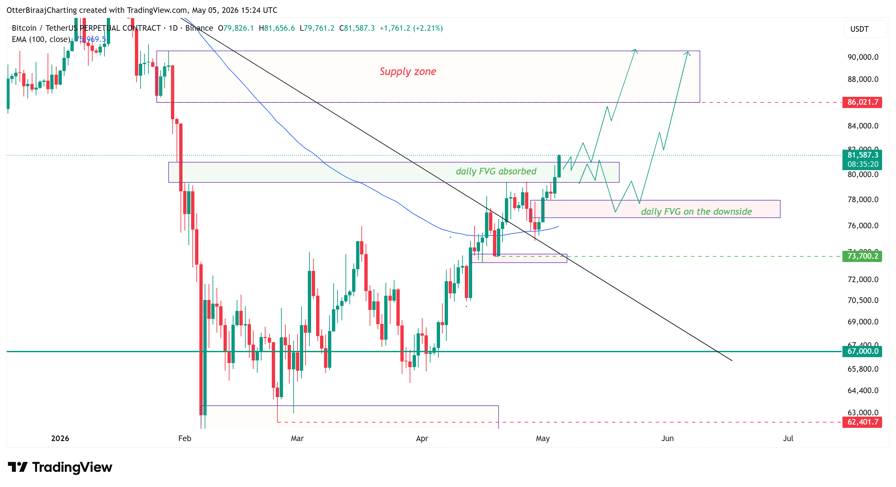
The BTC price action has turned constructive after Bitcoin broke above a descending trendline that capped rallies through April. The 100-day exponential moving average (EMA) now sits just below the price, acting as dynamic support.
BTC is also holding near $81,500, aligned with the short-term holder cost basis, a key level that keeps recent buyers in profit, and may further reduce selling pressure.
BTC/USDT on the one-day chart. Source: Cointelegraph/TradingView
The upside range of $86,000 to $90,000 aligns with a prior supply zone, where sellers stepped in and halted the recovery. This area marks a cluster of past selling activity, with relatively fewer resistance levels before it.
Below, the $76,000–$78,000 range serves as the first demand zone, supported by recent activity and a developed daily fair-value gap from last Friday.
Crypto trader KriptoHolder noted that liquidation clusters are shaping the near-term direction. The short liquidations sit around $81,000–$82,000, while a larger pool of long exposure rests between $77,000 and $78,000.
Data indicates $1.12 billion in cumulative shorts are at risk near $82,500, compared with over $4.2 billion in long positions facing liquidation near $77,000, defining a tight liquidity imbalance.
Related: Bitcoin short-term cost basis approaches profitability, but $80K must flip to support first
This article is produced in accordance with Cointelegraph’s Editorial Policy and is intended for informational purposes only. It does not constitute investment advice or recommendations. All investments and trades carry risk; readers are encouraged to conduct independent research.
Bitcoin (BTC) climbed 3.5% this week to hit $81,325 on Tuesday, its highest level since January. But is Bitcoin’s multi-month highs just a bear-market rally, or has it already bottomed to resume the so-called “supercycle,” as some traders suggest?
Key takeaways:
Bitcoin may rally to $180,000–$200,000 as institutional accumulation offsets bear-market pressure
Selling pressure remains firm near the $80,000–$82,000 area.
BTC/USD daily price chart. Source: TradingView
Bitcoin “supercycle” thesis targets $250,000 next
Bitcoin’s rebound now stands at 35.70% from its February low of $59,930. Still, BTC remains roughly 36% below its October 2025 record high near $126,200. This has sparked debate among traders, with some analysts predicting a return to new all-time highs this year.
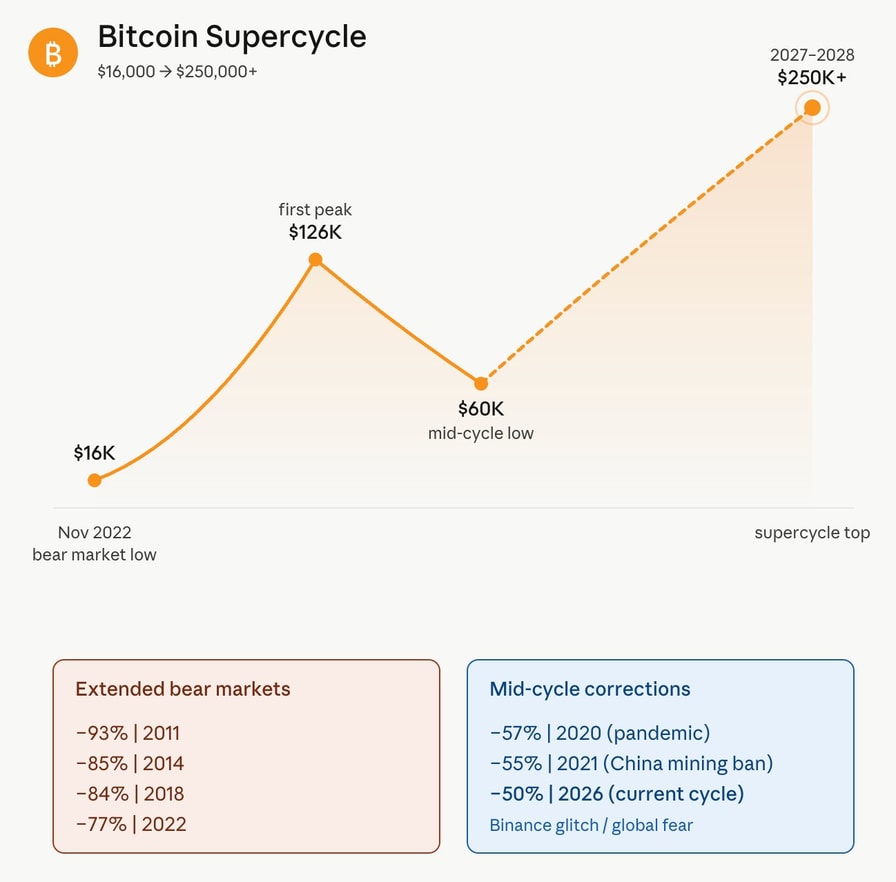
Bitcoin is not in a typical boom-bust cycle but transitioning into its first “supercycle,” according to analyst PlanC.
In a Tuesday post, he projected a move to above $250,000 by 2027–2028 from the $16,000 bear-market low in November 2022.
His framework splits the current cycle into three phases: an initial rally to $126,000 (already achieved), a mid-cycle correction toward $60,000 (done, as well), and a final expansion phase targeting new highs above $250,000.
Bitcoin supercycle illustration. Source: PlanC
The key distinction, he noted, is that the recent ~50% drawdown resembles prior mid-cycle resets, such as 2020 and 2021, rather than the deeper 70%–90% bear markets seen in 2014, 2018, and 2022.
In the current scenario, institutional demand is absorbing over 500% of the new daily BTC supply, turning sharp crashes into softer corrections.
Still, the thesis hinges on Bitcoin holding above its mid-cycle floor near $60,000. A breakdown below that level would invalidate the supercycle theory and reopen the case for a prolonged bear phase.
“I think once BTC clears the mid 80’s and holds the chances of seeing new highs are quite high,” analyst Pentoshi said in a Tuesday post, citing the ongoing supply squeeze.
He added:
“In terms of probabilities, I think the lows are in and we could see BTC trade as high as $180k between this year and next.”
Elliott Wave setup hints that Bitcoin’s bottom is in
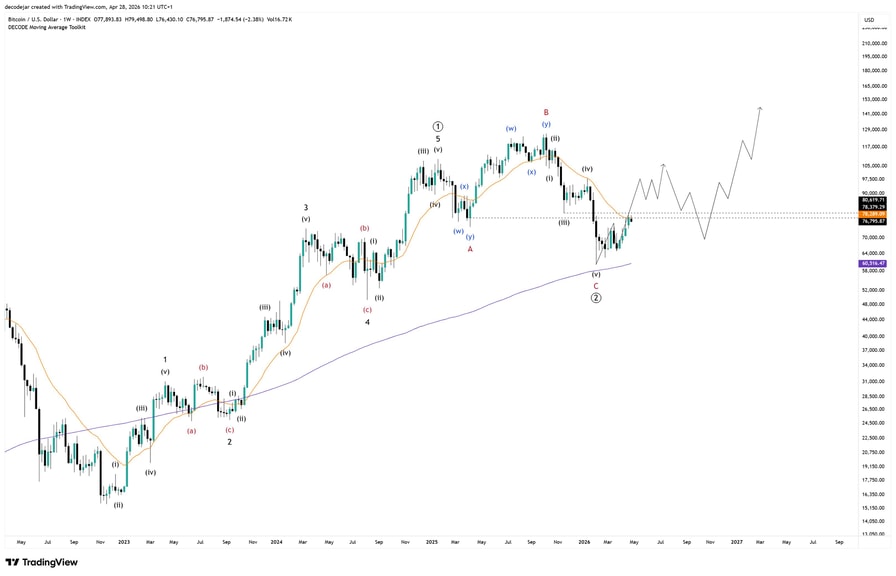
Bitcoin’s latest rebound has strengthened the case that its correction from the January 2025 high has ended, according to trader Decode’s Elliott Wave analysis.
The chart shows BTC likely completing a three-part A-B-C correction, with the final “C” wave bottoming near $60,000. In Elliott Wave terms, that usually marks the end of a corrective phase and can precede a new five-wave advance.
BTC/USD weekly chart. Source: TradingView/Decode
Decode notes that Bitcoin has now moved back above its November low, even if only slightly. That overlap invalidates bearish wave counts that expected “one more low” within the same downward impulse.
As a result, the bearish case has narrowed. BTC could still be inside a larger correction, but the cleaner setup now suggests the recent $60,000 area was likely a cycle low.
A decisive reclaim of the $78,000–$80,000 range as support would further boost the odds of a BTC price rally toward $90,000–$100,000 next.
Sellers step in near a key resistance confluence
Bitcoin’s rebound is running into a familiar resistance cluster, raising the risk of a short-term pullback.
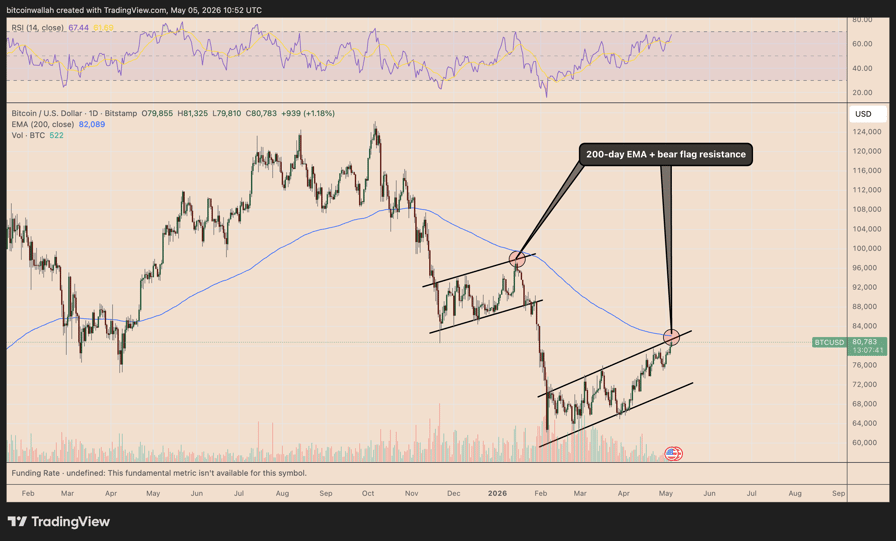
As of Tuesday, BTC is testing the confluence of its 200-day exponential moving average (200-day EMA, the blue line) and the upper boundary of a bear flag channel near the $80,000–$82,000 region.
BTC/USD daily chart. Source: TradingView
This resistance confluence increases the odds of a Bitcoin pullback in the coming days, with the downside target sitting around the flag’s lower trendline near the $70,000–$72,000 area.
A breakdown below the bear flag’s lower trendline risks pushing the price under $50,000.
A similar setup played out in January, when Bitcoin rallied into its 200-day EMA after a prolonged downtrend but failed to break higher. The rejection triggered another leg down before a more durable bottom eventually formed.
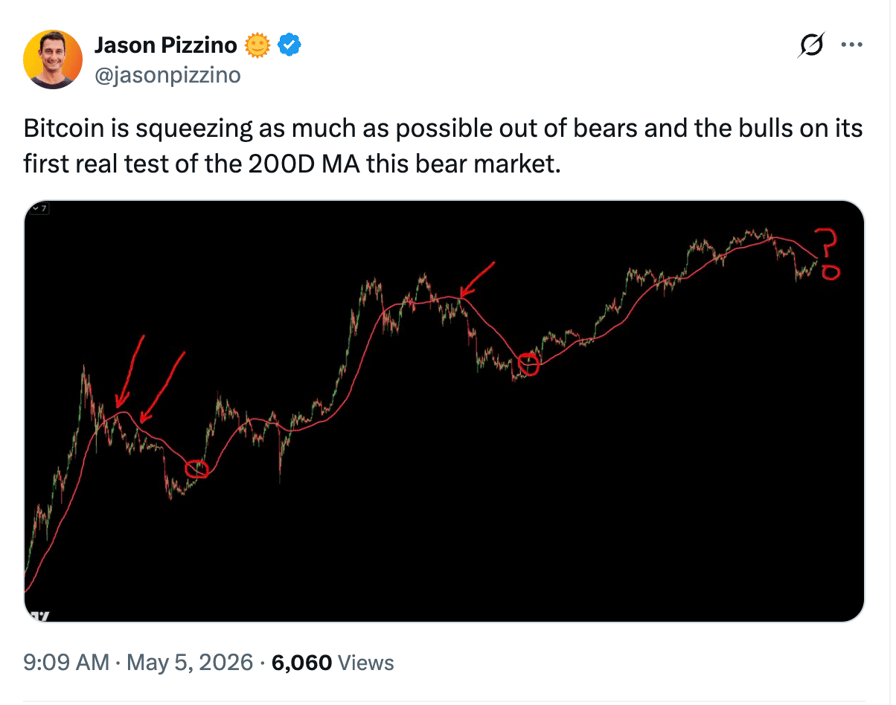
Also, the 200-day EMA served as strong resistance to Bitcoin’s bear market rallies in the past, particularly in 2018 and 2022, as highlighted in the chart shared by analyst Jason Pizzino.
Source: X
BTC’s price dropped by an average of 40% after testing the 200-day EMA as resistance during the 2018 bear market. In 2022, the average drawdown was around 35.5%.
Related: Bitcoin short-term cost basis approaches profitability, but $80K must flip to support first
BTC price may decline to the $48,000–$52,000 range if the fractal repeats, aligning with the bear flag downside target.
This article is produced in accordance with Cointelegraph’s Editorial Policy and is intended for informational purposes only. It does not constitute investment advice or recommendations. All investments and trades carry risk; readers are encouraged to conduct independent research.
WHY THIS MATTERS: This expansion by Temenos and AWS is a direct response to the banking sector’s accelerating pivot toward composable banking architecture. Financial institutions globally are no longer forced to undertake monolithic, multi-year core replacement projects. By offering digital front-office tools and payments capabilities alongside existing core functions as a single, flexible Software-as-a-Service solution, Temenos is drastically lowering the barrier to modernization. The value proposition is simple and urgent: banks can incrementally adopt new capabilities at their own pace, focusing on innovation and customer experience rather than infrastructure management. This shift—away from proprietary hardware and toward a cloud-native, consumption-based model—allows established banks to achieve the speed and agility of digital challengers while ensuring regulatory alignment, data sovereignty, and robust security through the AWS platform. It’s a significant moment that validates the market’s demand for flexible, end-to-end banking technology
Temenos (SIX: TEMN), a global leader in banking technology, today announced an expansion of its SaaS offering on Amazon Web Services (AWS), adding Digital Banking and Payments to its existing Core Banking SaaS on AWS.
With this expansion, financial institutions globally can now deploy end-to-end banking capabilities – spanning core, digital and payments – as Temenos SaaS on AWS. This gives banks more choice while supporting integrated operations and consistent experience across products, channels and markets.
Temenos SaaS on AWS offers composable solutions to help banks modernize across retail, business and corporate banking. Banks can adopt individual components, choose an end-to-end enterprise service, or combine both. Temenos can integrate with banks’ existing systems, or deliver a pre-configured, pre-integrated deployment for faster time to value.
Adopting Temenos SaaS means banks can focus on customers and innovation, not managing technology, helping them to launch new products faster and adapt swiftly to market changes. AWS infrastructure is designed to support sensitive workloads and is backed by a broad set of security standards and certifications used across regulated industries.
Barb Morgan, Chief Product & Technology Officer, Temenos, commented: “We’re delighted to expand our Temenos SaaS offering on AWS, further strengthening our SaaS capabilities and giving banks greater flexibility in deploying Temenos solutions as SaaS in line with their technology strategy and market requirements.”
Scott Mullins, Managing Director, Worldwide Financial Services, AWS, said: “Expanding Temenos Digital Banking and Payments on AWS enables institutions to adopt new capabilities at their own pace. Whether modernizing incrementally or going end-to-end, Temenos SaaS on AWS meets banks where they are — with the security, scalability and regulatory alignment that financial services demands.”
David Albertazzi, Executive Advisor & Director of Retail Banking & Payments Practice, Datos Insights, said: “Temenos’ expansion of its SaaS capabilities on AWS to include digital banking and payments reflects a broader industry shift toward more composable, cloud-based banking architectures. For financial institutions, this approach introduces additional flexibility in how core, digital, and payments capabilities can be deployed and integrated. As banks continue to modernize their technology environments, considerations such as security, data sovereignty, and regulatory alignment remain central to platform selection and implementation strategies.”
Temenos and AWS have collaborated since 2019, supporting a wide range of financial institutions globally, from established banks to digital challengers. Banks that have deployed Temenos solutions on AWS include MidWestOne Bank in the US, Credem in Italy, WeLab Bank in Hong Kong, and Bank ABC’s Ila Bank in Bahrain.
AWS offers broad geographical coverage for Temenos SaaS, helping banks address local data residency considerations and achieve high availability within their chosen region. Temenos SaaS on AWS is aligned with the AWS Well-Architected Framework, supporting high standards of operational excellence, security, reliability, performance efficiency, cost optimization, and sustainability.
FF NEWS TAKE: This partnership strengthens the trend toward fully cloud-native, end-to-end banking solutions, absolutely moving the needle for large-scale modernization. The key takeaway is the increased optionality for banks to adopt a truly composable architecture. What we must watch for next is the market uptake—specifically, which major institutions choose to deploy a combination of core, digital, and payments functionality simultaneously, and how quickly they achieve tangible time-to-market advantages over their competitors.
Strategy (MSTR) reported a net loss of $12.54 billion in the first quarter of 2026, as bitcoin BTC$80,592.79 fell from around $87,000 on Jan. 1 to roughly $68,000 by March 31.
Since the start of the second quarter, bitcoin has rebounded to above $80,000, while Strategy has continued to accumulate coins at a rapid pace, potentially setting the company up to post a sizable profit in the April-June period.
Led by Executive Chairman Michael Saylor, the company, the largest corporate holder of bitcoin, currently owns 818,334 BTC, acquired at an average price of $75,537.
Strategy ended the first quarter with $2.25 billion in cash, enough to cover approximately 18 months of preferred stock dividends.
MSTR shares are higher by nearly 20% year-to-date, though they remain lower by more than 50% on a year-over-year basis.
With first-quarter results largely expected and likely long ago priced in, investor focus will shift to the 5 p.m. ET earnings call, where Saylor and his leadership team are likely to outline their strategy.
Bitcoin price broke above $81,000 during Asian trading hours and early U.S. hours today, its highest price since late January and the latest sign that the market has moved past a brutal first-quarter stretch that bottomed near $60,000.
The move came on the back of several forces hitting at once: a flood of institutional money into ETFs, a shift in Middle East tensions, and a derivatives market that had been loading up for a run past $80,000 for weeks.
The structural setup for this was built in April. U.S. spot Bitcoin ETFs pulled in $2.44 billion in net inflows last month — the strongest monthly figure since October 2025, when Bitcoin price hit its $126,000 all-time high. BlackRock’s IBIT alone captured $1.71 billion of that total, a 70% market share that keeps widening the gap between the fund and every other ETF in the space.
Strategy, the Michael Saylor-led firm, also confirmed several massive Bitcoin purchases in April, bringing its total holdings to 818,334 BTC.
The geopolitical backdrop did the rest of the work. Iran has allegedly been charging oil tankers $1 per barrel in Bitcoin to pass through the Strait of Hormuz since mid-March, a toll the country chose in crypto because the funds are harder to freeze under sanctions. A single loaded supertanker carrying two million barrels generates a $2 million transit fee, all settled on-chain.
By Monday, a disputed Iranian missile claim briefly pulled BTC back toward $79,000, but it recovered overnight after Trump’s “Project Freedom” announcement — a U.S. military operation to escort commercial vessels through the strait — cooled the situation and sent crude futures down nearly 5%.
Bitcoin price catalysts this week
The options market tells a story of traders who saw this coming. Nomura’s Laser Digital flagged in a Tuesday research note that desks had built cheap upside call ratio structures over the past several weeks, and that a sustained break above $80,000 would flip Bitcoin’s risk reversal indicator from negative to positive.
On Deribit, the single largest open interest position across all options contracts is an $80,000 strike call expiring May 29, with 7,493.7 BTC behind it. Calls hold 58.69% of total options open interest versus 41.31% for puts, though near-term put volume has picked up as traders hedge the tail risk.
Two catalysts this week could push Bitcoin price in either direction. Strategy’s earnings release today will give the market its first look at how the company accounts for Bitcoin at current prices, while Friday’s nonfarm payrolls report will shape expectations for Federal Reserve policy through the summer.
Bitcoin price is up 6.2% on the week, currently trading at $81,035.
Miami Beach, FL — Tokenization is not replacing the system overnight, but it is steadily reshaping the plumbing underneath, Wall Street executives said at Consensus 2026 in Miami.
Digital asset leaders from Citi, JPMorgan and DTCC said during a panel discussion that blockchain-based rails are moving into production, with real volumes and real clients shaping how the technology is deployed.
A year ago, Citi’s tokenized deposit system was handling millions. “Now we’re moving billions,” said Ryan Rugg, who leads digital assets for the bank’s treasury and trade solutions unit.
The demand, she said, is coming from clients who want to move money around the clock, not just during banking hours.
JPMorgan is seeing a similar pattern. Its blockchain platform, Kinexys, has processed more than $1 trillion in transactions, said Kara Kennedy, who leads market development for the bank’s digital assets unit.
The focus is less on building parallel systems and more on stitching blockchain rails into existing infrastructure to enable faster settlement and continuous operations, she said.
DTCC, which sits at the center of U.S. market plumbing, is taking a longer view. The firm is working to bring parts of its $150 trillion securities infrastructure onto a shared digital layer, with initial rollout plans already underway.
“You can’t just replace what exists,” said Nadine Chakar, who heads digital assets at DTCC. “This is an evolution.”
That approach reflects a broader shift in the market. Early tokenization efforts often looked for problems to solve. Now, firms are targeting specific pain points, especially in areas such as collateral, cross-border payments, and liquidity management.
For large corporations, the ability to move funds in real time — across time zones and holidays — is changing how treasury functions operate. Instead of pre-positioning cash days in advance, firms can react instantly to margin calls or investment opportunities.
Still, the panelists pushed back on the idea that blockchain will remove intermediaries altogether. Core functions like risk management, compliance and settlement guarantees remain hard to replicate in fully decentralized systems.
“We will always need some level of intermediation,” Chakar said.
Crypto-native players, however, see a longer arc. Evan Auyang, president at Animoca Brands, said the industry is still in a transition phase, with blockchain gradually proving its efficiency before a bigger structural change.
“The nature of blockchain is that it’s transformative,” Auyang said, pointing to faster processes like loan approvals that can shrink from weeks to days. But he added that fully native onchain markets are “not ready yet,” given the scale of existing systems and regulatory constraints.
At the same time, he argued, the direction is hard to ignore. “If there’s efficiency and cost savings, it will be adopted,” he said, adding that traditional finance and decentralized systems are now “converging.”
Most people who try to learn trading hit the same wall. They watch a lot, understand parts of it, and still can’t connect everything into something usable. The issue is not effort. It’s how the learning is built.
You can see it in the way Brainsor.com is structured, where the focus shifts from consuming content to actually building understanding step by step. In 2026, that difference matters more than anything else.
A modern trading course is not about how much you can consume. It’s about whether you can take what you learned and use it when it actually counts.
Structure Is Everything Now
Most beginners don’t fail because trading is too difficult. They fail because their learning process has no structure.
One day it’s indicators. The next day it’s price action. Then something about macro. Everything sounds useful, but nothing connects.
A proper course removes that randomness. It gives you a sequence where each step builds on the previous one.
Strong programs usually follow a pattern like this:
Fundamentals first, without overload
Gradual move into real market behavior
Clear transitions between topics
Repeated reinforcement of earlier concepts
This kind of structure keeps things consistent. You’re not guessing what to learn next.
That’s one of the reasons Brainsor works well in this space. The learning path is already defined, so instead of jumping between ideas, you move through a system that builds understanding step by step.
Watching Is Not Learning
Understanding something while watching it is not the same as being able to use it.
This is where most courses fail. They explain things clearly, but they don’t train decision-making.
Real learning starts when you are forced to think.
An effective course pushes you into that mode:
You analyze instead of just observe
You answer instead of just listen
You repeat ideas in different situations
You make decisions, even small ones
That is how information turns into skill. With Brainsor.com, this is part of the process, not an extra feature. You’re constantly working through the material instead of passively going through it.
It Has to Reflect Real Markets
Markets today don’t behave in a clean or predictable way. They react to news, liquidity shifts, and sentiment changes almost instantly.
If a course only shows ideal setups, it doesn’t prepare you for real conditions.
You need to understand:
How price reacts to real events
How volatility changes behavior
How setups fail, not just how they work
How different markets influence each other
Without that, there is always a gap between theory and reality. Brainsor.com handles it well. The material doesn’t stay in theory. It connects ideas to what actually happens in current markets.
Simplicity Wins Over Complexity
There is a common assumption that more complexity means more value. More indicators, more strategies, more layers.
In practice, it does the opposite. It slows you down and makes decisions harder. Clear thinking leads to better execution.
An effective course focuses on:
Fewer concepts, explained properly
Clear situations where they apply
Understanding what to ignore
Consistent logic across all topics
This makes decision-making faster and more stable. And that approach is visible inside Brainsor.com. Instead of adding more layers, it focuses on making core ideas clear enough to actually use.
Feedback Changes Everything
Learning without feedback feels easy, but it hides gaps.
You move forward thinking you understand something, but you never really test it.
Good courses don’t allow that. They build in checkpoints.
This usually includes:
Self-assessment tools
Quick validation tasks
Structured progress checks
It keeps your understanding grounded and prevents you from moving forward with weak areas.
Psychology Is Not Optional
Even with solid knowledge, inconsistent decisions lead to inconsistent results.
Psychology plays a direct role in that process. Not in terms of motivation, but in how decisions are made under pressure and how stable the overall approach remains.
A strong course does not isolate this part. Behavior and analysis develop together, not separately.
Platforms like Brainsor.com approach it as part of the system rather than a standalone topic, shifting the focus from understanding markets to actually learning how to operate within them without relying on impulse.
What Actually Makes a Course Worth It
At a glance, most courses look similar. Videos, lessons, explanations.
The difference shows up in how they affect your thinking.
A course is worth your time when:
It removes noise instead of adding more
It builds a clear way to analyze markets
It forces you to apply what you learn
It helps you catch mistakes early
Without that, it’s just information.
When Learning Finally Starts Making Sense
There’s a point where things stop feeling random.
You stop jumping between ideas. You start seeing how everything connects. Decisions feel more controlled, even when the market is not.
That shift doesn’t come from watching more content. It comes from learning in a way that builds structure and forces application.
That’s what separates modern trading education from everything that came before.






.png?prefix=media%2Fcontent)