Home Blog Page 364

Canada Moves Closer to Banning Crypto Political Donations

0

Canada is moving closer to banning political donations made in cryptocurrency, as lawmakers in Ottawa tighten rules around how money flows into elections.

That’s after a proposed law — Bill C-25, the Strong and Free Elections Act — passed a second reading in the House of Commons on Friday. The vote signals that lawmakers support the bill in principle and will now study it in detail at committee, where amendments can still be made.

The legislation would prohibit political parties and candidates from accepting cryptocurrency donations, closing what regulators see as a gap in campaign finance rules.

First introduced on March 26, the bill is a broader overhaul of election laws aimed at strengthening transparency, tightening enforcement and reducing the risk of foreign interference. As Cointelegraph previously reported, crypto donations became a focal point due to concerns over traceability and compliance with existing limits.

While the bill is not solely focused on digital assets, it explicitly includes crypto in its restrictions on political financing.

There is no fixed date yet for when Bill C-25 will be taken up in committee.

An excerpt from Bill C-25. Source: Parliament of Canada

Related: Canada’s bid to ban crypto donations highlights transparency issue

Political ban comes amid Canada’s crypto embrace

The proposed ban comes as cryptocurrencies and blockchain infrastructure become more embedded in Canada’s financial system.

Regulators have advanced stablecoin frameworks that would give oversight powers to the Bank of Canada, while also refining rules for crypto investment funds, custodians and cold storage practices.

Canadian lawmakers have identified several potential benefits of a national stablecoin framework. Source: Government of Canada

This shift is unfolding under Prime Minister Mark Carney, a former central banker who has previously expressed skepticism about cryptocurrencies. Despite that stance, policymakers are moving toward a more defined regulatory structure that integrates digital assets into the financial system while imposing tighter limits on their use in sensitive areas such as elections.

Related: Deloitte, Stablecorp plan stablecoin infrastructure for Canadian institutions

Cointelegraph is committed to independent, transparent journalism. This news article is produced in accordance with Cointelegraph’s Editorial Policy and aims to provide accurate and timely information. Readers are encouraged to verify information independently.

Bitcoin, Altcoins Remain Range Bound As Bulls And Bears Fight For Control

0

Key points:

  • Bitcoin continues to face resistance near $79,500, but the trajectory remains up as long as the price holds above $76,000.
  • Most major altcoins are not showing any directional bias, suggesting a near-term consolidation.

Bitcoin (BTC) attempted to rise above $79,500, but the bears held their ground. BTC investor and author Michael Terpin told Cointelegraph that BTC risks falling to $57,000 in October 2026, based on a study of the “historical average” drawdown of about 1 year from a market-cycle top. Terpin added that BTC will have to rise above $100,000 for the bull market to resume.

Another negative view came from Bitcoin analyst Matthew Hyland, who said in a post on X that the “larger expected consensus outcome for BTC is another leg lower by October.” Veteran trader Peter Brandt also opined in an X post that BTC may form “an investable low” in September or October.

Crypto market data daily view. Source: TradingView

While several analysts expect a fall in BTC, crypto sentiment platform Santiment has a different view. Santiment said in a post on X that BTC wallets holding between 10 and 10,000 BTC have added 40,967 BTC since April 10, while retail investors holding less than 0.1 BTC have accumulated 46 BTC during the same period. If whales continue to buy and retail investors book profits, that may signal a long-term bull run.

Could BTC and the major altcoins rebound off the support? Let’s analyze the charts of the top 10 cryptocurrencies to find out. 

S&P 500 Index price prediction

The S&P 500 Index (SPX) rose to a new all-time high on Friday, indicating that the bulls are in command.

SPX daily chart. Source: Cointelegraph/TradingView

The upsloping 20-day exponential moving average (6,948) and the relative strength index (RSI) near the overbought zone suggest the up move may continue. The next levels to watch on the upside are 7,500 and then 7,877.

Sellers will have to swiftly yank the price back below the 20-day EMA to weaken the bullish momentum. If they manage to do that, the index may tumble to the 50-day simple moving average (6,795).

US Dollar Index price prediction

The US Dollar Index (DXY) reached the moving averages, where the bears are posing a stiff challenge.

DXY daily chart. Source: Cointelegraph/TradingView

The bears will attempt to push the price toward the 97.74 level, where buyers are expected to step in. However, if the bears push the price below the 97.74 level, the index may sink toward the 96.21-95.55 support zone.

On the upside, the bulls will need to sustain prices above the moving averages to increase the likelihood of a rally toward the 100.54 level. The bears will attempt to keep the index inside the 95.55 to 100.54 range by selling near the overhead resistance.

Bitcoin price prediction

BTC has been sustaining above the breakout level of $76,000, indicating that the bulls are not hurrying to book profits.

BTC/USDT daily chart. Source: Cointelegraph/TradingView

The upsloping moving averages and the RSI in the positive zone signal that the path of least resistance is upward. If buyers thrust the price above $80,000, the BTC/USDT pair may skyrocket to $84,000. 

Time is running out for the bears. They will have to quickly pull the BTC price below the 20-day EMA to gain the upper hand. The pair may then decline to the 50-day SMA ($71,820), signaling that the bears are active at higher levels.

Ether price prediction

Ether (ETH) remains above the 20-day EMA ($2,295), but bulls have failed to push it above the $2,465 resistance.

ETH/USDT daily chart. Source: Cointelegraph/TradingView

Sellers will attempt to strengthen their position by pulling the ETH price below the 20-day EMA. If they succeed, it suggests the ETH/USDT pair may remain within the ascending channel for a while longer.

Buyers will have to thrust the price above the resistance line to seize control. The pair may then soar to $3,050. Sellers will be back in the driver’s seat on a close below the support line.

XRP price prediction

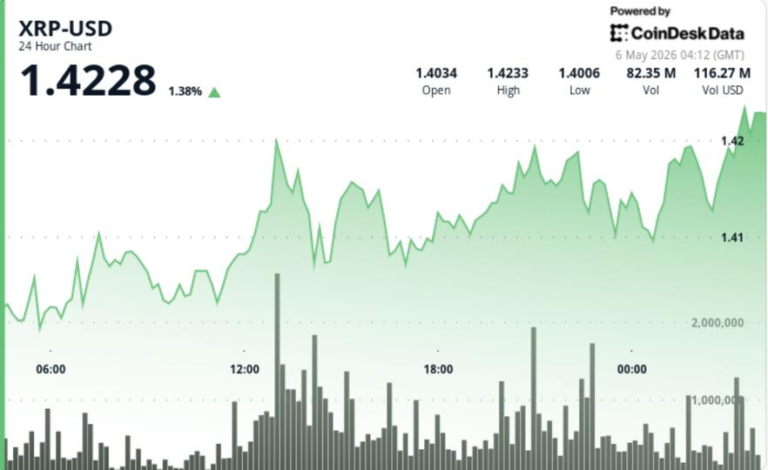
XRP (XRP) remains stuck inside the $1.27 to $1.61 range, indicating buying on dips and selling on rallies.

XRP/USDT daily chart. Source: Cointelegraph/TradingView

The 20-day EMA ($1.40) has started to turn up gradually, and the RSI is near the midpoint, indicating that the bulls have a slight edge. There is minor resistance at $1.51, but if it is crossed, the XRP/USDT pair may reach the downtrend line. A break and close above the downtrend line signals a potential trend change. The pair may then rally to $2.

Sellers are likely to have other plans. They will attempt to pull the XRP price back below the moving averages, retaining the pair inside the range.

BNB price prediction

BNB (BNB) is finding support at the moving averages, but the bulls have failed to trigger a strong bounce off them.

BNB/USDT daily chart. Source: Cointelegraph/TradingView

Buyers will need to drive the BNB price above $654 to signal strength. The BNB/USDT pair may then test the $687 resistance level, a critical level to watch. If buyers pierce the $687 level, the pair may jump to $730 and then to $790.

Instead, if the price turns down from the current level or the overhead resistance and breaks below the moving averages, it suggests the pair may remain within the $570 to $687 range for a few more days.

Solana price prediction

Solana (SOL) continues to trade near the moving averages, indicating a balance between supply and demand.

SOL/USDT daily chart. Source: Cointelegraph/TradingView

There is a minor obstacle at $90.73, but if that level is broken, the SOL/USDT pair may reach the $98 resistance. Sellers are expected to defend the $98 level with all their might, as a close above it opens the doors for a rally to $117.

Alternatively, if the SOL price turns down from the current level or the overhead resistance and breaks below $82.94, it suggests that the bears are attempting to take charge. The pair may then collapse to the $76 support.

Related: First 21-week trend line reclaim since October 2025: Five things to know in Bitcoin this week

Dogecoin price prediction

Dogecoin (DOGE) has been gradually moving higher but is expected to face selling in the $0.10 to $0.11 zone.

DOGE/USDT daily chart. Source: Cointelegraph/TradingView

If the DOGE price turns down from the overhead resistance zone, it is expected to find support at the moving averages. A sharp bounce off the moving averages increases the possibility of a rally to the $0.12 level.

Contrarily, if the price turns down and breaks below the moving averages, it signals that the bears remain sellers on rallies. The DOGE/USDT pair risks resuming the downtrend if the $0.09 support breaks down. 

Hyperliquid price prediction

Hyperliquid (HYPE) resumed its northward march after breaking above the $41.88 resistance on Sunday.

HYPE/USDT daily chart. Source: Cointelegraph/TradingView

The uptrend is facing selling pressure in the $43.76 to $45.77 zone, as seen in the long wick on the candlestick. Sellers will attempt to sink the HYPE price below the 20-day EMA ($41.25), opening the door to a drop toward the 50-day SMA ($39.50). 

Conversely, if the price rises above the current level or the 20-day EMA and breaks above $45.77, it signals that the bulls remain in control. That may propel the HYPE/USDT pair toward the $50-$51.43 resistance zone.

Cardano price prediction

Cardano (ADA) has been clinging to the moving averages for several days, improving the prospects of an upside breakout.

ADA/USDT daily chart. Source: Cointelegraph/TradingView

The downtrend line is the crucial resistance to watch out for as a close above it signals a potential short-term trend change. The ADA/USDT pair may surge to $0.32, then to $0.37.

On the contrary, if the ADA price turns down sharply from the downtrend line, it suggests that the bears are aggressively defending the level. The pair may then slump to the $0.22 support.

Stellar (XLM) drops 3.4%, leading index lower

0

CoinDesk Indices presents its daily market update, highlighting the performance of leaders and laggards in the CoinDesk 20 Index.

The CoinDesk 20 is currently trading at 2106.81, down 0.8% (-17.25) since 4 p.m. ET on Friday.

Three of 20 assets are trading higher.

Leaders: AAVE (+1.0%) and CRO (+0.8%).

Laggards: XLM (-3.4%) and NEAR (-2.9%).

The CoinDesk 20 is a broad-based index traded on multiple platforms in several regions globally.

Meta Taps Solar Energy to Power Data Centers

0

Meta on Monday said it had agreed to what it called a “first of its kind” deal harnessing solar energy to power AI data centers.

The Facebook parent company has signed a deal with startup Overview Energy to access up to 1 gigawatt of capacity from Overview’s space solar energy system.

Under the agreement, the partners plan to launch a thousand satellites into space. These would then direct infrared light to existing solar farms on Earth and convert it into electricity for data centers worldwide.

Financial terms of the deal were not disclosed.

Founded in 2022, Overview says its satellite system enables power to be routed worldwide based on demand without requiring an infrastructure overhaul on the ground.

Overview says it has already successfully proven the viability of the system, transmitting power from an aircraft to the ground. An initial orbit of the constellation to prove its efficacy in space is expected in 2028, with the first commercial delivery projected by 2030.

Related:DeepSeek-V4 Could Change Global AI Model Race

“Space solar technology represents a transformative step forward by leveraging existing terrestrial infrastructure to deliver new, uninterrupted energy from orbit,” Nat Sahlstrom, vice president of energy and sustainability at Meta, said in a release

With terrestrial data sites facing pushback over high land, water and energy consumption, AI vendors are increasingly turning to creative alternative methods to meet power needs. Deep sea and space, in particular, have been gaining traction, with other emerging players including Amazon’s Blue Origin and Los Angeles-based Orbital.

According to the companies, the deal makes Meta one of the first major corporations to secure rights to future space solar energy capacity delivered from orbit to the grid.

“Space is becoming part of America’s energy infrastructure,” Marc Berte, CEO of Overview, said in a statement. “Together with Meta, we’re looking beyond traditional constraints on where and when power can be delivered to meet the growing demand for electricity.”

Be Scared If You Don’t Own Bitcoin

0

Speaking on the Nakamoto Stage, Tim Draper told attendees that bitcoin has entered the financial mainstream and that governments now roll out “the red carpet” for the industry. He said the community is “starting to feel like something is happening” as adoption grows, and he cast that shift as the early phase of a larger transition in the money system.

In his view, people will move in stages: first from dollars to stablecoins, then from stablecoins to bitcoin as the final store of value and unit of account.

Draper praised Satoshi Nakamoto’s design of BTC as a system with no government control, no middleman banks, and no traditional account records. He described his own early journey with the asset, including buying large amounts of BTC, then losing those holdings amid front-running and failures at Mt. Gox. That episode led him to question whether the experiment was worth the risk until he watched crypto usage spread in markets around the world and decided to buy again.

To illustrate the fragility of fiat money, Draper told a personal story about a “one–million–dollar bill” that his father gave him when he was young. The bill turned out to be a Confederate note with no value, which he held up as a warning that government currencies can fail, leaving savers with worthless paper.

He connected that story to his decision to purchase bitcoin from the U.S. government in an auction of seized coins, where he paid above market because he viewed bitcoin as a superior long-term asset.

Draper: You should be scared if you don’t own bitcoin

Draper outlined a scenario in which retailers begin by accepting bitcoin alongside other payment methods and then transition to accepting only bitcoin.

In that world, he said, consumers would rush to banks to pull out their money and convert into BTC as trust in national currencies declines. He told the audience that anyone who manages a family “ought to have about six months’ worth of bitcoin” as protection against such a breakdown.

He extended that warning to sovereigns facing inflation or fiscal stress. If a government encounters hyperinflation and holds no BTC on its balance sheet, Draper argued, its currency and the wealth of its officials could become worthless in real terms.

“You should be scared if you don’t own bitcoin,” Draper said he is telling people these days, adding that those without exposure “should be very, very worried.”

Draper closed with a call to action aimed at the entire BTC ecosystem around him. He said that “those of us who have bitcoin are gonna help steer the world” as legacy currencies lose value, and he told attendees to go home and tell their families to buy bitcoin, their governments to buy bitcoin, and their friends to buy BTC.

Addressing founders and builders, he urged entrepreneurs to “push it as hard as you can,” saying that broad BTC ownership is both a hedge against currency risk and a path to a new monetary standard.

Bitcoin Bears At Risk Of $1.4B Liquidation If BTC Rallies To $80K

0

Key takeaways:

  • Persistent spot market accumulation from Bitcoin ETFs and Strategy provided a price floor for Bitcoin and threatens to trigger a short squeeze.
  • Negative funding rates and cautious options skews could trap bears if the Federal Reserve policy shifts or high oil prices trigger higher inflation.

Bitcoin (BTC) price sustained levels above $76,000 for the past week, distancing itself from its year low at $60,500. The recent bullish momentum came as crude oil prices jumped above $100 and the S&P 500 hit new trading highs, but futures market data may point to a short-term rally-ending outcome for Bitcoin.

A total of $1.4 billion in leveraged short positions near $80,000 has been built over the past 48 hours, according to CoinGlass data, and Bitcoin’s rejection at $79,500 has raised alarm.

Estimated Bitcoin futures liquidation levels, USD. Source: CoinGlass

Federal Reserve decision, inflation data may push Bitcoin above $80,000

The lack of investors’ appetite for bullish Bitcoin leverage has been evident, but a bear trap could spring if the US Federal Reserve adopts a less restrictive monetary policy or if investors anticipate higher inflation, which would reduce the expected net returns from fixed-income assets.

Bitcoin perpetual futures annualized funding rate. Source: Laevitas

The Bitcoin perpetual futures annualized funding rate has remained mostly negative over the past two weeks, a typical sign of growing bearish confidence. Curiously, this happened while Bitcoin’s price jumped to $78,000 from $72,000 on April 9 and most of those bets are at a loss at $76,700. A rally above $80,000 would likely force traders to close their positions.

Data show investors are no longer anticipating interest rate hikes from the Fed, even as Brent crude prices have reclaimed the $100 level. The pressure from high energy prices has a cascading impact on inflation expectations, but the Fed is also concerned with the weakening job market and economic growth.

Implied target rate probabilities for Sept. 16 Fed meeting. Source: CME FedWatch tool

US government bond futures contracts presently indicate 20% odds of interest rates decreasing by September, marking a complete turnaround from one month prior. Traders realized that the Fed is in a tough spot, hence the 3.95% yield on 5-year US Treasury became less appealing. An interest rate cut exerts upward pressure on inflation.

Sustained spot Bitcoin buying supports BTC’s bullish momentum

Bitcoin’s bullish momentum has been driven by the spot market, evidenced by Strategy (MSTR US) adding $255 million in BTC between April 20 to April 26 and the $824 million net inflows into US-listed Bitcoin exchange-traded funds (ETFs). Bitcoin buyers continued to accumulate despite the failed attempts to hold above $79,000.

Related: Critical Bitcoin trend change in works, but analysts say daily close above $80K required

To determine if professional Bitcoin traders are effectively leaning bearish, one should assess the options markets.

Bitcoin options 30-day delta skew (put-call) at Deribit. Source: Laevitas

The Bitcoin options delta skew shows put (sell) options trading at an 11% premium relative to call (buy) options, consistent with a bearish market. Whales and market makers are uncomfortable with downside risk, which reinforces the thesis of a potential bear trap if Bitcoin reclaims $80,000 in the near term.

Further Bitcoin bullish momentum remains far from certain, but as long as spot market demand remains strong, the pressure on short positions may continue to mount. If the current accumulation trend persists alongside a softening of Federal Reserve policy, the resulting liquidity squeeze could easily propel the price well beyond the $80,000 resistance level.

Hitachi digital services announces strategic partnership with Stripe to transform payment infrastructure, debuts joint industry event

0

Collaboration aims to simplify payments, reduce friction, and accelerate digital transformation across insurance, hospitality, retail, and transportation sectors

Hitachi Digital Services, the global systems integrator powering mission-critical platforms, today announced a strategic partnership with Stripe, the programmable financial services company, to deliver seamless, end-to-end payment solutions for enterprise organizations. The partnership initially focuses on the insurance industry, with plans to expand into retail and hospitality, and will be center stage during a joint insurance industry event later this month.

By partnering with Stripe, Hitachi Digital Services is transforming cumbersome payment capabilities to be intelligent dynamic assets—creating a frictionless process that improves conversion rates, reduces complexity, and enhances customer satisfaction.Share

The collaboration combines Hitachi Digital Services’ deep engineering expertise in enterprise-grade systems integration using AI with Stripe’s powerful payment infrastructure to address longstanding inefficiencies in how businesses secure, manage and integrate payments across customer journeys.

“Payments matter. They are a critical component to the customer experience and business health as a small improvement in process can yield significant value. Yet, payments are often treated as a final step in the customer journey,” said Rajashekar Busani, Chief Operations Officer, Hitachi Digital Services. “By partnering with Stripe, we’re transforming static, cumbersome payment capabilities to be intelligent dynamic assets—creating a seamless, frictionless process that improves conversion rates, reduces complexity, and enhances customer satisfaction.”

Simplifying a Complex Ecosystem

Traditionally, organizations manage multiple vendors for payment gateways, risk management, authorization, processing and reporting. This results in operational complexity and, often, fragmented customer experiences. Integration between numerous vendors creates vulnerabilities that can break a system, leave it susceptible to fraud or, minimally, create an unfriendly customer journey with limited payment choices.

Hitachi Digital Services and Stripe offer a unified solution that consolidates all the need-to-have functions into a single, streamlined infrastructure while still allowing organizations to deploy their CRM, PAS, and ERP systems of choice. This joint approach reduces the number of third-party relationships, improves reliability and security, allows for greater cost management, and delivers greater visibility and control over transactions.

Engineering-Led Innovation

A key partnership differentiator is the shared engineering heritage between the two companies. Unlike competitive industry collaborations, Hitachi Digital Services and Stripe emphasize building and integrating technology solutions end-to-end via modern, modular architectures that create scalable foundations for future innovations.

This approach is particularly relevant as industries undergo rapid transformation driven by increased digitalization, mergers and acquisitions, and emerging technologies such as AI-powered commerce. Organizations require modern payment infrastructure that supports traceability, security, and scalability—capabilities central to the joint offering.

While the initial focus is on insurance, the partnership is designed to scale into additional verticals including other financial services, hospitality, transportation and retail.

Joint Industry Event

Hitachi Digital Services and Stripe will host their first joint event on April 30, 2026, at Hitachi’s London office. The event brings together leaders from across the insurance and payments ecosystem including Stripe, Hitachi Digital Services, Visa, Mastercard, Hastings Direct, Markerstudy, and Cursor. Discussions will focus on helping insurance companies evolve payments from a basic operational function to a strategic digital asset as AI reshapes distribution, customer journeys, and the economics of the insurance industry overall.

“This event is an opportunity to bring together some of the most influential voices in payments and insurance to discuss the industry’s future. It also represents a major milestone in building a collaborative ecosystem around modern payment infrastructure,” said Stewart Reeder, Head of Insurance, Hitachi Digital Services. “Hyper-efficient payments systems hold untapped potential that we intend to help insurance leaders unlock.”

Tom Lee touts ETH as ‘wartime store of value’ as Bitmine (BMNR) buys more

0

Bitmine Immersion Technologies (BMNR), the ether (ETH) treasury firm helmed by Chairman Thomas “Tom” Lee, bought 101,901 ETH through last week, pushing its total holdings above 5 million tokens of the second-largest cryptocurrency.

The purchase lifted the firm’s ETH treasury to 5,078,386 tokens, or about 4.21% of ether’s circulating supply, according to a Monday update. Bitmine reached that milestone in roughly 10 months, since it pivoted to a digital asset treasury strategy company from a bitcoin miner in June.

“Bitmine ETH holdings crossed 5 million this past week,” Lee said. “This is a major milestone as the company moves towards acquiring 5% of the ETH supply.”

The latest purchase, worth roughly $236 million at current ETH prices, extends a streak of larger weekly purchases as Bitmine adds to its position while most digital asset treasuries remain on the sidelines.

The firm’s total crypto and cash holdings stand at $13.3 billion. Alongside its ETH position, the firm holds 200 bitcoin , $940 million in cash and equity stakes including investments in Beast Industries and Worldcoin-focused Eightco Holdings.

The company has also expanded its staking operations to generate yield on its ETH stash. About 3.7 million tokens — roughly 73% of its holdings — are now staked, generating around $264 million in annualized revenue. The firm debuted its Mavan staking platform in March to attract institutional clients alongside supporting its own treasury operations.

BMNR shares were unchanged in pre-market trading following the update.

Ether as ‘wartime store of value’

Lee framed ether’s role as shifting beyond a speculative asset. Citing recent research by Etherealize, he said ETH is increasingly being treated as a “store of value” and collateral as digital assets gain traction in financial transactions.

He also added that ETH has outperformed the S&P 500 since the start of the Iran conflict and pointed to growing use cases such as tokenization and AI systems relying on public blockchains as a long-term tailwind for the asset.

“There is a lot of meaning to ETH being the best ‘war-time store of value’ and to ETH being the asset leading since the war started,” said Lee.

Strategy (MSTR) adds $255 million more bitcoin to its treasury which now holds 818,334

0

Michael Saylor, the executive chairman of Strategy (MSTR), the largest publicly traded corporate holder of bitcoin, announced Monday on X the purchase of 3,273 bitcoin for roughly $255 million.

The purchase at an average price of $77,906 per bitcoin puts Strategy’s bitcoin treasury at 818.334, said Saylor.

“As of 4/26/2026, we ‘hodl’ 818,334 $BTC acquired for ~$61.81 billion at ~$75,537 per bitcoin,” the MSTR chair said.

Saylor also said Strategy “has achieved BTC Yield of 9.6%” year-to-date in 2026. YTD 2026.

Matt Cole, the CEO and chairman of Strive, also announced on Monday that his firm acquired 789 BTC for $61.43 million at an average cost of $77,890 per bitcoin.

Cole said that as of April 24th, Strive holds 14,557 BTC valued at nearly $1.13 billion.

Banma Intelligence and Alipay launch AI cockpit solution powered by Alipay AI Pay, enabling seamless and secure in-car transactions by voice

0

At the 2026 Beijing International Automotive Exhibition (“Auto China 2026”), OS and AI technology company Banma Intelligence and Alipay today launched a new AI cockpit solution integrating Alipay AI Pay, enabling drivers to complete purchases by voice command directly from their vehicle.

“In the past two years, smart cockpits have achieved rapid advances in perception and decision-making,” said Ming Cai, Banma Intelligence Chief Product Officer. “With large models onboard, vehicles can understand user intent and make recommendations. By integrating Alipay AI Pay into our AI cockpit solution, we are removing the last friction point in the in-car smart cockpit experience – drivers simply speak to pay, no phone required.”

The new AI cockpit solution initially covers two high-frequency use cases: entertainment and travel. With just a voice command, drivers can seamlessly access AI-powered services to purchase tickets, book hotels, and order food. For example, utilizing Banma Intelligence’s Yan AI and Alipay AI Pay’s capabilities, drivers can initiate a transaction by saying “help me buy two movie tickets.” The AI cockpit system can select showtimes and seats, with drivers able to complete payment by voice confirmation.

Alipay’s security capabilities, including multi-layered risk management and real-time anti-fraud measures, also safeguard every transaction.

The solution comes at a time when intelligence has become a key focus area for major automakers. As a key component of in-car services, payment plays a crucial role in enhancing the intelligent user experience, with both automotive system providers and automakers able to integrate their services with Alipay AI Pay. The new AI cockpit solution has completed technical integration testing with major automotive OEMs, who plan to roll out this feature in their new models in the second half of 2026.

Alipay AI Pay is an AI-native payment solution introduced in 2025 that enables secure, seamless transactions through AI agents via voice command. Alipay AI Pay surpassed 100 million users in February 2026, becoming the world’s first AI-native payment product to reach this milestone. During the week of February 5-11, 2026, it processed over 120 million transactions.

As agentic commerce grows in China, Alipay AI Pay has expanded across a range of use cases — from AI agents embedded in apps and mini programs for traditional retailers such as Luckin Coffee, to AI smart glasses such as Rokid’s, consumer-facing AI applications like Alibaba’s Qwen and OpenClaw-type AI agents.